DECEMBER 2012
WATERLINE 29
Nori by any other name Nori, or karengo as the seaweed is known in Maori, will never be the same again, thanks to research by Niwa scientists.
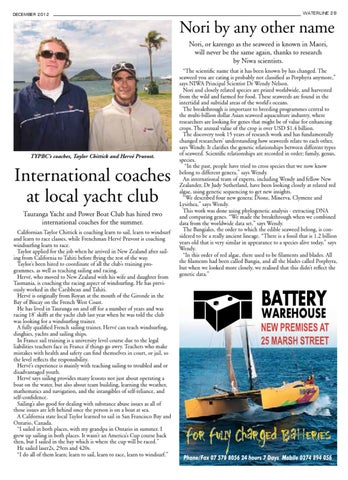
TYPBC’s coaches, Taylor Chittick and Hervé Pruvost.
International coaches at local yacht club Tauranga Yacht and Power Boat Club has hired two international coaches for the summer. Californian Taylor Chittick is coaching learn to sail, learn to windsurf and learn to race classes, while Frenchman Hervé Pruvost is coaching windsurfing learn to race. Taylor applied for the job when he arrived in New Zealand after sailing from California to Tahiti before flying the rest of the way. Taylor’s been hired to coordinate of all the club’s training programmes, as well as teaching sailing and racing. Hervé, who moved to New Zealand with his wife and daughter from Tasmania, is coaching the racing aspect of windsurfing. He has previously worked in the Caribbean and Tahiti. Hervé is originally from Royan at the mouth of the Gironde in the Bay of Biscay on the French West Coast. He has lived in Tauranga on and off for a number of years and was racing 18’ skiffs at the yacht club last year when he was told the club was looking for a windsurfing trainer. A fully qualified French sailing trainer, Hervé can teach windsurfing, dinghies, yachts and sailing ships. In France sail training is a university level course due to the legal liabilities teachers face in France if things go awry. Teachers who make mistakes with health and safety can find themselves in court, or jail, so the level reflects the responsibility. Hervé’s experience is mainly with teaching sailing to troubled and or disadvantaged youth. Hervé says sailing provides many lessons not just about operating a boat on the water, but also about team building, learning the weather, mathematics and navigation, and the intangibles of self-reliance, and self-confidence. Sailing’s also good for dealing with substance abuse issues as all of those issues are left behind once the person is on a boat at sea. A California state local Taylor learned to sail in San Francisco Bay and Ontario, Canada. “I sailed in both places, with my grandpa in Ontario in summer. I grew up sailing in both places. It wasn’t an America’s Cup course back then, but I sailed in the bay which is where the cup will be raced.” He sailed laser2s, 29ers and 420s. “I do all of them learn; learn to sail, learn to race, learn to windsurf.”
“The scientific name that it has been known by has changed. The seaweed you are eating is probably not classified as Porphyra anymore,” says NIWA Principal Scientist Dr Wendy Nelson. Nori and closely related species are prized worldwide, and harvested from the wild and farmed for food. These seaweeds are found in the intertidal and subtidal areas of the world’s oceans. The breakthrough is important to breeding programmes central to the multi-billion dollar Asian seaweed aquaculture industry, where researchers are looking for genes that might be of value for enhancing crops. The annual value of the crop is over USD $1.4 billion. The discovery took 15 years of research work and has fundamentally changed researchers’ understanding how seaweeds relate to each other, says Wendy. It clarifies the genetic relationships between different types of seaweed. Scientific relationships are recorded in order; family, genus, species. “In the past, people have tried to cross species that we now know belong to different genera,” says Wendy. An international team of experts, including Wendy and fellow New Zealander, Dr Judy Sutherland, have been looking closely at related red algae, using genetic sequencing to get new insights. “We described four new genera; Dione, Minerva, Clymene and Lysithea,” says Wendy. This work was done using phylogenetic analysis - extracting DNA and comparing genes. “We made the breakthrough when we combined data from the worldwide data set,” says Wendy. The Bangiales, the order to which the edible seaweed belong, is considered to be a really ancient lineage. “There is a fossil that is 1.2 billion years old that is very similar in appearance to a species alive today,” says Wendy. “In this order of red algae, there used to be filaments and blades. All the filaments had been called Bangia, and all the blades called Porphyra, but when we looked more closely, we realised that this didn’t reflect the genetic data.”
BATTERY WAREHOUSE