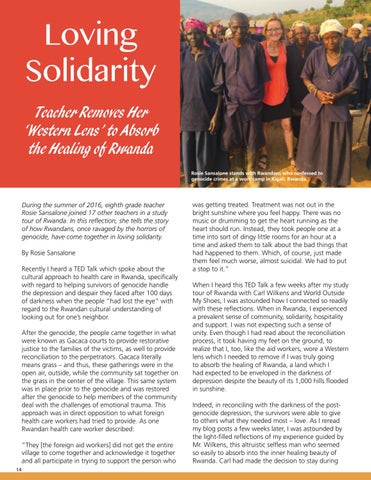
Loving Solidarity Teacher Removes Her ‘Western Lens’ to Absorb the Healing of Rwanda Rosie Sansalone stands with Rwandans who confessed to genocide crimes at a work camp in Kigali, Rwanda.
During the summer of 2016, eighth grade teacher Rosie Sansalone joined 17 other teachers in a study tour of Rwanda. In this reflection, she tells the story of how Rwandans, once ravaged by the horrors of genocide, have come together in loving solidarity. By Rosie Sansalone Recently I heard a TED Talk which spoke about the cultural approach to health care in Rwanda, specifically with regard to helping survivors of genocide handle the depression and despair they faced after 100 days of darkness when the people “had lost the eye” with regard to the Rwandan cultural understanding of looking out for one’s neighbor. After the genocide, the people came together in what were known as Gacaca courts to provide restorative justice to the families of the victims, as well to provide reconciliation to the perpetrators. Gacaca literally means grass – and thus, these gatherings were in the open air, outside, while the community sat together on the grass in the center of the village. This same system was in place prior to the genocide and was restored after the genocide to help members of the community deal with the challenges of emotional trauma. This approach was in direct opposition to what foreign health care workers had tried to provide. As one Rwandan health care worker described:
14 14
“They [the foreign aid workers] did not get the entire village to come together and acknowledge it together and all participate in trying Winter Magazine 2016 - 17 to support the person who
was getting treated. Treatment was not out in the bright sunshine where you feel happy. There was no music or drumming to get the heart running as the heart should run. Instead, they took people one at a time into sort of dingy little rooms for an hour at a time and asked them to talk about the bad things that had happened to them. Which, of course, just made them feel much worse, almost suicidal. We had to put a stop to it.” When I heard this TED Talk a few weeks after my study tour of Rwanda with Carl Wilkens and World Outside My Shoes, I was astounded how I connected so readily with these reflections. When in Rwanda, I experienced a prevalent sense of community, solidarity, hospitality and support. I was not expecting such a sense of unity. Even though I had read about the reconciliation process, it took having my feet on the ground, to realize that I, too, like the aid workers, wore a Western lens which I needed to remove if I was truly going to absorb the healing of Rwanda, a land which I had expected to be enveloped in the darkness of depression despite the beauty of its 1,000 hills flooded in sunshine. Indeed, in reconciling with the darkness of the postgenocide depression, the survivors were able to give to others what they needed most – love. As I reread my blog posts a few weeks later, I was astounded by the light-filled reflections of my experience guided by Mr. Wilkens, this altruistic selfless man who seemed so easily to absorb into the inner healing beauty of Rwanda. Carl had made the decision to stay during