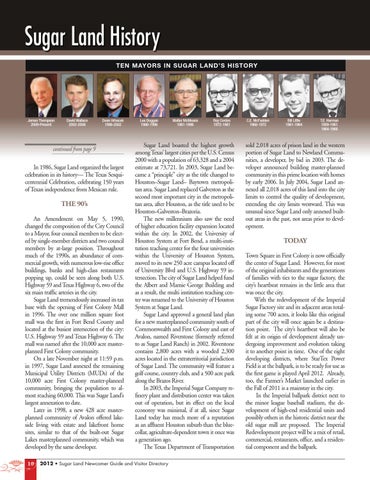
Sugar Land History TEN MAYORS IN SUGAR LAND’S HISTORY
James Thompson 2009-Present
David Wallace 2002-2008
Dean Hrbacek 1996-2002
continued from page 9 In 1986, Sugar Land organized the largest celebration in its history— The Texas Sesquicentennial Celebration, celebrating 150 years of Texan independence from Mexican rule.
THE 90’s An Amendment on May 5, 1990, changed the composition of the City Council to a Mayor, four council members to be elected by single-member districts and two council members by at-large position. Throughout much of the 1990s, an abundance of commercial growth, with numerous low-rise office buildings, banks and high-class restaurants popping up, could be seen along both U.S. Highway 59 and Texas Highway 6, two of the six main traffic arteries in the city. Sugar Land tremendously increased its tax base with the opening of First Colony Mall in 1996. The over one million square foot mall was the first in Fort Bend County and located at the busiest intersection of the city: U.S. Highway 59 and Texas Highway 6. The mall was named after the 10,000 acre masterplanned First Colony community. On a late November night at 11:59 p.m. in 1997, Sugar Land annexed the remaining Municipal Utility Districts (MUDs) of the 10,000 acre First Colony master-planned community, bringing the population to almost reaching 60,000. This was Sugar Land’s largest annexation to date. Later in 1998, a new 428 acre masterplanned community of Avalon offered lakeside living with estate and lakefront home sites, similar to that of the built-out Sugar Lakes masterplanned community, which was developed by the same developer. 10
Lee Duggan 1986-1996
Walter McMeans 1981-1996
Roy Cordes 1972-1981
Sugar Land boasted the highest growth among Texas’ largest cities per the U.S. Census 2000 with a population of 63,328 and a 2004 estimate at 73,721. In 2003, Sugar Land became a “principle” city as the title changed to Houston–Sugar Land– Baytown metropolitan area. Sugar Land replaced Galveston as the second most important city in the metropolitan area, after Houston, as the title used to be Houston–Galveston–Brazoria. The new millennium also saw the need of higher education facility expansion located within the city. In 2002, the University of Houston System at Fort Bend, a multi-institution teaching center for the four universities within the University of Houston System, moved to its new 250 acre campus located off of University Blvd and U.S. Highway 59 intersection. The city of Sugar Land helped fund the Albert and Mamie George Building and as a result, the multi institution teaching center was renamed to the University of Houston System at Sugar Land. Sugar Land approved a general land plan for a new masterplanned community south of Commonwealth and First Colony and east of Avalon, named Riverstone (formerly referred to as Sugar Land Ranch) in 2002. Riverstone contains 2,800 acres with a wooded 2,300 acres located in the extraterritorial jurisdiction of Sugar Land. The community will feature a golf course, country club, and a 500 acre park along the Brazos River. In 2003, the Imperial Sugar Company refinery plant and distribution center was taken out of operation, but its effect on the local economy was minimal, if at all, since Sugar Land today has much more of a reputation as an affluent Houston suburb than the bluecollar, agriculture-dependent town it once was a generation ago. The Texas Department of Transportation
2012 • Sugar Land Newcomer Guide and Visitor Directory
C.E. McFadden 1968-1972
Bill Little 1961-1964
T.E. Harman 1959-1961 1964-1968
sold 2,018 acres of prison land in the western portion of Sugar Land to Newland Communities, a developer, by bid in 2003. The developer announced building master-planned community in this prime location with homes by early 2006. In July 2004, Sugar Land annexed all 2,018 acres of this land into the city limits to control the quality of development, extending the city limits westward. This was unusual since Sugar Land only annexed builtout areas in the past, not areas prior to development.
TODAY Town Square in First Colony is now officially the center of Sugar Land. However, for most of the original inhabitants and the generations of families with ties to the sugar factory, the city’s heartbeat remains in the little area that was once the city. With the redevelopment of the Imperial Sugar Factory site and its adjacent areas totaling some 700 acres, it looks like this original part of the city will once again be a destination point. The city’s heartbeat will also be felt at its origin of development already undergoing improvement and evolution taking it to another point in time. One of the eight developing districts, where StarTex Power Field is at the ballpark, is to be ready for use as the first game is played April 2012. Already, too, the Farmer’s Market launched earlier in the Fall of 2011 is a mainstay in the city. In the Imperial ballpark district next to the minor league baseball stadium, the development of high-end residential units and possibly others in the historic district near the old sugar mill are proposed. The Imperial Redevelopment project will be a mix of retail, commercial, restaurants, office, and a residential component and the ballpark.