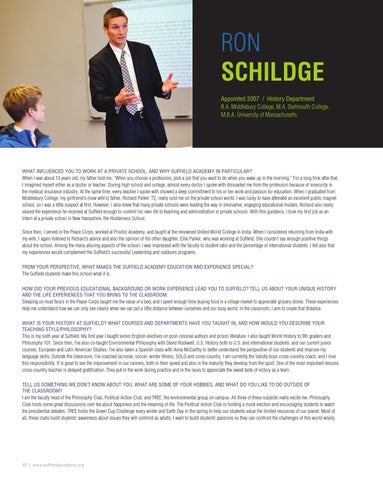
RON SCHILDGE Appointed 2007 / History Department B.A. Middlebury College, M.A. Dartmouth College, M.B.A. University of Massachusetts
WHAT INFLUENCED YOU TO WORK AT A PRIVATE SCHOOL, AND WHY SUFFIELD ACADEMY IN PARTICULAR? When I was about 13 years old, my father told me, “When you choose a profession, pick a job that you want to do when you wake up in the morning.” For a long time after that, I imagined myself either as a doctor or teacher. During high school and college, almost every doctor I spoke with dissuaded me from the profession because of insecurity in the medical insurance industry. At the same time, every teacher I spoke with showed a deep commitment to his or her work and passion for education. When I graduated from Middlebury College, my girlfriend’s (now wife’s) father, Richard Parker ’72, really sold me on the private school world. I was lucky to have attended an excellent public magnet school, so I was a little suspect at first. However, I also knew that many private schools were leading the way in innovative, engaging educational models. Richard also really valued the experience he received at Suffield enough to commit his own life to teaching and administration in private schools. With this guidance, I took my first job as an intern at a private school in New Hampshire, the Holderness School. Since then, I served in the Peace Corps, worked at Proctor Academy, and taught at the renowned United World College in India. When I considered returning from India with my wife, I again listened to Richard’s advice and also the opinion of his other daughter, Ellie Parker, who was working at Suffield. She couldn’t say enough positive things about the school. Among the many alluring aspects of the school, I was impressed with the faculty to student ratio and the percentage of international students. I felt also that my experiences would complement the Suffield’s successful Leadership and outdoors programs. FROM YOUR PERSPECTIVE, WHAT MAKES THE SUFFIELD ACADEMY EDUCATION AND EXPERIENCE SPECIAL? The Suffield students make this school what it is. HOW DID YOUR PREVIOUS EDUCATIONAL BACKGROUND OR WORK EXPERIENCE LEAD YOU TO SUFFIELD? TELL US ABOUT YOUR UNIQUE HISTORY AND THE LIFE EXPERIENCES THAT YOU BRING TO THE CLASSROOM. Sleeping on mud floors in the Peace Corps taught me the value of a bed, and I spent enough time buying food in a village market to appreciate grocery stores. These experiences help me understand how we can only see clearly when we can put a little distance between ourselves and our busy world. In the classroom, I aim to create that distance. WHAT IS YOUR HISTORY AT SUFFIELD? WHAT COURSES AND DEPARTMENTS HAVE YOU TAUGHT IN, AND HOW WOULD YOU DESCRIBE YOUR TEACHING STYLE/PHILOSOPHY? This is my sixth year at Suffield. My first year I taught senior English electives on post-colonial authors and prison literature. I also taught World History to 9th graders and Philosophy 101. Since then, I’ve also co-taught Environmental Philosophy with David Rockwell, U.S. History both to U.S. and international students, and our current junior courses, European and Latin American Studies. I’ve also taken a Spanish class with Anna McCarthy to better understand the perspective of our students and improve my language skills. Outside the classroom, I’ve coached lacrosse, soccer, winter fitness, SOLO and cross-country. I am currently the Varsity boys cross-country coach, and I love this responsibility. It is great to see the improvement in our runners, both in their speed and also in the maturity they develop from the sport. One of the most important lessons cross-country teaches is delayed gratification. They put in the work during practice and in the races to appreciate the sweet taste of victory as a team. TELL US SOMETHING WE DON’T KNOW ABOUT YOU. WHAT ARE SOME OF YOUR HOBBIES, AND WHAT DO YOU LIKE TO DO OUTSIDE OF THE CLASSROOM? I am the faculty head of the Philosophy Club, Political Action Club, and TREE, the environmental group on campus. All three of these subjects really excite me. Philosophy Club hosts some great discussions over tea about happiness and the meaning of life. The Political Action Club is holding a mock election and encouraging students to watch the presidential debates. TREE holds the Green Cup Challenge every winter and Earth Day in the spring to help our students value the limited resources of our planet. Most of all, these clubs build students’ awareness about issues they will confront as adults. I want to build students’ passions so they can confront the challenges of this world wisely.
42 | www.suffieldacademy.org