Winter/Spring 2014
RAMM:�LL:Z��
38
Beyond
39
The Armed Equation
My Harlem
Daniel Tisdale
Organized by Martha Scott Burton, Summer 2013 Curatorial Intern Daniel Tisdale is a conceptual artist, educator, publisher and activist who works primarily with photography and performance. The Radical Presence artist, who founded Harlem World, an online journal that documents the rich cultural life of Harlem, reflects on the two things he loves the most— Harlem and art.
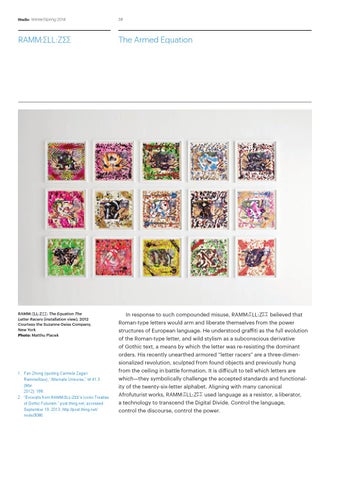
Crack Is Wack, Keith Haring (1986), 128th Street and Harlem River Drive: I love, love, love this wall. I first met Haring when I worked at Interview Magazine in the 1980s; he and Andy Warhol were hanging out in a stairwell between 32nd and 33rd streets. It is wonderful to have this mural in Harlem for everyone to experience. Ramm: �ll:z ��: The Equation The Letter Racers (installation view), 2012 Courtesy the Suzanne Geiss Company, New York Photo: Matthu Placek
1. Fan Zhong (quoting Carmela Zagari Rammellzee), “Alternate Universe,” W 41.3 (Mar 2012): 188. 2. “Excerpts from Ramm: �ll:z ��’s Iconic Treatise of Gothic Futurism.” post.thing.net, accessed September 19, 2013, http://post.thing.net/ node/3086.
In response to such compounded misuse, RAMM:�LL:Z�� believed that Roman-type letters would arm and liberate themselves from the power structures of European language. He understood graffiti as the full evolution of the Roman-type letter, and wild stylism as a subconscious derivative of Gothic text, a means by which the letter was re-resisting the dominant orders. His recently unearthed armored “letter racers” are a three-dimensionalized revolution, sculpted from found objects and previously hung from the ceiling in battle formation. It is difficult to tell which letters are which—they symbolically challenge the accepted standards and functionality of the twenty-six-letter alphabet. Aligning with many canonical Afrofuturist works, RAMM:�LL:Z�� used language as a resistor, a liberator, a technology to transcend the Digital Divide. Control the language, control the discourse, control the power.
Keith Haring Crack is Wack, 1986 Courtesy NYC Department of Parks & Recreation
Go Photo Studio / James VanDerZee Studio (1940s), Lenox Avenue between 122nd and 123rd streets: What I love about Harlem is that the history is so immediate, right where you stand. In these studios, many visual techniques were employed using props, architectural elements and costumes in the tradition of the Victorian and Edwardian eras. Go Photo Studio Photo: Kimberly Drew
Works Progress Administration murals at Harlem Hospital Center (1930s), Lenox Avenue and 135th Street: This collection of murals is just monumental, and includes masterpieces from the Harlem Renaissance by Aaron Douglas, Charles Alston, Vertis Hayes, Alfred D. Crimi, Georgette Seabrooke, Jacob Lawrence and many others.
Swing Low, Alison Saar (2007), 122nd Street, between St. Nicholas Avenue and Frederick Douglass Boulevard: This memorial sculpture of Harriet Tubman from 2007 by Alison Saar is one of my favorite works in Harlem. The piece silently pulls you in, much like the roots that flow behind Harriet Tubman, which seem to push and/or pull the back of her dress. Allison Saar Swing Low, 2007 Courtesy NYC Department of Parks & Recreation
There are many more masterpieces through Harlem, north and south, and river to river. What are your favorites?
Works Progress Administration murals at Harlem Hospital Center Photo: Kimberly Drew