Young inhabits and performs two nontraditional roles for an artist: one of a magician and the other of a preacher. In Post Black Magic (2010), and a series of subsequent videos and objects, Young employs sleight of hand and disappearance—two deceptive gestures used to lure audiences into an altered state of consciousness, highlighting the tension between what is seen and what is ignored when disbelief is suspended. Two white gloves are the only traces of Young’s presence, as he has disappeared into the saturated blackness of the video frame. The installation in this exhibition, Closing No. 1 (2012), uses a church pew and a recording of a man delivering a feverishly intense speech about painting, with a tone and inflection similar to that of a preacher. For some, religion can be interpreted as a relationship to unseen forces, which constitutes a belief system, much like secular magic. The enterprise of making art also involves considerable illusion, leaps of faith and dogma. Young’s diverse practice gives form to the many ways in which we interpret the unexplained phenomena punctuating daily life. (JJ)
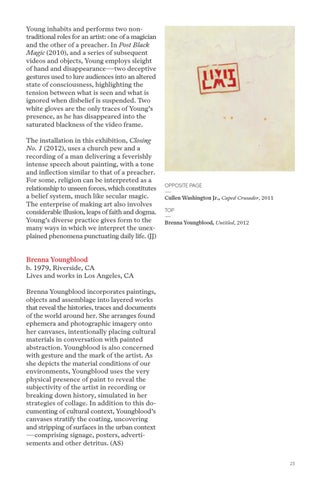
opposite page — Cullen Washington Jr., Caped Crusader, 2011 top — Brenna Youngblood, Untitled, 2012
Brenna Youngblood b. 1979, Riverside, CA Lives and works in Los Angeles, CA
Nate Young b. 1981, Phoenixville, PA Lives and works in St. Paul, MN Representations of constellations, magic and rhetoric are central to Nate Young’s conceptual practice. In his 2012 series “Constellations,” cosmological imagery 22
67611SMH.indd 22-23
appears alongside lyrics from popular songs. Placing these unrelated elements into conversation highlights how language and other systems of communication can affect interpersonal relationships. This idea continues in his “Magic, Illusion and Rhetorical Tactics” series (2010), where
Brenna Youngblood incorporates paintings, objects and assemblage into layered works that reveal the histories, traces and documents of the world around her. She arranges found ephemera and photographic imagery onto her canvases, intentionally placing cultural materials in conversation with painted abstraction. Youngblood is also concerned with gesture and the mark of the artist. As she depicts the material conditions of our environments, Youngblood uses the very physical presence of paint to reveal the subjectivity of the artist in recording or breaking down history, simulated in her strategies of collage. In addition to this documenting of cultural context, Youngblood’s canvases stratify the coating, uncovering and stripping of surfaces in the urban context —comprising signage, posters, advertisements and other detritus. (AS) 23
11/7/12 10:13 AM