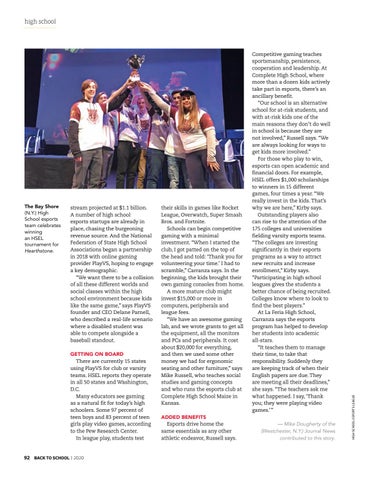
The Bay Shore (N.Y.) High School esports team celebrates winning an HSEL tournament for Hearthstone.
stream projected at $1.1 billion. A number of high school esports startups are already in place, chasing the burgeoning revenue source. And the National Federation of State High School Associations began a partnership in 2018 with online gaming provider PlayVS, hoping to engage a key demographic. “We want there to be a collision of all these different worlds and social classes within the high school environment because kids like the same game,” says PlayVS founder and CEO Delane Parnell, who described a real-life scenario where a disabled student was able to compete alongside a baseball standout. GETTING ON BOARD There are currently 15 states using PlayVS for club or varsity teams. HSEL reports they operate in all 50 states and Washington, D.C. Many educators see gaming as a natural fit for today’s high schoolers. Some 97 percent of teen boys and 83 percent of teen girls play video games, according to the Pew Research Center. In league play, students test
92 BACK TO SCHOOL | 2020
their skills in games like Rocket League, Overwatch, Super Smash Bros. and Fortnite. Schools can begin competitive gaming with a minimal investment. “When I started the club, I got patted on the top of the head and told: ‘Thank you for volunteering your time.’ I had to scramble,” Carranza says. In the beginning, the kids brought their own gaming consoles from home. A more mature club might invest $15,000 or more in computers, peripherals and league fees. “We have an awesome gaming lab, and we wrote grants to get all the equipment, all the monitors and PCs and peripherals. It cost about $20,000 for everything, and then we used some other money we had for ergonomic seating and other furniture,” says Mike Russell, who teaches social studies and gaming concepts and who runs the esports club at Complete High School Maize in Kansas. ADDED BENEFITS Esports drive home the same essentials as any other athletic endeavor, Russell says.
Competitive gaming teaches sportsmanship, persistence, cooperation and leadership. At Complete High School, where more than a dozen kids actively take part in esports, there’s an ancillary benefit. “Our school is an alternative school for at-risk students, and with at-risk kids one of the main reasons they don’t do well in school is because they are not involved,” Russell says. “We are always looking for ways to get kids more involved.” For those who play to win, esports can open academic and financial doors. For example, HSEL offers $1,000 scholarships to winners in 15 different games, four times a year. “We really invest in the kids. That’s why we are here,” Kirby says. Outstanding players also can rise to the attention of the 175 colleges and universities fielding varsity esports teams. “The colleges are investing significantly in their esports programs as a way to attract new recruits and increase enrollment,” Kirby says. “Participating in high school leagues gives the students a better chance of being recruited. Colleges know where to look to find the best players.” At La Feria High School, Carranza says the esports program has helped to develop her students into academic all-stars. “It teaches them to manage their time, to take that responsibility. Suddenly they are keeping track of when their English papers are due. They are meeting all their deadlines,” she says. “The teachers ask me what happened. I say, ‘Thank you; they were playing video games.’ ” — Mike Dougherty of the (Westchester, N.Y.) Journal News contributed to this story.
HIGH SCHOOL ESPORTS LEAGUE
high school