You may not have your computer with you, or your phone dies. Now you can write in cursive.” — CRAIG COUGHLIN, New Jersey General Assembly
Washington who cites research findings that forming cursive letters improves a child’s ability to spell and compose sentences. “This doesn’t mean you don’t let children use technology; it’s the world we live in,” Berninger says. She says children need to learn both cursive and keyboarding skills — starting in kindergarten. “The benefits of typing come later, in the sixth grade and up,” she says. “To think that typing alone can substitute is just a mistake. It’s not scientifically supported.” SURPRISE TO SOME PARENTS Kathleen S. Wright, an independent educational consultant in Columbus, Ohio, says cursive is still taught in many private schools. Often, parents of children in public schools don’t realize that the skill is no longer being taught until they perhaps ask their child to read a letter from a grandparent. “Most people assume it is being
taught,” says Wright, a former spokeswoman for Zaner-Bloser Publishing, a company that creates instructional materials to teach handwriting. Wright is happy that many states have restored funding to teach cursive, but worries that a generation of handwriters has
As we have done with the abacus and the slide rule, it is time to retire the teaching of cursive.” — MORGAN POLIKOFF, University of Southern California professor
been lost over the past decade. She says her own 10-year-old grandson was never taught cursive — something she didn’t realize until she asked him to write something in longhand.
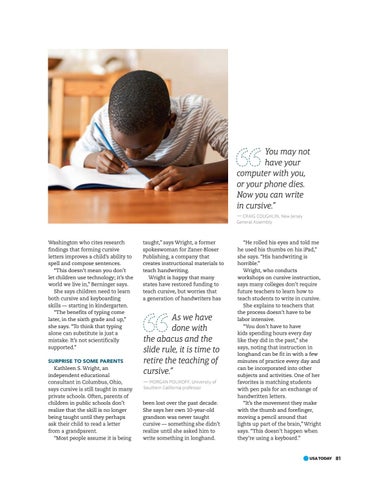
“He rolled his eyes and told me he used his thumbs on his iPad,” she says. “His handwriting is horrible.” Wright, who conducts workshops on cursive instruction, says many colleges don’t require future teachers to learn how to teach students to write in cursive. She explains to teachers that the process doesn’t have to be labor intensive. “You don’t have to have kids spending hours every day like they did in the past,” she says, noting that instruction in longhand can be fit in with a few minutes of practice every day and can be incorporated into other subjects and activities. One of her favorites is matching students with pen pals for an exchange of handwritten letters. “It’s the movement they make with the thumb and forefinger, moving a pencil around that lights up part of the brain,” Wright says. “This doesn’t happen when they’re using a keyboard.”
81