70 BACK TO SCHOOL | 2020
DEBATE OVER BEST TEACHING METHODS From 2000 to 2015, the percentage of Latino students enrolled in public elementary and secondary schools swelled from 16 percent to 26 percent, while the percentage of white students fell from 61 percent to 49 percent, according to the National Center for Education Statistics. Federal law requires districts to identify students with limited English skills and to serve them with an equitable, research-based program. Practices vary widely between states and districts. Some schools use transitional bilingual programs, which teach academic subjects such as science,
ENGLISH LEARNERS MAKE PROGRESS The city of Vineland, N.J., about an hour south of Philadelphia, represents changing U.S. demographics. More than 60 percent of the 11,000 students in Vineland public schools are Latino, reflecting a long-standing Puerto Rican
GETTY IMAGES; HARRISON HILL; ADAM MONACELLI (2)
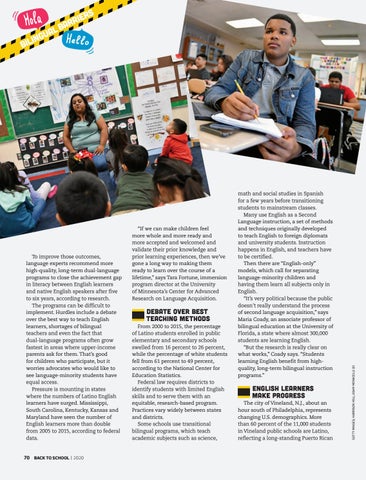
To improve those outcomes, language experts recommend more high-quality, long-term dual-language programs to close the achievement gap in literacy between English learners and native English speakers after five to six years, according to research. The programs can be difficult to implement. Hurdles include a debate over the best way to teach English learners, shortages of bilingual teachers and even the fact that dual-language programs often grow fastest in areas where upper-income parents ask for them. That’s good for children who participate, but it worries advocates who would like to see language-minority students have equal access. Pressure is mounting in states where the numbers of Latino English learners have surged. Mississippi, South Carolina, Kentucky, Kansas and Maryland have seen the number of English learners more than double from 2005 to 2015, according to federal data.
“If we can make children feel more whole and more ready and more accepted and welcomed and validate their prior knowledge and prior learning experiences, then we’ve gone a long way to making them ready to learn over the course of a lifetime,” says Tara Fortune, immersion program director at the University of Minnesota’s Center for Advanced Research on Language Acquisition.
math and social studies in Spanish for a few years before transitioning students to mainstream classes. Many use English as a Second Language instruction, a set of methods and techniques originally developed to teach English to foreign diplomats and university students. Instruction happens in English, and teachers have to be certified. Then there are “English-only” models, which call for separating language-minority children and having them learn all subjects only in English. “It’s very political because the public doesn’t really understand the process of second language acquisition,” says Maria Coady, an associate professor of bilingual education at the University of Florida, a state where almost 300,000 students are learning English. “But the research is really clear on what works,” Coady says. “Students learning English benefit from highquality, long-term bilingual instruction programs.”