BOYS & GIRLS CLUBS EQUIP KIDS FOR THE FUTURE
BACKtoSCHOOL 2020
Happy, Healthy Whole Tia Mowry’s parenting goals
TAKE LESSONS ON THE ROAD COVID-19’S IMPACT ON EDUCATION TIME-HONORED FIRST-DAY TRADITIONS
30 Essential SCHOOL SUPPLIES
it’s more than a bag
it's your hanging helper available at
Š2019 S.C. Johnson & Son, Inc. All Rights Reserved. 300221885
AVAILABLE AT
B
Swift More Cores. Revolutionary Speed. The wift is at the top of its class and it s ideal for home or the classroom t a mere . 5 pounds and only . inches thin, carrying it anywhere is a bree e and it s durable enough to withstand most anything The virtually borderless, 1 D P display engulfs your senses, while the new D y en eries obile Processor inside delivers all the power and performance you need. Did we mention that oms and Dads love it, too Windows 1 ome Up to D y en U obile Processorwith ultra fast cores
Ultrathin, ll etal Design 1 D P Display Up to 11.5 ours of Battery ife*
cer merica orporation. ll rights reserved. cer and the cer logo are registered trademarks of cer nc. ther trademarks, registered trademarks, and or service marks, indicated or otherwise, are the property of their respective owners. dvanced icro Devices, nc. ll rights reserved. D, the D rrow logo, y en, adeon, and combinations thereof are trademarks of dvanced icro Devices, nc. ther names are for informational purposes only and may be trademarks of their respective owners. *Battery life varies depending on power settings and usage. Based on Ultrathin laptop processors, defined as 15W typical TDP.
2020
62
FUTURE PREP Boys & Girls Clubs equip students for success now and later
FEATURES GETTY IMAGES
56
Tia Mowry Actressentrepreneur shares parenting strategies
68
Bilingual Education Schools teach English and Spanish, but access varies
72
Roadschooling Globe-trotting students receive classroom learning on the go 3
2020
UP FRONT
88
Products 10
Supplies to help make the grade
12
Best backpacks to tote school tools
DEPARTMENTS Elementary 80
Cursive writing experiences a bit of a revival
82
Concentration techniques that help kids focus
Shopping + Fashion
Middle School
14
States give breaks from sales tax
84
Helpful hints for parents hung up by homework
18
Earn extra credit with stylish options
88
Some states are allowing excused mental health days
Food
High School
24
Healthy snacks that pack a punch
90
Video gaming makes big-league moves
26
Get kids involved and invested in lunch prep
94
Class gives teens preview of adulting
Advice
Check It Out
30
96
Traditions that make the first day a treat
See what’s new at the library
Health
18
Keeping children’s well-being in check
Technology 38
Electronics that make the honor roll
40
Standout laptops and tablets
42
Educating Through Adversity
ON THE COVER: Tia Mowry, actress, entrepreneur and mother PHOTOGRAPHER: Jack Strutz
4 BACK TO SCHOOL | 2020
42
Amid COVID-19, colleges shift from campus to computers
50
E-learning companies come to the rescue after coronavirus hits
All product prices and availability are subject to change.
GETTY IMAGES (2); PROVIDED BY THE COMPANIES
32
FEATURED CONTRIBUTORS PREMIUM PUBLICATION EDITORIAL DIRECTOR Jeanette Barrett-Stokes jbstokes@usatoday.com
Lisa Iannucci has written and contributed to more than 20 books, including her latest, Road Trip: A Sports Lover’s Travel Guide. The Hudson Valley, N.Y., resident has written for such publications as USA Weekend, Syfy.com, Next Avenue and Glamour. She remembers making the first day of school special for her three nowgrown children (page 30). “I treasure all of the photos I took of them, the traditions we had and the memories I can look back on.”
Shameika Rhymes is a former TV news producer turned entertainment, lifestyle and culture writer. She lives in Charlotte, N.C., and has written for digital outlets and publications including Entertainment Tonight, Ebony, Insider and Vanity Fair. In this issue, she speaks with actress Tia Mowry about her back-toschool preparations (page 56). “Hearing her tips for getting her kids ready inspired me to use some of her ideas in my own life, especially the snack options.”
CREATIVE DIRECTOR Jerald Council jcouncil@usatoday.com MANAGING EDITOR Michelle Washington mjwashington@usatoday.com ISSUE DESIGNER Hayleigh Corkey EDITORS Amy Sinatra Ayres Tracy Scott Forson Patricia Kime Harry Lister Megan Pannone Deirdre van Dyk Debbie Williams DESIGNERS David Hyde Debra Moore Gina Toole Saunders Lisa M. Zilka CONTRIBUTING WRITERS Margaret Buranen, James Call, Marissa Cass, Valerie Finholm, Stacey Freed, Pam George, Chris Henry, Lisa Iannucci, Kristin Lam, Leah Murr, Lia Picard, Carli Pierson, Chris Quintana, Shameika Rhymes, Erin Richards, Sarah Sekula, Kristen Seymour, MJ Slaby, Fiona Soltes, Adam Stone, Jared Weber
ADVERTISING Patrick Burke | (703) 854-5914 pburke@usatoday.com
FACEBOOK Facebook.com/usatodaymags
6 BACK TO SCHOOL | 2020
Adam Stone’s coverage of education, technology and government has appeared in a range of national publications including EdTech, Government Technology and Teach Magazine. While researching the rise of esports in high schools (page 90), the Annapolis, Md.-based writer says, “I was pleasantly surprised to find out that the video games my kid plays might earn him a college scholarship! Fingers crossed.”
TWITTER @USATODAYMAGS
INSTAGRAM @usatodaymags
ACCOUNT DIRECTOR Vanessa Salvo | (703) 854-6499 vsalvo@usatoday.com
FINANCE BILLING COORDINATOR Julie Marco This is a product of
Without limiting the rights under copyright reserved herein, no part of this publication may be reproduced, stored in or reproduced in a retrieval system, or transmitted, in any form, or by means electronic, mechanical, photocopying, recording or otherwise without the written consent of USA TODAY. The editors and publisher are not responsible for any unsolicited materials.
PRINTED IN THE USA
PROVIDED BY THE CONTRIBUTORS
Fiona Soltes’ freelance work across industries such as retail, health care and the arts has appeared in numerous books and publications. The Nashville, Tenn.-based writer’s story about homework help tips for parents (page 84) hit home. “It reminded me not only of childhood days spent exploring the world through reading, but also the stress and frustration that came with geometry proofs and scientific theory.”
Leave
The learning environment looks different this Fall. Access to education to explain ďŹ nancial markets and the global economy is as important as ever. Designed for educators and students alike, Futures Fundamentals illustrates the impact futures have on the world around us – from car loans, to mortgages, to groceries. Through easy to follow digital content, interactive tools and videos, Futures Fundamentals provides free, standards-aligned e-learning resources explaining futures markets, core economic principles and how they play a role in global ďŹ nancial markets and everyday life. We believe people everywhere need to understand futures and how they impact the economics of the world around them.
Take a closer look and start learning today at FuturesFundamentals.org
BACK TO SCHOOL
UP FRONT PRODUCTS 10 | SHOPPING 14 | FOOD 24 | ADVICE 30 | HEALTH 32 | TECHNOLOGY 38
GETTY IMAGES
EDUCATING THROUGH ADVERSITY The COVID-19 pandemic forced school districts and colleges across the country to shift to online instruction. See how educators and companies answered the call. Page 42
9
up front | products
Smart Supplies
1
10
Stock up on school necessities BY MARISSA CASS
FILL BACKPACKS WITH THE supplies kids need to be well-equipped for the school year. From writing utensils to drinking vessels, don’t let your student leave home without these finds: 2 7 4
5
1
Students can stay organized and uplifted with the Find Joy medium 17-month academic planner. $28.95, bando.com
2
These 12 Grip Colored EcoPencils are made from reforested wood and are highly pigmented for richer color. $6.49, fabercastell.com
3
Waterproof and durable, these kids’ medical labels can be used to highlight allergies or other emergency information. $21, mabelslabels. com
10 BACK TO SCHOOL | 2020
6
11
9
4
reusable container that kids can pack with their lunch. $12.99 to $15.99, amazon.com
7
The Twist-n-Sharp manual pencil sharpener by Bostitch offers a compact design that fits easily in a pencil case. $5.08 for three, walmart.com
10
5
8
lighter and thinner than the earlier generation and pops in rose gold. $154.99, officedepot. com
Drink In the Box is a
Keep writing utensils and supplies organized in the Gear-Up pink/purple marble pencil case. $12.50, pbteen.com
6
The Cute Animals 3D eraser set includes 25 unique characters to accompany kids at their desks. $5, fivebelow.com
Send positivity and encouragement with White Inspirational pencils by Lily Kanter. $12 for 12, boonsupply.com
9
Featuring durable construction, a zipper and colored tabs, the Mead Five Star seven-pocket expanding file folder keeps kids organized. $6.99, target.com
The TI-84 Plus
CE graphing calculator is 30 percent
11
Made with youngsters in mind, the Safety
Scissors by My First Crayola have rounded
tips and plastic blades. $5.39 for three-pack, michaels.com
PROVIDED BY THE COMPANIES
3
8
TEACHING 101: COMMUNICATE WITH NOTES THAT STICK IN TOUGH CONDITIONS.
You need your tools to work for any classroom, any subject and any surface. That’s why, whether it’s rough surfaces or smooth, indoors or out, Post-it® Extreme Notes stick — and that means they get the message across, wherever you need them. • Water-resistant, durable and writable • Made with ultra-strong Dura-Hold™ Paper and Adhesive • Sticks in hot and cold conditions • Use indoor or outdoor: cinderblock walls, textured surfaces, cans and glass beakers, brick and wood walls, backpacks, chalk and whiteboards • Removes cleanly Not recommended for use on paper. For best results, apply to dry surface to hold in wet conditions. © 3M 2020. All rights reserved. Post-it and Dura-Hold are trademarks of 3M.
up front | products
5
4
6
1
3
7
2
Carry On
The Kids ClassMate
Varsity Unicorn & Dinosaur small backpack
features a chest strap to take pressure off shoulders and backs. $34.95, landsend.com
2
Backpacks to get supplies from point A to point B BY MARISSA CASS
The North Face women’s Jester Luxe
backpack features a large main space with a padded laptop compartment. $69, dickssportinggoods.com
SET KIDS UP FOR success with the perfect backpack to transport all of their school essentials. Check out these styles and find the best match for your student:
3
4
The Heritage backpack is the perfect starter size for new students and is available in various prints. $39.99, herschel.com
12 BACK TO SCHOOL | 2020
Disney’s Frozen 2 Olaf backpack by
Kipling is water-resistant, durable and complete with convenient pockets. $149, saksfifthavenue.com
5
The Kånken waterresistant backpack by FJÄLLRÄVEN offers functional design for any student. $80, nordstrom.com
6
The Mackenzie Glowin-the-Dark Dinos
backpack is customizable and available in four sizes, including a rolling option. $26.50 to $79.50, potterybarnkids.com
7
Let your student lighten their load with the spacious High Sierra Freewheel rolling backpack. $166, macys.com
8
Available in three colors, the Myth backpack offers plenty of compartments to store all necessities. $119.95, stmgoods.com
PROVIDED BY THE COMPANIES
1
8
up front | shopping + fashion
Ready, Set, Save States hold tax-free weekends to help with school shopping BY PAM GEORGE
14 BACK TO SCHOOL | 2020
GETTY IMAGES
F
or 20 years, bargain-hunting parents in South Carolina have saved money on clothing, school supplies and computers right before sending their kids back to the classroom. That’s because the Palmetto State is one of 16 in the country that holds annual back-to-school sales tax “holidays.” Typically held on a weekend in August, the state sales tax >
From all of us, to all of America. At Unilever, we know there’s never been a more important time to stand united. That’s why our brands and employees are coming together to deliver food, hygiene and cleaning products, and other critical supplies to aid organizations like Feeding America and Direct Relief. Visit our site to join in sending your support and gratitude to the volunteers working harder than ever to provide for those in need. Together, we will deliver hope to millions of Americans. To get help or give help, join us at WeAreUnitedForAmerica.com
up front | shopping + fashion
16 BACK TO SCHOOL | 2020
NEW MEXICO
Aug. 7-9 uClothing, footwear and accessories: less than $100 per unit uComputers: up to $1,000 Computer-related items: up to $500 uSchool supplies: less than $30 per item OHIO
Aug. 7-9 uClothing: $75 or less per item uSchool supplies and instructional materials: $20 or less per item OKLAHOMA ALABAMA
July 17-19 uClothing and footwear: $100 or less per article uComputers, software (games are excluded) and computer supplies: single purchase with a price of $750 or less uSchool supplies: $50 or less per item uBooks: $30 or less per book ARKANSAS
Aug. 1-2 uClothing and footwear: less than $100 per item uAccessories: less than $50 per item uSchool supplies, school art supplies and instructional materials: no limit — must be an item used for studying CONNECTICUT
Aug. 16-22 uClothing and footwear: less than $100 per item FLORIDA
Aug. 7-9 uClothing, footwear and certain accessories: $60 or less per item uSchool supplies: $15 or less per item uComputers and
accessories: the first $1,000 of the sale price for personal computers and certain computer-related accessories IOWA
Aug. 7-8 uClothing and footwear: less than $100 per item MARYLAND
Aug. 9-15 uClothing and footwear: $100 or less per item uBackpack: first $40 of the cost MASSACHUSETTS
(Not scheduled) uRetail items for personal use: up to $2,500 per item MISSISSIPPI
July 31 to Aug. 1 uClothing, footwear and school supplies: less than $100 per item MISSOURI
Aug. 7-9 uClothing: $100 or less per item uSchool supplies: less than $50 per item uComputer software: $350 or less per item uPersonal computers and peripheral devices: less than $3,500
Aug. 7-9 uClothing and footwear: less than $100 per item SOUTH CAROLINA
Aug. 7-9 There are no limits for: uClothing (including custom-made clothes), clothing accessories and footwear uSchool supplies used for school assignments uComputers, computer software, printers and printer supplies (whether purchased or leased) uCertain bed and bath supplies TENNESSEE
July 31 to Aug. 2 uClothing and footwear: $100 or less per item uSchool supplies and school art supplies: $100 or less uComputers: $1,500 or less TEXAS
Aug. 7-9 uClothing, footwear, backpacks and school supplies: less than $100 VIRGINIA
Aug. 7-9 uClothing and footwear: $100 or less per item uSchool supplies: $20 or less per item
GETTY IMAGES
is waived on certain school-related items. The promotion is a boon for people who live in states with a high combined state and local sales tax. According to the Tax Foundation, Tennessee (9.53 percent), Arkansas (9.47 percent) and Alabama (9.22 percent) are at the top of the list. In South Carolina, where the state and local sales tax can reach a total of 7.46 percent, consumers in past years have saved between $2 million and $3 million over the sales tax-free weekend, according to the state’s tax-free holiday website. Five states — Alaska, Delaware, Montana, New Hampshire and Oregon — don’t need a holiday. There is no sales tax in these states, according to Kiplinger. That’s a perk for residents and those who live near their borders. Here is a rundown of states with sales tax holiday events this summer. Note that some counties or municipalities may not participate. Check the sales’ start and end times; some events begin at 12:01 a.m. on the first day and end at midnight on the last. Visit your state’s tax website for updates before you shop.
TM
More Knowledge
is Power
AVAILABLE AT
Š2020 Energizer. Energizer, Energizer Bunny design, and certain graphic designs are trademarks of Energizer Brands, LLC and related subsidiaries.
up front | shopping + fashion
Dress Code Earn extra credit with these fashion picks BY LEAH MURR
WHEN WALKING THE HALLS, make the statement you want. Get inspiration from these playful prints, everyday basics with a twist and layer-friendly looks:
18 BACK TO SCHOOL | 2020
1
be bold
2
Molo Reif ball players T-shirt, $70, kodomoboston. com
2
Mae Jemison short-sleeve Trailblazer tee, $28, piccolinakids. com
3
Aerie Move printed highwaisted leggings, $49.95, ae.com
1
4
3
4
Riverside Tool & Dye tie-dye overalls, $200, freepeople.com
5
Sequin-design Sibling shirt, $9.99, hm.com
6
Sacred Heart girls’ socks, $14, happysocks. com
7
Soludos Sunrise Sunset sneakers, $38.95, nordstrom. com
5
PROVIDED BY THE COMPANIES
6
7
19
up front | shopping + fashion
1
ELEVATED ESSENTIALS
Cotton-linen wide-leg jumper, $143, scotchandsoda. com
2
2
Boys’ patterned shirt, $14.99, hm.com
3
Kit top by Pink Chicken, $54, garnethill.com
4
Boys’ striped belt, $24, janieandjack.com
3
5
Boys’ Club Nomade sweatpants, $94, scotch-soda.com
4
6
Cashmere crewneck sweater, $79.50, jcrew.com
7 5
Unisex suede Classic+ sneakers, $65, puma.com 6
1
PROVIDED BY THE COMPANIES
7
20 BACK TO SCHOOL | 2020
Available at:
up front | shopping + fashion
1
Tailored for Sport woven jacket, $80, puma.com
layer it up 2
2
Sweet Unicorn cardigan, $46, lolaandtheboys. com
3
Girls’ The Check Please cardigan, $348, kule.com
4
Perfect rain jacket, $120, jcrew.com
3
5
Boys’ The North Face ThermoBall Eco jacket, $120, nordstrom.com
1
6
Classic one-pocket shirt, $79.50, luckybrand.com
4
6
22 BACK TO SCHOOL | 2020
PROVIDED BY THE COMPANIES
5
T R U S T E D Q U A L I T Y F O R N E A R LY Available at
**20 billion active cultures per serving guaranteed at time of manufacture.
50
*These statements have not been evaluated by the Food and Drug Administration. These products are not intended to diagnose, treat, cure or prevent any disease.
YEARS
Š 2020 Nature’s Bounty, Inc.
742218CVS-KA
up front | food
Satisfying Snacks Give kids a brain boost with healthy pick-me-ups
For a smoothie with benefits, try Stonyfield Organic’s dairyfree fruit and veggie pouches, which have no added sugar. $5.99 for four, target.com
BY PAM GEORGE
B
Paleo Puffs by Lesser Evil come in a fun “No Cheese Cheesiness” flavor. The vegan snack contains organic cassava, coconut flour and sweet potato. $20.99 for 24 1-ounce bags, lesserevil.com 24 BACK TO SCHOOL | 2020
Siggi’s nondairy, plant-based yogurt alternative blends are protein-rich and come in four flavors. $1.99 to $2.19, find store locations at siggis.com
Made with pea-based protein, Simply Protein’s Crunchy Bites are low in salt and fat. Try the barbecue flavor for a tasty treat. $11.44 for a six-pack, simplyprotein.com
Contadina’s Pizzettas are another way to sneak veggies into your child’s diet. Warm in the microwave or oven. $3.79, find store locations at contadina.com
Popcorn Indiana’s flavors include aged white cheddar, sea salt and black-and-white drizzle popcorn with cocoa. $1.79 to $2.29, find store locations at www. popcornindiana.com
Blue Diamond’s antioxidant-rich almonds in snack tubes in a variety of flavors, including spicy dill pickle and blueberry. $11.88 for a pack of 12 1.5-ounce tubes, bluediamondstore. com
GETTY IMAGES; PROVIDED BY THE COMPANIES
ecause it’s easy for kids to deplete their energy, between-meal snacks help keep hunger in check. They can also ensure your child is getting enough nutrients. Here are some options to help you find the right bites:
MORE FLAVOR. WE WON’T JUDGE YOU WHEN YOU LICK THE BAG.
VISIT POPCORNINDIANA.COM TO FIND IT IN A STORE NEAR YOU.
®
up front | food
Classic Chocolate Chip Cookies
Lunch Plans Involving kids can result in meals they can’t resist BY LIA PICARD
M
aking school lunches is one thing, but if you want your kids to actually eat what you’ve prepared, it’s going to take a dash of creativity, a bit of ingenuity and a pinch of collaboration. So, put down the turkey and cheese sandwich and get the little ones to help you. The process can actually be fun and encourage healthy eating. The first step is getting kids to be excited in the kitchen. Duff Goldman, host of Food Network’s Kids Baking Championship and author of the forthcoming cookbook Super Good Baking for Kids, knows a thing or two about getting youngsters interested in cooking. “One of the biggest things is
26 BACK TO SCHOOL | 2020
giving them a choice,” says Goldman. This will help empower them. Don’t make the choice open-ended; give them a few options to choose from, he advises. For example: Do you want an apple, pear or orange? Not every meal has to be Instagram-worthy, but encouraging creativity is another way to get kids excited. On Kids Baking Championship, participants love the “dessert imposters” challenge, which involves making a dessert that looks like a savory dish such as bagels or burgers. At home, Goldman says something simpler like a heartshaped sandwich or fruit cutouts in star shapes would do the trick. “I think >
Instructions: Preheat oven to 375 degrees. Line a sheet pan with parchment paper. In the bowl of a stand mixer fitted with the paddle attachment, cream the butter, sugar, brown sugar and salt together on medium speed until it’s light and fluffy. Add the eggs and vanilla and mix to incorporate. Scrape the sides of the bowl with a rubber spatula and then mix for another 30 seconds. In a separate medium bowl, whisk together the flour and the baking soda. Add the flour mixture to the creamed butter and mix everything together on medium-low speed until combined. Take the bowl off the mixer. Add the chocolate chips and, using a rubber spatula, mix together gently by hand. Scoop 1 ½-inch balls of cookie dough and place them about 3 inches apart on a sheet pan. Bake for 8 to 12 minutes. Let the cookies cool for 5 minutes, then transfer them to a cooling rack. — Duff Goldman’s book, Super Good Baking for Kids, is available for preorder and will be released Sept. 29.
GETTY IMAGES; EVI ABELER
Makes 24 cookies Ingredients: 1 cup unsalted butter, room temperature ¾ cup granulated sugar ¾ cup light brown sugar, lightly packed 1 teaspoon kosher salt 2 large eggs 1 teaspoon pure vanilla extract 2 ¼ cups all-purpose flour 1 teaspoon baking soda 2 cups semisweet chocolate chips
up front | food
28 BACK TO SCHOOL | 2020
Hawaiian Sweet Roll Sliders Ingredients: 16-ounce package Hawaiian sweet rolls 2 packages honey ham or turkey Colby Jack cheese, cut into 12 small slices 1 tablespoon olive oil 2 tablespoons Everything Bagel seasoning blend Instructions: Preheat oven to 350 degrees. Slice Hawaiian rolls horizontally. Layer half of ham or turkey on the bottom half of rolls, then add cheese. Top with top half of rolls. Brush rolls with olive oil and top with Everything Bagel seasoning blend. Place on foil-lined baking sheet, covering rolls loosely with foil. Bake 10-15 minutes or until cheese is melted. Let cool 5 minutes, then slice into individual portions. — Luisa Hammett
PROVIDED BY LUISA HAMMETT
that when you can make the plate look like a smiley face or a badger or something crazy, that’s something that they really love,” he says. There’s another benefit beyond making the meal fun: It gets children invested in their nutrition and fosters a healthy relationship with food. Luisa Hammett, an Atlanta-based pediatric registered dietitian, says, “I actually recommend that parents start the whole process at the grocery store and let Mom know what is something they’d like to have in their lunch.” Not only does this take some pressure off of the parent prepping lunch, but the child has a say in it early on, which makes them more likely to eat the meal. This step is especially crucial for picky eaters who may feel like they’re not being heard. Goldman also suggests preparing their lunches with a little bit of panache. Ziploc and paper bags are efficient, but bento boxes can amp up the fun factor. The box typically has about five small compartments, allowing you to include a variety of goodies. What you pack can be simple — dressed salads, hard boiled eggs, pretzels, a small treat — but it’s way more fun to eat out of than a bag. Whatever you include, Hammett says it’s most important to have a balance of protein and fiber. For example, chopped chicken and fruit slices or hummus with carrots. If your child’s dietary needs allow, it’s totally fine to include a treat. “What we’re doing as parents, we’re trying to teach our children about eating everything in moderation. And that there’s a balance,” says Hammett. Just make sure that treat is actually something they want, and you’ll be golden. l
Available with
Start the new school year with some familiar friends. This school year, count on the trusted softness of Kleenex® facial tissue – featuring Buzz, Woody and the rest of the crew. Use non-contact shopping options, like Drive Up, and have it brought right to your car.
© Disney/Pixar ® Registered Trademark and TM Trademark of Kimberly-Clark Worldwide, Inc. © KCWW.
up front | advice
Great Start Traditions can make the first day of school a special treat
W
hen I was little, I would come home on the first day of every school year, and there was always a new book on my bed. For my mother, a young widow raising four children alone, life wasn’t always easy, but she lived for tradition — especially on holidays and birthdays. Knowing how much I loved to read, a new book was the perfect way to start off each school year for me, and
30 BACK TO SCHOOL | 2020
it was a reminder of how much she cared. I carried my mother’s thoughtfulness into my own children’s lives. When it was time for them to start school, we began our own traditions that I hoped would mean as much to them as mine meant to me. For us, it was all about our favorite pizza at dinner and High/Low, a game in which the kids shared their best and
not-so-good memories of that first school day. They loved the game so much they made me share mine! Of course, my low point was always missing them, but they caught on to that after a few years. The start of a new school year can be exciting or scary for your children, but creating a tradition that they will always remember can help to beat the first-day-ofschool blues.
GETTY IMAGES
BY LISA IANNUCCI
I don’t want to forget all the little moments, and I like comparing how much they’ve changed and grown over the years.”
DIANNE LISETTE PHOTOGRAPHY; PROVIDED BY SARAH ROBERTS; PROVIDED BY NATALIE THURMOND
— KRISTIN TAYLOR, mother of three
Kristin Taylor of Murray, Ky., wishes that her parents had documented her childhood more, so she’s vowed to do that for her kids. “I want to remember the moments that seem ordinary but end up being the stories we retell as our kids grow up,” says Taylor, mother to Cate, 13; Ben, 10; and Rachel, 4. Each year, she photographs her children in their school uniforms. “I don’t want to forget all the little moments, and I like comparing how much they’ve changed and grown over the years,” she says. The book The Kissing Hand, by Audrey Penn, has meant a lot to Marie Karns and her daughter, Lil. In the heartwarming story, a baby raccoon cries to his mom
that he doesn’t want to go to school and wants to stay home with her. The mom passes down a tradition from her mom to her little boy. She kisses the inside of his palm so he can take her love to school with him. “We read the book every year and then I kissed the palm of her hand and folded her fingers over it so she could take it to school with her,” says Karns of Oregon City, Ore. For some, tradition is about celebrating the first day when the kids get home. Sarah Roberts’ children, Ethan, 8, and Anna Kate, 5, choose a special treat. “We might get ice cream or bake cookies,” Roberts says. Madison, Ala., mom LeAnne McGee makes a school bus-
shaped cake and puts headshots of her kids — Alia, 16; Max, 14; Zac, 12; and Zoe, 9 — in the windows. “We have a little party after school,” she says. For Natalie Thurmond’s family, the tradition starts the evening before. “We have a big homecooked meal the night before to ease back-to-school jitters,” says Thurmond, also of Murray, Ky. Mom to Claire, 18, and Ella, 10, Thurmond also photographs her children on their home’s porch every year. “I plan on giving them a book of those photos when they graduate,” she says. Traditions create memories and one day, when the kids are older, it will be a great way to look back and remember those new beginnings.
Left to right, mothers Kristin Taylor, Sarah Roberts and Natalie Thurmond show off their families.
31
up front | health
Well-Child Check Keep your kids healthy this school year BY AMY SINATRA AYRES
32 BACK TO SCHOOL | 2020
reopening include screening students and staff for symptoms, promoting healthy hygiene practices and cloth face coverings for employees, encouraging social distancing and communicating with families regarding exposure to COVID-19, among other measures. We talked with doctors about what parents can do to get their kids ready for the transition — and how to keep them as germ-free as possible, whatever the new school year brings. KEEPING CLEAN AND WELL Remind kids of these simple steps to keep them healthy: washing their hands >
GETTY IMAGES
M
ost kids in the U.S. haven’t been in a classroom since schools hastily shut their doors in early spring as the coronavirus spread. Now, parents who ended the academic year scrambling to help their students with distance learning face a new challenge: keeping their children healthy once they return to school. The start of the school year could look different than usual in some parts of the country, with the possibility of more virtual learning or social distancing on campus as officials try to implement safety measures. The Centers for Disease Control and Prevention’s guidelines for
Back-to-School
Essentials
ChildLife Essentials® offers a variety of supplements developed by a pediatrician and formulated specifically for use by infants and children beginning at age six months. All ChildLife® products are made from natural ingredients, are gluten-free, and do not contain artificial colors, flavors, or sweeteners. To support your children’s daily health, try our daily maintenance recommendations: ChildLife® Multi Vitamin (liquid or non-gummy gummies) Liquid Vitamin C Pure DHA Vitamin D3 The combination of these vitamins will support your child’s brain, bone, and immune health for life.*
Nutrition for Kids! childlifenutrition.com |
#moregood | @childlifeessentials
*These statements have not been evaluated by the Food and Drug Administration. This product is not intended to diagnose, treat, cure or prevent any disease.
up front | health
34 BACK TO SCHOOL | 2020
date information and medications. WHEN TO STAY HOME Knowing when to keep your child home from school is likely to be more difficult this year, as the flu season kicks into gear along with the possibility of a second wave of COVID-19 infections. As a general rule, students are required to be fever-free for 24 hours without medication before returning to class. “I would encourage families, especially in this transition time, to err on the side of caution,” and keep your child home if you’re not confident they’re well, Gray says. “And, certainly if their child has had any direct exposure to someone with COVID-19, then (keep) them home for that twoweek period to monitor.” She says she’s hopeful that schools will make arrangements for kids who are quarantining to have the option to join classes virtually. SETTING EXPECTATIONS Beers and Gray note that there will be some anxiety on the part of teachers, administrators, parents and kids once schools reopen, and that it will be important to set kids’ expectations so they understand things may be different in the fall — and that schools may need to temporarily close again. “Helping them know what they can do to help keep themselves healthy is going to be the piece that gives them a sense of control,” Gray says. l
Supply Closet Keep these items around to disinfect surfaces or help wash away germs:
1
Purell’s advanced hand sanitizer comes in a jelly wrap carrier that attaches to backpacks and lunchboxes. $1.59, grocery stores and mass retailers
1
2
2
Wash kids’ clothing with Arm & Hammer’s Clean & Simple laundry detergent, made with only six ingredients. $4.99 to $8.99, Target
3
3
Use Clorox disinfecting wipes on high-touch surfaces. $2.98 for a 35-count bottle, Home Depot
4
Dial’s liquid hand soap in Coconut Water & Mango also hydrates skin. $.98, walmart. com 4
5
Keep Purell’s advanced hand sanitizer refreshing gel handy in the classroom and at home. $4.39 for an 8-ounce bottle, target. com
5
PROVIDED BY THE COMPANIES
frequently and thoroughly, coughing or sneezing into their elbow, and avoiding touching their faces. “Those remain the same in or out of COVID,” says Dr. Nathaniel Beers, a pediatrician at Children’s National Hospital in Washington, D.C., who serves on the executive committee of the American Academy of Pediatrics’ Council on School Health. Dr. Laura Gray, a clinical psychologist at Children’s National Hospital, recommends “talking repeatedly at home about what healthy habits at school will look like, and for families to be practicing at home. We know for our kids, as for anybody, it’s easier to maintain a routine and maintain habits that they’re used to doing ... things like talking to them about when they should be washing their hands — not just after using the bathroom — before they’re eating, if they’re touching or coming into contact with another person. And helping to talk through identifying where they could wash their hands.” It’s also important for people to keep up with recommended vaccinations, including the annual flu vaccine, Beers says. “We would strongly encourage that families reach out and get their flu vaccines scheduled in the late summer or early fall,” he says. Families with children who have ongoing health conditions or new conditions diagnosed since schools closed should work with their school to ensure they have up-to-
** IRI MULO as of March 22, 2020
Gummies & Syrup
Your Year-Round Immune Support* Solution for the Whole Family! www.sambucolusa.com *These statements have not been evaluated by the Food and Drug Administration. These products are not intended to diagnose, treat, cure or prevent any disease.
up front | health
Medicine Cabinet
Supplement their diet with Flintstones Complete chewable multivitamins. $15.86, amazon.com
Boost little ones’ immune systems with Zarbee’s Naturals Children’s Elderberry Immune Support gummies. $13.99, target.com
Be prepared to help kids feel better The fall can bring plenty of health challenges in any school year, from allergies to illness. Keep these products on hand to make a smooth transition for everyone:
Sooth your child’s cough with Zarbee’s Naturals Cough Syrup + Mucus. $6.68 for a 4-ounce bottle, amazon.com
Try Children’s Zyrtec dissolve tabs for 24-hour allergy relief. $18.99 for a 24-count box, target.com
36 BACK TO SCHOOL | 2020
Nature’s Way Alive! children’s chewable multivitamins are a glutenfree blend of fruits and vegetables. $11.81, amazon.com
Children’s Tylenol dissolve packs for kids ages 6 to 11 delivers acetaminophen in a powder form. $8, grocery stores
GETTY IMAGES; PROVIDED BY THE COMPANIES
Fight fall allergies with Children’s Allegra 12-hour liquid. $17.99 for an 8-ounce bottle, amazon. com
This is not a box. It’s the start of something big. At Unilever, we are committed to helping our nation’s aid organizations continue to provide essential supplies to those in need. That’s why our brands are coming together to deliver food, hygiene and cleaning products, and other critical items to Feeding America, Direct Relief, and more. Visit our site to join in sending support and gratitude to the workers and volunteers on the front line and, together, we will deliver hope to millions of Americans. To get help or give help, join us at WeAreUnitedForAmerica.com
up front | technology
A-Plus Electronics
GETTING BACK INTO THE school groove is far less grating when you’ve got cool gadgets designed to make life — and learning — easier than ever. Add these to your to-get list:
Tech that makes the honor roll BY KRISTEN SEYMOUR
1 2
1
Back up your biggest files and keep them handy wherever you go with the Toshiba Canvio Advance portable hard drive. Starting at $49.99, walmart.com
2
Print your assignments easily from any device, wherever you happen to be, with the Epson WorkForce WF-110 mobile printer with built-in wireless connectivity. $299.99, bestbuy.com
4
3
Easily paired with any compatible Alexa device, the Echo Glow is a multicolor smart lamp that helps kids stick to a routine with visual reminders and timers that they’ll love. $29.99, amazon.com
3
4
Set the right tone for your studies and block out any distractions with JBL Live 500BT wireless over-the-ear headphones with voice control, which work with Google Assistant and Amazon Alexa. $149.95, overstock.com
5
5
Need a little help staying connected and on task? Enlist the Google Nest Hub Max to share reminders and to-dos, make voice and video calls and much more. $226.71, homedepot.com
can blast handwritten notes to your preferred cloud service before you wipe and reuse the page. $33.27 for 8.5 x 11-inch size, amazon.com
7
7
38 BACK TO SCHOOL | 2020
The futuristic Rocketbook smart reusable notebook
Stay on schedule with the compact iHome Bluetooth dual alarm clock with Qi wireless charging and dual speakers. $59.99, bedbathandbeyond.com
PROVIDED BY THE COMPANIES
6
6
The learning journey starts here. Virtual Preschool AILA Sit & Play provides an essential and robust early preschool curriculum covering ABCs, 123s, colors, shapes, words, reading, and music for your child at home or in the classroom.
Personal Teacher AILA adapts to your child’s unique learning style while managing screen time and delivering the right content at the right time.
Š 2017-2020 DMAI, Inc. All rights reserved
Daily Learning Adventures Adorable original characters encourage your child to talk, read, count, sing, dance, and play games for a happy child at home or on the go.
12 months +
Safe Companion AILA offers hands-free and worry-free exclusive content without ads or inappropriate subjects. There are no subscription fees and all updates are FREE.
Learn more at www.animalisland.us
up front | technology
Connect and Compute
1
Apple’s 13-inch MacBook Pro now offers faster performance, twice the storage and a magic keyboard in addition to the all-day battery life it’s been known for. Starting at $1,299, apple.com
Laptops and tablets that stand out BY KRISTEN SEYMOUR
2
The Lenovo Yoga C940 Convertible 2-in-1 laptop is designed for efficiency with an Intel Core processor and full HD display with 10-point multitouch operation. Starting at $1,299.99, bestbuy.com
WHETHER THE START OF the school year brings with it a brand new classroom or a return to remote learning, these devices will set your student up for success:
1
3
Preloaded with 13 educational and entertainment games, the Contixo Kids Tablet K1 will get younger students excited to learn. $68.49, overstock.com
2
3
4
Does your computer have to be a laptop? The new iPad Pro can be used with touch, pencil, keyboard and trackpad for a seamless experience in school and beyond. Starting at $799, apple. com
5 5 4
With a 12.3-inch touch screen and laptop-to-tablet versatility, the Surface Pro 7 is a great option for students — wherever their current classroom might be. $699, bestbuy.com
6
7 6 7
40 BACK TO SCHOOL | 2020
The Fire HD 10 Tablet is now 30 percent faster, works hands-free with Alexa and offers up to 12 hours of active battery life. Starting at $149.99, amazon.com
PROVIDED BY THE COMPANIES
Need a PC that can keep up with your course load? The super fast Samsung Galaxy Book S can download even massive files, no Wi-Fi needed. Starting at $999.99 at samsung.com
educating through adversity
On Campus to Online COVID-19 forces colleges to shift to digital delivery of education
I
n early March, when it became clear that the coronavirus outbreak was a genuine worldwide crisis, colleges across the country canceled in-person classes en masse, mostly switching to digital courses. For many of those colleges, the first week was anything but smooth. Along with the transition to online classes, universities told students to leave the dorms. Later, graduation ceremonies were canceled, postponed or conducted virtually.
42 BACK TO SCHOOL | 2020
Faculty members who prided themselves on engaging students in learning and maintaining relationships found these tasks much more difficult to accomplish. They scrambled to learn how to post material online, master software for class discussions and record their lectures. Bewildered students found themselves back at home with only family members for company. Their friends, sports, clubs and activities were suddenly missing. Instead of
lively lectures and interesting class discussions, they were relegated to watching instructor-posted videos or trying to feel connected to classes via virtual meeting software. Many colleges and universities did their best to adapt to a new normal. They shipped computer equipment and academic materials to students who did not have the technology to learn remotely. Some instructors had to deal with new technologies and ways of teaching that left them
ILLUSTRATION: HAYLEIGH CORKEY/GETTY IMAGES
BY MARGARET BURANEN
VANDERBILT UNIVERSITY (2)
uncomfortable. Their students were likely spread across multiple time zones, which made scheduling a challenge. Some students lacked highspeed internet connections or up-to-date technology. Grading was a major concern for everyone. Columbia University in New York was among the schools that declared all spring semester final class grades would be pass-fail only. Classes that required students to demonstrate skills such as physical education made the students’ grades at midterm stand for their final mark. Another challenge was administering tests and final exams. Some professors elected to use their university’s software that enables students to take exams online. Other professors offered alternatives to exams, such as writing research papers or completing projects. The result is not necessarily the best example of distance learning courses, which, like in-person classes, take months to plan effectively. But, perfect or not, it became reality for millions of college students. To help students feel connected and focused on academic success, University of Kentucky (UK) officials called every student who had left campus. The calls were made by humans — not robocalls — which allowed faculty to address students’ concerns. The calls were made “to let the students know how much we miss them and want to make sure they are adjusting,” Assistant Provost for Student and Academic Support Adrienne McMahan says. “They are part of the UK family and we need to check in on our family.” Here’s how five colleges across the country met the challenges of remote learning:
VANDERBILT UNIVERSITY, NASHVILLE, TENN. Access to library materials is essential for most college students and teachers. Vanderbilt’s librarians wanted to assure students and faculty that they remained available to help them find information needed for coursework, research or teaching. They created an informal video discussing specific library services and how to request help. During the shutdown, most research libraries stopped providing physical materials through interlibrary loans. But Vanderbilt librarians compiled lists of resources temporarily available online and fulfilled more than 3,000 requests from Vanderbilt patrons. If the librarians couldn’t access a requested title for free, they purchased the digital version at no charge to the patron. The librarians also filled requests for another 3,000 free digital scans from Vanderbilt’s collections for students and faculty members at other universities. When students and faculty repeatedly said they felt part of a
moment in history, the librarians archived material on Vanderbilt’s response to the pandemic for future scholars. For students anxious about obtaining jobs, they offered online workshops and educational enrichment opportunities to strengthen résumés. “Vanderbilt’s libraries never ramped down,” says Valerie Hotchkiss, university librarian and English professor. “In fact, we’ve been open for business, remotely, since the day the physical library buildings closed. Our motto during the COVID-19 crisis has been ‘Knowledge Can’t Be Quarantined.’”
Tucker Biddlecombe, associate professor of choral studies, teaches an online class from his office at Vanderbilt University’s Blair School of Music.
43
educating through adversity
The school has an idyllic rural campus near the village of Clinton in New York’s Mohawk Valley. But as in many rural U.S. locations, Wi-Fi coverage can be spotty. Some faculty members did not have enough bandwidth on their home computers to handle the software that would allow them to teach their classes remotely. College officials helped these faculty members stay connected to their students by activating two drive-by Wi-Fi locations on
44 BACK TO SCHOOL | 2020
campus. The professors taught their classes while staying at a safe social distance, parked in their cars. Many of Hamilton’s students had no prior experience with online classes. A virtual student support center offered technology help from fellow students via email, online chat or Zoom. Like most small colleges, Hamilton is a close-knit community. Faculty members know their students and enjoy teaching small discussion classes. Converting
their classes to online-only meant mastering technology they never expected to use for teaching. To assist them, the dean of the faculty sent out a weekly newsletter with helpful tips from colleagues. To help lessen the stress of so many sudden changes, students, faculty and staff could take advantage of weekly meditation sessions and group discussions led by the college chaplain, and the director of counseling held a daily, 15-minute inspirational program.
Edna Rodriguez, associate professor of Hispanic studies at Hamilton College, accesses the campus Wi-Fi for a Zoom chat with students.
NANCY L. FORD PHOTOGRAPHY
HAMILTON COLLEGE, CLINTON, N.Y.
©2020 Talking Rain Beverage Company, Inc. • SPARKLING ICE® is a registered trademark of Talking Rain. 20200538829
For early birds, night owls, and mother hens. Zero sugar. Flavor for all.
educating through adversity
UNIVERSITY OF WASHINGTON, SEATTLE Among the first schools in the country to switch from campus to remote learning, the university’s Center for Teaching and Learning played a major role in helping faculty members convert their in-person teaching to online instruction. One of the many useful teaching tutorials was an ongoing program called the Pop-Up Series, which included panel discussions led by faculty and center staff members. The topics were specialized to provide guidance on how to help students succeed with remote learning. Sessions included Teaching International and Multilingual Students Remotely, Supporting Students From Underrepresented Groups and First-Generation College Students and Getting Useful Feedback From Students on Online Teaching. The university’s academic support programs website included information to assist students with the transition to online learning, including tips on required hardware, utilizing Zoom and other software, and setting up schedules and study areas. A free tutoring program connected students and tutors via Zoom.
What many universities offered seem like Band-Aid solutions, but that’s better than nothing, says Matthew Rascoff, who leads digital education and innovation at Duke. “This is first aid,” he says. “We’re calling this remote teaching, not online learning. This is not how you would normally do it.” He and his team had to respond quickly this year when its partner university in China, Duke Kunshan, had to suddenly pivot to digital instruction. That campus offered hands-on learning such as work study or in-person projects, the sort of experience that doesn’t necessarily translate to online coursework. Faculty have been able to use technology such as Zoom to continue classes. Professors can use polls, for example, to engage students in real time as though it was a classroom, Rascoff says. Students were satisfied with the instruction, he adds, but they missed their extracurricular activities. Duke managed to create workarounds. For example, the university provided students with fitness trackers for a physical fitness class. Exercise, Rascoff says, is important when people feel stressed. — Chris Quintana
46 BACK TO SCHOOL | 2020
GETTY IMAGES; DUKE PHOTOGRAPHY
DUKE UNIVERSITY, DURHAM, N.C.
educating through adversity
As the number of COVID-19 cases escalated across the Puget Sound region in March and new social-distancing restrictions were rolling out daily, biology professor Amy Lawrence herded her students anxiously through the hands-on learning they needed to complete classes. “We were just holding our breath hoping we could get our lab finals done,” Lawrence says. Her students made it just under the wire. On March 24, following Gov. Jay Inslee’s stay-home order, the college closed its campuses. Faculty and IT staff worked over spring break to convert roughly 1,000 courses to fully online instruction. “I consider our employees heroes,”
48 BACK TO SCHOOL | 2020
school President Marty Cavalluzzi says. “They’ve gone above and beyond to make this happen. Some of the challenges are we have faculty who have never taught in the online environment before, and it’s a different mode of instruction.” Among the hurdles to online learning, some students lacked devices and internet access. The college handed out laptops and mobile hot spots to all students with a recognized need, and the IT department issued a map showing where on its three campuses the Wi-Fi signal is strongest. On any day, a handful of cars could be seen on campus lots as students parked to complete their assignments. Faculty in typically hands-on classes
were creative in taking their instruction online, Cavalluzzi says. For example, the college culinary program was delivered entirely through video instruction, like TV cooking shows. Lawrence thinks some of the visual aids she’s been forced to create actually improved the instruction. She made videos (with her daughter’s assistance) and created slides to show parts of plant anatomy that students would have normally been seeing under a microscope. “I’m kind of making the information more accessible in a weird way,” she says. “I’m definitely going to be carrying some of these things forward.” — Chris Henry, Kitsap (Wash.) Sun
OLYMPIC COLLEGE
OLYMPIC COLLEGE, BREMERTON, WASH.
educating through adversity
Electronic Education Digital services come to the rescue during coronavirus closures
L
ike many educators nationwide, Texas A&M University, San Antonio associate professor Theresa Garfield immediately started leveraging commercial tools for distance learning when students were told not to return to campus after spring break this year amid the coronavirus outbreak. “Being able to reach across a virtual platform and connect personally
50 BACK TO SCHOOL | 2020
through Zoom, WebEx or Blackboard Collaborate allows students to not only see and have meaningful interaction with their professors but also with each other,” she says. By mid-April, education researchers at Entangled Solutions were estimating that 4,234 higher education institutions had been affected by the outbreak. Twenty-seven states had ordered or recommended school building closures,
affecting approximately 25.2 million public school students. There are no official numbers yet on how many colleges and K-12 districts pivoted to distance learning. But with virtually all of the nation’s students at home, it was evident that educators had shifted en masse to adopt new forms of connectivity. Teleconferencing company Zoom saw a massive uptick in activity, >
GETTY IMAGES
BY ADAM STONE
educating through adversity
reporting a spike in daily users to 200 million in March, up from 10 million in December, according to Bernstein Research. The company’s stock soared from $68 a share on Dec. 31, 2019, to $117 on April 8. As school districts scrambled to get devices into the hands of kids, Google announced it would provide 4,000 Chromebooks for California students and offered online resources to help students with special-learning needs use their devices. In addition to these general connectivity tools, some schools have found other commercial offerings designed to support specific academic aims. “As one of few institutions where foreign language is a requirement for all students, our language faculty have had to improvise in innovative ways,” says Jefferson Singer, dean of the college at Connecticut College in New London, Conn. The school has used Mango Languages, the vocabulary learning site Quizlet, multimedia annotation tool VoiceThread and Duolingo classroom in support of language learning. “Online learning tools have been invaluable as we support students in their educational journey,” Singer says. At Cedar Crest College in Allentown, Pa., Director of Graduate Education Programs Jill Purdy worked
52 BACK TO SCHOOL | 2020
with local K-12 teachers to help them quickly and effectively use commercial distance-learning tools. “Some teachers are reading stories. Others are teaching biology lessons on a whiteboard, and still others are just simply catching up with their students and supporting them in an emotional sense,” she says. “Without these tools, students would be working through email or packets of learning. With the short time permitted to begin teaching online, these types of tools have become invaluable.” Given how quickly educators say they were able to shift to online learning modalities, experts say these commercial distance-learning tools will likely play a bigger part in the education landscape going forward. The fall 2020 semester may prove a crucial turning point. “The COVID-19 school shutdown has revealed the vastness and breadth of online education tools,” says Lance Izumi, senior director of the Center for Education at the Pacific Research Institute, a California-based think tank. “Increasing the familiarity of education leaders, teachers and parents with these technological and online resources has the potential to dramatically change our practice regarding how best to improve the learning of our children,” he says. l
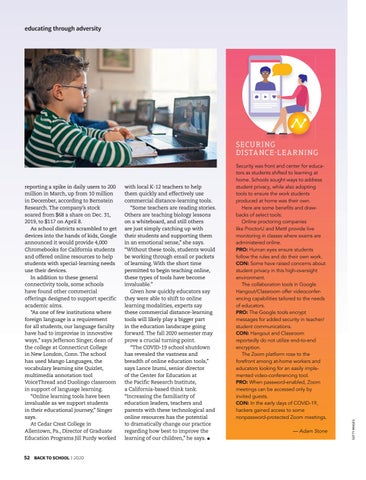
Security was front and center for educators as students shifted to learning at home. Schools sought ways to address student privacy, while also adopting tools to ensure the work students produced at home was their own. Here are some benefits and drawbacks of select tools: Online proctoring companies like ProctorU and Mettl provide live monitoring in classes where exams are administered online. PRO: Human eyes ensure students follow the rules and do their own work. CON: Some have raised concerns about student privacy in this high-oversight environment. The collaboration tools in Google Hangout/Classroom offer videoconferencing capabilities tailored to the needs of educators. PRO: The Google tools encrypt messages for added security in teacher/ student communications. CON: Hangout and Classroom reportedly do not utilize end-to-end encryption. The Zoom platform rose to the forefront among at-home workers and educators looking for an easily implemented video-conferencing tool. PRO: When password-enabled, Zoom meetings can be accessed only by invited guests. CON: In the early days of COVID-19, hackers gained access to some nonpassword-protected Zoom meetings. — Adam Stone
GETTY IMAGES
SECUR ING DISTANCE-LEAR NING
educating through adversity
Software Speak
Online language-learning companies thrive in wake of COVID-19
54 BACK TO SCHOOL | 2020
the weeks after it dropped student subscription fees. “In light of the current COVID-19 situation leaving millions of kids across the U.S. doing their schoolwork from home, the global language and literacy company, Rosetta Stone, is stepping up to help provide those workfrom-home parents some relief,” the company announced in press materials after dropping the student fees on March 30. In this unusual time, marketing materials position the products as the home-schooling solution for the coronavirus epidemic. A BOON FOR BUSINESS Before the pandemic, Rosetta Stone was serving 17,000 schools and 4 million students with English literacy and foreign-language services, says Maya Goodall, a company director. That number is now much higher. Babbel, based in Berlin, also has offered free access to students during the pandemic and has added more than 50,000 new young users, including around 10,000 new students in the U.S., a spokesperson says. As of March 19, shortly after the pandemic caused the closure of nearly all schools in America, Duolingo for Schools signups were increasing 425 percent week-over-week, driven largely by teachers assigning remote
work and parents looking for resources to home-school their children, says spokeswoman Michaela Kron. BEST OF BOTH WORLDS Some teachers will continue to incorporate what they see as the best of both worlds: robust, face-toface instruction as well as games and online tools to keep students engaged — even if it’s a struggle in the new world of remote learning. In a normal year, Richard de Meij, a world language teacher at Hartford Public High School in Connecticut, uses a variety of in-class and virtual tools. Now that everyone is at home, de Meij, who speaks eight languages, is teaching by video and encouraging students to stay connected to their studies via online software. “I think face-to-face learning in a classroom will never go away,” he says. “But it’s a golden moment for these language tools and learning platforms.” — Erin Richards
GETTY IMAGES
As children nationwide settled into weeks and months of remote learning, educational technology companies were having a heyday, marketing their products as musthave solutions to keep students connected and engaged. Few were poised to do so as well as language-learning software companies, which have spent years honing the digitized, personalized, gamified experience of self-paced education. Programs like Rosetta Stone, Duolingo, Babbel and Kahoot! have been used in schools for years, with a catch: They’re usually paired with a teacher. The tools could supplement foreign-language and English language instruction, but a few schools used them to fully replace a certified educator who was too difficult to find or too expensive to hire. CEOs of the companies have long stressed their software isn’t meant to supplant educators. But with hundreds of thousands of new users logging in from home, a global test is underway: How much will this digitized education experiment change learning once children eventually return to traditional classes? “I do think that this is one of those watershed moments,” says Matt Hulett, CEO of Rosetta Stone. The company said it added 10,000 to 20,000 new users each day in
CONVENIENT AFFORDABLE
$
TRANSFERABLE
TUITION IS 50% LESS THAN THE COST OF UNIVERSITY
APPLY TODAY! SCF.edu
ASSOCIATE
Text 941-304-5443
BACHELOR’S CERTIFICATES
BRADENTON • VENICE • LAKEWOOD RANCH • ONLINE
State College of Florida, Manatee-Sarasota is accredited by the Southern Association of Colleges and Schools Commission on Colleges to award associate and baccalaureate degrees. Contact the Commission on Colleges at 1866 Southern Lane, Decatur, GA 30033-4097 or call 404-679-4500 for questions about the accreditation of State College of Florida, Manatee-Sarasota. State College of Florida, Manatee-Sarasota does not discriminate on the basis of sex, pregnancy, race, religion, age, national origin/ethnicity, color, marital status, disability, genetic information or sexual orientation in any of its educational programs, services and activities, including admission and employment. Direct inquiries regarding nondiscrimination policies to: Equity Officer, 941-752-5323, 5840 26th St. W., Bradenton, FL 34207.
CREATORS OF:
The Story of the World The Ordinary Parent’s Guide to Teaching Reading Math Facts That Stick
And more!
Your Trusted Guide to Home Education for Over 20 Years
We’re not new to home education. For more than twenty years, we’ve provided millions of parents with easy-to-use, scripted curricula so they can teach their children with confidence. No expertise required.
Visit welltrainedmind.com/youcandothis to learn more.
56 BACK TO SCHOOL | 2020
JACK STRUTZ; GETTY IMAGES
HAPPY, HEALTHY &WHOLE Actress-entrepreneur TIA MOWRY aims to check all the boxes BY SHAMEIK A RHYMES
BEFORE TIA MOWRY BECAME a TV star and a household name, she was a student. And like scores of other young, impressionable people, she relied on instructors to help her learn the alphabet, how to tell time and decipher math equations. But she’ll never forget one lesson that a special teacher taught her: self esteem. >
57
Mowry and husband, Cory Hardrict
58 BACK TO SCHOOL | 2020
Tia, left, and Tamera Mowry on Sister, Sister
JACK STRUTZ; ABC; GETTY IMAGES FOR ESSENCE
Mowry and her daughter, Cairo, and son, Cree
“My elementary school teacher, Mrs. Smallwood, work,” she says. taught me to believe in myself even when I didn’t In order to get ready for back to school, Mowry know the answer. She did little things that showed has a checklist she follows. me she cared, and when someone is investing their “The main thing is to go ahead and check off time and showing you that they care, it makes you your list of tools that you’ll need for your child want to care about yourself,” says Mowry, whose ahead of time, like the essentials such as markers, acting career began in the 1990s when she starred pencils, backpacks and even lunch bags. Just like alongside her identical twin, Tamera Mowrymy mom used to do, I get new clothes including Housley, on ABC’s Sister, Sister. jeans, socks and new underwear because it’s the These days, the 42-year-old is busy wearing perfect time to get your child new stuff.” multiple hats as an actress, entrepreneur, author, She also suggests helping children deal with any producer, wife to actor Cory Hardrict and mother anxieties by visiting their classroom ahead of time, to son Cree, 9, and daughter Cairo, 2. She shares getting familiar with school grounds and meeting cooking tips and life hacks on the digital series the teacher before the first day of school. Once the Tia Mowry’s Quick Fix on Facebook and YouTube, school year kicks off, preparations don’t stop, so stars on the Netflix show Family Reunion and is Mowry says she tries to stay ahead of the game the co-founder of Anser, a health and wellness with a few tricks. supplement line. “I put out the first week of Now that Mowry, whose acting the clothes Cree is going to be credits include a starring role on wearing in his closet, so we The Game from 2006 to 2015 and both know what he’s going to several Lifetime and Hallmark be wearing and it’s prepped. It Channel holiday movies, has kids saves a lot of time and anxiety,” of her own, she appreciates even she says. more the role that teachers play as an essential part of a child’s QUICK FIXES development, in part because The kitchen is a place where of the countless hours spent Mowry feels right at home — after together in the classroom. And all, she authored a cookbook their impact goes beyond K-12. titled Whole New You: How Real Mowry and her sister graduated Food Transforms Your Life, for a — TIA MOWRY from Pepperdine University in Healthier, More Gorgeous You in California. There, one professor’s 2017 — so preparing food ahead lessons went beyond the of time is also on the to-do list. textbook. “My son is a huge snacker, so it’s beneficial “Dr. Banks was there when I was feeling insecure to create some snacks that you can do on the about my body, and I was on Sister, Sister at the time weekends and have enough stored for the week and taking diet pills. I just wasn’t loving myself, ahead. One that I like to do is apple crisps, which is and he made me realize the importance of my just cutting up apples, putting some cinnamon on mental health in his psychology classes,” Mowry them and putting it on a sheet tray, then throwing says. “Teachers are teaching you educational and it in the oven. Or you can create a popcorn medley life tools that really carry you on as you get older, with pretzels and other fun things.” and that’s why it is so important to show teachers For breakfast, she says her son loves overnight how much we care.” oats to start his day, and it’s an easy meal to prep ahead of time. BACK-TO-SCHOOL TRADITIONS “You just put oats with some milk and fruit ... in As Mowry gears up to send her son to fourth Mason jars in the refrigerator, so in the morning, grade, she’s relying on traditions that her mother you don’t have to make anything. You just screw off passed down. “My mom taught us that when you the top and it’s done,” she says. are going to school, you’re going to get an education Her son has a peanut allergy and daughter Cairo and learn new things, so it should be an enjoyable is a picky eater, so Mowry has to get creative with experience. So you should present yourself in a meals. For Cree, she will substitute almond butter way to let your teachers know that you are ready to or sunflower butter for peanut butter, but with >
GETTY IMAGES
“If you take care of yourself, you aren’t being selfish.”
59
Cairo she has to find ways to sneak in the foods the toddler doesn’t like. “She’s a huge smoothie drinker, but she doesn’t like vegetables, so I’ll throw an avocado and spinach into a smoothie. I just add whatever she doesn’t like to what she does like because she has to be familiar with whatever she is tasting.” She also adds honey to meals such as pancakes to sweeten the pot for her picky eater. “I respect her and what she likes and what she doesn’t, so it just means I have to find new ways to introduce foods to her.”
WELLNESS IS A WAY OF LIFE
The family takes supplements and stays active. “We have a bike and a treadmill. It’s just important to get the entire family moving and making sure you all are eating well-balanced meals with proper nutrition.” She also makes sure everyone is getting the proper amount of sleep and keeping regular sleep schedules. “Having them go to bed at the same time every day has been beneficial for us. They get on a circadian rhythm that has been helpful.”
ART IMITATES LIFE
The style in which Mowry parents is similar to It’s clear that health and wellness are of the Cocoa McKellan, the nontraditional mom that she utmost importance to Mowry, but she believes it’s portrays on Family Reunion. Cree slept in her bed equally important to pass that knowledge on to her until he was 4, and Mowry has continued the bedkids. sharing tradition with Cairo. “I felt like being a mom, “Cocoa is this kind of peaceful sometimes we take care of Zen-loving mother and that’s everyone but ourselves,” she says. the way that I am. She’s not “How can the goose lay the egg your traditional mom, and that’s if the goose doesn’t take care of where the conflict comes in on herself?” the show; it’s tradition versus She answered that question nontraditional. I grew up in a by co-founding the supplement traditional household. My mom line Anser with manufacturer is an evangelist, and she is for BioSchwartz after a longstanding spanking children and not for battle with endometriosis. She co-sleeping. I didn’t want to raise says her doctor told her after my kids that way, just like Cocoa several surgeries she would need doesn’t,” Mowry explains. to change her lifestyle to help The show tackles heavy with her symptoms. “I went on topics such as religion and race this journey of educating myself relations. For example, the family about how food exacerbates or reacts to police accosting the suppresses an existing condition, black McKellan kids for being in — TIA MOWRY so I changed my diet, started “the wrong neighborhood.” exercising and started taking “We’re not afraid to depict supplements and I saw a huge the truth, and that’s what is so shift.” During that journey, Mowry began noticing amazing about this show. It’s a success because it’s the lack of supplements specifically for women of multigenerational and everybody can sit down and color in the marketplace. watch.” “I wanted to basically start a conversation Whether she’s learning lines, chasing her toddler with the women that felt ignored or not included or having dance parties with her son, one thing within the conversation of health and wellness Mowry has realized is that balance isn’t in her because it should be accessible to everyone and it’s vocabulary. affordable.” “There is no such thing as balance for me,” she Anser’s collection includes multivitamins for confides. “If there is balance, then I’m not forgiving the entire family, prenatal formulas and beauty of myself. I’ve just learned to go with the flow, and supplements. while I have a list of priorities — and those are my “You are not whole if you are not well. If you take children, my family, their health and well-being care of yourself, you aren’t being selfish, and that’s — it’s important for me to be fulfilled and not lose the one thing I had to learn myself.” myself just because I’m a mom. So as long as I tap She reinforces a healthy lifestyle for her kids: into that, I am a happy person.” l
60 BACK TO SCHOOL | 2020
GETTY IMAGES
“When someone is investing their time ... it makes you want to care about yourself.”
JACK STRUTZ (2); JOHN P. FLEENOR/NETFLIX; BIC
BUSY WOMAN In addition to her Quick Fix and Family Reunion shows and Anser supplement line, Mowry partnered with the BIC brand to launch BIC Kids products in the U.S. The company says its washable markers, splinter-free colored pencils and break-resistant crayons will be available in time for back-to-school shopping.
61
62 BACK TO SCHOOL | 2020
BOYS & GIRLS CLUBS OF AMERICA (4)
Story From Boys & Girls Clubs of America
Boys & Girls Clubs of America equips youth with essential skills for now and laterr BY STACEY FREED
Nzingha R., above, was a Boys & Girls Clubs of America 2019 Youth of the Year finalist.
NZINGHA R. WANTS TO SOMEDAY BE A LAWYER and, ultimately, a Supreme Court justice. She is also interested in cooking and scriptwriting and acting. No one would guess how shy Nzingha is — or rather, used to be — when speaking with this intelligent and confident 17-year-old rising high school senior. But for the past eight years as a member of the Boys & Girls Clubs of America’s (BGCA) Gloucester County location in Glassboro, N.J., Nzingha has been honing her skills in public speaking and collaboration. “I love cooking,” she says, “and I was able to have my own (weekly) cooking and nutrition show. The scripts I wrote were about big things we were tackling like family issues. It was a good place for me to start using my voice for positive change, and that’s something you need for any kind of law.” The ability to work collaboratively, be a leader and take initiative are just a few of the attributes Nzingha developed through the organization’s programs aimed at equipping young people with essential skills to succeed at school, in adult life and at work. It can be difficult to point to one particular skill learned as a child and say that’s what translated into success at school or in a career. And while preparing a first grader for a career might seem premature, research shows that with practice, social and emotional skills have big payoffs throughout a person’s life. “If young people can practice these skills over time, they are better able to transfer them to real-life settings,” says Crystal Brown, BGCA national vice president of youth development. >
63
to ensure that youth are empowered to have agency over their lives and their futures.” — RACHEL SCHUTZ vice president of club services, Boys & Girls Clubs of Portland (Ore.) Metropolitan Area
64 BACK TO SCHOOL | 2020
What’s Essential? In her role, Brown oversees the strategic direction for program training and development. She describes essential skills as those “that allow young people to show up in the world.” Through games, interactions with others and the design of each club’s physical environment, youth learn to build relationships, solve problems, control their impulses, gain confidence and work together. BGCA thinks about development holistically and tailors programs to specific age groups. “What you would do with children ages 6 to 9 isn’t what you would do with teenagers,” Brown says.
Nzingha joined the club when she was 9. “My mom was looking for a place to put me and my sister after school that would be safe and productive,” she says. Over the years, she participated in events such as cleaning up around the community. “We had to be at the bus on time. I learned about being punctual and if you’re going to be late, to call. You have to be accountable.” Essential skills are considered when implementing each of the BGCA’s’ numerous programs. Take impulse control, for example. With teenagers, Brown says, club volunteers and staffers may weave that skill into the financial literacy program. “If you give a teen $20, they will likely go off and buy something. But in our financial literacy classes we talk about saving, money management and deferred gratification,” she says. For younger children, BGCA has a program called Smart Moves, in which, Brown says, groups might play a game where children sit in a circle and the facilitator acts as if they’re going to pass a ball to one particular child but then passes it to someone else. “It helps the child learn self-management by being able to control how they feel at that moment,” she says.
Keeping Up Engagement The Chattahoochee Valley club serves 750 children every day, ages 6 to 18. The club facilitates 176 activities per year, per age group, says Reaves, who has a background in mental health and youth development. For kids in kindergarten through eighth grade, the clubs use
a curriculum called Second Step, and with teens they use Ready, Set, Action. Reaves tells the story of a teenager who came to the club in 2018 when she was 16, four years after her father died. “Her attitude was disruptive at home and at the club. She would really explode. She couldn’t even articulate why she was so angry,” Reaves says. The staff got the teen into a social and emotional program in which she could discuss feelings and relationships with her peers. “That was step one for her, and it kept her engaged in the club,” Reaves says. Step two included more intensive services, including meetings with a licensed clinical social worker. Then she went through the Ready, Set, Action program and worked on her emotional management, empathy and teamwork. After that program, she participated in the Keystone leadership program that focuses on community service and mentoring younger members. The girl became vice president of that group. “Throughout her journey, we talked a lot about her responsibility to manage her emotions, take initiative and problem solve on her own. That’s really what essential skills are; if we had done those things for her, she would not have developed those skills on her own,” Reaves says. “She became a better student, daughter, friend, club leader.” This year, the teen was a finalist in the club’s Youth of the Year program, which helped her earn a college scholarship. She plans to attend a state university in Georgia. >
BOYS & GIRLS CLUBS OF AMERICA (4)
“We look
Teaching those skills can be daunting for parents and educators, so the BGCA’s 4,300 clubs throughout the U.S. can supplement their efforts. The organization, one of the oldest and largest after-school programs in the country, has seen success in working with young people to develop skills in six core areas: emotion management, empathy, teamwork, responsibility, initiative and problem-solving. Volunteers and staff members see firsthand how a child’s negative behaviors affect their health, their families and the wider community. To help students learn and incorporate these skills into their lives, “We get our young people involved in planning and opportunities to change their behaviors. We do things with them and not for them,” says Kimberly Reaves, vice president of operations at the Boys & Girls Clubs of the Chattahoochee Valley in Columbus, Ga.
65
coping strategies The Boys & Girls Clubs of America has incorporated programming from organizations like the Aspen Institute’s National Commission on Social, Emotional, & Academic Development and the Partnerships in Education and Resilience Institute, which is affiliated with Harvard Medical School, to understand children’s behaviors and emotions and the ways they affect the child, their families and wider communities. Here is a strategy parents can use to build essential problem-solving skills in their children:
S T E
P 66 BACK TO SCHOOL | 2020
STEP
Say the problem. Get your child to articulate wate what the issue is. Together, in a safe and respectful way, think of possible solutions to the problem. Explore consequences. There needs to be structured consequences. “Sometimes kids offer stronger consequences than adults do,” says Kimberly Reaves, vice president of operations, Boys & Girls Clubs of the Chattahoochee Valley, Columbus, Ga. Pick the best solutions and make your plan.
Part of looking holistically at youth is meeting them where they are. “When young people arrive at the clubs, we don’t know about their ability to develop healthy relationships with themselves and with others and if they have the skills to regulate their emotions and make responsible decisions,” Brown says. Clubs consider each child’s needs as well as the culture of the community. The Boys & Girls Clubs of Portland (Ore.) Metropolitan Area, serving 4,500 children per year in its 10 clubs, works to build the scaffolding that will serve youth as they go through programming as children and into their teen years. These soft skills range from simple things like learning to take turns, being able to express their needs and interacting in positive ways to building friendships, resolving conflicts and developing appropriate relationships. Members are made to feel emotionally and physically safe at all times so they can “calm the stress part of their brain that keeps them in fight-or-flight mode,” says Beverly Ajie, senior director of youth services at the Portland club. Programming is predictable and stable, and the staff uses a “lens of equity” to understand that everyone comes from a different perspective and has individual life experiences. What does success look like for these club members? “We look to ensure that youth are empowered to have agency over their lives and their futures,” says Rachel Schutz, Portland’s vice president of club services and a trauma informed specialist.
“When we talk about these essential skills, the end game is being a well-adjusted, fully developed adult.” Matthew Heady, senior director of teen services at the Portland club, builds on the work done with younger children by Schutz and Ajie. He highlights TreNisha S., who grew up in the club, as a success story. “She took part in the fun stuff and then as a teen we were able to connect her with internships,” he says. She went through the club’s workforce development program, where she worked on communication and critical thinking skills. “We do a lot of work on self-advocacy and efficacy to recognize when you need to speak up in the world,” Heady adds. TreNisha was able to put her skills to use as a paid guest services intern at Providence Park, where the Portland Timbers professional soccer team plays. Like TreNisha, Nzingha has been implementing what she’s learned at the club during an internship at a local law firm. She says she learned to be organized, on time and accountable by participating in BGCA programs. “I got to the office every day at 8:58 to clock in at 9. I got there early in case I tripped or something,” she says with a laugh. Every child needs support, direction and the ability to attempt new things, Heady says. “We see our club as a safe place to fail. You can come here and try something new in a safe space and if you do well, we build on that. And if you struggle it’s all right, too. We think of ourselves as bumpers like you see in a bowling alley.” l
BOYS & GIRLS CLUBS OF AMERICA (2)
’Lens of Equity’
Here’s your hack for the summer slump MAKE THE MOST OF PLAYTIME LAUNCH RIGHT IN WITH . . . GATHER THESE MATERIALS:
Rubber bands
Craft sticks
Cotton balls
1. Stack 3 craft sticks together and wrap each end with a rubber band.
3. Place the stack of 3 craft sticks in between the stack of 2 craft sticks and attach them with a rubber band where they overlap.
Glue
THE CATAPULT! Bottle caps
2. Do the same with another 2 craft sticks, but wrap only one end with a rubber band.
4. Glue a bottle cap to the end of the top craft stick.
Your catapult is finished! Shoot a cotton ball with your catapult. Modify your catapult by adding or subtracting craft sticks, rubber bands, and bottle caps. Does this change the accuracy of your catapult or how far your cotton ball can go?
TinkerActive workbooks cover essential skills with curriculum-based exercises and interactive tinkering, making, and engineering activities using common household materials!
The Active Way to learn through play
AVAILABLE WHEREVER BOOKS ARE SOLD
ODD DOT | An imprint of Macmillan Children’s Publishing Group
GETTY IMAGES
L A U G N I L I B 68 BACK TO SCHOOL | 2020
S R E I R R A B ts n e d u lp st ies e h h panis cess var S d n c l ish a d s , b u t a g n E t in ckgroun h S g u a HARD a t b N RIC I s R s E e Class om variou BY KRISTIN L AM AND fr os Angeles preschool teacher Rosa Ramirez has a special way of asking her students to line up for playtime outside. “Pueden pararse si llevan puesto algo de color amarillo, como una abeja,” she tells them. In English, Ramirez would say, “You can stand up if you are wearing yellow — like a bee.” But this is the half of the school day in which she teaches exclusively in Spanish. The preschool dual-language program at Gates Street Early Education Center in Lincoln Heights, one of Los Angeles’ oldest neighborhoods with dense populations of Latino and Asian residents, is part of a growing number of bilingual education models taking root in California and across the country. Many of them are designed
L
to serve students from Spanish-speaking families, as well as students from other cultures, with mounting evidence that learning two languages can help people from all backgrounds become stronger students. Roughly 3.8 million students in U.S. schools are native Spanish-speakers who are not proficient in English. They make up the bulk of the approximately 5 million students nationwide identified as Englishlanguage learners, the fastest-growing demographic in schools — and the lowestperforming, as judged by achievement tests and graduation rates. Sixty-seven percent of students with limited English skills graduated high school after four years in 2016, compared with 84 percent of all students, according to federal data. >
69
70 BACK TO SCHOOL | 2020
DEBATE OVER BEST TEACHING METHODS From 2000 to 2015, the percentage of Latino students enrolled in public elementary and secondary schools swelled from 16 percent to 26 percent, while the percentage of white students fell from 61 percent to 49 percent, according to the National Center for Education Statistics. Federal law requires districts to identify students with limited English skills and to serve them with an equitable, research-based program. Practices vary widely between states and districts. Some schools use transitional bilingual programs, which teach academic subjects such as science,
ENGLISH LEARNERS MAKE PROGRESS The city of Vineland, N.J., about an hour south of Philadelphia, represents changing U.S. demographics. More than 60 percent of the 11,000 students in Vineland public schools are Latino, reflecting a long-standing Puerto Rican
GETTY IMAGES; HARRISON HILL; ADAM MONACELLI (2)
To improve those outcomes, language experts recommend more high-quality, long-term dual-language programs to close the achievement gap in literacy between English learners and native English speakers after five to six years, according to research. The programs can be difficult to implement. Hurdles include a debate over the best way to teach English learners, shortages of bilingual teachers and even the fact that dual-language programs often grow fastest in areas where upper-income parents ask for them. That’s good for children who participate, but it worries advocates who would like to see language-minority students have equal access. Pressure is mounting in states where the numbers of Latino English learners have surged. Mississippi, South Carolina, Kentucky, Kansas and Maryland have seen the number of English learners more than double from 2005 to 2015, according to federal data.
“If we can make children feel more whole and more ready and more accepted and welcomed and validate their prior knowledge and prior learning experiences, then we’ve gone a long way to making them ready to learn over the course of a lifetime,” says Tara Fortune, immersion program director at the University of Minnesota’s Center for Advanced Research on Language Acquisition.
math and social studies in Spanish for a few years before transitioning students to mainstream classes. Many use English as a Second Language instruction, a set of methods and techniques originally developed to teach English to foreign diplomats and university students. Instruction happens in English, and teachers have to be certified. Then there are “English-only” models, which call for separating language-minority children and having them learn all subjects only in English. “It’s very political because the public doesn’t really understand the process of second language acquisition,” says Maria Coady, an associate professor of bilingual education at the University of Florida, a state where almost 300,000 students are learning English. “But the research is really clear on what works,” Coady says. “Students learning English benefit from highquality, long-term bilingual instruction programs.”
Rosa Ramirez, far left, teaches a preschool class at Gates Street Early Education Center in Los Angeles. Student Kevin Sanchez takes notes and Sonya Bertini, a bilingual special education teacher, works with a student at Vineland High School in New Jersey.
— MARIA COADY, associate professor, University of Florida
community and a swell of migrants from Central America in recent years. Many of those new arrivals are teens who came without their parents and have no recent history of attending school. Some of the parents work in the surrounding eggplant and cauliflower fields during the day. Some are highly transient, migrating with the seasons to wherever the work is. Like many districts in New Jersey, Vineland hosts a transitional bilingual program for students who arrive with limited English skills. This year, about 800 students were enrolled. They learn
their core academics in Spanish — often right next door to classes where the same content is taught in English — but they have time built into the day for speaking, reading and writing in English. Vineland’s program has been bolstered by JoAnne Negrin, supervisor of bilingual education. Since she was hired eight years ago, she made sure that all new textbook purchases were available in both Spanish and English, so students in the bilingual program could learn at the same pace as their English-speaking peers. Vineland’s English learners show some of the district’s highest academic improvement scores, Negrin says. Last year, the students met all of the targets outlined on state report cards. “People sometimes question, ‘How are students going to learn English if they spend the whole day learning in Spanish?’” Negrin says. “Well, our data shows that proficiency in literacy in the child’s first language is a very good indicator of how well that child is going to eventually learn English.” Other small victories are happening. Kevin Sanchez, 17, who arrived from the Dominican Republic last year with limited English, won first place in a regional science fair after investigating how windmills worked and building a model of one. Sanchez almost removed his entry from the fair when he learned that participants would be required to make an oral presentation to the judges. Encouraged by his bilingual science teacher, Sanchez enlisted a friend to
translate for him. “It felt really good that a student like me could win in a fair like that,” Sanchez says in Spanish.
BILINGUAL TEACHERS IN DEMAND Another major barrier to starting or expanding dual-language programs is the critical nationwide shortage of teachers who can speak and teach in Spanish and English. More than 30 states reported similar shortages in English as a Second Language teachers and world language teachers. As a result, more districts groom their bilingual teachers, either by helping staff achieve the necessary certifications or by encouraging former bilingual students to come back and teach. In Texas’ Rio Grande Valley, close to the U.S.-Mexico border, one district and a nearby university tried to bolster the pipeline of bilingual students becoming bilingual educators. The Pharr-San Juan-Alamo Independent School District serves a nearly all-Latino population of 32,000 students. The district has long supported a dual-language, SpanishEnglish program in all of its elementary schools. Students can choose to continue in the bilingual program in high school. After students graduate, they can continue their bilingual studies in Spanish and English at the University of Texas-Rio Grande Valley. The university added a minor in bilingual secondary education, says Janine Schall, chair of the bilingual and literacy studies department. The university can’t expand fast enough, Schall says. Would-be bilingual teachers often face daunting challenges such as affording the cost of their education and the paying for tests they are required to take to become certified. “We know that there’s a greater need for bilingual education teachers than we can meet right now,” Schall says. l — Jared Weber contributed to this story.
71
72 BACK TO SCHOOL | 2020
WHEN FAMILIES TAKE EDUCATION ON THE GO, SCHOOL LESSONS SPRING TO LIFE
BIONCA SMITH; GETTY IMAGES
BY SARAH SEKUL A
or 11-year-old Carter Davis, there’s no such thing as a typical school day. His lessons might involve learning about geysers at Yellowstone National Park, exploring tidal pools in California or researching fossils at Joshua Tree National Park. It all depends on where he and his mom, Bionca Smith, decide to park their van. They are known as roadschoolers, which is exactly what it sounds like: It’s the combination of travel plus virtual learning, and it’s a way for parents and children to take a different approach to school. For this mother-son duo, it started in 2017 when Carter was on the verge of failing second grade, and Smith was feeling overwhelmed by debt and tired of keeping up with the Joneses. They decided a drastic change was in order. First, Smith enrolled Carter in Connections Academy, a tuition-free online public K-12 school. That meant Carter now had a virtual classroom at his
fingertips and would meet online with his teacher and classmates once a week or once every two weeks. Smith also quit her San Francisco-based corporate sales job. Another huge step. “When I talked to Carter about attending school online and eventually traveling full time and exploring hidden gems around the world, he said yes,” Smith says. “After this, we ended our lease, and within 30 days we donated and sold as much stuff as we could.” She then bought two oneway tickets to Thailand, and they then jet-setted to France and Africa. About nine months, Smith bought a 1989 Ford Econoline camper van so they could set their sights on the U.S. and live the #vanlife. So far, so good. Carter has transformed his grades, and they are quite happy. Smith works as a motivational speaker and life coach and has since added social media influencer and content creator to her list of credentials. >
Bionca Smith and son Carter Davis’ camper van at Joshua Tree National Park in California
73
Carter and mom, Bionca, at a Bully Barricade Foundation event
“The parent is considered to be a learning coach,” says Smith, who shares their roadschooling experiences on the Off The Grid With A Kid blog and with videos on YouTube. “We support our children by making sure they’re on track and assist immediately as needed.” Carter’s teachers connect with him on one-on-one video chats, phone calls, secure email and chat features within the school’s platform. Students can take part in group discussions and collaborate on problem-solving
exercises. There’s also the opportunity to meet in person with classmates and teachers via school-sponsored field trips, social events and community service projects. Kids can even join clubs ranging from art and science to chess and video gaming, as well as career prep, National Honor Society and student council. “It’s incredible to be able to work beside my son and watch him joyfully explore the world without boundaries,” says Smith. “He has become very brave, resourceful and confident in who he is.”
In their spare time, Smith and Carter run a nonprofit organization called the Bully Barricade Foundation, through which they visit schools and talk about how children can handle being bullied. The foundation also connects roadschooling families through Facebook groups, sometimes facilitating in-person meetings.
For Whitley Alpher, 14, and her brother, Josiah, 17, who are also enrolled in Connections Academy,
BIONCA SMITH; GETTY IMAGES
“TRAVELING ON THE ROAD MEANS THAT THE TEXTBOOKS COME TO LIFE. ROADSCHOOLING IS LIKE BEING ON A NEVER-ENDING FIELD TRIP OR A MAGIC SCHOOL BUS. EVERY DAY FEELS LIKE SATURDAY.” — BIONCA SMITH, mother of roadschooling student, Carter
Bionca Smith and son Carter
74 BACK TO SCHOOL | 2020
FAITH ALPHER (2); GETTY IMAGES
online schooling meshes well with their busy schedules. They live in the San Francisco Bay Area, and their mother, Faith Alpher, frequently drives them to and from Los Angeles to audition for acting and modeling gigs. On weekdays, Whitley and Josiah wake up around 7:30 a.m. They open their laptops, and their lessons are waiting for them. Live lessons are available, but if they are busy with auditions, they can tune in and complete them later. This flexibility opens up a world of possibilities. Over the holidays, for example, Josiah and Whitley had the opportunity to spend an entire month with their grandparents in New Jersey while doing their schoolwork online. “Students can opt to start school at noon, complete a week’s worth of math on Monday or English on Tuesday,” says Mickey Revenaugh, co-founder of Connections Academy. “Lessons are both synchronous with peers (real-time online lessons) and asynchronous (online lessons, video tutorials, projects) on their own.” Whitley finished her third web design project this semester, learning to create an interactive button with JavaScript. And Josiah completed an assignment for his public-speaking class where he researched a famous
speech and examined how the speaker was able to capture the crowd’s attention. Much of that schoolwork was done on the road, in coffee shops or on set.
Sylvan Learning Center, which has been providing supplemental education for 40 years, also offers remote, online-learning opportunities where students and teachers work together through video conferencing calls. These programs are geared toward kids attending traditional schools who would like additional tutoring outside of school. “One of the most important aspects of education is the connection between the teacher and the student,” says Emily Levitt, vice president of education at Sylvan Learning. “Online learning can keep that connection going even when they are far apart.” Levitt says her sons recently grumbled about taking math lessons online, but their faces lit up when their favorite tutor appeared on screen. For Gabriela Molina, 17, online learning has been particularly lifechanging. She endured intensive bullying for years, and after trying several schools across Brazil and the U.K., it became clear that traditional
lpher Whitley A
school was just not the right fit. When her parents came across Fusion Academy, a tuition-based private school offering a one-to-one student-teacher ratio — both online and in the classroom — things started to go more smoothly for Gabriela. The school customized a program for her based on her learning style, passions and hobbies. Not only was bullying out of the picture, this new approach also meant that the family had the chance to travel to Mumbai, India, São Paulo and Cairo without interrupting Gabriela’s studies. Gabriela and her dad, Rafael, and mom, Lydia, are U.S. citizens but are based in London where Rafael works as an economist and often travels for work. He says it’s been a joy to see Gabriela combine her schoolwork with the real world. On their trip to Cairo, for example, the family had the opportunity to see the pyramids of Giza, tour the Nile River and visit the Egyptian museum. During this trip, Gabriela’s ancient civilizations teacher helped her integrate what she was learning in the classroom with her experiences. “All virtual classes are taught live and one-to-one by the teacher,” says Peter Ruppert, CEO and founder of iEducation Group, which runs Fusion >
Josiah Alpher
75
Gabriela Molina in Egypt
country or city she’s in, she receives her classes, does her homework and her confidence continues to grow. For instance, when the family was in Mumbai, Gabriela planned a solo tour of the city at age 16. “She met new people and was able to navigate the city on her own,” her father says. “She also researched clothing styles and went to a typical Indian garment store to purchase some
native clothes. She needed to negotiate prices on the basis of exchange rates.” It’s easy to see that learning from a distance works for many students and families. “Traveling on the road means that the textbooks come to life,” Smith says. “Roadschooling is like being on a never-ending field trip or a magic school bus. Every day feels like Saturday.” l
“ONE OF THE MOST IMPORTANT ASPECTS OF EDUCATION IS THE CONNECTION BETWEEN THE TEACHER AND THE STUDENT. ONLINE LEARNING CAN KEEP THAT CONNECTION GOING EVEN WHEN THEY ARE FAR APART.” — EMILY LEVITT, vice president of education, Sylvan Learning Center
at Gabriela the Cairo Citadel
76 BACK TO SCHOOL | 2020
RAFAEL MOLINA (2); GETTY IMAGES
Academy. “Our teachers check in with our students to see how they’re doing emotionally and whether academic progress is made. Parents also receive daily communication via email from each teacher who taught their child that day. The daily email includes a brief rundown of content covered, successes, areas of growth and questions.” For Gabriela, regardless of which
Don’t Forget Your Honey!
™
Our h is 10 oney certif 0% USDA and U ied organ ic .S. All p Sourced. are m roducts ade in USA. the
*when you purchase $50+
Innovation, Reliability & Quality HoneyWorksUSA.com
surelynatural.com
Our National Parks The National Mall welcomes millions every year, but what they see is hardly welcoming.
It welcomes the world to our most significant monuments and memorials. But like many national parks, the National Mall in Washington, D.C., desperately needs our help, including $350 million in federal funding for maintenance, repairs, and preservation. You can help with a simple letter. Visit NPCA.org/mall. Or call 1-800-NAT PARK.
BACK TO SCHOOL
LIVE. LEARN. ELEMENTARY 80
|
MIDDLE SCHOOL 84
|
HIGH SCHOOL 90
|
CHECK IT OUT! 96
GETTY IMAGES
ESPORTS EVOLUTION Video gaming teams are on the rise in U.S. high schools, giving students a chance at college cash. Page 90
79
elementary
Longhand Lessons Debate continues over returning cursive to the classroom BY VALERIE FINHOLM
80 BACK TO SCHOOL | 2020
an education professor at The University of Southern California in a New York Times opinion piece published in 2013. Cursive, however, has not gone quietly into the history books. Instead, a simmering debate continues today. Proponents say children who can’t read cursive miss out on a world of knowledge when they can’t read historical documents or even a handwritten letter from a relative. They also cite recent research that shows forming letters by hand in grades K-2 positively affects a child’s brain development, motor skills, comprehension and memory — the basis for learning to read and write. They’ve lobbied legislators across the country to return cursive instruction to elementary schools. So far, more than 25 states have restored funding for teaching cursive writing in their schools, according to the National School Boards Association. Ohio is one state that has decided that cursive isn’t obsolete. A law passed in 2018 requires students to write legibly in cursive
by the end of fifth grade. But the battle continues elsewhere in the U.S. After nine attempts at introducing a bill that would require Indiana elementary schools to teach cursive handwriting, state Sen. Jean Leising finally got the Indiana Senate to pass it in March. Whether or not it becomes law will be decided this summer. Leising argues that cursive writing is a critical skill for tasks such as signing important legal documents. In New Jersey, some schools teach cursive, but a bill proposed by Assemblywoman Angela McKnight would make it mandatory. She received support from Assembly Speaker Craig Coughlin, who backed the measure for utilitarian reasons: “You may not have your computer with you, or your phone dies. Now you can write in cursive.” BENEFITS OF CURSIVE “We’re bringing back handwriting,” says Virginia Berninger, a retired professor of education at the University of
GETTY IMAGES
O
n Feb. 17, 1835, Rose Terry Cooke dipped a quill pen into black ink and wrote in flowing script: “This day I am 8 years old. I will make a set of new resolutions but I will not write them down for fear I shall break some of them although I shall endeavor not to.” Rose, who lived in Hartford, Conn., wrote in cursive, a skill she practiced in her journal. An 8-year-old today might not be able to read what she wrote. That’s because many elementary schools stopped teaching cursive writing a decade ago when it was dropped by Common Core educational standards, a uniform set of curriculum requirements for public schools. Educators who support the move say cursive is no longer needed in the computer age when people communicate mostly on screens. They also argue that teaching the skill takes up too much of a teacher’s time. “As we have done with the abacus and the slide rule, it is time to retire the teaching of cursive,” writes Morgan Polikoff,
You may not have your computer with you, or your phone dies. Now you can write in cursive.” — CRAIG COUGHLIN, New Jersey General Assembly
Washington who cites research findings that forming cursive letters improves a child’s ability to spell and compose sentences. “This doesn’t mean you don’t let children use technology; it’s the world we live in,” Berninger says. She says children need to learn both cursive and keyboarding skills — starting in kindergarten. “The benefits of typing come later, in the sixth grade and up,” she says. “To think that typing alone can substitute is just a mistake. It’s not scientifically supported.” SURPRISE TO SOME PARENTS Kathleen S. Wright, an independent educational consultant in Columbus, Ohio, says cursive is still taught in many private schools. Often, parents of children in public schools don’t realize that the skill is no longer being taught until they perhaps ask their child to read a letter from a grandparent. “Most people assume it is being
taught,” says Wright, a former spokeswoman for Zaner-Bloser Publishing, a company that creates instructional materials to teach handwriting. Wright is happy that many states have restored funding to teach cursive, but worries that a generation of handwriters has
As we have done with the abacus and the slide rule, it is time to retire the teaching of cursive.” — MORGAN POLIKOFF, University of Southern California professor
been lost over the past decade. She says her own 10-year-old grandson was never taught cursive — something she didn’t realize until she asked him to write something in longhand.
“He rolled his eyes and told me he used his thumbs on his iPad,” she says. “His handwriting is horrible.” Wright, who conducts workshops on cursive instruction, says many colleges don’t require future teachers to learn how to teach students to write in cursive. She explains to teachers that the process doesn’t have to be labor intensive. “You don’t have to have kids spending hours every day like they did in the past,” she says, noting that instruction in longhand can be fit in with a few minutes of practice every day and can be incorporated into other subjects and activities. One of her favorites is matching students with pen pals for an exchange of handwritten letters. “It’s the movement they make with the thumb and forefinger, moving a pencil around that lights up part of the brain,” Wright says. “This doesn’t happen when they’re using a keyboard.”
81
elementary
Mind Over Matter How parents can help children focus for success BY CARLI PIERSON
82 BACK TO SCHOOL | 2020
but we have to watch “where the attention goes,” says Daniel Siegel, founding co-director of UCLA’s Mindful Awareness Research Center and executive director of the Mindsight Institute. “Attention is a driver of memory, he adds. “Kids who are doing more than one thing at a time won’t remember what they were doing before. So, one thing we’ve learned is that multitasking impairs memory.” That doesn’t mean that your child can’t have a favorite toy on their lap while they do their online learning, but it does mean they shouldn’t be playing with it at the same time. Siegel recommends letting kids take lots of breaks to get up and move their bodies. He also stresses the importance of children feeling seen and to “verbally
acknowledge that they’re having trouble concentrating and that things are hard for them right now.” PRACTICE MINDFULNESS AS A FAMILY Mindfulness is the practice of making a conscious choice to focus our awareness on our thoughts, feelings and surroundings. Many experts assert that practicing mindfulness helps kids relax, concentrate for longer periods of time and refocus their attention and energy. “A lot of people view mindfulness as sitting still, but when there’s a lot of emotional activity, sitting still can be problematic,” says Susan Kaiser Greenland, creator of Inner Kids, an online resource that offers family mindfulness and meditation activities.
GETTY IMAGES
T
he coronavirus pandemic forced most schools to abruptly close and turn to distance learning, leaving many families struggling to find fun ways to focus their children’s attention. As the new school year nears, whether in a real or virtual classroom, students might be anxious about what to expect. Before COVID-19 hit, getting some children to concentrate on school work could already be a challenge. Video games, smartphone apps, tablets and social media all competed for their attention. But there are simple techniques to help your kids improve their ability to focus by creating and strengthening neuropathways in the brain. By developing certain aspects of attention, children’s brains can grow,
Mindfulness, she says, “is also the skillful release of nervous energy.” So, if your child is upset or hyper, have them wiggle their body to get out that nervous energy and then go back to stillness a few times. It will help them become grounded, and once they’re grounded, they can concentrate better, she says. Greenland suggests families try simple exercises together like “paying attention to the breath, or moving your attention to ... sounds in the room.” She explains that “focusing awareness doesn’t mean you block out the difficult things; it means you gather your attention on one thing and keep it there.” OTHER CONCENTRATIONBUILDING ACTIVITIES Activities such as learning to juggle or balancing a basketball on their foot or a peacock feather in the palm of their hand are other great ways to train your children’s brains to concentrate. As with the mindfulness
exercises, challenge them to see how long they can do the activity and record their times. Keeping track of their improvement will also keep kids motivated and boost their self-esteem. Another simple exercise involves sound healing to increase focus and calm the mind. First, search for a three- to five-minute sound-only (no speaking) file on a smartphone app like Calm or Insight Timer, which has more than 45,000 guided meditations. Then, gather your family around a lit candle in a dark room. Make sure everyone is sitting comfortably and challenge your children to focus on the flame while being as quiet and still as possible until the timed meditation ends. Be prepared to try out different meditations and figure out what works best for your family. Remember that things are not normal right now and kids know it. According to Siegel, parents should be compassionate and provide sincere, positive encouragement when kids approach an activity with a positive
attitude and successfully complete it. Keep your cool when your child gets frustrated with her work. By staying calm, you’re modeling the type of behavior you want to see in your child when they are upset. Finally, instead of stressing about the benefits of online learning, Siegel recommends focusing on being present and supportive.
83
middle school
A Study on Studying How parents can help when the lessons don’t come easy BY FIONA SOLTES
84 BACK TO SCHOOL | 2020
GETTY IMAGES
N
ot long after the you, and what’s a strategy for coronavirus stay-atremoving the obstacle?’ ... And, home season started, of course, the simple truth is parents-turned-homeschoolthat our children really often just teachers took to social media want us to be empathetic, and to to joke about ways to get their say, ‘I’m here for you. I believe in kids “transferred” to someone you. I think you’re awesome.’” else’s class or implement courses Allyn, whose own children like honors laundry rather than are grown, says she learned complicated math. early on to create a supportive But in the midst of the stress learning environment at home. parents might have felt, the That includes a “safe, cozy, warm opportunities for learning and inviting” physical space, but became rich — and not just for also the security of a consistent the kids. routine and of encouragement. Before the new school “I’m not a big math lover, and year is in full swing, it when I was young, I was might be a good time afraid,” Allyn says. to open dialogue “But I remember ONLINE about what that my father ASSISTANCE worked — and set me up a little Parents can find resources that may what didn’t — in space in his help supplement their the previous one. office with him. children’s homework at “We love our He was nearby. It scholastic.com. children, and of wasn’t that he was course do not want helping, but that he them to have problems, was right there.” and that is a good instinct She also speaks of parents and good impulse,” says Pam being “co-learners” with kids, Allyn, author, motivational asking them how they go about speaker and senior vice president solving their equations, having of innovation and development them describe a plot or explain at Scholastic Education. “But very their scientific experiments. often it is most helpful to be in Parents can maintain a state the stance of a listener instead of of inquiry with their kids. That a problem-solver. might mean, for example, asking “Ask, ‘What didn’t work today? how they pushed through when What’s feeling hard right now?’ they got to a difficult part in their ... Instead of saying, ‘I’ll bet you reading, and then complimenting couldn’t do that because you the strategies they used. couldn’t read that hard word,’ try Kids can find comfort in something like, ‘I’m interested the knowledge that things are to know what might be stopping difficult for adults, too — and >
85
middle school
86 BACK TO SCHOOL | 2020
information they have, helping them take more ownership of their work. “Sometimes just pinpointing the source of confusion and passing that along to the classroom teacher is time well spent,” Freireich says. Many parents make the mistake of providing the answers, offering shortcuts or explaining what they learned when they were kids, Platzer adds. “These pieces of advice often confuse students, make them more reliant on help and contribute to a lack of self-confidence,” he says. “Instead, parents should help model best practices in terms of process and organization.” Platzer, too, recommends regular routines, checklists, plans and daily rhythms. “Sometimes this means initially helping
students create a work calendar, suggesting ways to break up large assignments into smaller chunks and being available to help students as they plan on their own,” he says. “Other times, it’s just a matter of asking questions like, ‘Can you talk me through your thinking?’ or ‘Did you explain why your evidence proves your point?’” Allyn recommends parents be proactive about homework challenges and willing to discuss how homework ties in with what is being taught at school. If there’s a disconnect, it may be that other students are struggling, and it’s good for the teacher to know that. “Everybody sees the value of the home/school connection,” she says. “But now people are seeing it in a new way.” l
PARENTS AS PARTNERS A supportive environment goes a long way toward helping students study, experts say.
GETTY IMAGES
can build self-confidence by learning how to move forward anyway. But what happens when the lessons are really difficult? Abby Freireich and Brian Platzer, authors of Taking the Stress out of Homework, due to be released in March 2021, and co-founders of Teachers Who Tutor | NYC, say they often hear from parents who feel “ill-equipped to help in a given subject.” “Take math, for example,” Freireich says. “Trying to recall long-forgotten concepts is challenging enough, and now most math content is being taught differently than it was when we were kids.” A different tactic might be to ask students to restate a question and to articulate what
dapper dog box end the “I highly recomm x to Dapper Dog Bo spoil anyone looking to h their dog with hig quality products” ne eway -@ipartywithbruc
GOODIES FOR YOUR DAPPER DOG
“The Dapp er D is pawesomog Box @pupsonpe” ar
have such “They also mer service. o st great cu inion, nothing In my op mpares” else co ensrule @thegold
A Monthly Dog Subscription Box of Goodies for Your Best Fur Friend Treats, Toys and Bandanas in Every Box!
The perfect gift for men At Broquet, we design gifts with real men in mind. It’s time to grow a beard. Cook with fire. Chop some wood. We know that “stuff” can't make the man. But what a guy does with it can. Check out our Broquets, and take one step in the right direction for men everywhere.
Every purchase you make supports shelter dogs looking for their forever family!
www.thedapperdogbox.com | info@thedapperdogbox.com
www.broquet.co
middle school
88 BACK TO SCHOOL | 2020
Time Out More schools are granting students mental health days
I
n districts around the country, students by 56 percent between 2007 and 2017 — feeling anxious or depressed can be with the pace of increase greater from 2013 excused from school just as they would to 2017 than from 2007 to 2013. For children if they had a stomachache or a fever. ages 10 to 14, the suicide rate tripled Last July, Oregon joined multiple states in between 2007 and 2017. a growing movement aimed at improving And last year, the Pew Research Center students’ emotional well-being by passing reported that 70 percent of teens surveyed legislation that expands the reasons for identified anxiety and depression as major excused school absences to include mental problems among their peers. or behavioral health. Oregon’s bill allows five mental health Those who backed the measure say it’s days a year. The state of Utah and meant to change the stigma around mental Montgomery County Schools in Virginia health in a state that has some of the adopted policies in 2019 that allow students country’s highest suicide rates. to take time off to focus on Experts say it is one of the first their mental well-being. In 2009, state laws to explicitly instruct Minnesota was the first state schools to treat mental health to pass a bill allowing excused of teens surveyed and physical health equally. mental health absences. identified anxiety Legislators in Florida The Florida bill would allow and depression as attempted to follow suit, but a one mental health day per major problems proposed measure was tabled in semester as an excused absence, among their peers. March. When Rep. Susan Valdes and a parental note would be filed the bill last year, she sought required for the missed day. SOURCE: The Pew to elevate mental and behavior Last August, a similar proposal Research Center health issues to the same level was filed in the New York State as the flu, colds and dental appointments, Assembly. treating them as legitimate reasons for “In the age of social media, the internet students to call in sick. and constant bombardment of negative “It is time for us to take mental health news and events, our children are bearing as a whole more seriously,” says Valdes, the brunt of a quickly changing society,” adding that kids today are under a lot of explains Valdes. pressure. In another sign that adolescent mental Supporters of similar measures approved health is getting increased attention, in other states cited studies that indicate Florida’s board of education voted last the mental health of teens and young July to require schools to offer at least adults has changed dramatically in the past five hours of mental health instruction decade. annually to sixth through 12th graders. The Centers for Disease Control and Prevention reported last October that the — James Call, of the Tallahassee (Fla.) suicide rate among people ages 10 to 24 Democrat, and The Associated Press was stable from 2000 to 2007, but increased contributed to this story.
PHOTO ILLUSTRATION: HAYLEIGH CORKEY/GETTY IMAGES
70%
89
high school
The Evergreen Valley High School esports team in San Jose, Calif., practices playing Rocket League.
Play to Win Esports provide an outlet for gamers to succeed at their craft
O
n spirit day at La Feria High School in Texas, the video gamers strut around in their matching team jerseys. “They all walk together through the hallways just like the football players do,” says teacher Claudia Carranza. “Most of them would otherwise walk around with their hoodies up and their heads down. Now they have swagger. They get to be leaders.” In addition to teaching math
90 BACK TO SCHOOL | 2020
and computer science, Carranza leads the school’s esports team. Around the nation, schools have embraced competitive video gaming as a way to meet students where they are, to get them engaged and to teach valuable life skills. “Eighty percent of the kids that participate in our league never took part in any other extracurricular activity,” says Jason Kirby, president of the High School Esports League
(HSEL). With more than 3,000 partner schools, it’s the largest group organizing competitive tournaments among high school gamers nationwide. “This is a means to engage the unengaged. It’s similar to terrestrial sports like football and baseball, but anyone can play, regardless of their shape, their gender or their race,” Kirby says. The growing esports trend enjoys a virtual world of momentum fueled by a revenue >
HIGH SCHOOL ESPORTS LEAGUE
BY ADAM STONE
Moving is the best medicine. Keeping active and losing weight are just two of the ways that you can fight osteoarthritis pain. In fact, for every pound you lose, that’s four pounds less pressure on each knee. For information on managing pain, go to fightarthritispain.org.
The Bay Shore (N.Y.) High School esports team celebrates winning an HSEL tournament for Hearthstone.
stream projected at $1.1 billion. A number of high school esports startups are already in place, chasing the burgeoning revenue source. And the National Federation of State High School Associations began a partnership in 2018 with online gaming provider PlayVS, hoping to engage a key demographic. “We want there to be a collision of all these different worlds and social classes within the high school environment because kids like the same game,” says PlayVS founder and CEO Delane Parnell, who described a real-life scenario where a disabled student was able to compete alongside a baseball standout. GETTING ON BOARD There are currently 15 states using PlayVS for club or varsity teams. HSEL reports they operate in all 50 states and Washington, D.C. Many educators see gaming as a natural fit for today’s high schoolers. Some 97 percent of teen boys and 83 percent of teen girls play video games, according to the Pew Research Center. In league play, students test
92 BACK TO SCHOOL | 2020
their skills in games like Rocket League, Overwatch, Super Smash Bros. and Fortnite. Schools can begin competitive gaming with a minimal investment. “When I started the club, I got patted on the top of the head and told: ‘Thank you for volunteering your time.’ I had to scramble,” Carranza says. In the beginning, the kids brought their own gaming consoles from home. A more mature club might invest $15,000 or more in computers, peripherals and league fees. “We have an awesome gaming lab, and we wrote grants to get all the equipment, all the monitors and PCs and peripherals. It cost about $20,000 for everything, and then we used some other money we had for ergonomic seating and other furniture,” says Mike Russell, who teaches social studies and gaming concepts and who runs the esports club at Complete High School Maize in Kansas. ADDED BENEFITS Esports drive home the same essentials as any other athletic endeavor, Russell says.
Competitive gaming teaches sportsmanship, persistence, cooperation and leadership. At Complete High School, where more than a dozen kids actively take part in esports, there’s an ancillary benefit. “Our school is an alternative school for at-risk students, and with at-risk kids one of the main reasons they don’t do well in school is because they are not involved,” Russell says. “We are always looking for ways to get kids more involved.” For those who play to win, esports can open academic and financial doors. For example, HSEL offers $1,000 scholarships to winners in 15 different games, four times a year. “We really invest in the kids. That’s why we are here,” Kirby says. Outstanding players also can rise to the attention of the 175 colleges and universities fielding varsity esports teams. “The colleges are investing significantly in their esports programs as a way to attract new recruits and increase enrollment,” Kirby says. “Participating in high school leagues gives the students a better chance of being recruited. Colleges know where to look to find the best players.” At La Feria High School, Carranza says the esports program has helped to develop her students into academic all-stars. “It teaches them to manage their time, to take that responsibility. Suddenly they are keeping track of when their English papers are due. They are meeting all their deadlines,” she says. “The teachers ask me what happened. I say, ‘Thank you; they were playing video games.’ ” — Mike Dougherty of the (Westchester, N.Y.) Journal News contributed to this story.
HIGH SCHOOL ESPORTS LEAGUE
high school
Focus on the gadgets that matter to you.
Download our free app. My Topics lets you choose the news you want to know about, when you want to know about it.
high school
Adulting 101 Class gives teens a peek at future roles and responsibilities BY MJ SL ABY
J
graduate high school,” she says, “I hate to stomp on your dreams, but that’s probably not going to happen.” The students, who were nearing the end of a monthslong project on budgeting, didn’t seem surprised. Officially titled Adult Roles and Responsibilities, McComb’s class covers topics including budgeting, banking and even planning a wedding. The state-approved course is an elective for juniors and seniors, and roughly 30 students are in a class. In the 2018-19 school year, students from 184 high schools in the state — public and private — completed the class, according to the most recent data available from
the Indiana Department of Education. Per the department’s course framework, students in the project-based class apply math and language arts skills to study topics including financial responsibility and interpersonal relationships and responsibilities. “This course provides the foundation for continuing and postsecondary education in all career areas related to individual and family life,” the state’s guidelines say. LESSONS FOR THE FUTURE McComb combines state requirements with her background in finance and the expertise of guest speakers, such as human resources directors and
$
GETTY IMAGES
ulie McComb weaves through the front rows of desks in her Westfield High School classroom in Indiana as students answer questions about credit scores and car loans. The day’s lesson is about transportation: how to budget for a car and other associated costs — insurance, registration, license plates and gas. And McComb explains how credit scores could affect a car loan. “Name a car you’d want,” she asks the room of juniors and seniors. “Matte black Lamborghini,” one student replies. McComb pauses. “As nice as it would be to go out and buy a Lamborghini when you
94 BACK TO SCHOOL | 2020
MICHELLE PEMBERTON/INDIANAPOLIS STAR (3)
insurance agents. Her lesson plans include budgeting, secure mobile banking and how to protect yourself from identity theft and social media misuse. She used to include how to set up a landline phone, but thinks students don’t need that skill anymore. However, other staples like handwriting thank-you notes and writing checks have stayed. “For every guest speaker, the students write thank-you notes, and it’s more than thanks and their name. I have them make it specific,” she says. “We mail these out the next day to practice what I preach.” The class’ budgeting project is titled Welcome To Your Future, and as part of it, McComb includes examples of careers while teaching lessons about money. She explains the job of an insurance actuary while talking about paying for car insurance, and says if students like math and logic, they might consider that career path. But the class isn’t about figuring everything out. “I don’t want them to think that they have to know everything right now,” McComb says. “They might still change their minds.” After all, that’s what she did. After 15 years in finance, McComb left her job to be a stay-at-home mom. But when her son went to kindergarten, she started substitute teaching and fell in love with working with teenagers. A few years later, McComb was offered a full-time job, and she accepted. Then, she realized she needed to go back to school in her mid-40s to earn a teaching degree.
BUDGETS AND COMPROMISE Seniors Lindsay Deck and Daniel Lauer were paired together for an assignment on planning a wedding with a $15,000 budget. They came in under budget at $11,000 but said they were surprised at the costs. Lauer says he splurged on what he would wear, but they saved costs by choosing less-expensive attire for the wedding party. The duo also cut costs by inviting fewer than 100 guests and scheduling the wedding on a Friday. “It’s definitely something where you are like, ‘That would be cool for my wedding,’” Lauer says, “and then you see the price.” Even if students decide they don’t want to have a wedding or marriage later in life, McCombs says the mock wedding lesson is still valuable because it teaches compromise. She says people often assume that students learn these skills at home, and sometimes they do. And bits and pieces are covered in other classes such as personal finance and accounting. But McComb says she tries to connect the dots “so that it’s much easier to digest and understand.” Lauer emphasizes the benefits of budgeting. He used to spend the money from a part-time job on food and hanging out with friends. Then he started saving so he’d have money to spend when he entered college. This class is all about “adulting things that will help me in the future,” he says.
$
Teacher Julie McComb leads a class on adulting at Westfield High School in Indiana.
Sydney Ballance, left, and Audrey Bettis learn life skills such as budgeting and planning in McComb’s class.
Students Snezhana Hardcastle, left, and Alex Pucci search for a car online as part of a class project.
— MJ Slaby writes for the Indianapolis Star.
95
check it out
Beyond Books From 3D printers to homework help, the modern library meets a variety of needs BY PAM GEORGE
A
ONLINE ACCESS To access the Fresno (Calif.) County Public Library’s (FCPL) digital services, cardholders use OverDrive’s Libby app. Another OverDrive app, Sora, lets K-12 students in local school districts borrow ageappropriate digital books without a library card. “We’re excited because it isn’t easy for some students to get a traditional library card — transportation can be a challenge,” says Thomas Wood, an FCPL collection development librarian. When the COVID-19 crisis hit, many libraries quickly expanded their online programs, and many began offering virtual homework help for students.
FAB LABS High-tech equipment is increasingly part of the mix, but that is par for the course, maintains Diana Brown, manager of libraries for New Castle County in Delaware. “When typewriters were new, we had typewriters,” she says. “When computers were new, we had computers.” The county’s Route 9 Library & Innovation Center features a maker lab — or fab lab — with high-tech tools such as a laser cutter and 3D printer. At the height of the COVID-19 pandemic this spring, Brown says a community group
96 BACK TO SCHOOL | 2020
used the facility to make face shields for first responders. The 4th floor maker space in the Chattanooga Public Library in Tennessee has a sewing lab and a loom. “We’re very big into textiles — this was
an old manufacturing town — so we’re staying true to our history,” says Corinne Hill, the library’s executive director. The Central Library in San Antonio, Texas, has a soundproof studio, where teens can practice music or make videos.
SOMETHING FOR EVERYONE As a modern-day community center, many libraries have upgraded offerings for all ages. In Glen Mills, Pa., at the Rachel Kohl Community Library, chair yoga classes typically sell out. The Route 9 Library in Delaware holds cooking classes in its café, and in Tennessee, the Chattanooga library staff whips up lattes using a proprietary coffee blend called Shush. FCPL locations have hosted therapy dogs that sit while young children practice reading aloud to them. As much as things have changed with these facilities, one thing is the same: A library should reflect the needs of its community, Hill says. “That model has served us well, and it will continue to serve us well in 2020.”
FRESNO COUNTY PUBLIC LIBRARY; NEW CASTLE COUNTY; SAN ANTONIO PUBLIC LIBRARY
t your local public library, you’re sure to find the expected items like books, magazines and encyclopedias, but many modern branches also house high-tech resources such as 3D printers alongside periodicals. Check out some of the updated amenities at 21st-century libraries:
Need it ready in under 10 minutes?
2020