VANDERBILT UNIVERSITY (2)
uncomfortable. Their students were likely spread across multiple time zones, which made scheduling a challenge. Some students lacked highspeed internet connections or up-to-date technology. Grading was a major concern for everyone. Columbia University in New York was among the schools that declared all spring semester final class grades would be pass-fail only. Classes that required students to demonstrate skills such as physical education made the students’ grades at midterm stand for their final mark. Another challenge was administering tests and final exams. Some professors elected to use their university’s software that enables students to take exams online. Other professors offered alternatives to exams, such as writing research papers or completing projects. The result is not necessarily the best example of distance learning courses, which, like in-person classes, take months to plan effectively. But, perfect or not, it became reality for millions of college students. To help students feel connected and focused on academic success, University of Kentucky (UK) officials called every student who had left campus. The calls were made by humans — not robocalls — which allowed faculty to address students’ concerns. The calls were made “to let the students know how much we miss them and want to make sure they are adjusting,” Assistant Provost for Student and Academic Support Adrienne McMahan says. “They are part of the UK family and we need to check in on our family.” Here’s how five colleges across the country met the challenges of remote learning:
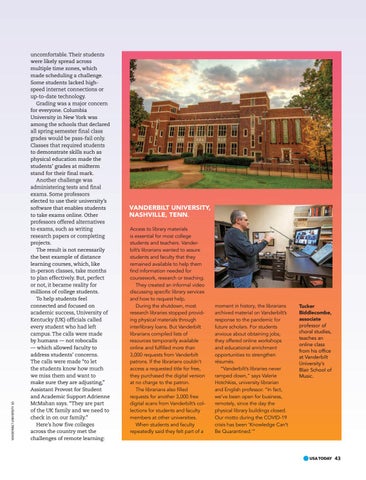
VANDERBILT UNIVERSITY, NASHVILLE, TENN. Access to library materials is essential for most college students and teachers. Vanderbilt’s librarians wanted to assure students and faculty that they remained available to help them find information needed for coursework, research or teaching. They created an informal video discussing specific library services and how to request help. During the shutdown, most research libraries stopped providing physical materials through interlibrary loans. But Vanderbilt librarians compiled lists of resources temporarily available online and fulfilled more than 3,000 requests from Vanderbilt patrons. If the librarians couldn’t access a requested title for free, they purchased the digital version at no charge to the patron. The librarians also filled requests for another 3,000 free digital scans from Vanderbilt’s collections for students and faculty members at other universities. When students and faculty repeatedly said they felt part of a
moment in history, the librarians archived material on Vanderbilt’s response to the pandemic for future scholars. For students anxious about obtaining jobs, they offered online workshops and educational enrichment opportunities to strengthen résumés. “Vanderbilt’s libraries never ramped down,” says Valerie Hotchkiss, university librarian and English professor. “In fact, we’ve been open for business, remotely, since the day the physical library buildings closed. Our motto during the COVID-19 crisis has been ‘Knowledge Can’t Be Quarantined.’”
Tucker Biddlecombe, associate professor of choral studies, teaches an online class from his office at Vanderbilt University’s Blair School of Music.
43