up front | health
34 BACK TO SCHOOL | 2020
date information and medications. WHEN TO STAY HOME Knowing when to keep your child home from school is likely to be more difficult this year, as the flu season kicks into gear along with the possibility of a second wave of COVID-19 infections. As a general rule, students are required to be fever-free for 24 hours without medication before returning to class. “I would encourage families, especially in this transition time, to err on the side of caution,” and keep your child home if you’re not confident they’re well, Gray says. “And, certainly if their child has had any direct exposure to someone with COVID-19, then (keep) them home for that twoweek period to monitor.” She says she’s hopeful that schools will make arrangements for kids who are quarantining to have the option to join classes virtually. SETTING EXPECTATIONS Beers and Gray note that there will be some anxiety on the part of teachers, administrators, parents and kids once schools reopen, and that it will be important to set kids’ expectations so they understand things may be different in the fall — and that schools may need to temporarily close again. “Helping them know what they can do to help keep themselves healthy is going to be the piece that gives them a sense of control,” Gray says. l
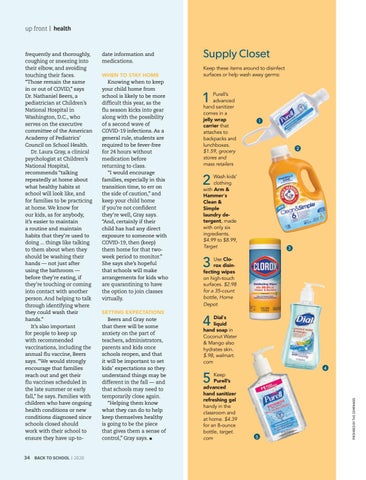
Supply Closet Keep these items around to disinfect surfaces or help wash away germs:
1
Purell’s advanced hand sanitizer comes in a jelly wrap carrier that attaches to backpacks and lunchboxes. $1.59, grocery stores and mass retailers
1
2
2
Wash kids’ clothing with Arm & Hammer’s Clean & Simple laundry detergent, made with only six ingredients. $4.99 to $8.99, Target
3
3
Use Clorox disinfecting wipes on high-touch surfaces. $2.98 for a 35-count bottle, Home Depot
4
Dial’s liquid hand soap in Coconut Water & Mango also hydrates skin. $.98, walmart. com 4
5
Keep Purell’s advanced hand sanitizer refreshing gel handy in the classroom and at home. $4.39 for an 8-ounce bottle, target. com
5
PROVIDED BY THE COMPANIES
frequently and thoroughly, coughing or sneezing into their elbow, and avoiding touching their faces. “Those remain the same in or out of COVID,” says Dr. Nathaniel Beers, a pediatrician at Children’s National Hospital in Washington, D.C., who serves on the executive committee of the American Academy of Pediatrics’ Council on School Health. Dr. Laura Gray, a clinical psychologist at Children’s National Hospital, recommends “talking repeatedly at home about what healthy habits at school will look like, and for families to be practicing at home. We know for our kids, as for anybody, it’s easier to maintain a routine and maintain habits that they’re used to doing ... things like talking to them about when they should be washing their hands — not just after using the bathroom — before they’re eating, if they’re touching or coming into contact with another person. And helping to talk through identifying where they could wash their hands.” It’s also important for people to keep up with recommended vaccinations, including the annual flu vaccine, Beers says. “We would strongly encourage that families reach out and get their flu vaccines scheduled in the late summer or early fall,” he says. Families with children who have ongoing health conditions or new conditions diagnosed since schools closed should work with their school to ensure they have up-to-