middle school
White’s journey into engineering mirrors the experience of many girls who aren’t naturally drawn to the subject — or who don’t think they’d be good at it. That’s starting to change, according to the results of a national engineering exam released in April. Across the country, eighth-grade girls outperformed boys, even though girls reported taking fewer engineering classes than boys, according to the results of the 2018 National Assessment of Educational Progress’ (NAEP) Technology and Engineering Literacy exam. “The girls have done extremely well in this assessment,” says Peggy Carr, associate commissioner for the assessments division at the National Center for Education Statistics. “Girls are outperforming boys whether they take a class or not, and when girls take a course, they also score higher.” NAEP, also known as the Nation’s Report Card, measures students’ reading and math knowledge. It launched an engineering literacy exam in 2014 to assess how well middleschoolers could apply engineering concepts to everyday life. Tasks on the exam ask them to think through problems, such as how to build a bike path or how to design a museum exhibit about Chicago’s water pollution in the 1800s. The exam was given to a sample of 15,400 eighth-grade students in 600
Girls outscored boys on a national engineering test, even though only
53% of girls
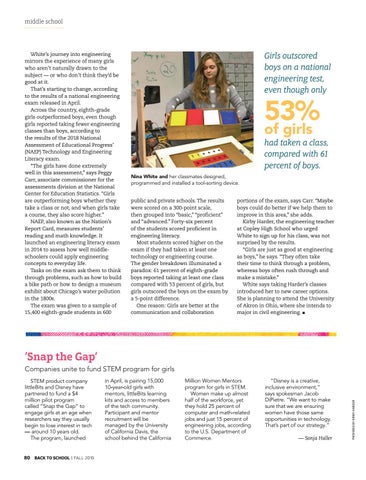
had taken a class, compared with 61 percent of boys. Nina White and her classmates designed, programmed and installed a tool-sorting device. public and private schools. The results were scored on a 300-point scale, then grouped into “basic,” “proficient” and “advanced.” Forty-six percent of the students scored proficient in engineering literacy. Most students scored higher on the exam if they had taken at least one technology or engineering course. The gender breakdown illuminated a paradox: 61 percent of eighth-grade boys reported taking at least one class compared with 53 percent of girls, but girls outscored the boys on the exam by a 5-point difference. One reason: Girls are better at the communication and collaboration
portions of the exam, says Carr. “Maybe boys could do better if we help them to improve in this area,” she adds. Kirby Harder, the engineering teacher at Copley High School who urged White to sign up for his class, was not surprised by the results. “Girls are just as good at engineering as boys,” he says. “They often take their time to think through a problem, whereas boys often rush through and make a mistake.” White says taking Harder’s classes introduced her to new career options. She is planning to attend the University of Akron in Ohio, where she intends to major in civil engineering. l
’Snap the Gap’ STEM product company littleBits and Disney have partnered to fund a $4 million pilot program called “Snap the Gap” to engage girls at an age when researchers say they usually begin to lose interest in tech — around 10 years old. The program, launched 80 BACK TO SCHOOL | FALL 2019
in April, is pairing 15,000 10-year-old girls with mentors, littleBits learning kits and access to members of the tech community. Participant and mentor recruitment will be managed by the University of California Davis, the school behind the California
Million Women Mentors program for girls in STEM. Women make up almost half of the workforce, yet they hold 25 percent of computer and math-related jobs and just 15 percent of engineering jobs, according to the U.S. Department of Commerce.
“Disney is a creative, inclusive environment,” says spokesman Jacob DiPietre. “We want to make sure that we are ensuring women have those same opportunities in technology. That’s part of our strategy.” — Sonja Haller
PROVIDED BY KIRBY HARDER
Companies unite to fund STEM program for girls