BOYS & GIRLS CLUBS INVEST IN TEENS’ JOB SKILLS
BACKtoSCHOOL FALL 2019
TECH LEADS THE WAY SUPPLY TRENDS FOR SCHOOL YEAR DOES HOMEWORK REALLY WORK? RAISING BETTER BOYS HEALTHY FOOD & SNACKS
it’s more than a bag
it's your hanging helper available at
Š2019 S.C. Johnson & Son, Inc. All Rights Reserved. 300221885
FALL 2019
46
HIGH NOTES Experts explain the benefits of music lessons
GETTY IMAGES
FEATURES Ready to Work 40 The Boys & Girls Clubs of America trains teens for employment
54
Bullied or Bullying No matter your child’s role, here’s how to help
58
Other Options Consider these questions when deciding posthigh school plans 3
FALL 2019
78
DEPARTMENTS Elementary 66
Educators question the worth of homework
68
The pros and cons of postponing kindergarten
Middle School
UP FRONT Products 10
Learn another language with these programs
12
Get the right tools to excel in school
72
Is your child ready to stay home alone?
74
Raise boys to be upstanding men
78
Girls excel in engineering
82
Determine what style of tutoring will help your child
Style 16
20
These A+ fashions will take you to the head of the class Create the perfect study space for your student
High School 86
These teen innovators are building businesses
90
Digital friendships may lack real connections
Technology
Perfect Finish
22
Make the grade with these smart gadgets
96
24
Technology leads the way in the classroom
Spelling Bee crowns eight co-champions
Food 30
Fill lunchboxes with these healthy treats
32
Get healthy kids’ meals delivered right to your door
Advice 34 Determine the best bedtime for your children
Health 36
Schools manage resurgence of measles
32 All product prices and availability are subject to change.
4 BACK TO SCHOOL | FALL 2019
GETTY IMAGES; YUMBLE
ON THE COVER: Find everything you need for a successful school year in this issue. PHOTOGRAPH: Getty Images
FEATURED CONTRIBUTORS PREMIUM PUBLICATION EDITORIAL DIRECTOR Jeanette Barrett-Stokes jbstokes@usatoday.com
Freelance journalist Matt Alderton writes about business, science, technology, travel and culture — including gender politics, which he studied as a journalism student at Northwestern University and addresses again in “From Boys to Men” (page 74). “Boys and men are at a crossroads; to help them, I learned, we must replace expectations of conformity with expectations of character,” says Alderton, who lives in Chicago with his partner, Jeff, and their Boston terrier puppy, Lucy.
In reporting the feature on workplace readiness for teens, Mary Helen Berg discovered that programs such as those sponsored by the Boys & Girls Clubs of America (page 40), strive to teach teens skills — like punctuality and teamwork — that they don’t always learn in the classroom but will need on the job. Her sidebar about taking a gap year (page 58) was inspired by her son, who funded his own post-high school break and then returned home to attend college. He graduated this spring.
MANAGING EDITOR Michelle Washington mjwashington@usatoday.com CREATIVE DIRECTOR Jerald Council jcouncil@usatoday.com ISSUE EDITOR Tracy Scott Forson EDITORS Amy Sinatra Ayres Harry Lister Sara Schwartz Debbie Williams ISSUE DESIGNER Amira Martin DESIGNERS Hayleigh Corkey Debra Moore Gina Toole Saunders Lisa M. Zilka CONTRIBUTING WRITERS Matt Alderton, John Bacon, Edward C. Baig, Mary Helen Berg, Emily Eileen Carter, Marissa Cass, Rosalind Cummings-Yeates, Valerie Finholm, Quinn Kelley, Zoe King, Jennifer Mabry, Jayne O’Donnell, Jorge L. Ortiz, Shameika Rhymes, Erin Richards, Kristen A. Schmitt, Laura Adams Stiansen, Adam Stone, Suzanne Wright
ADVERTISING Patrick Burke | (703) 854-5914 pburke@usatoday.com
FACEBOOK Facebook.com/usatodaymags
6 BACK TO SCHOOL | FALL 2019
Jennifer Mabry has profiled many interesting people and places throughout her journalism career. In addition to USA TODAY, her work has appeared in AARP magazine, TV Guide and elsewhere. “I don’t have children, so reporting on the debate over homework (page 66) was a revelatory experience,” she says. “I was surprised to learn how passionate educators, parents and students are about this subject.”
TWITTER @USATODAYMAGS
INSTAGRAM @usatodaymags
ACCOUNT DIRECTOR Vanessa Salvo | (703) 854-6499 vsalvo@usatoday.com
FINANCE BILLING COORDINATOR Julie Marco This is a product of
Without limiting the rights under copyright reserved herein, no part of this publication may be reproduced, stored in or reproduced in a retrieval system, or transmitted, in any form, or by means electronic, mechanical, photocopying, recording or otherwise without the written consent of USA TODAY. The editors and publisher are not responsible for any unsolicited materials.
PRINTED IN THE USA
PROVIDED BY THE CONTRIBUTORS
Shameika Rhymes is a former TV news producer turned entertainment, lifestyle and culture writer. In addition to USA TODAY, she has written for multiple digital outlets and publications including Entertainment Tonight, Ebony, Insider, Shondaland and Vanity Fair. In this issue, Rhymes discovered how much goes into a parent’s decision to leave their child home alone for the first time (page 72).
ZERO SUGAR. ALL THE FLAVOR.
© 2019 Talking Rain Beverage Company, Inc. All rights reserved. 2019033215
Sparkling water with naturally sourced colors and flavors.
BACK TO SCHOOL
UP FRONT |
STYLE 16
|
TECH 22
|
FOOD 30
|
ADVICE 34
|
HEALTH 36
GETTY IMAGES
PRODUCTS 10
9
up front | products
Lost in n o i t a l s Tran h ages wit u g n la n r Lea sof t ware apps and N B Y Q U IN
K ELLE Y
one your ph to leave D E arin? E d n N ek or Ma YS YOU ish, Gre WHO SA n a n e p e S b k r to spea as neve behind guage h new lan a g in Learn fun. or more easier —
View videos and authentic television shows with Yabla. Starting at $12.95/ month, yabla.com
Fluenz simulates oneon-one tutoring sessions. Starting at $308/ full suite, fluenz.com
10 BACK TO SCHOOL | FALL 2019
Perfect your accent, retention and listening skills with Rocket Languages. Starting at $99.95 for lifetime online access, rocket languages. com
Earn points, race against the clock and level up with Duolingo, which teaches 11 language courses. Free, duolingo. com
Choose from more than 100 languages and sync your Transparent Language app with your tablet or other digital devices. Starting at $24.95/ month, trans parent.com
Study real-life topics at your own pace with Babbel. Starting at $44.70/6 months, amazon. com
Pimsleur integrates lessons, speaking challenges, digital flash cards and games for more than 50 languages. Starting at $19.95/ month for premium access, pimsleur. com
PROVIDED BY THE COMPANIES
immerse le. lets you p p a e y schedu n etta Sto ou are and on an id s o ro R d n e h A T ry S and whereve in the iO e-apps th n o yourself /m /mobil at $5.19 one.com Starting rosettast s, re o st app
A clean start is the beginning.
The #1 wipe for classrooms.* *Based on TeacherLists, the leading platform for K-12 school supply lists in the U.S. Keep out of reach of children.
Back-to-school bonus pack!
Š 2019 The Clorox Company
up front | products
4
2
3
1 14 5 15
6
13
16 17
7
9 10 8
These must-have supplies will help kids make the grade BY MARISSA CASS
1. Mackenzie Disney Pixar Toy Story backpack, $26.50 to $59.50, Pottery Barn Kids 2. Scribble Stuff writing essentials kit, $13.97, Walmart 3. Alpha Convoy 120 backpack, $69.99, ogio.com 4. Pilot G2 premium gel pens, $17.49, amazon.com 5. AI Seeing Double Unicorn 16-inch backpack, $19.99, Target 6. Student planner, $9.99, Target 7. USA Gold sharpened pencils, $1.99, Walmart 8. Yoobi standing pencil case, $5.99, target.com 9. Colored pencils, $12, draperjames.com 10. Pilot Frixion erasable gel pens, $19.81, amazon.com 11. Scribble Stuff felt tip pens, $14.10, Walmart 12. Yoobi Ice Pop pencil case, $6.99, yoobi.com 13. Mead Five-Star planner, $12.99, Target 14. Week-To-Week desk notepad, $10, bando.com 15. Scribble Stuff gel pens, $10.99, Walmart 16. Be Nice Have Fun Work Hard planner, $28, bando.com 17. Hey Y’all ballpoint pen and case, $25, draperjames.com
22 BACK MAG NAME XXXXXXXXXX 12 TO SCHOOL | FALL 2019
PHOTO STYLING: CREDIT AMIRA MARTIN; PHOTOGRAPHY: JERALD COUNCIL
11 12
School Tools
up front | products
Backpacks
1. Parkland’s Tello recycled backpack, $40, parklandmfg.com 2. Alpha Convoy 120 backpack, $69.99, ogio. com 3. Cat & Jack Olivet unicorn backpack, $22.99; lunch bag, $9.99, Target 4. Parkland Remy Skylar backpack, $50, parklandmfg.com 5. Jumpstreet backpack, $44.99, Target
Lunch Gear
1. EZ wipe lunchbox, $24.95, landsend.com 2. Ecolunchbox Seal Cup Trio, $32.99, ecolunchboxes.com 3. Parkland reusable Peachy Snack Bag Duo, $14.99, parklandmfg.com 4. Hey Y’all and Magnolia water bottles, $25 each, draperjames.com 5. Batman dual-compartment lunchbox by Thermos, $17.99, Macy’s
1. Yoobi’s mini highlighters, $6.99, Target 2. Rocketbook Everlast smart notebook and pen, $31.99, Staples 3. Pencil pouch, $9.95, Land’s End 4. Lilly Pulitzer 2019-2020 large agenda, $30, lillypulitzer.com 5. White Weekly dry-erase planner, $15, dormify.com
14 BACK TO SCHOOL | FALL 2019
PROVIDED BY THE COMPANIES
Extra Supplies
up front | style
s n o i h s a F Fine ok First-day lo
ve s they’ll lo
AT R A A M Y S IN IN G A N D B Y ZO E K
AY R E S
Pippa & Julie’s Vivian coral jumper. $35 to
$40, pippaandjulie.com
Cat & Jack boys’ peace sign graphic tee. $6, Target
Pippa & Julie’s Jaya Folkloric print romper. $50,
Boys’ Mini Series dinosaur-camouflage jogger pants. $28,
bloomingdales.com
pippaandjulie. com
$24.99 (available Sept. 9); straight carpenter jean,
$29.99; mid-top suede sneaker,
$29.99 (available Aug. 12), Old Navy 16 BACK TO SCHOOL | FALL 2019
Fairmount zipper lightup sneakers, $115; St. Laurent EZ Dots silver light-up sneakers, $108,
mypopshoes.com
PROVIDED BY THE COMPANIES
Boys’ pullover hoodie, $24.99; corduroy shirt,
U.S. Polo Assn.’s boys’ long-sleeve printed chambray woven shirt. $16.66 to
$20.79, amazon.com
Boys’ cargo pants.
$39.95, landsend.com
Bold Product name Cupcake bank by Melissa and Doug, $6.99 at melissaanddoug.com.
Girls’ leggings.
$22.95, landsend.com
Girls’ neckerchief, $9.99; Shaker Sweater Marl, $29.99; corduroy skirt, Trippy Dippy dress. $29.50,
volcom.com
Cat & Jack girls’ bomber jacket. $24.99, Target
$24.99 (sweater and skirt available Sept. 9); high-top sneakers, $29.99, Old Navy
17
up front | style
Vans sneakers.
$59.99, Kohl’s
Popsugar printed wrap dress. $60,
kohls.com
Converse Chuck Taylor All Star Shoreline slip-on sneakers. $49.99,
zappos.com
Vans checkerboard slip-on shoes. $50,
Arizona Brown Sugar loose-fit flex canvas jacket. $64,
vans.com
jcp.com
Mudd faded jean jacket. $54, Kohl’s
Lil Pair O Dice sneakers for girls.
$36, sanuk.com
Adidas sneakers.
Arizona Graphite navy slim tapered track pants.
$50, jcp.com
18 BACK TO SCHOOL | FALL 2019
Nike Classic Cortez sneakers.
$58.99 to $70, Nordstrom
Arizona camo nondenim ankle pants.
$49, jcp.com
Florsheim’s Navigator Jr. plain-toe Oxford shoes. $60,
florsheim.com
PROVIDED BY THE COMPANIES
$64.99, Kohl’s
up front | style
Study Room Create the perfect atmosphere for your teen to excel BY TRACY SCOTT FORSON
Room Essentials’ organizer task lamp illuminates any space and holds small supplies in its base. $14.99, target.com
MOTIVATION TO HIT THE books can be difficult to find. Make it easier with a comfortable space reserved for study time. Stimulate the mind with colorful supplies and designs that inspire.
Available in an assortment of colors, the Swingline Anywhere stapler helps students keep it all together. $4.59, target.com
Artori Design’s Book & Hero black metal bookend is a superb way to keep textbooks organized. $25.95, amazon.com
20 BACK TO SCHOOL | FALL 2019
This sticky memo notepad ball comes in a colorful array and a fun shape. $12, urbanoutfitters.com
The Pen to Paper mousepad serves double duty, functioning as a notepad, too. $12, urbanoutfitters.com
Teens will stay focused while poring over assignments with this Skålberg/Sporren swivel chair, available in several colors. $39.99, Ikea
PROVIDED BY THE COMPANIES
The Realspace Halton desk combines style and utility, featuring a sleek design and drawers for files and office supplies. $199.99, Office Depot
ONLY AT TARGET
®
up front | technology
Tech Time Give kids a jump-start with these smart gadgets BY QUINN KELLEY
WE’VE DONE THE HOMEWORK, and these products are sure to bring school-year success.
1
6
With activity tracking, music and notifications, the Fitbit Versa smartwatch does so much more than tell time. $179.95, fitbit.com/versa
1
2
Print projects wirelessly with the
HP Tango Smart Home Printer.
$149.99, amazon.com
2
3
The iPhone XR features a 6.1-inch liquid retina display and face ID. Starting at $749, apple.com
4
The LeapFrog
LeapPad Ultimate Ready for School tablet
5
adapts to more or less challenging levels to keep kids engaged. $89.99, target.com
5
4
3
6
The 10.5-inch
Samsung Galaxy Tab S4 offers a DeX
mode for a more PC-like experience. $647.99, amazon.com
22 BACK TO SCHOOL | FALL 2019
PROVIDED BY THE COMPANIES
The Google Pixel 3a takes beautiful photos in portrait mode and lets parents put time limits on apps or give kids bonus screen time. Starting at $399, store.google.com
up front | technology
Teaching With Tech Gadgets enhance classroom learning BY ADAM STONE
24 BACK TO SCHOOL | FALL 2019
86%
GETTY IMAGES
L
ynDel Randash sees assignments in just that firsthand the power area,” she explains. of technology in With technology nearly of parents say elementary education. As ubiquitous in most in-school computers a K-5 teacher at Roosevelt K-12 classrooms, some are helpful to their child’s education Charter Academy in educators are seeking Colorado Springs, Colo., sophisticated apps and she uses Microsoft software to enhance Word and PowerPoint their lessons. Others are SOURCE: MICROSOFT RESEARCH to help kids hone their considering how to best presentation skills. For students who are implement the powerful digital tools young struggling, she uses tools like Istation — richly learners value. animated, gamelike educational technology Of the 150 teenage girls who attended a — to customize her lessons. “If someone is recent PixelHacks conference in San Jose, having trouble with antonyms, they get an Calif., 70 percent say fluency with the tools of antonym assignment. I can look at the areas science and technology is important to their where they are having trouble and give them future careers. Parents concur: 86 percent >
Launch Your Creativity Aspire 5 Go to class in style — and with the power to take on all of your school projects with ease — with the Aspire 5 Laptop. This cool PC earns an A+ on every aspect of everyday computing! Housing an 8th Gen Intel® Core™ i3 Processor, the Aspire 5 lets your creativity soar to new heights with sharp, crisp visuals — showcased on a 15.6" Full HD IPS screen — while the thin bezel provides you more space to work with wherever inspiration strikes. It’s the perfect companion to take with you wherever you go!
• 8th Gen Intel® Core™ i3 Processor
• Windows 10 in S mode
• 15.6" Full HD IPS display
• Up to 9.5 hours of battery life*
* Battery life varies depending on product specifications, computer settings and applications or features. © 2019 Acer America Corporation. All rights reserved. Acer and the Acer logo are registered trademarks of Acer Inc. Other trademarks, registered trademarks, and/or service marks, indicated or otherwise, are the property of their respective owners. Intel, the Intel Logo, Intel Inside, Intel Core, and Core Inside are trademarks of Intel Corporation in the U.S. and/or other countries.
up front | technology
Teacher Shelby Horne uses technology to complement her lessons at Orchard View Elementary in Grand Rapids, Mich.
have learned, whether that’s a movie or a website they have published, an interactive e-book or a student portfolio.” In Texas’ Plano Independent School District, all students carry Chromebooks. Digital learning specialist Clara Alaniz encourages kids to express themselves using the video discussion platform Flipgrid. of classroom work is done By recording their answers to with paper and pencil questions, “Students can have SOURCE: NAZARENE UNIVERSITY ample time to think about their responses. They can delete their INSPIRING MINDS responses if they want to record again. That isn’t Today’s teachers don’t just use technology something you can do in a traditional classroom as a means to distribute information to kids. setting,” Alaniz says. “I am the parent of a child Increasingly, they are turning to digital devices as a who will never raise his hand in class, but if he can means for sparking creativity in the classroom. record and listen to himself before he submits his “We are seeing more conversation about the work, he will absolutely do that.” balance between content consumption and content As they leverage technology to expand students’ creation,” says Monica Burns, an educational learning, teachers also are making use of digital consultant and founder of Class Tech Tips. “It’s tools to make their own classroom time more about kids making something that shows what they effective. >
26 BACK TO SCHOOL | FALL 2019
42%
PROVIDED BY ORCHARD VIEW ELEMENTARY; GETTY IMAGES
say in-school computers are helpful to their child’s education, according to Microsoft’s research. In this pro-digital climate, technology has gained a firm foothold in elementary education. Today, less than half of classroom work — 42 percent — is done using paper and pencil, according to Nazarene University, which found that some 73 percent of teachers use tablets or laptops daily and 86 percent have Wi-Fi in their classrooms.
NEW
EXTRA LIFE EXTRA POWER * *
*Delivers extra life or extra power, vs. Coppertop AA/AAA in a wide range of devices.
WITH RESEALABLE PACKAGING
New at © 2019 Duracell Inc.
up front | technology
86%
28 BACK TO SCHOOL | FALL 2019
TOOLS FOR THE CLASSROOM
High-tech devices boost learning to new levels Laptops continue to rule as the digital device most used by teachers in classrooms, but when it comes to tablets, more instructors are turning to the iPad. Apple’s strength comes on the creative side, helped by a library of some 200,000 education and reference apps. Some of the most popular devices are those that place a digital, interactive spin on the classic chalkboard. Here are some useful gadgets and apps teachers recommend: uTeachers can use the iPad to enrich lessons with sound and motion, using a range of interactive tools to bring added dimensions to classroom learning. Starting at $299 for those who qualify for an education discount; $329 for others, apple.com uTurn your Apple device into a teaching tool with the DBPower projector that shares digital content from your iPhone and iPad. $60, amazon.com uA powerful teaching aid, the Socrates Learning Platform guides students through thousands of educational topics with individual learning paths to meet specific student needs. Classroom summer school edition $39.99, withsocrates.com uThe interactive Promethean Board acts as an oversized digital computer screen that allows students to create and manage images, lead online explorations or collaborate on visual projects. Starting at $1,000, prometheanworld.com uMicroduino, small electronic building blocks, empower kids to assemble robots, solve problems and explore imaginatively. Starting at $89, microduinoinc.com — Adam Stone and Edward C. Baig
GETTY IMAGES
‘REPLICATING HERSELF’ use to simulate arguing a With digital video case before the Supreme recording, storage and Court or running their own playback readily available, presidential campaign. some teachers have taken On the cutting-edge, to videotaping their lessons some schools are in advance. How are implementing virtual recordings a better option reality software as a way to than talking to the kids? take students places they “It’s about using the could never go, or to show teacher’s time differently,” them things they could says Renée Laverdière, a never see in a conventional principal in the education classroom. practice of The Boston “Students in a biology Consulting Group. “She classroom cannot ‘see’ can pause the inside the playback of a cell,” to offer says Jennie additional Lynn Roy, a explanation technology to a student, integration while others specialist at continue the Windham watching. School She’s District essentially in New of teachers replicating Hampshire. have Wi-Fi in their herself. This But when classrooms is pretty a teacher SOURCE: NAZARENE UNIVERSITY simple leads a technology, virtual reality but you can use it to expedition into the cell, augment humans in “it can transform their powerful ways.” usually one-dimensional Technology also can interactions with cell deliver educational organelles into a close-up materials in a more experience.” customized manner. Advocates for classroom Laverdière points to technology say these Reading Plus, a tool that tools don’t replace the tracks a reader’s eye teacher. Rather, they create movements. “If students a learning partnership are getting hung up in between teacher and certain places, this helps student, says Shelby Horne, them to follow the words in a sixth-grade teacher at order to make their reading Orchard View Elementary more efficient,” she says. in Grand Rapids, Mich. Other tools may help “When we release with “social-emotional” ourselves from the model learning, a term for soft of expecting the classroom skills such as creativity, teacher to be the ultimate persistence and expert, we are joining collaboration. For example, alongside our students and Laverdière mentions modeling for them what iCivics, a role-playing curiosity and learning look product students can like in action,” she says. l
PICTURE DAY IS COMING Find your Picture Day at MyLifetouch.com
Join to receive exclusive offers and more when you order online!
Don’t miss a year, capture every missing tooth and every milestone K–12. #LifetouchPictureDay |
| MyLifetouch.com ©2019 Lifetouch, Inc. All Rights Reserved.
up front | food
Grab-and-Go Goodies Stock kids’ lunchboxes with scrumptious snacks BY MARISSA CASS
THESE YUMMY OPTIONS ARE great for busy families and will keep kids happy and full.
The Nutty Best Sellers variety pack features to-go packs of almonds, cashews and pistachios. $31.99 for 24 packs, nuts.com
Yoyos Fruit Rolls by Bear are made with real fruit and are not genetically modified. $4.99 for five rolls, freshdirect.com Earth’s Best Organic Sesame Street Toddler Crunchin’ Grahams are a yummy honey flavor and are USDA Certified Organic. $22.68 for a pack of six, amazon.com
Containing only two ingredients, Cherry Apple Fruit Bites by Kind provide a full serving of fruit in each pouch. $20.34 for a box of 20 pouches, kindsnacks.com
A portable version of the chocolate-hazelnut spread that everyone loves, Nutella & Go! $16.99 for a pack of 12, jet.com
Clif Bar’s Clif Kid Organic ZBar is a delicious iced oatmeal cookie made from whole grains. $11.29 for 18 bars, walmart.com
GETTY IMAGES; PROVIDED BY THE COMPANIES
Keebler’s Paw Patrol Grahams are crispy, crunchy, made with whole grains and come in 12pack boxes. $4.99, target.com
up front | food
Chicken pops with baked carrot fries
Breakfast enchilada with black beans and roasted potatoes
Ground beef and veggie sauce over gluten-free rotini pasta
Bean-a-rito with sweet potato mash
Easy Entrees Subscription boxes deliver healthy lunches for kids
A
fter one too many conversations with other moms about how frustrating and difficult it was to prepare healthy meals for their kids every day, Joanna Parker came up with the idea for Yumble, a subscription service that delivers seasonal, local and, when possible, organic kid-friendly meals to your doorstep — no cooking required. Yumble currently serves most of the East Coast and the Midwest.
32 BACK TO SCHOOL | FALL 2019
Options include chicken pops with baked carrot fries, enchiladas and 24 other weekly meals to choose from on the menu, which rotates constantly. “The first recipes were created and tested in my home kitchen on my three children,” Parker says. “I like to describe our recipes as having what I call Yumble DNA — meaning they are made from wholesome, real ingredients so parents can feel proud serving them.”
YUMBLE
BY LAURA ADAMS STIANSEN
lunch break These companies remove “preparing lunch” from your to-do list. Delivering healthy eats directly to homes, these subscription box services offer moms and dads a lunch break: NURTURE LIFE
Co-founder Jennifer Chow wants her Chicago-based company to do exactly as its name suggests. Prioritizing organic and locally sourced ingredients, menu options include chicken meatballs with pasta and veggies, and mac ‘n’ cheese with cauliflower. Starting at $10.40 for five meals for ages 4-8; $12.40 for 14 and older, nurturelife.com
BOX’D EATS
Use Your Noodle and the Hail, Caesar Wrap sandwich are just two options that CEO Rachel Ball offers with this Washington, D.C.-based lunch delivery service. Parents can have these creatively named meals — along with “garnish” notes of encouragement — delivered three times a week. $6.99 per meal, boxdeats.com
PROVIDED BY THE COMPANIES
RED APPLE
Boston-area parents can order healthy salads, sandwiches, pasta dishes and more delivered to their homes. Founder Lisa Farrell promotes healthy, balanced eating, according to the company’s website. Lunches offer a main entree and your choice of fruit, veggie and treat. $7 for small meals; $9 for large meals, redapplelunch.com
33
Bedtime Benefits Adjust your child’s schedule before heading back to school BY VALERIE FINHOLM
A
ttention, parents: It’s 8 p.m. Do you know where your children are? If they’re not in bed, you may be overlooking one of the most important things you can do to prepare your kids for school. In the summer, bedtimes can become more fluid, with youngsters staying up later and later. But before school starts, it’s important to establish a bedtime routine that will ensure they get proper rest to prepare them for busy days. Researchers have found that kids need more sleep than adults — lots more — to support their growth and development. The American Academy of Sleep Medicine recommends that preschoolers get 10 to 13 hours of sleep a day, gradeschoolers get nine to 12 hours and teens sleep eight to 10 hours. Kids who don’t get enough sleep — even an hour or so less than recommended — may have trouble paying attention, sitting still or keeping their emotions in check at school, says sleep psychologist Lisa J. Meltzer, an associate professor of pediatrics at National Jewish Health in Denver. “Sleep is just as critical as diet and exercise,” says Meltzer. “We need to make sleep a priority, and often it’s not.” CAUSE FOR ALARM “Twenty years ago, people went to bed earlier,” says Marc Weissbluth, professor emeritus of clinical pediatrics at Feinberg School of Medicine at Northwestern University in Chicago. Yesteryear’s children also spent more time napping. There are many reasons for this,
34 BACK TO SCHOOL | FALL 2019
including naps cut short in day care on/off switches, but our brains have and working parents who postpone dimmer switches. So, it takes quite a bedtime to spend time with their while for our brains to shut down at children, says Weissbluth, author night,” Meltzer says. of Healthy Sleep Habits, Happy Child. Weissbluth says waiting until Another culprit: Many parents are the first day of school to alter sleep sleep-deprived themselves — getting patterns can leave children in a daze by on six or seven hours a night — for the first few weeks. So, don’t wait and don’t recognize the condition in until the night before school starts to their children. Research shows that adjust your child’s bedtime. Instead, regular sleep deprivation has serious gradually shift bedtime, putting your — and lasting — side effects for kids, kids to bed 15 minutes earlier each including behavioral problems, weight night, starting about two weeks before gain, hypertension, headaches and school starts, Meltzer says. With nine depression. to 12 hours needed for grade school In a study published in 2017 in students, that translates to a bedtime Academic Pediatrics, of about 7:30 or 8 parents and p.m., if children need teachers reported to be up around 6 or more problems 6:30 a.m. with 7-year-olds For grade school who didn’t get kids and younger, enough sleep a popular bedtime during their routine is a bath TOO TIRED toddler and followed by a Signs that a child isn’t preschool years, story. For older getting enough sleep, compared with children, the according to sleep those who got an American Academy psychologist Lisa J. age-appropriate of Pediatrics Meltzer, include: amount of sleep recommends that during those years. all screens be turned uFalling asleep at Insufficient sleep off at least one hour school was defined as before bedtime so less than 12 hours teens have time to uSnoozing during short trips in the car during infancy, less wind down. than 11 hours for Be aware that uFatigue during 3- and 4-year-olds sleep habits shift evening homework and less than 10 during puberty, so time hours for 5- to it’s natural for teens 7-year-olds. to stay up later. A uIrritability The study short after-school found that the nap can help sleep-deprived teens work more kids struggled with emotional control, efficiently, according to the National paying attention and making friends. Sleep Foundation. Also, they should Other research has linked poor sleep steer clear of caffeine-infused drinks and attention deficit hyperactivity late in the day. disorder. Establishing a good sleep routine early will pay off in the future. “When WINDING DOWN children very young get the sleep they Kids need to wind down before they need, it helps them for the rest of their sleep, so it’s important to establish lives because they know how it feels a sleep ritual. “Our technology has to be well-rested,” Weissbluth says.
GETTY IMAGES; ILLUSTRATIONS: AMIRA MARTIN
up front | advice
up front | finances
Recommended Sleep for Children In addition to the American Academy of Sleep Medicine’s guidelines for children of different age groups, the American Academy of Pediatrics suggests that all screens be turned off at least 60 minutes before bedtime and that TV, computers and other screens not be allowed in kids’ bedrooms.
GRADE SCHOOLERS 6 to 12 years 9-12 HRS
TODDLERS
1 to 2 years 11-14 HRS
TEENAGERS
(including naps)
13 to 18 years 8-10 HRS
PRESCHOOLERS
PHOTO CREDIT
INFANTS
3 to 5 years 10-13 HRS
4 to 12 months 12-16 HRS (including naps)
359
up front | health
Contagious Comeback Measles cases continue to climb as ‘eliminated’ disease spreads
P
arents may now have more to worry about when sending kids back to school. The resurgence of measles, which has been reported in 26 states this year, continues to affect more Americans. The majority of cases remain in New York City and its suburbs, including Rockland County, where in April unvaccinated minors were barred from public places for 30 days. In Washington state, where nearly 80 incidents have been reported, Gov. Jay Inslee declared a state of emergency through May 25 and signed a bill ending personal or philosophical measles vaccine exemptions for most
36 BACK TO SCHOOL | FALL 2019
parents whose kids will attend day care centers or schools. Although the Centers for Disease Control and Prevention considered the disease eliminated in 2000, there have been more than 1,000 cases reported this year (as of June 13, 2019). That’s the largest annual total since more than 950 cases were reported in 1994. Measles is making a comeback, in part, because of a movement against vaccinations in the U.S. “A critical number of parents have chosen not to vaccinate their children,” says Paul Offit, director of the Vaccine Education Center at Children’s Hospital of Philadelphia. “If you get to a few
thousand cases, you’ll start to see children die of measles again.” Some vaccine opponents worry that the mumps, measles and rubella (MMR) vaccine causes autism. However, studies continue to disprove any link. Before the vaccine (which is sometimes combined with varicella, which protects against chickenpox) became available in the U.S. in 1963, about 450 to 500 people died from measles each year. By 2010, that number was down to 63. The two-dose MMR vaccine is 97 percent effective against the virus, according to the CDC. “The suffering we are seeing is avoidable,” says Secretary of Health >
GETTY IMAGES
BY JOHN BACON AND JORGE L. ORTIZ
NE W
®
KILLS 99.9% OF FINALLY, A MOPPING CLOTH THAT
GERMS
*
Fits Swiffer® Sweeper
*On hard, non-porous surfaces. Use as directed. Keep out of reach of children. Swiffer® Sweeper is a registered trademark of the Procter & Gamble Company.
Try more Clorox® Scentiva® Pacific Breeze & Coconut products today
up front | health
and Human Services Alex Azar. “Vaccines are a safe, highly effective public health solution that can prevent this disease.” Experts also believe the increase is a result of decreased awareness. Some have forgotten the devastation the disease once caused. “When I was growing up, everybody got measles — and some people died,” recalls Michael Gochfeld, professor emeritus at Rutgers University’s Environmental and Occupational Health Sciences Institute. As for polio, “It was lurking at your doorstep — you didn’t go out in the summer.” Measles, ranked among the most contagious diseases in the world, is known for its itchy rash; however, it is actually a respiratory disease. Cough, runny nose, sore throat, red eyes and high fever are among the other symptoms. While the increased number of measles cases has recently received lots of attention, it’s not the only disease making an unwanted comeback. Mumps and pertussis (whooping cough) have been on the rise in recent years, and the previously devastating tuberculosis is still causing trouble, though not at the rate it once did. “It’s pretty incredible because even in the late 1960s, early 1970s, we were having so much success in coming up with new vaccines, new drug treatments, that we really felt like infectious diseases were going to be something we had beaten,” says Judd Hultquist, assistant professor of infectious diseases at Northwestern University’s Feinberg School of Medicine. “Yet, here we are 50 years later, and they’re making a comeback.” l — Lindy Washburn of the North Jersey Record contributed to this article.
Reported measles cases in the U.S. this year
1,044
(as of June 13, 2019) 667
63
187
Judd Hultquist, an infectious diseases expert at Northwestern University, and Paul Offit of the Vaccine Education Center at Philadelphia’s Children’s Hospital, identify the signs, statistics and potential solutions for some troubling illnesses that won’t go away: MEASLES
Symptoms: small white spots inside the mouth, facial rash that starts at the hairline and spreads, fever What to know: There’s no cure for measles, although some medications may alleviate the symptoms. Measles crisis: Last year’s 372 U.S. cases were the secondhighest total in more than two decades, and this year’s pace could easily yield more than 1,000 cases. Recommendation: prevention through the MMR (measles, mumps, rubella) vaccine that can only be administered to children from 12 months through 12 years of age MUMPS
372 220
Bug Off!
188
55
86
120
‘10 ‘11 ‘12 ‘13 ‘14 ‘15 ‘16 ‘17 ‘18 ‘19 SOURCE: Centers for Disease Control and Prevention
38 BACK TO SCHOOL | FALL 2019
USA TODAY
Symptoms: puffy cheeks, fever, headaches, muscle aches What to know: Mumps outbreaks are likely related to its vaccine’s immunity diminishing after 10 years, even
with a booster shot. Mumps crisis: Mumps has never been eradicated in the United States, but the yearly average of 186,000 cases when the vaccine was introduced in 1967 fell to a few hundred in the 1990s. Recommendations: a third booster shot for those in outbreak settings, which may become standard practice for older teens PERTUSSIS
Symptoms: violent coughing that impairs breathing and can be fatal for babies younger than 1 year old What to know: Administered with immunization for diphtheria and tetanus, the vaccine is now known as DTaP (diphtheria, tetanus and pertussis). Pertussis crisis: Before the vaccines introduction in the mid-1940s, the annual number
of cases nationally sometimes topped 200,000, with thousands of children dying. Recommendations: vaccination for all babies and children, preteens and teens, pregnant women and adults who have never received a dose of Tdap (tetanus, diphtheria and pertussis) TUBERCULOSIS
Symptoms: cough, chest pain What to know: TB typically affects the lungs but can also harm the brain, spine and kidneys. The disease is especially dangerous for people with a compromised immune system. TB crisis: Despite advances in treatment, tuberculosis hasn’t been eradicated — and likely won’t be for a while. Recommendations: one of several treatment options available for latent TB infection; several medications for TB disease
Advertisment
A Hero’s Story: How a Student Saved a Life with a Simple Swab
F
or high school students, junior year can be one of the most important and informative of their high school experience. They are taking their SATs, beginning to take electives, and generally preparing themselves for life in a world outside of the straightforward path of secondary education. For many students it is a time to explore their interests and contemplate how they want to make an impact on society. For Stanley Reynolds however, there was one unique qualifier to his resume that made him stand distinctly apart from his peers: lifesaver. In the spring of 2014 Stanley, then a junior at Rockhurst High School, saw what he believed to be a blood drive being held at his school and decided to stop by. He was told that, in addition to the blood drive they were also registering potential bone marrow donors with DKMS, an international nonprofit. Knowing little about the process, other than that it was incredibly rare to match a patient, Stanley decided to join in the off chance that he could potentially help someone in need. A year later Stanley’s decision had faded in his mind and he was focused on his upcoming graduation and going to the state championship with his school’s lacrosse team…until he received a call from DKMS. “I really have no memory of when I got the call but I remember being surprised as well as thinking how cool it was I was matched,” says Stanley. “I felt special that I was matched with someone else over the hundred of thousands of options.”
Learn more about our highschool program: dkms.org/highschool
It was and still is one of my proudest accomplishments and is on my resume. It is painless and DKMS coordinates the entire process so it’s stress free. There’s really no reason not to do it. -STANLEY, bone marrow donor
Stanley knew little about his recipient, other than the fact that he was a man in his 40’s with a rare blood disorder. That and the fact that Stanley was his only match and his best chance at life. Despite originally fearing that donation would be a painful and scary experience, Stanley found the reality to be surprisingly simple. “Completely inconsequential,” Stanley remarked. “I had brought my laptop and watched some movies. Fell asleep several times.” For Stanley, a seemingly small decision to register with DKMS at his high school in 2014 led to a man receiving a life-saving transplant a year later. Stanley is currently studying for his undergraduate’s degree and quite a bit busier than he was in high school, but when asked if he would donate again he replied yes without hesitation. “This is the potential to save a life,” Stanley pointed out. “How many chances like that do you get?
With the knowledge that young donors provide the highest chance of success for a transplant, the DKMS high school program is rallying students from around the country to register and turn a small moment in their lives into a lifetime for patients in need.
Story from Boys & Girls Clubs of America
LIFE SKILLS IN STORE Boys & Girls Clubs partners with retailers for youth job-training
Skills Teens Need The Department of Education outlines three categories of skills young people should master to become workforce ready:
40 BACK TO SCHOOL | FALL 2019
Interpersonal skills such as the ability to communicate, collaborate, resolve conflicts, respect differences and work Effective independently are important, as Relationship is a positive attitude. Flexibility, initiative and self-discipline are Skills also essential qualities.
PHOTO CREDIT
BY MARY HELEN BERG
osiah Mattox always had drive. Growing up in Cleveland, where violent crime rates are the highest in Ohio, the threat of following in the path of others who were unable to overcome similar trappings inspired him to work diligently. However, in order to become a success, Josiah believed he’d need more than the savvy that helpd him navigate his neighborhood. He’d also need soft skills like thinking critically and communicating clearly. That is one reason Josiah, 15, connected with the Boys & Girls Clubs of Cleveland. The Boys & Girls Clubs of America (BGCA), one of the oldest and largest afterschool organizations in the country, helps members as young as 6 years old develop those sometimes difficult-to-measure “soft” skills, says president and CEO Jim Clark. Serving more than 4 million young people nationwide, the nonprofit prepares members for academic and career paths and builds workplace readiness into all of its programs. Soft skills also include the ability to collaborate and work independently, and are valued highly by employers, according to the 2019 Job Outlook survey published by the National Association of Colleges and Employers.
PHOTO CREDIT GETTY IMAGES; PROVIDED BY OLD NAVY
J
Young job applicants need to be able to manage time, money and resources; to find, organize and analyze information; to Workplace communicate in written or oral presentations; to perform as Skills part of a team and be able to work with digital technology.
AFTER-SCHOOL INFLUENCE Some teens pick up informal pointers on soft skills at home or at school, but students who attend after-school programs consistently engage in activities that promote these skills, says Jodi Grant, executive director of the Afterschool Alliance, a nonprofit advocacy group. Importantly, these programs encourage today’s teens, a generation often tethered to computer and mobile screens, to practice interpersonal relations, a critical skill in the workplace. “The No. 1 thing afterschool offers is human interaction,” Grant says. “There’s a whole host of skills that create the infrastructure you need for success in life, school and at the higher levels in the workforce, and this is what after-school (programming) does best.” At BGCA, programs such as Junior Staff and Career Launch encourage teens to practice leadership, teamwork and other soft skills that they can transfer to the workplace. Then, BGCA partners with other nonprofits and businesses to provide opportunities for members to practice these skills in the real world. “One of the biggest challenges facing our nation is the lack of a skilled and >
Applied Academic Skills
Reading, writing, math and science skills are indispensable, and job seekers should be able to organize, reason and problem solve, as well as think critically and creatively.
41
ready workforce,” Clark says. “We know that more than half of U.S. employers say that their biggest obstacle to growth is a lack of qualified candidates with soft skills. And more than 75 percent of youth express concerns about whether they have the skills necessary to secure a job.”
EFFECTIVE PARTNERSHIP In 2017, BGCA partnered with the retailer Gap Inc. for This Way Ahead, a program to train, mentor and hire youth ages 16-24 for first-time jobs at the company’s stores. The program is meant to give “young people — especially those facing barriers to employment — an opportunity for a first job,” according to David Ard, senior vice president for Gap Inc.
42 BACK TO SCHOOL | FALL 2019
“A first job is an important milestone in every person’s life,” Ard said in testimony to the U.S. Ways and Means Committee last year. “For many young people, especially those with limited opportunities, it can be life-changing and shape an individual’s prospects for the future.” The company plans to hire 5 percent of all new entrylevel store employees from the program by 2025. To be eligible for This Way Ahead, BGCA members must first complete club workforce development programs, where they learn about interpersonal skills, work ethic, customer service, career options and financial literacy, says Terri Fishback, BGCA senior director of youth development strategy. Club mentors collaborate with
PROVIDED BY OLD NAVY
back of book header
back of book header
By 2020, Gap Inc. expects 10,000 teens and young adults will have participated in This Way Ahead.
representatives from area Gap, Old Navy, Banana Republic or Athleta stores to guide interested teens through the application and interview processes for an entry-level job, says Tory Coats, director of career readiness for Boys & Girls Clubs of Cleveland. “We talk to teens about career readiness, soft skills, leadership and career research, website tools and how to best interview,” says Coats. Before applying, teens may tour a store, meet with a manager and attend workshops on topics that cover conflict resolution and customer service. Teens who land jobs are paired with a mentor at the store and a job coach at the club to advise them and follow their progress. Coats worked with Josiah, offering
interview coaching and helping him prepare his resume. “Mr. Tory really made it sound really professional,” says Josiah, who secured a job at Old Navy. “I could probably get any job.”
THE VALUE OF SOFT SKILLS Over the long term, teens who learn soft skills could see a payoff in better opportunities and higher wages, according to Pew Research Center. Jobs demanding strong social skills grew by 83 percent between 1980 and 2015, and jobs requiring computer skills and critical thinking increased 77 percent. Wages for those jobs increased by $4 an hour, up to $27 between 1990 and 2015, while jobs requiring physical skills increased by only $2 to >
43
$18 hourly. “We are not witnessing an end to the importance of cognitive skills; rather, strong cognitive skills are increasingly a necessary — but not a sufficient — condition for obtaining a good, high-paying job,” according to David J. Deming, a research associate for the National Bureau of Economic Research. “You also need to have social skills.” There’s simply no “machine substitute” for good old-fashioned social interaction, Deming adds. Bruce Tulgan, author of Bridging the Soft Skills Gap: How to Teach the Missing Basics to Today’s Young Talent, agrees. “The cliché is you get hired for your hard skills, but you get fired for your lack of soft skills,” he says. “People who show up excelling in these skills set themselves apart as peer leaders and as people who can handle more responsibility. It’s a huge advantage at a whole lot of levels.” The support and training pay off, says Brian Quail, president and CEO of Boys & Girls Clubs of Broward County in North Lauderdale, Fla. “Our partners are telling us that when they hire a youth from Boys & Girls
1 The Torch Club builds character and leadership skills through volunteer opportunities for tweens. Old Navy supports Torch Club, provides volunteers and sponsors an annual fund drive.
ONward! is Old Navy’s three-prong effort to support community nonprofits by providing opportunities for youth to build leadership and workplace skills. It includes:
2 O.N. the Job has introduced 90,000 tweens and teens to retail careers through workshops and a hands-on opportunity to shadow an Old Navy store associate for a half day.
3 This Way Ahead, a Gap Inc. program for youth ages 16 to 24, provides first jobs at affiliated stores. The company plans to expand the program to 60 cities globally by 2020.
GETTY IMAGES; PROVIDED BY BRIANNA CORNELIUS
Steps To Success
Clubs, they’re head and shoulders above the general population that they’re hiring,” Quail says. “They have the soft skills; they have the knowledge and know where they want to go.” Brianna Cornelius, 18, of Coral Springs, Fla., says the This Way Ahead initiative gave her the tools she needs to succeed on the sales floor at Old Navy, where she became a sales associate in 2018. “Our goal is that every teen that comes to the Boys & Girls Clubs has some Brianna Cornelius exposure in careers, whether it’s from a guest speaker or attending one of our workshops with a basic introduction to careers,” Coats says. “It was an answer to my prayers,” says Josiah, who used to believe that playing in the NBA was one of his few career options. “I’m looking at things in a whole other way now.” l
Focus on the stocks that matter to you.
Download our free app. My Topics lets you choose the news you want to know about, when you want to know about it.
46 BACK TO SCHOOL | FALL 2019
g n i t t i H the Right s e t o N
Introducing your kids to music has a bevy of benefits BY SARA SCHWARTZ
slew of instruments spread on a table in front of him, then fourth-grader Anthony McGill quickly gravitated toward the saxophone, picking it up and testing the keys. There was just one problem. “It was too big,” he says, laughing. “So I picked the clarinet.” McGill’s older brother was already learning the flute, and both boys had taken piano lessons. Their parents, Demarre and Ira Carol McGill, actively encouraged their sons to experiment with music. “They wanted to support our passions, and they didn’t have any restrictions as far as what those could be,” he says. Today, McGill, 39, serves as principal clarinet of the New York Philharmonic — and is the orchestra’s first African-American principal player. He regularly appears as a soloist for many of North America’s top orchestras and serves on the faculty of the Juilliard School. He has also performed with Itzhak Perlman, Yo-Yo Ma and Gabriela Montero at the inauguration of President Barack Obama in 2009. McGill’s brother, Demarre McGill, is also an accomplished musician, playing principal flute for the Seattle Symphony. McGill says education — of all kinds — emphasized by his parents played a critical role in the brothers’ success. >
GETTY IMAGES
A
47
Hitting the Right Notes
Clarinetist Anthony McGill, right, instructs the next generation of musicians as artistic adviser with Juilliard School’s Music Advancement Program.
“They both understood the value of education because their lives were changed because of being able to graduate from college and to pursue art as a major,” he says. “They didn’t have any concept that you couldn’t do something because it was artistic. That actually helped them become who they were in every single way.” It helped their sons, too. Growing up on the South Side of Chicago, where a great income disparity exists, McGill says his parents’ encouragement, life experiences and positive influence helped them look beyond their environment. “We needed to be surrounded by that,” he says. “We were very lucky to have that.”
PRACTICE MAKES PERFECT For Julia Jones, 15, picking up the violin at age 5 was directly tied to her mother’s own musical past. Teresa Jones earned her master’s degree in music from The National
48 BACK TO SCHOOL | FALL 2019
Tchaikovsky Music Academy of Ukraine in Kiev, and worked at the National Radio Symphony Orchestra of Ukraine. “She always wanted me to play some kind of instrument,” Julia says of her mother. “She really wanted me to try to play the violin so we could bond.” Julia continued musical instruction at the Lucy Moses School at Kaufman Music Center in New York City. The performing arts complex also houses the Special Music School, Merkin Concert Hall and the Face the Music youth program. Being consistently surrounded by incredible musical talent and instruction can propel students — but practice still makes perfect. “On a school day, I practice about four hours. I come home, and I start right away, then I do homework later on,” Julia says. “And then during the weekends or any free day, I practice about five hours-plus, just because I really want to use my time in a good way.” Julia’s dedication has propelled her success. The
teen has already performed in Germany, Italy, Greece and France. She’s won multiple awards at competitions, performed Bach’s Double Concerto with Grammy-winning violinist Joshua Bell in 2017, and in 2018 joined the Perlman Music Program, which offers musical training to “young string players of rare and special talent.” “My ultimate goal is to become a soloist and share my understanding and interpretation of music,” she says. “After becoming a part of The Perlman Music Program, I really fell in love with chamber music, especially string quartets. So if being a soloist doesn’t really work out, or I change my mind, I would definitely want to be part of a string quartet.” Aside from professional benefits, Julia notes that musical study has given her social and intellectual prowess, as well. “Making sure that I am on track with practicing has really made me more responsible as a person and has surprisingly really increased my memory,” Julia says. “It’s (also) made me a lot more efficient with working, especially for things like homework. So I really appreciate that.”
GETTY IMAGES ; RICHARD TERMINE; PROVIDED BY KAUFMAN MUSIC CENTER
Julia Jones, 15, practices the violin about 30 hours each week.
GETTY IMAGES
AHEAD OF THE CLASS Listening to and playing music offers a multitude of physical benefits. Studies have shown it can induce relaxation and provide comfort. It has been found to lower blood pressure, reduce stress and ease muscle tension. For children, it can serve as an emotional outlet and encourage positive ways of dealing with challenges, helping them become mentally and physically healthy adults. “It’s very therapeutic,” notes Julia. “I get to let out my emotions in a different way.” As Julia experienced with her improved memory, there can also be cognitive benefits. Musical instruction accelerates brain development in areas related to language, speech perception, reading and processing sound, according to a five-year study conducted by researchers at the University of Southern California. The results, published in 2016 in the Developmental Cognitive Neuroscience journal, explained how learning to play a musical instrument affects a child’s social, emotional and cognitive development. A group of 6- and 7-yearolds taking music lessons was compared with two other groups — one in a community soccer program, and others who were not involved in any after-school program. After two years, scientists found that the auditory systems of the musical children matured faster than their counterparts. Daniel Levitin, rockerturned-neuroscientist, is not surprised by these results. He previously worked as a session musician, sound engineer and record producer. In 2007, he published This Is Your Brain >
PLAYING IT FORWARD SHEILA E. BOOSTS MUSIC AND ARTS FOUNDATION FOR KIDS Sharing the gift of music comes easily for singer, songwriter and musician Sheila E. As a young girl, her family would often grab instruments and head to a foster care or inner-city facility to perform impromptu jam sessions. “It started out with my parents taking us when we were really young,” she says. “We’d say, ‘We just want to play for the kids and bring a little joy.’ And so we did that often — most of our lives growing up.” Today, the accomplished percussionist, also known as Sheila Escovedo, along with vocalist Lynn Mabry, is cofounder of Elevate Oakland, a nonprofit that uses music and art to serve the needs of youth in Oakland, Calif., public schools. Hailing from the Bay Area, the women know firsthand the struggles that many kids there face. “A lot of the schools we noticed really didn’t have a music program,” Sheila E. says. “So we would ask if there’s just one room that we could take and transform into the music room. We would donate drums, violins, saxophones.” The duo would set up music stations at desks, with a keyboard, computer, headphones and audio software programs such as Pro Tools and Garageband, so the kids could learn to make and record music. Slowly, they’d see transformations in the kids. One young man wanted to share a rap song that he had produced. “We listened to the story, and then, like a couple of lines later, we realize he was talking about himself,” she says. “In the rap, he’s talking about when he wrote it he was sleeping in a friend’s car in front of the school because he had nowhere to live.” The program has been as beneficial for Mabry and Sheila E. as it has for the children in the program. Both women experienced childhood trauma and turned to music to find solace. “We know how much music has saved our lives, and we’re able to share how we feel through music,” Sheila E. says. “We thought it was important to share, ‘Hey, we know where you are. We’ve been there. We’ve been abused. We understand it. We went through being angry as well. We know what that’s like and you know, this music helped us.’” What began in 2001 as a small endeavor has now helped more than 3,000 kids. The two plan to expand to other cities as well: “Music is so powerful,” says Sheila E. “It is healing.” To learn more or to donate, visit elevateoakland.org. — Sara Schwartz
49
Hitting the Right Notes
on Music: The Science of a Human Obsession, which examines why we become emotionally attached to music in our teen years and how music is fundamental to our species. He believes that children who take music lessons experience other advantages over those who don’t. They tend to do better in school, learn to read at a more rapid rate and have fewer behavioral problems, says Levitin, who is also the founding dean of arts and humanities at the Minerva Schools at Keck Graduate Institute in California. “To play an instrument with other people in, say, a fourth-grade band, you have to think about what other people are doing. You have to be a little more selfless in order to make your contribution fit with theirs. You can’t play too loud. You have to play at the right time. You have to anticipate when they’re going to do what they’re gonna do.” It also promotes hand-eye coordination: “That kind of motor control refinement that happens at an early age helps to expand the repertoire of things your brain can do,” he says.
REALISTIC EXPECTATIONS If there are pitfalls to learning a musical instrument, it’s that, for most, it requires a lot of work
50 BACK TO SCHOOL | FALL 2019
— during those childhood and adolescent years when attention spans are generally short. “Instruments are hard. When you look at somebody who plays, and plays an instrument well, it seems effortless. So it can be easy to become discouraged because what you’re playing in the first couple of years on any instrument doesn’t really sound very good,” Levitin says. “But if you go into it with the expectation that it’s going to take some work and the work will be rewarded, that’s a helpful attitude.” He adds that practice — not talent — is what primarily propels musical expertise. “Consistent daily practice is what causes you to improve,” he says. “If you were to practice seven hours a week, all on Sunday, versus seven hours a week, an hour a day, the hour a day is far more effective. You just can’t cram.” Clarinetist McGill, who is also the artistic adviser for Juilliard’s Music Advancement Program (MAP) advises musicians to have a goal. “Professionals don’t practice without goals,” he says. “Because that’s just play, that’s not really practice.” MAP serves students ages 8 to 17 from New York City’s five boroughs and the tri-state area. It includes a comprehensive
LOVE IT OR LEAVE IT It’s important for parents to understand that they can provide the musical equipment, pay for the best instruction and carve out the time for their kids to practice — but ultimately, the child has to be interested. “If kids are totally not interested in music at all, that’s going to be harder for them to do it consistently. They have to like the thing. I didn’t start off loving music. I just had it consistently, and I fell in love with it because it was around, and it’s amazing and wonderful and can change your life,” notes McGill. “Without that consistency, I’m not sure it would have.” Julia, too, is content with the path she’s taken. “I’m just really happy with my choices with music, and I think it’s really important that all kids try out music,” she says. “I know that a lot of other people have ideas that they would want to share with the world, and I think it’s cool that I get to express them through the music.” l
GETTY IMAGES; PROVIDED BY KAUFMAN MUSIC CENTER
Experts believe starting music lessons as a child has long-term emotional, physical and cognitive benefits.
curriculum, summer study partnerships and opportunities for performances. Founded in 1991, it actively seeks students from diverse backgrounds underrepresented in the classical music field. Every candidate must go through an extensive auditioning process to join MAP. “We talk to parents to see if they are going to be able to bring their kids to this school. It takes not just the kids’ involvement, but it really does take parents’ attention,” McGill says. Students can get the best musical training, but if they aren’t monitored by their parents or guardians to practice, progress likely will lag. However, overwork is just as disruptive: “On the other extreme, too much work without proper goals and encouragement is probably equally bad,” McGill adds.
Hitting the Right Notes
CHIME IN FIND THE BEST MUSICAL INSTRUMENT FOR YOUR CHILD Knowing which instruments are best for your children will help make the selection process smoother. Regardless of age, there’s an appropriate musical instrument for any child to discover a love of music. Katherine Palmer, the curator of education at the Musical Instrument Museum (mim.org) in Phoenix, lists some of the best for kids:
FOR SCHOOL-AGE CHILDREN:
FOR OLDER CHILDREN:
Instruments that kids can play independently with or without other musical sounds are a good option for toddlers and other young musicians. Drums, egg shakers, single jingle bells and glockenspiels all make great choices for exploration. Avoid musical instruments that require batteries, are made of plastic and light up because these qualities can overload the senses. Prioritize instruments made of natural materials that can be played acoustically.
Bigger isn’t always better when carrying a violoncello or tuba becomes a consideration. Choose musical instruments that are size-appropriate and will promote fine motor skill development and listening skills. Piano and violin are ideal beginning instruments because there are instructors who incorporate play-based approaches to make learning fun. As they get older, utilize school music programs or local music stores and rent instruments before making a purchase.
There are plenty of entry-level apps to introduce teens to digital music-making. As they start layering beats on phones and tablets and become more engaged, other hardware and software will allow them to record themselves, develop a sound and sample from sound libraries. Digital music is a great entry point for youth who would like to explore instrumental music-making outside of a formalized band or orchestra.
GETTY IMAGES
FOR YOUNG CHILDREN:
52 BACK TO SCHOOL | FALL 2019
Back To School? Make Sure Immune Support Is On the Shopping List!
The Original Black Elderberry Extract. Now with more great tasting ways to give your family the immune support you need.* @sambucol
@sambucolusa
@sambucol
www.SambucolUSA.com For special offers, coupons and to find a store near you. *These statements have not been evaluated by the Food and Drug Administration These products are not intended to diagnose, treat, cure or prevent any disease.
BY KRISTEN A. SCHMIT T
54 BACK TO SCHOOL | FALL 2019
M
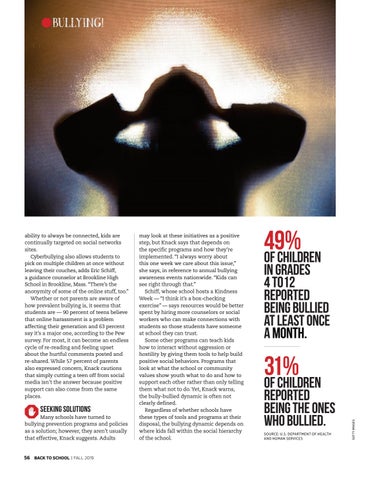
iddle school can be tough: switching classes, learning locker combinations, more challenging coursework. It’s also where the most bullying begins. According to the U.S. Department of Health and Human Services, about 49 percent of children in grades four to 12 reported being bullied by other students at least once a month, and 31 percent of children reported being the ones who bullied.
GETTY IMAGES
Whether your child is the perpetrator or victim, here’s what you need to know
Those numbers suggest that it’s more likely than not that your child will either be the target of bullying or the instigator.
Prevalent Perpetrators We think we know what a bully looks like. Pop culture paints an image of an alpha male or female who is either the star football player or head cheerleader. However, it’s not always that easy to identify the problem child, especially if
their misdeeds occur primarily online. More male students may be physically bullied than female (6 percent versus 4 percent), according to the National Center for Educational Statistics. Jennifer Knack, an associate professor of psychology at Clarkson University who has researched bullying for 15 years, points out that girls are typically socialized out of physical bullying and, instead, start using bullying tactics like ostracism or spreading rumors.
However, cyberbullying affects both genders. A 2018 Pew survey found that 59 percent of U.S. teens experienced some form of abusive online behavior and, unfortunately, it doesn’t stay within the confines of school property. Before social media, students who were bullied at school, on the school bus or in the neighborhood, could escape to the safety of their homes in the evenings. Now, with the >
55
SEEKING SOLUTIONS Many schools have turned to bullying prevention programs and policies as a solution; however, they aren’t usually that effective, Knack suggests. Adults
56 BACK TO SCHOOL | FALL 2019
may look at these initiatives as a positive step, but Knack says that depends on the specific programs and how they’re implemented. “I always worry about this one week we care about this issue,” she says, in reference to annual bullying awareness events nationwide. “Kids can see right through that.” Schiff, whose school hosts a Kindness Week — “I think it’s a box-checking exercise” — says resources would be better spent by hiring more counselors or social workers who can make connections with students so those students have someone at school they can trust. Some other programs can teach kids how to interact without aggression or hostility by giving them tools to help build positive social behaviors. Programs that look at what the school or community values show youth what to do and how to support each other rather than only telling them what not to do. Yet, Knack warns, the bully-bullied dynamic is often not clearly defined. Regardless of whether schools have these types of tools and programs at their disposal, the bullying dynamic depends on where kids fall within the social hierarchy of the school.
49% of children
in grades 4 to12 reported being bullied at least once a month.
31% of children
reported being the ones who bullied. SOURCE: U.S. DEPARTMENT OF HEALTH AND HUMAN SERVICES
GETTY IMAGES
ability to always be connected, kids are continually targeted on social networks sites. Cyberbullying also allows students to pick on multiple children at once without leaving their couches, adds Eric Schiff, a guidance counselor at Brookline High School in Brookline, Mass. “There’s the anonymity of some of the online stuff, too.” Whether or not parents are aware of how prevalent bullying is, it seems that students are — 90 percent of teens believe that online harassment is a problem affecting their generation and 63 percent say it’s a major one, according to the Pew survey. For most, it can become an endless cycle of re-reading and feeling upset about the hurtful comments posted and re-shared. While 57 percent of parents also expressed concern, Knack cautions that simply cutting a teen off from social media isn’t the answer because positive support can also come from the same places.
WHO’S A BULLY? The distinction between bully and bullied isn’t always clear. In a school environment, social hierarchy often determines these two positions, which isn’t always a good thing. “Bullies who are on the higher end of the social hierarchy are often liked by teachers, liked by administrators and so they often get a pass even though they’re harming other children in terms of their social relationships,” says Knack. Schiff says it can also be difficult to decipher the truth from multiple versions of an incident. Did a student trip another on purpose or was it truly an accident? “The question of intent can also be hard to judge, depending on the situation,” says Schiff. Kids can pretend they’re joking or teasing was misinterpreted and, based on their social status and whether or not they’re already viewed as troublemakers, they can often maintain their social standing because they are so well-liked within the school environment.
While the conscious awareness may not fully be there, Knack believes that those who bully understand that their behaviors reward them with social privilege, whether they’re fully conscious of it or not. “They definitely are trying to figure out how to maintain that power,” she says. Kids who are bullied often withdraw from activities, go from being talkative to quiet, experience fluctuations in grades — all red flags that parents need to be aware of — but what about the kids who are doing the bullying? If you notice that your child is suddenly getting a lot of extra attention from classmates, that could be a different sort of red flag, especially if that attention comes out of left field. “Some kids who are engaging in bullying behavior may react with more confidence,” says Knack. “Kids have a hard time knowing what to do with that extra attention. It can be hard because some of these (behaviors) we expect because they’re hitting puberty … but it’s important for parents to pay attention.” l
Parental Guidance If you suspect your child may be the bully: uAssess yourself. “It’s really important for parents to take some time for selfawareness,” says Clarkson University associate professor Jennifer Knack. Kids can pick up nuances from everyday life and copy behaviors. Reflect on how you talk about colleagues or relate to your friends and, if needed, “show a less aggressive way of interacting,” she says.
uRecognize that bullying doesn’t have one cause. There is not a onesize-fits all reason behind why someone bullies. “We’re quick as a society to point to parents and say, ‘This is your fault,’” says Knack. “Parents who are doing the absolute best we could expect still have kids who are picking up things from teachers, coaches or other kids.”
uTalk about what it means to be cool. As kids move into middle school, speak with them often about what it means to be cool within a peer group. Encouraging empathy can be helpful as kids begin to realize how their actions affect others. “Having those conversations helps your child learn to navigate situations without aggression,” says Knack.
One Teen’s Tale “The Survival Guide to Bullying” At age 8, Aija Mayrock became the target of her peers. “I had a lisp and a stutter,” she says. “Because I was bullied for the way that I spoke, I stopped speaking.” Because of social media, the bullying continued even after a move from New York to California. That’s when she told her parents. While she admits to feeling like the entire world was against her, she was determined to prevail. “I had these really big dreams for myself,” she says. “I wanted to be a writer, a performer. I allowed my bullies to take a lot from me, but I wasn’t going to allow them to take those dreams.” So Mayrock began to write. Her ideas manifested into a book, The Survival Guide to Bullying: Written by a Teen, which became an international bestseller. Now a speaker and activist, Mayrock credits her writing as the outlet that helped her heal. She encourages those who are being bullied to harness their creativity. “Don’t suffer in silence,” she says. “You truly are never alone.” — Kristen A. Schmitt
57
C O L L E G E OR
NOT?
How to discern your child’s best post-high school path
W
BY EMILY EILEEN CARTER
ith the rising price of college tuition and more college grads facing crippling
student loan debt, many parents and high school students are thoughtfully considering their post-high school options. Determining the correct course of action for your soon-to-be graduate can be tough. Weighing the cost of higher education, the job market and cost of living, families are considering options other than automatically enrolling scholars into a four-year institution. So what choices do teens have? And how do you know which is the right one? Answering these
?
What are the student’s goals?
What are the student’s career aspirations?
“It’s important to start having conversations with your teens early about what their career and college goals are,” advises counselor James Rumbaugh of Owen High School in Black Mountain, N.C. “Our job here is to get students career and college ready. If they are already having these conversations at home, it will help them refine their goals and decide what (is) the best post-high school track for them to follow.”
That’s one question to ask, says Terry Brasier, vice president of student services for Asheville-Buncombe (N.C.) Technical Community College. Then, based on these goals, determine whether the student is prepared academically “to gain admissions into a college and/ or university which offers a major or program of study that would help the student gain the knowledge and skills to enter into their chosen career path,” Brasier says.
GETTY IMAGES
questions can help:
?
59
What about going straight to work? For some students, going to work immediately after high school is the right option, and it can be combined with education. On-the-job training is valuable, Brasier notes, but suggests teens still take a class or two. “I would encourage students who choose to enter the workforce to also strongly consider seeking highereducation opportunities through the college and university system as most jobs require additional educational attainment (above) the high school degree to gain promotions and job mobility,” he says. At the least, students need a plan before they graduate, no matter what it is. “Our goal as school counselors is for our students to be college and career ready,” Rumbaugh says. “We are not pushing everyone to go to college or even a four-year college. We think it’s very important that our students have a post high-school plan after they graduate.”
60 BACK TO SCHOOL | FALL 2019
What does the student need?
When should college prep begin?
Over the years, school counselors have changed their approaches to helping students decide which path is best. “In previous years, it was often very set that some students were going to a two-year school and others were better suited for a four-year college,” Rumbaugh says. “Every student has strengths and areas where they can grow, and our jobs as school counselors is to be individually studentminded so we can help them find success with their post-college plan.” He adds that students’ financial needs may be different, but there are plenty of resources available. “Even if there haven’t been family conversations, we can still work towards helping them find and apply to the right colleges and acquire financial help.”
Because colleges often have high school course prerequisites, it’s important to start considering college and career goals as early as middle school, Brasier says. This allows students to get on a path to be “college ready” by the time they graduate high school. Actually researching colleges and universities typically happens in early high school years, he says. “During this phase, the student will have narrowed their career path choices, continued to become academically prepared and begun the review and search of colleges/universities that offers majors/programs to prepare them for their career path,” Brasier says. By junior or senior year, after visiting campuses and reviewing cost and admissions criteria, a student should be ready to pick a school or schools to which they wish to apply.
Students need a plan before they graduate, no matter what it is.
Is it time for a gap year?
More students are opting to take a year off after high school. “Gap years may be beneficial for students who are not sure of their career path/college choice and/or who lack the motivation or desire to enter the college/ university system directly after college,” Brasier says. “Some students may choose to work to save money for tuition and/or do volunteer work in a possible career avenue to inform their career choice.” Rumbaugh cautions that a gap year is great — if there’s a plan behind it. While taking time off from their educational pursuits, many drop the ball on their academics, he says. “I recommend if a student is going to take a break that they at least enroll in one or two courses at a community college. It keeps their brain academically stimulated, and they are more likely to stick to an education plan.” He points out that should a teen then apply to college after that gap year, the admissions office will want to know what that student did during that time off. “So, doing a program like Outward Bound, study abroad or something similar is important,” Rumbaugh says.
GETTY IMAGES
?
Would a community college be better? When deciding whether students are ready for a four-year college, it’s important to look at their motivation and academic preparedness. “If a student has struggled academically and does not express interest or aspirations to attend a four-year university, then they may want to consider a community collegeuniversity transfer option,” Brasier suggests. “This option allows for the student to build their academic skills, improve their grade-point average and seek career guidance so they can best determine the right major choice and then start the university search process.” He notes that students may find their career path while studying at a community college. There may also be a financial benefit. “The amount of savings a student can have during a two-year cycle at a community college versus starting at a university can add up to over $20,000,” he says. “Community colleges also afford students the benefit of residing with family to save money, flexible course options and career exploration services for students who are undecided on a career path and/or who are looking for a new career path and/or retraining.” TIP
GETTY IMAGES
Community college can save money.
EVEN TRADE
Learning a manual skill can lead to a lucrative career
D
akotah Luke spent most of his 20s doing manual labor. He saw skilled workers building better careers for themselves and decided he wanted in. “Those guys got the most overtime. They got paid the most, and it was just cool to see them building these structural steel items,” he says. Luke opted for trade school — specifically, the welder’s program at Pellissippi State Community College in Knoxville, Tenn. That two-year program landed him a job at RTE Machine and Fabrication in Tennessee. “The training helped. It opens up a lot more options,” he says. Four-year institutions aren’t for everyone. With college costs rising and a nationwide skills shortage in the manual arts, many find trade school an attractive option. The American Welding Society predicts a shortage of more than 450,000 welders by 2022. Overall, experts expect some 3 million job openings in the skilled trades by 2028, while unemployment among recent college graduates is at almost 7 percent in some areas. A hungry job market means a chance at greater job security. Cost can be another point in favor of specific training in welding, plumbing, electrical and other fields. “Student loan debt is crushing the younger generations,” says Mark C. Perna, author of Answering Why: Unleashing Passion, Purpose, and Performance in Younger Generations.
“In general, trade schools are much more affordable than traditional four-year colleges and universities.” Trade school tuition averages $33,000 in total, according to DegreeQuery.com, while four years of tuition and fees at a typical state college average $39,880. Starting salaries, meanwhile, don’t vary by much. A general electrician earns about $57,350 a year, and a welder earns more than $40,000 for entry-level positions. That’s not far off from the $49,700 starting salary of the average college grad. Still, trade school has its downsides. “Those considering trade school may also have to battle the negative stereotypes that are still out there about blue-collar work,” Perna notes. Also, some may not be temperamentally suited to manual work. “It’s important to understand your personal preferences before committing to a program of any kind.” For some employers, though, trade school graduates are a must-have. As CEO of manufacturing company WCCO Belting in Wahpeton, N.D., Tim Shorma depends on trade school graduates to keep production moving. “The hardest thing is to find people who like to do things with their hands, people who can roll up their sleeves and do hard mechanical skills: twist a wrench, drill something,” he says. “The majority of our jobs don’t need a four-year degree.” — Adam Stone
61
TIP
Do your research. Attend a gap year fair, pick up books on the topic, check out resources at the Gap Year Association or meet with a gap year consultant.
MIND THE GAP Make the most of a year off from college
62 BACK TO SCHOOL | FALL 2019
• A gap year helps binge-watching Netflix? Students should “decide what is the purpose of the gap year, what are the outcomes you want, how you are going to achieve those outcomes, and then use that as a framework to design an experience,” says Joe O’Shea, an assistant vice president at Florida State University and author of Gap Year: How Delaying College Changes People in Ways the World Needs. The best gap year plans include a range of volunteer and paid work, career exploration and unstructured time, Knight says. There are programs available to help make gap years structured, adventurous and rewarding. Pricey programs can cost the equivalent of a year of college tuition, but you can design a gap year to fit any budget. Some colleges now provide scholarships designed specifically to help fund gap years, and industry programs awarded $4.2 million in scholarships and grants in 2016, Knight says. Students can also consider paid internships, temporary jobs or programs such as AmeriCorps.
— Mary Helen Berg
students fine-tune personal, academic and career goals.
• Most gap year students
graduate in four years, with 83 percent doing so with average GPAs of “B” or better, according to a Gap Year Association survey.
• Students can earn
college credit or cash through some programs.
8
Cons
• Not all schools will
defer financial aid when a student takes a gap year, Palmer says.
• Travel programs can be
expensive — up to $55,000 for a program that hits nine countries in nine months, Knight says.
• Your student may
experience FOMO (fear of missing out) when they see friends’ campus adventures on social media, according to Palmer.
GETTY IMAGES
T
here are plenty of reasons students may not want to start college right after high school. Some may need to earn money for tuition, feel burned out, lack direction or have wanderlust. All make good gap year candidates, says Melissa Palmer, co-director of college counseling at Oakwood High School in North Hollywood, Calif. “It’s a great idea for everybody,” Palmer says. About 40,000 U.S. students will take a gap year sometime between high school and their junior year of college, a number that has grown 9.3 percent over the past few years, says Ethan Knight, executive director and founder of the Gap Year Association, a nonprofit that accredits and sets standards for gap year programs. If your children are considering a gap year, make sure they’re truly invested in planning it, and design a year that reflects their goals and interests, Knight advises. “The more that the student is the driver, the better the results,” Knight says. But how do you make sure your student doesn’t spend a gap year
8Pros
REDEEM THIS GIFT CARD FOR... ANY 529 College Savings Plan ANY Student Loan Account
Patched Up Parenting: A Guide to Co-Parenting
™
SLOW SIMMER TACO SAUCE
• Wicked Tasty Taco is rich beef stock infused with authentic Mexican-style spices. • No artificial ingredients, flavors or colors • Gluten Free • 24 month shelf life before opening; 6 months in fridge after opening • Use for tacos, dips, chili, soup and so much more
Taco Tuesday Every Day!
Available at BarnesandNoble.com & Amazon.com
Get 15% off with coupon code USATACO
www.kitchenaccomplice.com
Also available at Walmart, Kroger, Meijer, Safeway, Albertsons, Wakefern, Hy-Vee and Amazon.com
Say Hello! to the Only Liquid Vitamin Line for Children
Gluten Free
Learn more at WWW.CHILDLIFENUTRITION.COM
Doctor Developed
Great Taste
@ c h i ld l i f e e s s e n t i a l s
BACK TO SCHOOL
LIFE LESSONS
ELEMENTARY SCHOOL 66
|
MIDDLE SCHOOL 72
|
HIGH SCHOOL 86
|
PERFECT FINISH 96
DAVID YELLEN
SWEET SUCCESS Alina Morse, 14, is founder and CEO of a sugar-free, vegan candy company. Find out more about Zollipops and other businesses started by young entrepreneurs (page 86).
65
elementary
Does Homework Work? School districts weigh pros and cons of take-home assignments
T
he pressure-filled lives of modern families are causing more school districts across the nation to rethink approaches to a decades-old staple of the American education system: homework. Around the country, there have been many districts that have abolished homework. Some schools in Florida
66 BACK TO SCHOOL | FALL 2019
have even gone so far as to prohibit any assignments outside of class time and issue an edict that students go home, relax, play and enjoy time with their families. Allison Wienhold, who teaches high school Spanish at Dunkerton Community School District in rural Iowa, doesn’t assign homework. If class
time is used judiciously, there’s no need for additional work to be assigned outside the school day, she says. After hearing about her students’ lives outside of school, she determined that homework has become busy work, which she doesn’t consider useful. It also takes time away from their familial responsibilities, to which Wienhold, a
GETTY IMAGES
BY JENNIFER MABRY
toward a system that won’t factor and helps teachers determine and homework into students’ final grades, assess whether a student has mastered at present there is no stated policy a skill during class time. She says it also at the secondary level regarding the helps inform the teacher as to how well allocation of homework. they are doing their job. Kris Felicello, assistant The teachers at her school give superintendent for educational services homework that “aligns with the daily with the North Rockland Central School learning activities and outcomes that District in New York, expects to have intentionally supports what kids learn a new homework policy in place by at school,” she says. the end of 2019, in Romano, who has response to fifth-grade been teaching for 17 students’ petition to years, emphasizes that abolish it. More than homework at Veritas 150 signatures were is not given with collected. the expectation that “Homework is such parents aid their child a controversial topic,” beyond reminding Felicello says. “Some them to do it; nor is it people feel strongly scored in a way that we shouldn’t have it, would be punitive or and some feel it’s a negatively affect a rite of passage. When student’s grade. the students came Despite the to me and were so trend toward passionate about it, ending take-home it was kind of that assignments and tipping point.” the popular petition, — ALLISON WIENHOLD, Although educators North Rockland’s teacher, Dunkerton Community School District, Iowa are examining how new policy may not to reform homework abolish homework policies, some experts argue that this completely. Teachers are trying new ongoing debate has already been settled approaches, such as assigning longby years of research and data. term projects with deadlines, which Alfie Kohn, a former teacher and allows students to work at their own author of The Homework Myth: Why Our pace and convenience, and learn timeKids Get Too Much of a Bad Thing, says management skills and prioritization. studies have proved that there’s no If her school district expected valid reason for homework. “We have teachers to give homework, or it was more than 100 years of research on a district requirement, Wienhold says the topic, and the results are startling. she would provide “choice enrichment,” No scientific study has ever found where she might suggest Spanishany benefit to any kind of homework,” language books, television programs or he says, adding, “Newer research is social media platforms for students to casting doubt on whether homework engage and help them improve their is necessary in high school. … There is conversation and comprehension. no evidence homework raises student “You don’t always have to tell kids test scores or promotes meaningful what to do and how to do it,” says Gary learning.” Armida, an English teacher at North Still, Rachel Romano, founder and Rockland High School. “You can just executive director of Veritas Prep make sure they have the skills, and Charter School in Massachusetts’ you’ll be amazed at what they come up Holyoke School District, sees the benefit with.” of take-home assignments. The work — Kimberly Redmond of The provides an opportunity for students (Westchester County, N.Y.) Journal News to practice their lessons independently contributed to this article.
I do not work outside of school. I leave my school work at school. I respect the balance and separation of school and home.”
married mother of two children younger than 5, can relate. Many students hold jobs, are caretakers to younger siblings while parents work or are busy participating in extracurricular activities. “I do not work outside of school. I leave my school work at school,” says Wienhold, who believes it would be wrong to hold her students to a different standard. “I respect the balance and separation of school and home.” Wienhold also contends that it is not equitable to assign students homework when many don’t have access to a computer or the internet at home. Although her district is moving
67
elementary
Considering Kindergarten Experts weigh pros and cons of ‘redshirting’
A
sk most parents, and they’ll readily admit that they want to provide their children with every advantage possible and every opportunity to succeed. In some cases, that means making important decisions during those first critical years of formal education: Will the right preschool lead to the best prep school and college? What professors will help further their careers? What careers will afford them the life they want? It’s a lot to consider when planning the future for someone who has yet to master the alphabet, but one of the first such decisions some parents have to make is:
68 BACK TO SCHOOL | FALL 2019
Should we redshirt? Delaying kindergarten takes children who would be among the youngest in one class and postpones advancement so that they are among the oldest in the next class. Once a relatively rare occurrence, “redshirting” has become more common — and controversial — in the past decade. “Many parents think everybody is doing it, but it’s a small percentage,” says Laura Saunders, a psychologist at Hartford Hospital’s Institute of Living in Connecticut. Most children are enrolled in kindergarten at age 5. In 1968, 4 percent of kindergarten >
GETTY IMAGES
BY VALERIE FINHOLM
Start The New School Year With Some Old Friends
When your child heads back to school, bring their favorite characters along for the ride. Find your favorite Kleenex® brand products at Target or online at Target.com.
© Disney/Pixar. ®/TM Trademarks of Kimberly-Clark Worldwide, Inc. or its affiliates. © KCWW
elementary
It’s a lot to consider when planning the future for someone who has yet to master the alphabet.
READY OR NOT “I can’t tell you the number of conversations I’ve had on the playground about this,” says Diane Whitmore Schanzenbach, director of the Institute for Policy Research at Northwestern University and co-author of Is Your Child Ready for Kindergarten?, an article published in 2017 in the Education Next journal. “Everybody thinks about it if their kid is anywhere near the (cutoff) bubble.” Schanzenbach recommends that parents wait until the last minute to decide whether they’re going to delay kindergarten for younger children. That’s because kids can grow leaps and
70 BACK TO SCHOOL | FALL 2019
bounds — physically and cognitively — the summer before school starts, depending on the enrollment date. “Sometimes waiting and seeing and getting more information before you make a decision is the right approach.” In 2007, Schanzenbach co-authored a study published by the National Bureau of Economic Research that challenged earlier research suggesting that redshirted children tended to do better socially and academically throughout life. Her analysis found the opposite: The early edge faded by middle school and in the long run, kids who started kindergarten younger ended up on top. “It’s that younger kids are inspired by their (older) classmates,” she says, and end up surpassing them. Older kindergarten students scored significantly lower on achievement tests in middle school than those who started at a younger age, she says. They were also less likely to take college entrance exams. One of the culprits: Redshirted kids who go through school as the oldest and smartest in their class may suffer from boredom and end up not pushing themselves academically. On the other hand, a 2018 study published in the New England Journal of Medicine found that kindergarten students who turned 5 in the month before kindergarten started were more
likely to be diagnosed with attention deficit hyperactivity disorder than children who started kindergarten in the month they turned 6. WHAT’S A PARENT TO DO? Saunders and Schanzenbach say readiness for school — not a child’s size — should be the most important factor in deciding whether to redshirt. Parents of younger boys who are short in stature and feel pressured to hold them back should talk to their pediatricians. If a child is very small, pediatricians can do a simple test to make sure their growth hormones are in balance. A child’s teacher is another good resource, and some grade schools can evaluate a child’s readiness for kindergarten. Schanzenbach recommends taking that advice “with a grain of salt,” however, since preschools stand to gain an extra year of tuition if a child is redshirted and elementary schools often find older children easier to teach. She says that parents who enroll younger children in kindergarten and then decide they’d benefit from a delay can determine at the end of the year whether their children need to repeat the year. “It’s something you can do down the road,” she advises parents. l
GETTY IMAGES
students were 6 years old. By 2008, the number had risen to 17 percent — more boys than girls. Many parents think enrolling their children in kindergarten when they’re older will give them an academic or athletic advantage in the long run, but research is mixed on this. “It is not necessarily an advantage to hold kids back,” notes Saunders, who urges parents to look at developmental guidelines, not just at a child’s stature, when making a decision to postpone kindergarten for a year. “Is it in the child’s best cognitive, social and emotional interests?” Saunders asks.
middle school
Home Alone When is it OK to leave your child unsupervised? BY SHAMEIK A RHYMES
P
arents’ busy schedules don’t always align with the demands of a new school year. With competing priorities inside and outside the home, some parents must decide whether their school-aged child can be left home alone for parts of the day. Whether parents are running a quick errand or working after school has let out, many factors should be considered before handing over the house key to a child. According to the U.S. Department of Health and Human Services’ Child Welfare Information Gateway, only three states have laws regarding a minimum age for leaving a child unsupervised at home (Illinois, age 14; Maryland, age 8; Oregon, age 10), while other states offer guidelines. “Parents should be aware that if their state does not outline the legalities of leaving their children alone, the courts do recognize the child’s maturity level, the safety of the child, how long the child was left alone and the parents’ concern for the child’s overall welfare and steps taken to ensure their safety,” says Rolanda Mitchell, an education counselor at North Carolina State University.
72 BACK TO SCHOOL | FALL 2019
GETTY IMAGES
WHAT TO CONSIDER “Parents should look for signs of responsibility when their children are with them before leaving them home alone. Are they able to follow directions without being told repeatedly? Do they only follow directions if you are there watching? If they only follow the rules when you’re watching, it’s unlikely that they will follow them when they are home alone,” Mitchell says. “School behavior can also be a good indicator because school is where children spend the most of their time without their parents watching. If they’re misbehaving or violating rules, they may do the same when they’re home alone.” Amy Jackson allowed her 16-yearold daughter to start staying alone in their Kingwood, Texas, home at age 11 because she felt her daughter was mature enough. “We started out with small increments. I would go to the store and leave her at home watching a movie because I knew I could trust her. I believe the key is really knowing your children, because not all 11- or
12-year-olds think and behave the same.” SET GROUND RULES Talk with your children to find out how they feel about shouldering the responsibility of staying home alone. Some children may be ready for it, while others may hesitate or be afraid. Parents should let their children know what’s expected of them, including setting a consequence and reward system. “The child should know what will happen if they don’t follow the rules. Additional television or computer time, or even getting to choose what’s for dinner can give them some incentive to do the right thing,” says Mitchell. SAFETY FIRST Safety is another major concern for parents. In case of an emergency, children need to know what to do and whom to contact. This information should be written in a way the child can understand and posted in a place they can readily see. Parents should also make sure their child has access to a phone. Creating a check-in
system will put both the parent’s and child’s minds at ease about this new adventure. Jackson says she role-played with her daughter to make sure she was prepared in case of an emergency. “We went over what to do if someone knocks on the door or if she smelled smoke. We even practiced calling 911 and what to say in certain situations.” KEEP YOUR CHILD OCCUPIED Tasks or completing educational activities are great ways to keep your child busy. “Give them chores to do that you have seen them complete successfully,” says Mitchell. “Start with giving them things assigned by the school such as homework, worksheets or assigned reading. It’s important to not only assign tasks, but to follow up to make sure it’s completed by asking to see it or asking for details about what they read.” If you decide to let your child stay at home alone, there are benefits, explains Mitchell. “It demonstrates a great deal of trust between a parent and child and can strengthen the relationship.”
73
middle school
From Boys to Men How we parent young males today can define masculinity tomorrow
A
n age-old rhyme suggests that the recipe for raising healthy, well-adjusted boys consists of snips, snails and puppy dog tails. However, with daily headlines about sexual harassment and mass shootings — most of which are committed by males — some parental figures are looking for new ingredients that will result in men who cope better with their challenges.
74 BACK TO SCHOOL | FALL 2019
When it came to boys, the focus was often on teaching independence and resilience. However, digital parenting coach Shelley Jefsen is among those who thinks it’s time to change that. Instead of leaving young boys to their own devices, she and her husband are intimately involved in their children’s lives — including that of their 12-yearold son.
“In the midst of innumerable allegations bringing white-hot attention to the behavior of males, I’m committed to setting my preteen boy up for success,” says Jefsen, author of the parenting blog Mama Duck. Jefsen sends her son on regular “daddy dates” with his father to nurture a relationship that in another era might have been neglected. “During these dates,
GETTY IMAGES
BY MAT T ALDERTON
my husband takes only one child developing healthy, happy men out for focused attention. … doesn’t fall on psychologists During their time together, my alone. Mostly, it belongs to son feels seen, heard and valued. parents, who must navigate a While out together in public, my complicated and changing world husband holds his hand, puts of gender, justice and health in his arm around him, laughs with order to decide whether to rear him and gives him 100 percent — their sons by leaning into or away providing both physical, as well from “traditional masculinity.” as communicative evidence to my son that men are not islands.” A WORLD OF WORRY It’s not just parents who are Mothers can’t help worrying changing course with boys. It’s about sons. But Dionne Boldin the culture at large. In 2018, — mother of boys ages 8 and 14 for example, the American — believes she has valid reasons Psychological Association (APA) for concern. issued its first-ever guidelines “As my 14-year-old gets for treating boys and men. older and starts spending more Although critics accused it of time away from home without politicizing and pathologizing parents, there are a whole new gender, APA Chief of set of worries I now have,” says Professional Practice Boldin, wife of retired Jared Skillings NFL wide receiver GOOD says that the Anquan Boldin, who OR BAD? guidelines were is African-American. Stirring debate with created to help “I worry about its recent ad campaign, Gillette pledged “to men and boys him being racially actively challenge the “embrace their profiled. I worry stereotypes and masculinity in about him properly expectations of what flexible ways interacting with it means to be a man.” that can protect his female friends. I their health and worry about him always enhance their lives.” being hyper-aware of his Then, in January 2019, surroundings and protecting shaving company Gillette himself in a country where announced an ad campaign in mass shootings have become which it switched its famous the norm. Those are just a few tagline to “The Best Men Can Be,” of my deepest worries — all the calling on men in the #MeToo era what-ifs.” to “strive to be better” and “help In the face of so many each other be better.” uncertainties, parents who were “All of this is part of a raised to believe boys are resilient groundswell that’s causing us must instead acknowledge that to think about what it means to they’re vulnerable, according be male in modern society,” says to Judy Y. Chu, author of When Matt Englar-Carlson, a professor Boys Become Boys: Development, of counseling at California Relationships, and Masculinity and State University, Fullerton, and a lecturer at Stanford University, co-author of the APA guidelines. where she teaches about “We need to be aware that men psychosocial development. have real needs and concerns, “Boys are socialized to be and we need to offer services to disconnected from themselves men that in some way are able to and others,” explains Chu, address those.” who says traditional notions of But the responsibility for masculinity favor stoicism >
TIPS: PARENTING STRATEGIES uReplace shame with comfort: “We’re socialized to think men are tough,” says Matt Englar-Carlson, professor of counseling at California State University, Fullerton. “It’s important to see boys as boys and not as men. Toughening a boy up through shame just weakens his insides, and that most likely will have ramifications.” uPresent positive male role models: “Mothers and women can tell boys it’s OK to express their emotions and have intimate relationships, but boys need to see men do it, too,” says author Judy Y. Chu. “Whether it’s their father, uncle, teacher or coach, the men in their lives must exhibit these qualities in order for boys to perceive them as vital.” uEncourage intimacy: “The single best protector against (adolescent) risks … is having access to at least one close, confiding relationship,” explains Chu, who says intimate relationships act as “safe spaces” where boys can be authentic. “That could be with a parent, sibling, teacher, coach — anyone, as long as they can rely on and confide in that person.” uBe transparent: Self-described “hypercommunicative” parents Sarah Beatty and Shane Martin believe the best gift they can give their 12-year-old son is context. So, they’ve created an open-door policy wherein he can ask them anything and receive an honest, adult answer. “My biggest fear as a parent is that if I avoid talking about something because I want to protect my kid, what I’ll actually be doing is leaving him with no skills, tactics or strategies for how to handle it,” explains Beatty, who says transparency allows her and her husband — not the internet, media or peers — to educate her son about adult subjects. uOffer validation: Parents should validate instead of dictate their sons’ identities, says Englar-Carlson. “In doing so, you get to know who your son is rather than who you or society think he ought to be.”
75
middle school
over sensitivity and isolation over intimacy. “That does them great harm in terms of their social relationships, their psychological development and even their physical health.” The data speaks for itself: Men die by suicide at four times the rate of women. They die younger and are more susceptible to cancer. Men are more likely to drink alcohol at hazardous levels, drop out of high school and be homeless or incarcerated. Males also outnumber females as both victims and perpetrators of violent crime, including homicide, and commit the majority of bullying and mass shootings, according to researchers. “When traditional masculinity is enacted in a rigid way … it creates problems, and those problems are both intrapersonal and interpersonal — ‘intra’ meaning things like depression, anxiety and anger, and ‘inter’ meaning things like domestic
76 BACK TO SCHOOL | FALL 2019
violence and aggression toward others,” Englar-Carlson says. “The research on this is clear: Over-conformity to traditional masculine norms leads to distress.” POINTERS FOR PARENTS Because masculinity is not medicine, there is no recommended dosage. Parents who want to raise successful men should therefore let boys decide for themselves how much or how little they want to conform to traditional gender norms, suggests Ted Bunch, founder of A Call to Men, an organization that provides educational programming to help males embrace a “healthy, respectful” version of manhood that transcends the boundaries of what he calls the “man box.” “Men aren’t given permission to feel sadness, pain or disappointment because they exist outside the man box,” Bunch says. “That needs to
change. Boys need to be able to embrace and express their full range of emotions.” Parents who validate their sons can still shape them by reinforcing their best instincts, says parent Sarah Beatty, who recalls a favorite memory: When her son was just 4 years old, he helped calm her fussy infant daughter by sensing she was cold and covering her with a blanket. “We praised him when he did that,” Beatty adds. “We try to compliment him whenever he’s showing sensitivity, nurturing and empathy.” Boldin says being a role model is one of the best ways to teach children how to interact with others. “All we can do is lead by example, in terms of conduct, and explain over and over again why this matters in hopes it will stick. It’s like practicing, practicing, practicing for a terrible game that may never come in hopes that if they’re ever forced to play, they will win.” l
GETTY IMAGES
A FEW GOOD MEN Experts say boys need male role models to help shape their masculinity.
middle school
Girl Power Engineering scores soar even without instruction BY ERIN RICHARDS
78 BACK TO SCHOOL | FALL 2019
GETTY IMAGES
N
ina White, a recent graduate of Copley High School in Ohio, took an engineering class on a whim during her junior year, mostly because she liked the teacher and he encouraged her to sign up. Her senior year, she took an advanced class and helped her school win a national engineering competition by designing a product for a local company. >
middle school
White’s journey into engineering mirrors the experience of many girls who aren’t naturally drawn to the subject — or who don’t think they’d be good at it. That’s starting to change, according to the results of a national engineering exam released in April. Across the country, eighth-grade girls outperformed boys, even though girls reported taking fewer engineering classes than boys, according to the results of the 2018 National Assessment of Educational Progress’ (NAEP) Technology and Engineering Literacy exam. “The girls have done extremely well in this assessment,” says Peggy Carr, associate commissioner for the assessments division at the National Center for Education Statistics. “Girls are outperforming boys whether they take a class or not, and when girls take a course, they also score higher.” NAEP, also known as the Nation’s Report Card, measures students’ reading and math knowledge. It launched an engineering literacy exam in 2014 to assess how well middleschoolers could apply engineering concepts to everyday life. Tasks on the exam ask them to think through problems, such as how to build a bike path or how to design a museum exhibit about Chicago’s water pollution in the 1800s. The exam was given to a sample of 15,400 eighth-grade students in 600
Girls outscored boys on a national engineering test, even though only
53% of girls
had taken a class, compared with 61 percent of boys. Nina White and her classmates designed, programmed and installed a tool-sorting device. public and private schools. The results were scored on a 300-point scale, then grouped into “basic,” “proficient” and “advanced.” Forty-six percent of the students scored proficient in engineering literacy. Most students scored higher on the exam if they had taken at least one technology or engineering course. The gender breakdown illuminated a paradox: 61 percent of eighth-grade boys reported taking at least one class compared with 53 percent of girls, but girls outscored the boys on the exam by a 5-point difference. One reason: Girls are better at the communication and collaboration
portions of the exam, says Carr. “Maybe boys could do better if we help them to improve in this area,” she adds. Kirby Harder, the engineering teacher at Copley High School who urged White to sign up for his class, was not surprised by the results. “Girls are just as good at engineering as boys,” he says. “They often take their time to think through a problem, whereas boys often rush through and make a mistake.” White says taking Harder’s classes introduced her to new career options. She is planning to attend the University of Akron in Ohio, where she intends to major in civil engineering. l
’Snap the Gap’ STEM product company littleBits and Disney have partnered to fund a $4 million pilot program called “Snap the Gap” to engage girls at an age when researchers say they usually begin to lose interest in tech — around 10 years old. The program, launched 80 BACK TO SCHOOL | FALL 2019
in April, is pairing 15,000 10-year-old girls with mentors, littleBits learning kits and access to members of the tech community. Participant and mentor recruitment will be managed by the University of California Davis, the school behind the California
Million Women Mentors program for girls in STEM. Women make up almost half of the workforce, yet they hold 25 percent of computer and math-related jobs and just 15 percent of engineering jobs, according to the U.S. Department of Commerce.
“Disney is a creative, inclusive environment,” says spokesman Jacob DiPietre. “We want to make sure that we are ensuring women have those same opportunities in technology. That’s part of our strategy.” — Sonja Haller
PROVIDED BY KIRBY HARDER
Companies unite to fund STEM program for girls
Introduce your students to the world of futures. Futures markets impact everyday life in ways you may not realize: like the cereal you have for breakfast, the fuel in your gas tank, or the loan you get to buy a home. Designed for educators and students alike, Futures Fundamentals provides videos, infographics, and interactive tools that explain the world of futures – and the role they play in the world we live in. You’ll also find Econ Essentials, a program that explains economic principles through the lens of energy, agriculture, and financial markets.
Learn more at FuturesFundamentals.org
middle school
Time For a Tutor? Determine which form of academic help works best for your child BY SUZANNE WRIGHT
82 BACK TO SCHOOL | FALL 2019
GETTY IMAGES
I
t’s easy to miss clues that your child needs academic assistance, and kids are often reluctant to discuss their struggles, making it more difficult to determine when a tutor may be an asset. “If your child is secretive about their grades, resists help with homework and gives you vague answers to questions about school, these are red flags,” says Beverly Hills, Calif.-based psychiatrist Carole Lieberman, who treats children and families dealing with academic challenges. However, determining that your child needs a tutor is only the beginning. Once that’s been decided, parents must weigh the options and figure out which type of tutor is best to address their child’s needs. There are three tutoring methods: one-on-one (private or franchise-based), online and group. Children respond to each approach differently, so you may need to experiment to find what works best. David Jones, who teaches algebra, biology, English and geometry, works independently and through HeyTutor.com, which connects students with academic assistance. Jones believes chemistry and empathy are as critical as expertise. “The biggest challenge for my students is attitude, not aptitude. The idea that ‘math sucks’ or they aren’t good at it is prevalent and powerful. I challenge these notions. I felt that way when I was in middle school,” says Jones. Such thinking can be debilitating, he says, but it can be overcome. Jones has been tutoring Atlanta sixth-grader Jack Jenkins most weekdays this school year.
“At first, I wasn’t excited about having a tutor, but I like David,” says Jack. “He cares about me and wants me to do well. I know that school is important, and that I need to do well if I want to have a good future. David has helped me keep up with my work and tests.” Jack’s parents, Jo and Michelle Jenkins, are impressed. “David has done amazing work with our son, who has ADHD and has really struggled,” says Jo. “David’s understanding of ADHD has helped Jack respect and trust him. The result has been improved study habits and an overall increase in grades.” For some, there may be a stigma attached to needing a tutor, but Jones says that even gifted students struggle. Hiring help is not necessarily an indication that a child is less capable. “Their self-worth is tied to academic success and praise. Kids argue or shut down when faced with a challenge. I have to be sensitive to this, while not cutting them slack and falling short of my obligation as a tutor,” Jones explains. Jana Rodgers, of Buford, Ga., used Wyzant Tutoring, an online service that also provides in-person instruction, for both of her children. Rodgers appreciated the convenience and flexibility, along with the ability to quickly compare tutors with different specialties, hourly rates and reviews. Rodgers says Wyzant was also a time-saver in traffic-choked Atlanta because they didn’t want to have to commute. “We weren’t limited geographically in finding an awesome tutor. If it’s midnight >
WHAT PAR ENTS SHOULD K NOW uTrust your instincts. If you sense your child is struggling, act. uBe proactive. Partner with your child’s teacher to discuss options. uDo your homework. Ask for recommendations, referrals and resources. Read reviews and check credentials. uStick with it. Children may ask to quit. uRequest progress updates from the tutor. uAsk your child what’s working and not working. uRecognize this is a family effort. uKnow that extra support pays off.
SEEING THE SIGNS Earning low grades is one of the most obvious ways to tell if your child needs tutoring, but it’s not the only indication that there’s an issue. Psychiatrist Carole Lieberman says these signs may suggest your child needs a tutor: uDecreased enthusiasm or boredom uIssues with time-management uPoor study habits uConstant confusion uWorking diligently without correlating success uDrop in self-confidence uFaking an illness
83
middle school
uuu
WHERE TO START: TOP TUTORS There are nearly 800 tutoring franchises across America. Parents and professionals singled these out:
HUNTINGTON LEARNING CENTERS huntingtonhelps.com uFocus: Assessments take child’s learning style into account. uScope: Hundreds of locations. uOf Note: All tutors are degreed and hold state or Huntington certification; centers are accredited by either the Middle States Association or Western Association of Schools and Colleges; no contracts required.
84 BACK TO SCHOOL | FALL 2019
KUMON MATH & READING CENTERS kumon.com uFocus: Rigorous methodology requires daily practice and repetition in a self-paced environment; worksheets are completed both at home and centers. Speed, accuracy, organization and proficiency are emphasized. uScope: 1,400+ locations. uOf Note: Instructors are trained in the Kumon method, but not necessarily in subject matter.
MATHNASIUM mathnasium.com uFocus: Results are based on monthly enrollment and several weekly “workouts.” Students master computation and problem-solving as a foundation for algebra, geometry, trigonometry and pre-calculus. uScope: 1,000+ locations. uOf Note: Games build skills, encouraging a love of math; uses mental, tactile, verbal and written teaching techniques; incentive program.
TUTOR DOCTOR tutordoctor.com uFocus: In-home, personalized, one-on-one tutoring. uScope: 28,000+ global instructors. uOf Note: Offers nine tutoring programs, including those for veterans and students with special needs; tailors teaching to schoolwork; 60-day money back guarantee.
VARSITY TUTORS varsitytutors.com uFocus: Online, live-learning platform matching students with vetted experts in less than four seconds. uScope 1,000+ subjects and 40,000 tutors. uOf Note: Delivered 3 million+ hours of tutoring to 200,000 students. GETTY IMAGES
in Georgia and we needed help, there was someone available on the other side of the country — or the world. If we had to ramp up for a test or tackle challenging material, we didn’t have to sign up for a long program. So cost wasn’t a barrier.” Margie Wojciechowski of Scottsdale, Ariz., has twin girls, Miranda and Morgan, who began struggling with math in fifth grade. Wojciechowski was shocked at her daughters’ test results. “While I knew they struggled, I didn’t realize the extent of their deficit. They were still counting on their fingers, and their math confidence was low,” she says. “They were frustrated; there was complaining and tears — it took two hours a night to complete 30 math problems. I felt it was time to take math support to the next level. So we signed up for Kumon,” says Wojciechowski, referring to the popular math and reading tutoring program. While they are still working to improve, homework time has already dropped by half and test scores improved over six months. “I’m so proud of my girls’ resilience and hard work,” Wojciechowski says. “Their grades are huge confidence boosters. Now they come home and say, ‘I got this, Mom.’” l
Make This Their Best School Year Yet. Give them the Mathnasium advantage Does your child have the skills and confidence they need to succeed this school year? Mathnasium makes the difference. We’re the authority in math education, with over 1,000 learning centers worldwide. Our expert instructors teach each child individually, using customized learning plans to help them start off strong and achieve their academic goals for the entire school year and beyond!
Visit www.mathnasium.com to find your nearest center today!
Changing Lives Through Math.™
high school
Teens Taking Charge Young innovators prove that being a boss has nothing to do with age BY ROSALIND CUMMINGS-YEATES
I
t’s about more than learning how to drive or figuring out what outfit to wear to prom for today’s teens. They are more focused on changing the world. According to a Gallup Student Poll, 77 percent of students in grades five
through 12 want to be their own boss; 45 percent hope to start their own business, and 42 percent plan on inventing something that will change the world. These teens are proving that business savvy can develop at any age:
Kellie Graves
When she was in the seventh grade, Kellie Graves attended her first diversity and inclusion conference. “It was so interesting that I grew a passion for this kind of work. Since then, I’ve attended 15 diversity and inclusion and leadership conferences,” says the 17-year-old leader from
86 BACK TO SCHOOL | FALL 2019
Pennsylvania. While many middle schoolers were worried about peer acceptance and the latest sneakers, Kellie founded her school’s first diversity group and started working on an app, Bias Buster. “I did a survey for data at my school and found that 97 percent knew what diversity was,
but only 57 percent thought it applied to their (lives). I thought I could teach cultural competency through an app,” she says. Bias Buster is targeted to kids and teens and aims to eliminate bias at a young age, before it has a chance to develop. The app will be available to the public soon.
Bias Buster “features topics around cultural identity, gender and equality,” Kellie says. “A big part of bias is awareness and education. If people aren’t aware, they don’t know that they’re being biased. This app will help create cultural competency and awareness.”
A.J. GRAHAM; GETTY IMAGES
Spreading Diversity Awareness
No Simple ‘Feet’
RACHEL MARTINEZ; GETTY IMAGES
Sebastian Martinez has always loved cool socks. When he was in prekindergarten, he grabbed pairs from his closet and put on a fashion show. “They just look really cool on your feet, and they’re comfortable,” says the 11-yearold Florida mogul. “My mom asked me if I wanted to design my own socks, and I started right away.” The Are You Kidding sock company kicked off soon after, with Sebastian as CEO and designer, and his 13-year-old brother Brandon as director of sales. ”Our socks are super funky. Who wouldn’t love
them?” says Brandon. Last year, they started a nonprofit so that they could donate funds directly to kids in shelters and foster care. During the last four years, the company has sold thousands of socks for cancer research. Each year, Are You Kidding sponsors an online campaign, Rock Your Socks. This year’s fundraiser benefits the Stand Up to Cancer charity. “If you don’t give back, then what are you even doing?” asks Brandon. “You never know when you’ll need help,” adds Sebastian, “and we want to put smiles on kids’ faces.”
Sebastian and Brandon Martinez
87
high school
Alina Morse
Sugar-Free Success
88 BACK TO SCHOOL | FALL 2019
stores, a feat that landed Alina the distinction of becoming the youngest person on the cover of Entrepreneur magazine. As Alina prepares for her first year of high school while managing a candy empire, she offers this advice for young entrepreneurs: “Ask questions. Do your homework. The more you learn will help you find your way and realize your dream faster. Work hard. Try. Believe and never give up!”
BUNNY POP Alina visited the White House as a guest of Michelle Obama twice to share her Zollipops with celebrants at the annual Easter Egg Roll.
DAVID YELLEN; GETTY IMAGES
Most parents try to curb their child’s candy intake, but the restrictions Alina Morse’s mom enforced sparked innovation in the then 7-year-old. “I love candy and like most kids, I was tired of hearing ‘no,’” says Alina, now a 14-year-old Michigan entrepreneur. “I started researching how to make healthy candy by swapping out the bad stuff for healthier ingredients. I learned to make candy off of YouTube and also discovered that tooth decay was the greatest epidemic facing kids. Protecting kids’ smiles with something that tasted delicious and everyone could enjoy became my mission.” The name of that delicious mission is Zollipops, which Alina launched in 2014 at age 9. Zollipops is currently a multimillion-dollar candy company with products sold in more than 7,500
Available Nationwide including or online at www.WOWBUTTERdirect.com for an online discount offer, use code ‘2USA’ for $2 off your first purchase.
VISIT
WWW.WOWBUTTER .COM
high school
Anti-Social Media Do digital connections lead to isolation? BY EDWARD C. BAIG AND JAYNE O’DONNELL
SELFAWARENESS Teens say that ample social media use can affect their social and emotional health.
90 BACK TO SCHOOL | FALL 2019
GETTY IMAGES
T
oday’s kids have their digital devices within arm’s reach practically all the time, and 70 percent of teens admit to tapping into social media multiple times a day, according to a 2018 report by Common Sense Media, a nonprofit family advocacy group. In fact, nearly 40 percent say they use it more than once in an hour. With constant access to hundreds of friends across multiple social media platforms and text messaging at their fingertips, well-connected teenagers may give the impression that they’re a tweet away from seizing the Most Popular yearbook superlative; however, researchers suggest that they might not be making the meaningful connections they need to provide a sense of belonging and community. When compared with teens in earlier decades, members of Generation Z — those born in 1997 and after — are less likely to “get together with friends in person, go to parties, go out with friends, date, ride in cars for fun, go to shopping malls or go to the movies,” says Jean Twenge, a San Diego State University psychology professor and author of iGen: Why Today’s Super-Connected Kids are Growing Up Less Rebellious, More Tolerant, Less Happy — and Completely Unprepared for Adulthood — and What That Means for the Rest of Us. Experts suggest this lack of interaction can lead to feelings of isolation and loneliness, and some question whether the prevalence of Facebook, Twitter and other platforms is the cause. >
YOUR DESTINATION FOR SCHOOL UNIFORMS
NEW THIS YEAR
Getting dressed for school shouldn’t be bothersome. Izod’s Sensory-friendly School Wear line was developed so that every child can feel at ease and important. Garments are tagless and feature softer fabric and flat seams ensuring optimal comfort.
ADAPTIVE SCHOOL UNIFORM COLLECTION Full assortment of Toddlers, Boys, Girls, Guys, Juniors and Adaptive school uniforms at JCPENNEY.com
high school
70 percent of teens admit to tapping into social media multiple times a day
students that may have 1,000 friends online but struggle to make friends in real life.” According to the Common Sense survey, representing more than 1,000 U.S. adolescents age 13 to 17, teens say that lots of social media use affects their social and emotional health, but not necessarily in a negative way. In fact, many claim positive effects; however, researchers caution against relying on teens to make that judgment. Parents’ opinions vary. Rob Agnello holds social media’s influence partly at fault for his 14-year-old daughter’s suicide in 2015. He says his daughter Rebecca had a good group of friends, but “sitting with her phone and people not getting back to her” was particularly painful for her. However, Ceciley Bradford says her “typically very reserved” 17-year-old daughter has more friends than she had at the same age. Though her >
GETTY IMAGES
“There is a huge concern these days about the potential impact of social media and 24/7 tech use on today’s teens, including linking social media use to technology addiction, the decay of in-person social skills and multiple harms to kids’ mental well-being,” says Common Sense Media founder and CEO James Steyer. In her book, Twenge suggests that teens who spend the most time on their screens are more likely to be unhappy. Despite the impression that robust, healthy friendships exist, the images people share on social media platforms can cause others to feel as though they’re not measuring up, experts say. There’s little face-to-face communication to put those online representations in context. “At the root of it is a sense of disconnection,” says Varun Soni, a vice provost at the University of Southern California overseeing the office of wellness and crisis intervention. “These are students who are so connected online but disconnected offline. These are
92 BACK TO SCHOOL | FALL 2019
Yogurt Pancakes
From Greek Gods | Breakfast and Brunch | American 8oz The Greek Gods® Honey Vanilla Yogurt 7 tablespoons flour (or gluten free alternative) 1 tablespoon sugar (replace with honey) 1 teaspoon baking powder ½ teaspoon salt 2 large eggs ½ teaspoon vanilla extract - Place Greek Gods yogurt in a medium bowl. Add flour, sugar, baking powder and salt. Stir together very gently. Stop short of the mixture being totally combined. You want the pancakes to have some interesting texture. - Whisk eggs in a separate bowl. Add vanilla to eggs and stir to combine. Pour egg mixture into the greek yogurt-flour mixture. Stir together gently. Don’t worry about the mixture being totally combined; a little white and yellow swirling is fine. - Pour the batter onto a griddle sprayed with cooking spray, ¼ cup at a time. Cook for 1 to 1 1/2 minutes, then flip the pancakes. Cook for another 45 seconds and remove to plate. - Repeat with the remaining batter. Top pancakes with syrup, fruit, or desired toppings.
Visit our website for our full line of flavors www.greekgodsyogurt.com
high school
GETTY IMAGES
daughter’s in-person interactions parent,” she explains. with friends usually also involve Although Bradford says her cellphones, she says they laugh daughter initiated her own limits about what they’re seeing on on cellphone use, implementing Instagram and discuss social media an hourlong ban each night, many posts and timelines. parents wonder when to intervene “I don’t know that I see a negative and limit teens’ screen time and in it,” says encourage Bradford, who in-person has “friended” interactions. TIPS her daughter Experts say there’s online. “I think no one-sizeCaroline Knorr, parenting what it does do, fits-all solution. editor for Common Sense it relieves some Some suggest Media, advises parents to focusing more on of that anxiety take control of their teens’ identifying online about having to screen time by: activities that may communicate help teens become with other people uCreating device-free rooms in the home more social, such — with adults. as chronicling She would much uSetting rules for devicetheir hobbies or rather send a free family time interests in a blog ‘thank you’ text uConnecting with your or volunteering message, rather kids online with a charity. than calling them. “The panic She doesn’t have uEncouraging your kids about screen time to worry about to “block” bullies is distracting what the next uScheduling time spent people from question will be. outdoors and with friends asking thoughtful She can maintain uLeading by example questions about her politeness, what we would and it removes like our kids to do awkwardness.” online,” says Sonia Using social Livingstone, a social psychologist media creates a buffer that some at the London School of Economics might consider anti-social, but and Political Science. “What would Bradford says reading discussions be good things to do? We want to about sensitive issues online helps switch the conversation away from her daughter broach these topics with her. “We talk a lot about (the) number of hours of screen time fashion, entertainers and what and start focusing on the kinds of they’re doing and what her friends activities and how it makes us feel.” l are doing. That’s her way of bringing USA TODAY writer Ken Alltucker up conversations that would be hard for a teenager to bring up to a contributed to this article.
94 BACK TO SCHOOL | FALL 2019
Focus on the gadgets that matter to you.
Download our free app. My Topics lets you choose the news you want to know about, when you want to know about it.
back of book header
e l b a v e i L Un-Bee
a ar, Shruthik keth Sund Sa , d er ar h ow op H ali, Christ hasri, Erin bhijay Kod ishik Gand ners atankar, A kh Su as joint win m d u Padhy, Soh e announce g in er in w lt a su aj R re , Rohan on May 31 ee B g Serrao and n li tory. ional Spel 94-year his Scripps Nat mpetition’s co of the 2019 e 0,000 cash th $5 a in e ed ght-way ti om receiv h w of ch the first ei ghout the ds, ea from throu 14-year-ol er spellers h The 12- to ot 0 50 an ed more th prize, best s. ie or it rr te s U.S. and it JACK GRUBER; GETTY IMAGES
R
4 MAG NAME XXXXXXXXXX 96 BACK TO SCHOOL | FALL 2019
Conquer the classroom with HP Kick off the new school year with a stylish HP printer and laptop.
HP DeskJet 2636 All-in-One Get simple and affordable mobile printing1
HP 15 Ghost Silver Laptop HP 15-dw0037wm
Also available in
Original HP 65 Ink Cartridges Create vivid, bright colors and crisp text
Available at
1
For details on local printing requirements see hp.com/go/mobileprinting. Intel, Pentium, Intel Core, Celeron, Intel logo and the Intel Inside logo are trademarks of Intel Corporation in the U.S. and other countries. © Copyright 2019 HP Development Company, L.P. The information contained herein is subject to change without notice.