Hitting the Right Notes
on Music: The Science of a Human Obsession, which examines why we become emotionally attached to music in our teen years and how music is fundamental to our species. He believes that children who take music lessons experience other advantages over those who don’t. They tend to do better in school, learn to read at a more rapid rate and have fewer behavioral problems, says Levitin, who is also the founding dean of arts and humanities at the Minerva Schools at Keck Graduate Institute in California. “To play an instrument with other people in, say, a fourth-grade band, you have to think about what other people are doing. You have to be a little more selfless in order to make your contribution fit with theirs. You can’t play too loud. You have to play at the right time. You have to anticipate when they’re going to do what they’re gonna do.” It also promotes hand-eye coordination: “That kind of motor control refinement that happens at an early age helps to expand the repertoire of things your brain can do,” he says.
REALISTIC EXPECTATIONS If there are pitfalls to learning a musical instrument, it’s that, for most, it requires a lot of work
50 BACK TO SCHOOL | FALL 2019
— during those childhood and adolescent years when attention spans are generally short. “Instruments are hard. When you look at somebody who plays, and plays an instrument well, it seems effortless. So it can be easy to become discouraged because what you’re playing in the first couple of years on any instrument doesn’t really sound very good,” Levitin says. “But if you go into it with the expectation that it’s going to take some work and the work will be rewarded, that’s a helpful attitude.” He adds that practice — not talent — is what primarily propels musical expertise. “Consistent daily practice is what causes you to improve,” he says. “If you were to practice seven hours a week, all on Sunday, versus seven hours a week, an hour a day, the hour a day is far more effective. You just can’t cram.” Clarinetist McGill, who is also the artistic adviser for Juilliard’s Music Advancement Program (MAP) advises musicians to have a goal. “Professionals don’t practice without goals,” he says. “Because that’s just play, that’s not really practice.” MAP serves students ages 8 to 17 from New York City’s five boroughs and the tri-state area. It includes a comprehensive
LOVE IT OR LEAVE IT It’s important for parents to understand that they can provide the musical equipment, pay for the best instruction and carve out the time for their kids to practice — but ultimately, the child has to be interested. “If kids are totally not interested in music at all, that’s going to be harder for them to do it consistently. They have to like the thing. I didn’t start off loving music. I just had it consistently, and I fell in love with it because it was around, and it’s amazing and wonderful and can change your life,” notes McGill. “Without that consistency, I’m not sure it would have.” Julia, too, is content with the path she’s taken. “I’m just really happy with my choices with music, and I think it’s really important that all kids try out music,” she says. “I know that a lot of other people have ideas that they would want to share with the world, and I think it’s cool that I get to express them through the music.” l
GETTY IMAGES; PROVIDED BY KAUFMAN MUSIC CENTER
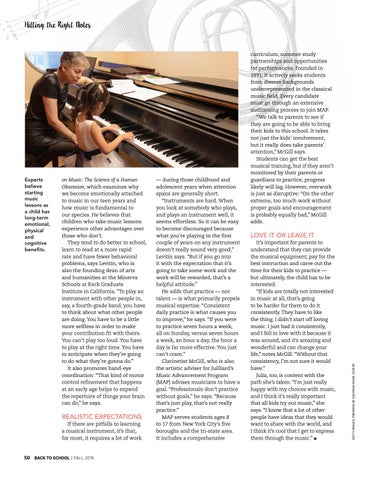
Experts believe starting music lessons as a child has long-term emotional, physical and cognitive benefits.
curriculum, summer study partnerships and opportunities for performances. Founded in 1991, it actively seeks students from diverse backgrounds underrepresented in the classical music field. Every candidate must go through an extensive auditioning process to join MAP. “We talk to parents to see if they are going to be able to bring their kids to this school. It takes not just the kids’ involvement, but it really does take parents’ attention,” McGill says. Students can get the best musical training, but if they aren’t monitored by their parents or guardians to practice, progress likely will lag. However, overwork is just as disruptive: “On the other extreme, too much work without proper goals and encouragement is probably equally bad,” McGill adds.