up front | health
and Human Services Alex Azar. “Vaccines are a safe, highly effective public health solution that can prevent this disease.” Experts also believe the increase is a result of decreased awareness. Some have forgotten the devastation the disease once caused. “When I was growing up, everybody got measles — and some people died,” recalls Michael Gochfeld, professor emeritus at Rutgers University’s Environmental and Occupational Health Sciences Institute. As for polio, “It was lurking at your doorstep — you didn’t go out in the summer.” Measles, ranked among the most contagious diseases in the world, is known for its itchy rash; however, it is actually a respiratory disease. Cough, runny nose, sore throat, red eyes and high fever are among the other symptoms. While the increased number of measles cases has recently received lots of attention, it’s not the only disease making an unwanted comeback. Mumps and pertussis (whooping cough) have been on the rise in recent years, and the previously devastating tuberculosis is still causing trouble, though not at the rate it once did. “It’s pretty incredible because even in the late 1960s, early 1970s, we were having so much success in coming up with new vaccines, new drug treatments, that we really felt like infectious diseases were going to be something we had beaten,” says Judd Hultquist, assistant professor of infectious diseases at Northwestern University’s Feinberg School of Medicine. “Yet, here we are 50 years later, and they’re making a comeback.” l — Lindy Washburn of the North Jersey Record contributed to this article.
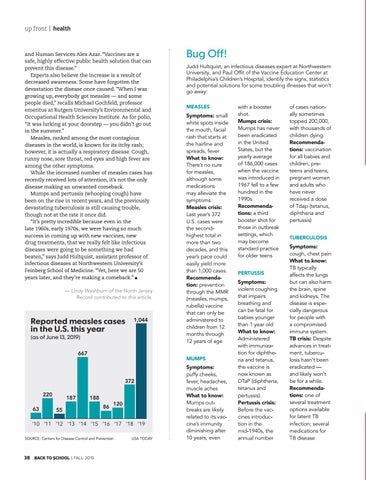
Reported measles cases in the U.S. this year
1,044
(as of June 13, 2019) 667
63
187
Judd Hultquist, an infectious diseases expert at Northwestern University, and Paul Offit of the Vaccine Education Center at Philadelphia’s Children’s Hospital, identify the signs, statistics and potential solutions for some troubling illnesses that won’t go away: MEASLES
Symptoms: small white spots inside the mouth, facial rash that starts at the hairline and spreads, fever What to know: There’s no cure for measles, although some medications may alleviate the symptoms. Measles crisis: Last year’s 372 U.S. cases were the secondhighest total in more than two decades, and this year’s pace could easily yield more than 1,000 cases. Recommendation: prevention through the MMR (measles, mumps, rubella) vaccine that can only be administered to children from 12 months through 12 years of age MUMPS
372 220
Bug Off!
188
55
86
120
‘10 ‘11 ‘12 ‘13 ‘14 ‘15 ‘16 ‘17 ‘18 ‘19 SOURCE: Centers for Disease Control and Prevention
38 BACK TO SCHOOL | FALL 2019
USA TODAY
Symptoms: puffy cheeks, fever, headaches, muscle aches What to know: Mumps outbreaks are likely related to its vaccine’s immunity diminishing after 10 years, even
with a booster shot. Mumps crisis: Mumps has never been eradicated in the United States, but the yearly average of 186,000 cases when the vaccine was introduced in 1967 fell to a few hundred in the 1990s. Recommendations: a third booster shot for those in outbreak settings, which may become standard practice for older teens PERTUSSIS
Symptoms: violent coughing that impairs breathing and can be fatal for babies younger than 1 year old What to know: Administered with immunization for diphtheria and tetanus, the vaccine is now known as DTaP (diphtheria, tetanus and pertussis). Pertussis crisis: Before the vaccines introduction in the mid-1940s, the annual number
of cases nationally sometimes topped 200,000, with thousands of children dying. Recommendations: vaccination for all babies and children, preteens and teens, pregnant women and adults who have never received a dose of Tdap (tetanus, diphtheria and pertussis) TUBERCULOSIS
Symptoms: cough, chest pain What to know: TB typically affects the lungs but can also harm the brain, spine and kidneys. The disease is especially dangerous for people with a compromised immune system. TB crisis: Despite advances in treatment, tuberculosis hasn’t been eradicated — and likely won’t be for a while. Recommendations: one of several treatment options available for latent TB infection; several medications for TB disease