The Masonry Footings, Tower Foundations and Towers
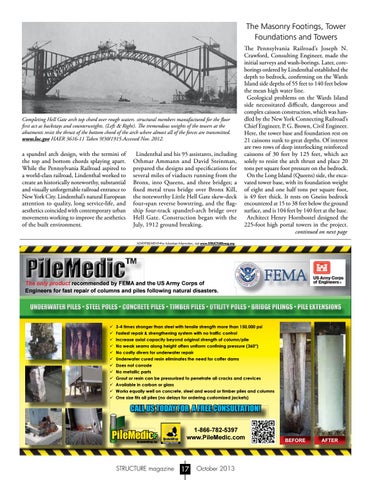
Completing Hell Gate arch top chord over rough waters. structural members manufactured for the floor first act as backstays and counterweights. (Left & Right). The tremendous weights of the towers at the abutments resist the thrust of the bottom chord of the arch where almost all of the forces are transmitted. www.loc.gov HAER 3616-11 Taken 9/30/1915.Accessed Nov. 2012.
a spandrel arch design, with the termini of the top and bottom chords splaying apart. While the Pennsylvania Railroad aspired to a world-class railroad, Lindenthal worked to create an historically noteworthy, substantial and visually unforgettable railroad entrance to New York City. Lindenthal’s natural European attention to quality, long service-life, and aesthetics coincided with contemporary urban movements working to improve the aesthetics of the built environment.
Lindenthal and his 95 assistants, including Othmar Ammann and David Steinman, prepared the designs and specifications for several miles of viaducts running from the Bronx, into Queens, and three bridges; a fixed metal truss bridge over Bronx Kill, the noteworthy Little Hell Gate skew-deck four-span reverse bowstring, and the flagship four-track spandrel-arch bridge over Hell Gate. Construction began with the July, 1912 ground breaking.
The Pennsylvania Railroad’s Joseph N. Crawford, Consulting Engineer, made the initial surveys and wash-borings. Later, coreborings ordered by Lindenthal established the depth to bedrock, confirming on the Wards Island side depths of 55 feet to 140 feet below the mean high water line. Geological problems on the Wards Island side necessitated difficult, dangerous and complex caisson construction, which was handled by the New York Connecting Railroad’s Chief Engineer, P. G. Brown, Civil Engineer. Here, the tower base and foundation rest on 21 caissons sunk to great depths. Of interest are two rows of deep interlocking reinforced caissons of 30 feet by 125 feet, which act solely to resist the arch thrust and place 20 tons per square foot pressure on the bedrock. On the Long Island (Queens) side, the excavated tower base, with its foundation weight of eight and one half tons per square foot, is 49 feet thick. It rests on Gneiss bedrock encountered at 15 to 38 feet below the ground surface, and is 104 feet by 140 feet at the base. Architect Henry Hornbostel designed the 225-foot high portal towers in the project. continued on next page
ADVERTISEMENT–For Advertiser Information, visit www.STRUCTUREmag.org
The only product recommended by FEMA and the US Army Corps of Engineers for fast repair of columns and piles following natural disasters.
UNDERWATER PILES • STEEL POLES • CONCRETE PILES • TIMBER PILES • UTILITY POLES • BRIDGE PILINGS • PILE EXTENSIONS 9 9 9 9 9 9 9 9 9 9 9 9
3-4 times stronger than steel with tensile strength more than 150,000 psi Fastest repair & strengthening system with no traffic control Increase axial capacity beyond original strength of column/pile No weak seams along height offers uniform confining pressure (360°) No costly divers for underwater repair Underwater cured resin eliminates the need for coffer dams Does not corrode No metallic parts Grout or resin can be pressurized to penetrate all cracks and crevices Available in carbon or glass Works equally well on concrete, steel and wood or timber piles and columns One size fits all piles (no delays for ordering customized jackets)
CALL US TODAY FOR A FREE CONSULTATION! TM
By QuakeWrap, Inc.
STRUCTURE magazine
1-866-782-5397 www.PileMedic.com
17
October 2013
BEFORE
AFTER