structural QUALITY Identification, Cause, Prevention, and Repair of Cracks By Dave Flax
C
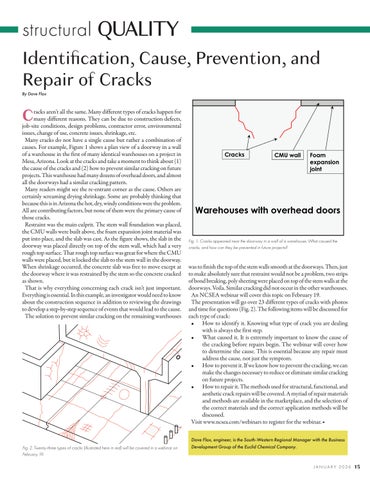
racks aren’t all the same. Many different types of cracks happen for many different reasons. They can be due to construction defects, job-site conditions, design problems, contractor error, environmental issues, change of use, concrete issues, shrinkage, etc. Many cracks do not have a single cause but rather a combination of causes. For example, Figure 1 shows a plan view of a doorway in a wall of a warehouse in the first of many identical warehouses on a project in Mesa, Arizona. Look at the cracks and take a moment to think about (1) the cause of the cracks and (2) how to prevent similar cracking on future projects. This warehouse had many dozens of overhead doors, and almost all the doorways had a similar cracking pattern. Many readers might see the re-entrant corner as the cause. Others are certainly screaming drying shrinkage. Some are probably thinking that because this is in Arizona the hot, dry, windy conditions were the problem. All are contributing factors, but none of them were the primary cause of those cracks. Restraint was the main culprit. The stem wall foundation was placed, the CMU walls were built above, the foam expansion joint material was put into place, and the slab was cast. As the figure shows, the slab in the doorway was placed directly on top of the stem wall, which had a very rough top surface. That rough top surface was great for where the CMU walls were placed, but it locked the slab to the stem wall in the doorway. When shrinkage occurred, the concrete slab was free to move except at the doorway where it was restrained by the stem so the concrete cracked as shown. That is why everything concerning each crack isn’t just important. Everything is essential. In this example, an investigator would need to know about the construction sequence in addition to reviewing the drawings to develop a step-by-step sequence of events that would lead to the cause. The solution to prevent similar cracking on the remaining warehouses
Fig. 2. Twenty-three types of cracks (illustrated here in red) will be covered in a webinar on February 19.
Fig. 1. Cracks appeared near the doorway in a wall of a warehouse. What caused the cracks, and how can they be prevented in future projects?
was to finish the top of the stem walls smooth at the doorways. Then, just to make absolutely sure that restraint would not be a problem, two strips of bond breaking, poly sheeting were placed on top of the stem walls at the doorways. Voila. Similar cracking did not occur in the other warehouses. An NCSEA webinar will cover this topic on February 19. The presentation will go over 23 different types of cracks with photos and time for questions (Fig. 2). The following items will be discussed for each type of crack: • How to identify it. Knowing what type of crack you are dealing with is always the first step. • What caused it. It is extremely important to know the cause of the cracking before repairs begin. The webinar will cover how to determine the cause. This is essential because any repair must address the cause, not just the symptom. • How to prevent it. If we know how to prevent the cracking, we can make the changes necessary to reduce or eliminate similar cracking on future projects. • How to repair it. The methods used for structural, functional, and aesthetic crack repairs will be covered. A myriad of repair materials and methods are available in the marketplace, and the selection of the correct materials and the correct application methods will be discussed. Visit www.ncsea.com/webinars to register for the webinar. ■ Dave Flax, engineer, is the South-Western Regional Manager with the Business Development Group of the Euclid Chemical Company.
JANUARY 2026
15