Both are developed and amended in open public forums through somewhat different consensus processes.
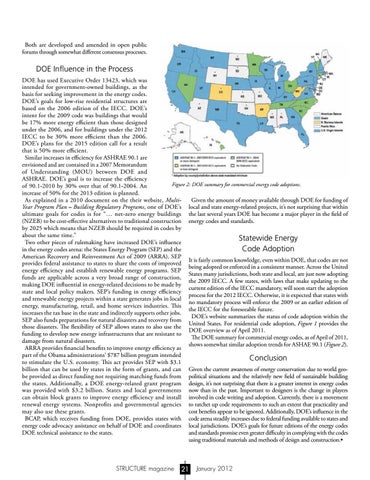
DOE Influence in the Process DOE has used Executive Order 13423, which was intended for government-owned buildings, as the basis for seeking improvement in the energy codes. DOE’s goals for low-rise residential structures are based on the 2006 edition of the IECC. DOE’s intent for the 2009 code was buildings that would be 17% more energy efficient than those designed under the 2006, and for buildings under the 2012 IECC to be 30% more efficient than the 2006. DOE’s plans for the 2015 edition call for a result that is 50% more efficient. Similar increases in efficiency for ASHRAE 90.1 are envisioned and are contained in a 2007 Memorandum of Understanding (MOU) between DOE and ASHRAE. DOE’s goal is to increase the efficiency Figure 2: DOE summary for commercial energy code adoptions. of 90.1-2010 by 30% over that of 90.1-2004. An increase of 50% for the 2013 edition is planned. As explained in a 2010 document on the their website, MultiGiven the amount of money available through DOE for funding of Year Program Plan – Building Regulatory Programs, one of DOE’s local and state energy-related projects, it’s not surprising that within ultimate goals for codes is for “… net-zero energy buildings the last several years DOE has become a major player in the field of (NZEB) to be cost-effective alternatives to traditional construction energy codes and standards. by 2025 which means that NZEB should be required in codes by about the same time.” Statewide Energy Two other pieces of rulemaking have increased DOE’s influence in the energy codes arena: the States Energy Program (SEP) and the Code Adoption American Recovery and Reinvestment Act of 2009 (ARRA). SEP It is fairly common knowledge, even within DOE, that codes are not provides federal assistance to states to share the costs of improved being adopted or enforced in a consistent manner. Across the United energy efficiency and establish renewable energy programs. SEP States many jurisdictions, both state and local, are just now adopting funds are applicable across a very broad range of construction, the 2009 IECC. A few states, with laws that make updating to the making DOE influential in energy-related decisions to be made by current edition of the IECC mandatory, will soon start the adoption state and local policy makers. SEP’s funding in energy efficiency process for the 2012 IECC. Otherwise, it is expected that states with and renewable energy projects within a state generates jobs in local no mandatory process will enforce the 2009 or an earlier edition of energy, manufacturing, retail, and home services industries. This the IECC for the foreseeable future. increases the tax base in the state and indirectly supports other jobs. DOE’s website summarizes the status of code adoption within the SEP also funds preparations for natural disasters and recovery from United States. For residential code adoption, Figure 1 provides the those disasters. The flexibility of SEP allows states to also use the DOE overview as of April 2011. funding to develop new energy infrastructures that are resistant to The DOE summary for commercial energy codes, as of April of 2011, damage from natural disasters. shows somewhat similar adoption trends for ASHAE 90.1 (Figure 2). ARRA provides financial benefits to improve energy efficiency as part of the Obama administrations’ $787 billion program intended Conclusion to stimulate the U.S. economy. This act provides SEP with $3.1 billion that can be used by states in the form of grants, and can Given the current awareness of energy conservation due to world geobe provided as direct funding not requiring matching funds from political situations and the relatively new field of sustainable building the states. Additionally, a DOE energy-related grant program design, it’s not surprising that there is a greater interest in energy codes was provided with $3.2 billion. States and local governments now than in the past. Important to designers is the change in players can obtain block grants to improve energy efficiency and install involved in code writing and adoption. Currently, there is a movement renewal energy systems. Nonprofits and governmental agencies to ratchet up code requirements to such an extent that practicality and may also use these grants. cost benefits appear to be ignored. Additionally, DOE’s influence in the BCAP, which receives funding from DOE, provides states with code arena steadily increases due to federal funding available to states and energy code advocacy assistance on behalf of DOE and coordinates local jurisdictions. DOE’s goals for future editions of the energy codes DOE technical assistance to the states. and standards promise even greater difficulty in complying with the codes using traditional materials and methods of design and construction.▪
STRUCTURE magazine
21
January 2012