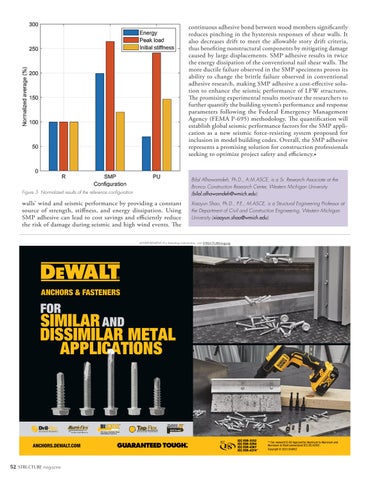
continuous adhesive bond between wood members significantly reduces pinching in the hysteresis responses of shear walls. It also decreases drift to meet the allowable story drift criteria, thus benefiting nonstructural components by mitigating damage caused by large displacements. SMP adhesive results in twice the energy dissipation of the conventional nail shear walls. The more ductile failure observed in the SMP specimens proves its ability to change the brittle failure observed in conventional adhesive research, making SMP adhesive a cost-effective solution to enhance the seismic performance of LFW structures. The promising experimental results motivate the researchers to further quantify the building system’s performance and response parameters following the Federal Emergency Management Agency (FEMA P-695) methodology. The quantification will establish global seismic performance factors for the SMP application as a new seismic force-resisting system proposed for inclusion in model building codes. Overall, the SMP adhesive represents a promising solution for construction professionals seeking to optimize project safety and efficiency.■
Bilal Alhawamdeh, Ph.D., A.M.ASCE, is a Sr. Research Associate at the Bronco Construction Research Center, Western Michigan University (bilal.alhawamdeh@wmich.edu).
Figure 3 Normalized results of the reference configuration
walls’ wind and seismic performance by providing a constant source of strength, stiffness, and energy dissipation. Using SMP adhesive can lead to cost savings and efficiently reduce the risk of damage during seismic and high wind events. The
Xiaoyun Shao, Ph.D., P.E., M.ASCE, is a Structural Engineering Professor at the Department of Civil and Construction Engineering, Western Michigan University (xiaoyun.shao@wmich.edu).
ADVERTISEMENT–For Advertiser Information, visit STRUCTUREmag.org
Drill Screws
52 STRUCTURE magazine