public-private institutions, non-profits, and their constituents. While the term is not our own, we do believe it best describes the various initiatives surveyed herein. EXPERIMENTATION INFORMS DESIGN In short, tactical urbanism interventions create a laboratory for experimentation. Case studies from across North America reveal the benefit of taking an incremental approach to the process of city building. To be sure, long term change often starts with the process of trying something small. Upon implementation, results may be observed and measured in real time. And when done inexpensively, and with flexibility, adjustments may be made before moving forward. Indeed, there is real merit in a municipality spending $30,000 on temporary material changes before investing $3,000,000 in those that are permanent. If the improvement doesn’t work as planned, the whole budget will not be shot, and future designs can continue to be calibrated to meet the needs of a particular, and dynamic context. If done well, such small scale changes may be conceived as the first step in realizing lasting change. Thus, tactical urbanism is most effective when used in conjunction with long term planning efforts.
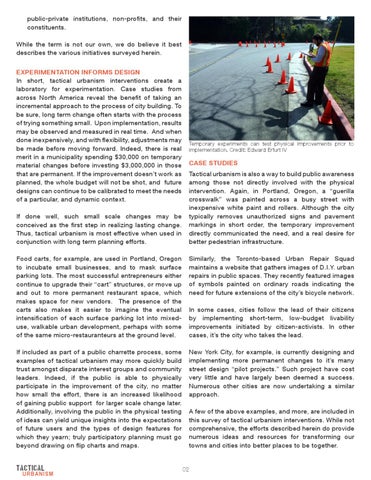
Temporary experiments can test physical improvements prior to implementation. Credit: Edward Erfurt IV
CASE STUDIES Tactical urbanism is also a way to build public awareness among those not directly involved with the physical intervention. Again, in Portland, Oregon, a “guerilla crosswalk” was painted across a busy street with inexpensive white paint and rollers. Although the city typically removes unauthorized signs and pavement markings in short order, the temporary improvement directly communicated the need, and a real desire for better pedestrian infrastructure.
Food carts, for example, are used in Portland, Oregon to incubate small businesses, and to mask surface parking lots. The most successful entrepreneurs either continue to upgrade their “cart” structures, or move up and out to more permanent restaurant space, which makes space for new vendors. The presence of the carts also makes it easier to imagine the eventual intensification of each surface parking lot into mixeduse, walkable urban development, perhaps with some of the same micro-restauranteurs at the ground level.
Similarly, the Toronto-based Urban Repair Squad maintains a website that gathers images of D.I.Y. urban repairs in public spaces. They recently featured images of symbols painted on ordinary roads indicating the need for future extensions of the city’s bicycle network.
If included as part of a public charrette process, some examples of tactical urbanism may more quickly build trust amongst disparate interest groups and community leaders. Indeed, if the public is able to physically participate in the improvement of the city, no matter how small the effort, there is an increased likelihood of gaining public support for larger scale change later. Additionally, involving the public in the physical testing of ideas can yield unique insights into the expectations of future users and the types of design features for which they yearn; truly participatory planning must go beyond drawing on flip charts and maps.
New York City, for example, is currently designing and implementing more permanent changes to it’s many street design “pilot projects.” Such project have cost very little and have largely been deemed a success. Numerous other cities are now undertaking a similar approach.
Tactical
URBANISM
In some cases, cities follow the lead of their citizens by implementing short-term, low-budget livability improvements initiated by citizen-activists. In other cases, it’s the city who takes the lead.
A few of the above examples, and more, are included in this survey of tactical urbanism interventions. While not comprehensive, the efforts described herein do provide numerous ideas and resources for transforming our towns and cities into better places to be together. 02