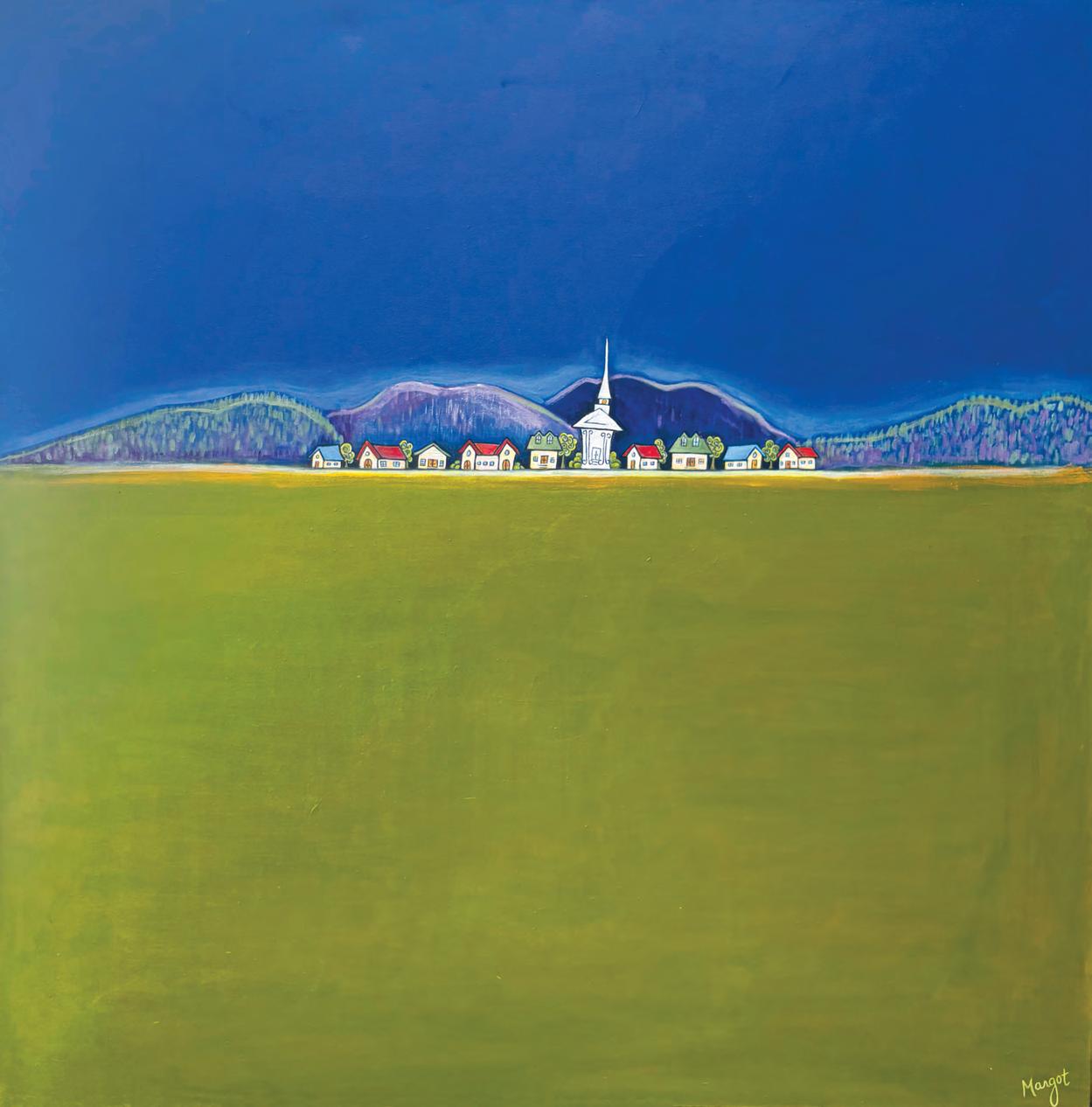
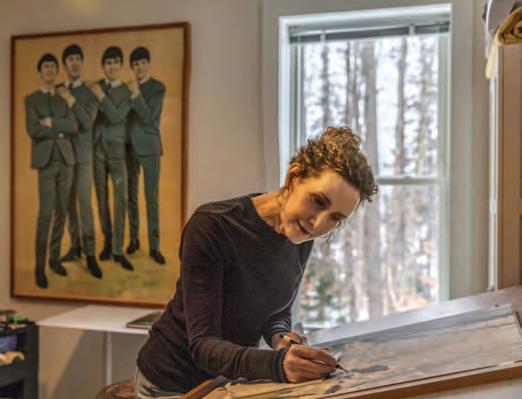
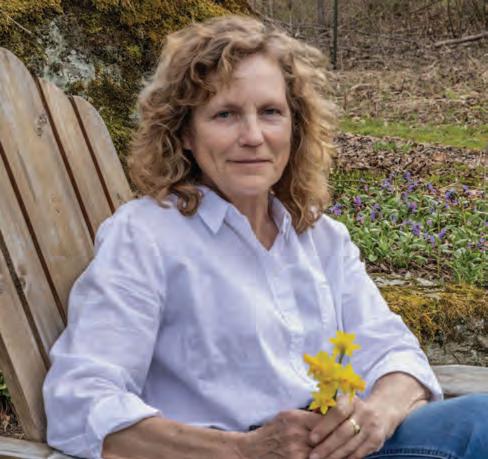
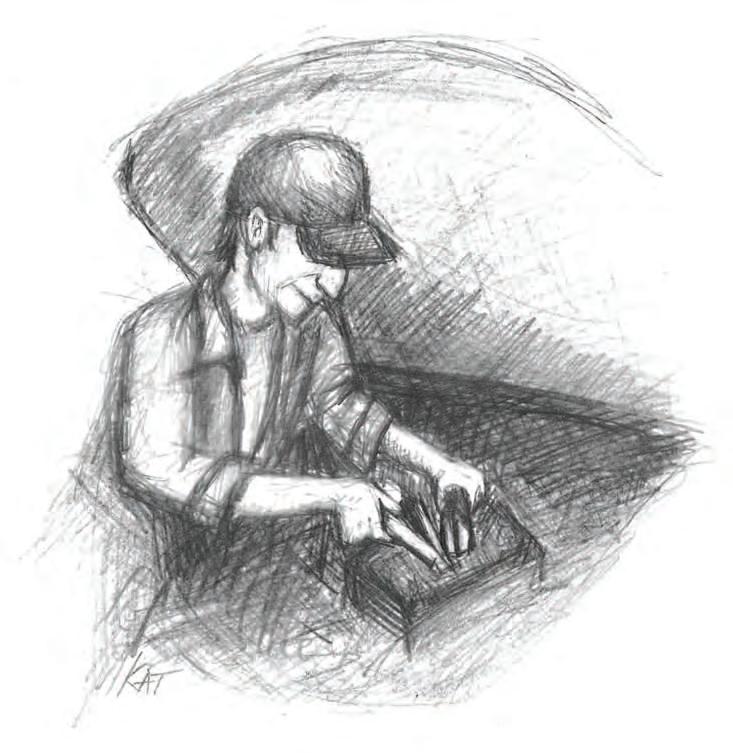
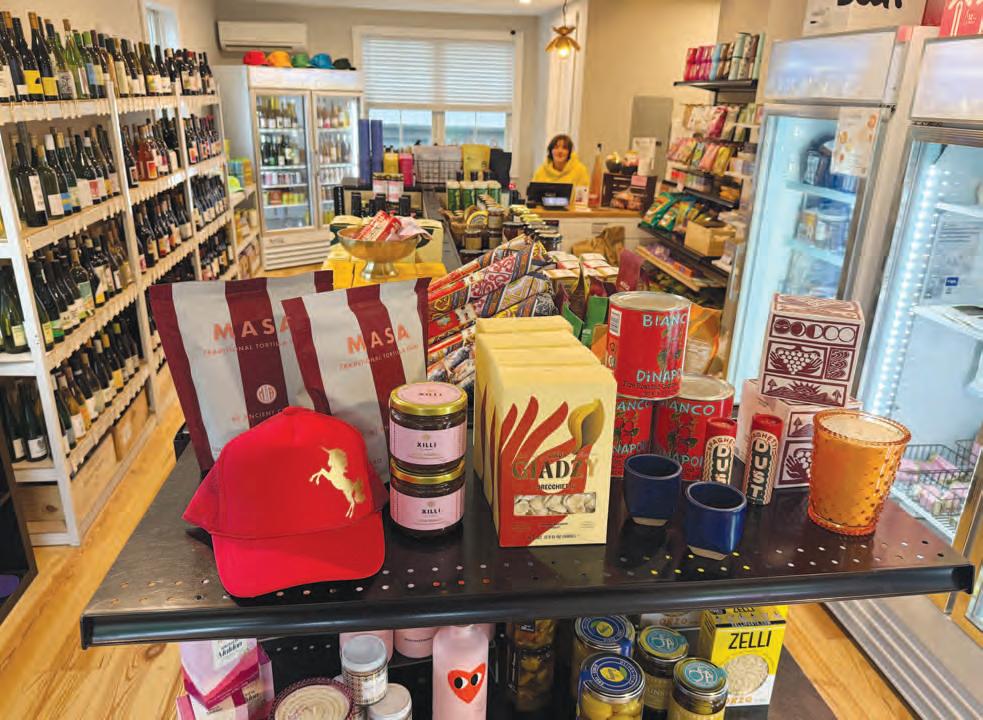
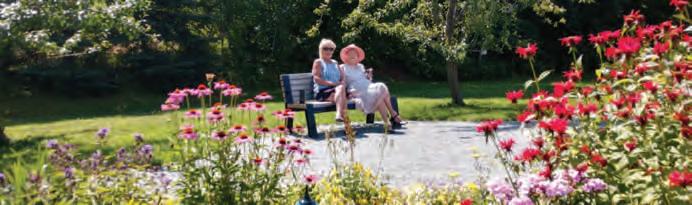
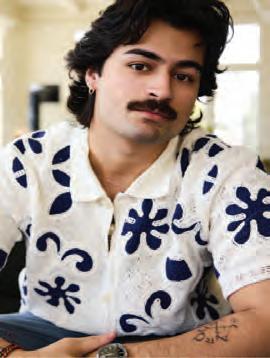
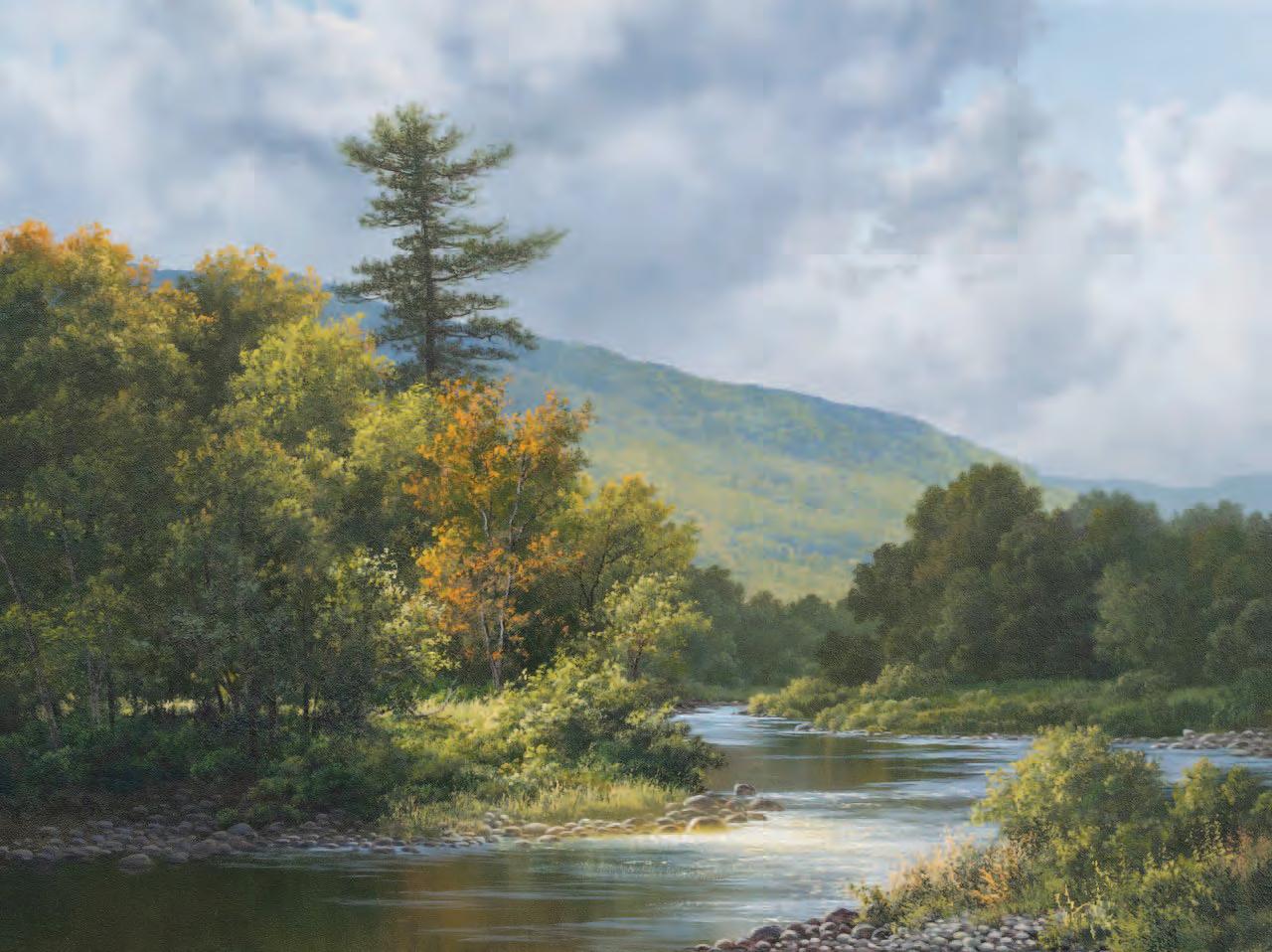
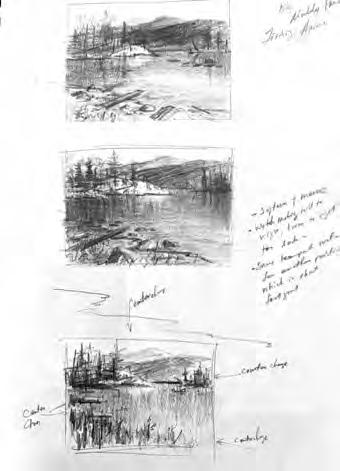
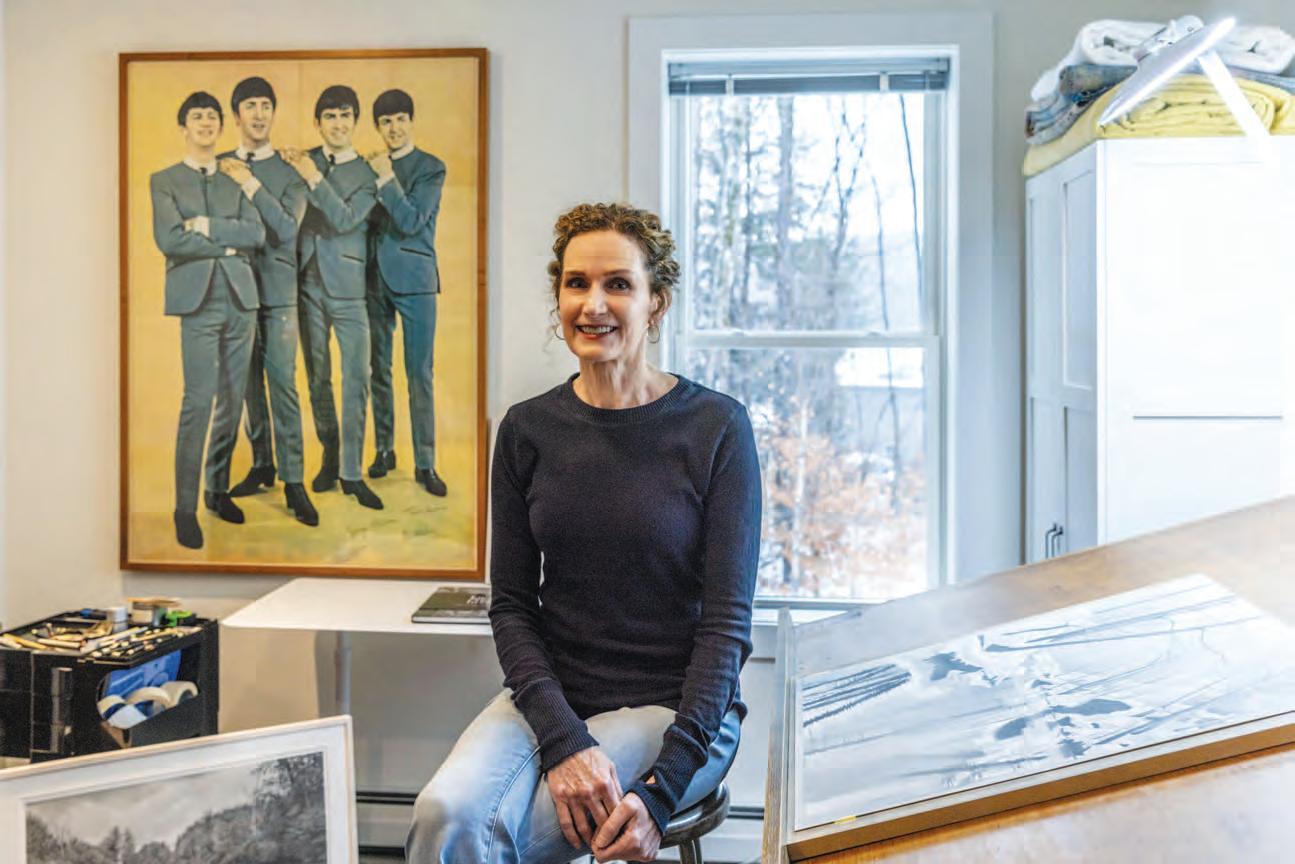
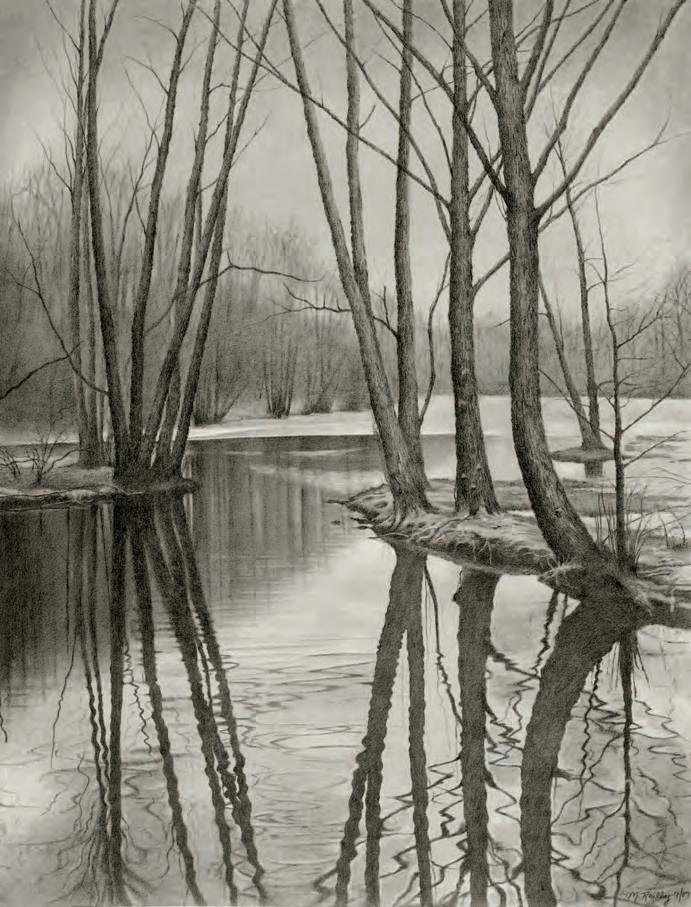
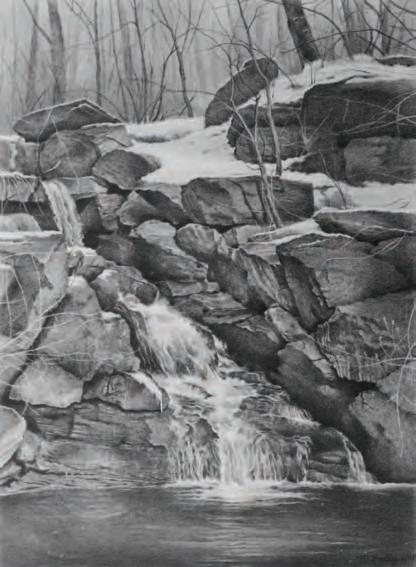
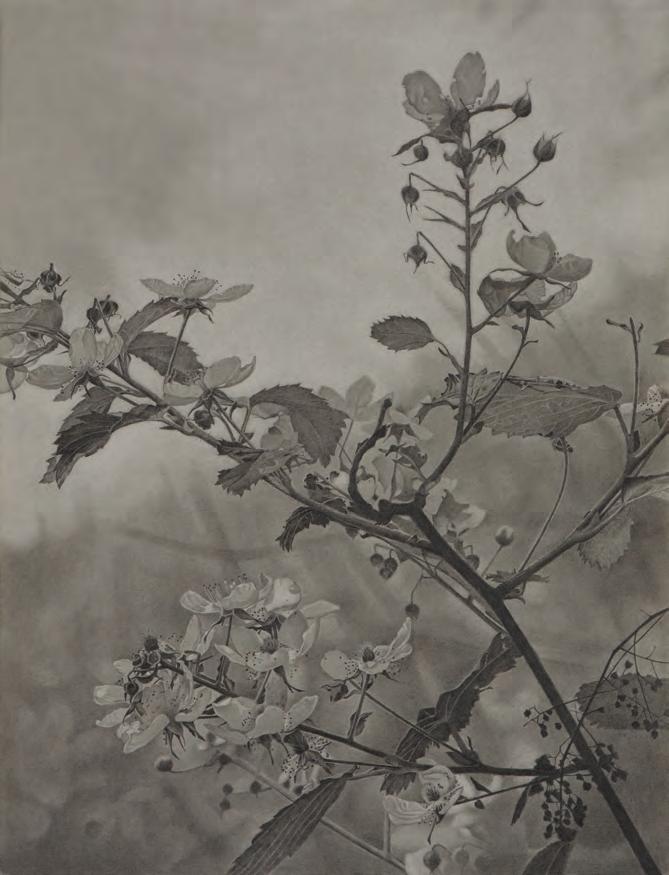
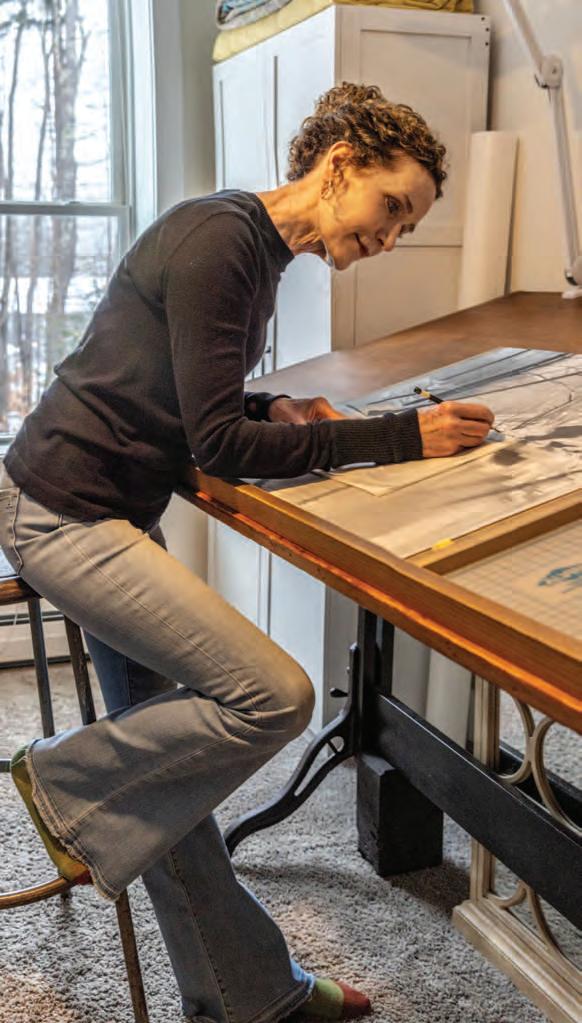
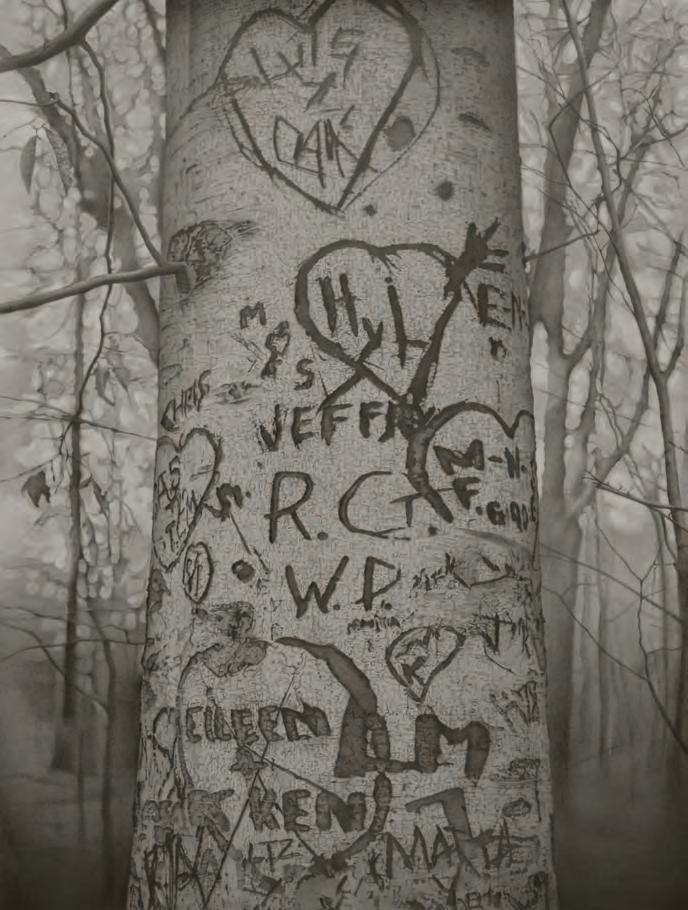
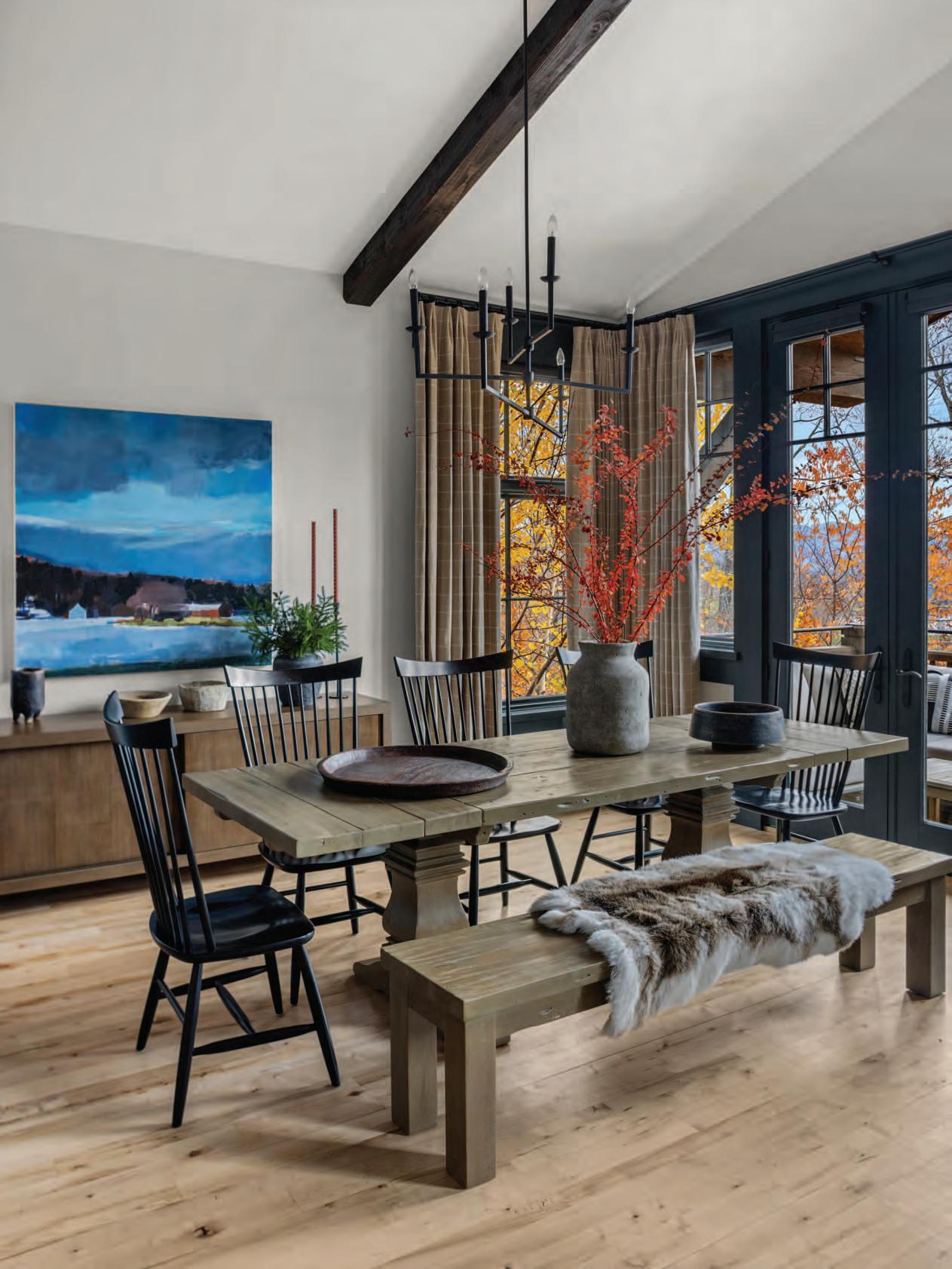
Originally from Canada, Rowan formerly lived in Stowe where she worked as a graphic artist at The Stowe Reporter, which publishes this magazine. During her time here, Rowan’s paintings often captured the vibrant Vermont landscape, sometimes in an amusing way, like the one on our cover. Rowan, while busy raising two boys, put art on the back burner. But as her boys grew, she slowly returned to painting and quickly regained her momentum.
Now living in Colorado, her focus has shifted from landscapes to finding her creative voice in abstract expressionism. Her work is dramatic, and summons attention through her powerful use of a limited palette, strong shapes, and lyrically bold mark-making. She works in acrylics and mixed media.
Whether a landscape or abstract piece, Rowan’s works are exuberant and full of life. More at margotrowan.com.
Katerina H Werth
Tommy Gardner
Katerina H Werth
Gordon Miller
Wendy Ewing, David Hatoff, Judy Kearns, Michael Kitchen, Bryan Meszkat
Leslie Lafountain
Kate Carter, Greg J Popa
Mark Aiken, Drew Bressel, Kate Carter, Lindsay Raymondjack, Paul Rogers, Tom Rogers, Kevin Walsh
Mark Aiken, Patrick Billow, Mark Bushnell, Aaron Calvin, Kate Carter, Biddle Duke, David Hatoff, Robert Kiener, Sabrina Staab, Kevin Walsh
Stowe Guide & Magazine is published twice a year: Winter/Spring & Summer/Fall
Vermont Community Newspaper Group LLC P.O. Box 489, Stowe VT 05672
Website: stowetoday.com, vtcng.com
Editorial inquiries: katerina@stowereporter.com
Ad submission: ads@stowereporter.com
Phone: (802) 253-2101 Fax: (802) 253-8332
Copyright: Articles and photographs are protected by copyright and cannot be used without permission.
Editorial submissions are welcome:
Vermont Community Newspaper Group P.O. Box 489, Stowe VT 05672
Publication is not guaranteed. Enclose SASE for return.
Subscriptions are $24 per year. Send a check or money order to Stowe Guide, P.O. Box 489, Stowe, 05672
Advertising inquiries are welcome.
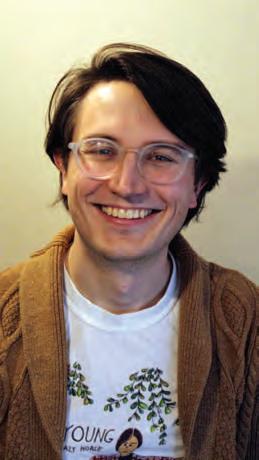
MARK AIKEN
IN THIS ISSUE: Jon Osborne emphasizes family and Maple p.80 / Edibles p.160 / Trail Mix, p.66
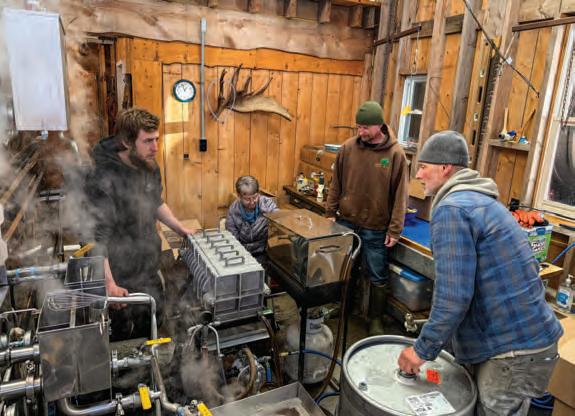
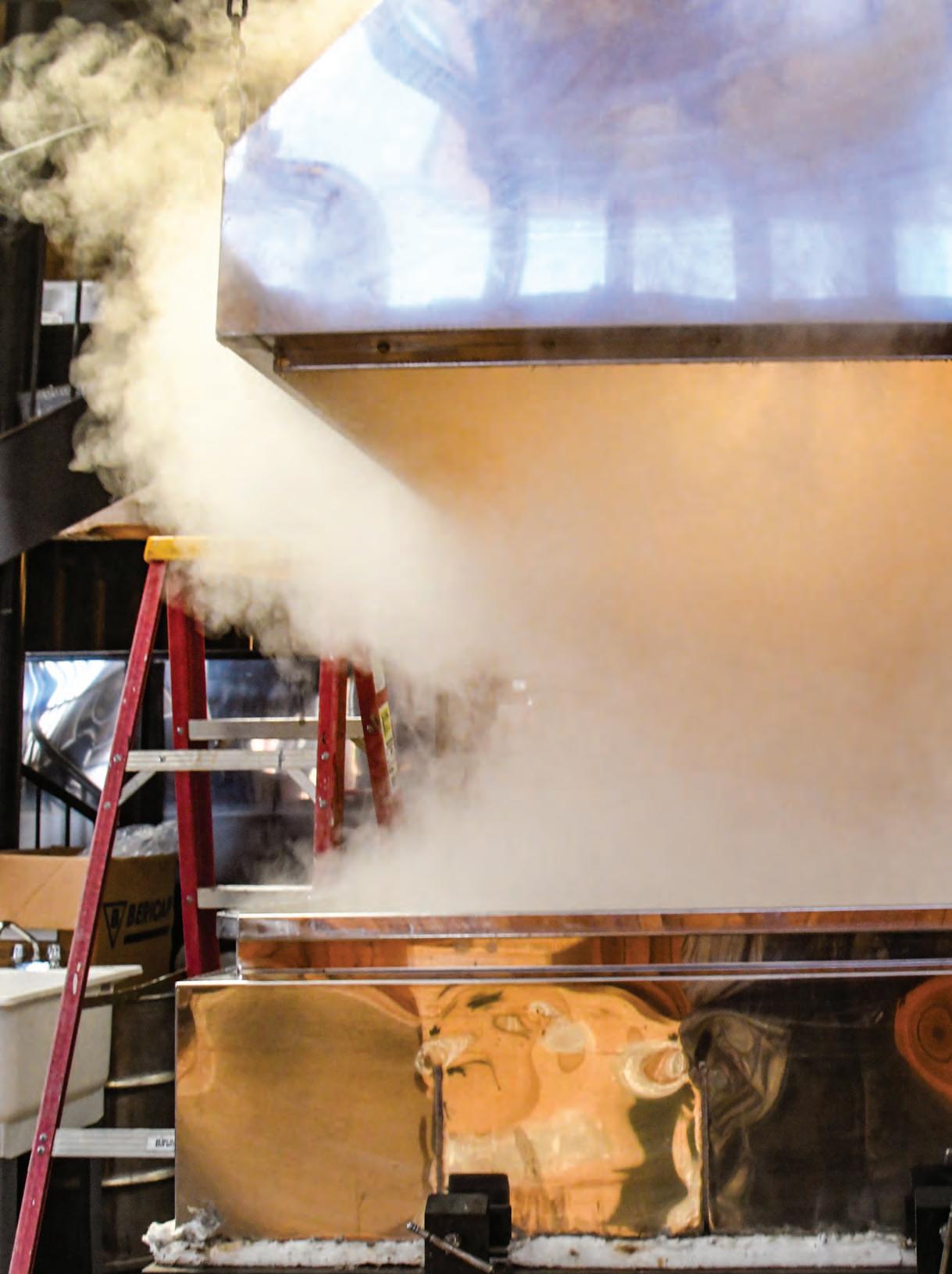
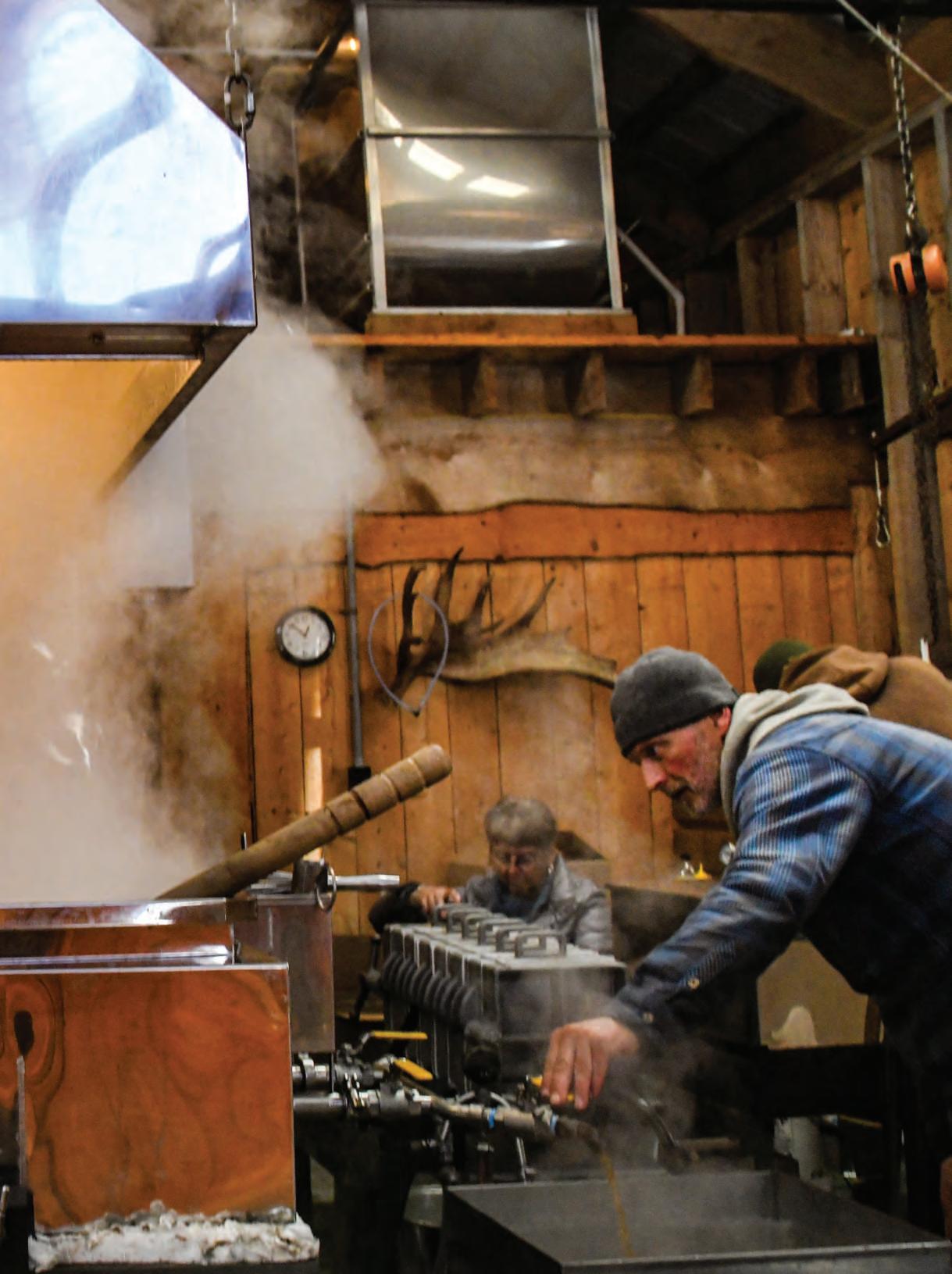
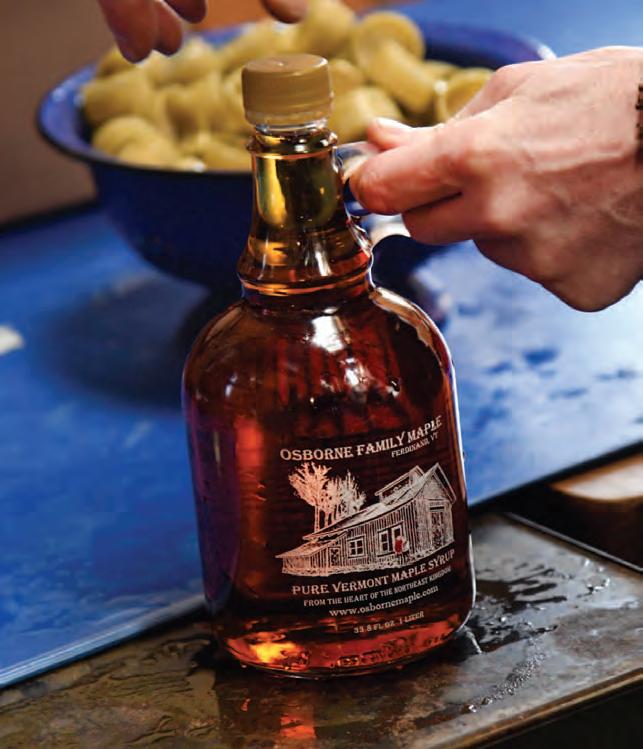
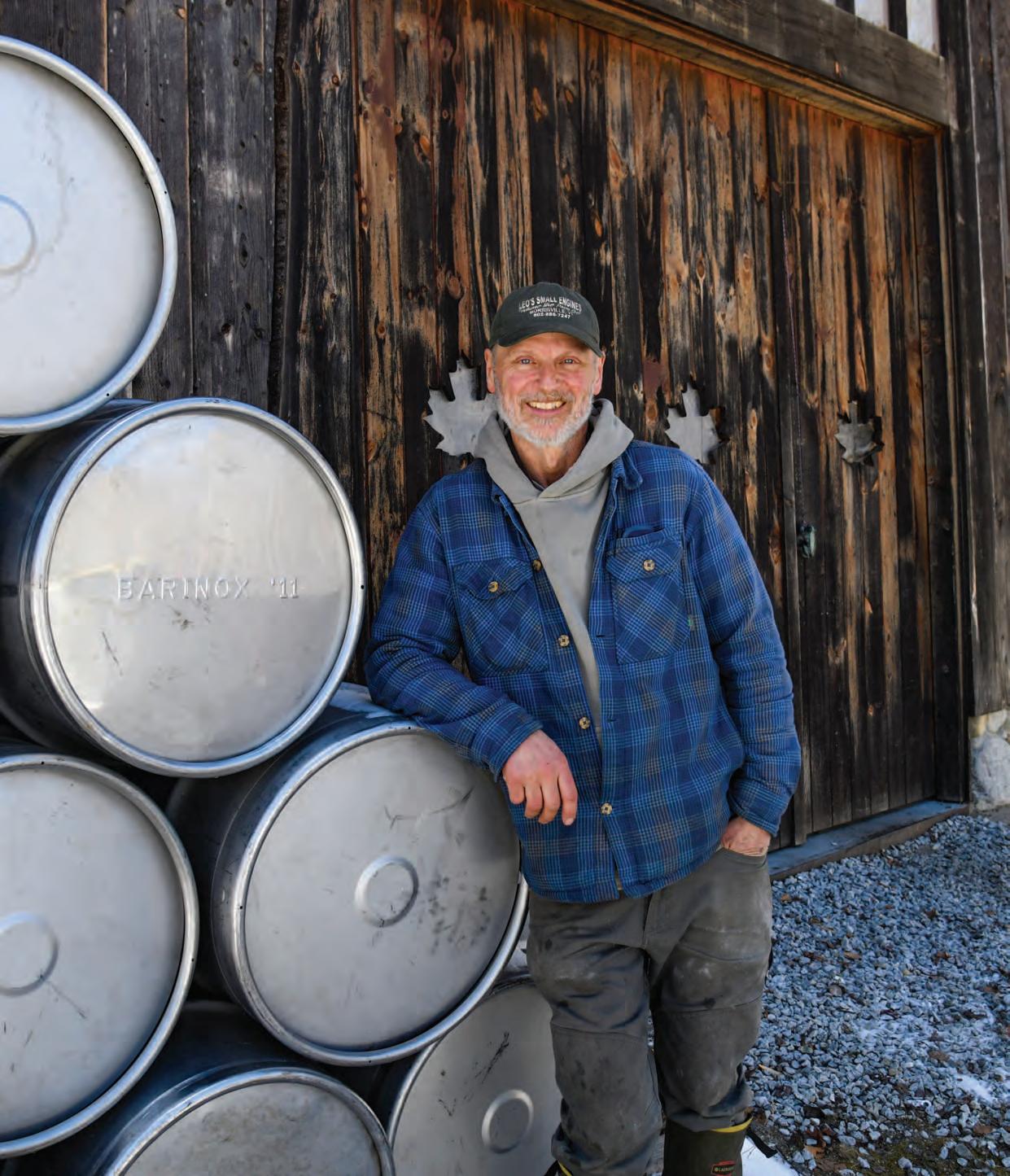
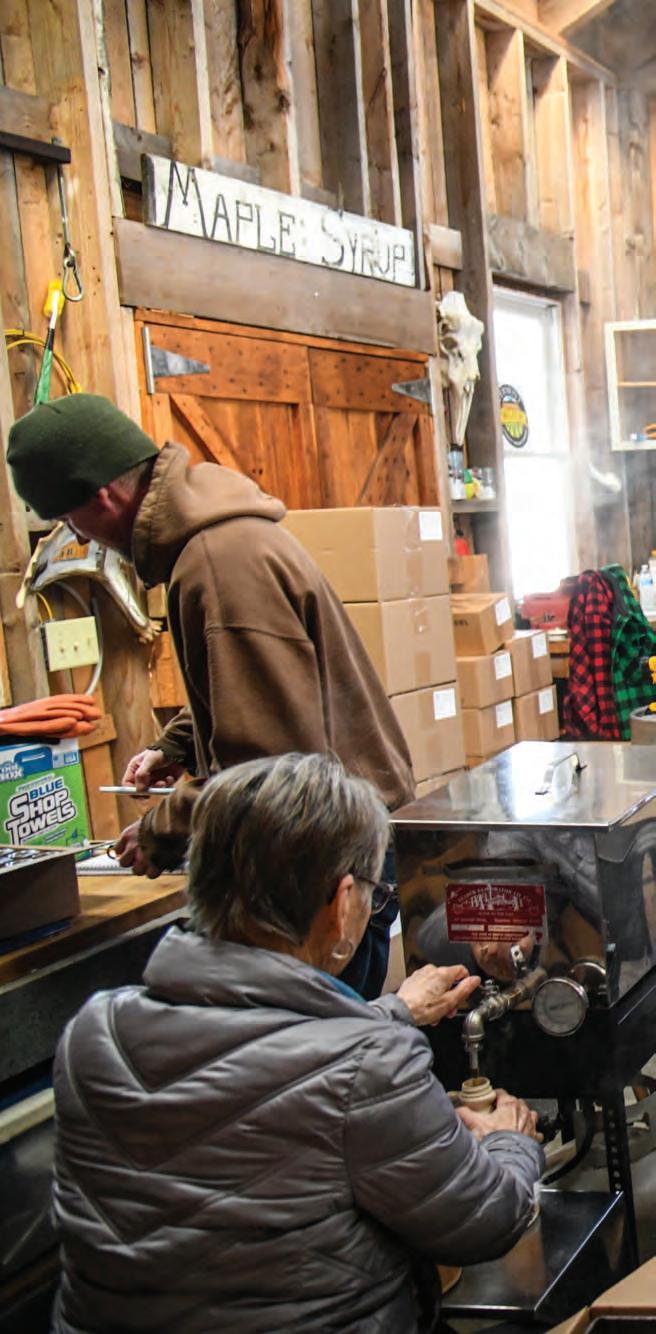
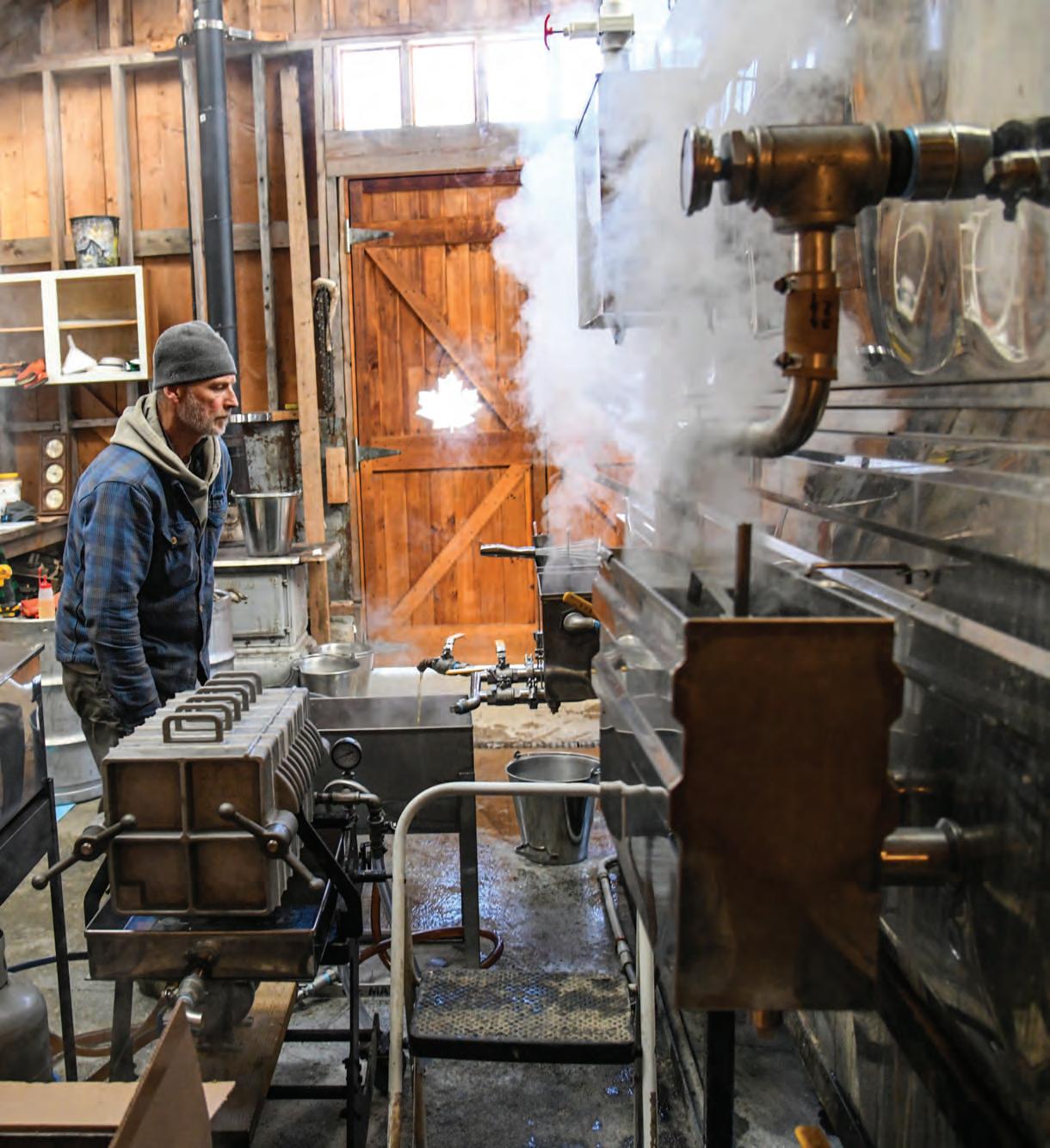
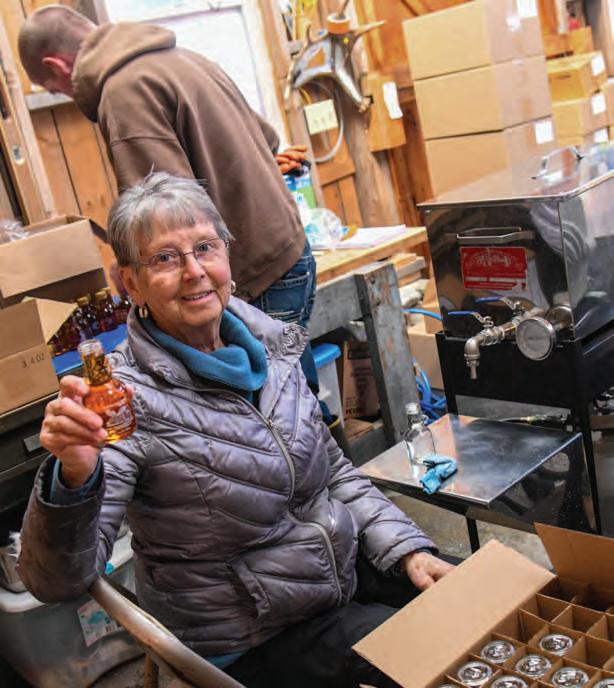
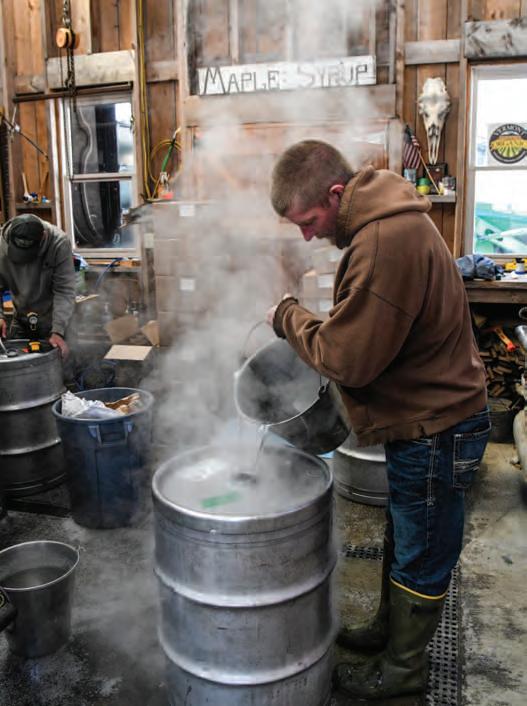
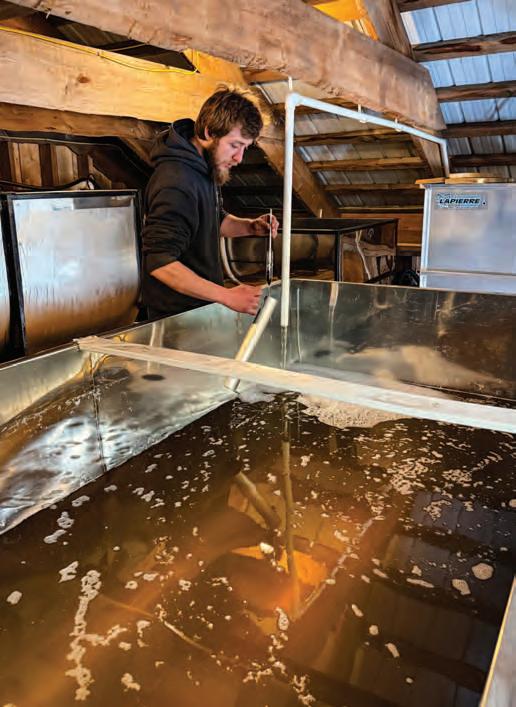
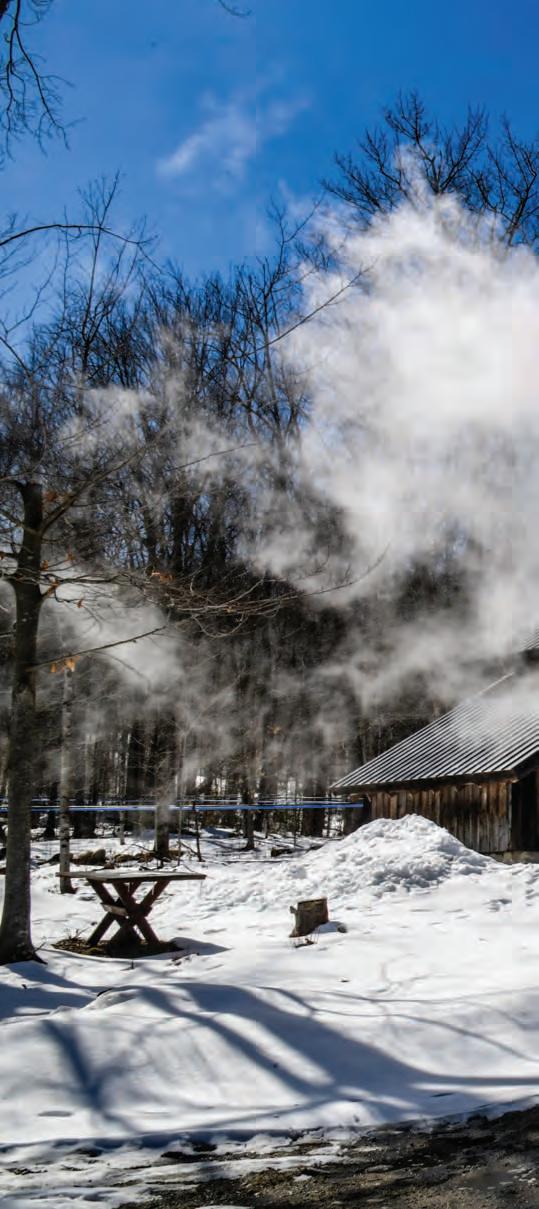
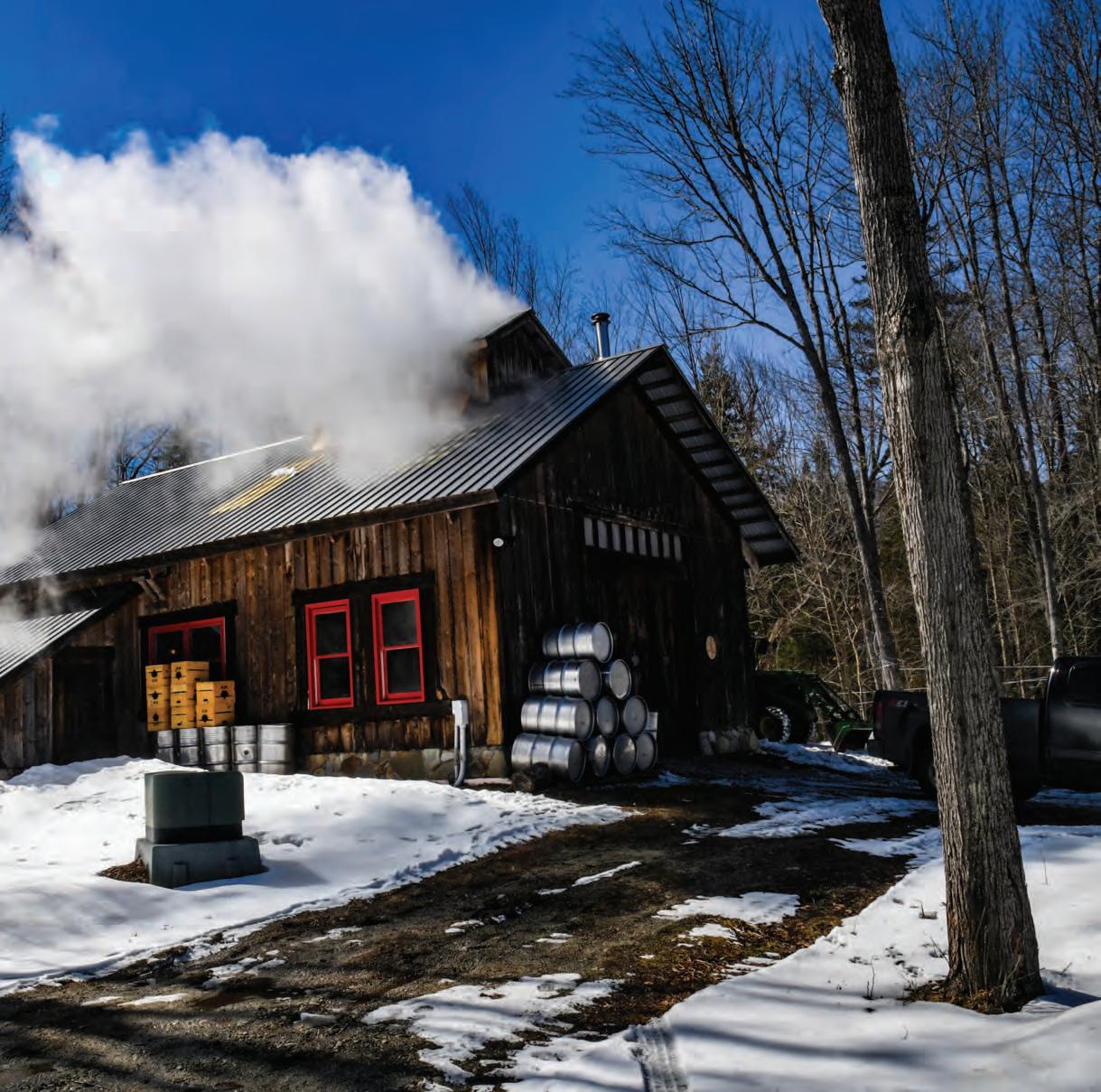
Behind the scenes: I live on a dirt road that gets pretty bad sometimes in mud season. But nothing like the road I encountered on my way to a sap boil with Jon Osborne at his sugarhouse in Ferdinand. “I meant to ask what kind of car you were driving,” he said, observing mud caked on the sides of my truck. It’s a good thing I drove the truck; my other car’s a minivan, and it would have never survived. “I’m glad you made it,” he said. “A lot of people can't find Ferdinand on the map.”
Currently: When he’s not boiling his own sap or interviewing sugarmakers, Mark, a freelance writer, teaches skiing at Stowe, leads clinics for PSIA (Professional Ski Instructors of America) and—his favorite full-time role—is a husband and dad in Richmond.
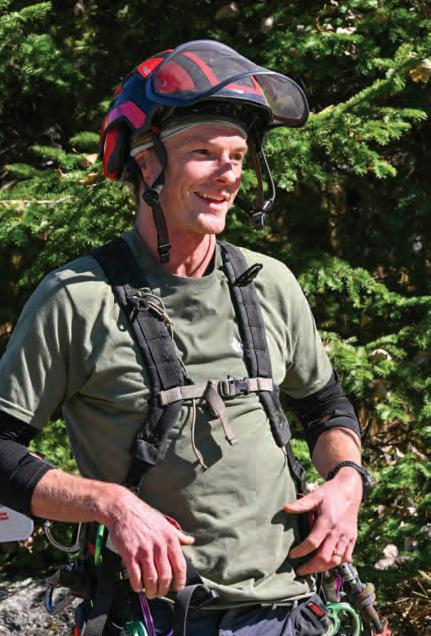
AARON CALVIN
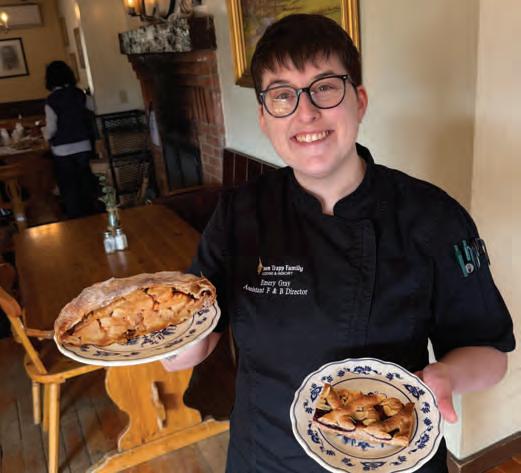
IN THIS ISSUE: Disrupted p.118 / von Trapp staples, p.168
Behind the scenes: Adriana Teresa Letorney, director of the movie "Disrupted", was born in Puerto Rico but relocated to Stowe with her husband, who is from Vermont. The couple were looking to settle in Vermont and were charmed by Stowe, which she says has "innate magic" and "felt inclusive and diverse in some ways" because she heard different languages being spoken on the streets.
Currently: Aaron Calvin is an award-winning journalist and writer living in Vermont. He's currently a staff writer at the Burlington weekly Seven Days, and previously worked at The Stowe Reporter and News & Citizen newspapers covering Lamoille County. He was named the New England Newspaper and Press Association's Reporter of the Year for 2024.
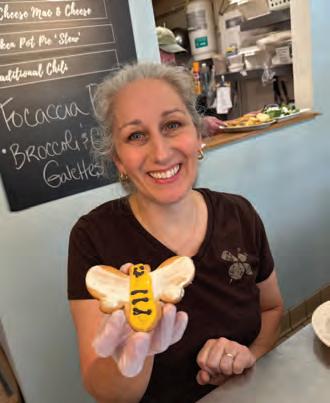
KATE CARTER
IN THIS ISSUE: Sips of summer, p.144, Inclusive and welcoming: Sense of place at Straw Corner , p.206
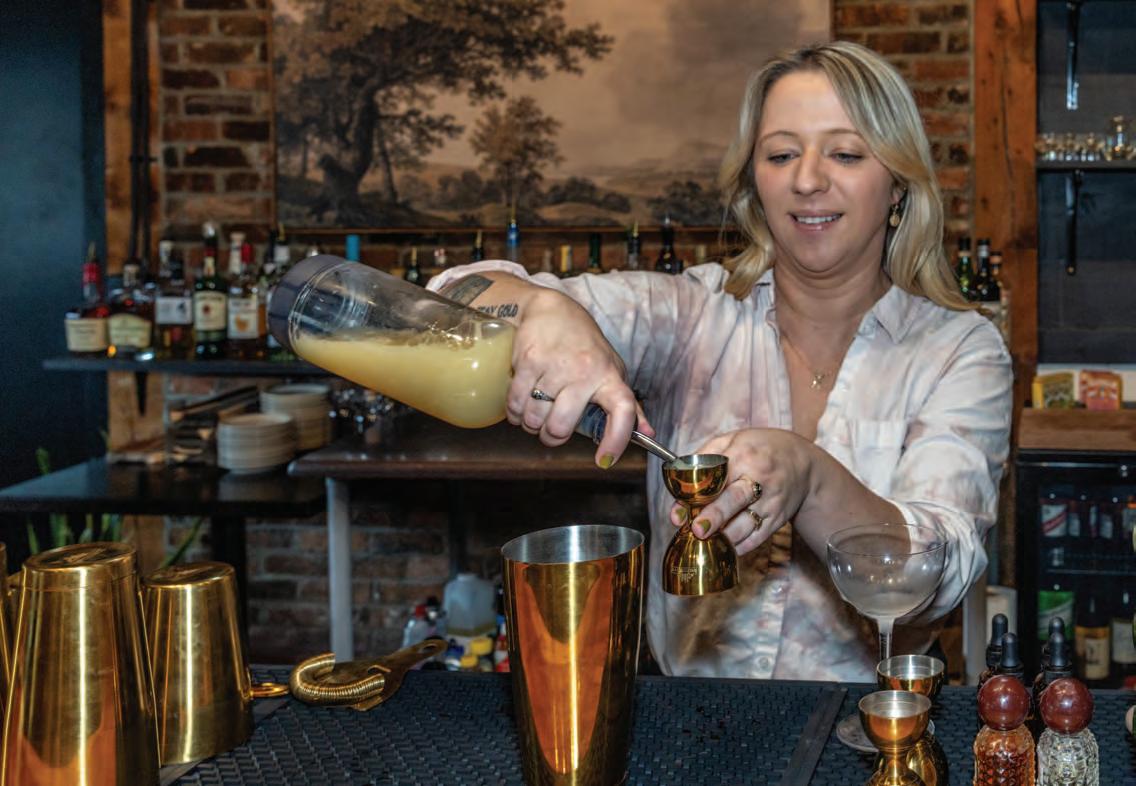
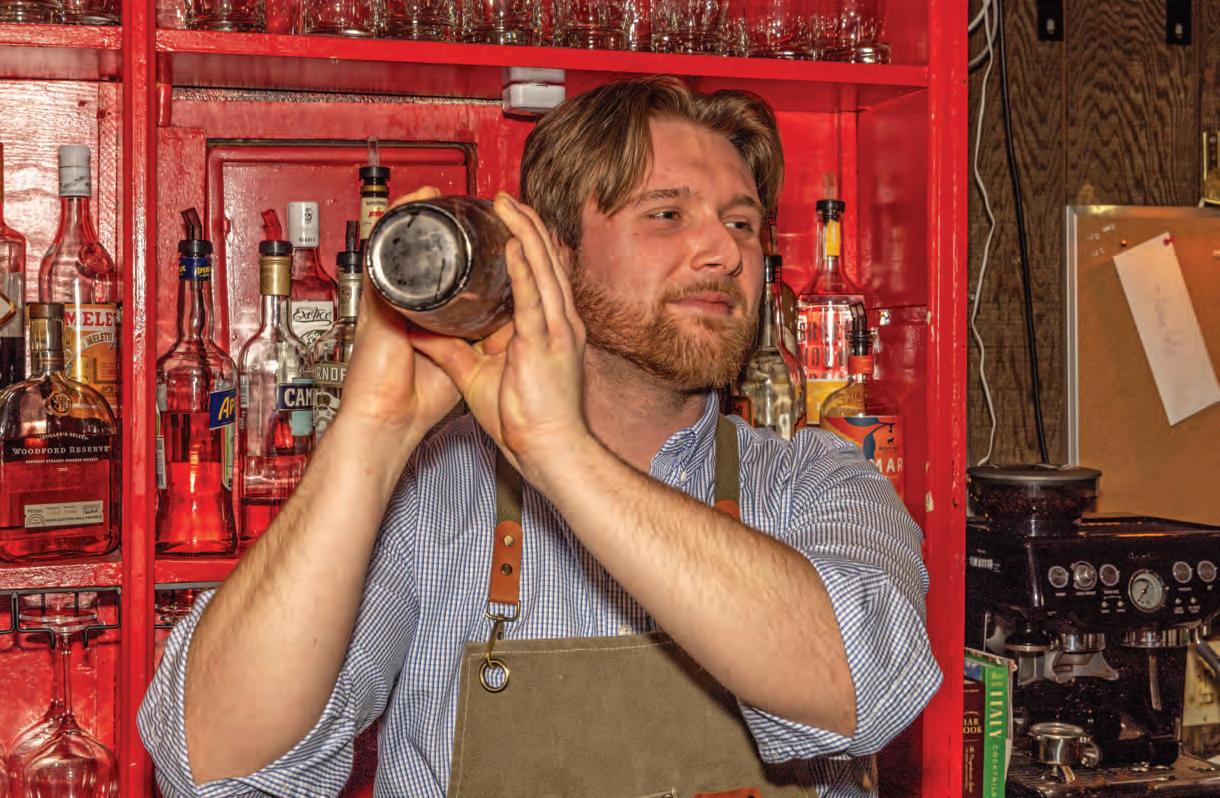
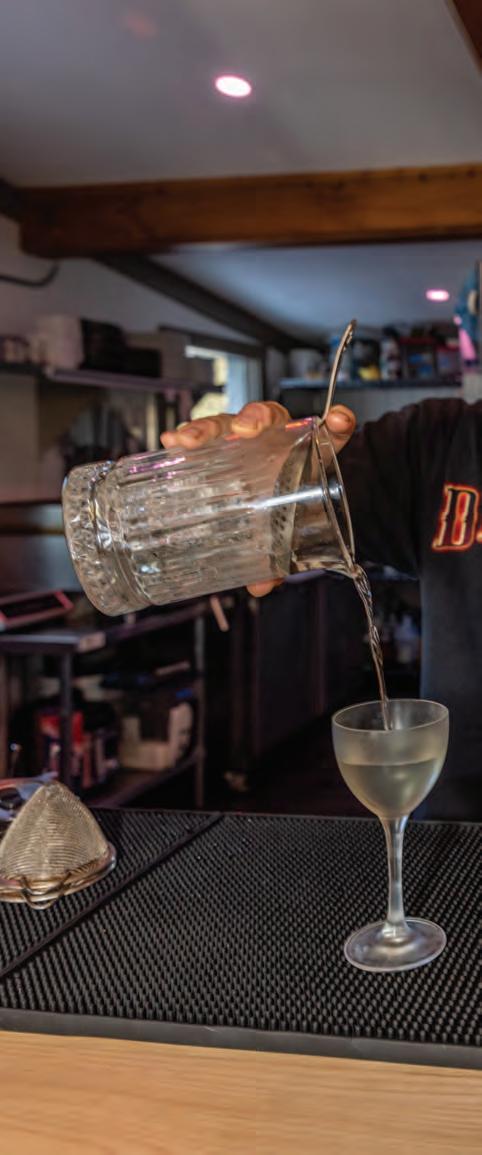
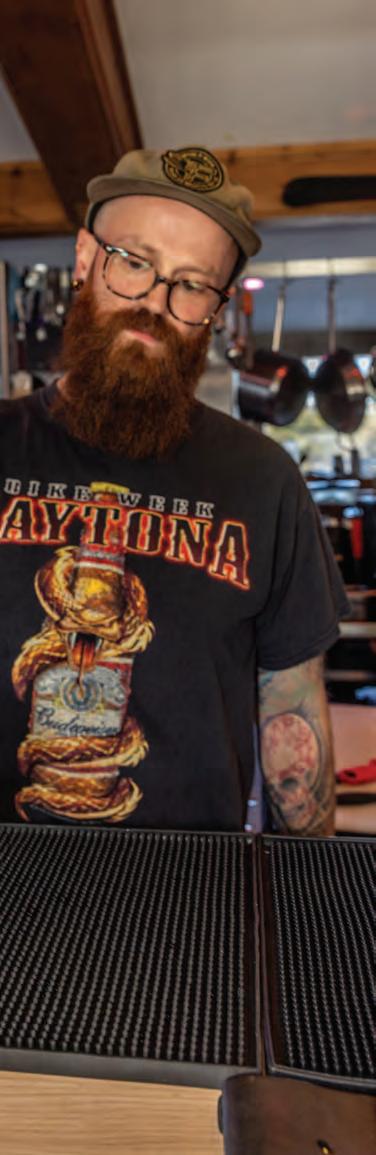
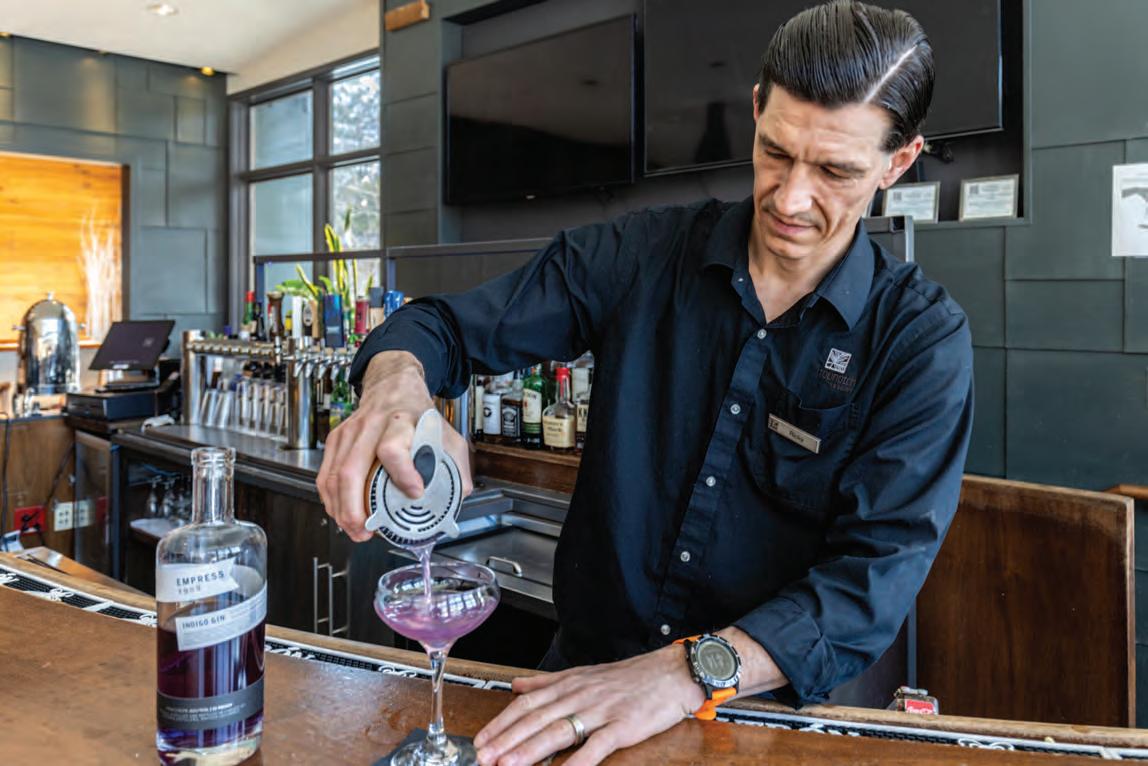
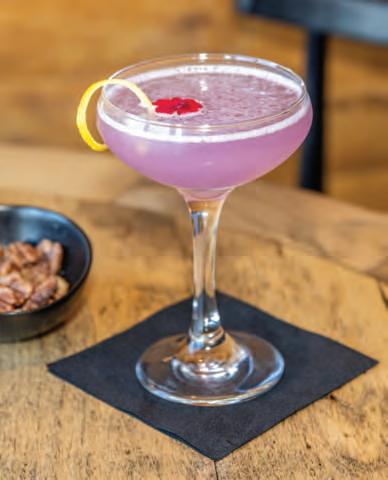
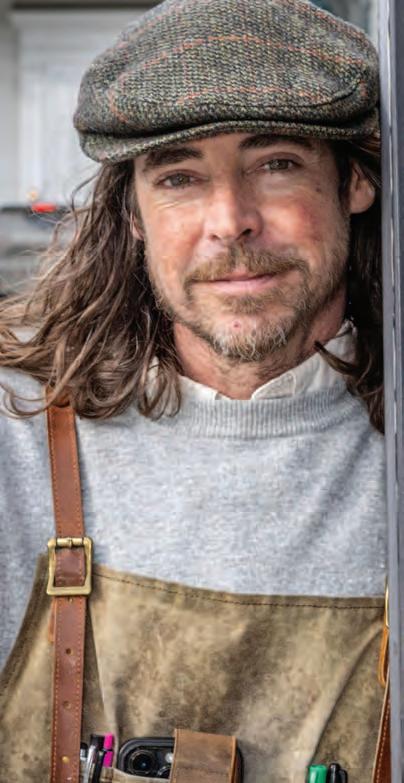
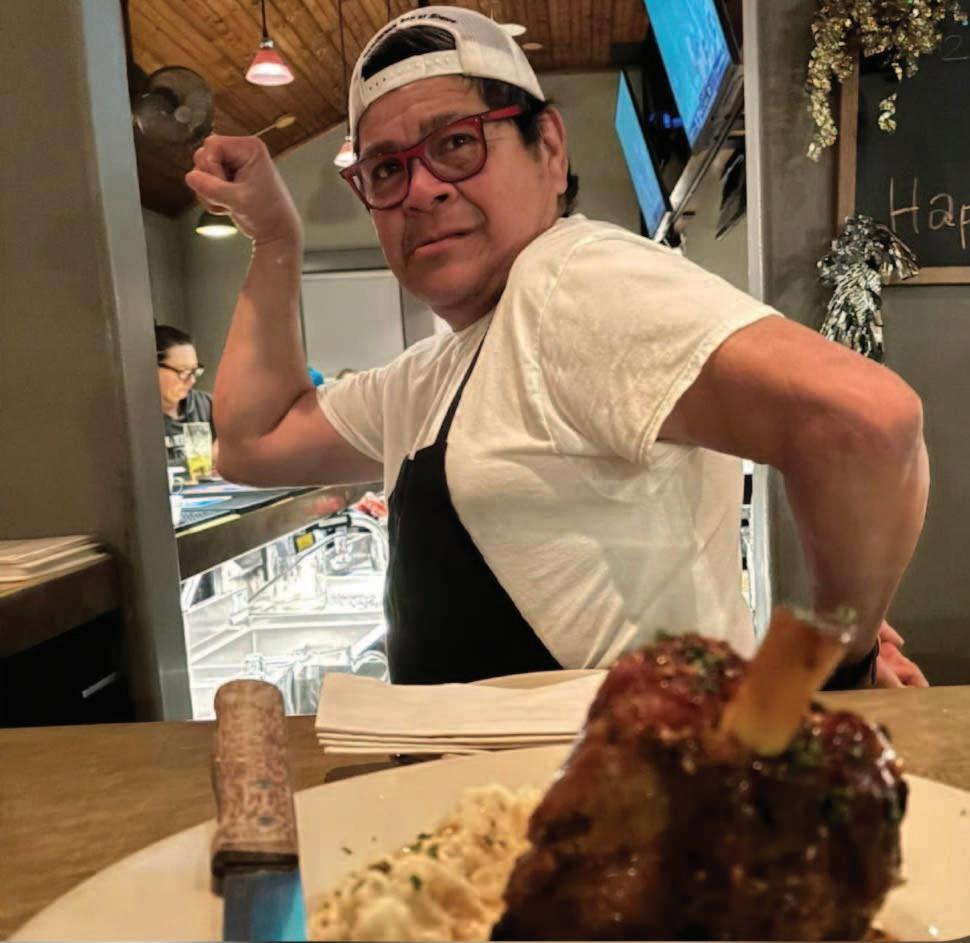
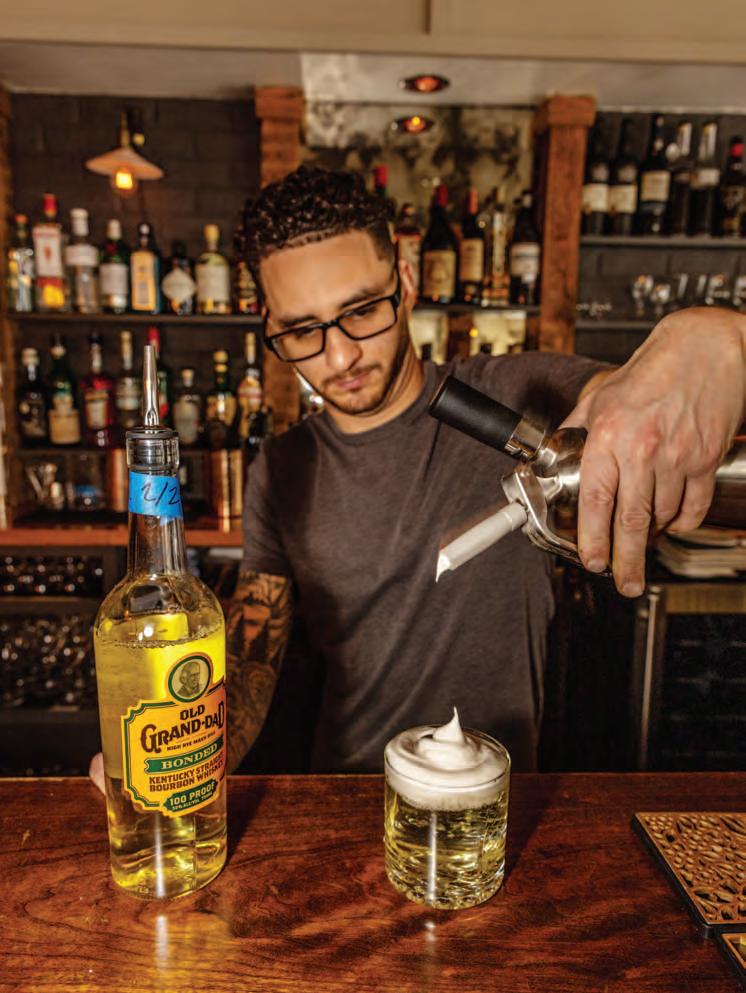
Behind the scenes: Best assignment ever! Meeting the six bartenders featured in this story, watching them make their exclusive cocktails, tasting them, and photographing the creators and their creations was a highlight of my winter. I was so impressed with their imaginations and willingness to welcome me into their mixology world. Best of all, every one had great stories behind their drinks’ names. And no, I did not visit them all in one day. It took six.
Currently: Kate is a freelance writer and photographer. When she’s not researching stories, she is photographing homes for builders, interior designers, property managers, real estate agents, and this magazine. Contact her at vtrealestatephotos.com.
PAUL ROGERS
IN THIS ISSUE: Presence & form, p.92 / Stick season p.98
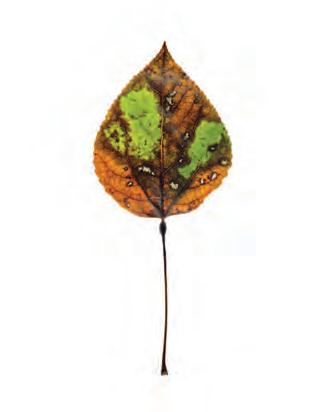
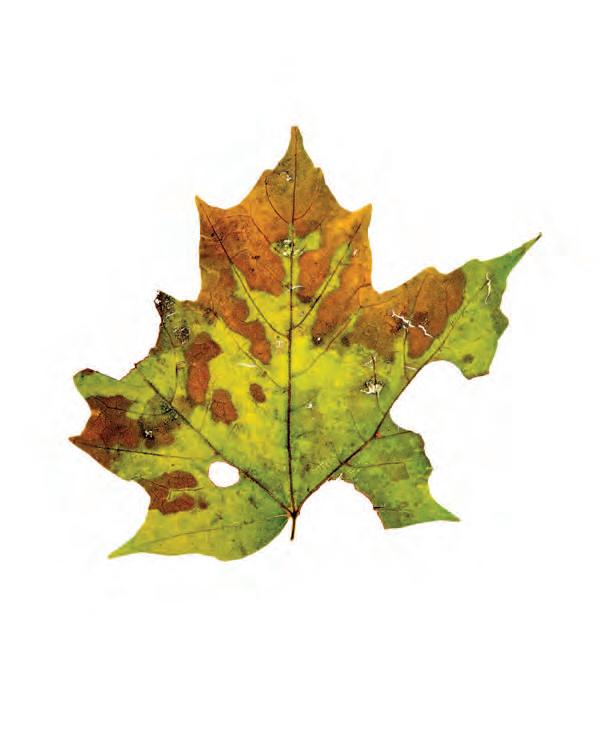
Behind the scenes: Individual autumn leaves have been an interest of mine since working on my degree in photography. Inspired by direct-positive botanical images published by Kodak, I began this project by creating camera-less photographs—or photograms—of autumn leaves on large format color negative film. When printed, each positive image left behind a detailed record of light coming through a single leaf. My updated method of using a digital camera to capture backlit leaves yields a similar result, while the process of leaf collection in local Vermont woodlands hasn’t changed in over 40 years: filled with wonder.
Currently: Paul Rogers is a native of Stowe with deep roots in Vermont. He studied at Rochester Institute of Technology’s School of Photographic Arts and Sciences, earning a Bachelor of Fine Arts in Photography. He specializes in commercial, fine art, and nature/landscape photography, photographic education, photography for artists, and humanitarian work for faith-based organizations. The photographer has traveled to 20 countries on assignment, but is best known for his Vermont “Stick Season” project, and for his images of entertainer Rusty DeWees. His work can be viewed at paulrogersphotography.com and on Instagram: @paulrogers.vermont
WILD LEGACY Cannabis Dispensary
Where did you find this magazine? Did you pick it up at a gas station in the middle of the quintessentially Vermont village of Stowe, or did you find it at one of the many places along Mountain Road, the spine of the town, with its innumerable eateries and inns?
Did you spot it at one of the rest areas along the interstate on your way here?
“Here.” In Stowe, that word tends to have different meanings for different people, at different times of the year. A town of just over 5,000 people would be considered a tiny burg in many states, but that’s an above average population for a Vermont community.
That figure, though, is just the tally of folks who call Stowe their home. The true number of people in town on any given weekend dwarfs that number. Perhaps you’re one of them, and you need something to inspire you, to inform you, to help you plan your vacation or give you an insight into the area.
If so, you’re off to a good start. The Stowe Guide is truly that.
Sure, you’ll find lists of events and galleries, breweries and creemee stands, and a calendar of events for whatever week or month you’re in town. But you’ll also find indepth interviews with people who have incredible stories to tell; feature-length pieces about the arts, agriculture, and architecture; photographs of food and drink so inviting they might bring on cravings.
No mere reflection of this area, this publication takes you beneath the surface. Read this thing cover to cover, and you’ll feel a connection.
There’s a reason why folks who live around here are the first ones to grab the thing off the racks and pore through it: They see themselves, their neighbors, their special places in the pages, issue after issue.
Is this the first time you’re seeing this magazine, and did it jump out at you because of the pretty picture on the front. Or is it a publication that you read twice a year, and have done so for years?
Did you keep the magazine? Is it back home with you?
HOURS: MONDAY - SATURDAY 10 TO 7
SUNDAY 10 TO 4
Cannabis has not been analyzed or approved by the Food and Drug Administration (FDA). For use by individuals 21 years of age and older or registered qualifying patient only. KEEP THIS PRODUCT AWAY FROM CHILDREN AND PETS. DO NOT USE IF PREGNANT OR BREASTFEEDING. Possession or use of cannabis may carry significant legal penalties in some jurisdictions and under federal law. It may not be transported outside of the state. The effects of edible cannabis may be delayed by two hours or more. Cannabis may be habit forming and can impair concentration, coordination, and judgment. Persons 25 years and younger may be more likely to experience harm to the developing brain.
It is against the law to drive or operate machinery when under the influence of this product. National Poison Control Center 1-800-222-1222.
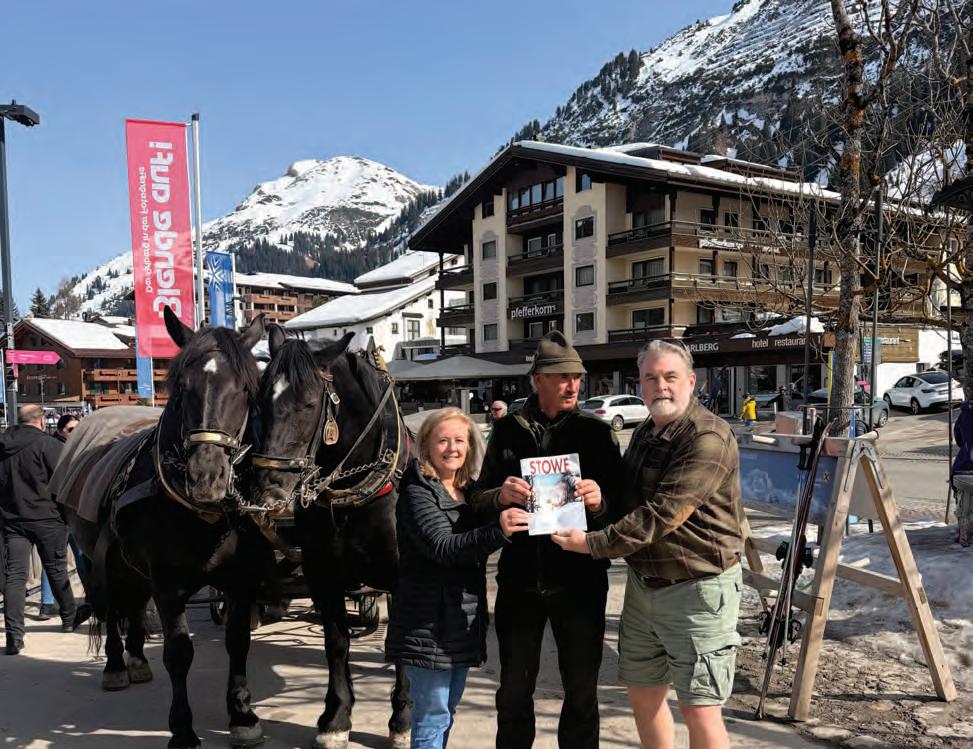
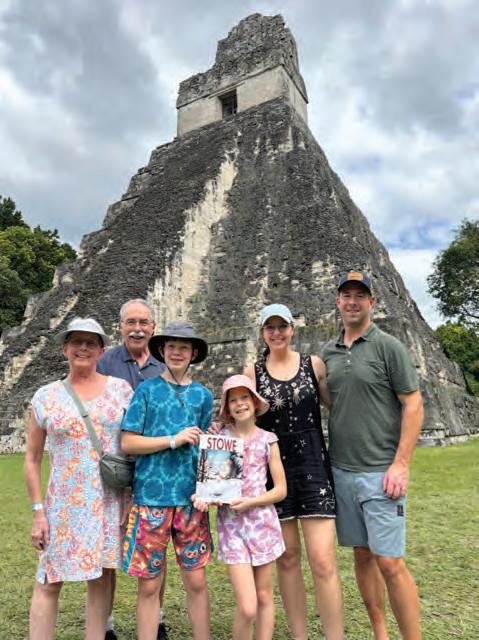
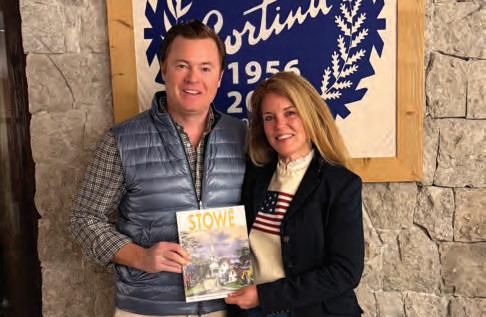
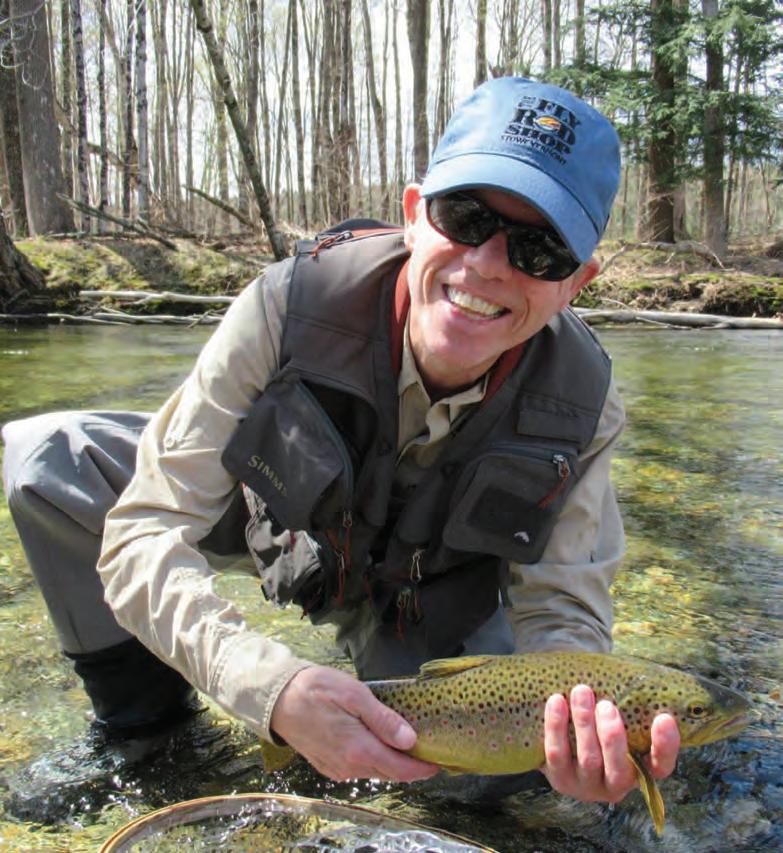
In every edition of the Stowe Guide & Magazine, you’ll see a few photos of folks posing with it in far flung places around the globe. Maybe this will be the issue you take with you on your next vacation as a photo companion, and maybe you’ll send that photo back to us, and we’ll print it. You’ll be a part of it. In a way, reading this now, you already are.
—Tommy Gardner
Correction
One of the men in a photo of the Sepp Ruschp Ski School class of 1941-1942 is named Otto Hollaus. The caption, in the winter-spring 2025-2026 edition, had the wrong last name listed.
“What do you miss about Vermont?”
It’s a question people often ask me when I moved back to the tip of Long Island, N.Y., after living and working in the Green Mountains for two decades.
First, an explanation. The South Fork of Long Island has always been home, and the return wasn’t so much a decision as a process. My wife and I could have seen it all through up north. We loved it and cared about it, raised our family there, built a life.
But over a decade ago, we began spending more time in Long Island, drawn by family, a family home, an ailing elder. There was also, of course, that web of a lifetime of friends, and that intangible thing called roots, coming clear, for example, when strangers at the grocery or hardware stores ask after my uncle, or my father, or my cousins.
Pretty soon, we’d sold it all in Vermont—a business and a home—and we were in Long Island, down the
street from where we were married in Springs, N.Y., right back where we’d begun.
This is a very different place from Vermont. The Green Mountain State is the New Zealand of the United States: somewhat isolated, mountainous and lush, with a self-reliant, fiercely independent, libertarian, and mostly liberal population.
Vermont is also a brand: healthy, beautiful, unspoiled, small-farm agricultural, innovative (think Ben and Jerry’s, Burton, and Seventh Generation, among others), the Napa of beer.
But Vermont, the brand, is just that—an image. Like so many American states, it also has serious social and economic problems, including much poverty, which is the root cause of a high incidence of domestic violence and an opioid crisis, which, in turn, is largely to blame for crime. I harbor no illusions.
But I do miss Vermont. I could always feel my heart rate slow a few beats when we crossed north into Vermont on the interstate, the green hills fanning out ahead.
Much about Vermont is admirable: how the state can repeatedly elect a Republican governor, even as it keeps Democrats in control of the Legislature; the state’s collective reverence for nature, no matter where you stand on the political spectrum; the closeness and smallness of the communities, which force good behavior, a certain respect, and decency.
Vermont, home to about 650,000 souls, is the second-least populous state after Wyoming. Life in its collection of small towns is open—exposed, if you will—and that’s mostly a good thing.
Thanks to its smallness and to the state’s long tradition of the annual town meeting on the first Tuesday in March in every community, Vermont seems to have preserved, almost nurtured, a sense that we are all in this together. There is accountability in the smallness.
“In a hurry this morning, eh?” came the question as I grabbed a few things at the grocery store one afternoon a few years into our arrival in Stowe.
“Huh?” I replied.
“Got word you jumped the three-way downtown.”
That was life in Vermont. I’d not waited my turn at the three-way intersection in town. Word had gotten around.
I never did that again.
Such encounters were often more than a chance to scold, and the conversation probably ended with something like, “Well, I hope you weren’t in a hurry for any trouble …”
What I found in spades across Vermont was a willingness, a desire, even, to respectfully share expectations of one another, expectations of our conduct, which can be benchmarks for expectations of ourselves, for defining our values, our community. What could be more important these days as we pull away from each other into toxic “them” and “us,” along economic, political, religious, and native, localversus-outsider lines?
Our house was at the bottom of a long, steep hill. Shortly after moving in, I reached out to the local police chief and asked if he could slow the traffic zooming past well above the 30-mph speed limit. He posted a squad car nearby.
Not long afterward, Chip Percy, whose family runs a dairy farm at the top of the hill (off the aptly named Percy Hill Road), found me at a gathering. His milk truck on the morning run was a major speeding offender.
“That was a strange hello to your neighbors,” he offered, wisely, with a smile. “Call me next time.”
He was dead right, of course. We became friends.
I haven’t found a better state motto than Vermont’s: “Freedom and Unity.” Two opposing, aspirational ideals, which speak to the very foundation of this country. The health and happiness in any society comes from the potent stimulus of individual liberty and from the strength and satisfaction derived from working together and caring for one another. >>
We are so far from that these days. President Donald Trump and his entourage hurl hate upon hate on at least half of the U.S. citizenry. He hates his opponents, he says, and is demanding, forcing our silence and our obeisance. We who disagree with him are liars, stupid people destroying America. No freedom, no unity.
Fittingly, the motto of New York state, where I now reside, is precisely New York: “Excelsior,” which means “ever upward.” It has more than a whiff of the competitive, elbows-out place where we live, but also hints at a transcendent awakening, a rising, which is my preferred takeaway.
What I miss about Vermont is what I seek and have found here. It resides in most smaller communities where we work together to live together. People who serve, people who listen, people who smile, generous people, people who give more than they take, people who love and revere nature.
VERMONT IS ALSO A BRAND: HEALTHY, BEAUTIFUL, UNSPOILED, SMALL-FARM AGRICULTURAL, INNOVATIVE ... THE NAPA OF BEER.
One of the things about Vermonters is that they know how to do useful things, like how to safely clear a roof of snow, and how to drive on icy roads, how to cob-stack wood so the stack will stay standing, how to run a woodstove efficiently, how to fell a nuisance tree. After 20 years there, I’m pretty handy.
“I need a jump.”
The man had waved me over in the busy summer traffic on Main Street in Sag Harbor a few years ago. He was standing by the bed of his parked truck, the open hood facing the storefronts.
Traffic piled up behind my Toyota pickup. Annoyed drivers honked. I got him to deal with the angry drivers as I angled in as closely as possible. Then I pulled out my long jumper cables from the bed of my truck and got him going.
As I unclipped the cables and got ready to pull away, I asked: “Why’d you stop me?” After all, the street was filled with possible helpers, and the fire department was across the street.
The guy smiled and pointed to my Vermont license plates. I had yet to change them out.
“I knew you’d stop, and I knew you’d help.”
I laughed.
“Yeah,” I replied. “But I’m actually from here.” n
Biddle Duke is a former owner/publisher of The Stowe Reporter.
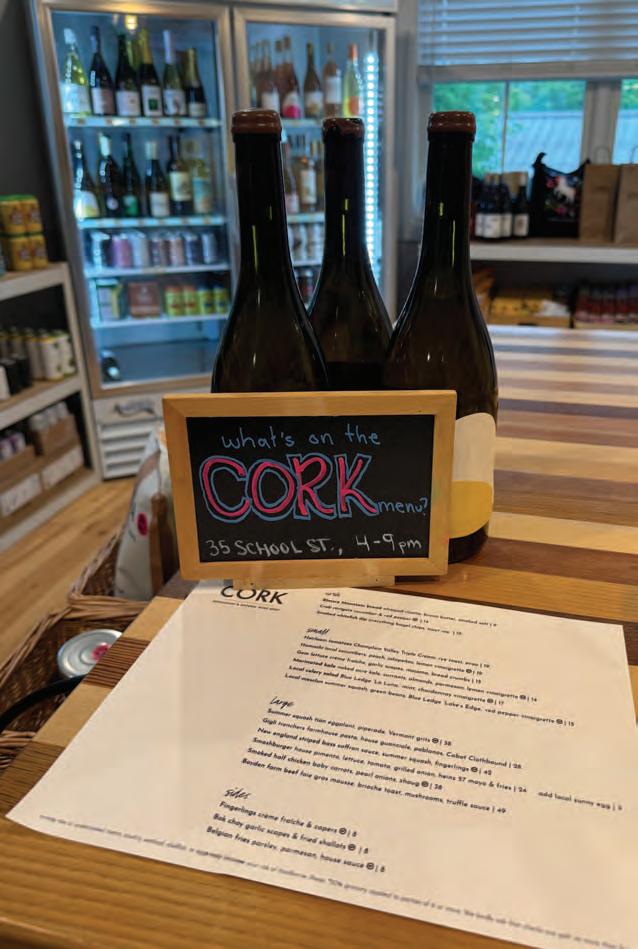
With last year’s opening of their market and Swedish candy shop on Pond Street, Stowe natives Danielle and Katie Nichols are officially at the helm of a miniempire and providing some of the most unique experiences in food and wine in Stowe. Danielle spent her youth traveling the world as a ski coach before returning to Vermont in 2011 to open Cork restaurant in Waterbury. In 2015, she opened a second location in her hometown after acquiring the former Blue Moon Cafe location on School Street and opening a second Cork location—this one with a full restaurant menu—and inviting her sister Katie to leave her sommelier job in Boston to help her run the business.
wKatie agreed on the condition that the wine market portion of the business focus entirely on natural wine. Embracing the natural approach was not only a way to introduce additive-free wine to their hometown, but also to articulate their values.
“We care so much about the food that we put in our bodies, but nobody really thinks about what we’re drinking,” Katie said. “We’re really trying to focus on wines that come from a real sense of place and focusing on being respectful to the land. We live in this beautiful place, and I think we all kind of pay attention to that.”
Despite the difference in age—Danielle is about 10 years older—the Nichols sisters were bound together early in life, along with their other two siblings, by a remarkable loss. Their mother, Terry, died at just 50 in 1998. She owned and ran Edelweiss deli and the former boutique clothing store Decisions Decisions, along with her husband, and worked in the executive office at Topnotch Resort, setting an early example for her industrious daughters.
Danielle was 20 and Katie was just an 8-year-old at the time, thrusting Danielle into a semi-caretaker role for the rest of her sister’s youth. >>
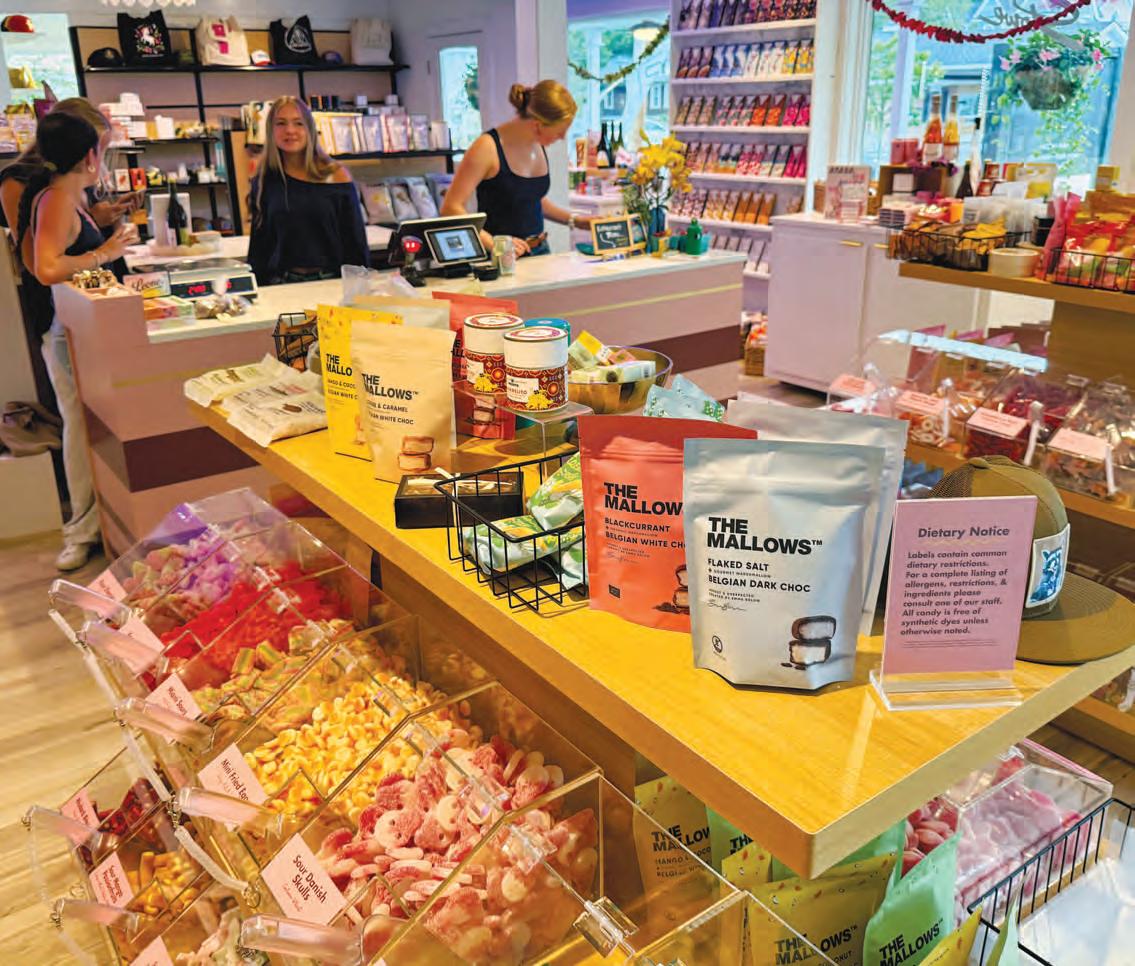
UNIQUE TREATS The Cork market on Moscow Road pulls in customers to and from the mountain with unique provisions shoppers are unlikely to be found elsewhere.
RURAL ROUTE
SWEET TREATS The new Cork market on Pond Street specializes in Swedish candy and provides employment opportunities for local teens.
Expansion plan
As the post-pandemic tourism economy in Stowe surged, the Nicholses expanded their all-natural ethos into Moscow. With the small hamlet entering a seeming period of revitalization led by Stowe Selectboard member Ethan Carlson and his wife, Kristy, the sisters were invited to open a shop in a building along Moscow Road with Danielle’s childhood friend, Neil Handwerger, who has brought to Moscow an iteration of his Cafe on Main that is located in Stowe village.
The sisters remembered when the Moscow building served as a general store—DeCelle’s Market—and although initially skeptical, they decided it made good business sense as multitudes of locals and tourist drive through Moscow on their way to the Mountain Road and skiing.
By opening a new market focused on selling their now trademark natural wine selection and a variety of other unique “provisions,” Danielle brought back an aspect of her Waterbury location, which she closed in 2018, and expanded what Cork could mean to the Stowe community.
“There are so many cool makers out there who fit into our big overarching natural wine, local food, organic approach,” Danielle said. “All the products in there—smaller producers, local stuff, really cool Italian products, French products— you don’t really see other places.”
Across the Pond
When a picture-framing business on Pond Street exited, another childhood friend, realtor McKee Macdonald, pushed Danielle to open a candy store, just around the corner from her flagship Cork location. The focus at this third >>
RURAL ROUTE
WINE-FORWARD As the name suggests, Cork began as a wine-forward enterprise.
installment of the Cork brand is on Swedish and other high-quality confections, as well as the kind of market offerings already available in Moscow.
The expansion has allowed the original Cork to focus more on being a restaurant. Natural wine is still available for purchase, but in a limited selection, with more right across the street. Last year, the Nichols brought on chef Weston Nicolls, classically trained in the French culinary tradition, but with a pedigree in Vermont’s ubiquitous farm-to-fork style.
As opposed to larger restaurants constrained by a need to serve a high volume of customers, the more intimate dining room at Cork has allowed Nicolls to subtly shift his menu, not just with the seasons, but even within the seasons.
Like many Stowe chefs, he takes advantage of the supply line to fresh Atlantic fish with a crudo appetizer and halibut, and the access to local beef and pork. Some menu items are labeled generally, as a specific cut of meat can change depending on what’s best from what’s available that day, and dependent on the loyal waitstaff the Nicholses have cultivated to convey the subtleties of the night’s menu.
“We say Boyden Farm beef because it’s going to be Boyden Farm beef, but it might be hanger steak on Friday and ribeye on Saturday,” Nicolls said.
The Nichols family may now have a comfortable culinary nexus in town, but they don’t take it for granted. As yearround tourism in Stowe post-pandemic starts to subside and challenges to the tourism economy take shape, it’s their dedication to catering to locals like themselves that will get them through the vagaries of the boom-bust cycles, they say.
Having grown up in Stowe, Danielle recognizes that, unless you’re a wealthy second-homeowner, scrapping it out as an entrepreneur in Stowe’s tourism economy is the only way locals can make it work in their hometown.
“When you live in this town, you kind of figure out what it takes to survive, and so taking risks and being in businesses is how I’ve figured out how to be here,” she said. n
Hank Glowiak
‘Do amazing things, turn off unnecessary lights and idling cars, ride a bike’
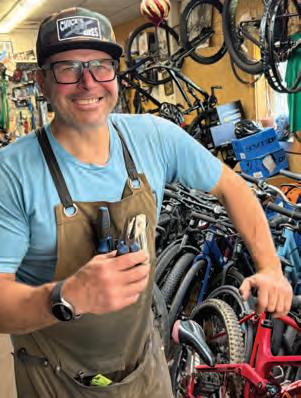
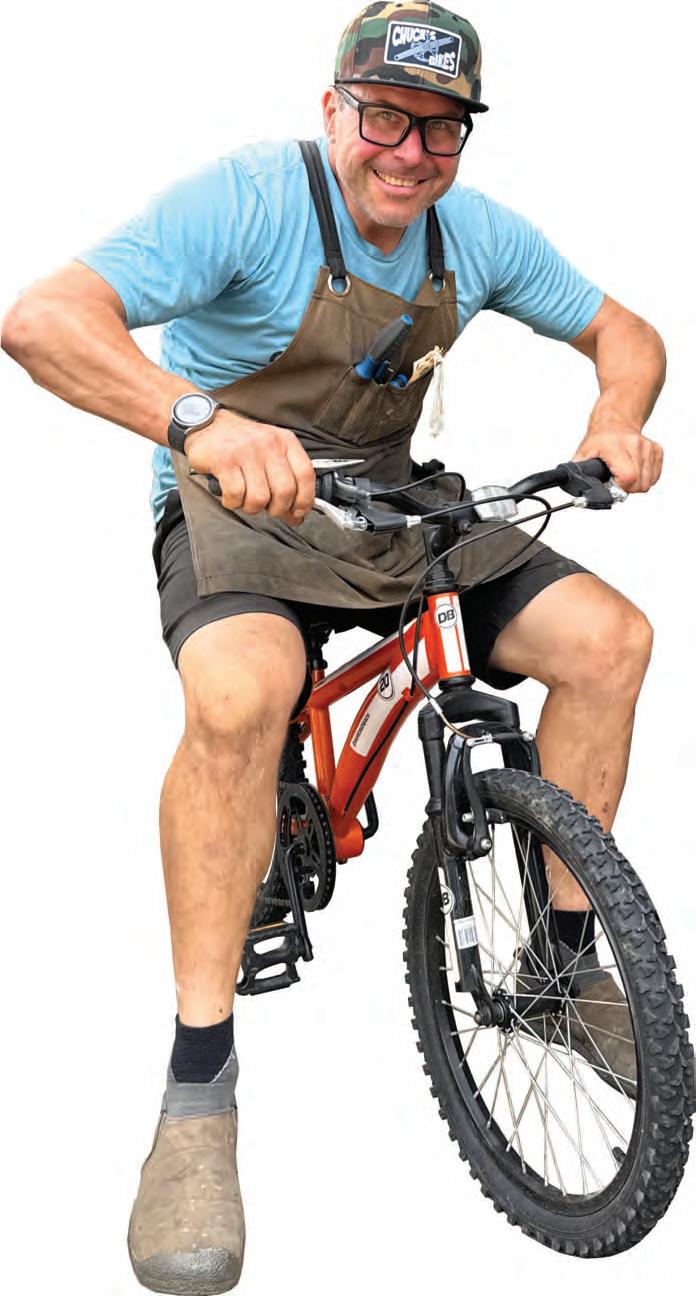
Most people who ride a bicycle are familiar with Chuck’s Bikes on Bridge Street in Morristown. Owner Hank Glowiak not only sells and repairs bicycles, he’s an advocate for building and maintaining mountain bike trails in the Morristown area. He lives in Elmore with his partner, Caitlin Mahoney, and their son, Oliver, who attends Peoples Academy Middle School. When you call Chuck’s Bikes and get the answering machine, you’ll hear this message: “Do amazing things, turn off unnecessary lights and idling cars, ride a bike.” Glowiak would prefer to see more bikes and fewer cars on the road, and more mountain bikers helping to maintain the trails they ride instead of counting on those thrilling trails to magically take care of themselves.
Have you always been into bicycles?
the intErviEw
I’ve liked bikes since I was a kid. I would always clean and take care of my bike after a ride. My dad accused me of losing tools all the time. We lived four miles from town, and I’d ride or skateboard into town all the time. One time I had a flat tire and walked my bike into town to look for a tube. I didn’t have any money, and the bike shop owner wouldn’t give me a tube. I had to walk all the way back home with my bike. I don’t want to be like that. If a kid comes in and needs a tube and can’t pay, I will give it to him.
When did you acquire Chuck’s Bikes?
Chuck Schultz opened the shop in 1982. In June 2000, when gravel biking was just getting started, he built a custom gravel bike for a guy who shall remain unnamed. He was a problem customer who didn’t really know how to ride a bike and had one complaint after another. He kept coming back to Chuck to fix things and the situation finally put Chuck over the edge. He was done. The next morning we had a deal. The shop was then located on Main Street. I moved it to the Carwin’s Antiques building in 2010 and have been here ever since. Last year I celebrated 25 years as owner.
What did you do before that?
When I was 17 and graduated high school, I enlisted in the U.S. Navy and became a nuclear mechanic on submarines. I spent six years in the Navy, living and working on a nuclear-powered submarine. I’m very good at figuring things out and fixing them. After my stint, I couldn’t deal with being in a busy and cramped environment anymore and moved to Waterbury in 1996. I worked at The Shed, Trattoria La Festa, and Pinnacle Sports.
Where did you grow up?
Bristol, Connecticut. My family members are Polish immigrants. I’m a first-generation American. My family worked hard, like all immigrants do. Now I’m doing it.
Does the shop sell road bikes or mountain bikes, or both?
Mostly gravel and mountain bikes. Road bikes are dinosaurs. No one wants to ride on the roads now. They will ride gravel
GORDON MILLER
bikes on dirt roads, but gravel bikes are evolving into mountain bikes.
What is your focus in the shop?
Order, fix, sell, make people leave here with the cheapest price and best service I can give them. I want to include everybody and everything. We are all part of the system. I try to do something whenever I go riding. I encourage everyone to participate. Pick up sticks and branches, do something; don’t just be a consumer. That’s how things have changed. No one wants to be part of the system. They just want to benefit from it. I have a hashtag: “Preserve, Participate, Be Safe.”
Where have you done trail building?
Early on, I built and maintained the trails at Cadys Falls on town property and adjoining land where the landowners gave permission. Now I have friends who help me maintain the trails. Trying to get others to help is tough. I’m known as the trail Nazi. I think everyone should be involved in maintaining the trails they ride on so freely. Mountain biking isn’t what it used to be. Before, everyone was involved in trail building and grooming. Now, people are addicted to trail riding in a way that’s not thoughtful of others. I’ve converted a lot of people into being more involved in trail care.
What do you do in winter?
I work on bikes and groom fat bike trails. I have a groomer with an attached Snowdog. It was the first one in New England. I bought it direct from an owner who worked at Snowdog. The trails are great until walkers come along when the snow is soft and they posthole. Then it gets cold and the holes freeze and the trails become unrideable. I try not to be confrontational when I see walkers, but they don’t understand they are ruining the trails for others. I’m considering leaving snowshoes at the trailhead in hopes walkers will use them instead of just walking in boots and mucking everything up.
Are you political?
Absolutely. People will come in the shop and bait me, just to get me going. I’d like to see towns have live-time updates during elections. I also think we need gun control. George W. Bush changed politics forever. Now it’s MAGA and fake news and AI, and Walmart, Amazon, Elon Musk, Google.
What is the future of Chuck’s Bikes?
I want to keep prices low. With tariffs that will be difficult and everything will have to go up, but I will try my best to keep prices low while maintaining high quality. n
RURAL ROUTE
FIRST CLASS Tommy Gardner, Kristen Braley, Liberty Darr, Sophia Balunek and Patrick Bilow at the New England Newspaper and Press Association Better Newspaper Competition in March.
TOWN NEWS
NEWSPAPERS, MAGAZINES, COLLECT REGIONAL J-AWARDS
The Vermont Community Newspaper group, which publishes this magazine and five other small, hyperlocal weekly newspapers, took home more than two dozen awards for journalism and design at the New England Newspaper and Press Association’s annual Better Newspaper Competition, during a ceremony March 14 in Portsmouth, New Hampshire.
Judges named top three award-winners in dozens of editorial and advertising design categories, and all five VTCNG newspapers, and this magazine received awards this year.
Always among the top three, and this year atop the heap, was the Stowe Guide and Magazine, once again winning Best Niche Publication; it was publisher Greg Popa’s penultimate edition. “The magazine is filled with excellent content, including stories, photos, ads and more,” judges wrote, adding, “Whoever is responsible for the ads definitely deserves a raise.”
Also among the top overall newspapers, News & Citizen received a third-place nod for overall General Excellence in the large circulation category.
Among first-place individual editorial awards:
• Protest or demonstration coverage: Liberty Darr, The Other Paper, for “South Burlington man walks across the country to ‘fix democracy.’”
• Arts and entertainment reporting: Aaron Calvin, Stowe Reporter, for “Steel and Stone,” about local sculptor Chris Curtis. Judges said the story was “both elegantly and ruggedly told,” with a nod to descriptions “of a unique artist’s physicality with his pieces.”
In other top three editorial awards:
• Business and economic reporting, small weeklies, second place,: Darr and Briana Brady, Shelburne News, for “Maple syrup makers deal with uncertainty.”
• Business and economic reporting, second place, large weeklies: Calvin, News & Citizen, for “Cambridge farmer expands into Granite State meat processing.”
• Government reporting, second place: Darr, Shelburne News, for “Cemetery commissioner accosts grieving family.” Judges shouted out Darr for sticking with the story and “tracking how town officials dealt with the problem, and ultimately ducked responsibility.”
• Good News award, third place: Darr, Shelburne News, for “Shelburne’s long lovers celebrate 75 years.” Judges noted, “Everyone loves a love story, and this one is first-rate.”
• Housing news, third place: Calvin and Patrick Bilow, Stowe Reporter, for “In Stowe, short-term rentals are owned from afar.” Judges praised the balance and presentation, and noted, “Tremendous effort to push out data … a month after it was created.”
• Housing news, third place: Bilow, Stowe Reporter, for “Graduates explore the world during gap years.” Judges said the piece “both informs and delights, and for both parents and kids.”
• Local personality profile, third place: Rob Kiener, Stowe Reporter, for “Mr. Lipsky goes to Montpelier,” a profile of Stowe’s independent logger-turned-legislator.
• Personality photo, second place: Tori Westphal, Stowe Reporter, for “Oxen Pull,” which judges said “conveys personality through action and local tradition.”
• Reporting on religious issues, third place: Calvin, for “A guru teaches Buddhism for the A.I. age.” Judges said it was a “super interesting story about the intersection of an ancient religion and technology.”
• Social issues feature story, second place, small weeklies: Darr, The Other Paper, for “South Burlington Police Department adds community services unit.”
• Social issues feature story, third place, large weeklies: Darr and Brady, The Citizen, for “Librarians grapple with uncertainty over federal fiats.”
• Spot news story, third place: Brady, The Citizen, for “Mobile home park goes without water for a week after leak.” Judges wrote, “Not super sexy subject matter, but kudos to this reporter for thoroughly covering all the bases.” (Note: The Citizen, a small circulation weekly, was placed in the larger category, making it even more impressive to secure reporting nods.)
Design and advertising
Among the top nods for advertising, the News & Citizen won the General Excellence award, with judges calling it “a wonderful community newspaper” and saying it “has a wonderful balance of being smartly designed and packed with information, advertising, etc.”
The Stowe Reporter placed third in the same category, with the judges saying the paper “is like an old friend…someone you love to spend time with. Classically designed, packed with ads, information and strongly engaged with the community.”
The company also took home two more top ad design awards:
• Best ad designer, second place: Kristen Braley, The Other Paper, noted for her “signature style that is shown consistently from advertiser to advertiser.”
• Niche Publication, second place: Katerina Werth, for Stowe/Green Mountain weddings, and its “fantastic, inclusive cover and gorgeous interior spreads and pages.”
In other ad design awards:
• Real estate display ad, first place: Braley, Stowe Reporter, for Pall Spera.
• Automotive display ad, third place: Braley, News & Citizen, for a Lamoille Valley Chevrolet ad and its “attention-grabbing photo” and “clear layout with great type treatment.”
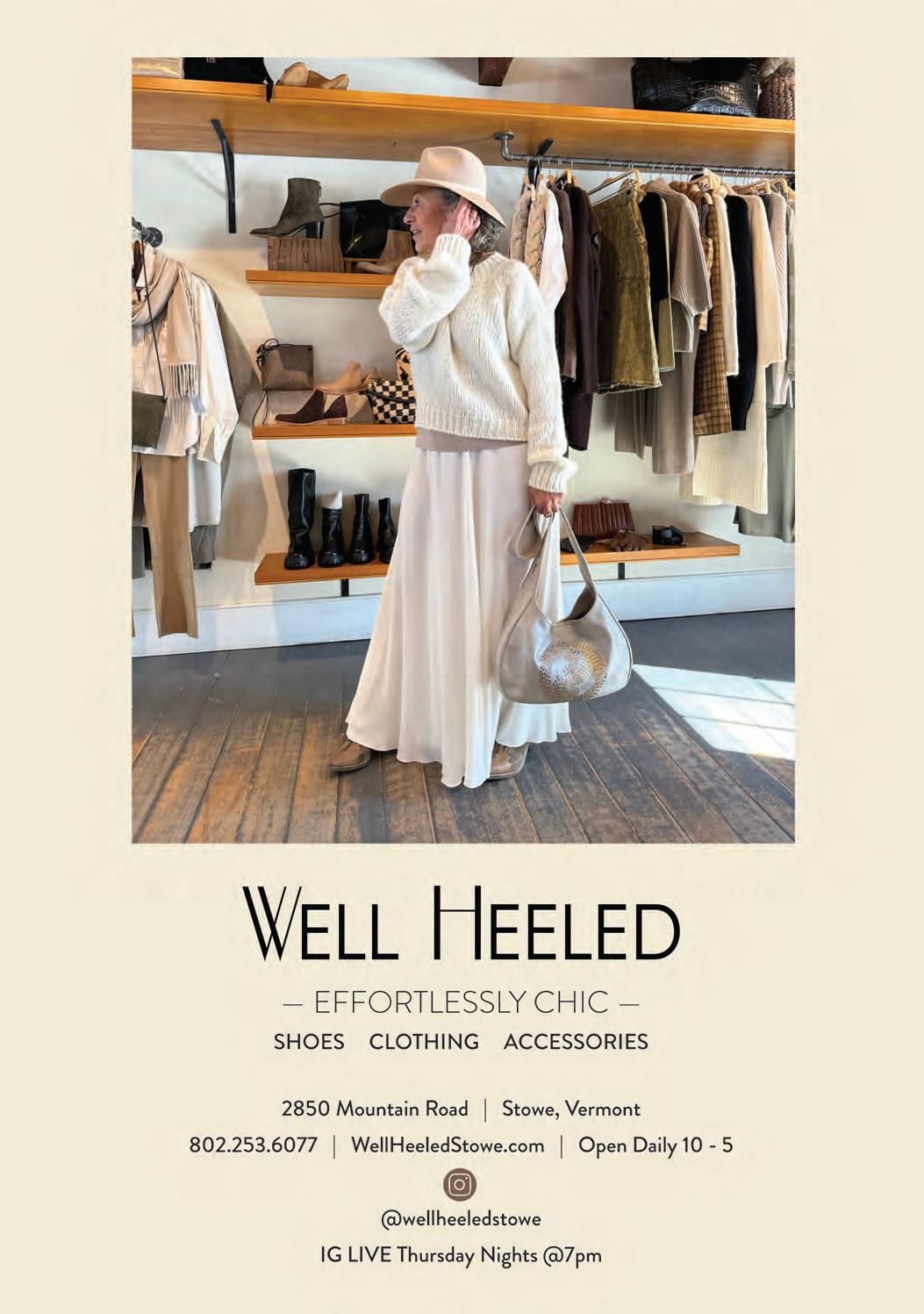
• Most creative use of small print space, second place: Werth, Stowe Reporter, for a Well Heeled ad featuring “an appealing illustration of a shopper.”
• Local display ad, black and white, third place: Werth, Stowe Reporter, for Body Lounge ad that judges said was “well ordered” with “great informational text.”
• Themed multiple advertiser pages, second place: News & Citizen, for its cannabisthemed Green Guide, which judges noted for both its design and editorial content.
• Contests, second place: Braley, Stowe Reporter fall foliage photo contest. Judges noted the photography “is an advertisement in itself for this community.”
1. Bob Shannon and Tina Sprague traveled to Austria last winter. This photo was taken in Lech am Arlberg with Fiaker, a horse-drawn carriage for hire. 2. To ring in the New Year, Bob and Wendy Parrish, of Stowe/Morrisville, visited Belize with their family (Katie, Adam, Hunter and, Rowen of Lexington, Massachusetts). Here they are in front of the Temple of the Great Jaguar during an excursion of the ancient ruins of Tikal in Guatemala. 3. Kathleen and Duncan McIntyre of Stowe made it to the Olympic Winter Games in Cortina Italy in February to cheer on our local Vermont heros
Do you have a photo of our magazine on some far-flung island or rugged mountain peak? Send it along to ads@stowereporter.com, with Stowe Magazine in the subject line. We’ll pick the best one—or two!—and run it in the next edition. Please include details of your adventure.
RURAL ROUTE
MR. MONOPOLY Parading on Main Street to celebrate the announcement of a new Stowe-themed version of the board game that bears his name.
Mr. Monopoly, the mustachioed, top-hatted, canewielding, money-bagger himself, was in town to celebrate the announcement of a Stowe-themed version of the wildly popular board game that bears his name.
The mascot was joined by New York City representatives of Top Trumps USA, the company that holds official privileges to recreate the game that was first launched by Parker Brothers in 1935 and acquired by Hasbro in 1991. Over the last six years, Top Trumps has produced 40 versions of the game based on different towns throughout the country.
Stowe’s version will be the first ever set in Vermont. There have been others modeled after the Green Mountain State, but not under official permission from Hasbro.
“We look for sweet spots in the United States, ones that have local pride, local history and a strong sense of community,” Lindsay Wallace, a Top Trumps USA representative, said. “Stowe, for sure, has that, so we’re super excited to kick off this project.”
Top Trumps has not begun designing the Stowethemed version of Monopoly, and the company is soliciting recommendations from visitors to and residents of Stowe on what should be included.
While the tokens and four corner spaces –– Go, Jail, Free Parking and Go to Jail –– will remain the same as the original board game, the remaining 22 property spaces and storytelling cards will be adapted to fit Stowe’s community.
That means the iconic Atlantic City squares from Mediterranean Avenue to Park Place will be replaced with local businesses, nonprofits and landmarks, and the Community Chest and Chance playing cards and the Monopoly money will be customized for Stowe.
When adapting the game for a town, the brown-colored set spaces typically include natural areas, such as parks, trails or anything “outdoorsy,” Wallace said.
She said the light blue set features heritage and cultural spaces; the pink spots are for sports and events; the orange for local shopping; the red for restaurants and bars; the yellow for hospitality; green for education or anything that’s important to the city.
The dark blue — Park Place and Boardwalk in the original board — is always reserved for the most iconic landmarks, Wallace said.
She said Top Trumps has received hundreds of recommendations since announcing the Stowe version of Monopoly.
She didn’t describe the type of submissions the com-
pany has received, stating the final product won’t necessarily be a surprise to those who are familiar with Stowe, but a handful of residents shared their recommendations with the Stowe Reporter.
They plugged local restaurants, bars and businesses they may run or frequent. Many suggested Stowe Mountain Resort, as well as events like the Stowe Derby and the Stowe Jazz Festival. There were local landmarks such as the Stowe Community Church, library, town hall and the Stowe Recreation Path in the mix. The editor of the Stowe Reporter, naturally, suggested the town’s newspaper of record.
One resident suggested paying homage to once-popular businesses that have closed, like the Rusty Nail and The Shed. Wallace said the property spaces typically include existing businesses, but that doesn’t necessarily preclude shuttered businesses from the storytelling cards.
Wallace approached recommended business and entities about potentially joining the board. Those that are included pay a sponsorship fee, which Wallace said makes the local versions of the board game possible, but she wouldn’t say how much a sponsorship costs.
Monopoly: Stowe Edition will officially launch in January 2027 with a local party.
—Patrick Bilow
GORDON MILLER
River Arts:‘Art100’
River Arts gallery, February 14
Jo Sabel Courtney and Shap Smith. Kyle Nuse and Jonah Rabinowitz.
Destiny and Jack McAllister with their Wild Woog.
Abel and Andrea Warden.
Nancy Banks and Marcie Scudder.
Beth Gadbois and Dan Noyes.
Dave Durand, Joan Fitzgerald, Megan Batchelder, Melissa DiMotta, and Kate Gluckman.
Jeremy and Cori Fine.
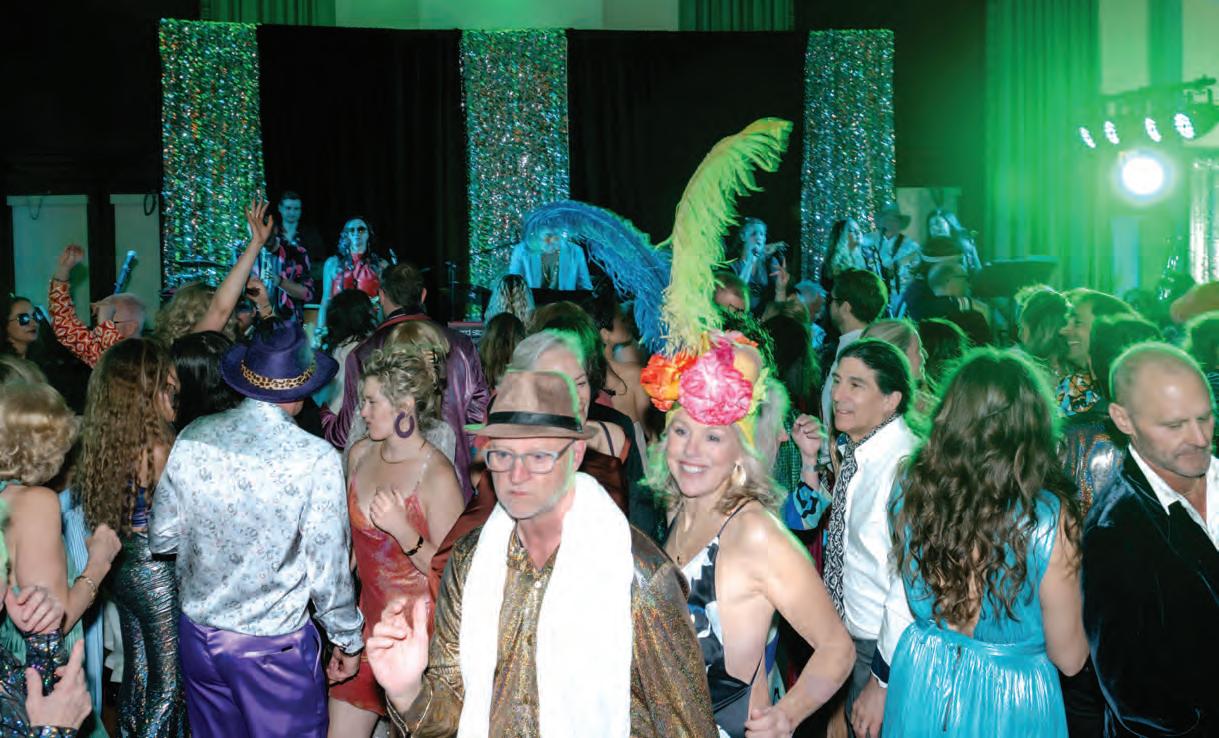
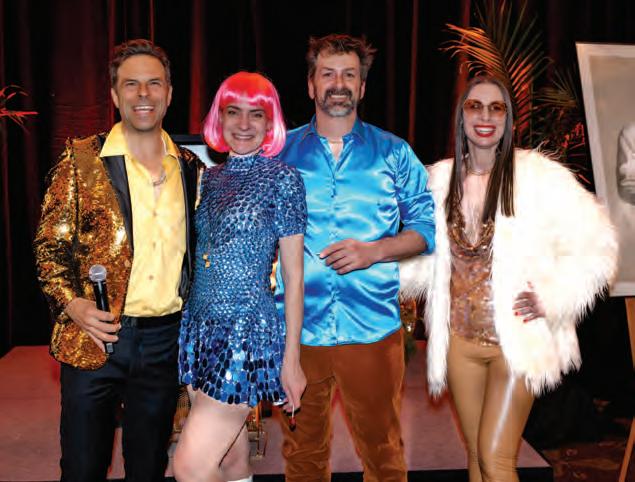
The Current: ‘Gala ’54: After Hours’
Spruce Peak at Stowe, April 11
Maggie Macdonald, Danielle Nichols, Lauren Abendroth, and Kristy Carlson.
Jerry Marshall, Maggie Macdonald, Katherine Neel, Jana and Matt Moore, Dave Wilkins, Molly Pindell, and Erik Hoekstra.
Geoff Kuffner, Marcy Wunderlich, Chad Forcier, and Tiffany Tona.
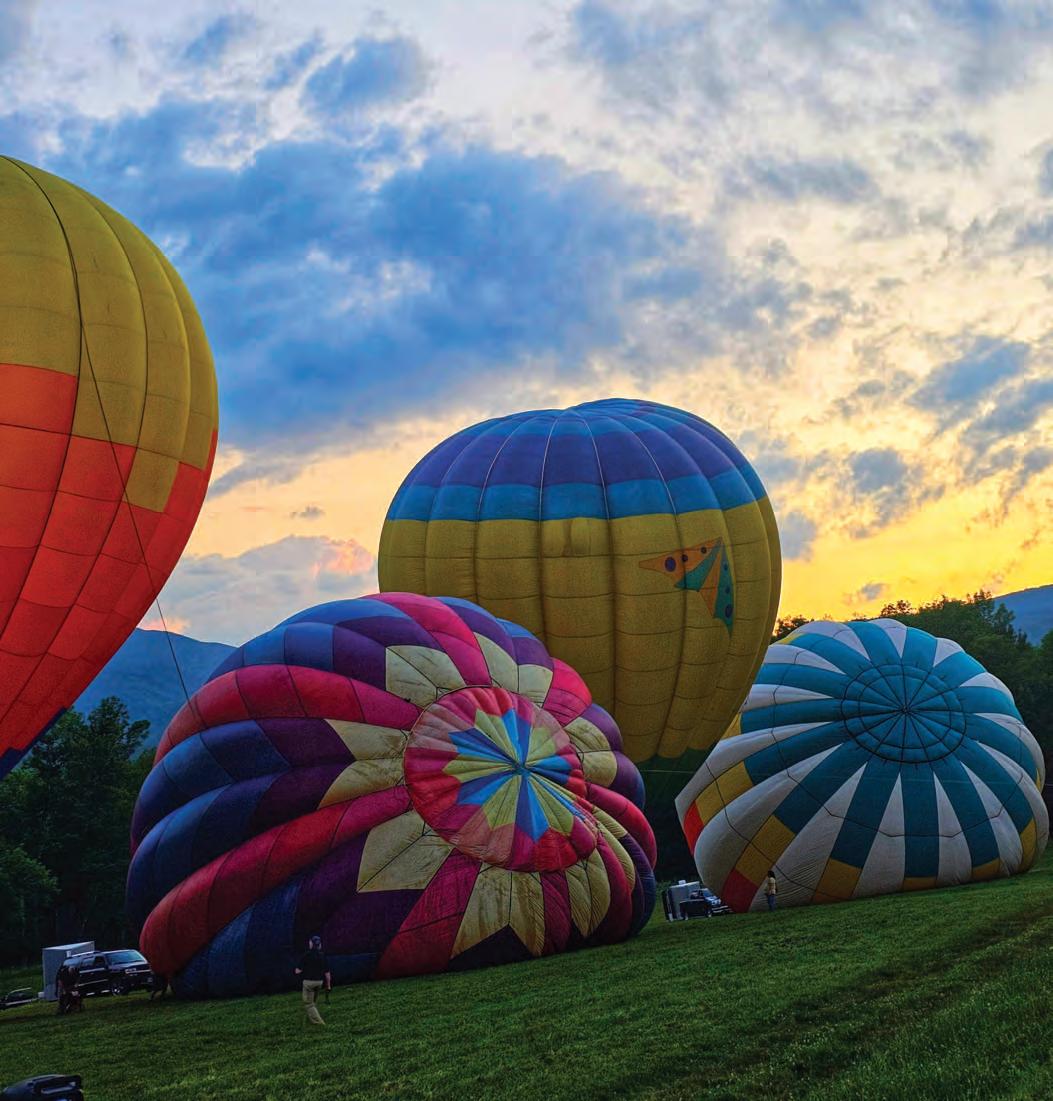
For details, see stoweballoon.com.
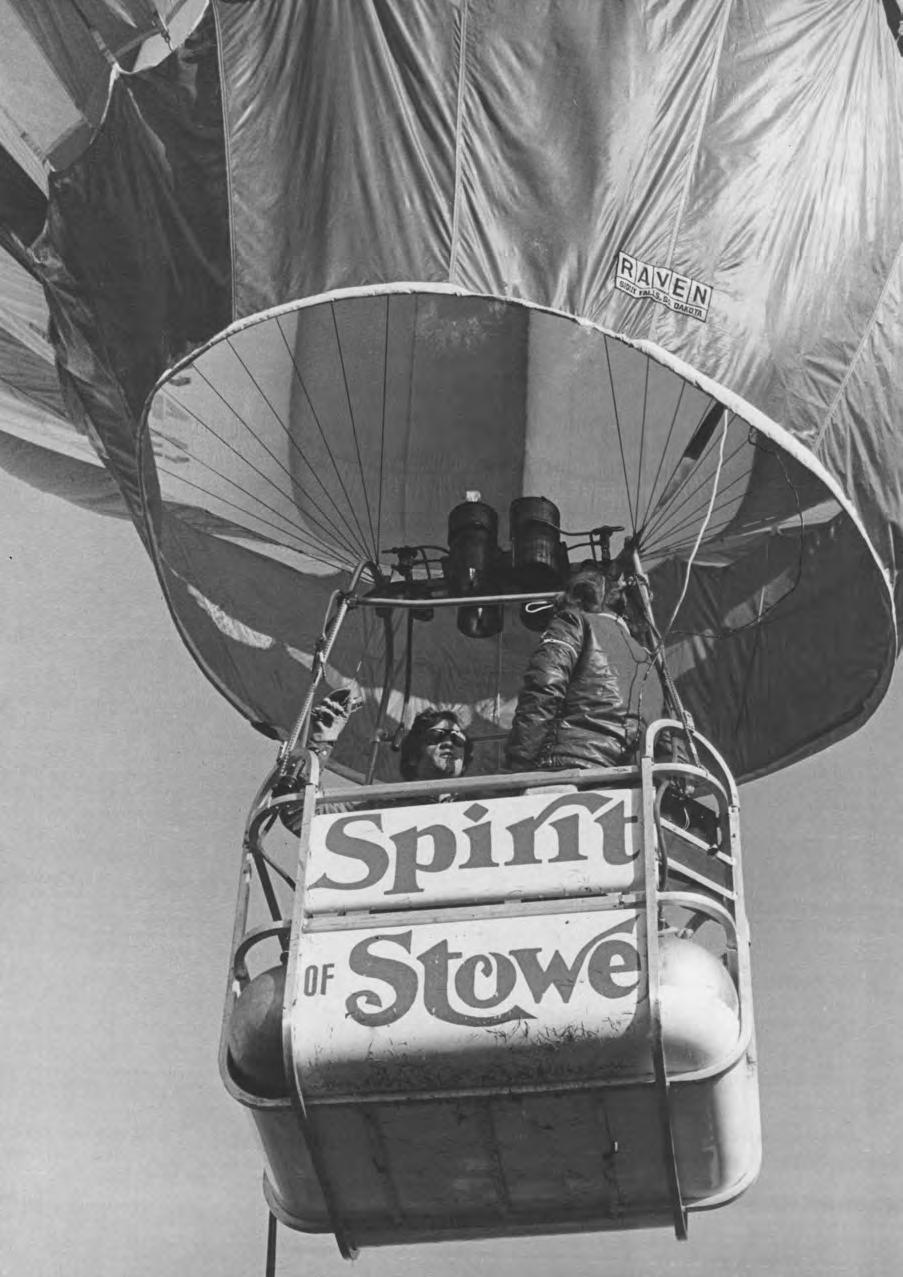
SPIRIT OF STOWE The late Chuck Baraw, longtime owner of Stoweflake Resort and Spa, soars above the town in a hot air balloon during one of the resort’s annual balloon festivals. The festival took a hiatus for several years with a comeback in 2025 at the Trapp Family Lodge. This year’s Stowe Balloon Festival will be located at Mayo field, hosted by Mountain View Vacations.
PHANTOMS OF THE NORTH: GREAT GRAY OWLS
The great gray owl (Strix nebulosa) is a northern raptor that only occasionally graces our northeastern states. Also called the phantom of the North, these owls have large facial discs with alternating areas of light and
dark gray, creating a concentric ring pattern around their yellow eyes. Beneath their face is a white “bowtie.” Despite this dapper feature, the owl’s luminous eyes, impressive size, and large talons give it a fierce appearance.
Great gray owls are the largest owls—from head to tail feathers—in the world, with females averaging around 28 inches long and males around 26 inches long. Their wingspan can reach over 5 feet. Despite their stature, these owls weigh only about two-and-a-half pounds on average—less than both
great horned and snowy owls. Great gray owls’ hulking appearance is a trick of dense plumage that helps them endure cold winters farther north.
This circumboreal species lives in northern forests in Canada and the United States, as well as in Russia, Mongolia, and the Scandinavian countries. Great grays breed in dense conifer forests and hunt in open meadows and snow-covered bogs. Their large facial discs help focus and funnel sound (much like cupping a hand over your ear), while the asymmetrical placement of their ears allows them to precisely locate the sound’s origin. With this highly sensitive hearing, they can track the movement of rodents tunneling beneath snow. Great gray owls hunt both by flying low over open fields and by sitting and listening in low branches or on road signs, before “snow plunging”—bursting through the top layer of snow to catch rodents in the subnivean zone.
Great grays can plunge through nearly 18 inches of snow, at times requiring the strength to break through a top crust that can support the weight of a 175-pound person. This feat doesn’t just require physical strength, but also a recalibration of where the prey actually is; the snowpack refracts sound, creating what researchers call an “acoustic mirage.” A 2022 study published on this phenomenon in “Proceedings of the Royal Society B” found that the sound of scurrying rodent feet can be displaced up to five degrees from the actual location of the prey. The least distortion occurs directly above the source of the sound, which is why great grays tend to hover in place low to the ground before striking.
Their preferred diet consists of voles and lemmings. When these small mammals undergo population crashes, generally every three to five years, great grays may venture south en masse in search of food. One of the most notable irruption years was in the winter of 1978, when 154 owls were documented in New England and New York.
When great grays do grace our northeastern woods, they usually head back north in February and March. Males begin calling for mates in January and February. Great grays don’t build nests, instead using tree cavities or nests abandoned by other raptors. Because of these nesting preferences, coupled with their size, great grays tend to thrive in forests with large diameter living and dead trees. In April, a female will lay two to five eggs — depending on the availability of prey—and owlets hatch a month later. Both parents hunt to support the young, though males do most of it during incubation and when the owlets are young.
Black bears and great horned owls will sometimes prey on young great gray owls, but adults have no natural predators in North America. (In Europe, the Eurasian eagle-owl is the only known predator of adult great gray owls.) Adult deaths are often the result of vehicle collisions or of consuming prey that has been poisoned by rodenticides.
I have yet to see this graceful giant, and due to its elusive nature, I may never get to. For me, part of the magic is simply knowing that this phantom of the North visits our winter woods from time to time. Maybe one winter, without realizing it, I’ll pass beneath a great gray owl perched on a branch above me, its watchful eyes and powerful ears noticing everything before it takes to the air on silent wings.
Catherine Wessel is the assistant editor at Northern Woodlands. Illustration by Adelaide Murphy Tyrol. The Outside Story is assigned and edited by Northern Woodlands magazine and sponsored by the Wellborn Ecology Fund of New Hampshire Charitable Foundation: nhcf.org.
FINE ART GIFTS DECOR FURNITURE JEWELRY
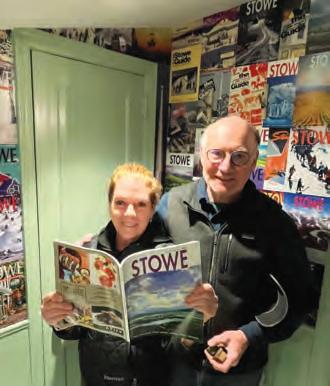
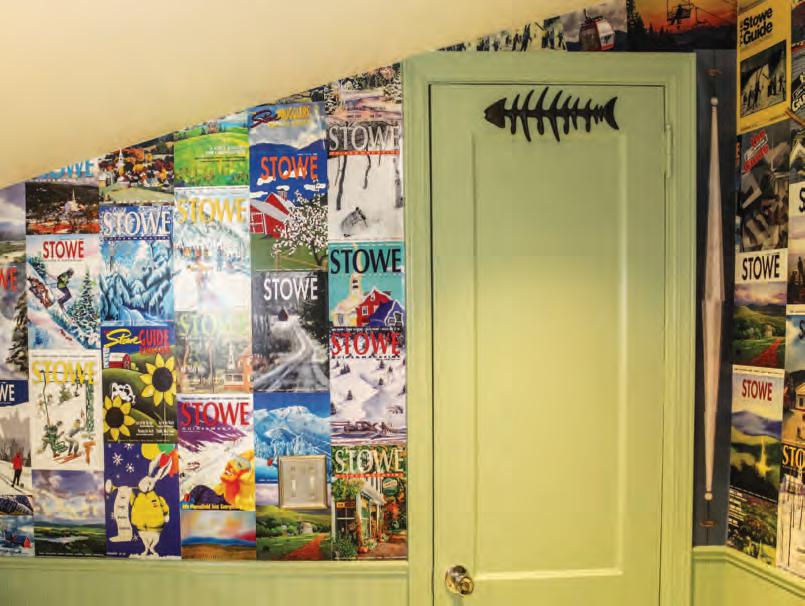
GOT IT COVERED Stowe Guide and Magazine covers adorn the walls of a bathroom in Greenwich Connecticut.
ROOM DESIGNED WITH STOWE IN MIND
Interior design inspiration comes from myriad places; nature, art, music, passion, to name a few. For Brenda and Val Vallely of Greenwich Connecticut, their inspiration came from their love of Stowe. As a tribute to the ski town, they wallpapered their bathroom with covers of this very magazine.
Inspiration also came from a friend’s bathroom that was papered in The New Yorker magazine covers. “When I saw my friend’s bathroom, I loved it,”Brenda said. “Val and I decided we wanted to do the same with Stowe magazine covers.
The couple owns a condo in Notchbrook and for the past 50 years they have come to Stowe every weekend. “My aunt and uncle were ski bums in Stowe and I’ve been skiing all my life,” Val said. “Stowe is our second home and it is near and dear to us. We bought one of the Notchbrook condos before it was even completed, and we still have it.”
“Val is a fabulous skier,” Brenda chimed in. “I am not. I lived for 16 years on a sailboat, but now I can ski the blue trails.”
When the two decided to wallpaper their Greenwich bathroom with Stowe magazine covers, they reached out to the magazine as well as Stowe Free Library and amassed all 70 covers that had been published over the last 35 years.
“We got whatever the magazine supplied. The ones from the library came with stickers that said Do Not Remove. We didn’t remove them,” Brenda said.
A color consultant by trade, Brenda recommends wallpaper and paint choices to her clients, so hanging wallpaper was not new to her. Rather than hanging the actual covers, she took them to Edgar at the local FedX store and had copies made on waterproof, heavy-grade paper to prevent moisture from ruining them. After preparing the wall surfaces, she put up wallpaper lining and covered it with paste. Then she began figuring out the configuration of how to present the covers on the walls.
“Planning the placement of the covers took two days on the living room floor. I wanted to be stragetic about colors and repeats, since we had doubles of some of them,” Brenda explained. Installing them took another three days. I tried to tell a bit of a story in pictures, such as the four seasons of the Notch, people in the lift line, then riding up the gondola, and then skiing. I also tried to show Stowe icons, such as the steeple in town and the gondola.
The end result is a one-of-a-kind bathroom that reminds them of their favorite place to escape to. “It was so much fun to do and everyone who sees it loves it,”Brenda said. “It was a labor of love for both of us.”
—Kate Carter
COURTESY PHOTOS
AGAIN END OF AN ERA FOR CADYS FALLS NURSERY
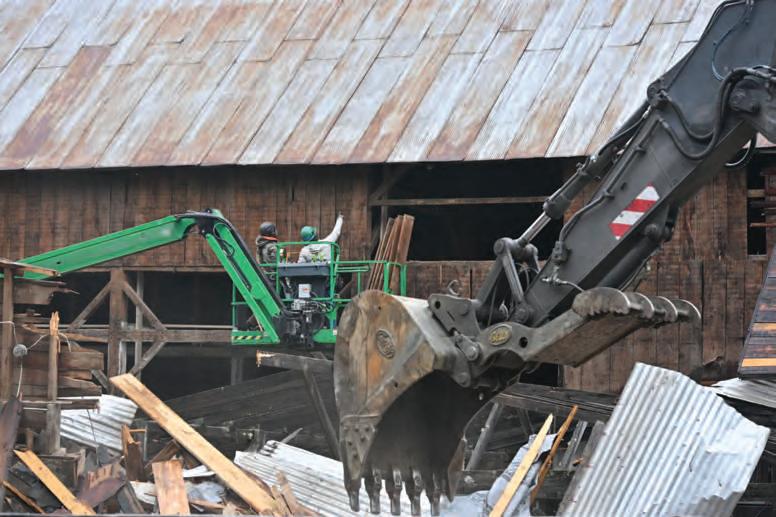
An 1850s Morristown home and barn that raised a family and thousands of exotic plant species for more than four decades has been wiped from their environment—the home by an excavator and the barn by several eager members of the Vermont Youth Conservation Corps.
Don and Lela Avery met in Big Sur, California before they moved with their two sons to a 22-acre property on Duhamel Road in 1979. Leveraging fertile soil next to the Kenfield Brook, they started propagating famously stubborn plants with success, a hobby that blossomed into a renowned business, the Cadys Falls Nursery.
Customers from around the country visited Morristown to purchase rare plant species from the Averys. In elaborate gardens around their home, they planted more than 1,400 plant varieties—from showy Lady’s Slippers to dwarf conifers—complemented by paths, sculptures, and rock walls that Don built over the years.
The Averys closed the nursery at the onset of the pandemic and opened their beloved gardens to the public. Don and Lela, unbothered and welcoming, would go about their day while guests, plant-savvy or simply seeking serenity, wandered the gardens freely.
But living at the confluence of the Kenfield Brook and Lamoille River has its disadvantages. In terms of 100-year floods— dramatic events that might occur once a century—the Averys had experienced eight in 40 years.
They hoped the flood of 1995 was the worst of it, and after initial concerns that they couldn’t live in the home, the flooding relaxed for decades, and the Averys decided to hunker down.
Then, the Flood of 2023 raised the water level to the first-floor windows of their home.
“We made a decision to stay there and get old there and die there, or whatever you can do,” Don Avery said. “But then 2023 came around and it just slammed us. We weren’t young anymore. We couldn’t really deal with it.”
After a two-year search for a new home, the couple signed their property over to the State of Vermont. The Vermont Department of Fish and Wildlife purchased the property through a flood-plain buyout for $850,000 and is restoring the land to its natural environment. That money covers the town’s assessed value of the property as well as the cost of removing the home and barn. >>
STORY / Patrick Bilow PHOTOGRAPHS / Gordon Miller
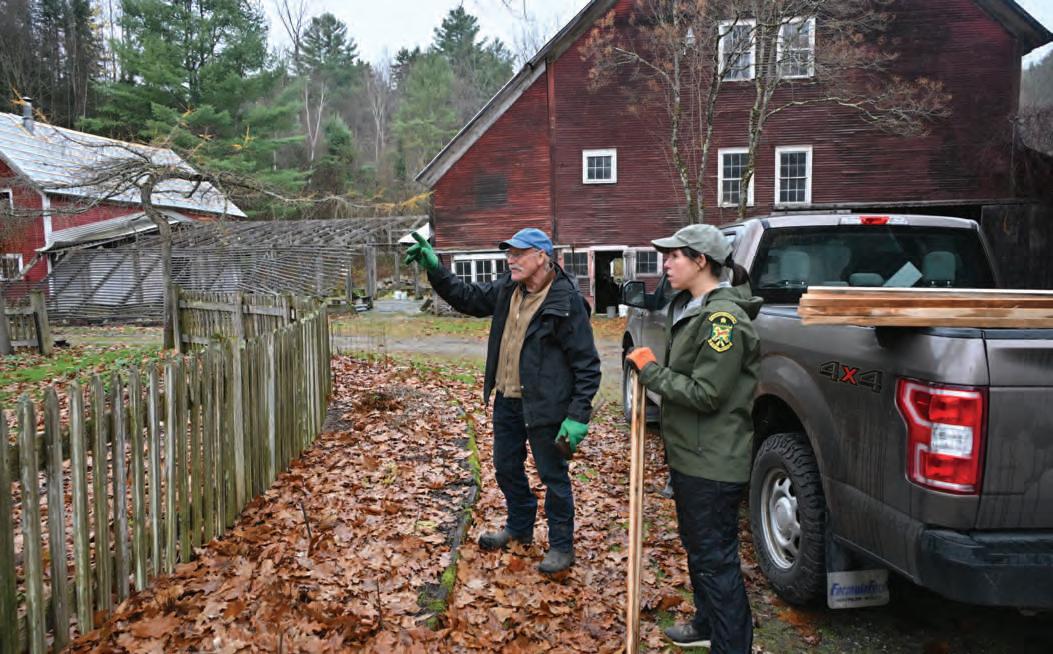
FOUR DECADES Don Avery, the former owner of Cadys Falls Nursery in Morristown, and Jennifer Klebs with the Department of Vermont Fish and Wildlife, build a fence around the the property's sprawling elaborate gardens in November. Don lived at the nursery with his wife Lela for 40 years before Fish and Wildlife purchased the property through a flood plain buyout last fall.
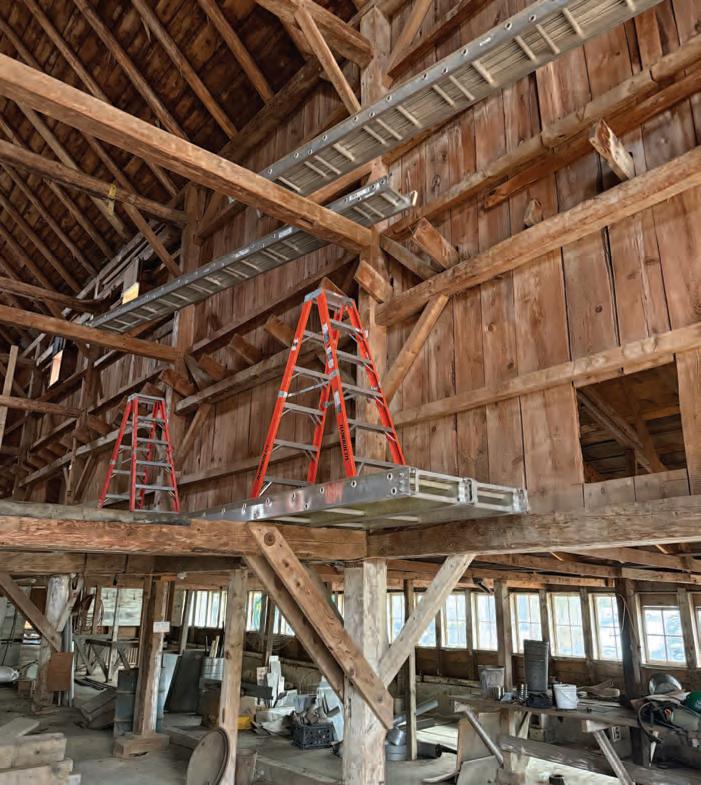
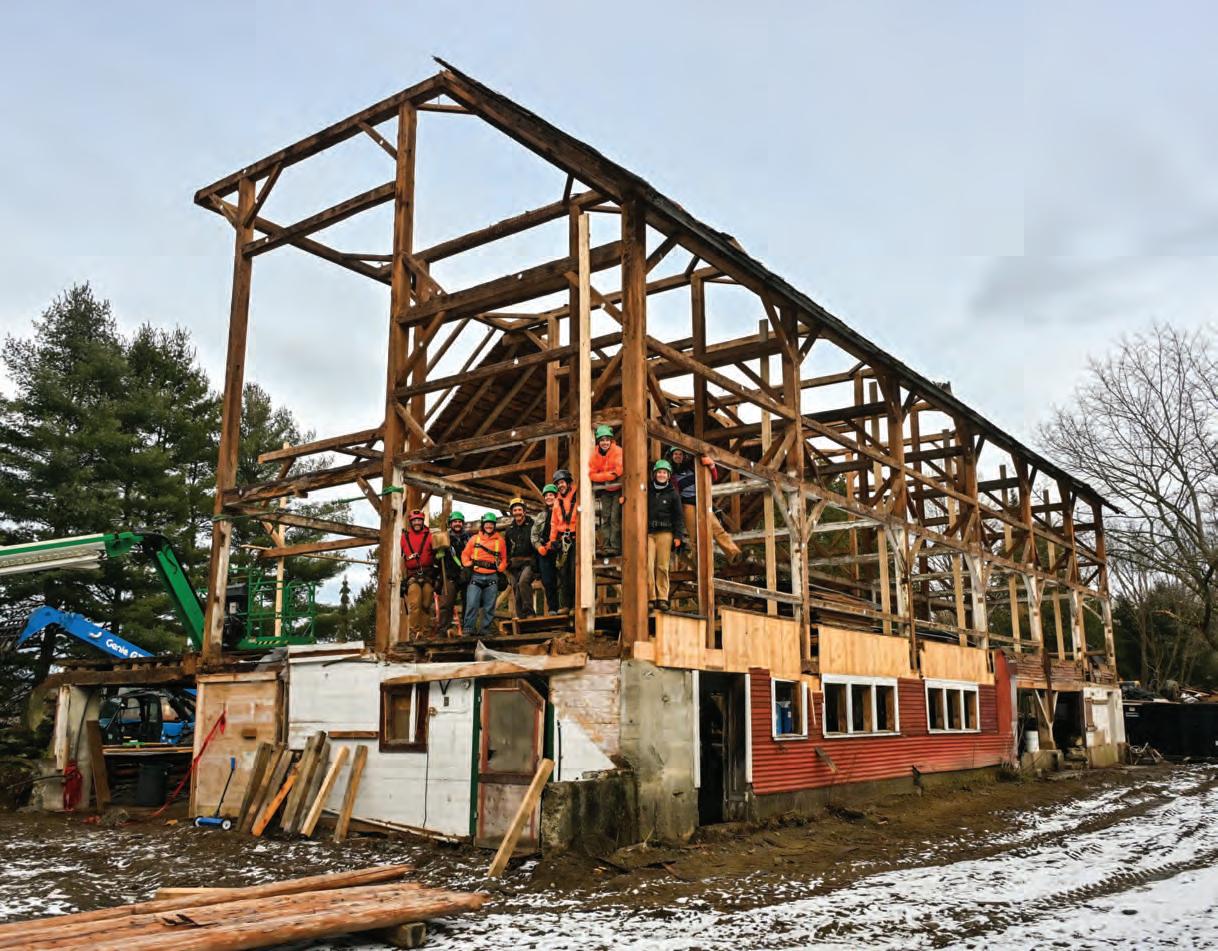
COMPREHENSIVE PROCESS Don and Lela Avery's property on Duhamel Road was home to an 1850s three-story barn with a skeleton of hand-hewn timbers and spikes driven into the joints. Other structures around the barn were demolished, but the historic barn was meticulously disassembled and rebuilt in another location. Huntington-based Building Heritage led the project, along with members of the Vermont Youth Conservation Corps.
RURAL ROUTE
The home was demolished and dragged away, but the barn, with its historic features and towering timber frame, received a decidedly different treatment. Under the guidance of Huntington-based Building Heritage, workers with the Vermont Youth Conservation Corps took the structure apart piece by piece and are rebuilding it at a different location.
As public land, rip rap in the river will be removed and beavers will move in. The area will continue to flood, but that could improve flooding conditions downstream, according to Will Eldridge, an aquatic habitat biologist with Vermont Fish and Wildlife.
“This is really best for everybody, so I’m not as heartbroken as some people would think,” Don Avery said.
Built to last
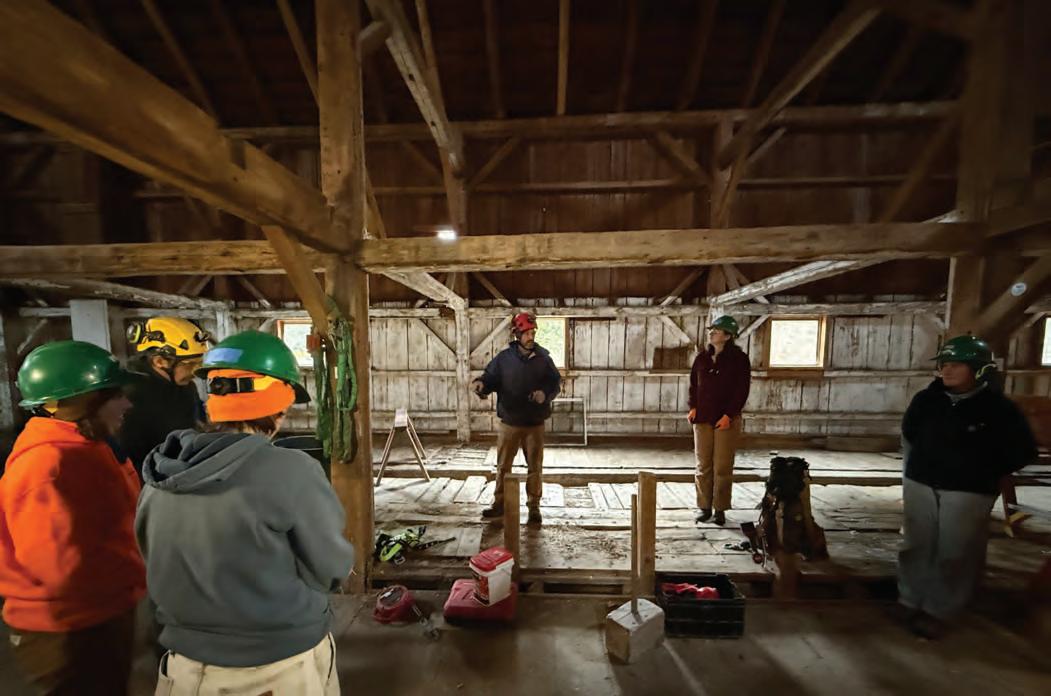
Last fall, workers with the Vermont Youth Conservation Corps climbed high into the barn’s rafters and used L-shaped metal rods to pry wooden pegs from timber frame joints. Tyler Hadar, one worker, had devised a system for labeling the timbers with silver placards, so they’d know how to put the barn back together.
The crew members came from different Conservation Corps programs, but they all had an appreciation for the structure they are disassembling. Hadar is with the timber framing program and others came from the farming and conservation program.
Interstate 89 travelers might recognize the massive red East Monitor barn off the highway near Richmond, one of the largest barns in the state, which Building Heritage rehabilitated in 2023.
Eliot Lothrop of Building Heritage said the Conservation Corps work-
ers had renovated lots of old barns, but this was their first time taking one down.
Workers stripped the two-story barn down to the historic timber frame. Accessory structures attached to the barn, like greenhouses and out-barns, were torn away and demolished, the old clapboards and metal roofing thrown away, but the hand-hewn timbers and inside-facing boards will be repurposed.
For those in the timber framing program, the project was a practical look at age-old building practices they’d learned about. For farming and conservation workers, it was a lesson on how to deal with ancient structures that are common throughout Vermont’s landscape.
Jessie Gustafson, another worker with the timber framing program, was happy the barn is being saved, and she found a type of serenity among the hand-hewn timbers from 150 years ago.
“I feel like it’s a lot of respect for the trees that went into making this, and the people that took the time to make it,” Gustafson said. “It’s just such a beautiful barn, and it’s fun to be in here. It’s also fun just, like, ripping stuff up.”
Repurposing structures like the barn also cuts down on the amount of material deposited in a landfill, fulfilling a state mandate to reduce waste after a buyout.
The Averys’ home was a different story. Although it was a historic structure with its own timber frame skeleton, layers of plaster and other material in the home rendered it too difficult and expensive to renovate. Prior to the demolition, the Averys asked friends and neighbors to raid their home. Building material and appliances, including marble >>
FLOOR PLAN Eliot Lothrop of Building Heritage charts course for the day with Vermont Youth Conservation Corps workers on the first floor of the barn.
RURAL ROUTE
NICK OF TIME Workers with Building Heritage and the Vermont Youth Conservation Corps peer through the second-floor rafters of the stripped-down barn. They finished in the nick of time before winter.
windows, a wood stove and hardwood went to seven surrounding counties in Vermont.
“It was nice because it all went to people we knew, people who were building a house or renovating their house, so we knew it was all going to get used,” Lela Avery said.
Not fade away
Every structure and piece of material on the property was removed, down to bare soil, except for Don and Lela’s plants, which they have three years to relocate, a courtesy likewise granted to farms during a buyout.
Vermont Fish and Wildlife doesn’t want to manage the gardens, but the Averys wanted to break it up anyways. They’ve seen some private gardens wither once they become public.
“It’s too personal,” Don Avery said. “We always knew this wouldn’t be here forever, but we wanted someone who would take care of the plants after us.”
They don’t have a plan for all the species, but some of the rare conifers will return to Greg Williams, a Wolcott plant master who taught the Averys how to graft trees decades ago.
“It was a good long run,” Lela Avery said. “We really enjoyed it. We loved our little place there. We loved our business, and we loved our customers.” n
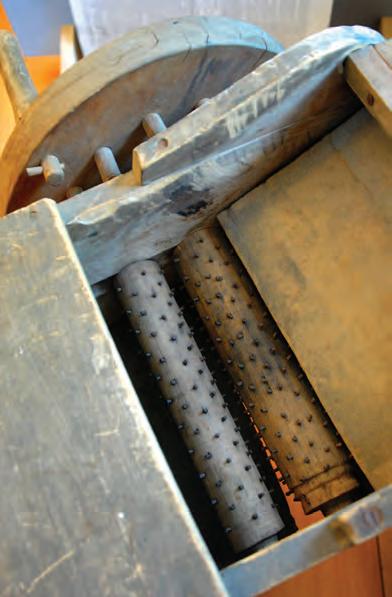
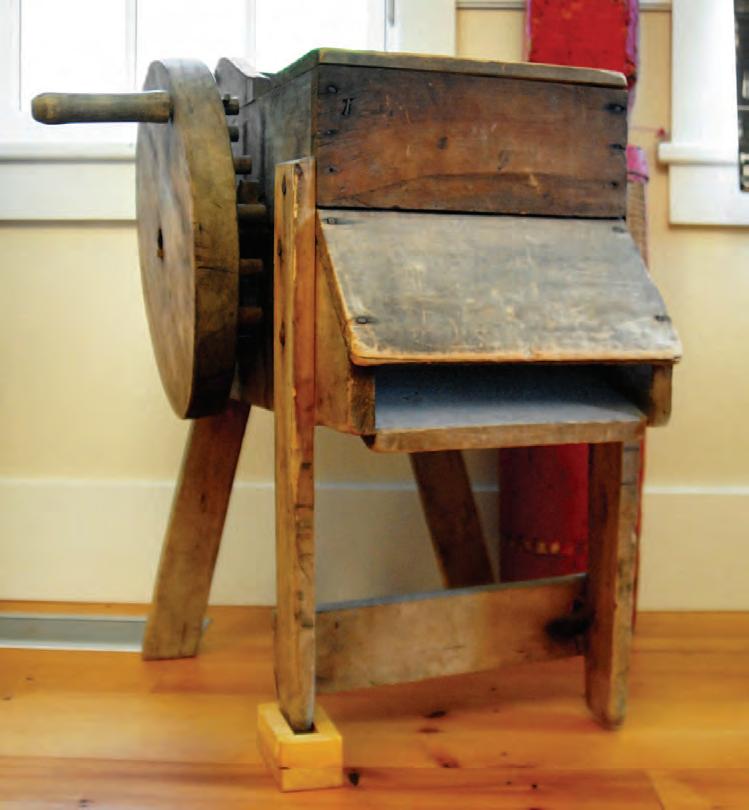
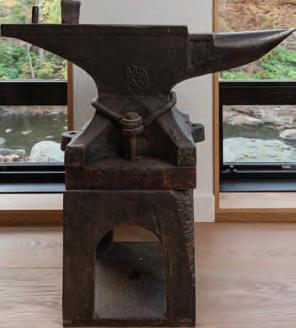
Also referred to as the Stowe Historical Society Museum’s “whatchamacallit,” this contraption has baffled all the experts who have examined it, leaving them to ask, “What the heck is it?”
“We just don’t know,” Barbara Baraw explained. “And because we don’t know what local family donated it, we can’t track it back to them.”
Most agree that it is homemade, one of a kind, built in the 1800s, and used in a home. A butter churn? A grain or bean thresher? A seed stripper? Given its design with rotating cylinders that produce a combing action, some have guessed it was used to comb or process some material, perhaps a wool comber or cleaner. “I doubt that because there
were two wool carding factories in town at the time and farmers took their wool to them for carding and combing,” says Baraw. “I think it was used to clean or husk corn or peas; or something that needed husking.”
To identify the curious artifact, the Stowe Historical Society turned to the Stowe Reporter, which published a picture of it and asked if any readers could help. None could. Until someone comes forward with a certain answer, this century-old piece will continue to be known as the museum’s “whatchamacallit.”
—Rob Kiener
WHATCHAMACALLIT
RURAL ROUTE
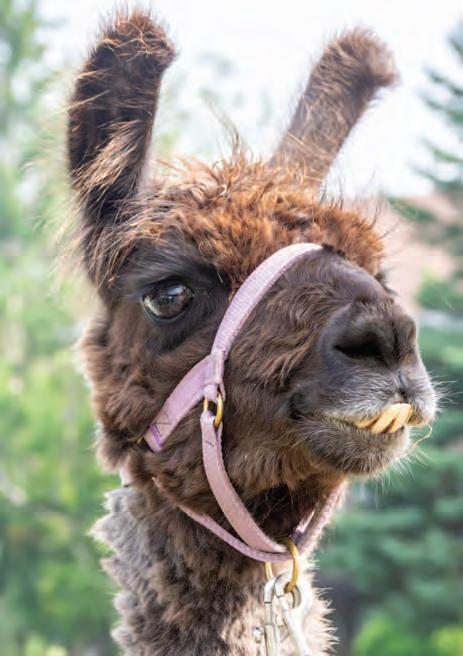
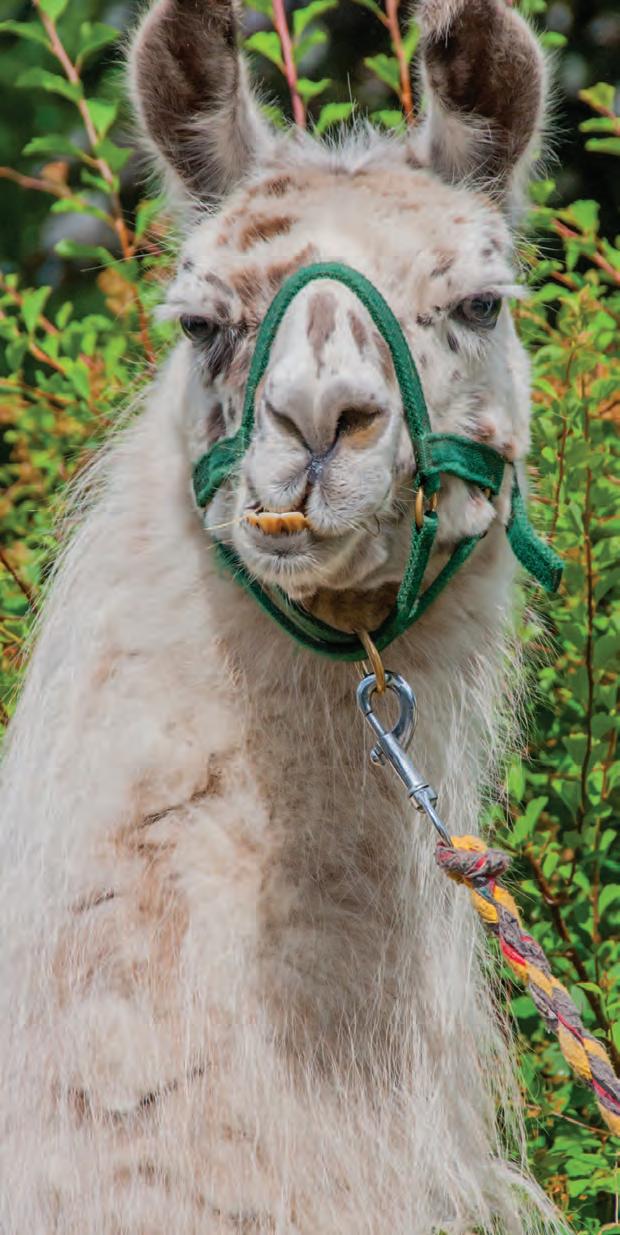
For thousands of years, llamas have trekked through the Andes in South America as reliable, sure-footed pack animals. They crisscross trails in northern Vermont, too, thanks to the Northern Vermont Llama Company in Waterville.
Since llamas are intelligent and curious creatures who like to check people out, don’t be surprised if a llama greets you by sniffing and blowing on you. That’s called a llama kiss and likely means you meet with the llama’s approval, according to Lindsay Chandler, co-owner of the company.
While llamas don’t bite people, poorly behaved people might not get a kiss. A llama will spit to show their disapproval of bad behavior. More commonly, though, a llama saves its spit for other nasty llamas.
Since restrictions on the importation of llamas from South America were lifted in 1984, interest started to increase in the United States in the 1980s and 1990s. Relatives of camels, llamas are somewhat smaller in size but can still weigh several hundred pounds.
Llamas are tall, athletic, and graceful with wide eyes, large ears, long, elegant necks, beautiful eyes, luxurious fiber—and great eyelashes.
Lindsay Chandler and her husband, Geoff, love to hike, and decided to combine that pastime with
STORY / Kevin Walsh
their passion for llamas. They began offering treks in Jeffersonville through Smugglers’ Notch Resort and now trek across the resort’s trails a few times each week from late spring to midOctober.
“There is something special about llamas— a calmness, independence, and royalty,” Chandler said. “But they are also comical, and in some ways ridiculous. They are quiet, not demanding, and very easy to care for.”
Their son, Stephen, now mainly runs the company.
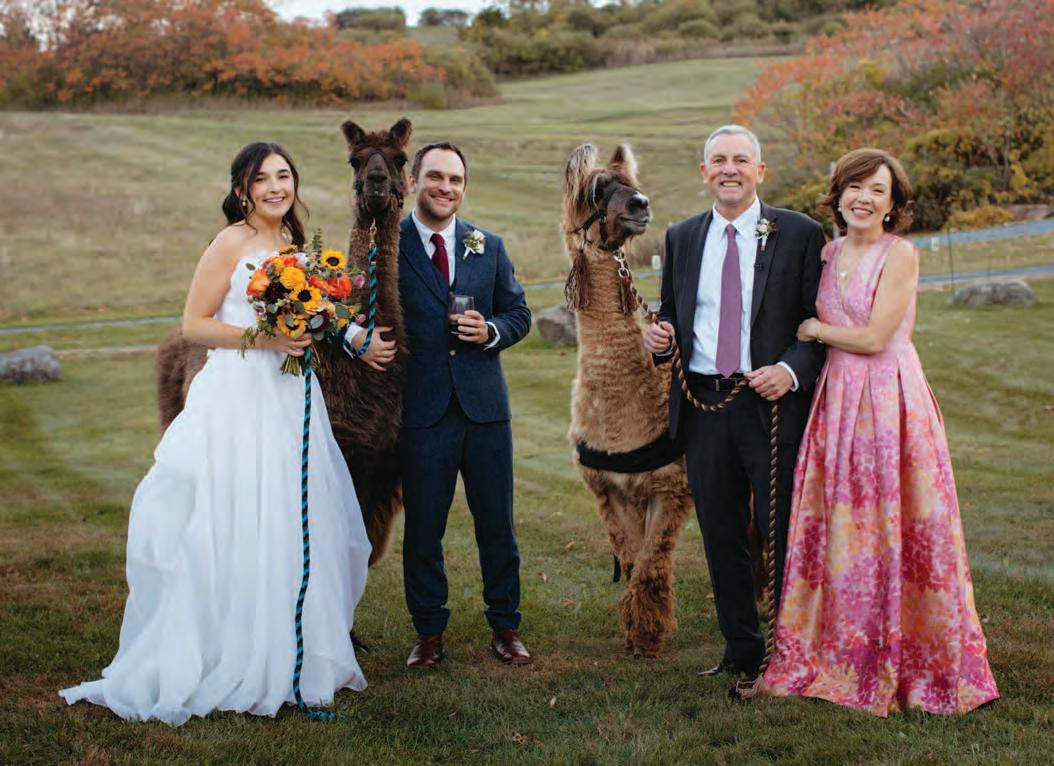
The Chandlers have brought their llamas to schools and nursing homes, various other events, and even a wedding reception. “The llamas walked around delivering beers to
SPECIAL GUESTS Emma and Brian De La Bruere welcomed the Northern Vermont Llama Co. llamas to be a part of their wedding in October of 2025 at the Old Lantern Inn and Barn in Charlotte, Vermont.
guests from their packs,” Chandler said. “They were the hit of the show.”
A typical trek lasts just over two hours. Llamas are fitted with a neck halter with a lead, as well as a saddle for carrying cargo. People don’t ride the llamas; instead, they walk them using the halter.
“The llamas love to go for a walk. They will go right with you,” Chandler said.
The treks are leisurely, since llamas tend to make stops to browse for food. People can score points with their llamas by scratching them behind their ears or on their backs.
Smugglers’ guests Stacey Leichman Cahn and her 16-year-old son, Hugo Cahn, from Brooklyn, New York, say trekking with llamas is “something out of the ordinary.”
Hugo agreed with Chandler’s assessment that “each llama has a different personality. Some have high energy, others low energy. Some like to lead the pack, others want to stay behind.”
“They know which llamas would be good for each type of person on a trek,” said Stacey, adding, “How many people get to say that they hiked with a llama in Vermont?”
KEVIN WALSH
TRAIL ACCESSIBILITY
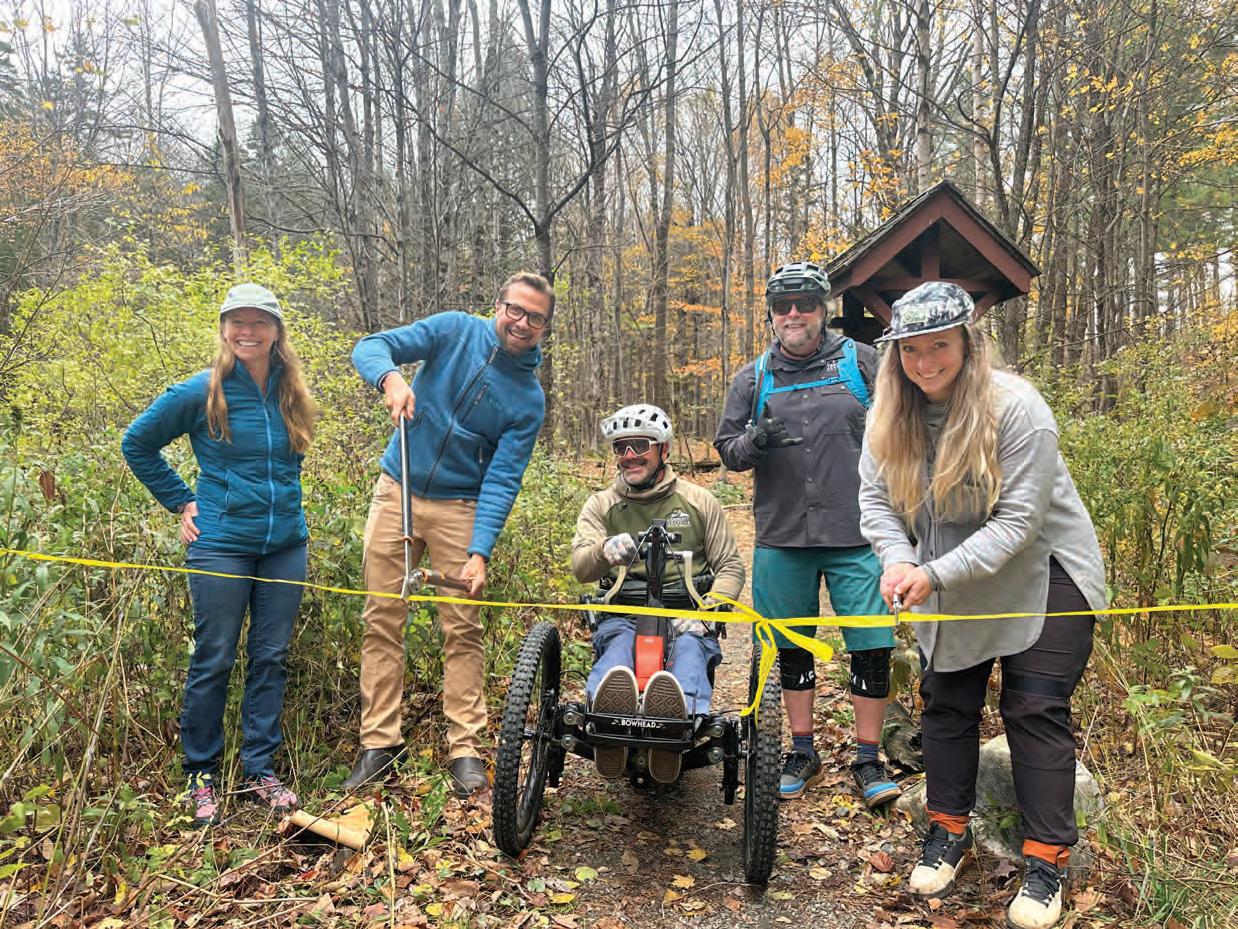
OPEN ACCESS Trail users with all manner of wheels—and some with four legs—celebrate the opening of new adaptive trails in Kirchner
STOWE’S KIRCHNER WOODS
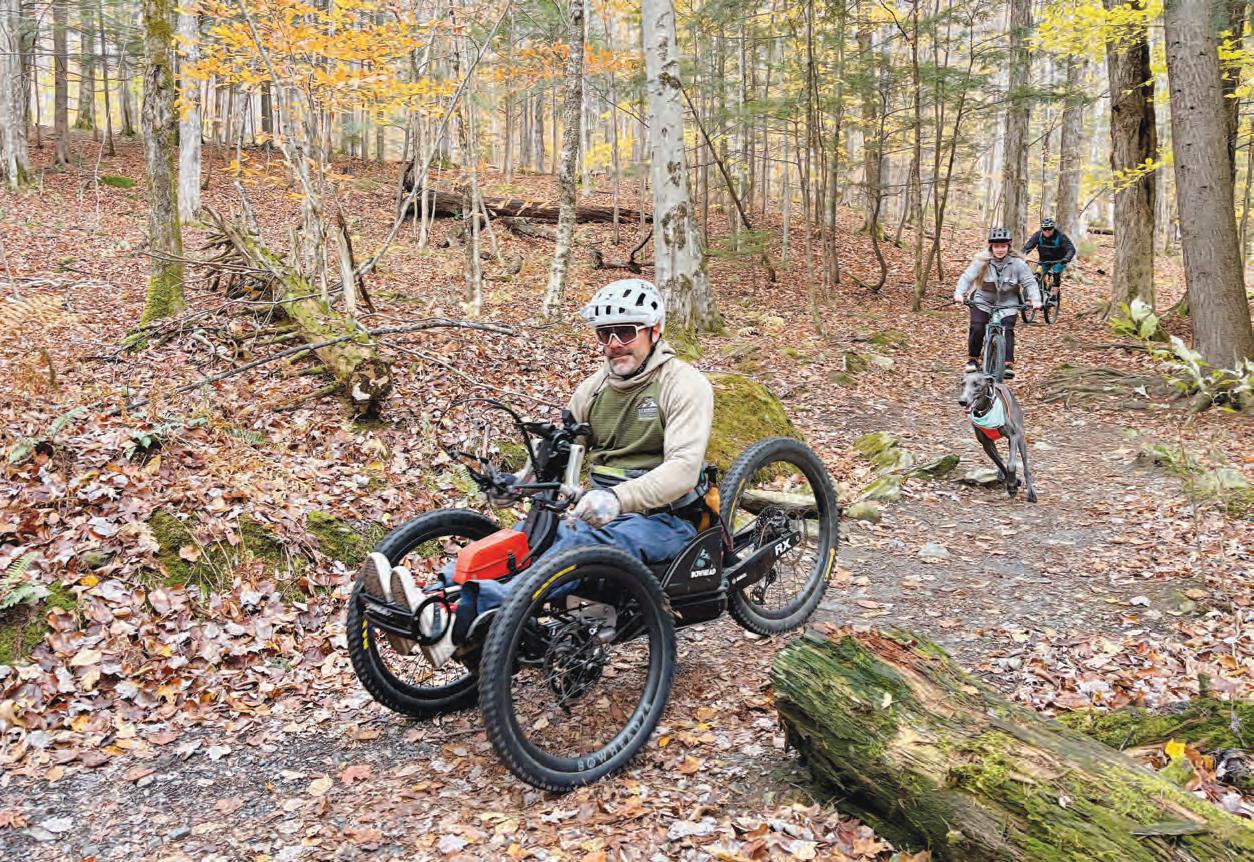
Riding trails in Kirchner Woods on Taber Hill Road on a Thursday morning a couple of winters ago, Louis Arevalo noticed the smell of rain-soaked cedars and decaying leaves melting into the ground.
Long a locals’ hangout for lunch rides and dog walks, these trails have become a lot more accessible through minimal upgrades. Arevalo is an adaptive rider from Essex who rides a recumbent, hand-powered bike. He’s known for tackling terrain some able-bodied riders would shake their heads at, but today he’s taking flow laps with his dog, Ozul, smelling cedars and leaves, and giving feedback to Stowe’s trail ambassadors about the upgrades.
“I can ride more advanced terrain,” Arevalo said. “But it’s nice to
have gentle terrain for everybody to either learn on or just play together on.”
It didn’t take much to make the Kirchner trails more accessible— mostly widening bridges and removing some rocks—but there’s a massive payout as people of all ages and abilities can now enjoy them. Arevalo especially likes how the trails still feel natural, with roots and non-threatening rocks making the ride interesting, but not necessarily technical.
“The number one question we received about this project was, ‘Is this going to become another Cady Hill?’ And the answer is, ‘No,’” Caroline Loeb, stewardship director with the Stowe Land Trust, said. “We’re not >>
STORY / Patrick Bilow PHOTOGRAPHS / Tom Rogers
Woods in Stowe.
TRAIL ACCESSIBILITY
THROUGH THE WOODS Louis Arevalo leads the way—followed by his pup, Ozul—through Kirchner Woods in Stowe.
smoothing trails in the same way. Cady Hill serves a very different purpose. The goal here is to keep the rugged natural beauty while providing better access.”
According to Kenzie Brunner, executive director of the Stowe Trails Partnership, Stowe has some of the best accessible riding terrain in Vermont—and she would know. In her prior role with the Vermont Mountain Bike Association, she traveled the state taking inventories of these types of trails.
Since the formation of the Trail Accessibility Hub through the Vermont Trails and Greenways Council in 2023, which dispersed $600,000 in Vermont to assess and upgrade as many trails as possible, towns like Stowe have been expanding their accessible terrain to the point where some zones no longer distinguish between an accessible and non-accessible trail.
Kirchner Woods is the latest trail network in Stowe to receive this treatment. Charlie’s Bypass and Eagle Ridge in Cady Hill have seen the biggest changes, and Stowe Trails is currently planning another beginner and adaptive-friendly trail behind Stowe Village Inn.
Riding is only permitted on trails in the bottom half of Kirchner Woods, but the area is still a hotbed of activity for hollow residents and visitors alike.
Seeing the falls
The Mill Trail to Bingham Falls is also getting an accessibility makeover. Owned by the Stowe Land Trust, the trail is short and not intended for mountain biking, but it’s extremely popular and dangerous for some people.
According to Rogers, Stowe Mountain Rescue, of which he is a member, responds to Bingham Falls seven or eight times a season. From a Google Maps perspective, it’s just a short jaunt from Route 100 to the majestic crashing falls, but the trail is steep with several hazards.
The calls are mostly non-emergent—lots of twisted ankles and busted legs—but some are more complex, with people trying to navigate areas where “they could really hurt themselves,” Tom Rogers, executive director of the Stowe Land Trust, said.
Stowe Land Trust is midway through an accessibility project in the area. So far, it has replaced culverts with bridges and removed dangerous hazards. Rogers said the motivation is twofold—to improve flood resiliency and create a universally accessible trail.
“It’s just such a beautiful falls, and a lot of people want to see it,” Rogers said. “Our goal is to open up the outdoors and nature, especially in some of these really high-profile beautiful spots, to people of all abilities.” n
Proudly Celebrating 25 Years of Sharing the Joy of Water, Wellness, and Belonging
WhereWaterLives
COMPETITION SIZED LAP POOL - KIDDIE POOL - WATER SLIDE
LEARN TO SWIM LESSONS - SWIM TEAM - MASTERS SWIMMING - AQUA AEROBICS
SPACIOUS FITNESS AREAS - PERSONAL TRAINING - FITNESS CLASSES - YOGA
STOWE BIKE TRAIL NETWORK EXTENDS TO
Stowe’s mountain bike empire is expanding with a new network of trails proposed in Mud City between Morristown and Stowe.
Stowe Trails Partnership is partnering with the Rooney family to build 10-15 miles of new trails on their Mud City Loop farm. Former dairy farmers, the Rooneys currently raise pastured beef on the land, but they have another vision of becoming a mountain bike destination.
According to Kenzie Brunner, executive director of Stowe Trails Partnership, the organization has signed a land use agreement with the Rooney family and construction will begin this year. Stowe Trails contracted Hardy Avery to build the trails. A former Morristown and Stowe resident, Avery is the architect of countless trails in Lamoille County.
The project is still in its infancy, but Brunner said a wooded, remote hill on the Rooneys’ land is the proposed location for the new network. The general plan is to build a beginner uphill trail that serves intermediate to advanced downhill only trails. The uphill track and at least one advanced downhill trail should be finished by the end of the year, Brunner said.
Save for old sugar house roads, there isn’t much trail-wise on the Rooney land, but it’s located in an area that could connect existing trail networks, like Sterling Valley, the Catamount Trail, and even some trails in Morristown.
Brunner said the new network is answering a call for more advanced downhill terrain. Unlike the bidirectional trails in Cady Hill Forest and Adams Camp—where downhill riders must watch the corners—some of the trails on the Rooney property will be built with speed demons and rock junkies in mind.
“We’re trying to fill the niches for what we’re missing, which is technical, steep stuff, but also opportunities for people that like flow and getting air,” Brunner said.
There are plans for beginner terrain as well. Brunner said it’ll be the type of place where “dad can ride with the kids on this lovely little green loop and work on skills, and mom can go crush a double black diamond.”
—Patrick Bilow
PROUD PARTNERSHIP Selina Rooney at the family farm. The family has partnered with Stowe Trails Partnership to build a network of mountain bike trails on the property.
MTB & GRAVEL BIKE EVENTS
STOWE TRAILS PARTNERSHIP
The outfit you want to join for all things MTB in Stowe. Rides, events, trails, more. stowetrails.org.
JUNE 27: Velo Stowe
Talta Lodge, gravel event you won’t want to miss. stowetrails.org/events
AUGUST 30: Race to the Top of Vermont
4.3-mile hill climb, bike or run up Mansfield’s Toll Road, 2,564 vertical. rtttovt.com.
OCTOBER 10: 15th Annual Leaf Blower Fall Classic 15th annual Leaf Blower Fall Classic at Strawberry Hill Farms. stowetrails.org/events
Golf
More than a dozen courses are within an hour’s drive, but two of the state’s most spectacular are the 6,213-yard, 18-hole Stowe Country Club, and the private Stowe Mountain Club. Other courses options abound, from Copley Country Club in Morrisville, to options in the Mad River Valley, Burlington and beyond.
Adventure mountains
Hiking options abound in the Greens. Access the Long Trail from the top of Mansfield and the extensive trail network from the summit area. Routes up Vermont’s highest peak come from all directions— Nebraska Valley, Ranch Camp, Smugglers Notch, and even Underhill, on the mountain’s backside. In addition to Mansfield, the mountain trails around Stowe are too numerous to list, from the Sterling Pond Trail in the Notch to Belvidere Mountain. A good place to get oriented is at the Green Mountain Club headquarters in Waterbury Center. Looking for an adventure? ArborTrek on the Cambridge side of Smugglers Notch offers ziplining, a treetop obstacle course, and more.
Paddle sports
Local outfitters offer river trips on the Lamoille and Winooski rivers, where you can canoe past dairy farms and through quintessential Vermont villages, all the while soaking in sweeping views. Or if you prefer, launch a kayak on Lake Eden, Lake Elmore, Caspian Lake, Wolcott Pond, or Waterbury Reservoir. Canoes and paddleboards are welcome everywhere, such as Long Pond in Eden, Green River Reservoir in Hyde Park, and Little Elmore Pond.
Swimming holes
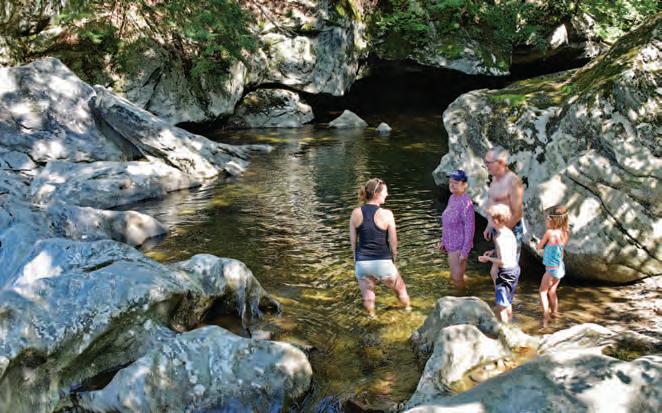
Innumerable mountain streams meander through the Green Mountains, serving up a Vermont-style swimming experience and a unique kind of solitude. Some are a cinch to find: A walk up the Stowe Recreation Path to a spot on the West Branch River, or the well-known Foster’s swimming hole. Better yet, find your own!
Bike in the woods
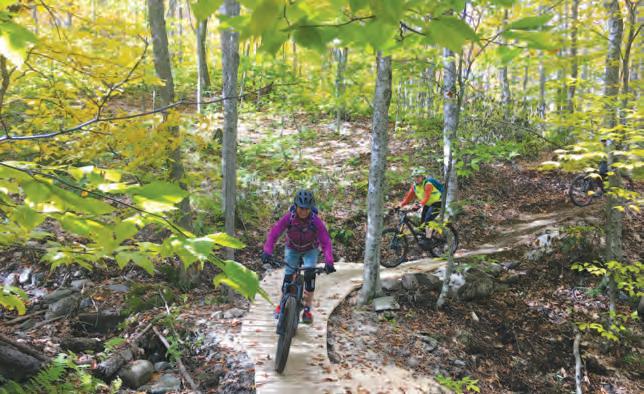
Whether you want a gentle ride along the 5.3-mile award-winning Stowe bike path with its views of Mount Mansfield or a teeth-chattering, lung-burning trip through Cady Forest or Adams Camp, strap on your helmet and get riding. Varied terrain and hundreds of miles of trails make the region a perfect biking destination. To get started, stop into a local bike shop or go to stowetrails.org.
Stowe Recreation Path & Rail Trail
Stowe’s nationally recognized 5.3-mile walking and hiking greenway starts in the village behind the Stowe Community Church. While never far from civilization, the path offers scenic views of the West Branch River and Mt. Mansfield. Other access points are on Weeks Hill Road, Luce Hill Road, on the Mountain Road across from Well Heeled, and at the path’s end on Brook Road. The Lamoille Valley Rail Trail meanders through several of the towns north of Stowe. It’s a great biking, running, and walking path—93 miles in all. lvrt.org.
STOWE SPOTS
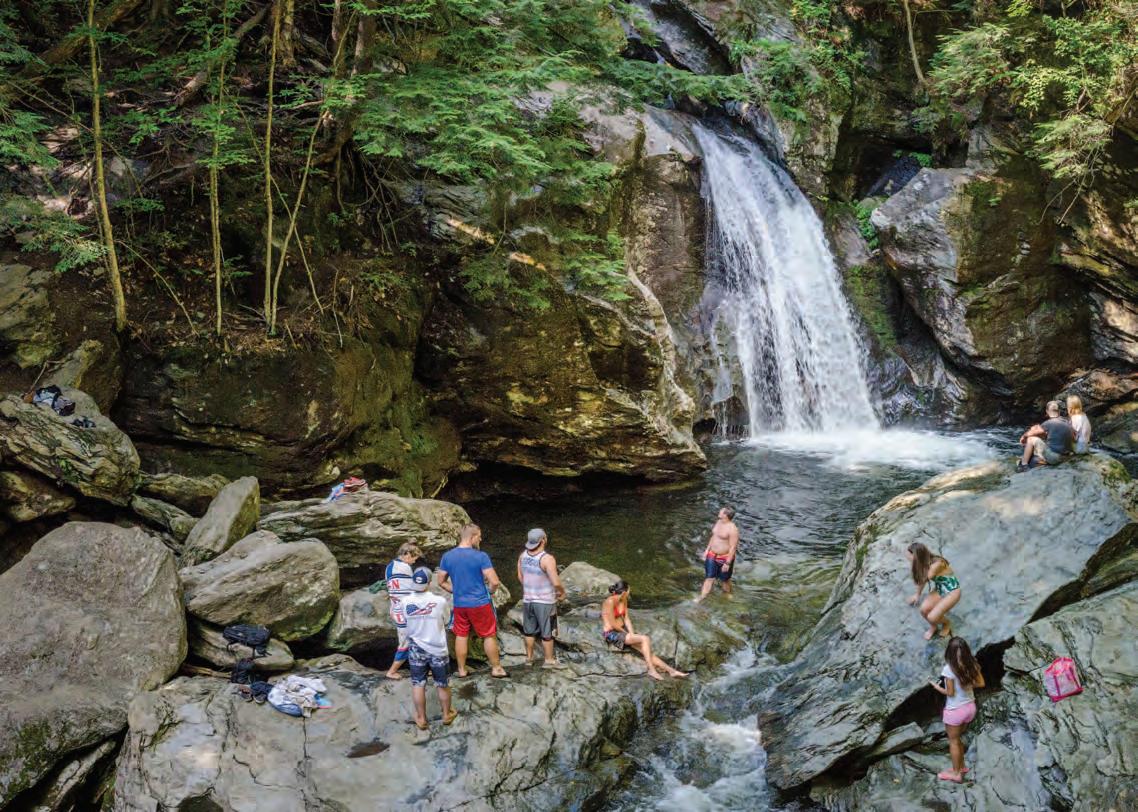
GO-TO SPOTS The quandary of living in a tourist town: Your once-local favorite swimming holes become the go-to spots for visitors, once the word gets out.
DESTINATION
Stowe is famous for its ski slopes, mountain views, and picture-perfect New England charm—the kind you see in postcards and Instagram posts. But growing up in a place like Stowe makes your relationship with the town a little more complicated.
“Growing up in a tourist-heavy town like this meant constantly adapting to change—new restaurants replacing old favorites, and larger, more modern buildings taking over the rustic, homey buildings we grew up with,” Stowe local Maddie Ziminsky said.
Just because you live in a beautiful place doesn’t always mean it feels like it’s yours.
Visitors show up year-round: skiers in winter, hikers and bikers in summer, and leaf-peepers in fall. The stream of tourists brings business and energy, but it also changes the town you grew up in.
/
That rural-but-not-too-remote vibe is part of what makes Stowe attractive to both tourists and residents. But for people who call it home, those constant changes can feel different.
For teens, it’s not just new buildings or businesses. It’s watching parts of your childhood disappear. Hangout spots fill up with strangers. The places that once felt like yours slowly feel like they belong to someone else.
“Sometimes tourism is very noticeable during the winter season or fall foliage,” Molly Barrett Croes, who moved to Stowe at age 6, said. “All the traffic can make you late for practices or other activities. You have to plan ahead during heavy tourist times.”
It’s not just about traffic or crowds. It’s the subtle cultural shifts that make the town feel a little less familiar.
Croes remembers how the pandemic brought a wave of new faces.
ESSAY
Sabrina Staab
/ Paul Rogers
“People just came to escape (Covid), and many of them didn’t understand the town or its issues. It kind of disrupted things,” she said.
Locals notice variations from their small, everyday habits, like tourists not staying to the right on the popular Stowe Recreation Path or not signaling when they pass. Or when people assume goggles or gloves hanging from a tree are up for grabs—that’s just part of the local lost-and-found trust system.
“I can’t blame people for finding safety in a more rural state, especially a rural town like this, and then wanting to stay once they’d begun building connections,” Ziminsky said.
Still, that growth comes at a cost.
“Tourism has changed the feel of many local hidden gems,” Croes said. “People publish books and blogs about the best swimming holes, trails, or hidden places, and once that happens, they are not hidden anymore.” >>
ROUTE 15 • JOHNSON, VERMONT
(11⁄2 miles west of the village)
Open 7 days a week: 10AM –7PM
Label, OFF PRICE Clothing for Men, Women & Teens
STOWE SPOTS
It’s not that locals don’t want to share their favorite spots, it’s just that sharing often means they lose a little of what made them special.
Stowe Mountain Resort is perhaps the most prominent example.
“As a local, I used to go up there all the time, since it’s only 10 minutes from my home. Now, it’s a rarity to go near it,” Ziminsky said. “It’s just grown so huge, and it doesn’t feel nostalgic anymore.”
Abianna Noonan added: “Vermont summers have always been something special. The beauty of our small town creates a universal drive to be outside and enjoy our authentic and raw nature.”
But finding spaces that still feel truly local? Residents say that’s getting harder, other than, say, specific powder stashes on the mountain or prime swimming spots about which locals remain tight-lipped.
In a town where sharing too much can mean losing the untouched parts you have, keeping secrets isn’t just protective, it’s kind of an act of preservation.
When asked about her favorite local spots, Ziminsky laughed, “I couldn’t give away any of Stowe’s local secrets, could I?”
While some teens say most of their friends are originally from outside Stowe—or even outside Vermont—others remember a tighterknit community where most of their circle grew up right in town. But not every “local” experience looks the same.
Despite everything—the changes, the crowds, the loss of old hangouts—there’s still magic in Stowe. You just have to make it your own.
“My perfect summer day in Stowe?” Croes asked. “I’d hike the Pinnacle trail in the morning and then go swimming in Bingham Falls. Or maybe walk on the recreation path and go swimming somewhere there. I’d probably get dinner at Trapps or hang out at the the meadow concert platform to end the day.”
Noonan paints it a little differently, a little bit the same.
“I’d wake up early to catch the sunrise through the mountains and make my way into a local coffee shop, each one with their own house-made treats,” she said. “After a slow morning, I’d hike Pinnacle or Mansfield, then finish the day swimming in the river with friends.”
Stowe is shaped by the people who come and go, as well as by those who stay. Perhaps being a local sometimes just means knowing the quiet swimming holes, the unwritten rules, and simply appreciating what it means to be a part of this community.
Being a local doesn’t always mean you belong fully, and being a tourist doesn’t always mean you don’t. Many Stoweites live somewhere in the middle. n
Sabrina Staab is an intern majoring in English and psychology at Florida State University. She spends her summers in Stowe.
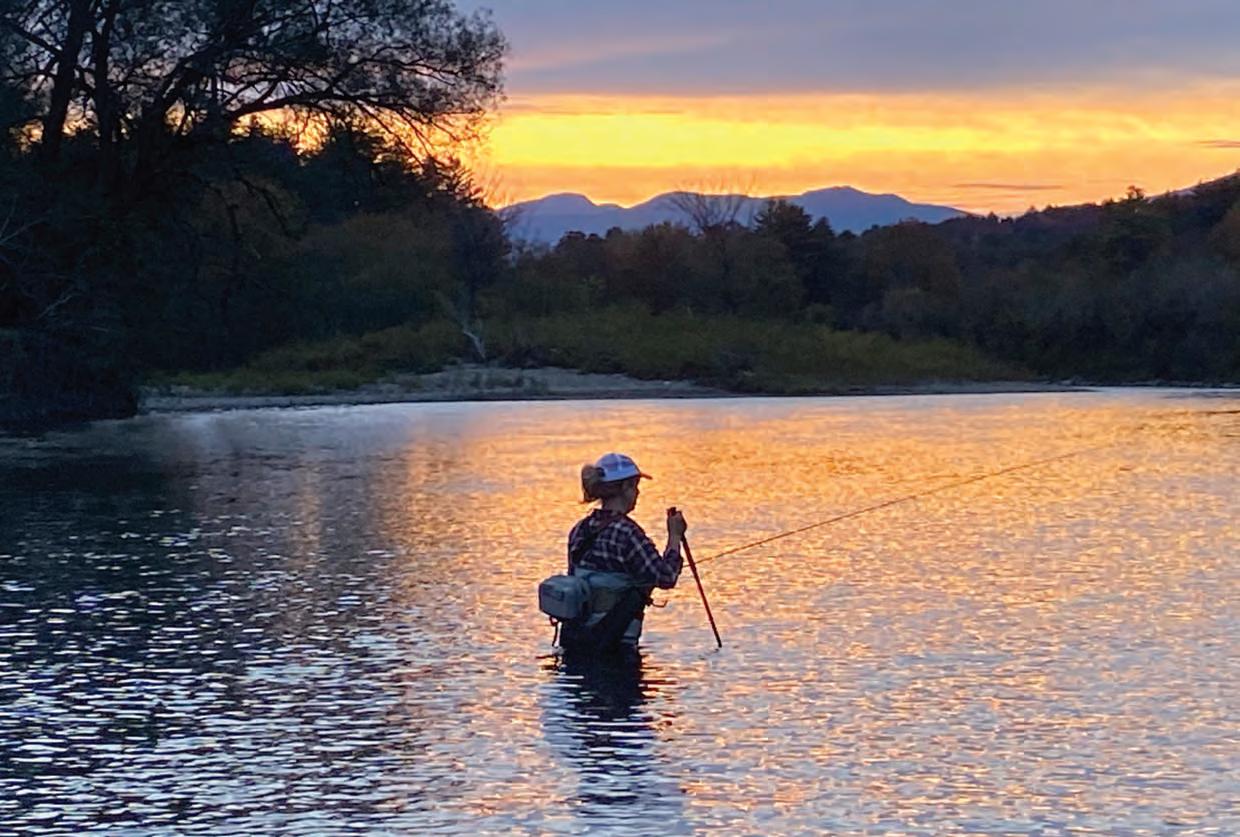
• Fly Fishing Adventures 1/2 & Full Day
• Ice Fishing Tours 1/2 & Full Day
• Private Casting Clinics
• Family Gone Fishing Adventures
• Fly Fishing Gear & Products
• Spin Fishing Gear
MOUNT HUNGER AND WHITE ROCK VIA THE HAYWARD TRAIL
Everyone knows Mount Hunger is an easy-to-access, frequently hiked, and much-loved peak in the Worcester Range. Most Stowe and Waterbury locals and visitors hike its west-facing Waterbury trail.
Love it though we may, that trail shows the wear and tear of lots of hiking and trail running.
“The Stowe side gets heavy use,” says Walter Opuszynski, outdoor recreation specialist for the Vermont Department of Forests, Parks and Recreation.
Consider this alternative: Adding just 30 minutes to your drive can give you a completely different experience climbing the same peak. On the Middlesex side of the Worcester range, the Hayward Trail approach to Hunger is less traveled, woodsier, and feels much more “out there” than its highly-trafficked western counterpart—the Stowe side to
which Opuszynski refers.
“The difference between the east and west sides is amazing,” he said.
Adding the lollipop route to White Rock adds less than a mile to the Hunger out-and-back and makes a wonderful and rocky ridge walk.
Don’t get me wrong, there is no problem with hiking up Hunger from the west side—if you like people. You are almost certain to encounter other hiking groups. Indeed, on peak weekends and certainly during foliage season, you may have to jockey for a parking spot in the lot.
Things are different on the other side. Before leaving Interstate 89, be sure to have your pack already full of foodstuffs and water, your car gassed up, and the trailhead plugged into your GPS. >>
ROCK WALK The trail turns to stone on the way to the White Rock summit.
TRAIL JOURNAL
EPIC VIEWS The Worcester Range from Hunger Mountain.
Center Road is paved when you first exit the highway, but it soon turns to dirt. There are no stores or amenities, and cell service is inconsistent between the interstate and the trailhead.
Approaching the trailhead after the approximately eight-mile dirt road Tour de Middlesex, many people report saying, “Is this it?” On the far side of the mountains, signage, like the cell service, can be spotty. There are parking spots and an overflow lot, as peak seasons do happen even on the quiet side.
The hike to the summit of Mount Hunger follows the Hayward Trail. Formerly the Middlesex Trail, it was renamed in 2025 for the late Tim Hayward, a Middlesex resident and United States Marine Corps veteran who served as chief of staff in the administrations of two Vermont governors (Dick Snelling and Jim Douglas) and for U.S. Representative James Jeffords. Hayward used this route to hike Hunger often and even brought members of his staff up the trail as a teambuilding activity. Former staffers requested the trail be renamed for him.
Different from the Waterbury trail, the Hayward can get overgrown. In fact, when I hiked the trail last summer, several wooden steps and ladders were rotted and nonfunctioning. Trail crews the state have since rebuilt the ladders using milled cedar they carried up the trail.
A surprising amount of thought goes into what materials to use for stairs and other aids, explained Opuszynski.
“First we look to reroute,” he said. “But if that’s not an option, we’ll build steps.”
Ideally, they would use fallen wood from the trailside; on the other hand, they want structures to last.
“There is a metal staircase at one spot,” Opuszynski said. The 18-step structure replaced a rope.
Two hundred fifty miles of trails go through lands managed by Forests, Parks and Recreation. Of those, advocacy organizations partner with the state to steward all but 44 miles of trails. Despite the passion and enthusi-
asm for hiking the Worcester Range, these mountains, including all the trails on Hunger, fall into the 44 with no partnering organization, and therefore Forests, Parks and Recreation trail crews do all trail maintenance on the Hayward and every other trail in the Worcester range.
The summit push on the Hayward is a rocky scramble, and 360degree views of Mount Mansfield, other Green Mountains, Lake Champlain, and the Adirondacks reward successful scramblers. Spend some time on the summit (if you were my 12-year-old companion, you’d busy yourself finding the three metal summit markers) before turning downhill on the Waterbury Trail, the trail most other hikers ascend. The White Rock Trail intersects the Waterbury after about a tenth of a mile, and you will generally find yourself alone on the .6mile traverse.
The White Rock Trail meets your route down, the Bob Kemp Trail, on a flat rocky platform. Don’t descend yet, though—the ascent to the summit of White Rock is a highlight of the trip, with several challenging rocky scrambles to a craggy perch with more 360-degree views.
The return trip retraces the White Rock summit push back to the Bob Kemp, which intersects the Hayward in about a mile. The entire trip with the lollipop is about 6.3 miles.
Mount Hunger is a favorite among locals and visitors alike. It’s somewhat surprising that advocacy groups haven’t banged down Walter Opuszynski’s door to help maintain the local treasures that are the trails in the Worcester Range.
“Maintaining trails and renaming trails is interesting business,” Opuszynski said, noting that both happened in the past year on the Hayward Trail. In 2026, much of the word gets passed online, so it is possible that the name “Middlesex Trail” could persist on sites other than the Department of Forest, Parks, and Recreation-endorsed Trailfinder.com. Regardless of name, on this hike, there’s a front door and a back door, and the back door makes a nice adventure. n
Hikers in the mid-1920s turned to the Green Mountain Club’s 1924 Long Trail guide for the most up-to-date information. The northern end of the included map became outdated in the summer of 1926 when workers extended the trail 10 miles from Hyde Park to Jay Peak.
the long, fast trail
The Three Musketeers’ and a spe edy hiker’s end-to-end exploits generate headlines—and controversy
MARK BUSHNELL
Irving Appleby garnered regional and national headlines during his end-toend hikes of Vermont’s Long Trail in 1926 and 1927.
James P. Taylor spearheaded the founding of the Green Mountain Club in 1910.
During the summer of 1927, two groups of hikers prepared for arduous treks through the wilderness. They planned meticulously, leaving behind anything that wasn’t worth the weight and shipping ahead food they would need farther along the route.
The lure was the Long Trail, which had recently been extended so that it now ran from the Massachusetts state line to just shy of the Canadian border. One group was composed of a military veteran and a speed-walking champion; the other featured an 18-year-old woman who had just graduated high school, and two women teachers in their mid-20s. The hikes would generate newspaper headlines, as well as controversy within the hiking community.
The Long Trail, America’s oldest long-distance hiking trail, was the brainchild of James P. Taylor. As a teacher and administrator at Vermont Academy in Saxtons River, Taylor loved taking students on hikes but found few trails that reached the state’s mountaintops. By his count, there were only eight such trails, though historians put the number at closer to 40. So, Taylor spearheaded the founding of the Green Mountain Club in 1910. The club’s goal was to create “a long trail” through the heart of the state that would make “the Vermont mountains play a larger part in the life of the people,” he said.
Taylor himself would also play a larger role in the state’s economic development, soon becoming secretary of the Greater Vermont Association, which eventually became the Vermont Chamber of Commerce. He would remain in that role for the rest of his life, nearly four decades. A gifted promoter, Taylor saw positive press coverage of the Long Trail as a cornerstone to luring tourists to Vermont. By the summer of 1926, the Green Mountain Club had arranged for the route to be extended all the way north to Jay Peak. (A crew would extend the trail to the Canadian border in 1930.)
STORY : mark bushnell
VERMONT HISTORICAL SOCIETY NEWSPAPERS.COM
The military veteran preparing to hike the trail was 37-year-old Irving Appleby. Although he was American, Appleby had eagerly volunteered to serve in the Canadian army, even claiming that his birthplace was New Brunswick when he’d really been born in Syracuse, N.Y. Both of his parents were Canadian, which could explain his decision to join Canada’s army. During the First World War, Appleby fought in France, was wounded six times—by bullet, shrapnel, and gas—and received a medal for bravery. He was also said to be the fastest long-distance runner in the Canadian army. Now a civilian, he found work as a salesman for the milk company Hood in Boston, but Appleby thirsted for fresh adventure. He set his sights on the Long Trail.
Appleby made headlines the previous summer when he became the first person to hike the then roughly 255-mile-long trail from end to end. Traveling from north to south, he took two weeks to complete the hike. Appleby declared his true time to be 12 days and five hours, because he faced hours of delays beyond his control. Those interruptions included time he spent helping his traveling companion, a Harvard professor who fell ill, hike out from the trail, as well as an evening spent attending a dinner in his honor hosted by the Green Mountain Club in Bennington.
Appleby’s dedication to put in the hard miles was impressive. As he explained to reporters, he hiked 16 hours a day and slept six. The other two hours he spent setting up and taking down his camp—and eating. To fuel himself, Appleby ate four times a day—at 4 a.m., 10:30 a.m., 4 p.m., and shortly before he went to sleep at 10 p.m.
“Only the most hardy of New England mountain climbers attempt the journey over ‘The Long Trail’ that stretches over the peaks of the Green Mountains,”
the Associated Press stated in an article on July 30, 1926, so Appleby was “confident that he had set a record that would stand for a long time.”
But Appleby changed his mind. He knew someone who could better that time: himself. He announced to the press that he would return during the summer of 1927 and complete the trek in 10 days, this time traveling from south to north.
Replacing the Harvard professor as Appleby’s companion was F.C. Jameson, said to be a champion heel and toe walker, as racewalking was then known. Some newspapers reported the man’s first name as Robert, while still others referred to him as George Jamieson. In the end, it wouldn’t really matter. Readers wouldn’t have long to get to know him.
Accompanied by several students from Williams College, the pair left at first light on Saturday, July 2, from Williamstown, Mass. The college students stopped after about 15 miles and left Appleby and Jameson to complete the remaining 240 miles.
On the night of July 4, some fishermen tenting at an abandoned lumber site just north of Stratton Mountain witnessed two exhausted hikers limp into camp. The hikers were “in pitiable condition,” according to one news report. “Jamieson was almost unable to walk because his feet were cracked and blistered, and Appleby was suffering.”
Deciding that Jameson needed to see a doctor, the pair hiked out to Manchester Depot, with Appleby carrying both 35-pound packs. In addition to blistered feet, the doctor suspected Jameson might also have diphtheria, symptoms that include weakness, swollen lymph nodes, and fever. He “forbade him to continue,” newspapers reported.
Having also lost his hiking companion the previous summer, Appleby >>
VERMONT HISTORICAL SOCIETY
The Three Musketeers (from left, Catherine Robbins, Hilda Kurth and Kathleen Norris) became the second, third and fourth person ever to hike the Long Trail from end to end, a feat they accomplished in 1927. Photos and details of their trek were printed in newspapers across the country.
was used to hiking alone. Although he himself suffered fever and some intestinal trouble, Appleby soldiered on. Soon, newspapers were reporting that Appleby had covered 118 miles of trail in 50 hours. (For some reason, many news articles stated that the Long Trail was 278 miles long, adding nearly 25 miles to the Green Mountain Club’s own calculation.)
News about Appleby became sparse for several days, until the Associated Press reported on July 13 that Appleby had telephoned James P. Taylor of the state chamber from a forester’s lodge north of Belvidere Mountain. Appleby expected to reach the end of his route in North Troy by 1 p.m. the following day.
Heavy rains and thunderstorms delayed him, but Appleby reached North Troy at 8 p.m. on July 14, where he was greeted by chamber officials and given a celebratory dinner. Subtracting the time he had spent in Manchester while Jameson was being treated, newspapers reported Appleby’s total hiking time as 10 days and 10 hours. He said he hoped to return the next year and hike the trail in nine days. Appleby also said he would be returning to Boston with three fewer teeth, lost in a fall near Sterling Mountain.
Appleby was the hero of the hour. Thanks in part to the publicity efforts of Taylor and the chamber, articles and photographs appeared in newspapers around the country. He looked to parlay his minor celebrity into endorsement deals and even spoke about possibly starring in a movie that would document his next Long Trail hike.
For all the overwhelmingly positive press coverage, Appleby was surely stung to read the Bennington Banner’s stern editorial criticizing him for his haste on the trail and his self-promotion off it.
While conceding that Appleby “is a man of tremendous vitality,” the
n Wire service photographs of Irving Appleby appeared in many American newspapers, including the St. Louis Post-Democrat, left, and the Minneapolis Star Tribune, right.
paper wrote, “his description of the achievement did not put him in good favor with the officials of the Green Mountain Club.”
In recounting his trek, Appleby had emphasized the hardships he faced. “His story was one qualified to keep people away from the Long Trail,” the Banner declared. “He pictured the greatest part of it as a dense wilderness and almost impassable, miles from civilization and beset with dangers with which only the experienced woodsman could cope … In short, the Long Trail was painted as a tortuous and unmarked trail through the wilds with death in many forms stalking those who dared to challenge it.”
The Banner said the Long Trail could more accurately be described as a well-marked, well-maintained path that passes “swift mountain trout brooks” and “several of Vermont’s beautiful lakelets,” while crossing “wooded ridges with frequent outlooks.” Hikers are never far from “camps, hotels, lodges, and farm houses,” so they are never “in danger of losing touch with civilization.”
The newspaper also took issue with the speed of Appleby’s trek. “Vermont’s Long Trail was never intended as a marathon course for such vigorous hikers as Mr. Appleby,” the Banner declared. “It is a thing of beauty and a place for contentment and is supposed to be enjoyed at leisure. If Mr. Appleby takes any pleasure in tearing over the length of the Trail in 12 days, well and good, but he misses the whole purpose of the project and nothing of any value is accomplished.”
The rebuke foreshadowed criticism Appleby would soon face.
Just days after he completed his hike, a very different group of trekkers took to the trail. Like Appleby, they intended to hike the entire route, but they planned to do it at a far more meditative pace. At Taylor’s urging, the
NEWSPAPERS.COM
nation’s press publicized the all-woman trio’s adventures, introducing more readers to Vermont’s Long Trail and making the women minor celebrities.
This spelled bad news for Appleby. Not only would he have to share the spotlight, but by viewing the trail as something to be savored, not conquered, the women were inadvertently strengthening the arguments against his hurried style of hiking.
Treasuring the trail
Kathleen Norris had an audacious idea. The 18-year-old would hike Vermont’s aptly named Long Trail, starting at the Massachusetts border and traveling north to where the path petered out just shy of the Canadian border. It was 1927, and only one person had ever hiked the roughly 255-mile-long route from end to end.
Norris and her father had planned to hike the Long Trail together after she graduated high school, but, tragically, he died during her senior year. Still, she decided to stick with the plan and hike the trail in his honor.
Norris mentioned the idea to her teacher Hilda Kurth, who eagerly agreed to join her. Together they discussed who else should accompany them. For safety, people advised them to have four members in their party. They ended up adding only one more, but it was a well-informed choice. The previous summer, Kurth had hiked extensively in Alaska with Vermonter Catherine Robbins, a teacher in Brandon, so they asked Robbins to join the expedition. Though the women never sought attention for their hike, the press eventually got wind of it and dubbed them “The Three Musketeers.”
When James P. Taylor, founder of the Green Mountain Club, learned about the women’s plans to take to the trail, he saw it as a great way to keep Vermont in the national spotlight. When he fed the story to reporters, they ate it up. “‘The Three Musketeers’ have come to life again,” proclaimed a wire service article that ran in multiple newspapers. “But this time they appear as young women instead of the swash-buckling heroes of the Dumas novel.”
But while the press had covered Appleby’s expedition from even before he set foot on the trail, there were no news reports when the Three Musketeers started hiking north from Massachusetts 12 days after Appleby completed his race. Stories about the women’s trek were only published when they neared the end of the trail; Taylor perhaps having withheld word of their trek until that point.
roni and cheese, as well as cornmeal, oatmeal, raisins, crackers, chocolate, and a product called Mapleine, from which they could make a maple-flavored syrup by adding sugar and water. It was a far more interesting and varied diet than the rice, bacon, cornmeal, and raisins that Appleby had subsisted on.
They brought a small tent but slept mostly in shelters under their blankets. They also carried flannel pajamas, ponchos, three compasses, two axes, a hatchet, and a Kodak camera. The compasses came in handy when they lost the trail one night. Another day, Robbins used the hatchet
When Irving Appleby and the Three Musketeers hiked the Long Trail, they probably relied on the most up-to-date handbook available, the 1924 Long Trail Guide. m
In a paternalistic society, supporters like Taylor might have harbored concerns that the women would give up along the way. Womanhood wasn’t widely seen as being compatible with such rigors as outdoor adventure. After all, just eight years earlier, women were still being denied the right to vote in national elections. A San Francisco Examiner headline about the Three Musketeers’ expedition contained a fair share of amazement: “They Carried No Firearms, and Had No Male Escort.”
When the Three Musketeers later recounted their time on the trail, however, there was no doubting their outdoor skills or their resolve. The women had planned carefully. While Norris and Robbins carried knapsacks and Kurth wore a pack basket, they made sure to keep their loads reasonable—no more than 25 pounds. They did so by shipping food ahead to post offices near the route. Their supplies included dehydrated vegetables, powdered milk, bacon, baking and pancake flour, and maca-
to kill a porcupine, as the Green Mountain Club encouraged hikers to do at that time to prevent the animals from damaging shelters along the route.
During the hike, they were occasionally caught in the rain and later recalled being “always wet,” especially their 14-inch-tall hiking boots. Their one luxury was a four-ounce ukulele. When they grew tired, they’d rally by playing it and singing the “peppiest songs they could think of” or composing one on the spot.
The women spoke warmly of interesting encounters along the trail. Before departing, they had been warned they might meet unsavory “fern pickers” who lived in backcountry camps and collected in-demand species for shipment to florists around the country. Ignoring the advice to avoid them, the women “found that these fern-pickers were very interesting and treated them with more hospitality than people in some of the cities.” The fern pickers were staying in a disused lumber camp with some surprising luxuries, including electric lighting and even a Victrola, >>
MARK BUSHNELL
Photos on pages 72-75 are from Catherine Robbins’ scrapbook, courtesy of her granddaughter Cara Nelson l July 25, 1927, Williamstown, Massachusetts, the morning the three women started their Long Trail hike. From left, Hilda Kurth, Kathleen Norris, and Catherine Robbins.
at a time when many Vermont communities still had no electrical service.
Clear skies greeted the women when they summited Killington Peak. In no rush, they spent an hour on top, enjoying the distant views, then spent the weekend at the Long Trail Lodge at Sherburne Pass, where the hostess gave Norris a green felt hat as a memento. She wore it for the rest of the hike. Kurth and Robbins opted to wear bandanas on their heads. Any covering helped keep insects from biting.
The women took periodic days off to rest and let their clothes dry. “Although not in competition with Appleby’s record for speed over the trail, they are going the whole distance in comfort,” wrote the Brattleboro
Reformer
As they reached Camel’s Hump’s summit, the sun was just setting, “almost too beautiful to be real.” They camped on the mountain and were disappointed when clouds rolled in and unleashed soaking rains overnight. It was still raining when they set out in the morning for Mt. Mansfield.
They enjoyed exploring the sights and talking with people they met along the hike. At Belvidere Mountain, they toured the asbestos mine and took samples with them, then visited with the fire warden stationed on top. They were nearing the end of the trail.
Harold French, a member of the state Chamber of Commerce, greeted the women at Hazen’s Notch. He brought along a gallon of vanilla ice cream and was accompanied by a photographer, who captured some now-famous photographs of the hikers.
Two days later, they reached the summit of Jay Peak, where a welcoming committee of officials from North Troy and the state chamber met them. But they weren’t done yet. The Three Musketeers descended the mountain and then hiked another eight miles along a road, before
taking a crude trail to reach the Canadian border.
Cheerful stories and photographs of Vermont’s Three Musketeers appeared in newspapers across the country. It was everything that Taylor and other marketers of the state could have hoped. “It is a great advertisement for Vermont,” declared the Morrisville Messenger, “and also for the splendid womanhood that America is producing—her greatest and best crop.”
The Messenger also noted that big city newspapers loved the story of the Three Musketeers and called for more photographs and human-interest details of their trek. “Those girls have blazed the way for hundreds of equally fine girls to a real healthy vacation, at very small cost,” the newspaper wrote. “We will see a great invasion of our mountains next season.”
Not to be outdone, Appleby wrote excitedly to the state chamber of commerce about the boon that news of his own hikes had brought the state.
“For the first time in New England history, Vermont and the Long trail are known to the ‘man on the street,’” he wrote. “Half a million folks are discussing the subject, every young hiker, male and female, and half the athletes in Boston are laying plans to go over the Long trail.”
His boots, hiking equipment, and photographs would soon be displayed in the window of a “big shoe store on one of our busiest corners (in Boston),” he explained. “I estimate that over a million people will see that exhibition.”
Appleby wrote to Taylor that the Christian Science Monitor had published a story about his hike that was reprinted in newspapers “in the most important cities of every civilized country in the world. If that isn’t publicity, what is?”
Despite the exposure Appleby generated, some Green Mountain Club leaders were growing uncomfortable about having him as their mascot. His brashness and ambition rubbed them the wrong way. They seemed to >>
THEIR MOTTO: THE MUSKETEERS MUST GET THERE
Aug. 11, 1927, Catherine
Robbins and Hilda Kurth at Brandon Pass, known today as Brandon Gap.
Catherine Robbins waves on top of Lincoln Peak while Hilda Kurth takes a rest.
Morning of Aug. 22, 1927, leaving Ed Derby’s Farm, where the three women had slept on the milkroom floor.
Aug. 25, 1927, Kathleen Norris, Hilda Kurth and Catherine Robbins on top of Jay Peak as they hike on their last day on the Long Trail.
Entitled “MODERN GIRLS,” the poem read in part:
prefer the image the Three Musketeers presented of the Long Trail.
In November 1927, the club asked Appleby to provide daily itineraries for his record-setting hike, saying they wanted to clarify inconsistencies in the stories he was telling reporters. Appleby was stunned. In an ill-tempered letter to Green Mountain Club officials, he reminded them how famous he was and how much free publicity he had brought the Long Trail and Vermont. The club reprinted the letter in its Long Trail News.
“Why do you not question or criticise the ‘Three Musketeers’ as to whether they ever covered the Trail or not? You didn’t question or criticise the girls for just one good reason,” he wrote, before adding some italics, “Because they were girls, young, pretty, popular and unusual.”
If Appleby was irked by the different reception the women received, he apparently felt no animosity toward them personally. In fact, he took the women out to dinner after they returned from their hike and at some point even penned a poem in honor of the second, third and fourth person ever to hike the Long Trail from end to end.
The growing concerns raised by Green Mountain Club leaders were not just about Appleby and his strong personality, but also about his “marathon hiking.” The group’s founders had conceived of the Long Trail as a peaceful refuge from the
“Three modern girls of Viking heart In the teeth of a mountain gale, Singing a song as they trudge along, Defiant of rain and hail; True of purpose and strong of will, Nor seeking the sheltering vale, Fighting their way up the rugged slopes To conquer the old Long Trail.”
increasing pace of modern life, not as a road to be rushed down.
Editors of the Long Trail News painted a lurid picture of the threat posed by self-promoting speed-hikers: “Unless this tendency were checked, there is no knowing to what lengths it might go. …We might, in the course of
l
Catherine Robbins and Hilda Kurth in front of the New Webster Camp at Stratton Mountain
Aug. 25,
NEVER QUITE SO HAPPY, NEVER QUITE SO GLAD!
a year or two, meet on the trail student artists, with their sweaters emblazoned with the names of firms who made their boots and other articles of equipment. Record smashers would dash by, accompanied by camera men who would take motion pictures of them. … Marathon runners would rush along in both directions. … And the genuine nature lover, for whom the Trail was intended, would be crowded out of the cabins and off the trail entirely.”
Despite this war of words, Appleby maintained a strong connection with hiking in Vermont and was doing just that when drenching rains caused devastating flooding around the state in November 1927. While hiking in East Wallingford, he was struck by an uprooted tree and taken to the hospital in Rutland. Newspapers reported that Appleby had helped alert Red Cross officials to the plight of more than 100 families in Johnson that had been left homeless by what would become known as the Great Flood of 1927.
If some people viewed Appleby and the Three Musketeers as pre-
senting starkly different ways to use the Long Trail, the hikers never spoke publicly against each other. It was as though they believed the Long Trail was long enough to accommodate both types of hiking. Nearly a century later, both types of hiking coexist on the Trail.
Even though the Long Trail today is longer than it was in his day, reaching all the way to the Canadian border, the end-to-end record that Appleby established has been repeatedly shattered and now stands at an astonishing three days and 21 hours. Nevertheless, the Three Musketeers’ more leisurely and contemplative style of hiking is still how most people enjoy the Long Trail.
While debate still continues over the “right” way to hike, the hiking community has largely embraced a new ethos summed up by the acronym, HYOH: Hike Your Own Hike. n
Mark Bushnell is a Vermont journalist and historian. He is the author of “Hidden History of Vermont” and “It Happened in Vermont”.
1927, Catherine Robbins, Hilda Kurth, and Kathleen Norris at the Canadian border. m
family BUSiNESS
Jon Osborne emphasizes family and maple
STORY : mark aiken
PHOTOGRAPHS : gordon miller
SHACK Opposite page, Jon Osborne outside the sugarhouse in Ferdinand. below, Liquid gold, a 500 mL jug of Osborne syrup, complete with a splash of red on
The logo on a bottle of Osborne Family Maple syrup is based on a photo of a couple standing in front of their sugarhouse. “Those are my parents, Gary and Janet,” explained Jon “Ozzie” Osborne, owner and co-founder of Osborne Family Maple. “And that’s our sugarhouse.” A closer inspection of the logo reveals the smallest splash of color—his father’s red and black Johnson Woolen Mills jacket.
In the graphic design business, adding a second color to a printed logo—like that tiny splash of red on a maple syrup jug—carries a disproportionate cost.
“I’ll never take that red away,” Osborne said.
Gary and Janet raised Jon and his brother Troy in Island Pond, just a few miles from a property in Ferdinand that had been in the family for four generations. Gary, Janet, and Jon founded Osborne Family Maple on that property in 2007. A family friend shot the photo shortly before Gary died in a logging accident on the property in 2010.
“It was the end of the sugaring season, and we were supposed to be pulling taps,” Osborne remembered. Osborne got held up at his primary job, so Gary decided to do the logging work instead. The friend sent the photo shortly after Gary died.
Gary had studied forestry at the University of Vermont and loved trees. Janet said he was always looking at logs on logging trucks, and he dreamed of sugaring.
“A lot of sentiment, pride, and hard work went into making this syrup,” Osborne said, holding a halfgallon bottle and remembering his dad. “We’ve all worked too hard. No way we stop now.” >>
SUGAR
the Osborne logo.
BOILING DAY Below, light amber syrup pours from a spigot on the side of the Jon Osborne evaporator. Right, Osborne (in blue) keeps an eye on the boiling sap while his mother Janet bottles syrup as it comes out of a filter press.
While Osborne spends much of his life commuting between his home in Lake Elmore and the sugarhouse in Ferdinand, many readers have probably never heard of Ferdinand, population 16 according to the 2020 census. You get there on dirt roads out of Island Pond and Brighton, roads that turn to sloppy mud during sugaring season. I know, because I visited the Osborne sugarhouse on a warm day in early April, driving past a few hunting camps and lots of hardwood forestland. Without four-wheel drive and high clearance, I wouldn’t have gotten there.
Maple sugaring is not an easy endeavor. It involves physical labor in all weather conditions, endless hours, organizational skills, plumbing skills, tons of gear and equipment, a certain amount of handiness, and patience. To do it for one’s living requires faith and belief. Gary’s vision for sugaring was a backyard hobby operation.
“I told him I already had too many hobbies that I don’t have time for,” Osborne said. But a more scaled up commercial operation might be a nice way to supplement his career as a fundraiser for Vermont Land Trust. The father-mother-son team (with plenty of help from another son—Troy, a builder and architect) sprang into action, tapping 4,000 trees the first year, building a sugarhouse, and learning more each day, month, and year. >>
BOTTLE TIME This page, Janet Osborne never misses a boil, serving as the main bottler of syrup as it comes out of the evaporator. Opposite page, Jon Osborne is involved in all aspects of his operation, including measuring the specific gravity of newly boiled syrup using a hydrometer.
While every day spent sugaring—or preparing for sugaring—is a tribute to his father, Osborne’s focus is producing high-quality, clear, sweet, certified organic maple syrup. This corner of Vermont consistently gets the state’s coldest temperatures, which Osborne believes may contribute to the clarity and quality of syrup, along with the soil and the tall, straight trees. He also noted that, while there’s little stability in sugaring, the consistent comparative cold may bode well for the potential longevity of sugaring in the Kingdom in a gradually warming planet.
“We were the biggest maple operation in the area when we started,” Osborne said.
They had already laid the concrete forms for the slab and were ready to pour concrete, when Osborne arrived to find his father had removed the forms. In their place was a pile of stone.
“My father collected every one of those stones from this land,” said Osborne. “I had been ready to do a concrete foundation, but what am I going to do, walk away?”
They built the sugarhouse on the stone foundation and outfitted it with a Leader oil-fired evaporator and tanks, made in Swanton. Every year, they streamline their process, add capacity, or upgrade some aspect of the system.
“I suspect the ones who truly make money in this business are the equipment manufacturers,” Janet laughed.
Osborne has added taps on the 80-acre Ferdinand property—referred to as the “home woods”— and he leases 45 adjacent acres, which brings his total number of taps to 7,000. He is no longer the largest operation on the block, far from it. His immediate neighbor is Sweet Tree, Vermont’s largest producer of syrup with 460,000 taps.
“It’s been interesting to see the industry explode around us,” he said.
There’s not much connection between industry giant Sweet Tree and small-scale sugarmakers like Osborne other than the fact that they are neighbors—and the fact that Osborne employs two former Sweet Tree employees.
He takes pride in the quality of his syrup, which he sells in a variety of bottle sizes and in all grades (delicate golden, light amber, dark amber, robust dark, and strong dark), and that it comes from generational land. Osborne, who spent 25 years at Vermont Land Trust helping to foster human connections to the landscape that defines Vermont, now works year-round sugaring, logging, and maintaining his own sugaring operation.
“The well-being of people and landscapes are intertwined,” he said. >>
Conventional sugarmakers don’t fertilize and use pesticides in entire forests, and there are no animals to feed. What, then, makes a sugaring operation organic?
“A lot of it is how you handle your sap and syrup,” Osborne said, noting that certified organic guidelines also address practices like limiting the number of taps on a given size tree.
For example, Osborne has several tanks in and around his sugarhouse. Every container must be food-grade and kept clean. Sap can never be collected in a bucket or tank containing lead. Have you seen Vermont postcards with metal buckets hanging on maple trees? Traditionally, those metal buckets contained lead.
Here, and at most modern commercial operations, taps connect to flexible plastic tubing that funnel sap to the sugarhouse. Often, sugarmakers use a vacuum system to coax sap from trees and a reverse osmosis system to increase sugar content in the sap they eventually boil.
When sap is heated, it will often foam, which can gum up the fittings and working of a sugarhouse operation. Modern conventional operations will add a synthetic defoaming agent to keep sap boiling and syrup moving smoothly through the system. Osborne uses organic sunflower oil.
“We go through everything with a fine-tooth comb. For example, we use no brass fittings,” said Osborne, noting inspectors come periodically.
Almost as much work as following the standards is the documentation—being certified requires diligent record-keeping and traceability. A certified organic sugarmaker is uber-organized and detail-oriented, something I observed during my visit. Despite having a paid helper, his mom, and an old friend along for support, Osborne kept hands and eyes on every aspect of the process—the sap running from the lines, the equipment, and the color and specific gravity of the syrup.
The last piece, the specific gravity, or density, is a sugarmaker’s ultimate measurement. Over and over, Osborne filled a tall, narrow hydrometer cup with ever thickening syrup off the evaporator and carefully dropped in his hydrometer. With bated breath, everyone waited to see if the hydrometer floated. Once it did, they began bottling as quickly as possible so as not to overcook the syrup.
Of course, people paused to sample the product from shot-sized Dixie cups. Sweet, delicious, and fresh.
Osborne uses several innovations to streamline his process. He filters the sap as it comes into the sugarhouse and filters it again after boiling it down to syrup creating incredibly clear liquid. He captures the steam from his giant Leader evaporator to warm the sap before introducing it to the liquid in the evaporator. Adding cold sap would slow the boiling process and waste energy.
During my visit, they bottled most of the syrup immediately. That’s where Janet comes in. >>
DEEP IN PRODUCTION Previous page, sap flows from trees to sugarhouse via flexible plastic tubes. Top, boiling day takes coordinated efforts from all involved. Below left, Matt Moore pours water that was heated by steam from the evaporator. Below right, Garrett LeTourneau checks specific gravity of sap before it enters the evaporator.
“She’s here for every single boil,” Osborne said. She finds her place next to a spout where she pours the just-boiled syrup into logo-ed Osborne Family Maple bottles. On the day I visited, Janet bottled 130 gallons of syrup in 250 milliliter, 500 milliliter, half-liter, liter, and half-gallon jugs. She used her “Checker,” a small digital instrument to ascertain the syrup’s grade. On this day it gave her a number reading of 49, just barely within the “Dark” range.
“It makes me happy to see everything that Gary and Jon worked so hard to build,” she said. “It’s a great way to spend time with my son.”
Osborne marvels at the interconnectedness of Vermont, especially among small Vermont businesses. On one trip hauling recently printed glass jugs from Cambridge to Ferdinand, he stopped at Johnson Woolen Mills, where he met the mill’s owner, Gene Richards, who was expanding the showroom to include a restaurant space. Osborne shared that the family of his wife Kate owned the mill for 90 years.
The two connected, and Richards gave Osborne a tour of the new space. Later, Johnson Woolen Mills featured Osborne Family Maple in their “Out There Chronicles” series and became a customer. Of course, everyone remembers that Gary’s red and black jacket came from the Woolen Mills.
Blair Marvin, owner of Elmore Mountain Bread, also buys Osborne syrup. Marvin was concerned about the future of The Elmore Store, a fixture in the village of Lake Elmore and key to the personality of the small community. She contacted Osborne as a fellow vendor and patron and because of his experience at Vermont Land Trust. They and others formed Elmore Community Trust, which saved the store—it also supports other special community places.
“The store is just a beloved community resource,” Osborne said. It’s also one of his primary accounts, and front and center is a display featuring jugs of Osborne syrup.
The list of Vermont contacts grows the more you learn about his operation.
The graphic designer who designed the logo with Gary’s red jacket is a Vermonter with Lake Elmore connections that Osborne met when he lived in Boulder, Colorado. The wooden crates that hold four-gallon jugs are made by a local woodworker in Island Pond.
Osborne’s favorite aspect of sugarmaking also makes the vocation challenging—the adventure (which some may call unpredictablility). You’ll never know exactly when the sap will run— most times during the day, but often through the night. Fallen branches will rip taps out of trees or take out sap lines.
Of course, the 21st century sugarmaker monitors sap lines by smartphone.
Osborne’s garage and living room have, at times, served as year-round bottling and distribution centers. There seems to always be something to do, but when there’s not, they supplement the sugaring operation by selling firewood. In the past two
years, Osborne drastically increased his number of taps and tanks. But uncertainty can come in other forms—in February, oil and gas prices skyrocketed during the war with Iran.
Osborne has already weathered the biggest curveball of all: the death of his dad.
“Continuing after his death was complicated,” he said, noting that Vermont Land Trust, his employer at the time, was accommodating and flexible. “I lost my business partner, my dad, and my best friend.”
His brother Troy was instrumental in initially coming in when Gary passed, stepping in with tapping, boiling, cleaning up, and more.
“It is not what I, or my wife, signed up for,” he said. “It takes a good Vermont girl like that to understand what I’m doing out here.”
Speaking of not what she signed up for, Janet reiterated, “I thought this was going to be a hobby!”
Nineteen years after starting, and 16 years after Gary’s death, Osborne regularly puts in 80-hour workweeks.
“But I feel so good doing it,” he said. n
behind the facade PRESENCE & FORM
Many notable 20th century photographers used white backdrops for their portraits. While some critics saw the resulting ground as an uncomfortable void, others recognized that the space brought attention to the subject, emphasizing presence and form. With natural environments replaced by blank (but not necessarily meaningless) backgrounds,subjects were out of context. Aesthetically, the subject was presenting itself directly to the viewer, with whom they might re-create a lost narrative.
ESSAY & PICTORIAL : paul rogers
“Every so often what lies behind the facade is rare and more wonderful than the subject knows or dares to believe.”
—irving penn
Photography of botanical subjects can be likened to that genre of portraiture. But unlike humans, whose inner nature is mostly hidden from the camera, autumn leaves are translucent and do reveal what’s inside.
Technically speaking, these leaf photographs are dual exposures: illuminated strongly from behind for an inside look, and discreetly from the front for a hint of our common view. It’s as if we’re holding each leaf up to a bright sky for a glimpse of that translucence.
No longer in their natural habitat, isolated from their kin, subjects are considered alone, bare, and without makeup. Attention is kept on the individual. The narrative is ours to create.
Leaf-shapes hit us in the face: strong positive forms. Mostly tall, centered, and upright, each
carries a certain dignity, asking for a consideration of their character and beauty. Colors and detail draw us in: hues of autumn’s glory, but subject to the ravages of time and the elements.
No one leaf is picture-perfect. No cheerleader effect here. They carry evidence of both a spectacular life and an inglorious end. If our eyes linger, we might notice those all-white negative spaces that reach past the leaf toward each photograph’s inevitable bounding box. White is more than just a convenient ground on which to place the leaves; it’s a new habitat for them, and a new shape all its own.
Some subjects appear confident on these blank canvases, others rather self conscious. Lifted from their natural environments, it’s as if they’re posing themselves in the confines of their new white world. Like people in portraits, they stand before their viewers, waiting to be considered. To be seen as they could never see themselves. n
LIFTED.
[we reflect on] autumn leaves once found among their own now bound
but free in homes of space untangled
—paul rogers
SPOT IN A COLD SEASON
Ijust got off the phone with Richard Wobby. As executive vice president of the Associated General Contractors of Vermont, he’s a busy guy. But in late October each year, he’s crazy busy. I reached out to him for background on a story I’m writing about his other calling as organizer for the annual Wheels for Warmth tire sale, an event that I photographed in 2013. The statewide fundraiser happens annually, and by the time that project finishes up at the end of the month, he’s ready for a breather.
After all these years, I needed details that had been lacking in my original notes, things only Wobby would remember. I sent him some photos, and he recommended a phone call. That’s when we chatted for half an hour about the Wheels for Warmth program, especially its genesis. With a new set of notes in hand, the direction of my story had just taken a sharp turn.
Wobby, as he is often called, grew up in Barre alongside Phil Scott, Vermont’s current governor. They had worked closely over the years. He was there two decades ago when Scott brought an interesting idea: raising fuel assistance for Vermonters by selling good used tires. What if those commonly discarded items could be donated by the public and then resold, with revenue going to those in need? As a side benefit, perhaps unsuitable tires could be conveniently recycled at the centralized drop-off site, keeping them out of the trash heap.
A great concept, but they would need help getting started. Enter a man of many talents.
Many knew Ken Squier: NASCAR Hall of Fame, Thunder Road, WDEV, local hero. He, along with businessman and state Sen. Dick Mazza, were instrumental in getting
Wheels for Warmth off the ground. Squier knew that for this endeavor to succeed, it had to be more than just a garage sale. It had to create enthusiasm and a sense of community. His advice, “You’ve got to create a circus of this.”
Wobby told me that if Squier and Mazza hadn’t been there to help at the start, they would have stumbled. But they did succeed and have done so every year since that first fundraiser in 2005.
Just as the 20th consecutive event wrapped up, Wobby was thrilled at the success and longevity of the program: “It’s held its roots very strongly.”
My own introduction to the event came in 2013 as I was searching for late-autumn events to photograph for my Stick Season Project. Between fall foliage and the first lasting snows of winter, I made pictures of people, natural and human-made landscapes and cultural activities across the state. In the end, I hope that the best of my images will somehow form a figurative portrait of Vermont during this leafless season.
Photographing Wheels for Warmth would be a great opportunity to add to this body of work. So, I was off to the host site in Middlesex to chronicle one of Vermont’s many faces.
Sporting gray-tinged red hair, Wobby met me at the gate. His was a face familiar to anyone who had seen Phil Scott’s race car in a local parade. It was still dark as he brought me onto the property. He, Scott, and many other volunteers had worked hard to prepare the place and were still busy with last-minute preparations.
Spotlights beamed the place to life in the early dawn. Patrons queued for hours before the seven o’clock opening. WDEV would broadcast live, as it does every year: Its “Music to Go to the Dump By” program would delight listeners and bring attention to the event.
On the hour, patrons were led peacefully through the gate and to the staging area, where
tire sizes and prices were posted, making ease of the hunt. Shoppers had long anticipated those opening minutes, but they were polite and quiet in their pursuits. After selection, tires were moved by cart to the cashier before heading off to their new homes in various corners of the state.
It was a big event. Businesses sponsored a food sale. Musical talent showed up. Scott paused for interviews when he wasn’t hauling an overflow of tires from great trailer bins. From the start, Wheels for Warmth has been
much more than a garage sale. Beyond the buzz, the state’s best known, late-autumn fundraising event was producing tangible, life-preserving results.
My photograph of Vermonters during the opening minutes of that sale is trivial compared to the lasting impact of the event itself. But it does speak to the grassroots effectiveness of the campaign. Each year it gets bigger and better, with last fall’s event setting a record for revenue. With an understandable sense of satisfaction in his voice, Wobby told me that over a period of 20 years, Wheels for Warmth has now distributed just shy of one million dollars.
So, as we head into this next quiet season, before the rush of holidays
and winter, let’s consider setting aside a decent set of wheels for donation. It does a body good, especially during stick season. n
Editor’s Note: Local photographer Paul Rogers each year writes a series of essays detailing his travels throughout the area looking for images to photograph for his ongoing exploration of Vermont’s fifth “season.” Here’s one of his essays from last fall.
TIRED AND TRUE The Wheels for Warmth event in Middlesex in 2013.
SHOP • ARTS • EXPLORE
The Bryan Art Gallery in Stowe presents painter Andrew Orr’s “A Journey of Place,” a five-year project that launches this month and will culminate in late 2031. During this time, Orr will paint four one-of a-kind artworks depicting familiar and far-flung locations around the state. To culminate each season of Orr’s work, these paintings will be displayed at gallery receptions created to showcase and sell these pieces. Inset: A sketch of a soon-to-be Andrew Orr painting.
A year-long celebration of New England’s landscapes through the work of 16 leading contemporary artists. Chosen based on the previous year's viewer favorites, this exhibition captures the essence of the region’s diverse terrain, from tranquil countryside and bustling waterfronts to misty woodlands and vibrant cityscapes.
This space compliments the Main Gallery in Jeffersonville, while allowing greater reach on both sides of the mountain. In addition to works by Legacy Artists, a selection of paintings from other shows in Jeffersonville will round out the collection.
Baggy Knees Shopping Center, 394 Mountain Rd., Stowe. (802) 253-7282. frontfourgallery.com. Front Four Gallery showcases world-class art from local, national, and international artists.
LUKE IANNUZZI POTTERY
5711 E. Warren Road, Warren. lukeiannuzzipottery.com.
Ceramics for the table & the home Instruction for all levels
NORTHWOOD GALLERY
151 Main Street, Stowe. (802) 760-6513. northwoodgallery.com.
Handcrafted treasures including pottery, jewelry, photography, glasswork, prints and more.
REMARKABLE THINGS
34 S. Main Street, Stowe. (802) 253-4693. stowecraft.com.
Unique gifts, art, jewelry, home furnishings, and accessories. All designed and made by artisans with a passion for their craft. n
GOINGS ON
n ONGOING
THROUGH OCTOBER 18
Stowe Farmers Market
Enjoy breakfast, lunch, live music on the field. Take home local produce, meat, cheese, herbal products, crafts, and jewelry. Sundays, 10 a.m. - 2 p.m. Topnotch field, 3420 Mountain Road. stowefarmersmarket.com.
JUNE – OCTOBER
Club Racing at Stowe Yacht Club
Watch yacht sailors in action. Monday and Wednesday afternoons, weather permitting. Commodores Inn, Route 100 South, Stowe. stoweyachtclub.com.
JUNE 26 – 28
STOWE BALLOON FESTIVAL
JULY 11 – AUGUST 22
Art on Park
Featuring delicious food from local food vendors, agriculturally based products, and a broad selection of art from Vermont fine artists and artisans. Musicians entertain. Thursdays, 4 - 7 p.m. Village green, Stowe village.
SELECT FRIDAYS
Weekends on the Green
Artisan market, music, food, lawn games, more. On the village green, Spruce Peak at Stowe. Fridays, sprucepeak.com.
DAILY
Stowe Free Library events and activities stowefreelibrary.org.
n JUNE
JUNE 4
Newcomers’ Night
A warm welcome to all newcomers to Stowe with a wealth of information and opportunities. Spruce Camp at Stowe Mountain Resort, Mountain Raod. stowevibrancy.org.
JUNE 4 – 7
Green Mountain Yacht Racing
Watch J Class and EC12 yacht sailors in action. Commodores Inn, Route 100 South, Stowe. stoweyachtclub.com.
GOINGS ON
JULY 4
STOWE FOURTH
JUNE 20
Catamount Ultra Marathon
25k & 50k courses through pastures and forest. Trapp Family Lodge trails, Stowe. 7 and 8:30 a.m. starts. catamountultra.com.
JUNE 26 – 28
Stowe Hot Air Balloon Festival
A weekend filled with hot air balloons, vendors, live music, family entertainment, crafts, and food and beverages. At Mayo field. stoweballoon.com.
n JULY
JULY 4
Moscow Parade
World-famous shortest 4th of July parade. Starts promptly at 10 a.m. in Moscow Village.
JULY 4
Stowe Fourth of July Parade & Fireworks
A full day of festivities, live music and great eats on Main Street! Get your spot to watch the annual parade down Main Street at noon, participate in a pie-eating contest or join in on the world’s shortest marathon on the Stowe recreation path. Kick-off Art on Park along Park Street where you can browse artisan vendors! Fireworks at dusk. stowevibrancy.com.
JULY 4
Spruce Peak Independence Day Day filled with live music, entertainment,
games, kids’ activities, food, and fireworks, noon-10:30 p.m. On the green at Spruce Peak village. sprucepeak.com
JULY 4
Morristown July 4th Celebration
Festivities include a patriotic parade, a community festival, live music, and a fireworks display to close out the evening. From colorful parade entries to food, games, and entertainment, there is something for everyone to enjoy.
JULY 17 – 19
Lamoille County Field Days
Agricultural fair. Horse, pony, and ox pulling, draft horse show, gymkhana, midway, much more. 9 a.m. Route 100C, Johnson. lamoillefielddays.com.
JULY 24 – 26
Northeast Junior Disc Golf Championship
A PDGA A-Tier event on two world-class courses set within Vermont’s scenic Green Mountains at Smugglers’ Notch Resort. smuggs.com.
n AUGUST
AUGUST 13 – 15
A Taste of New England Region’s best chefs come together for food, spirits, and wine celebration. Spruce Peak at Stowe, sprucepeak.com.
AUGUST 14 – 16
Stowe Jazz Festival
World class, Grammy award winning, international Jazz Artists perform at 11 Stowe venues, including the SJF MainStage located at the Stowe Events Field, Weeks Hill Road. All performances free to the public. stowejazzfestival.org
Stowe fireworks
GOINGS ON
SEPTEMBER 18 – 20
BRITISH INVASION
AUGUST 30
Race to the Top of Vermont
A 4.3-mile hill climb up Mount Mansfield Toll Road in Stowe—2,564 vertical feet. BBQ, music, prizes. rtttovt.com.
n FALL EVENTS
SEPTEMBER 18
British Invasion Block Party
British invade Main Street, Stowe. From 69:30 p.m. dance to Joey Leone’s Chop Shop and mingle among beautiful British cars. Food court and craft beer garden. stowevibrancy.com.
SEPTEMBER 18 – 20
British Invasion Car Show
British classic sports car and motorcycle event. Cultural activities, crafts, auto jumble, car corral. Stowe Events Field, Weeks Hill Road, Stowe. britishinvasion.com.
SEPTEMBER 19
Trapp Family Lodge Oktoberfest 17th annual Oktoberfest with all things
Austrian, all things von Trapp! Live music, traditional fare, and contests. Trapp Family Lodge Bierhall, Trapp Hill Road, Stowe. Ticketed event. trappfamily.com.
SEPTEMBER 20
Trapp Cabin Trail Races
5k, 10k and half marathon to Trapp cabin. Party, prizes, bib raffle, food. Races start at 9 a.m. greenmtnadaptive.org.
SEPTEMBER 26
RocktoberFest
All-day street festival featuring live music, food, games, puppet shows, crafts, vendors, chair auction, more. 10 a.m. - 5 p.m. Portland Street, downtown Morrisville. Most events are free. morristownvt.org.
SEPTEMBER 27
Vermont Pumpkin Chuckin’ Festival
Send the pumpkins flying. Music, kids’ activities, 11 a.m.- 4 p.m. Ticketed event, benefits Clarina Howard Nichols Center. Stowe Events Field, Weeks Hill Road, Stowe. vtpumpkinchuckin.blogspot.com. facebook.com/VermontPumpkin/
OCTOBER 3
Copley’s Moxie Gravel Grinder 10-, 25- and 50-mile courses or shorter ebike routes. Lost Nation Brewing, Morrisville. Registration at bikereg.com.
OCTOBER 17
Trapp Mountain Marathon 13.1-mile loop up Round Top Mountain. ironwoodadventureworks.com.
OCTOBER 18
Heady Trotter
Four-miler, food and music festival, 10 a.m.2 p.m. Alchemist, Cottage Club Road, Stowe. runsignup.com.
NOVEMBER 1
Vermont 10-miler
Benefits Stowe Land Trust. 9 a.m. Mayo Farm Events Field. vermont10miler.com.
DECEMBER 4 - 6
A Traditional Christmas in Stowe
Various venues throughout Stowe Village. stowevibrancy.org. n
SINGER, SONGWRITER American singer, songwriter and a Broadway stage actress, Shayna Steele, to perform at the Stowe Jazz Festival this August.
A SIZZLING SUMMER SEASON
The hills are alive again with “The Sound of Music” presented by the James E. Dianich Family at the Trapp Family Lodge Concert Meadow August 5,6, and 7. After a sold-out run in 2024, it returns to the Green Mountain hills to bring Rodgers & Hammerstein’s legendary music to where it was destined to be heard. These performances are conducted by Vermont Symphony Orchestra’s Andrew Crust, and are brought to you by Lyric Theatre Company and the Vermont Symphony Orchestra, and are produced in partnership with von Trapp Family Lodge and Resort, The Flynn and Spruce Peak Arts.
MUSIC IN THE MEADOW
Trapp Family Lodge Concert Meadow, Trapp Hill Road. Bring a picnic and low chairs—or blanket. sprucepeakarts.org.
ALCHEMIST MUSIC & EVENTS
100 Cottage Club Road, Stowe. alchemistbeer.com. See Boogie & Brew p.112.
CHAMBER MUSIC STOWE
Mozart Room, Trapp Family Lodge, Stowe. 6 p.m. chambermusicstowe.com.
July 19
Summer Concert
Enjoy a relaxing evening of beautiful chamber music.
SPRUCE PEAK UNPLUGGED
Summer concert series on the village green, Spruce Peak at Stowe Mountain Resort. sprucepeakarts.org.
July 16
Big Head Todd and the Monsters
For close to four decades, the members of Big Head Todd and The Monsters have continued to both throw down in the studio and light up stages worldwide
August 2
Spin Doctors
Their first album in 12 years is at once a bold leap for a legendary band and the sound of a group truly revitalized.
MUSIC & THEATER
August 19
Indigo Girls
one of the most successful folk duos in history.
STOWE ART ON PARK
July 9 – August 20
Thursdays through July and August on Park Street in Stowe village. The market features food from local vendors, agriculturally based products, and a broad selection of art from fine artists and artisans. 5 - 7 p.m. stowevibrancy.com.
STOWE JAZZ FESTIVAL
August 14 - 16
Stowe Jazz Festival: World class, Grammy award winning, international Jazz Artists perform at 11 Stowe venues, including the SJF MainStage located at the Stowe Events Field, Weeks Hill Road. All performances free to the public. stowejazzfestival.org
BREAD & PUPPET THEATER
Route 122, Glover. Tickets at breadandpuppet.org.
May 31
Museum opens with an afternoon of music and puppet shows, 2 p.m.
June 5 – August 28
Friday Night shows
In the Papier Maché Cathedral, 7 p.m. No show July 3.
July 19 – August 30
Summer Circus & Pageant
Brand new circus crafted for this exact moment. Around 4:30 p.m. a pageant will commence on the pageant field. As always, the afternoon will feature puppets big and small, acts serious and silly, and performances slapstick and sublime. Stilt dancers, paper maché beasts of all sizes, and a riotous brass band make a raucous, colorful spectacle of protest and celebration, Sundays, 3 p.m.
September 13 – 27
Septermber Shows
Up-to-the-minute, urgently-needed political puppet theater. Sundays, 3 p.m.
October 4
Political Leaf Peeping
Last event of the season with music and puppet shows, 2 p.m
CRAFTSBURY CHAMBER PLAYERS
World-class musicians with music director Frances Rowell. ccpvt.org or (802) 5860616. Wednesdays, Ellen-Long Music Center, Colchester. Thursdays, Hardwick Town House. July 15 - August 20.
FRANK SUCHOMEL ARTS CENTER
At QuarryWorks in Adamant. Free. Directions, reservations at fsmac-quarryworks.org. Musical concerts range from classical, contemporary, to experimental. Theatrical productions are presented by QuarryWorks, a community theater offering musical, children’s, original, and classical works.
LAMOILLE COUNTY PLAYERS
Hyde Park Opera House, 85 Main Street. $10 to $20. 7 p.m.; Sundays, 2 p.m. (802) 888-4507. llcplayers.com.
June 19 – 21 & June 26 – August 8
The Addams Family
July 17 & 18
Rock of Ages - Children’s Theater Workshop Show
August 28 – 30 & September 4 – 6
Neil Simon’s California Suite
October 16 – 18 & October 23 – 25
The Diary of Anne Frank
December 4 – 6 & December 11 – 13
A 1940s Radio Christmas Carol
Morrisville Live at The Oxbow
GORDON MILLER
Yacovone
MORRISVILLE LIVE AT THE OXBOW
Weekly music at Oxbow Park, downtown Morrisville. Wednesdays at 5:30 - 7:30 p.m., free. morristownvt.org.
July 8 The Buck Hollers
July 15 Devon McGarry Bane
July 22 Cheddar
July 29 Al's Pals
August 5 Blackwolf
August 12 Ryan Sweezy and The Midnight Walkers
August 19 Lesley Grant Band & Morrisville Coop corn roast.
ROCKTOBERFEST
Portland Street, downtown Morrisville. Most events are free. morristownvt.org.
September 26
All-day street festival featuring live music, food, games, puppet shows, crafts, vendors, chair auction, more. 10 a.m. - 5 p.m.
RUSTY PARKER PARK CONCERTS
Waterbury Rotary concerts, Rusty Parker Park, Main Street, Waterbury. Free, Thursdays 6 - 8:30 p.m.
June 11 Waterbury Community BandCommunity wind band
June 18 Hardscrabble - Beautiful blend of bluegrass & acoustic covers
June 25 Gas Station Nachos - High-energy covers
July 2 Seth Yacavone Band - Bluesy Hard Rock
July 9 Buck Hollers - Americana & country
July 16 Atlantic Crossing - Celtic folk
July 23 John Lackard - Blues & grooves
July 30 Moonbird - Covers of old school & contemporary tunes
August 6 Yankee Chank - Cajun & Louisiana dance music
August 13 Party CrashersHigh-energy dance band n
Seth
MUSIC TO GET YOU MOVING
A summer of live, outdoor, high-energy music—sure to get you up and moving—is in full swing at The Alchemist Brewery in Stowe.
“In the summer, our vinyl walls come up in the patio stage, and that’s where the bands will be,” John Walsh, the Alchemist’s systems operations manager, website guru, music aficionado, and everyone’s favorite IT guy, said. “Entertainment is Wednesday through Sunday, with occasional acts on holidays. It’s all outdoors and folks are encouraged to bring chairs and picnics.”
The Alchemist plans to offer as much music as possible this summer. “We hire local bands almost exclusively that fit with our vibe,” Walsh said. “All the music is high energy and meant to get folks out of their chairs and dancing like there’s no tomorrow.”
Concerts are free, thanks to Alchemist owners Jen and John Kimmich, who believe that arts should be accessible to everyone. “Music is an added value to anyone who comes to The Alchemist,” Walsh said.
Here’s an overview of what you can expect to see, hear, and dance to this summer.
Seth Yacovone plays solo on Sundays and, on special occasions, with the Seth Yacovone Band, an improvisational, heavy blues rock trio. Yacovone is a singer-songwriter-guitarist and bluesman from Morrisville. The band’s sound is largely influenced by traditional blues, the Allman Brothers, Santana, Grateful Dead, and Frank Zappa.
Yacovone’s current lineup has been together for over a decade, and features drummer Steve Hadeka, bassist Alex Budney, and Yacovone on guitar.
The up-tempo band Cheddar plays funk, covers, and everything from Lauryn Hill to George Clinton. The Vermont-based band features Pete Cornell on guitar, Janéa Hudson/Ava Sophia on vocals, Brandon Terzakis on drums, and Mats Thureson on bass. Cheddar performances are sprinkled throughout the summer.
HiFi is another Vermont-based band specializing in vintage house music, featuring DJ Fidelma Wyse on the Maschine mixer, Jofus on bass, and Phil Carr on drums. They are known for original house tracks and a retro rave vibe that’s upbeat and fun. HiFi will be playing every other Wednesday on the patio through the fall.
YYZeppelin is a Vermont-based tribute band based in Johnson that specializes in the music of Led Zeppelin and Rush. It is known for high-energy, authentic performances, and is scheduled to play June 13 and 27.
Hailing from Stowe are the Balconiers, an eclectic music trio featuring George Petit on guitar, John Rivers on electric fretless bass, and Gaza Carr on drums. The Balconiers play some funk, jazz, and original music every Wednesday from 4-6 p.m.
DJ cRAIG mITCHELL , a.k.a. oLIVERtWISTED, is a graduate of St.
THE ALCHEMIST
Michael’s College and has been deejaying gigs in the Winooski and Burlington area for more than 30 years. His musical career has taken him to New York City, Boston, Jamaica, and Canada. He’s worked with Jay-Z, Janet Jackson, Yoko Ono, Backstreet Boys, The Strokes, Michael Bublé and Moby. He will be on the Alchemist patio off and on throughout the summer.
On July 4, Sabouyouma, a West African band, will take the Alchemist stage. It is a seven-piece Afro-Funk groove machine led by Guinean-born balafonist Ousmane Camara. (A balafon is like a vibraphone.) Band member Assane Coly, who is fluent in the Senegalese vocal-drum language, sends everyone into motion with traditional songs of the Congo. The band also includes bass, trumpet, and assorted rhythmic instruments.
The Stowe Jazz Festival returns Aug. 14-16 with music under big tents in the field behind the brewery. It’s all jazz: bebop, Brazilian, swing, progressive/electric, standards, AfroCuban, instrumental, and vocalists. Venues for the festival are at different locations around town. The Alchemist will be a side-stage, with music every day. Visitors are welcome to bring lawn chairs and picnics, and the beer is not far away. There’s also a food truck if picnic baskets are not your thing.
Other performers peppered throughout the summer include DJ Fattie B, DJ Kanganade, Liquid Light, The Sara Whitehair Band, Sonido Mal Maiz, MINC, and more. The schedule will be updated frequently, so check at alchemistbeer.com for specific dates and times.
If you come, don’t forget a hat, sunglasses, and your dancing shoes!
—Kate Carter
“I WILL WORK 'TILL I DROP”
How does one go from getting a degree in marketing to a decadeslong career performing magic shows? Well, as unlikely as it seems, that’s been the career path for Marko the Magician.
Also known as Mark Gagnon, a.k.a. Marko, has been consumed by magic since he was a kid. And when his earnings from performing magic shows as a young adult surpassed the money he earned at his day job, Marko switched to a life of magic and never looked back.
A popular weekly fixture at Smugglers’ Notch Resort for decades,
Marko performs his slight-of-hand illusions up to three times a day. “We all need to let go sometimes, and magic does that for people,” Marko said.
Attend one of his shows and you are repeatedly left asking yourself, “How in the world does he do that?”
For instance, last summer in one of his shows, Marko asked multiple members of his audience to open to any page in one of the many books he brought to his stage. Regardless of the book or >>
MAGIC MAN Marko the magician enlists the audience members to perform his magic tricks. Marko designs and makes the cards he uses in his per formances.
STORY / KEVIN WALSH PHOTOGRAPHS / GORDON MILLER
page, Marko revealed to each person the first and last word on the selected page without holding or looking at the book.
Mark relies on illusion, misdirection, and deception.
“As a magician, your job is to change something to be the way you want people to perceive it, even if that’s not how it really is,” he said. “Magic is an illusion. You fool people.”
By knowing how people’s brains perceive things, Marko says he can “play games with those normal perception rules.”
In addition to magic, Marko is also a trained hypnotist and offers separate hypnosis events. He studied for many years with Ormond McGill, once a world-renowned hypnotist.
While magic is based on illusion, hypnotism is real, he said. When performing a magic show, Marko’s ability to control his audience’s perceptions involves various skills, but prime among them is misdirection, overloading his audience’s brains with visual and verbal stimuli— and humor.
“A big part of magic is relying on brain overload,” Marko said. “Something right in front of your face can be invisible when your brain is working on overload.”
Marko keeps the audience busy during a trick by bantering, performing various antics and activities, and engaging them with stories and jokes.
“My style is to have fun with people. I like engaging with the crowd. I want them to feel I’m in their living room,” Marko said.
Throughout his show, a steady stream of jokes keeps the audience both entertained and preoccupied. While some of Marco’s humor seems planned, other moments clearly develop spontaneously as he reacts to the flow of any particular audience.
For example, during one show Marko met a young boy with a large cowlick. He told the audience he’d also had a cowlick as a boy and always wished it would disappear. Then, showing the audience his bald spot, he cautioned everybody to be careful about what they wish for to laughter from the crowd.
In his adult shows, Marko’s humor gets a little saltier and more colorful, but he still stays in the “PG” range.
Marko, who is entirely self-taught, has more than 2,300 tricks stored in a huge computer database. He has eight shows in his repertoire in any given year and swaps tricks in and out of each year’s performances. He also keeps detailed records to keep his routines fresh and different.
Marko has done his magic shows for over three decades, in Stowe and other Vermont locations, in addition to his long-standing gig at Smugglers’ Notch Resort. He also has a national following and performs many out-ofstate shows each year, including corporate events, birthday parties, and on the national stage like the Masters PGA Golf Tournament and in Las Vegas.
Marko designs many of his tricks, never uses assistants,
makes some of his performance clothes, designs and prints the 5,000 different cards he uses as trick props, handles each show’s lighting and audio-visual tasks, embroiders his own shirts, and designs and creates many of his own props using a 3-D printer. And when a gig is too far away to reach in the Marko van, he sometimes flies to a location in his Cessna single-engine plane.
The married father of two sons, Marko, 63, now based in Montpelier, still loves his “day” job, which often extends way beyond 40 hours. “I don’t like to sit still, and I don’t require a ton of sleep. I will work till I drop. I can’t imagine retiring,” he said. n
BALANCE Photojournalist Júlia Pontés, featured in Stowe filmmaker Adriana Teresa Letorney's short film "Disrupted," said it is unviable for woman trying to balance a career in the field and a family, regardless of the accolades and recognition achieved.
PLIGHT OF PHOTOJOURNALISTS
When the Washington Post laid off 300 employees in February, or 30% of its workforce, much attention was rightfully paid to the total decimation of its sports department and the depletion of the local metro team.
Amid the depressingly frequent layoffs and general collapse of print and digital media companies over the last 20 years, the focus has largely been on the writers.
In these widespread layoffs, however, the Post cut “all staff photographers,” according to the New York Times. It’s just this kind of liquidation of professional image capturers that Stowe filmmaker Adriana Teresa Letorney argues should draw just as much grief and concern as the loss of the wordsmiths.
In “Disrupted,” her half-hour-long film that screened at The Current art gallery last fall, Letorney argues that the consignment of staff photographers to freelance roles and the devaluation of photojournalists and editors over the past two decades or so has left news consumers worse off. Without a robust field of professional image experts, the rapid rise of artificial intelligence and its ability to produce realistic fake images has left the public more vulnerable to misinformation. While “disruption” is generally spoken of in positive terms in the technology sector, it’s hard to watch Letorney’s film and not see
the negative consequences this has had on the information industry.
The film brings viewers into the context of media industry collapse through a rapid supercut of layoff announcements, before exploring the consequences through a revolving panel of commentators that include Columbia Journalism School professor and documentarian Nina Berman; former Washington Post photo editor Mary Ann Golon; and Mark Lubell, former director of the International Center for Photography. Letorney even allows room for voices not exactly in line with her project’s thesis, like Bharat Krish, a former product director at Newsweek who has, since the film was made, gone on to become an “AI transformation leader” at an investment group.
Letorney acknowledges the importance of “citizen journalists” — now, practically everyone with a smartphone. They often find themselves filming incidents that become the biggest news of the day, like the murder of George Floyd by a Minneapolis police officer in 2020 or the recent killings in Minneapolis by federal immigration and border control agents. There’s no need for journalists to be in the right place at the right time anymore, because everyone seems to be everywhere all at once now.
Still, having someone in the field who knows the art and ethics of photojournalism is important. Every image is bound by its framing and >>
STORY / AARON CALVIN
PAUL ROGERS
FINDING
therefore expresses a point of view, sometimes subtle and sometimes not. As Lubell says in the film, “Everyone can take an image. Not everyone can take a photograph.”
At the same time, the market value of a photograph has never been lower. Despite the training and expertise that goes into capturing remarkable and meaningful photography and video, the professionals in these crafts continue to be pushed out of newsrooms or relegated to freelance roles. Getty images has a functional monopoly over image syndication, while more newsrooms are turning to generative AI for illustrations for their news stories, settling for a simulacrum over the real thing.
“It is proven that images shape the way people think, engage with each other, and the decisions that they make, from something as basic as like, ‘Should I buy from this brand versus another?’”
Letorney said. “There’s also evidence that the average person is actually demanding images that they can trust.”
The life and work of Júlia Pontés becomes a loud case study of the plight of modern photojournalists in “Disrupted.” Pontés hails from the Iron Quadrangle in Brazil, home to the largest open pit mining operation in the world. She’s risked life and limb among threats from mining companies and police to document the environmental and societal impact of these operations.
The most challenging part of this work, according to Pontés, was not risking her physical safety, but having to figure out how to pay rent each month. The problem worsened when she became a mother. “You’re either a mother or a photojournalist,” she says in the movie.
The story of Disrupted is not just about the danger posed to society at large by the devaluation of image experts, but the personal toll industry collapse has taken on professionals like Pontés, who has since sought refuge in another industry known for its precarity: academia. In a moving scene from the film, the production team steps out from behind the camera to comfort Pontés as she breaks down in tears while discussing the difficulty of trying to make a family as a photojournalist.
Letorney does an admirable job balancing the personal with the broader fallout of the thinning ranks of photographers and photo editors, with one person in the film observing, “Democracy is a fragile idea.” Without a source for transparent and professional images, what’s left is propaganda.
“If that happens, that shows the decline of the health of our democracy, and we’re seeing it already happening because of social media,” Letorney said. “We’re just bombarded and inundated with trash, and the world deserves better.” n
GREAT RISK Putting herself at great risk, part of Pontés work has included aerial photography of the Iran Quadrangle, the region of Brazil where Pontés is from and the largest open-pit mine in the world.
JÚLIA PONTÉS
MINAS GERAIS Photojournalist Julia Pontes uses the unique perspective provided by aerial photography to get a new perspective on the impact of mining on the Brazilian landscape in photographs like these shown above.
JÚLIA
FEST FOUNDER KEEPS THINGS FREE, BUT DONORS NEEDED
For those who really dig listening to jazz music on vinyl records, few things are as pleasurable as digging through a milk crate of used records and pulling out a gem.
Consider the following missive one of those finds. It was recently penned by George Petit as a near-decade lookback at the origins of the first Stowe Jazz Festival, which has grown into an annual gathering of some of the hottest names in the genre — a genre that defies such words as, you know, “genre.”
Petit has refused to charge admission for the festival, then and now, a stance he explains below. That doesn’t mean he won’t take donations from those who can afford to support the free music. His goal is to raise $180,000 this year. Those who are unable to donate are still welcome to enjoy the music, all over town, Aug. 14-16.
Now, heeeeeerrre’s George:
It’s true. I was on my way to Santa Barbara, having produced and engineered a record in NYC that won album of the year in 1987. I rented a U-Haul, adopted a puppy, and left the city, happily. I’d heard that Stowe was lovely and I grew up in the mountains, so I decided to stop by and check it out for a night before “turning left.”
Within three days, I had an old Jeep, a house, and a job teaching on the mountain. Paul The Dog and I never made it to Santa Barbara.
In 1991, 1992, I had this idea to start a jazz festival. So, I met with some local gentry to ask for interest or support. One said, “Jazz? I hate Dixieland music…” I tabled the idea.
I met my wife, Donna, here in 1997. She was in a master’s degree program back in NYC, so, grudgingly, I moved back. We were married in five months, 29 years ago. We decided that after the master’s program, we would leave the city. Three years turned into 17. Big magnet, that city. It took years to decide when and where to go. The only place in the USA we considered was Stowe.
The biggest reason for me? The community. I clearly remember having a brutal flu in my first year of teaching and bailing out of work for a few days. That afternoon, a bunch of instructors turned up at my little house with groceries…unannounced. Dropped bags in the kitchen and left. Who are these Vermont people? I was literally in tears.
So yeah, we moved back in 2016.
I had zero intention of starting a festival; not part of my reason for returning. But soon after landing (thanks to Bobby for the help!), I remembered the idea. So, I bought a used bike and pedaled around town, stopping in at businesses to gauge interest. Within a couple of weeks, I had over 40 partners. I popped in at The Alchemist to meet Jen and John, without an appointment. Kinda typical of me, I guess. Jen signed on as our host in under ten minutes (these people are fantastic and just get it).
That was 10 years ago.
The first few years were tough; we were not a nonprofit then. I reached out to a few people at my new “office” at PK Coffee (boy, do I miss that place) — Eric, Bruce, Brian, Katrina — who must have thought I was nuts. But they signed on.
We put the thing together for September 2017. On the first night, by 9 p.m., it was 40 degrees and pouring. The Brazilians onstage thought we were insane. We gave them little space heaters. Just before their set, I grabbed the mic and asked the audience to quickly grab all the pop-up tents, bring them together in front of the stage and zip-tie them together. In 10 minutes, we had a tent village and a mosh pit of mud, populated by scores of people dancing to Samba in the rain. There have been several such epiphany moments over the years. Entire families attending our Main Stage each day because we are 100% free. Venues packed at night, especially Doc Ponds and Piecasso. The weekend fixture of Chico Pinheiro at Cork.
George Petit is not afraid of doing the dirty work.
2026 Stowe Jazz Festival
August 14, 15, 16
Always Jazz... Always Free!
Families. The community. Music everywhere.
stowejazzfestival.org
It takes 12 months to pull this together. We now are a 501(c)(3) with a board of directors who work their tails off. Our funding comes from dozens of local businesses, anonymous “angel” donors, and a few funds and foundations like the Vermont Community Foundation.
At the end of the three-day event each year, spread out over 11 venues, we never know if we can make it to the next year. The office? In my house. The phone and email accounts? Mine. It’s tough. Tougher this year — tipping point, no kidding.
I pray it is not our last year. Ten years of work. The impact on the Arts and Stowe. I can’t throw in the towel; not my nature.
So why not charge for tickets, cover charges, parking? Because we wouldn’t see the kids kicking the ball around with mom and dad, the family picnics. Our multi-Grammy winning artists would not be here, sharing their brilliance with everyone, with folks who could never afford a festival like this.
We have no politics, no gender preferences, no religion, no profit motive, no “-isms” at all. What we do have is 10 years of one of the best and most unique events in the East. Parity, equality, diversity, opportunity — maybe that is an “-ism.”
Because music is the glue of society, and creates community cohesion, and, shit, don’t we all need that now?
That’s my story and I’m sticking to it, as they say. Please consider supporting by going to gofund.me/73b16572d. Checks in support to can be mailed to SJF, PO BOX 6, Stowe, Vermont 05672.
And if you cannot, that’s cool, just come and enjoy the music and be with each other. n
2026 Stowe Jazz Festival signature artist: Katerina Hrdlicka Werth
SHADES OF GRAYS
Stowe artist explores nature with graphite
At first glance, it’s hard to discern if Mary Reilly’s drawings are black and white photographs. It’s difficult to imagine she could create such exquisite detail with any medium other than a camera. But she can, using graphite pencils.
STORY : kate carter
CHERRY BLOSSOMS, FOUND ON STOWE'S RECREATION PATH. —GRAPHITE PENCIL ON PAPER
She calls it “drawing with tone,” and her technique is both additive and reductive.
She adds graphite for darkness and then removes it with soft, molded erasers and eraser stubs to attain lighter shades.
“It’s a hyper-realistic approach to drawing, where you can’t see the pencil strokes. It’s a mystery to anyone not familiar with the process,” Reilly said.
To achieve this hyper-realistic effect, she uses Toison d’Or pencils, which are professional-grade, high-quality graphite pencils, known for their smooth, consistent, and break-resistant lead. They are ideal for fine art, sketching, and technical drawing. Her toolbox also includes Tombow pencils, a favorite among artists for their extra-refined, high-density graphite that resists
breakage, a variety of erasers in different sizes and density, and a chamois cloth.
Reilly begins the process of “drawing with tone,” a moniker she conceived to describe her technique, on a durable sheet of white paper with a smooth finish, not at all toothy. The first step is to create a middle tonal value covering the entire sheet, smoothing it out with a chamois cloth to make it velvety and consistent.
“It could take a week to create the tonal layer,” Reilly said. “It’s labor intensive. I apply the graphite and rub it with the chamois until it’s a flawless halftone. The neater the toning process, the better it sets me up for the rest of the piece.”
Once she has achieved this base, Reilly uses photographs, usually landscapes or seascapes, never human action, to create her drawings. >>
KATE CARTER
REILLY WAS DRAWN TO THE WILD ROCKY EXPANSE FOUND ALONG STOWE'S RECREATION TRAIL. —GRAPHITE PENCIL ON PAPER
FROM REILLY'S NEW YORK CITY SERIES, WHICH ENCOMPASSED THE WOODED AREAS OF THE PARKS WITHIN ALL FIVE OF THE CITY'S BOROUGHS. CLOVE LAKE IS ONE OF THE LAKES WITHIN CLOVE LAKES PARK IN STATEN ISLAND. —GRAPHITE PENCIL ON PAPER
“I studied with Frederick Brosen, a watercolor artist whose work is shown at the Forum Gallery in New York City. He helped me to find the subject and hone in on what to draw and make it personal to me. I choose nature, not at a passing glance, but glorifying it.”
Eventually Rielly puts the photograph away so she “doesn’t become a slave to it” and begins the process of adding darker layers with the graphite pencils and then using eraser-blending stumps to remove graphite and achieve lighter layers. This process allows Reilly to
explore the full range achievable in a gray-scale palette. Reilly grew up in Yorktown Heights, New York, and after high school moved to New York City, where she worked as a graphic artist for Speed Graphics, doing mock-ups for agencies on Madison Avenue. She eventually started to paint portraits of children. It wasn’t until she took classes from Sharon Sprung at the National Academy of Design that she began to focus on drawing with graphite. (Sprung painted the White House portrait of Michelle Obama.) >>
BARE TREES AGAINST AN OMINOUS SKY HAS BEEN THE SUBJECT OF MANY OF REILLY'S DRAWINGS FOR THE SIMPLICITY IN COMPOSITION. SHE SAW THIS SCENE WHILE WALKING ON ROBINSON SPRINGS ROAD IN STOWE, LOOKING TOWARD WATERBURY. —GRAPHITE PENCIL ON PAPER
I CHOOSE NATURE, NOT AT A PASSING GLANCE, BUT GLORIFYING IT.
CHERRY BLOSSOMS FOUND ALONG THE RECREATION PATH IN STOWE NEAR CHASE PARK. —GRAPHITE PENCIL ON PAPER
LABOR INTENSIVE Reilly works on a current piece that will take approximately three years to finish.
“Nobody else that I am aware of is using the same technique,” Reilly said. “I’ve never heard of anyone who does it. I gave it the ‘drawing with tone’ name and Sprung approved.”
While living in New York City, Reilly embarked on an all-consuming project of drawing the nature found in Manhattan’s Central Park and New York City’s four other boroughs. It’s her way of paying tribute to the 30,000 acres of New York City’s municipal parks and 14 miles of public beaches. She compiled a body of work that includes rivers, streams, creeks, marshes, lakes, ponds, and beaches.
I’VE BECOME A FOREST BATHER HERE IN VERMONT
In 2021, that work came together in a book, “Taller Than Trees,” published by Studio 96 Publishing. The coffee-table book includes approximately 50 blackand-white drawings. Along the way, she became enthralled by the graffiti etched into trees in Alley Pond Park in Queens, which has one of the most ancient forests in New York City. Thus, began her “Graffiti Trees” series, included in the book.
“My mother was a painter. I might have gotten the painting gene from her, but really, it’s innate. I used to draw trees when I was 7 or 8 and I’m still drawing them,” said Reilly, who has been drawing for over 25 years.
In 2015 Reilly, her husband, and two daughters moved to Vermont. “We wanted a better lifestyle for the girls and they love to snowboard. We came to Stowe often for a more outdoorsy experience and decided to move here,” she said. Now Reilly’s subjects are found in Stowe’s woodlands, streams, and wildlife. >>
But she hasn’t left New York City behind. She’s currently working on a 24-inch by 24inch drawing of a scene she photographed in Thain Family Forest, a 50-acre swath of oldgrowth forest along the Bronx River in the New York Botanical Garden, formerly known as the Native Forest. “I really miss the energy of the city, but I’ve become a forest bather here in Vermont,” Reilly said.
Reilly is represented by Garvey|Simon, a New York City-based private dealer, where her work ranges from $2,400 to $14,000, depending on the size. “For most artists it usually takes two to three years to build a body of work, but I’m more like three years because of how long the process takes,” Reilly said.
If you’re interested in learning Reilly’s “drawing with tone” method, you’re in luck. She teaches a class at River Arts in Morrisville and at Burlington City Arts. n
See her work at maryreillyart.com.
IN THE WOODED AREA OF ALLEY POND PARK, QUEENS, THERE ARE ACRES OF MARKED BEECH TREES WITH MARKINGS THAT DATE BACK TO THE 1930S. THIS DRAWING IS PART OF REILLY'S "GRAFFITI TREE" SERIES FROM THE PARK. —GRAPHITE PENCIL ON PAPER
“I’m gonna die with a smile if it kills me,” Jon Gailmor sang on his 1990 song of the same name.
He sang it again in a video he released in April 2020, at the height of the COVID-19 pandemic, in the midst of a project in which he posted a video of a performance each day of the lockdown, like bottled musical messages cast into the digital ocean, beginning with an original song about the virus on March 25, 2020, and ending with Steve Winwood’s “Back in the High Life Again” as the vaccines rolled out on May 9, 2021.
As a description for the video where he sang about planning to revel in the pleasures of life so deeply that he would embrace its end satisfied, he appended a note: “My philosophy of life since August 5, 1948.”
Core of optimism
He sang his song about leaving this world with nothing left undone for the last time on Nov. 30, 2025 and died at 77 with a smile on his face in his son’s New Orleans home following a leukemia diagnosis 18 months prior.
Gailmor was born in Manhattan and spent his early childhood in Philadelphia at the dawn of postwar America. His father came from a family of Orthodox rabbis, according to Westport reporter Dan Woog, but his father, William, left the synagogue to become a leftist journalist and eventual speechwriter for Henry Wallace, one-time vice president to Franklin D. Roosevelt and Progressive Party presidential candidate the year Gailmor was born, he told the Burlington Free Press in 1981. He was Wallace’s godson. >>
GORDON
MILLER
MUSICIAN AND MODERATOR Jon Gailmor was the consummate showman, whether with a gavel or a guitar.
COURTESY PHOTO
LOCAL ICON
GAILMOR AND MORE Gailmor was equally at ease mixing it up with Vermont’s most popular public officials, like Sen. Patrick Leahy, right with wife Marcelle; or playing guitar and singing for the smallest crowds, like this one in tiny Waterville, below.
The future Vermont music icon graduated from Staples High School in Westford, Connecticut, in 1966, and his early adulthood was shaped by a turbulent world for someone born out of the hope that World War II would be the last war. He remarked to the Free Press that marching in the Poor People’s Campaign to Washington, D.C., in 1968, a protest for economic justice for the poor organized by Martin Luther King, Jr. prior to his assassination but carried out after it, was one of the “most beautiful days of (his) life.”
Despite the core of optimism that would become his hallmark as a professional musician, he grew increasingly pessimistic about the political state of the country as the 1960s soured into the ‘70s. After vagabonding about Europe and releasing a little noticed folk record on British label Polydor with a former high school classmate, he decided the commercial music industry was not for him. In the late 1970s, he settled on the shores of Lake Elmore.
“Vermont is what America could be and should be. Vermont is a country, a closely-knit country of its own. In many ways, Vermont feels like the ‘60s. There’s that ‘being a part of something’ and ‘having a say in something’ attitude here,” he said.
Vermont, in turn, embraced him and allowed his career as a children’s entertainer, teacher, and troubadour to flourish.
Gailmor planted his songs like little seeds, one by one, in classrooms and in parks and churches and village granges; in “Just Kidding,” the radio show for children on WDEV that ran for 25 years; in his popular songwriting workshops; and in his general ability to break out into song wherever he went.
‘Pete Seeger of Vermont’
For nearly half a century, Gailmor planted his songs everywhere he went, whether it was a packed crowd in his hometown Elmore United Methodist Church or with the Vermont Symphony Orchestra, which he performed with in the summer of 1993 in a performance that prompted a Free Press writer to dub him “Vermont’s John Denver.”
“The guy could play anywhere, anytime and not miss a beat,” friend Rusty Dewees, a fellow entertainer and Elmore resident, said. “He produced the same high-level output whether it was a dementia ward where everyone was sleeping, or a sold-out show with 10,000 people. You don’t see that with all entertainers. It’s unique.”
He wasn’t afraid to play broadly across genres as long as it came from a true feeling.
In The Barre Montpelier Times Argus, writer Tom Mckone, quoting a friend, remembered Gailmor as the “Pete Seeger of Vermont.” He was well on his way to gaining that status when he opened for Seeger and Arlo Guthrie at Sugarbush in 1978.
In an essay on the songwriting method he passed along to students, published in 2006, Gailmor wrote that in his misbegotten days trying to make it in the music business, he learned that trying to write a hit left him feeling empty, and that “honest writing unearths threads that connect us all, and that songs that were remembered came from the gut.
Despite his endless circuit of performing, teaching, and raising his family with his wife, Cathy Murphy—she died in 2022—Gailmor still devoted time to his role as town moderator, which he held through 2024. Armed with Robert’s Rules of Order, he ran Town Meeting Day in Elmore for decades, facilitating the kind of community-centered political life that made him choose Vermont in the first place.
Time for town meeting
Gailmor would dote on Murphy whenever he got the opportunity, including in a 2022 interview with the News & Citizen about town moderators itching to get back to in-person town meetings. He said one of his favorite photos of his wife was from Town Meeting Day 1980 when she delivered “an eloquent presentation” about the importance of a nuclear arms freeze between the United States and the Soviet Union.
Of course, because this love for Town Meeting Day was a true feeling, Gailmor had to write a song about it. “A Town Meeting Tune” from his 1994 album “Checking In” is a paean to the annual enactment of small-scale democracy.
“Creating songs is exhilarating and fulfilling,” Gailmor once said. “It also saves me an awful lot of money on therapy. As I age, my pieces become more personal and carry an urgency for me to launch them into the world while I’m still in it.” n
—Aaron Calvin Patrick Bilow and Tommy Gardner contributed to this story.
DREW BRESSEL
GORDON MILLER
FOUND IN VERMONT
BEAUTY ON THE EDGE
Jim Hurlburt, owner of JH Forge, started his knife-crafting career in the 1980s when he was working as a farrier in Stowe. He had developed a specialized knife for shoeing horses, and that morphed into designing beautiful hand-made knives for humans. Under the guidance of local chef Jack Pickett, he created balanced, comfortable knives sharp enough for extremely precise slicing. The handles are made from locally harvested hardwoods such as tiger maple and cherry, and the blades are of the highest quality steel. His inventory includes 10 styles of kitchen knives, custom knives, and 8 farrier knives that are sold around the world. All are handmade by Hurlburt in his North Ferrisburgh workshop.
INFO: jhforge.com
BUTTERCRUNCH BLISS
If you have a sweet tooth, look no further than Mother Myricks Buttercrunch, made of toffee centers, dipped in milk chocolate or dark chocolate, and rolled in oven roasted cashews and almonds. Irresistible! Or consider the light, moist, lemony LuLu Lemon Cake. Super yummy! And that’s not all. Don’t forget to try the fudge, hot fudge sauce, raspberry almond heart cookies, and Russian Rugelach, a pastry with a tender, flaky dough that’s rolled and filled with imported apricot jam, dark raisins, cinnamon sugar, and walnuts. You can get all that and more at Mother Myricks in Manchester.
INFO: mothermyricks.com
WHAT THE BRANCH KNOWS
Here in Vermont, we tend to be hyper aware of the weather, yet weather forecasts vary dramatically from one source to the next. Enter Vermont Weather Sticks, a low-tech weather prediction tool you can mount right outside your kitchen window. Traditionally made of balsam fir or maple, the stick reacts to changes in humidity. When humidity is high, the wood absorbs moisture, causing it to swell and bend downwards (rain is coming). When humidity is low and the air dries, so does the stick, and it straightens or curves upward (look for the sun). The sticks also react to barometric pressure. When the pressure falls, the stick points down; when it rises, it points up. Just like the weather stations, they are not 100 percent accurate, but they come close and are unique. They are also fun conversation starters. Get yours at online at vermontcountrystore.com. Only $10. While you’re at it, get a few for your forecast-addicted friends.
INFO: bit.ly/3XihkTW
GRASS-FED GLOW
Next time you’re disappointed with your choice of skin-care products, consider tallow. Seriously! Tallow from grass-fed cows is packed with vitamins A, D, E, and K, the nutrients your skin loves. Vermallow, a small company in Jericho, makes skincare products from 100-percent grassfed-finished tallow (suet) sourced from Vermont farms when they harvest their cows for meat. Vermallow runs the suet through a process that changes it to an odor-free, chemical-free, completely organic fat that skin soaks up like a sponge. Like any solid fat, tallow is harder and denser at colder temperatures, and softer at room temperature. Vermallow products are soft and silky, easily spreadable onto skin, just like butter on toast.
INFO: vermallowvt.square.site
GOOD CLEAN LIVING
Organic, natural, sustainable. Those three words best describe all of Vermont Soap’s products, which include hygiene items for people, infants, pets, and horses, as well as home care and personal care products in diverse scents or fragrance free. They even make Produce Magic for washing your veggies, Mat Cleaner for washing your yoga mats, and Funga Soap for your problem piggies. All products are sustainably sourced, completely natural, or food grade certified organic. Vermont Soaps is the place to go for safe, sustainable, and effective organic products for your body, pets, and home.
INFO: vermontsoap.com
SI P • STAY • SU P • INDULG
The Stowe area boasts a variety of cuisines and dining atmospheres, from swanky bistros that embrace the local food movement to fine-dining establishments featuring award-winning chefs and busy pubs with the latest microbrews—and everything in between! Check out the area’s great places to stay, as well, from full-service resorts to quaint country inns. Our guide to dining and lodging outlines the myriad choices from which to choose.
stowe serves up
Stowe’s bartenders know that summer in the Green Mountains calls for something bright, refreshing, and creative. From the village and up Mountain Road, barkeeps are shaking up drinks that capture the season’s easygoing, relaxed spirit. Some lean into Vermont flavors like maple and locally grown fresh herbs, while others layer citrus, spice, and unusual spirits in unexpected ways. The result is a lineup of signature cocktails you will only find in Stowe—all handcrafted creations that offer a taste of summer in a glass.
WHEREABOUTS
LIQUID ASSETS Bartender Madison Webber is the food and beverage director at Whereabouts,, and is often referred to as The Director of Liquid Assets at Day Haus, where the cocktail bar is located. She has a long history of tending bars in Vermont and Massachusetts and satisfies her creative urges by designing unique cocktails.
THE CHINOOK
This cocktail is named after Day Haus owner Hannah Mitrani’s grandparents’ camper. It took them from ski resort to ski resort as they followed their daughter, who raced on the U.S. Ski Team. The Chinook is Whereabouts’ original cocktail and by far the most popular.
Ingredients: Tequila
Hibiscus-infused simple sugar
Fresh lime juice
Cinnamon simple syrup
Orange bitters
Shake with ice and double strain
Bar notes: Funky, upscale, well-balanced, bright red margarita that packs a punch. Webber says it will never leave the menu.
Your one stop shop for great food, unique treasures and affordable lodging! Our market has a great selection of antiques, furniture, gifts and more! The newly renovated guest rooms provide a comfortable place to rest following your Stowe adventures!
Breakfast and lunch served all day, every day!
TRATTORIA LA FESTA
PISTACHIO MARTINI
Jeff Zeigler, co-owner of Trattoria La Festa, churns homemade pistachio gelato for the restaurant, and uses the leftover pistachios soaked in the cream, straining them to build this unique pistachio martini.
Ingredients:
Vanilla vodka
House-made pistachio cream
Amaretto
Shake with ice and serve in a chilled martini glass topped with crushed pistachios
Bar notes: This is a fabulous dessert cocktail, creamy and silky smooth. The nutty flavor is balanced, the drink is visually appealing, and customers love it. After one sip you might get addicted to pistachios, if you’re not already.
SHAKEN, NOT STIRED Ryan Aughey prefers to shake the martini to make the drink extremely cold, perfect for a hot summer day on the Trattoria La Festa patio.
A TWIST Ryan Aughey garnishes La Vetta with basil and a twist of lemon.
LA VETTA
The name is Italian for The Top, and a nod to Mt. Mansfield’s summit—Vermont’s highest peak. It’s new to the menu this summer and was a collaboration between bartender Ryan Aughey and new owner of Trattoria La Festa, Jeff Ziegler. Aughey loves the flavor of basil and wanted to create a cocktail to go with their Italian menu. The restaurant has patio gardens where they grow a variety of herbs, including the basil for this cocktail. It’s picked fresh every day throughout summer.
Ingredients:
London dry gin, such as Bombay Sapphire
St.-Germain elderflower liqueur
Fresh-squeezed lemon juice
Basil-infused simple syrup
Shake vigorously with ice until your fingers freeze
Pour into champagne flute and top with Prosecco
Bar notes: Light and bright, great for a summer day, with a balance of bitter and sweet and a hint of basil.
WITH
SIMPLE FLAVORS Chris Leighton, owner of Après, is a talented and creative cocktail designer, and likes to do simple cocktails using the best ingredients. “Treat the ingredients well, bring out their individual flavors,” he says.
THANKS, IT HAS POCKETS
Designed in collaboration with Barr Hill, where Chris tended bar for several years, this gin cocktail begs the question, “Whose pockets?” As a bartender, you get to hear a wide variety of, well, interesting conversations. For Chris, when a woman approaching the bar was complimented on her dress, her reply was, “Thanks, it has pockets!”
Ingredients:
Barr Hill Gin
Lillet Blanc, a French aromatized aperitif made of a blend of Bordeaux grapes, citrus liqueurs, and quinine
Bitters, often called “the salt and pepper of the liquor cabinet,” concentrated botanical infusions that stimulate taste buds and digestive enzymes
Clarified lime
Orange blossom water
Topped with a lime twist and a Luxardo cherry, Italian Marasca cherries soaked in a rich, dark syrup
Bar notes: The idea behind Thanks, It Has Pockets is based on being completely colorless and full of flavor. It’s clear, presents like a martini, and drinks like a floral gimlet in a Nick and Nora glass.
NO OTHER BIRD WOULD BE SO BOLD
Created by Après’ bartender Denny Cappuccilli, the Prosecco greets you first, followed by a balanced blend of melon, lemon, and mint. About the name: It’s from the song “Bird” by Elephant Tree.
Ingredients:
Vodka
Fresh honeydew melon
Fresh lemon
Fresh mint
Prosecco
Bar notes: No Other Bird is like no other cocktail. It’s the perfect transition to lighter flavor profiles as winter turns to spring and summer. The color is very springlike and the bubbles are a nod to spritz-style cocktails. Mint serves as the aromatic as warmer days loom and more time outdoors beckons. Sit by the pool and sip all afternoon.
THE ROOST
cocktails based on what The Roost’s kitchen has available.
MAYFLOWER SOUR
Named for the spring-blooming Canada Mayflower (Maianthemum canadense), this cocktail is a collaboration between food and beverage manager Eric Griffin and bartender Ricky Klingert, who has been mixing drinks at The Roost for six years. He often creates cocktails based on what the kitchen has available. The Mayflower Sour is definitely not a wallflower.
Indigo gin, a botanical Canadian gin with a deep-blue color derived from butterfly pea blossoms, serves as this cocktail’s base. It has a complex, citrusy, earthy profile of juniper, grapefruit, and tea. It changes from blue to lavender or pink when mixed with citrus or tonic.
Ingredients:
Empress 1908 Indigo Gin
Fresh lavender and fresh mint infused in simple sugar
Hint of lemon
Serve in a coupe glass and garnish with lemon twist and flower blossom
Bar notes: Heady at the beginning, blooming with a touch of sour at the end, delivering a bouquet of flavor. A smooth and easy-to-drink cocktail.
INDIGO DREAMS Ricky Klingert creates
Wood Fired Neapolitan Pizza Home Made Pasta
Prime Wood Fired Steaks
EXPANDING THE WHEEL Bar manager Ian Budd has been working in bars for over 25 years. At Cork, he tries to stock Vermont spirits as much as possible. “I like cocktails that stand on their own, that are curated off the beaten path, offering thoughtfulness every step of the way. I expand the wheel, not reinvent it.”
VERMONT OLD FASHIONED
Budd has been making this cocktail ever since he created it seven years ago. It’s a classic with a twist. Whiskey forward smokiness bridges sweet and bitter, providing a smooth balance.
Ingredients: Ridgeline Vermont Whiskey, made by Split Spirits in Middlebury Smoked maple syrup Bitters
Bar notes: Stirred, not shaken, and poured over an oversized ice cube in a tumbler, and garnished with an orange twist and Amarena cherry.
HONEY, I’M HOME
Named by server Ava Shinners, it’s a cocktail you would love to have waiting for you when you get home at the end of a long day. Budd introduces a frothy eggwhite topping to this one. “I’m a sucker for egg whites in a cocktail. They add creaminess to the texture and create balanced, silky notes.”
Ingredients:
Barr Hill Gin
Orange blossom-infused honey
Fresh squeezed lemon juice
Apricot-vanilla bitters
Served in a coupe glass and topped with whipped egg whites
Bar notes: The apricot plays well with the citrus and rounds everything out for a dreamy cocktail.
SIGNATURE SUCCESS Michael Andres has been tending bar for over a decade, and settled in at Plate last year. “Of all the cocktails I make at Plate, the signature cocktails sell the best.”
TEA TIME 2.0
Based on the Arnold Palmer whiskey sour, but with a spin. Andres makes his with a clarified whiskey sour and tops it with a foam concoction.
Ingredients:
Base:
Old Grand-Dad bourbon, 100 proof
Fresh-squeezed lemon juice
Bitters
Pour over milk and squeeze through
cheese cloth
Foam topping:
Peach-steeped ginger black tea concentrate
Simple syrup
A tad of lemon juice
Domaine de Canton, a French ginger liqueur
Water
Xanthan gum and methyl cellulose (replaces the more traditional egg-white foam but lasts longer)
Garnish with a mint sprig
Bar notes: An unexpectedly delightful upgrade to the golfer’s famous cocktail, one you’re sure to enjoy at the 19th hole.
EAST OF ELDER
Andres based this summery drink on the Eastside cocktail, then dressed it up.
Ingredients: Barr Hill Gin
Mint
Cucumber syrup
Lime St. Elder elderflower liqueur
Bar notes: Shake and strain over ice in a tumbler, garnish with mint and a lemon slice. Welcome to summerland! •
•
BEE KIND
Lisa and Dan Griffin, owners of Stowe Bee Bakery and Cafe, have been serving up breakfast, lunch, coffee, and treats since 2016.
SERVING STOWE FOR 10 YEARS
Ron Feinstein, a homeowner in Stowe for 51 years, remembers his first visit to Stowe Bee Bakery and Café on the Mountain Road in Stowe.
“I have been a customer since the day it opened,” Feinstein said, noting he ordered popovers and scones on that first day. “You couldn’t get a decent popover within a 100mile radius of Stowe—maybe 200,” he said. “They were differentiating. Even on day one.”
Stowe Bee co-founders and owners Lisa and Dan Griffin celebrated 10 years in May. Open five days a week (closed on Mondays and Tuesdays), the Bee offers counter service for breakfast and lunch and seating for 35. Lisa Griffin, who learned pastry making at the Culinary Institute of America, bakes, while self-taught chef Dan heads up the lunch offerings. Lisa emphasizes the importance of the whole team of employees, something Feinstein says is apparent to customers.
“I recognize situations that work for people in a retail space,” Feinstein said. “Stowe Bee is a very pleasant place to eat.”
A town in need of a bakery
Working in Lisa’s family woodworking business in Manhattan for 20 years, the Griffins felt that business, while thriving, was slowing. When one year Dan announced he was taking their young son to a Patriots game for New Year’s Eve, Lisa wondered, “What are my daughter and I going to do?” They decided to go skiing at Stowe.
The mother-daughter ski trip was a success and, the next time, the whole family came.
This led to regular winter and summertime trips to Stowe and eventually a second home, which turned into their primary home. But something was missing. There were places offering baked goods, but no dedicated bakery.
“We also felt like Stowe needed a real bakery,” Lisa Griffin said.
The decision to move to Stowe and open Stowe Bee Bakery evolved over time.
“The more you talk about it, the more it comes into focus,” Griffin says. When their son graduated from eighth grade, the Griffins made their move and opened in May 2016.
“We strategically opened during a low-volume time, so we didn’t get overwhelmed,” Griffin said. In the beginning they focused on baked goods and paninis for lunch. They have
STORY / Mark Aiken PHOTOGRAPHS / Gordon Miller
expanded over time.
The breakfast menu includes pastries and an assortment of egg sandwiches. Lunch features paninis, wraps, salads, and comfort foods like soups and shepherd’s pie. And there is always a counter of sweets and treats like cookies (large and miniature), brownies, bars, and other desserts.
Stowe resident Janice Fetsch is a regular 6 a.m. swimmer who picks up a scone (“I love the apricot-raisin ones,” she said) and a hot latte most mornings on her way home. “The cakes are so pretty,” she added, noting that she takes advantage of Stowe Bee’s “Celebration Cake Jar Box” delivery service to send cakes to friends and family around the country.
Feinstein said he has taken advantage of Stowe Bee’s catering services for gatherings of up to 100 people. >>
EDIBLES
Trying new things
“Pastry was always an interest and passion of mine,” Griffin said.
Before entering the family woodworking business, she had worked in a bakery in Amherst, Massachusetts, which she found “boring and monotonous.” An efficiently run bakery may have the same people always perform the same tasks— like an assembly line—but for her, working on an assembly line isn’t an engaging job experience.
“I try to be cognizant of that with our employees, because I remember what it was like to make the same item over and over,” she said, noting that her staff takes turns working on all the baked products. “We have core recipes that we always make. But I always encourage the bakery staff. If they see something that they love that they want to bake, I’m like, let’s do it. I’m always happy to try something new and see if customers like it.”
Stowe Bee also caters to food allergies and intolerances—before opening, Griffin actually returned to Culinary Institute of America to take a course in gluten-free baking. In fact, some Stowe Bee’s bestsellers are made gluten-free, like the crustless quiche. The gooey fudge brownie, made with applesauce, is gluten-free and vegan.
“It’s moist and delicious,” she said, noting that although Stowe Bee has plenty of products that don’t contain gluten, and are, in fact, made in a kitchen that isn’t dedicated gluten-free. They call those things “flourless,” and every morning, they bake five to seven flourless pastry items.
Keeping it local
Stowe Bee uses local products: cheeses and butter from Cabot creamery; milk from Mansfield Dairy; flour from King Arthur Flour; gluten-free breads from West Meadow Farm Bakery; and sausages, meats, and bacon from McKenzie.
Finding wholesome Vermont ingredients isn’t challenging. Finding and retaining quality staffing is.
“A hundred percent, that is the biggest challenge,” Griffin said. “It is so important to have good people around you.”
Stowe Bee employs 10 full- and part-time employees. Customer Feinstein observed that he has seen enormous turnover in his half-century in Stowe—businesses, shops, people, restaurants, and workers.
“Stowe Bee seems to navigate this,” he said. “They always seem to have good people and a good culture.”
This most likely goes back to Griffin’s original bakery experience and her interest in avoiding that experience for her staff, some of whom have been there for five years. “We try to keep it interesting,” she said. “And we are a no-drama kitchen.”
Asked what she likes most about her job, she paused to reflect over Stowe Bee’s decade-long journey.
“I like that there are so many different things to do,” she said, listing baking, advertising, doing dishes, and sales analysis. “But really, it’s that I have gotten to interact with the people of Stowe every day for the last 10 years.” n
OPEN KITCHEN Stowe Bee Bakery bakes up from scratch breakfast, lunch, beverages and a delightful array of sweets & treats.
BRINGING FOOD AND COLOR TO NEBRASKA VALLEY
Do you enjoy bright, vibrant colors? How about bright red juicy strawberries, yellow sun tomatoes, orange frost-sweetened carrots, and green lettuces, chard, and kale? If yes, you should probably visit the Long Winter Farm Stand in Nebraska Valley, open on summer and fall weekends.
“I really enjoy being outside,” said Annie Paradee, who owns the farm with her husband Andrew. “And I love the rush from big, beautiful, colorful harvest days.”
Long Winter Farm is a highly diversified farm that grows 30 types of vegetables and fruit, along with chickens, cows, and pigs. “There’s a lot to juggle with all the animals’ needs, 30-plus veggie crops, retail, our CSA, and all of it.” Paradee said, noting that the veggies and eggs are available at the farmstand while they sell meat in bulk directly to customers. “But we do love simultaneously raising our kids with the work.”
Strength in Diversity
Farming in Vermont has never been more difficult for many reasons, and finding and keeping land is one of them. The Paradees acquired the land for their farm when retiring farmer Christine Kaiser sold 49 acres of her family farm while at the same time conserving it through a partnership with the Vermont Land Trust and Stowe Land Trust. It will be per-
manently conserved as a farm, and the Paradees are the current owners and stewards.
Part of this stewardship—and one of the couple’s long-term goals from the beginning—is taking care of their land so that the next generation of farmers that takes over has a biodiverse property with healthy soils. They use soil-building regenerative practices like minimum tillage, compost-based fertility systems, rotational livestock grazing, and tree planting.
The Paradees enjoy outdoor work, and they make use of five unheated high tunnels to give themselves a head start.
“They move us into one warmer USDA hardiness zone,” said Paradee, referring to geographic areas defined by average minimum temperatures.
The fruits, vegetables, laying chickens, and meat chickens are certified organic, grown and raised according to standards monitored by organizations like Vermont Organic Farmers and the Real Organic Project.
The cows and pigs, which the Paradees raise for pasture management, and grass-fed beef and pork, do not get the organic label.
“Sourcing calves and piglets has been tricky,” said Paradee. “Sometimes we can get them from organic farms, sometimes we can’t.”
In other words, the only difference between Long Winter beef and pork and organic beef and pork is where the cows and pigs come from. >>
STORY / MARK AIKEN
GORDON
EDIBLES
Organic grain is much more expensive than conventional, but the Long Winter ethic is to do things the right way. Organic label or not, the Paradees raise their animals according to Real Organic Project guidelines for pasture size and animal welfare.
All the moving parts add up to a lot of work, but Paradee keeps this in perspective.
“There is strength in diversity,” she said. “Animals add fertility to our soils, and we utilize their compost in our production system. And our animals eat scrap veggies and weeds, too.”
The best community
Annie and Andrew met in 2008 when they worked as ski instructors at Stowe Mountain Resort. To this day, they enjoy the seasonality of farming, and Andrew still teaches skiing every winter weekend. They married in 2010 and served in the Peace Corps as forestry and agriculture volunteers in Zambia from 2012-2014. While in Zambia, they read about the organic food movement at home in Vermont (Annie grew up in Waterbury Center and Andrew on a dairy farm in Sheldon). Their work with small-scale subsistence farmers was a good introduction and they realized they wanted to get into organic and regenerative farming in Vermont after Peace Corps.
Organizations like the Vermont Land Trust and Stowe Land Trust help farmers find buyers and conserve land in perpetuity, ensuring that Vermont maintains a working landscape. The fundraising around conservation easements can make land more affordable for new farmers.
“The Nebraska Valley community was particularly active in fundraising for the conservation easement,” Paradee said.
From the start, the couple has aimed to run a sustainable business that provides for their family and benefits that community.
“Our community is the best,” she said, noting the many frequent customers at their farmstand and the 70 members of their CSA (community supported agriculture) program. CSA pickup days are on Tuesdays, and they stock the farmstand for weekends on Fridays.
“Tuesdays and Fridays are such fun afternoons with customers sharing
favorite recipes and weekend plans and gushing over their favorite produce,” she said.
Many customers have young children who pack vegetables into their reusable bags, practice adding up the prices on the farmstand calculator (while parents check the math on their phones), and choose flower bouquets made by Oliver and Elliot Paradee, ages 6 and 4.
“They have their own microenterprise,” said Paradee. “And our CSA has a 90 percent retention rate.”
Favorites
“Our intention is to keep doing what we’re doing, but doing it better,” said Paradee. “But Andrew and I are always inspired to try new things. We’ll try a new crop or add a new production space.”
They already have some perennial fruit trees, for example, but this year, they have leaned into more—plums, peaches, figs, apples, pears, Asian pears, and cherries. The new trees will take four to five years to bear fruit.
Meanwhile, everyone has their favorites. Andrew loves growing ginger, potatoes, sweet potatoes, and strawberries. Annie’s favorites are carrots, melons, asparagus, celery. Annual bestsellers are strawberries, sweet corn, cherry tomatoes, lettuce, sugar snap peas.
“It’s also exciting to see people learn to love new favorites based on our growing,” she said. “Like fresh ginger, sweet winter spinach, Romano beans, and frost-sweetened carrots.”
Farming is hard work, and it is unpredictable. Like many Vermont farms, Long Winter Farm has endured damaging rains, theft, and weather damage to their crops and tunnels. They’ve even had tourists wandering around their private property.
However, they feel supported by their community and proud that they are doing work that preserves their local landscape and a Vermont way of life. They got into farming because they liked working outdoors, spending time with family, and they wanted to run a sustainable business that benefited their community.
“I feel like, so far, we’re doing that,” Paradee said. n
FAMILY BUSINESS
From left to right: Oliver Paradee picks carrots in a high tunnel, Elliot Paradee picks chard, Oliver surveys tomatoes.
CONSIDER THE SCHNITZEL
The history and evolution of the von Trapp staples
In the days before the von Trapps were made famous by midcentury Hollywood, they published a collection of recipes. They had started welcoming visitors to Cor Unum, the estate they had begun to build out of the ruins of an old farmhouse at the top of Luce Hill in Stowe. The deeply religious refugees had fled Nazi-occupied Austria in 1938, washing up in Stowe in 1941. They started holding weeklong “Sing Weeks” over a two-month intensive each summer at Cor Unum, Latin for “one heart”. These camps capitalized on their notoriety in the states, and they held them through the 1940s as early dreams of their world-renowned hospitality business gestated. Visitors saw Vermont at its most verdant and indeed lit the wildflowered hills up with the sound of music. Campers stayed in the family’s home while the family stayed in a camp down the hill, according to a retrospective on Trapp Family Lodge published in the Stowe Reporter at the turn of the century.
Eric Merriam serves up veal schnitzel with spätzle, red cabbage, and pickles.
AUSTRIAN CUISINE Signature Austrian cuisine like the Linzertorte and apfelstrudel (left), not to mention schnitzel (right) have done as much as Julie Andrews to establish the von Trapp legacy.
They had done it before, back in the old country, when they tried to save Baron Georg von Trapp’s estate by renting out the rooms while they moved into the servants’ quarters after the family lost everything when a regional Austrian bank went bankrupt in 1934. That’s according to Austrian writer Irmgard Wöhrl in “The Trapp Family Cookbook,” her cooking remembrance of her grandmother, Johanna Raudaschl, who served the family as a hired cook before the financial collapse.
These campers came to Stowe to immerse themselves in the von Trapp lifestyle, and that included the food. Apparently, the Tyrolean cuisine left a strong impression. Early in their time in Stowe, though it’s not clear exactly when, the von Trapps distributed a recipe collection, a plastic-bound, notecardsized book of family favorites titled “Gezegnete Mahlzeit: Trapp Family Singers Cookbook.”
A brief introduction from the family is addressed from Cor Unum in Stowe: “For many years we have been besieged by our friends who have enjoyed dishes at Cor Unum or at the Trapp Family Music Camp to let them have these traditionally Austrian recipes.”
The foreword explains its title: The von Trapp Family, 12 at the table when at full strength, would stand, hold hands, and wish one another a “blessed mealtime.”
This rare cookbook, which can be found, uncatalogued and undigitized, at the University of Michigan Longone Culinary Archive, contains many favorites that contemporary visitors to von Trapp Family Lodge will recognize, like the iconic Linzertorte or the ubiquitous schnitzel, and others that have proved not as popular, like “beef goulash-Hungarian style,” or fish soup made with roe. The food that has done so much to put a “little bit of Austria” in Vermont, that’s made the Trapp Family Lodge part of Stowe’s mythos, has a culinary legacy that reaches deep into the family’s heritage in a bygone European aristocracy. The chefs that run the lodge today keep the flame alive while innovating to appeal to the modern diner.
The culinary traditions of the von Trapps go even deeper than what gets served at its restaurants and cafes. A portion of his estate was set aside for cultivation and husbandry that supplied the family pantry, according to Wöhrl, so the von Trapps were no strangers to such work when they set up a dairy and sugaring operation in Luce Hill before opening the lodge.
In a brochure dated to the 1960s welcoming guests to the lodge, guests were told to expect
“three hearty meals a day featuring the best American cooking, varied with authentic Viennese culinary delights.” Much has changed since the early days of the family’s establishment in Stowe, but this sentiment could be as true today as it was 76 years ago.
‘Now that’s a Linzertorte!’
There may be nothing more emblematic of the von Trapp legacy than the Linzertorte, a thin layer or raspberry and red currant jam between two layers of shortbread crust, the top layer latticed. Thin sliced almonds accent the complicated sweetness and warm spices in the jam. It’s available by the rectangle at the Kaffeehaus.
The recipe recorded in “Gezegnete Mahlzeit” feels deliberately simplified to account for what was on the shelves of most supermarkets at the time in America—and the local general store in Stowe. The ingredient list calls for ground nuts—walnuts and almonds will do, but not peanuts—an orange or lemon peel, cinnamon and cloves. Though not included in the recipe list, home cooks are directed to “spread tart currant preserves over layer in tin.”
As the resort grew, and the cooking and baking was handed off to professionals, somehow a
few little details got lost. When Marshall Faye came to town from the Northeast Kingdom and took up the apron in the early 1980s, not long after a fire destroyed Cor Unum and set the stage for the modern von Trapp Family Resort, pumping out the Linzertorte became his duty for 30 years, well into the next millennium.
In the eponymous anecdote from his cookbook of that time, “Now That’s What I Call a Linzertorte,” first published in 2004, Faye writes that Maria von Trapp initially said his Linzertorte was good, but not as good as she remembered “from when she was growing up in Austria.” Faye puzzled over this until Johannes, the youngest and only currently living von Trapp “child” remarked to him one day that currants were grown in fields around Salzburg. Faye mixed in currant jelly with the raspberry jam on his next iteration and Marie remarked, “Now that’s a Linzertorte!”
When Maria thought of Linzertorte, she may have been thinking of the kind prepared for her by the von Trapp’s live-in cook in those halcyon days exaggerated and mythologized in the “The Sound of Music.” Back in 1931, four years after Maria and The Baron married, Raudaschl came to cook for the von Trapps. In her cookbook published in 2012, Wöhrl provides great insight into the culinary, cultural and historical forces that still shape von Trapp cuisine to this day.
In Wöhrl’s cookbook, Raudaschl’s recipe for Linzertorte is quite similar to the one described in “Gezegnete Mahlzeit,” with some key departures from both that cookbook and Faye’s method. As Wöhrl describes in the recipe, her grandmother used red currant jam, no raspberries involved, and the jam sat on top of a layer of thin wafers. Her grandmother always covered the Linzertorte “with so-called ‘icing’ to prevent it from drying out.”
Today, the Linzertorte, along with Sachertorte and apfelstrudel, is a von Trapp Family Lodge staple. According to assistant food and beverage director and former executive pastry chef Emery Gray, these classic examples of the central European pastry are time consuming, with no way to make them more efficient, which is also part of their beauty. She takes time to teach her team to hand pull ribbons of dough for the strudel and perfect the lattice work on the Linzertorte. Each pastry chef has made their own adjustments to these traditions, but the core remains the same.
“Being able to have these recipes—honoring the family, honoring the history—it’s probably the three dishes that all of the guests who have been coming here for years and years, who own a guest house or a villa, expect to see. It could make or break a visit if you don’t have those,” Gray said. >>
Lunch · Dinner · Sunday Brunch
Menu
FAVORITES The chicken schnitzel sandwich is popular at von Trapp Family Lodge's casual Bierhall, but the traditional fried veal cutlet (pictured) remains a signature dish of the lodge's dining room.
A pan-fired tradition
The schnitzel—a fried piece of breaded meat, often veal—may not seem that groundbreaking. It appears in “Gezegnete Mahlzeit,” and is such a brief recipe that it shares a page with kartoffel-wuerstal gulyás, a sort of AustroBavarian bangers and mash. The recipe instructs the home cook to debone their cut of veal and portion it into the three pieces before hammering it thin. Bread it, fry it. It really is that simple.
It has also, perhaps more than any feature of the von Trapp menu outside of the desserts, proved enduringly popular.
The Stowe Mountain Chapel
Since the von Trapp family began serving their traditional cuisine to the “Sing Week” visitors in the 1940s, it’s likely to have appeared in some form on the menu. A 1978 menu from the lodge’s restaurant—hand-lettered by Rosmarie Trapp, the second youngest child of Georg and Maria, who died in 2022— features “Wienerschnitzel mit Preisselbeeren.” This dish featured a freshly breaded veal cutlet sauteed in butter and served with cranberries.
At the present day von Trapp Family Lodge, diners can sit in the Salzburg Room and look out over the Worcester Range as they dig into their wiener schnitzel, breaded veal, herbed spätzle, cucumber salad, cabbage, fresh lemon, and lingonberry jam.
Executive chef Brian ONeil presides over this tradition, along with executive sous chef Eric Merriam. They tinker around the edges and push the envelope where they can, but most of their job is to produce traditional favorites like the wiener schnitzel at volume.
At the Bierhall, the casual restaurant and brewery opened in 2016, the schnitzel chicken sandwich has become the most in-demand item on the menu, rivaling even the Johannesburger, which the restaurant sold around 10,000 of last year.
“Originally the schnitzel chicken sandwich wasn’t on our menu, but once we had run it as a special, and it sold so well, we ended up putting it on the menu,” Jacub Burton, executive chef at the Bierhall, said. n
Open May through September
Wednesdays
63 Brickhouse Road, East Hardwick, VT 802.472.5104 | summersweetgardens.com
EDIBLES
QUARTER CENTURY Piecasso, and Ed Rovetto receives staff, current and former, and regulars at the restaurant’s 25 years celebration last January
25 YEARS ON MOUNTAIN ROAD
When Ed Rovetto started selling pizza in Stowe at the dawn of a new millennium, he immediately made his mark with a simple proposition: two slices and a soda for about five bucks.
That deal helped establish Piecasso in its first location at the Gale Farm Center and then in its move across the street to one of the town’s largest restaurant spaces in 2006. The lunch special is part of the secret sauce that led to the pizza joint becoming one of the oldest still-operating restaurants in Stowe, humming along as culinary trends shifted over a quarter century, that included a recession and a pandemic.
“Our slice special, when it started across the road, the two slices and a soda — that kind of just took on a life of its own with UVM kids coming into town that passed on the secret spot to get slices in Stowe after the mountain and whatnot,” Rovetto said.
The same special is still what keeps it going today, though the price has risen to $8.52 — still below the rate of inflation
over the last 25 years, but indicative of how much has changed in that time.
“We wanted to keep it a special. We just wanted to keep it under 10 bucks, so that blue collar workers and people just wanting to get a quick bite could feel like they can still get something affordable in town that’s delicious and quick,” Rovetto said.
Despite his pizza pedigree—Rovetto was born into a “second-generation pizza family,” as he describes it, of Sicilian immigrants, and was raised among the ovens of the family pie joint in west-central New York—the success of Piecasso was never a sure thing. When Piecasso expanded, he told the Stowe Reporter a decade later, “there was literally a betting pool to see how quickly we would close.”
Few in Stowe’s dining scene would bet against Piecasso today, as Rovetto has proven that there’s little as dependable as his pies. The pizza business, as any New York City slice >>
EDIBLES
joint owner could tell you, is all about cost and volume.
Rovetto has kept the value proposition simple while building one of Stowe’s most identifiable culinary aesthetics and balancing the family-friendly daytime vibes that shift into an all-ages après ski spot in the evening.
Last January, Piecasso commemorated its landmark anniversary with a night of music and slices, which was well complemented by the Zero Gravity and Fiddlehead flowing through the taps. It was a night to appreciate what Rovetto built, but also those who helped him build it, including the nearly 3,000 employees who worked at the restaurant over that time; and, Rovetto pointed out, the devotion of his local regulars, not to mention the patience and support of his family, particularly his wife, Sarah.
“Cultivating the culture of both the vibe and the place, and what the individual employees and their style brings to the place, has been the special sauce to Piecasso lasting as long as it’s lasted,” Rovetto said.
The Stowe restaurant scene has never been more chal-
lenging, either. Rovetto has endured the feast-and-famine nature of running a large-occupancy restaurant in a resort town. He called out the 2025 foliage season as being particularly difficult. It’s a time he rides out annually with a reduced staff after a major chunk of his summer labor pool — students and foreign visa workers — leave town.
With other restaurants and hoteliers raising the alarm around the difficulty of hiring in Stowe, where it’s extremely difficult to find housing affordable on a bartender’s salary and workers often commute long distances, Rovetto spoke to the challenge of balancing the rising cost of ingredients and trying to pay his workers.
“I get nervous about finding a ceiling with how much money people are willing to pay for a pizza,” he said. “I have to cover my costs, and I have to pay people a living wage, and we have to keep the wheel going around, but it’s difficult. I feel like we’re close to the ceiling of where our pizza prices could go, because it’s not a filet mignon.”
—Aaron Calvin
FAMILY AFFAIR The Rovetto family, from left, Vienna, Luca, Sarah, Ed, and Leo.
REAL ESTATE LIFESTYLE &
Are you searching for the perfect home or vacation getaway? Looking to update your 1970s kitchen, add a great room, or find a stone mason to redo your uneven terrace? Well, the search is over. Our guide to real estate and homes is your one-stop shop to find a new home or connect with the finest architects, interior designers, builders, and other craftsmen and suppliers for everything home-related. Our newspapers and websites—Stowe Reporter (stowetoday.com, and stowereporter.com, and vtcng.com) and News & Citizen (newsandcitizen.com)—are great community and real estate resources.
THREE HOUSES BEYOND STOWE FOR UNDER
$500,00
Stowe has condos for sale under $500,000, but no houses, so we went beyond Stowe and found these three attractive houses in Waterbury, Morristown, and Johnson.
A blend of classic charm and modern updates make this home extra appealing. The wraparound porch is ideal for visiting with friends or just relaxing as the world passes by. The open floor plan on the main level flows seamlessly from living room to dining room to kitchen and has hardwood floors and a gas fireplace surrounded by custom built-ins. The updated kitchen includes stainless steel appliances, an island large enough to eat at, and contemporary finishes. A first-floor bedroom allows for single-level living, guests, office, or TV room, and is complemented by a renovated full bath and dedicated laundry room. Upstairs are two bedrooms, an updated bath, and walk-in closet. The house is move-in ready.
Outside: Set against a wooded backdrop with a gently sloping yard, the property offers a sense of privacy while remaining close to Waterbury’s shops, restaurants, and recreation. Zoned for an additional unit on the property.
This classic 1880 village residence is a rare opportunity to own a home with timeless character. It has four bedrooms and two baths and is believed to still have its original wood floors and windows, along with stained-glass accents throughout. High ceilings and generously sized rooms create a bright, spacious feel, while the large, functional kitchen has a pantry and is ideal for everyday living and entertaining. Though in need of some TLC, this home offers a wonderful opportunity to restore and enhance its historic beauty
Outside: The property includes a four-car garage and a substantial barn, providing ample storage and versatility. Located close to the heart of Morrisville, the Lamoille Valley Rail Trail, and the Copley Country Club.
This unique 1856 farmhouse was lovingly renovated while paying homage to an earlier time. The hard and softwood floors were brought back to their former glory, and the doors retain their 175-year-old patina. An attached barn/workshop was redesigned into a stunning primary en suite, perfect for single-level living. It has a cathedral ceiling, exposed beams, stone sinks, and a vanity made from slabs of wood from an old tree stump. An additional three bedrooms and large bath are on the second floor. The kitchen was enlarged and includes a farm sink, island counter, and a backsplash made from old slate roofing shingles, creating a cozy, vintage vibe. A spacious living room has windows on three sides. The entire home was rewired, replumbed, and insulated.
Outside: This house is situated on an elevated lot, and the Gihon River flows behind it. A large two-car garage is on the site. Conveniently located near the village of Johnson, Northern Vermont University, The Vermont Studio Center, and the rail trail. It’s a short drive to Smugglers’ Notch, Stowe, and Jay Peak ski resorts, offering plenty of opportunities for skiing, biking, hiking, and swimming.
JAKE BLAUVELT GETS AIR
In the 2013 film, “Naturally,” pro snowboarder Jake Blauvelt travels to northern British Columbia to launch himself repeatedly over a wind lip high in the mountains. The snow on the landing is poor, and he crashes hard each time, eventually dislocating his shoulder before deciding to call it a day, although he would return months later.
It might have been easier for Blauvelt to manufacture what he calls a “cheese wedge” jump with the perfect takeoff aimed at a soft landing. That’s what most riders do when the cameras are rolling on someone else’s dime and there’s only so much time to get the shot, but Blauvelt prefers the sometimes gnarly features that occur naturally, even if they point to uncertain landings.
“A lot of people were going out and building cheese wedges, and I just wasn’t into it,” Blauvelt said. “Riding natural terrain and working with the natural features and wind lips and cornices and cliffs and trying to just paint a good pretty picture on the way down, that’s what I really wanted to do.”
Blauvelt, calm and soft-spoken, has based much more than a riding style on Mother Nature’s endless bounty.
Growing up in Waterbury Center, he ate from sprawling gardens nurtured by his mom, a habit he and his wife, Kristin, carry on with their children, Nella, Amelia and Brodie. In 2023, after it had come time to step away from a full-time snowboarding career, Blauvelt founded Acer Tree Co., with his business partner Jeff Spear, just miles from his childhood home.
During long walks in the woods as a kid, Blauvelt’s dad, a carpenter by trade, instilled in his son a deep reverence for trees, serving as personal inspiration for the company Blauvelt co-founded decades later. His dad taught him how to use a chainsaw and split logs that kept their house warm, and in the spring, they’d tap sugar maples on their property.
As a company, Acer plays a supportive role to nature, walking the line between the world humans have built and the one upon which they are built. When an ancient tree is rotting and threatens a roofline, Acer brings it down gracefully. When another requires support to live longer––like the monster white Oak in the center of Straw Corner in Stowe Village––Acer builds a fence around and trims, nourishes and monitors that tree.
“Aside from snowboarding, I’ve always known that this was another one of my interests in life,” Blauvelt said.
STORY / PATRICK BILOW PHOTOGRAPHS / GORDON MILLER
Pro snowboarder and co-founder of Acer Tree Co. Jake Blauvelt dangles from a tree.
Built to ride
With roots planted at Bolton Valley Resort, Blauvelt’s snowboarding career quickly grew tall and wide with branches that spread throughout the world. He started out skiing, but after breaking his leg when he was around 11, he decided what he really wanted was to go sideways.
“I learned how to snowboard and just sunk my teeth into it,” Blauvelt said. “I was just really stoked. All I could think about was snowboarding and when I was going to ride next.”
He said snowboarders just want to be skaters, and as a product of ‘90s and early 2000s skate culture, he soon gravitated to the terrain parks at local resorts in Bolton and Stowe. He’d do anything for air––constantly probing for side hits on his way to the park––but he lacked the fundamental skills for performing big tricks, which can often mean the difference between fun and an injury.
“Luckily I was made of rubber, like most kids are, and, somehow, I survived,” he said.
Under the tutelage of legendary coaches in high school, Blauvelt honed his skills and his snowboarding career catapulted.
During his freshman and sophomore years, he worked with Bud Keene and Jenner Richards at the Mount Mansfield Ski and Snowboard Academy, two influential coaches that “really opened my eyes to what you could do on a snowboard,” Blauvelt said.
His junior and senior years were spent at a different program in Mammoth Lakes, California, which at the time was considered the epicenter of the freestyle snowboarding scene in North America.
Just a few months shy of graduation, Blauvelt secured gold at a U.S. Open slopestyle event at Stratton Mountain Resort. He’d already won many smaller events, but the Stratton victory propelled him to the world stage at the ripe age of 17.
“That really solidified my name in the contest circuit and allowed me to get bigger and better sponsors and get paid and whatnot,” Blauvelt said. “At that point, it made perfect sense to put college and hold and focus on snowboarding, because maybe I could take it even further.”
ALL NATURAL Blauvelt's snowboarding style was built on riding natural terrain.
COURTESY
All about style
Newly planted trees in a field resemble one another, their differences only becoming apparent as they grow and mature. That’s how Blauvelt progressed as a snowboarder after exiting the stressful competition scene.
He was transfixed by videos of Terje Håkonsen, Craig Kelly and other pro snowboarders who were getting paid by their sponsors to ride huge lines in the backcountry. Those videos were surging in popularity, allowing sponsors to showcase their product in action and giving athletes the freedom to ride more than machine-built jumps on cable television.
“That’s what started really speaking to me at that point,” Blauvelt said. “I didn’t want to do contests anymore. I wanted to go into the backcountry and film.”
From California, Blauvelt set course for the Pacific Northwest, an area he called home for nearly two decades. The towering mountains left him speechless and the terrain was so varied, he hardly did the same run twice.
He was sponsored by some of the biggest names in snowboarding at the time––Forum, Oakley, The North Face––and while. >>
GEARED UP Blauvelt prepares to climb a tree using specialized gear.
SPOKESPERSON Blauvelt, with microphone, addresses a crowd at the Waterbury Skatepark, which he helped build by spearheading a fundraising campaign.
those brands put him in touch with other riders in the Pacific Northwest, the young star stayed humble and was eager to listen and learn, particularly when it came to snow science and avoiding avalanches.
Blauvelt said he had many good years riding for Forum, but the company was all about getting the shot. He said it was, in many ways, among those purveyors of cheese wedge culture, lining up the cameras, telling riders where to go, and generally “treating us like sheep.”
His agent, a business savvy British guy, proposed an alternative.
“He really helped me realize that, if you want to make it to the top level of snowboarding, you need to create your own brand and produce your own stuff,” Blauvelt said. “It was a lot more work, but it was fully worth it.”
The film “Naturally” was shot by legendary independent filmmaker Gabe Langlois, his longtime partner in the backcountry, and is Blauvelt’s homage to his personal style. No
manipulation or full-frontal brand shots––just the mountains as they are and a kid from Vermont getting lost in natural terrain that never ceased to amaze him.
At points in the film, Blauvelt glides successfully over snow in Japan like a mountain breeze, kissing the ground or flying high above it, bobbing and weaving around trees and rocks.
If it weren’t for the paintbrush marks behind him, and the thousands that watched the film, the next adventurer probably wouldn’t have known he was there.
Full circle
Like many professional athletes, there came a point when Blauvelt started asking what’s next.
After landing back in Vermont, he started looking for a different career that kept him connected to his passions while allowing him more time with family. The pandemic had also begun, and Blauvelt was going crazy. Typically, he would travel to Chile or Argentina for summertime turns, but the world >>
was on lockdown and he was stuck at home.
He considered carpentry, and while it wasn’t his dad’s career that he chose, it was their shared memories of times in the woods among trees that led him to Vermont Arborists, where he worked parttime for a summer.
That company eventually shuttered, but Blauvelt had tapped into the childhood joy and serenity he once felt among the trees, leading him and Spear to take a leap and start Acer.
Blauvelt has done his time with a chainsaw and climbing trees, but his main role with the company is now more administrative. He gives estimates, schedules projects and spends a great deal of time visiting with clients, many of whom know his family.
Since moving back to Vermont, he’s reconnected with the community in more ways than through Acer.
Blauvelt helped spearhead a massive fundraising campaign that funded construction of the Waterbury Skatepark near his childhood home, the location of which was once a flat parking lot where he learned his first tricks.
“Now 30 years later, we’ve got a sick concrete park,”
Blauvelt said. “It feels really good to have that for everybody.”
As Acer approaches its three-year anniversary, Blauvelt is reveling in the only job he’s had as an adult outside of snowboarding.
The job not only upholds his emotional relationship to nature, but it kickstarts the type of adrenaline he feels on the snowboard. He and his crew will sometimes travel deep into the silent woods. They climb high, taking in the breeze, sunshine and views, and make tough decisions with consequences for human life and property.
Moments of serenity and anticipation climax with a downed limb or trunk, and fizzle out when the operator is safely back on the ground and a house remains unscathed––like pushing your weight over a cornice, holding an edge with every turn and arriving safely at the bottom.
“I try to live my life in a way that makes me happy and healthy, and I’ve taken chances for that” Blauvelt said. “Go all in. Take some risk and go for it. You only live once.” n
TREE TOPPER Blauvelt inches his way along a tree limb high in the air.
GREAT TIME TO START THINKING SNOW
As late spring turns into early summer, our minds shift from sliding on snow to biking and hiking in Vermont’s lush green landscapes and the many waterways that provide access to swimming, canoeing, kayaking, paddleboarding, and boating.
But summertime is actually the best time to start thinking about winter, from prepping and storing away your gear properly, to making next season’s purchases. This is where your local ski shop plays a more key role than most can imagine.
As a kid, my first acquaintance with the world of skiing was at my local ski shop. It was funky old place that was full of dark corners and smelled like hot wax.
Downstairs, the ski benches were cluttered with inexplicable tools, faded old posters of ski racers, freestylers, and scantily clad women in Lange boots. Postcards from ski destinations like Aspen and Sun Valley, Switzerland, and France were tacked to the walls. Ski techs with furrowed brows hunched over wax
encrusted ski benches, tuning skis and doing things to ski boots that I had never seen before. Customers were somewhat confused and miffed about why their ski boots had to be fit so tight.
For those like me who chose to build their life around skiing, it all goes back to the brick and mortar, mom and pop shops that got us all hooked.
Later, in my high school years, I would live out that dream by working in that very same ski shop, learning how to hand tune a pair of skis and fit ski boots the right way. Most importantly, I got to purchase the skis that my heroes in the movies and in the magazines were skiing on at a cost so cheap compared to what the customers were paying that it seemed like highway robbery. It was the place I first tried beer and those funny smelling cigarettes, after the owners left and the doors were locked for closing time, cranking out ski tunes that were due the next day, listening to Steely Dan and the Grateful Dead.
Historically, ski shops acted as evangelical missions for the sport when it was obscure and created social centers for skiers. They were the original importers of exotic ski gear and clothing, and now-standard products like foot beds and custom boot liners. They employed real skiers who helped facilitate the customers’ buying decisions. Along with the sales process and technical jargon, they always had stories about that unforgettable powder day and the cheap beers and cute ski bunnies at the bar afterwards.
Fast forward to the new millennium of online shopping, Airbnb, cell phones, and a whole lot of things conceived and invented to disrupt the traditional buying ways of the past and it’s easy to see why many of these ski shops have gone by the wayside.
Online buying has put a huge dent in even the established ski retailers’ business. Many retailers, to stay in business and be competitive, have jumped into e-commerce. Other than buying ski boots, ski gear has become just another commodity, and it makes sense for a lot of people to shop that way. Many ski shops were destined to be extinct in the modern era because they refused to keep up the times and modern technology.
But while e-retailers offer attractive pricing and the convenience of shopping from your laptop or smartphone, they lack two critical things that every skier needs: a custom boot fitter and veteran ski techs. The internet isn’t going to grind your boot shells, build you a custom foot bed, P-Tex those core shots, or fix that blown out sidewall. A laptop won’t fix your skis and boots and get you back on the hill tomorrow for that storm that’s coming in.
The local ski shop is the only reality check between marketing hype and you saying you are an expert skier while you hurtle down the mountain on slippery sticks.
Every skier needs to learn that the brand new boots that feel oh-so-good are usually one size too big; that remounting the bindings off your old straight skis is not a good idea; and buying those 110 underfoot powder skis you have been eyeing in a 190-centimeter length are not the appropriate daily driver ski in Stowe. The Black Diamond marketing department can’t give you advice on how not to fall backward or skin up the Nosedive headwall after a thaw/freeze cycle on those skins you just bought online from the mega outdoor store.
A local shop will cut and trim those skins properly and recommend you purchase some ski crampons to have in your pack.
My old ski shop is now long gone but shops like MountainOps, Pinnacle Sports, Aj’s Ski and Sports, and Umiak Outfitters in Stowe are still as relevant and important as ever to the ski community. Most have been in business for 20-50 years and have been owned by the very same owners, skiers and former ski bums themselves, not paper pushers.
They are niche shops that cater to certain aspects of skiing or outdoor adventures, whether it be on super skinny Nordic skis, touring equipment, super wide powder skis, snowshoes, or custom boot fitting. That also applies to the paddleboards, kayaks, bicycles, and shoes that most of these shops carry.
Someone who works at one of these shops has probably used that particular piece of gear.
Summer is the best time to visit these shops for the best deals. And because it is not ski season, workers can take the extra time to have those long and meaningful conversations with you about what equipment is best for your specific needs, budget and goals. It’s also the best time to schedule a session for custom boot fitting.
So, flex the skis in the rack, smell the hot wax downstairs, cozy on over to a couch in one of these shops, grab a seat and talk skiing with these folks.
CUSTOM FIT MountainOps shop manager Robbie Laughlin boots gives vertical skinning king Noah Dines a custom boot fitting.
CONFLUENCE ELMORE BRANCH
CONFLUENCE WILD BRANCH
CONFLUENCE GREEN RIVER
FISHERMEN’S ACCESS
ROUTE 15A BRIDGE
CONFLUENCE OF KENFIELD BROOK
BLACK FARM ROAD
RIVER ROAD/WATERMAN BROOK
GIHON RIVER
FISHING THE MIGHTY LAMOILLE RIVER
One would think, after such an epic ski season this winter, the only thing to look forward to would be next ski season. While many of you will count the months until the next powder day, the ski gear in our mud room is quickly being replaced by the fishing gear.
I’ve been a fishing guide for 40 years and have had the great fortune to fish all over the world. The Lamoille River right here in Vermont is still one of my favorite rivers to guide. With many easy access points and low angling pressure, a day on the Lamoille can’t be beat.
The Lamoille River flows 84 miles, starting at its headwaters in Greensboro and meandering in a westerly direction until it reaches the shore of Lake Champlain in Colchester. It is a major water shed in the state for trout fishing. The
Lamoille River is a small freestone stream in its upper reaches and is also a great place to target wild brook trout and wild and stocked rainbow trout.
While I’d love to talk about the entire river, I’ll just share my favorite parts.
The river widens as it flows through Wolcott, with multiple tributaries spilling into the river as it flows toward Morrisville. You’ll want to check them out, and they are referenced on the map. The Elmore Branch in Wolcott (1); Wild Branch on the North Wolcott Road (2); the Green River entering by Morrisville Used Auto (3); Fisherman’s Access (4); and the 15A Bridge (5) all provide great access points along Routes 15 and 15A.
If you’re looking to spend the day targeting wild brown trout, brook trout, and both wild and stocked rainbows, get your gear
HYDE
WOLCOTT
ILLUSTRATION BY KATERINA WERTH ESSAY / BOB SHANNON
and head out. You may even stumble upon a rogue wild brown trout pushing the two-foot class.
If a single day of fishing the Lamoille isn’t quite enough, let me tell you more. There is also good fishing in Morrisville between the Repute 15A bridge and Oxbow Riverfront Park, with access along the Lamoille Valley Rail Trail or the Oxbow parking lot.
The water slows significantly below the Oxbow and runs through two dams. The first one, in the village across from the police station, has several deep ledge pools that may hold large fish.
The other dam, off Lake Lamoille, is downstream near Cady’s Falls. Lake Lamoille is not trout water, but canoe or kayak fishing for bass and pickerel is not a bad day.
You’ll enter trout water again at Kenfield Brook off Duhamel Road (6) and will have good access. The 10 Bends area off Black Farm Road (7) is a little further downstream.
If your day has you heading toward Johnson, there are still access points along the river on Route 15. Waterman Brook (8) is a great spot with easy access from River Road. Route 100C will provide access to the Gihon River (9), a large tributary of the Lamoille.
The last spot I’ll share is Hogback Road (10), downstream from Johnson along the north side of the river. The Ithiel Falls area is a vast section of the river with great runs and pools holding trout.
My favorite times of the year to fish the Lamoille River are May through June and again from September through October. The temperatures and conditions are usually fantastic during these time periods. Don’t get me wrong, the mid-summer fishing is amazing, too, if the water temperatures remain cool.
Water temperatures in the Lamoille can exceed 70 degrees during a hot summer, so just fish early in the day and bring a thermometer.
I can’t give away all my secrets, but I bet if you fish with a 9ft, 4wt or 5wt fly rod, you won’t be disappointed. My fly choices are vast, but you’ll always find some Copper Johns, Prince Nymphs, Elk Hair Caddis, Parachute Adams, Wooly Bugger, and the Lamoille River Muskrat fly.
Tight Lines!
Bob Shannon is the owner of the Fly Rod Shop in Stowe and has been a professional flyfishing guide for over 30 years. He is coauthor of “Vermont Trout Streams: A Fly Angler’s Guide to the Best.
LANDSCAPE ARCHITECT Ambler at the Blacksmith Shop, another of his landscape design/build projects.
BLENDING NATURE WITH THE HUMAN EXPERIENCE
For Ian Ambler, what began as a career in landscape architecture has evolved into a full-fledged landscape design and build firm located in Stowe. He now handles all aspects of his chosen profession, from design and earthwork to masonry, water features, and plant selection and installation. Ambler lives in Waterbury with his wife, Stacey, their two children, Livi, 18, and Rowan, 16, and their Australian Labradoodle, Pippa. He and his team create ecologically driven landscapes and specialize in utilizing earth, stone, plants, and water to craft unique outdoor spaces that seamlessly blend nature with the human experience.
DISPLAY One of Ambler’s more memorable and captivating designs was for Piecasso, located on Mountain Road. The colorful elements invite those who pass by to stop in for some pizza.
How did you land in Stowe?
I was born in Ontario and, when I was 4, my parents moved to the U.S and then to Stowe. I grew up in Stowe Hollow, where I played with dirt, water, and rocks from the stream in my backyard.
Where did you get your landscape architectural degree?
I attended Cornell University Department of Landscape
Architecture. After graduating in 1997, I traveled extensively, planting trees in British Columbia, working for landscape architects in Toronto, apprenticing with Natural Homes of New England, and managing construction projects abroad for an ecological engineering firm in Burlington. Toronto was too industrial and commercial, which wasn’t what I want to do. I came back to Stowe in 2000. >>
VIBRANT
POOL This luxurious outdoor space is designed to mimic a natural swimming hole, with organic stonework, gently sloping edges, and cr ystal-clear water that feels seamlessly integrated into the surrounding landscape. A cascading waterfall adds movement, natural aeration, and soothing sound, enhancing the illusion of an untouched, tranquil retreat.
What got you interested in landscape architecture?
I’ve always been interested in how houses fit into the landscape. I learned a lot in Toronto, but was more interested in building in nature. I’ve always been a fan of Frank Lloyd Wright and his philosophy of emphasizing buildings that harmonized with the environment and their inhabitants. For a year, I worked in Scotland, learning about their building methods. When I returned to Stowe I worked for Cushman Design Group. Then I went to Burlington to work at Ocean Arks International, a nonprofit whose mission is to
design, develop, and apply the latest ecological and biological knowledge toward developing sustainable methods of wastewater treatment. I had the opportunity to go to China for a six-week project as the point-person for the company.
When did you start Ambler Design?
We made it official in 2002. By then, I was doing patios, stonewalls, water features, wildflower gardens, hot tub installations, fire pits, outdoor kitchens. >>
NATURAL
JP MARHEFKA
For whom do you primarily work?
Eighty percent of our work is for second-home owners who want low-maintenance landscaping. Since Covid, we’ve done an amazing number of pools and all the landscaping that comes with them. I work with AJ at Stowe Pools. He does all the mechanicals and earthwork.
How big is your staff?
For eight months of the year, we employ 10-14 people and the staff handles all aspects of a project. In the off-season, that drops to five, including my wife, Stacey, who has been a big part of where we are today. Every year, I try to create a plan to give employees yearround work, such as house building and renovations, temporary driveways, and planning for summer projects. Most of my employees want to keep working for me, and I want to keep them on. I feel fortunate to have the same employees year after year.
What are you working on now?
I’m doing design work for upcoming projects, ordering materials, getting ready for spring. Right now, my staff is working on a 50foot long by 5-foot-high granite retaining wall for a golf course, The Mountain Course at Spruce Peak.
What are a few of your favorite projects?
Creating the landscaping at the blacksmith building at Straw Corner, where the owner is developing a downtown extension of Stowe Village. It’s very creative for me, and we’re about 20 percent done. There is a lot more coming in the future to make it a social outdoor space for visitors and locals to stroll, check out the shops, and relax by the river. I also enjoyed designing the landscaping at Piecasso and Talta Lodge. All three were pleasant, collaborative processes, where I was responsible from beginning to end. n
ROBINSON SPRINGS Perched above a sweeping canopy of woodland, this residence is framed by a landscape of tiered gardens and stone terraces that echo the surrounding terrain. At dusk, soft architectural lighting brings the outdoor spaces to life.
INCLUSIVE & WELCOMING
Sense of place at Straw Corner
Preserving old buildings in small towns like Stowe is about protecting identity, continuity, and economic vitality. The Stowe Community Church steeple, century-old storefronts, and the weathered barn just off Main Street are landmarks that create a sense of place. In small communities especially, architecture tells the story of who built the town, how it grew, and what mattered, over time, to the people who lived there. When these buildings disappear, so does the story of a town’s past.
Text, p.227 Photographs, p.210 >>
MUD ROOM
GATHERING SPACE
GATHERING SPACE
Lindsay Raymondjack Photography
CUSTOM KITCHEN
LOWER APARTMENT
STUDIO KITCHEN
BED &BATH
•
• ADDITIONS & WHOLE-HOME UPDATES
• NEW HOME CONSTRUCTION
• BASEMENT FINISHING & INTERIOR TRANSFORMATIONS
•
•
One barn at Straw Corner in Stowe village is a good example of how Stowe is working to protect its architectural heritage. It lies in an historic overlay district that extends from the Brass Lantern on Maple Street south to MyEyeDr. on Route 100. The barn, commonly known around town as The Blacksmith Shop, was built in the late 1800s and still stands, thanks to a recent renovation.
“Our objective is to protect the historic nature of the overlay district and other areas,” said McKee Macdonald, chair of Stowe’s Historic Preservation Commission, established in 2000. “The Blacksmith Shop is a prominent structure in the center of town. It’s an interesting mix of historic and modern lines. When the new owner, Peter Livaditis, wanted to renovate it, it was necessary that he be part of a collaborative process with Stowe’s historic preservation commission and development review board.”
A brief history lesson
Livaditis bought the barn from Richard Spreda in 2022, who, in turn, purchased it in 1994 from John Paul Patnode, a well-known and beloved potter and community member, whose studio and shop was in a separate building. Spreda, a self-taught blacksmith, forged assorted useful and decorative ironworks on the main floor, where he also had a retail store. He lived in an apartment above the shop.
According to Stowe land records, the building’s history dates to the late 1800s. Although it is unclear who built the original barn, it appears that in 1886, Mr. F. S. Wells sold his adjacent homestead to John and Mora Straw. That’s why the area is called Straw Corner, which is comprised of 10 buildings. The Strom’s homestead is now a toy shop, aptly named Once Upon a Time Toys.
It’s likely the barn was included in the sale to the Straws. Both properties changed hands numerous times within several families. Eventually Wendall and Phyllis Mansfield sold the homestead and barn to John F. and Patricia J. Jones in 1985, who then sold the house to. >>
Stanley Mansfield and the barn to Patnode four years later.
Patnode later sold the barn to Spreda and his pottery studio to Susan and Stephen Fishman, who opened a high-end gift shop. Livaditis now owns both buildings, plus the original homestead, and three other buildings at Straw Corner.
Today
Livaditis, a commercial real estate developer from Chicago, has an architectural degree and a degree in finance. He and his wife have a second home in Calais, Vermont, where they spent their time during the pandemic, which got Livaditis to thinking about his next project.
“My wife and I love Stowe, and we arrived on the decision quickly. As a mountain town, Stowe has a vibrant and healthy community,” he said.
Livaditis began acquiring the buildings in Straw Corner, which he rents to various retailers. His focus is to curate tenant diversity where shop owners live in harmony and support each other. The Blacksmith Shop is his most recent acquisition.
“It appealed to me and I’m interested in the reuse of historic buildings. As a live and workspace overlooking the West Branch Little River, I thought it would be interesting to see where we could take it.”
Livaditis contracted with Volansky Studio in Stowe to draw plans for a renovation. “The building was in rough shape,” architect Andrew Volansky said. “We brought in a structural engineer, Artisan Engineering of Shelburne, which determined it was structurally unsound and not sustainable in its current condition.”
Because it’s in the historic overlay, Livaditis had to go through a rigorous process with the historic preservation commission to get permission to tear it down. “We had four. >>
meetings with them,” Volansky said. “They were very receptive to our plans of retaining the original form of a red gabled barn. We wanted to keep as much of the original materials as possible. We saved the wood siding and repurposed it in the new structure’s ceilings and we reused a lot of brick to keep the feel of the older building, and the history of Spreda’s work remains with various artifacts.”
Livaditis hired Donald P. Blake Jr. Inc. builders in Morrisville for the renovation. Project manager Travis Cutler said there were some interesting obstacles to overcome. The proximity to the river and presence of ledge were the biggest challenges, as was working in a village with a lack of parking and storage. Also, Livaditis wanted minimal impact on the other businesses during construction. He also wanted different infrastructures for the building’s different uses, and finding the balance was another challenge. The only things the builders were able to keep were the existing foundation and chimney.
room, kitchen cabinets, custom bed frames and night stands, closets, laundry cabinets, and storage, all created in the builder’s custom woodworking shop. The main floor was designed to accommodate a retailer, which turned out to be Simon Pearce, a high-end gift shop featuring handmade blown glass and other items made at its flagship Quechee, Vermont, location. Below that, overlooking the river, is a studio apartment.
“It’s a small building, but it wasn’t a small project. A lot of effort went into a very little box,” Cutler said.
“We wanted to maintain the same flavor of the original building with red clapboard siding and traditional wood trim,” Cutler said. “Beyond the building’s core we began to include more modern elements, such as structural steel, I-beams, and a steel staircase to the second-floor apartment, with steel risers and steps.”
The apartment has many custom interior finishes, including cabinets and built-ins, mud-
Livaditis also wanted to create an outdoor common space where people could wander between shops and relax on benches overlooking the river. He hired Ian Ambler of Ambler Design to create landscaping that flows down to the river in tiers. Ambler used granite sourced from Vermont quarries and native plantings to create a calm and inviting space.
“Our focus is to create a very pedestrian-oriented environment, similar to a European alpine town,” Livaditis said. “You’ll see as you walk through, we’ve created multiple spaces to either sit and pause or walk on these protected walkways. We just want to make it very inclusive and welcoming to everybody.” n
S TOWE MAGAZINE BUSINESS DIRECTORY
ANTIQUES
BITTNER ANTIQUES
Third-generation Vermont antique dealer Brian Bittner: broad experience with pocket and wristwatches, jewelry, silver, artwork, coins/paper money, historical/military, older collectibles, heirlooms. Free house visits. 2997 Shelburne Road, Shelburne. (802) 489-5210. bittnerantiques.com.
ARCHITECTS
ALAN GUAZZONI DESIGN
From traditional lines to contemporary angles. Combining site opportunities, building functions, and client wishes for well conceived, pleasing residential and light commercial building design. (802) 253-6664. guazzonidesign.com.
ANDREW VOLANSKY, AIA / VOLANSKY STUDIO ARCHITECTURE & PLANNING
The term studio speaks to an open process of collaborating with our clients and general contractors who execute our designs. This respectful approach has proven to contribute significantly to project success. (802) 416-0005, info@volanskystudio.com, volanskystudio.com.
BROWN + DAVIS DESIGN
We are a small architecture firm dedicated to the belief that good design matters. We specialize in thoughtfully crafted and energy-efficient residential design throughout Vermont. (802) 899-1155. brownanddavis.com.
ELD ARCHITECTURE
Creating thoughtful, site-specific designs in response to each client's unique goals. We provide the opportunity to experience your home three-dimensionally and are committed to creating enduring relationships with our clients. eldarchitecture.com. (802) 521-7101.
ELIZABETH HERRMANN ARCHITECTURE + DESIGN
EHA+D is an award-winning residential architecture firm based in Central Vermont. We specialize in designing exceptionally beautiful, well-crafted, energy-efficient homes. (802) 4536401. eharchitect.com.
HARRY HUNT ARCHITECTS
Helping clients design modern, low-carbon dream homes—true to the spirit of Vermont. Member American Institute of Architects. Certified passive house designer. (802) 253-2374. harryhuntarchitects.com
GOLDSMITH AND DAVIS
Formally known as J. Graham Goldsmith Architects, we specialize in high-end custom residential design and development throughout New England. Quality, timeless architecture. Member Stowe Area (800) 862-4053. info@goldsmithanddavis.com, goldsmithanddavis.com.
KANE ARCHITECTURE
Residential, commercial, and institutional architectural design services, including landscape and site design. Low carbon local. Member of Protect Our Winters. Patrick Kane, pdkanearch@gmail.com. (802) 535-9894. kanearchitecture.com.
LEE HUNTER ARCHITECT, AIA
Stowe-based architectural firm offering a personal approach to creative, elegant design. Residential, commercial, and renovations. leehunterarchitect.com. (802) 917-3381.
METHOD ARCHITECTURE STUDIO, PLLC
A Stowe-based architectural studio specializing in energy efficient, modern timber frame, custom home designs. View our process, portfolio, and client stories at methodarch.com. 259 Summit View Drive, Stowe. (802) 585-3161.
SAM SCOFIELD, ARCHITECT, AIA
Professional architectural services for all phases of design and construction. Residential and commercial. Carlson Building Main Street, Stowe. (802) 253-9948. samscofieldarchitect.com.
ARCHITECTURAL DESIGN
CUSHMAN DESIGN GROUP
Custom architectural, interior, landscape design, and master planning for your home or business. Integrating beauty, craftsmanship, and sustainability. Creative, intuitive, functional, efficient. (802) 253-2169. cushmandesign.com. inquiry@cushmandesign.com.
ART GALLERIES
ARTISANS’ GALLERY
A must-see collection of Vermont fine art and craft since 1995. Pottery, jewelry, photography, fiber, woodenware, greeting cards. Gifts for every occasion. 11-6 daily. Historic Bridge Street, Waitsfield. (802) 496-6256. vtartisansgallery.com.
BRYAN GALLERY
Bryan Gallery, Jeffersonville & Bryan Fine Art, Stowe. Vermont's premier New England landscape art gallery. Open Wed–Sun. 180 Main St, Jeffersonville (802) 644-5100; 64 S Main St, Stowe (802) 760-6474.
THE CURRENT
A center for contemporary art and art education, established in 1981. Exhibitions of acclaimed artists. Art classes. Cultural events. Schedule: Monday-Friday 10-5, Saturday 10-3. 90 Pond St., Stowe. (802) 253-8358. thecurrentnow.org.
FRONT FOUR GALLERY
An outstanding selection of original paintings, sculpture, and glass by locally, nationally, and internationally acclaimed artists. Celebrating 34 years. 394 Mountain Road, Baggy Knees Shopping Center, Stowe. frontfourgallery.com. (802) 253-7282.
MONTSTREAM STUDIO
Katharine Montstream is a painter in Burlington Vermont focusing on the landscape as her subject. Montstream’s paintings are in oil and watercolor of the Green Mountains, swimming holes and Lake Champlain. (802) 363-9253.
NORTHWOOD GALLERY
Gallery exclusively featuring Vermont artisans. Jewelry, pottery, prints, local photography, woodwork, cards, stained glass and more. 151 Main St., Stowe. (802) 760-6513. info.northwoodgallery@gmail.com
ROCK ART BREWERY
Enjoy a pint while you view the brewery or wander our art gallery, showing more than 60 Vermont artists. (802) 888-9400. rockartbrewery.com.
AWNINGS
OTTER CREEK AWNINGS
Expand your outdoor living space with the help of Otter Creek Awnings. Providing custom outdoor shading solutions since 1976. Free onsite estimates. Showroom at 19 Echo Place, Williston, or othercreekawnings.com. (802) 864-3009.
BAKERIES
BLACK CAP COFFEE & BAKERY OF VERMONT
Croissants, danishes, muffins, scones, tarts, cakes. Everything made in house. Glutenfree/vegan options. A fun place to work, meet, or hang out. Open daily. Stowe and Morrisville downtowns, Waterbury Train Station. blackcapvermont.com.
STOWE BEE BAKERY
Breakfast, lunch, beverages, and array of sweets and treats. Takeout or relax in our dining room. You can count on Stowe Bee for all-natural meals and amazing from-scratch pastries. 1056 Mountain Road, Stowe. (802) 760-6728 and info@stowebeebakery.com.
BIKE SHOPS & INSTRUCTION
MOUNTAINOPS
High-quality bikes and best location guarantee—exclusive access to the Stowe Recreation Path across from Topnotch Resort. Hiking information, trail maps and accessories, extensive line of camping gear. Daily at 9 a.m. (802) 253-4531. mountainopsvt.com.
BOOKSTORES
BEAR POND BOOKS
Complete family bookstore. New York Times bestsellers and new releases. Children and adult hardcovers, paperbacks, Vermont authors, daily papers, puzzles, greeting cards. Open daily. Depot Building, Main Street, Stowe. (802) 253-8236.
BREWERIES & CIDERIES
THE ALCHEMIST
A family owned and operated craft brewery specializing in fresh, unfiltered IPA. Open for retail sales and onsite consumption, 11 a.m. - 6 p.m., 7 days a week. Order online at shop.alchemistbeer.com. 100 Cottage Club Road, stowe. alchemistbeer.com.
ROCK ART BREWERY
Visit us for a wonderful variety of our handcrafted beers. Enjoy a pint while you view the brewery or wander our art gallery, showing more than 60 Vermont artists. You could also enjoy a pint and pretzel on the porch with your dog. (802) 888-9400. rockartbrewery.com.
BUILDING & CONSTRUCTION
WORKHORSE BUILDING & REMODELING LLC
Family owned and operated focusing on bringing your projects to reality with over 40 years experience where quality, planning, and craftsmanship matter. Call to schedule a free estimate. (802) 598-5009.
BUILDERS & CONTRACTORS
DONALD P. BLAKE JR INC.
Handcrafted quality in building, offering experienced and reliable contracting services since 1985. Specializing in custom home new construction, renovations, commercial construction and construction management. (802) 888-3629. stowebuilder.com.
GYLLENBORG CONSTRUCTION
Recognized for high-quality craftsmanship. Our priority is to encourage and promote environmentally friendly living. Individualized customer service and attention to detail for custom homebuilding, renovations, and additions. Established 1995. gyllenborgconstruction.com. (802) 279-4818.
MOUNTAIN LOGWORKS, LLC
Handcrafted log homes. Specializing in Scandinavian Full Scribe and Adirondack-style log structures with log diameters up to 30 inches. In-house design service available. (802) 7485929. mountainlogworks.com.
PATTERSON & SMITH CONSTRUCTION, INC.
Custom builder, remodeling firm, and general contractor in Stowe. Our mission is to provide each customer and their designer/architect with the highest degree of customer service, management, and craftsmanship. pattersonandsmith.com. (802) 253-3757.
RED HOUSE BUILDING
Full-service, employee-owned building company with an emphasis on timeless craftsmanship. Meeting the challenges of unique and demanding building projects, from contemporary mountain retreats to meticulously restored historic buildings and high-efficiency homes. (802) 655-0009. redhousebuilding.com.
SISLER BUILDERS INC.
Custom home building, remodeling, woodworking, home energy audits and retrofits, quality craftsmanship, resource efficient construction, modest additions to multi-million-dollar estates. 40 years in Stowe. References available. sislerbuilders.com. (802) 253-5672.
UNDERSTORY DESIGN BUILD
We create inspiring spaces with thoughtful design and quality construction. From renovations and additions to new homes, we bring your vision to life with our design or yours. (802) 760-7667. understorydesignbuild.com.
BUILDING MATERIALS
RKMILES
Founded in 1940, rkMiles is a family-owned company providing services and materials for all types of building and design. Nine locations serving Vermont and western Massachusetts, including Stowe and Morrisville. rkmiles.com.
CANNABIS DISPENSARIES
BEST BUDS
Visit us to shop premium flower, edibles, concentrates, and more. All Vermont grown and locally sourced. Open every day in Morrisville. Browse our menu and order online at bestbudsvt.com.
CRAFT CANNABIS COMPANY
Locally curated cannabis products, tested by us, for you. Deli-style bulk flower, high-end edibles, and great prices. Vinyl records, guitar accessories, glass, dab rigs, infused beverages and more. 46 Hutchins St., Morrisville. 21 and over only.
HIGHER ELEVATION
Recreational cannabis dispensary. Open Tuesday to Saturday, 10 a.m.-7 p.m., and Sunday 10 a.m.-5 pm. 65 Northgate Plaza, Suite 6, Morrisville. higherelevationvt.com
WILD LEGACY CANNABIS
Wild Legacy Cannabis Dispensary is a woman-owned small retail business. We carry a unique inventory. Our amazing staff will guide you to products that suit your preferences. Located at 10 Railroad St., Morrisville.
CANOEING
VERMONT CANOE & KAYAK
The Lamoille River is our playground. Daily rentals of kayaks, canoes and paddleboards. Pack a picnic, swim or relax on the sandy beaches. Guided tours tailored to your spirit of adventure. vtcanoeandkayak.com. vtcanoes@gmail.com. (802) 644-8336.
CHURCHES & SYNAGOGUES
BLESSED SACRAMENT CATHOLIC CHURCH
Mass schedule: Saturday, 4:30 p.m., Sunday, 8 a.m. and 10:30 a.m. See bulletin for daily masses. Confession Saturday 3:30-4 p.m. Father John Schnobrich, Pastor. 728 Mountain Road, Stowe. (802) 253-7536.
JEWISH COMMUNITY OF GREATER STOWE
For information regarding services, holiday gatherings, classes, and workshops: JCOGS, Stowe, Vt. 05672. 1189 Cape Cod Road, Stowe. (802) 253-1800. jcogs.org.
ST. JOHN’S IN THE MOUNTAINS EPISCOPAL
At the crossroads of Mountain and Luce Hill roads in Stowe. Holy Eucharist Sundays at 10 a.m., in person and online. St. John’s is wheelchair friendly, visitors and children welcome. Rev. Rick Swanson. stjohnsinthemountains.org. (802) 253-7578.
STOWE COMMUNITY CHURCH
Stowe Community Church is non-denominational, open, and affirming. All are welcome. 9:30 a.m. Sunday services are in-person and livestreamed. The iconic building hosts public and private events, including weddings, vow renewals, and memorial services. Visit us at stowecommunitychurch.org.
UNITARIAN UNIVERSALIST FELLOWSHIP
Sunday services at 4:30 p.m., St. John’s in the Mountains Episcopal Church, Mountain and Luce Hill roads, Stowe. Weekly September to June. All welcome. For information: UU Fellowship of Stowe on Facebook.
WATERBURY CENTER COMMUNITY
Route 100 next to the Cider Mill. We warmly welcome visitors. (802) 244-6286. Sunday worship 10:30 a.m. Handicapped accessible. Church is a National Historic Place. Pastor Shirley Nolan.
CLOTHING & ACCESSORIES
ARCHERY CLOSE
Clothing boutique with a curated collection of emerging designers, trend-setting styles, and cult brands. Men’s and women’s clothing. 1650 Mountain Road, Stowe. archeryclose.com, @archeryclose @archeryclosemens. (802) 242-0448.
BOUTIQUE AT STOWE MERCANTILE
Fabulous contemporary fashion for women. From casual to professional, Boutique can make you feel beautiful any time. Lingerie, dresses, skirts, tops, jeans, sweaters, more. We’ll dress you for any occasion. Depot Building, Main Street, Stowe. (802) 253-3712.
COCO GOOSE BY GREEN ENVY
All your favorite brands. Laid-back luxe clothing, shoes, accessories. Veronica Beard, Ulla Johnson, Nili Lotan, Herno, The Great. Over 100 designers. Premium denim, including Mother, Citizens of Humanity, Agolde, Frame, AG, and Amo. Mountain Road, Stowe. (802) 253-2661. shopcocogoose.com. @cocogoose.official. Daily.
FORGET-ME-NOT-SHOP
Treasure hunt through our huge selection of famous label off price clothing for men, women, and teens at 60 to 80 percent off. Route 15 Johnson, just 1.5 miles west of Johnson Village. Open 10-7.
IN COMPANY CLOTHING
Celebrating 26 years. Specializing in personalized service and top designer labels. Come see what’s in. 10-5 daily. Sunday hours may vary. 344 Mountain Road, Stowe. (802) 253-4595. incompanyclothing.com. @incompanyclothing.
S TOWE MAGAZINE BUSINESS DIRECTORY
JOHNSON WOOLEN MILLS
Home of famous Johnson Woolen outerwear since 1842, featuring woolen blankets, and men’s, women’s, and children’s wool and flannel clothing. Route 15, Johnson. (802) 635-2271. johnsonwoolenmills.com.
MOUNTAIN ROAD OUTFITTERS / MALOJA (MAH-LOW-YA) FLAGSHIP STORE
Made for the mountains. A European outdoor sport, lifestyle, apparel, and accessories brand. Winter: Nordic and alpine ski. Summer: mountain and road bike. 409 Mountain Road, Stowe. (802) 760-6605. mountainroadoutfitters.com.
ROAM VERMONT
Adventurous footwear and apparel for men and women. Explore in style with Patagonia, Kuhl, Birkenstock, Prana, Dansko, and Blundstone. Located on historic Langdon Street in downtown Montpelier. Open Monday to Saturday. (802) 613-3902. roamvt.com.
SHE WHO RULES
Women’s clothing boutique in downtown Morrisville. Owner Shauna Nichols is a long-time wardrobe stylist and expert in customer service with an extensive background in women’s retail. Unique, yet classic styles, with a focus on quality at an approachable price point. @swrclothing_vt. (802) 272-5793.
WELL HEELED
Sophisticated collection of shoes, boots, clothing, and accessories for an effortlessly chic lifestyle. Stylish interior combined with personalized service and by appointment shopping available—a #mustdoinstowe. Daily 11 a.m.-5 p.m. (802) 253-6077. wellheeledstowe.com.
YELLOW TURTLE
Clothing, toys, and gifts for babies, kids, and teens. 1799 Mountain Road in Stowe. yellow-turtle.com, @yellowturtlevt.
COFFEE HOUSES
BLACK CAP COFFEE & BAKERY OF VERMONT
Locally roasted coffee. Lattes, smoothies, teas, chais. Fresh pastries, breakfast, lunch. Gluten-free/vegan options. A fun place to work, meet, or hang out. Open daily. Stowe Village, Morrisville downtown, Waterbury Train Station. blackcapvermont.com.
VERMONT ARTISAN COFFEE & TEA CO.
Stop by our state-of-the-art coffee roastery and coffee bar. Delicious coffee espresso drinks, whole bean coffees, and premium teas. 11 Cabin Lane, Waterbury Center. vtartisan.com.
DELICATESSEN
EDELWEISS MOUNTAIN DELI
Farm-to-table prepared foods. Delicious deli sandwiches, salads, baked goods. Craft beer, wine, and local spirits. Monday-Friday, 10:30 a.m.-6 p.m. Saturday and Sunday, 9 a.m.-6 p.m. 2251 Mountain Road, Stowe. (802) 2534034. We are all about the local.
DENTISTRY
STOWE DENTAL ASSOCIATES
Christopher P. Altadonna DDS and Jeffrey R. McKechnie DMD. (802) 253-7932. stowedentalassociates.com. stowedentist@gmail.com
DISTILLERIES
BOYDEN VALLEY WINERY & SPIRITS
Farm-to-glass distillery just 9 miles from Smugglers Notch Scenic Byway. Tour our 4th-generation farm, gristmill, and stillhouse. Sample handcrafted bourbons in our vintage rickhouse and unwind with a cocktail in the Winfred & Stearns Lounge. Enjoy seven wine varieties. Visit us in Cambridge.
GREEN MOUNTAIN DISTILLERY
Vermont’s No. 1 organic distillery. Vodkas, gin, maple liqueur, and small-batch whiskey. 171 Whiskey Run. Route 100 between Stowe and Morrisville; turn on Goeltz Road. (802) 253-0064. greendistillers.com.
SMUGGLERS’ NOTCH DISTILLERY
Come taste our award-winning spirits. Tasting rooms in Jeffersonville, Stowe, Waterbury Center, Burlington, and Manchester for samples, sales, and more. Daily. smugglersnotchdistillery.com.
ENGINEERS
MUMLEY ENGINEERING INC.
Civil engineering services for residential and commercial land development, including subdivisions, site plans, wastewater and water systems, and stormwater management. Permitting for local zoning, state, and Act 250. Contact tyler@mumleyinc.com. (802) 851-8882.
EXCAVATING
DALE E. PERCY, INC.
Excavating contractors, commercial and residential. Earthmoving equipment. Site work, trucking, stone, top soil, sand, gravel, soil, sewer, water, drainage systems, and supplies. Weeks Hill Road. (802) 253-8503.
MARTIN WERTH LANDSCAPING & EXCAVATING, INC.
Foundations, septic systems, utility placement, driveways, roads, hardspaces, ponds, water features. Full house site preparation. Over 35 years in business. Call for a free estimate. {802) 777-0169.
FARMERS MARKET & ORGANIC PRODUCE
FOOTE BROOK FARM
Seasonal vegetable farmstand late May through November, daily 10 a.m.-6 p.m. We grow our own and carry local specialty food. June and August, pick your own flowers & herbs, sunflower maze, and wild flower loop walk. Non-organic sod for pick up. footebrookfarm.com. (802) 730-3587.
STOWE FARMERS MARKET
Every Sunday through Oct. 19. New hours: 10 a.m. - 2 p.m. along the Stowe Recreation Path at Topnotch Field. Enjoy breakfast, lunch, live music, local produce, meat, cheese, herbal products, pottery, jewelry, and more. 3420 Mountain Road. stowefarmersmarket.com.
FINANCIAL SERVICES
VERMONT COMMUNITY FOUNDATION
We’re a collective of over 1,000 individuals, families, and businesses dedicated to making a meaningful impact in the place we call home. Our funds and programs provide nearly $80 million a year in grants in Vermont and beyond. vermontcf.org.
FISHING & HUNTING
FLY ROD SHOP
Vermont’s most experienced guide service. Guided fly fishing, ice fishing and family tours. Weekly taste of Vermont tours. Fly tackle, fly tying supplies, spin and ice fishing tackle. Route 100 South, Stowe. flyrodshop.com. (802) 253-7346.
FLOORING
FLOORING AMERICA
Customize your home with flooring that compliments your space while honoring your style. Choose from our leading collection of hardwood, carpet, tile, laminate, vinyl, and rug selections. Williston. flooringamerica-vt.com. 802-448-4771.
FURNITURE
BURLINGTON FURNITURE
From modern and contemporary to classic and Vermont traditional, we are passionate about bringing the perfect style to both the interior of your home as well as your outdoor spaces. Sofas, dining, lighting, rugs and outdoor furniture —our design team can help you pull your space together! Showroom: 747 Pine St., Burlington. burlingtonfurniture.us. (802) 862-5056.
MOSS BOUTIQUE
Artist-owned boutique featuring contemporary Vermont oil paintings by Jennifer Hubbard alongside crafts by other independent designers, as well as beautiful and unique home furnishings, decor, gifts, and jewelry. Portland Street, downtown Morrisville. (802) 851-8461. mossboutiquevt.com.
STOWE LIVING
Welcome to your new favorite store. Unique home décor and take-home furniture for the entire home. Gourmet kitchenware, gadgets, specialty foods, bedding, bath, clothing, jewelry, gifts. Ship and deliver. 1813 Mountain Road. (802) 253-8050. Shop online at stoweliving.net.
GIFT & SPECIALTY SHOPS
BLACK CAP COFFEE & BAKERY OF VERMONT
Local artists and makers displaying gifts, cards and more within your favorite coffee shop and bakery. A fun place to work, meet, or hang out. Open daily. Stowe Village, Morrisville downtown, Waterbury Train Station. blackcapvermont.com.
THE BODY LOUNGE
A natural body and bath shop with an additionally large selection of whimsical gifts, cards, beautiful artisan jewelry and local art. Red Barn Shops, 1799 Mountain Road, Stowe. (802) 253-7333. bodyloungevt.com.
THE COUNTRY STORE ON MAIN
The Country Store on Main offers a curated selection of gifts, kitchen gadgets, luxury bedding, home goods, accessories, and all things Vermont. Located downtown at 109 Main Street. Open every day. (802) 253-7653. countrystorevt.com.
GREEN MOUNTAIN DRY GOODS
A well-curated collection of Vermont-designed, Vermontmade, Vermont-inspired gifts for all ages. We’re the gateway to your Waterbury-Stowe Road shopping experience. 132 Waterbury-Stowe Road, Waterbury.
REMARKABLE THINGS AT STOWE CRAFT
For over 40 years, Remarkable Things is a locals’ favorite place to shop for handmade art, jewelry, gifts, and home décor. 300-plus small studio artists are lovingly represented by our family-owned gallery. Shop remarkablethingsvt.com.
SIMON PEARCE
Situated on Mountain Road, our Stowe location features handmade glass evergreens, barware, candlelight, and more—thoughtful designs made to bring beauty to every day. Open daily. simonpearce.com.
STOWE MERCANTILE
Fabulous old country store, Vermont specialty foods, penny candy, clothing, bath and body, wine, craft beer and cider, and toys. Play a game of checkers or a tune on our piano. Depot Building, Main Street. (802) 253-4554. stowemercantile.com.
TANGERINE & OLIVE
Independent makers from across North America. Clothing, jewelry, letterpress cards and stationery, maple syrup, and inspired gifts for the outdoor lover. Downer Farm Shops, 232 Mountain Road. tangerineandolive.com. (802) 760-6692.
HEALTH & FITNESS CLUBS
ELEVATE MOVEMENT COLLECTIVE
Multi-sport training facility promoting health and wellness through physical education and community engagement. Camps, classes, and open gyms for kids and adults to train parkour, trampoline, climbing, ninja warrior, and much more. Mountain Road, Stowe. (802) 5850579. elevatemovementcollective.com.
RIDE CYCLE + STRENGTH
State-of-the-art fitness studio offering indoor cycling, strength, step, Pilates, HIIT, and kickboxing classes. All levels welcome. 1940 Mountain Road, Stowe. (802) 825-5989. info@rideindoorcycling.com. rideindoorcycling.com.
THE SWIMMING HOLE
Nonprofit community pool and fitness center. Olympic-sized lap pool, toddler pool, waterslide. Learn-to-swim classes, masters swimming, aqua-aerobics, personal training, group fitness classes, yoga. Memberships, day guests, and drop-ins. (802) 253-9229. theswimmingholestowe.com.
HEATING, AC, & FUEL
FRED’S ENERGY
Experienced, licensed and insured professionals!Quality heating/ AC installation and service; heating oil and propane; generators; water heaters/ softeners; central vac; 24/7 EMERGENCY SERVICE and more!. Morrisville office: (802) 888-3827. callfreds.com.
HOME AUTOMATION
DAISY VERMONT
From smart shades and lighting, to home theater and audio systems, and home security solutions, we make technology work for you. (802) 264-8680. daisyco.com.
INNS & RESORTS
AWOL STOWE
AWOL Stowe is your private alpine retreat featuring an outdoor sauna, cedar hot tubs, cold plunge pools, communal fire pits, an on-site librar y, and gear storage. Mountain Road, Stowe.
BLUEBIRD CADY HILL LODGE
Bluebird Cady Hill Lodge is your launch pad for Vermont adventure with indoor and outdoor pools, a playground, shuffleboard court, game room, and cozy bar and lounge. Mountain Road, Stowe.
EDSON HILL
Enjoy a tranquil escape at Edson Hill: 38 private acres with 22 individually inspired guest rooms. Experience our commitment to genuine service, casual luxury, and top-notch hospitality. edsonhill.com. 802-253-7371.
FIELD GUIDE LODGE
Field Guide Lodge is a stylish basecamp, centrally located in the heart of downtown Stowe, featuring pet-friendly rooms, an outdoor pool, hot tub, and onsite bar and tasting room.
GREEN MOUNTAIN INN
In the heart of Stowe village, over 101 accommodations featuring classic charm and modern comfort. Year-round outdoor pool and Jacuzzi, health club, sauna, fire pits, Stowe Village Massage. Two restaurants: Whip Bar and Grill and 18 Main. (800) 253-7302. greenmountaininn.com.
INNSBRUCK INN AT STOWE
Stay close to adventure with complimentary breakfast, pickleball, pool, and sauna, just two miles from the mountain. The scenic Stowe Recreation Path begins right outside your door. (802) 308-4326. innsbruckinn.com.
SMUGGLERS’ NOTCH RESORT, VERMONT
America’s Family Resort. Mountainside lodging. Award-winning kids’ programs. Zipline canopy tours. Winter: Three interconnected mountains, 2,610 vertical. FunZone 2.0 entertainment complex. Summer: 5 pools, 3 waterslides, 2 freshwater reservoirs, disc golf, mountain bike park. (888) 256-7623. smuggs.com/sg.
SPRUCE PEAK RESORT
From lawn games, maple creemees, and family celebrations to farm table dinners, amazing concerts, and world-class culinary events, experience the heart of mountain culture this summer at Spruce Peak. At Spruce Peak at Stowe. sprucepeak.com.
SUITES AT 109 MAIN
The Suites at 109 Main offer modern and comfortable accommodations in a historic downtown building—just steps from shops, dining, and more. Your home away from home in Stowe.
TÄLTA LODGE, A BLUEBIRD BY LARK
Tälta Lodge is designed with the adventurer in mind. Featuring rooms, suites, and cabins, gear storage, a pump track, indoor pool, hot tub, sauna, and onsite bar and restaurant. Mountain Road, Stowe.
TOPNOTCH RESORT
Stowe’s only luxury boutique resort wows with contemporary rooms, suites, one-to-three-bedroom resort homes, an airy bar and restaurant, world-class spa and tennis center, and indoor/outdoor pools. topnotchresort.com.
INSURANCE
STOWE INSURANCE AGENCY, INC.
Stowe’s premier multi-line insurance agency since 1955. Our pricing and service are second to none. Glenn Mink, Robert Mink, Renee Davis, and Richard West. (802) 253-4855.
INTERIOR DESIGN & DECORATING
CLOSE TO HOME
Locally owned and design driven, Close to Home is the premier destination for fine decorative plumbing and architectural hardware showroom. Since 1999, our team has helped discerning homeowners, architects, and designers create interiors that make a statement. closetohomevt.com. 257 Pine St., Burlington. (802) 861-3200.
DESIGN STUDIO OF STOWE
Creating beautiful interiors from classic to modern with respect to client’s taste, property, budget, deadline. New construction, renovations, and updates to existing spaces. Residential to light commercial projects. Allied Member ASID. 626 Mountain Road, Stowe. (802) 2539600. designstudiovt.com.
GALEN ARNOT INTERIORS
Boutique interior design firm specializing in high-end residential projects. We manage every detail—from concept through installation—offering architectural interiors, custom furnishings, and seamless project coordination for timeless, livable spaces. galenarnotinteriors.com. (802) 373-2782.
STOWE OUTPOST INTERIOR DESIGN
Boston-based interior designer Marc J. Langlois, captivated by Stowe, established his studio to design exceptional interiors, providing full-service solutions spanning from classic to contemporary styles. 4285 Mountain Road. (617) 959-1908. marcjlangloisinteriors.com. Instagram: @stoweoutpost. @marcjlanglois.
JEWELRY
FERRO ESTATE & CUSTOM JEWELERS
Stowe’s premier full-service jeweler since 2006. We specialize in estate jewelry, fine diamonds, custom design, jewelry repair, and appraisals. In-house repair studio. American Gem Society. 91 Main St. (802) 253-3033. ferrojewelers.com @ferro_jewelers_stowe.
VON BARGEN’S JEWELRY
A second-generation family business with five locations in Vermont and New Hampshire, including a jewelry making studio. Specializing in ideal cut diamonds, fine handmade artisan jewelry, and custom jewelry creation. (802) 882-8750. vonbargens.com.
S TOWE MAGAZINE BUSINESS DIRECTORY
LANDSCAPE ARCHITECTURE
AMBLER DESIGN
Ambler Design is a landscape design-build firm creating elegant, ecologically driven outdoor spaces, integrating architecture, plants, stone, and water through a collaborative, full-service process from concept to construction. (802) 253 4536. amblerdesign.com.
LANDSHAPES
Serving Vermont’s residential and commercial landscapes with design, installations, and property maintenance. Projects include unlimited varieties of stonework, gardens, water features, and installation of San Juan pools and spas. (802) 434-3500. landshapes.net.
SITEFORM STUDIO
Landscape architect who combines an understanding of people, place, and the environment to craft resilient, sitespecific landscapes for projects throughout New England. Member ASLA. (617) 458-9915. siteformstudio.com.
WAGNER HODGSON LANDSCAPE ARCHITECTURE
The process of uniting program, context, form and materials provides the basis for our work, crafting modern sculptural landscapes expressing the essential inherent beauty of natural materials. Vermont, (802) 864-0010. Hudson Valley, New York. (518) 567-1791. wagnerhodgson.com.
LAWYERS
BARR LAW GROUP
Complex litigation and commercial transactions, including class actions, securities litigation, EB-5 fraud, arbitrations, trials, appeals, criminal defense, corporate mergers/acquisitions, Native American/tribal matters, real estate, aviation, personal injury/wrongful death. Licensed in Vermont, New York, and Massachusetts. Offices at 125 Mountain Road, Stowe, (802) 253-6272; 100 Park Avenue, New York, N.Y. (212) 486-3910. barrlaw.com.
DARBY KOLTER & ROBERTS, LLP
General civil practice: real estate (commercial and residential), business formation, family law, estate planning/probate administration, personal injury, worker’s compensation, and mediation services, commercial litigation, appellate representation, constitutional and civil rights, public records. 89 S. Main St., Waterbury. (802) 244-7352. waterburystowelaw.com.
LAJOIE & TAYLOR
Lajoie & Taylor is a full-service law firm focusing on Real Estate, Estate Planning, Business, Civil Litigation, Family Law, and Personal Injury. 638 S. Main Street Ste.1, Stowe. lajoietaylor.com.
OLSON & SEABOLT, PLC
General law practice: commercial and residential real estate, business representation (formation, maintenance, and asset purchases/sales), estate planning and LGBTQ matters. 188 S. Main St., Stowe. (802) 253-7810. olsonplc.net.
STACKPOLE AND FRENCH
Litigation, real estate, land use permitting & development, timeshares, corporate, utility, trust and estate planning and administration, probate, and general counsel services. Offices in Stowe, Jeffersonville, Waterbury, and Shelburne. (802) 253-7339. stackpolefrench.com.
STEVENS LAW OFFICE
Full service: We provide over 30-plus years of experience and in-depth representation in real estate, estate planning, family and criminal law, and business formation. Stowe, Derby offices. (802) 253-8547 or (866) 786-9530. stowelawyers.com.
MARKETS & GROCERIES
COMMODITIES NATURAL MARKET
One-stop grocery shopping featuring organic and local produce, groceries, artisanal cheeses, fresh bread, local meats, phenomenal beer and wines, gluten-free galore, wellness products, bulk section, more. Mountain Road, Stowe. Daily. (802) 253-4464. commoditiesnaturalmarket.com.
MASSAGE & BODYWORK
SNOW MOUNTAIN SPA
Snow Mountain Spa was born from Yan’s deep passion for wellness and holistic healing. With over 14 years of experience in therapeutic care, we crafted a sanctuary where relaxation and rejuvenation take center stage. 512-C Mountain Road, Stowe. Book your appointment: (802) 760-6892. yanwei@snowmountainspa.com.
STOWE VILLAGE MASSAGE
Our registered professional massage therapists offer personalized treatments and massage services for a healthier, happier you. TripAdvisor rated No. 1 spa in Stowe. Book online or call (802) 253-6555. stowevillagemassage.com.
NURSERIES
SUMMERSWEET GARDEN NURSERY & TEA ROOM
Stroll through beautiful display gardens, shop for flowers and herbs. Enjoy English cream tea in the tea room, browse for hats in the gift shop. Free Sunday garden tours at 1 p.m. East Hardwick. (802) 472-5104. summersweetgardens.com.
PERSONAL CHEF
SWEET & SAVORY PERSONAL CHEF SERVICES
Sweet & Savory’s goal is to prepare and deliver high-quality, healthy, and delicious meals to locals and visiting out-oftowners. Personal chef services, weekly meals, catering for all occasions. Easier than takeout. (802) 730-2792. sweetsavorystowe.com.
PRINTING
THE UPS STORE
From blueprints and banners to business cards and brochures, we print it. Shipping, scanning, and every other business service you can think of, we are your locally owned business partner. 998 S. Main Street., Stowe. (802) 253-2233. store2614@theupsstore.com.
PROPERTY MANAGEMENT
RURAL RESOURCES
Comprehensive property and household management services. Full-service professional management team specializing in the details of preserving your investment. Concierge/ housekeeping, vendor management, design/remodels, much more. (802) 253-9496. admin@ruralresourcesvt.com
SEB SWEATMAN PROPERTY MANAGEMENT
Comprehensive home oversight. We manage maintenance, vendors, and routine checks so your property stays ready. Professional, consistent support. Call (802) 279-0165 or visit homevitals.com.
REAL ESTATE & RENTALS
COLDWELL BANKER CARLSON REAL ESTATE
Real estate services representing Stowe and surrounding communities. Our talented team leads the industry in local knowledge, innovation, and expertise. Located at 91 Main St., Stowe (802) 253-7358, and 74 Portland St., Morrisville, (802) 521-7962. stowevermontrealestate.com.
ELEMENT REAL ESTATE
Element Real Estate delivers a boutique, client-first approach, transforming real estate from sales to service— one transaction at a time. Visit us at 1250 Route 100, online at realestatevt.com, or call (802) 253-1553.
FOUR SEASONS SOTHEBY’S
Our Stowe office showcases the charm and allure of the town, known for its beauty and community. With diverse listings and expert agents, we unlock the door to your best life. fourseasonssir.com. (802) 253-7267.
KAREN CLEARY, REALTOR
Representing the needs of buyers and sellers in Stowe and beyond with Coldwell Banker Carlson Real Estate. Here to help, from your first home to your dream home. (802) 2494649. karen@karenclearyvt.com. karenclearyvt.com.
LANDVEST
LandVest, an exclusive Christie’s international real estate affiliate, is a leading provider of real estate services to clients in Vermont and beyond. Discover the LandVest difference: (802) 318-6034. mkauffman@landvest.com.
LOVE2LIVEINVT TEAM
Stowe & surrounding areas real estate experts. Representing buyers and sellers across luxury homes, second homes, and year-round residences. love2liveinvt.com. Brooke Mitchell, (802) 696-2251, and Karen Crist, (802) 793-2454.
PALL SPERA COMPANY REALTORS, LLC
Experienced professionals offering personalized guidance, market expertise, strategic marketing, and strong negotiation skills to help both buyers and sellers achieve their goals. Stowe Village (802) 253-1806, Stowe Mountain Road (802) 253-9771, and Morristown (802) 888-1102. pallspera.com.
STOWE COUNTRY HOMES
Locally owned and operated, we offer a curated collection of short-term and seasonal vacation rental homes, unique for their individual character. Each home is privately owned, immaculately maintained, and well-stocked. info@stowecountryhomes.com. (802) 253-8132. stowecountryhomes.com.
STOWE MOUNTAIN RENTALS
Stowe Mountain Rentals specializes in private rentals within the Lodge at Spruce Peak. As the top private rental company, we offer exclusive access to exceptional accommodations. stowemountainrentals.com. (802) 798-3142.
STOWE RESORT HOMES
Luxury vacation homes for the savvy traveler. Book some of Stowe’s best resort homes—online. Well-appointed, tastefully decorated homes at Topnotch, Spruce Peak, and throughout Stowe. (802) 760-1157. stoweresorthomes.com.
VERMONT
REAL ESTATE CO.
Just listed. Luxury mountain properties through Vermont Real Estate Company, Vermont’s No. 1 independent brokerage. Alison Beckwith’s expertise now at our Mountain Road office. Buy or sell today. Call (802) 540-8300. vermontrealestatecompany.com.
RESTAURANTS & NIGHTCLUBS
BENCH
Unique to Stowe, wood-fired comfort food including pizza. Local ingredients in a relaxed, rustic modern Vermont atmosphere. Enjoy après ski or dinner with family and friends. 28 taps, craft beer, cocktails, and extensive wine list. Daily. 492 Mountain Rd., Stowe. benchvt.com. (802) 253-5100.
BLACK CAP COFFEE & BAKERY OF VERMONT
Serving breakfast and lunch. Breakfast burritos and sandwiches, quiches, lunch sandwiches. Gluten-free/vegan options. A fun place to work, meet, or hang out. Open daily. Stowe and Morrisville downtowns, Waterbury Train Station. blackcapvermont.com.
BLACK DIAMOND BARBEQUE
Just five miles from Stowe. Not just barbecue. Local ingredients, housemade desserts, outdoor seating, beer garden, covered porch, large groups, dine-in, takeout. Craft beer and cocktails. Open Thursday, Friday, and Saturday, blackdiamondbarbeque.com. (802) 888-2275.
BURT’S IRISH PUB
Stowe's local Irish pub for over 45 years. Come enjoy our popular brunch specials out on the lawn every Sunday or stop in anytime for a cold drink and a quick bite to eat. Mountain Road, Stowe. 21+. (802) 253-6071.
BUTLER’S PANTRY
Serving breakfast & dinner 5 days a week in the historic Butler House in downtown 128 Main Street in Stowe. Made from scratch from our pantry to you! We have a petfriendly patio too, weather permitting. We accept dinner reservation requests online or by phone at (802) 2532955. butlerspantrystowe.com.
CAFÉ ON MAIN & CAFÉ ON MOSCOW
Two locations in Stowe. Savor our authentic Vermont breakfast and lunch menus along with baked goods and catering services. Check out Facebook page for daily specials. Café on Main: 802-253-0077. Café on Moscow: 802-585-1749.
THE DINING ROOM & TAVERN AT EDSON HILL
Edson Hill offers casual fine dining in an elegant setting and seasonal menus with locally sourced ingredients. Open Tuesday-Sunday. Reservations required. edsonhill.com/menu. 802-253-7371.
18 MAIN
Enjoy an extensive breakfast menu set in a charming historic location overlooking Main Street. We offer the best flavors of Vermont in a warm and inviting atmosphere. Public welcome. greenmountaininn.com.
HARRISON’S RESTAURANT
Located in historic Stowe Village serving elevated takes on American dishes with wine, craft beers, and cocktails in a unique, parlor-like space. Patio dining in summer and fall. Reservations accepted. (802) 253-7773. harrisonsstowe.com.
IDLETYME BREWING COMPANY
Small-batch craft lagers and ales. Lunch and dinner daily from 11:30 a.m. Innovative cocktails, extensive wine list, family friendly, fireplace dining. Outdoor patio. Perfect for special events. Beer to go. 1859 Mountain Road, Stowe. (802) 253-4765. idletymebrewing.com.
LADDER 1 GRILL
We are located in the historic firehouse. We offer steaks, seafood, pasta, burgers, brick oven pizza, beer, wine, and full bar. We are open Tuesday through Saturday, 11 a.m.9 p.m. (802) 883-2000.
PIECASSO PIZZERIA
& LOUNGE
New York-style pizza, eclectic music, great vibes. A local favorite. Creative entrees, craft beer, gluten-free menu, online ordering, takeout, delivery. (802) 253-4411. piecasso.com.
THE RESERVOIR RESTAURANT
In the heart of downtown Waterbury. We specialize in local Vermont based comfort food and some of the best beers available. Private second floor events space for up to 50 people. Dinner daily, lunch Saturday and Sunday. (802) 244-7827. waterburyreservoir.com.
THE ROOST AT TOPNOTCH RESORT
The Roost has long been one of Stowe’s best tables— whether inside or fireside—where the local food and drinks are as inspiring as our views of Mt. Mansfield. topnotchresort.com.
ROUND HEARTH CAFÉ & MARKETPLACE
Breakfast and lunch all day, every day. Shop while you wait. Check seasonal hours and lodging availability at roundhearth.com. Located at 39 Edson Hill Road, Stowe. (802) 253-7223.
SALUTE STOWE
Chef owned and operated. Scratch kitchen, authentic Italian cuisine. Homemade pasta, wood-fired Napoletana pizza, prime steak, fresh seafood, daily baked bread and specials, gluten free vegetarian options. Catering available. 18 Edson Hill Road, Stowe. (802) 253-5677. salutevt.com.
10 RAILROAD STREET
10 Railroad Street serves American comfort foods and all manner of cocktails in the lovingly restored historic Morrisville train station. Enjoyed by locals and visitors alike. 10 Railroad St., Morrisville. (802) 888-2277.
TRAPP FAMILY LODGE
Trapp Family Lodge offers diverse dining options: von Trapp Brewing Bierhall (Austrian cuisine, local beers), The Lounge and Dining Room (Vermont and Austrian-style meals), and Kaffeehaus Bakery and deli. trappfamily.com.
WHIP BAR AND GRILL
Serving dinner nightly 4:30-9 p.m., bar opens at 3 p.m. Daily lunch starting July 1. Patio open mid-April–midOctober. Offering an extensive variety of hand-cut prime steaks, fresh seafood, soups, salads and homemade desserts. thewhip.com. At the Green Mountain Inn, Stowe village.
RETIREMENT COMMUNITY
CRAFTSBURY COMMUNITY CARE CENTER
Homelike, supportive living in a beautiful rural setting, yet close to communities, healthcare, friends, and family. We emphasize independence and activities and are surprisingly affordable. Join us, won't you? Level III residential care. 1784 E. Craftsbury Rd, Craftsbury. (802) 586-2414.
WAKE ROBIN
A vibrant non-profit life-care community located on 136 acres just south of Burlington in Shelburne. Residents enjoy independent living in cottages and apartments and comprehensive, on-site health care for life. wakerobin.com. (802) 264-5100.
THE WOODLANDS AT STOWE
An active 55+ independent living community with spacious apartments, chef-prepared meals, and a warm, embracing, and engaging neighborhood of residents located within walking distance of Stowe village. (802) 253-7200. woodlandsstowe.com.
S TOWE MAGAZINE BUSINESS DIRECTORY
SHOE STORES
WELL HEELED
Unique collection of shoes, boots, handbags, belts, clothing, and jewelry in a chicly updated Vermont farmhouse halfway up Stowe’s Mountain Road. Shoes are our specialty and effortlessly chic our motto. Daily 11 to 5 and private appointments. Insta: wellheeledstowe. (802) 253-6077. wellheeledstowe.com.
SPA
TOPNOTCH RESORT
Bring mind, body, and soul into better balance. Enjoy fitness classes, a selection of over 100 treatments, indoor/outdoor pools with a cascading waterfall, and men’s and women’s lounges. Memberships. Mountain Road, Stowe. topnotchresort.com.
SPECIAL ATTRACTIONS
BRAGG FARM SUGARHOUSE & GIFTS
8th generation sugarhouse, using traditional sugaring methods. Free daily tours and tastings, see our nearby maple trees. World’s best maple creemees, farm animals, large gift shop, mail order. 1005 Route 14N, East Montpelier. (802) 223-5757, (800) 376-5757.
COLD HOLLOW CIDER MILL
Experience Vermont. Independent, authentic, and charming. Uncover your inner Vermonter with family or friends. Visit our working cider mill, Route 100, Waterbury Center. (802) 244-8771. coldhollow.com.
MONTPELIER ALIVE
Just 30 minutes from Stowe Village, Montpelier, America’s No. 1 small town for shopping, welcomes you downtown to explore one-of-a-kind shops and local charm. Exit 8 off Interstate 89.
MORRISVILLE ALLIANCE FOR CULTURE & COMMERCE (MACC)
Your go-to organization for information about Recreation, Events, History, Culture, Restaruants, Retail and Service Businesses in Morrisville Vermont. maccvt.org.
SPRUCE PEAK ARTS
The Stowe region’s premier, year-round presenter of professional performing arts including music, theater, dance, film, education, and family programs on stage, on screen, and across the community. (802) 760-4634. Visit sprucepeakarts.org for more information.
STOWE HISTORICAL SOCIETY & MUSEUM
Preserving Stowe’s rich history. Museum at the West Branch and Bloody Brook Schoolhouses, next to Stowe Library. Wednesday to Saturday, 1-4 p.m., and when the flags are out. (802) 253-1518. stowehistoricalsociety.org. info@stowehistoricalsociety.org.
STOWE VIBRANCY
Dedicated to boosting social, recreational, and cultural activities in Stowe Village, and strengthening the town’s economic and physical characteristics, this nonprofit produces and co-produces five events and series annually. stowevibrancy.org.
VERMONT GRANITE MUSEUM
Exhibits, demonstrations, hands-on activities, gift shop and more. Celebrate the history, artistry, technology, and science of Vermont’s granite industry. Open May-October, Tues-Sat 10-4, 7 Jones Brothers Way, Barre. vtgranitemuseum.org.
SPECIALTY FOODS
LAKE CHAMPLAIN CHOCOLATES—STOWE
Handcrafted chocolates made in Vermont using local ingredients and fair-trade certified chocolate, including truffles, caramels, clusters, and more. Plus, hot chocolate, espresso drinks and award-winning house-made ice cream. lakechamplainchocolates.com. (802) 253-9591.
LAKE CHAMPLAIN CHOCOLATES
—WATERBURY
Premium, handcrafted chocolates made in Vermont using local ingredients and fair-trade certified chocolate. Plus, a hot chocolate and espresso café, award-winning house-made ice cream and plenty of factory seconds. (802) 241-4150. lakechamplainchocolates.com.
SPORTING GOODS
OUTDOOR GEAR EXCHANGE & GEARX.COM
Vermont’s local, neighborhood gear shop since 1995—now in three locations. Excellent prices, service, and selection of gear for skiing, riding, biking, and climbing. Downtown Burlington. Bike shop in Waitsfield. (888) 547-4327.
UMIAK OUTDOOR OUTFITTERS
Let the adventure begin with Umiak Outdoor Outfitters. We are a full-service outfitter offering sales, tours, and rentals for activities like kayaking, canoeing, paddleboarding and river tubing! 849 S. Main St, Stowe. (802) 253-2317. umiak.com.
TENNIS
TOPNOTCH RESORT
Vermont’s premier tennis resort featuring over 30 tennis and pickleball programs perfect for aficionados, beginners, the young and young at heart. Six seasonal outdoor and four indoor hard courts, as well as a USPTA-certified international staff. Mountain Road, Stowe. topnotchresort.com.
TOURS & TOUR OPERATORS
LAMOILLE VALLEY BIKE TOURS
Pedal the rail trail then paddle the river on Vermont Canoe & Kayak and Lamoille Valley Bike Tour's combined Vermont adventure. lamoillevalleybiketours.com and vtcanoeandkayak.com. (802) 730-0161 or (802) 6448336.
VON TRAPP FAMILY LODGE & RESORT
Guided tours showcase the lodge, von Trapp history, brewery and, maple sugar production. Immersive walks through the resorts working forest and farm landscapes Year-round tours and experiences are offered daily.
TOYS & GAMES
ONCE UPON A TIME TOYS
Make every day a play day with Airfort®. Test your agility on a ninjaline. Traditional toys like Lego® to eclectic ones like loveable monsters. Vermont’s most exciting store for 47 years. Birthday? Get a free balloon. (802) 253-8319. fun@stowetoys.com. stowetoys.com.
TRAVEL & TOURS
SAVOR VERMONT
Elevate your Vermont experience with a guided tour. Savor Vermont curates the ultimate tasting journey though some of the states' most iconic craft landscapes. Our guides don't just navigate the roads; they open doors. We connect you to the visionary brewers, cheesemakers and artisan practitioners who define Vermont. (802) 917-6656. savorvermonttours.com
PATH+PLAIN TRAVEL
Remarkable luxury African safaris. With 20 years’ experience, we blend the best accommodations, routes, and guides into an adventure you’ll never forget. Visit pathplaintravel.com or call (802) 222-6320 to learn more.
WEDDING FACILITIES
EDSON HILL
Edson Hill offers an exclusive, quintessential Vermont estate on 38 acres with picturesque views, 22 luxurious guestrooms, and a talented culinary team to help create the wedding of your dreams. edsonhill.com. (802) 253-7371.
GREEN MOUNTAIN INN
Village location including the Mansfield Gardens providing a beautiful location for an outdoor ceremony. Two reception locations; 18 Main and Village Room accommodating up to 125 individuals. In-house wedding coordinator. greenmountaininn.com/occasions/weddings.
STOWE MOUNTAIN CHAPEL
Hike, drive, or ski to visit this four-season interfaith chapel. All are welcome for reflection and meditation. Ideal for intimate wedding and memorial services. Check out our website for photos and details. stowemountainchapel.org.
WINE, BEER, & SPIRITS
BOYDEN VALLEY WINERY & SPIRITS
Only nine miles from Smugglers Notch, enjoy international award-winning wines and spirits in our 1875 carriage barn on a fourth-generation farm. Enjoy a cocktail, wine, and cheese in the loft or outdoor terrace. 64 VT Route 104, Cambridge. boydenvalley.com.
YOGA
PEAK YOGA
Peak Yoga classes help to build strength in body and mind. We provide grounding and uplifting classes for all levels in our beautiful and bright Stowe studio. Located in The Swimming Hole, 75 Weeks Hill Road, Stowe. Book a class at peakyogastowe.com. Follow us on Instagram: @peakyogastowe.