Dream It, 4 Build It
Isn’t 10 Innovation Just an App
20 Building Inspiration
the Past 32 Preserving While Building
ISSUE 3 • 2025
insights
Solving Challenges
STOBG builders are tackling complex projects of all types and sizes
the Future
IN THIS ISSUE
IN EVERY ISSUE
4 Dream It, Build It
3 Executive Message 10 Innovation Column
Studio construction in Disney’s stateof-the-art NYC HQ
6 History Reimagined
Light on 18 Shedding a Hidden Problem
Why LED lighting falls short in elevator spaces
University of Georgia’s Holmes-Hunter Academic Building
8
Wegmans Open for business in Norwalk, CT
20
Building Inspiration The LEGO Group’s US HQ
Why process change still matters in sustainability
14 Safety Column 24 Under Construction 30 STOBG Cares 37 From the Field Trackout mats on jobsites
St. Vincent Regional Hospital
Honoring service, changing lives
12
Inside 25 Water Street The nation’s largest office-toresidential conversion
22 The Science of Scent
O n the road: high demand is driving the growth of travelers
Osmo AI
reaking Barriers, 28 BBuilding Health
University Health Wheatley Center
reserving the Past While 32 PBuilding the Future
16
When Disaster Strikes Layton delivers
26 A New Home for Excellence
Historic renovations in Dublin
UNF’s Osprey Ridge Honors Residence Hall
insights Mailbox or Inbox? INSIGHTS MAGAZINE IS NOW AVAILABLE AS A PRINT OR DIGITAL SUBSCRIPTION! Scan the QR code to continue receiving a hard copy.
To opt out of receiving this magazine, please contact us at: UnsubscribeINSIGHTS@STOBuildingGroup.com 2 | Issue 3 2025 STOBG Insights
Top Four 34 London’s Sustainability Stories in 2025
38 Uncharted Territory
IPD for Interior Renovations
Publication Leadership: Senior VP Marketing & Corporate Communications, Rebecca Leonardis Editor, Alison Smith Creative Director, Sarah Kennedy Lembo Content Contributors: Breanna Ahern, Alice BodhillMaher, Sierra Bonner, Andrew Clark*, Leah Collie, Julia D’Amico, JP Ervin, Colette Finnerty, Brad Hatch, Patrick Moriarty Proofreader: Kari Mullen Special thanks: to the STOBG Corporate Marketing and Business Unit marketing teams. *External Contributor
2023 Marketing Communications Award Winner–Newsletter
2022
2022 Zweig Awards Marketing Excellence Award— External Newsletter
AMERICAN DIGITAL DESIGN AWARDS
2024 WINNER
STO Building Group refers to a group of separate legal entities including: Structure Tone, LLC Structure Tone Southwest, LLC Structure Tone International Limited (UK) Structure Tone Limited (Dublin) STO Mission Critical Pavarini North East Construction Pavarini McGovern, LLC L.F. Driscoll Company, LLC L.F. Driscoll Healthcare Govan Brown Ajax Building Company BCCI Construction Layton Construction Abbott Construction RC Andersen as well as their subsidiaries, joint ventures, divisions or affiliates. Each member company is an independent legal entity operating and providing services solely under its own name.
A MESSAGE FROM JIM AND BOB
If there’s one thing our builders excel at, it’s solving our clients’ challenges. In fact, that’s exactly why we formed the STO Building Group—the local knowledge and relationships of our member builders, combined with global expertise and resources of the wider organization, means we can tackle basically any type of project, no matter how big, small, or complex. That’s what this issue of STO Building Group Insights is all about. Some of the projects highlighted in this issue showcase very big, very complex construction, like 25 Water Street in Manhattan. Pavarini McGovern led the transformation of this former office building into what is now the largest office-to-residential conversation in the country. In Montana, our Layton team is building a hospital that will not only be a state-of-the-art replacement to a 100-year-old facility, but also the tallest building in the state. Smaller projects pose interesting challenges, too. Our builders are experts at the nuances of historic restorations, which can range from small upgrades to full-scale rebuilds, as covered in several articles in this issue. And time is almost always a challenge—which our Structure Tone Southwest and LF Driscoll teams both managed masterfully in two fast-tracked healthcare projects that needed to meet critical community care needs. Our builders find solutions. And when you combine all of that expert problem-solving into one client-focused organization, the possibilities are endless. That’s really what drives STOBG, and it’s the key value we bring to our clients and partners across the globe. Please enjoy this issue!
SUBSCRIBE TO THE BUILDING CONVERSATIONS PODCAST
STO Building Group is an equal opportunity employer. © Copyright STO Building Group, 2025. STO Building Group Insights is a publication of the STOBG Corporate Marketing Department 330 W. 34th Street, New York, NY 10001 Issue 3 2025 STOBG Insights | 3
NEW YORK
Dream It, Build it
STUDIO CONSTRUCTION IN DISNEY’S STATE-OF-THE-ART NYC HQ
Located at 7 Hudson Square, The Walt Disney Company’s New York City headquarters redefines working in media. What sets this project apart is its ambitious transformation of a full city block into a vertically integrated, media-ready urban campus for broadcasting, digital, and editorial functions. Two 320ft towers are united by the Great Room, which acts as the beating heart of this creative hub. Flexible workplace “neighborhoods” with large newsrooms, collaborative studios, and open-air terraces give employees a range of work environments and amenities that promote productivity and engagement, reflective of Disney’s mission to foster community with the goal of inspiring unbridled creativity, strengthening partnerships, and building trust among and between teams.
CHALLENGE ACCEPTED: DESIGNING & BUILDING FOR MEDIA PRODUCTION As one of Manhattan’s largest broadcast projects under one roof, studios and other media spaces, including three large studios for both live and audience programming, total nearly 725,000sf within Disney’s HQ. The upper levels contain workspaces as well as a newsroom and additional studios for national and local news teams. Housed in double-height areas, these spaces accommodate state-of-the-art set equipment and lighting. Design and construction of Disney’s studios and media rooms presented complex technical challenges. “Studio construction is all about 4 | Issue 3 2025 STOBG Insights
planning and coordination,” says Kiera Brady, Structure Tone project manager. “You have one shot, especially when it comes to these larger studios.” During the planning and preconstruction phase, the team had to factor in the scaffolding load, as well as the concrete design mix. “In this case, we increased the pounds per square inch (PSI) of the mix to have it meet the curing time more quickly. This shorter curing time then allowed us to jack the slab faster,” clarifies Brady. “We also utilized a new slip brace between walls that allowed us to frame the interior studios on the isolated floor before the floor was raised, as the slip brace enabled the walls to move with the isolated slab.”
For above ceiling coordination, the team established the steel grid early on to allow for streets and avenues for all systems: from ductwork, to sprinkler, to conduit running above the isolated ceiling. Another factor with all these systems is the threaded support rods can cause potential vibration or sound if touching another system. This was a critical part of Structure Tone’s QA/QC program before closing the ceiling and removing the working platform: ensure everything is running independently and will not cause issues down the road. The project team also utilized first installs, a list of required completed tasks for the design team and end users to review, such as connecting studio walls to the isolated ceiling and the first isolated floor pour. This review and approval process ensured standards were set early and achieved for final installation. The overall focus throughout the entire construction process was sound. Every penetration needed to be acoustically sealed. Additionally, the location near the subway line necessitated extra acoustical protection from vibrations. Brady further explains, “There were numerous inspections and walk throughs with the acoustical consultant for the penetrations, for ceiling isolators, and the isolated floor. We knew we were doing our job correctly when each day the rooms got quieter and quieter.” One other major area to navigate was the coordination and handover with the core and shell contractor, including the commissioning of all systems concurrently. David Leitner, Structure Tone senior vice president of operations and project executive on Disney’s NYC headquarters, explains: “All broadcast areas went through the BIM process, but we also needed to include the base building systems which were not 100% complete at the time of the fit-out.” Managing the coordination with the base building systems was crucial to ensuring the success of the fit-out of the studios specifically, and the rest of the interior in general.
“
For any broadcast facility, the planning, scheduling, and understanding of technology all stand out. For Disney—a complex HQ project in a new building—the QA/QC process was invaluable to the success of building their studios.” SAYS SCOTT CORNEBY, EVP, STRUCTURE TONE NEW YORK
DID YOU KNOW? That 7 Hudson Square, also known as The Robert A. Iger Building, is certified LEED BD+C CS (Core & Shell) Platinum and runs fully on electricity? Also supporting Disney’s commitment to sustainability is the headquarters’ interior, which is certified LEED ID+C Platinum.
A HEADQUARTERS THAT GOES THE DISTANCE Disney’s NYC headquarters is a dynamic hub for creativity, community, and innovation. By uniting multiple teams under one roof, Disney built a more connected and collaborative workplace. Cutting-edge studios and media-ready workplaces establish a seamless platform for media in any format, with ability to anticipate evolving and future advancements in technology. This adaptability enhances engagement and minimizes potential renovation costs, resulting in a purpose-built facility that not only enables employees to elevate storytelling but also strengthens the fabric of the city itself.
PROJECT DETAILS Location: New York, NY Size: 1.2Msf Client: The Walt Disney Company Owner’s Reps: Cumming Group; Macro (interior) Architects: Skidmore, Owings & Merrill (SOM) (core & shell, graphic design & wayfinding); Gensler (interior architecture and design – workplace strategy and design, media production and broadcast design) Engineers: Jaros, Baum & Bolles (MEP); Thornton Tomasetti (structural) Langan Engineering & Environmental Services (civil & geotech) Interior MEP: Robert Derector Associates Certification: LEED Platinum
©
ROBERT DEITTCHLER
Sector: Commercial Completion: 2024 Issue 3 2025 STOBG Insights | 5
History Reimagined:
University of Georgia’s Holmes-Hunter Academic Building The University of Georgia’s Holmes-Hunter Academic Building stands as both a cultural landmark and a symbol of resilience. Led by Ajax Building Company, the renovation of the 39,000sf building not only includes modern upgrades but also safeguards history. Named for Hamilton Holmes and Charlayne Hunter-Gault, the first African American students to enroll at UGA, the building’s renewal mirrors their trailblazing legacy—transforming adversity into progress.
PROJECT DETAILS Location: Athens, GA Size: 39,000sf
Client: Board of Regents of the University System of Georgia Architect: Perkins & Will; Fitzgerald Collaborative Group
Sector: Education Completion: 2024
AN INSTITUTE OF INTEGRITY
SAFETY AND STRATEGY
Once two separate structures, the Holmes-Hunter Academic Building now functions as a unified hub for both student services and academic programs. Inside, offices such as the Registrar, Student Financial Aid, and Institutional Diversity share space with the Center for International Trade and Security and the African Studies Institute.
As with many historic structures, the Holmes-Hunter Academic Building presented significant challenges. First, builder’s risk insurance coverage proved challenging due to the age, historic classification, and original wood structure. Ultimately, coverage was provided by a series of insurers where each value tier was covered by a single carrier up to the full value of the project—a truly unique situation.
Designed to honor the building’s legacy while ensuring it met the demands of a modern university, the renovations included a fully restored courtyard, integrating new MEP systems, and adding an elevator alongside upgraded staircases and stairwells, bringing the facility into code and full ADA compliance. 6 | Issue 3 2025 STOBG Insights
As for the building itself, termite-damaged framing, an unstable stone foundation, and a misaligned attic structure forced major revisions to the original plan. Ajax implemented a recovery strategy to keep the project on track, including extended work hours, weekend, and holiday shifts, and carefully coordinated overlapping crews.
“
From the unforeseen hazards of a historic building to the constant flow of students and staff on campus, our team was prepared, communicated clearly, and took action to ensure the entire process was safe,” SAYS BROCK EDWARDS, AJAX SENIOR SUPERINTENDENT. “This project is a clear testament to the strength of our safety program and culture.” A QUALITY APPROACH Quality on the Holmes-Hunter project was not just about finishing clean; it was about doing justice to a building that holds weight in history and design. From the start, the team prioritized craftsmanship as a non-negotiable, notably when the selective demolition process revealed deeper structural issues. When termite-damaged wood and an unstable stacked stone foundation were uncovered, the team did not patch; they replaced and rebuilt, using steel framing and shotcrete to reinforce the structure without compromising the building’s historic character.
HONORING A LEGACY Beyond construction techniques, the project had a powerful social and cultural contribution. The building is named after
Hamilton Holmes and Charlayne HunterGault, the first African American students admitted to the University of Georgia. Ajax honored that legacy by maximizing diversity in project delivery. The team conducted four MWDBE outreach workshops during preconstruction and partnered with Artesian Contracting, a certified MBE, as part of the construction management team. In total, 20% MWDBE participation was achieved, totaling over $5 million.
KEEPING HISTORY ALIVE From an aesthetic perspective, the project went to great lengths to restore and replicate key architectural details from the early 20th century. Heart pine floors, wood wainscoting, and cast-iron columns were salvaged and
refinished wherever possible. Where replacements were necessary, period-accurate methods were used, including replication of plaster, stucco, and ironwork to match the 1906 design. These efforts were not just cosmetic; there were structural and spatial decisions made to ensure consistency in form and experience. This renovation merges modern performance with historical preservation. Accessibility, safety, and comfort were delivered without sacrificing character, while community-focused efforts ensured meaningful MWDBE participation. The project demonstrates how historic institutions can be preserved and elevated through technical rigor, collaboration, and cultural respect. The work also uncovered a long-covered mural during the demolition process. Rather than conceal it, conservators stabilized and restored the piece, integrating heritage and visual storytelling back into the building. The renovation created a building that functions as well as it looks. It delivers accessibility, safety, and comfort while preserving and celebrating its layered history. The space is once again able to serve its academic and administrative roles, without losing its soul. “When you walk through HolmesHunter now, you feel both the history and the future of this campus,” says Edwards. “It’s a building that remembers where it came from, but it’s also ready to serve generations of students still to come.”
r As part of the restoration, the team refurbished a mural that was discovered during demolition Issue 3 2025 STOBG Insights | 7
Wegmans
This past summer, Pavarini North East (Pavarini) completed construction on this 94,000sf supermarket in Norwalk, CT, as well as an 8,800sf retail whitebox building for future tenants. The new store, which opened in July 2025 and is the first in the state, features prepared food counters, a second-floor seating area, traditional grocery store aisles, and a two-story cast-in-place post-tension parking garage with 550 spaces and solar panels that help power the store.
Open for Business in Norwalk, CT
SITEWORK AND DEMOLITION
to keep the project moving forward while still meeting the original design intent but was significantly more challenging to build. “Soil nail walls follow specific procedures,” explains Cote, “so we had to be sure to adhere to the steps carefully.”
Starting preconstruction in 2022, Pavarini’s team mobilized to the site in May 2023, completing over 12 acres of demolition throughout the course of the project. Subsequent sitework included the removal of underground storage tanks, dewatering, installing new utilities, and building retaining walls adjacent to the parking garage. There was also significant roadwork required adjacent to the project on RT-1, including adaptive signal upgrades and the addition of ADA crosswalks to provide congestion relief and easier access to the new campus. One of the main challenges during this phase was construction of the retaining walls. “We needed to complete two large and complex retaining walls prior to starting foundations on the parking garage,” describes Robert Cote, Pavarini superintendent. During preconstruction, the team realized that they needed to be redesigned to work around an adjacent occupied property. Pavarini collaborated with the design team to create plans for a soil nail wall. This solution allowed the team 8 | Issue 3 2025 STOBG Insights
CAREFUL COORDINATION IN CONNECTICUT
DID YOU KNOW? Adirondack Studios, the creative production company that designs the faux windows and awnings for Wegmans’ in-store displays, has a portfolio of clients that includes Universal Studios, Top of the Rock, and Hershey Park.
With the 12-acre campus consisting of exterior sitework, façade work and interior fit-outs exceeding 100,000sf, precise coordination of subcontractors and on-site personnel was essential. “Twelve acres might sound like a lot of space,” says Eugen Emini, Pavarini project manager, “but with all the trades, materials, and equipment required for this project, it filled up quickly.” At the peak of construction—when work on the supermarket, retail structure, and parking garage was happening simultaneously—more than 200 workers were active on site. “It was critical that we developed and communicated a clear path forward” Emini adds, “so that each trade partner understood their responsibilities, and no one became overwhelmed.”
In order to start the supermarket fit-out, the Pavarini team worked efficiently to complete the core and shell in a short period of 11 weeks to make the building water-tight. This included a structural steel frame, pre-cast tilt up panels at the loading dock and membrane roof.
PROJECT DETAILS Location: Norwalk, CT
Once the building shell was ready, construction progressed smoothly. Pavarini managed the installation of several signature food service departments and displays (sushi, subs, pizza, deli, prepared food, etc.), while also putting in place new means of vertical transportation (four elevators, two escalators, and a cart-veyor). The store’s interior also consists of a complex refrigeration system, including a rooftop ‘refrigeration powerhouse’ with unique mechanicals and precise installation requirements. The system was prefabricated offsite and then hoisted onto the roof for install. Kyle Grymes, Pavarini MEP superintendent, took the lead to bring this heavy mechanical reliant project from an initial BIM coordination concept to life. Additional store highlights include a covered skybridge connecting the parking garage to the grocery store on the second level and the signature clocktower—a trademark of all Wegmans stores. Coordination with local utility and permitting agencies added another layer of complexity. “This was a highly intricate project, requiring numerous special inspections for concrete, soil, sitework, and more,” explains Ted Orgera, Pavarini project executive. “On-site PM Eugen Emini worked closely with Wegmans and leveraged our long-standing relationships with state and local agencies to keep things moving efficiently and ensure compliance at every stage.”
THE WEGMANS WAY MEETS QUALITY 360º A project of this complexity and size required true commitment to document management and quality control. “This was a one-of-akind project with a one-of-a-kind client,” says Orgera. “From 1,000+ submittals, to 300+ change directives, Pavarini rotational project engineer Chris Bucci was tasked with spearheading the document control process.” The team held frequent walk-throughs with Wegmans’ QA/ QC staff throughout construction and as a result, had close to zero punchlist at the store’s grand opening.
Size: Market: 94,000sf Garage: 230,000sf Retail: 8,800sf Client: Wegmans
Engineer: Langan Engineering & Environmental Services, Inc. Sector: Retail Completion: July 2025
Architect: CPL
“
This was a true team effort,” NOTES BRIAN BOYCE, PAVARINI VICE PRESIDENT OF OPERATIONS. “Wegmans was great to work with and we’re very proud to have been a part of this project.”
Michael Melanophy, Pavarini business unit leader, agrees: “A project of this caliber could only be completed through an unwavering commitment to quality and client service. Our team brought Wegmans’ vision to life—delivering a stunning new store for the Norwalk community. The success of this project was also made possible by the outstanding collaboration with the entire Wegmans design, real estate, site, and construction teams.”
Issue 3 2025 STOBG Insights | 9
IN EVERY ISSUE
INNOVATION COLUMN
Innovation Isn’t Just an App
3. Look for allies. Driving change is hard. Doing it alone is nearly impossible. The best process innovations happen when you find the other person who also sees the bottleneck, the duplicated effort, or the unnecessary waste. Maybe it’s a super who knows how to simplify a workflow. Maybe it’s a PM who’s tired of throwing away so many doors. Start there. Change gets traction when people feel supported, not lectured.
Why Process Change Still Matters in Sustainability
4. Keep it simple. We love frameworks. But at the end of the day, if your solution is too complex to explain to someone in a five-minute huddle, it’s not going to work on a jobsite. When designing a new process or rolling out a tool, ask yourself:
Jennifer Taranto VP of Sustainability, STO Building Group
In construction, innovation is often equated with technology. We hear it every day: “Just implement this app, this dashboard, this software platform, and your problems will disappear.” But let’s be honest. For many teams, the tools keep piling up while the real-world friction stays exactly the same.
That’s because innovation isn’t just digital. It is also cultural. It’s about how we think, how we communicate, and how we do the work. If we want innovation to stick, we have to start asking better questions. Here are eight reminders for anyone trying to drive sustainable change in this space. 1. We’re overburdened by software solutions. There’s an app for everything. In the sustainability arena, teams are juggling half a dozen platforms just to coordinate waste tracking, embodied carbon, LEED documentation, and GHG emissions. The problem isn’t that these tools are bad. Many are useful, and we value them. But layering them on without real integration or strategy doesn’t help. If your team is spending more time logging into platforms than solving problems, you may need fewer tools and more thoughtful process design. 2. Don’t outsource thinking. Technology can support good decisions, but it doesn’t replace judgment. No carbon calculator knows your site constraints. No green building management tool understands your client’s risk tolerance. No AI engine can read the room on a tense project call. If something seems off, question it. If a process feels broken, say something. Use your experience, your instincts, and your professional judgment.
10 | Issue 3 2025 STOBG Insights
l
Can anyone understand it?
l
Can it survive staff turnover?
l
Can it be applied in a high-pressure situation?
l
Will it still work when things go wrong?
Complexity looks impressive on slides. Simplicity gets results in the field. 5. Understand your sphere of influence. Maybe you can’t overhaul your company’s entire waste management strategy, but you can make sure your job has clearly labeled bins and a clean dock. Maybe you can’t mandate a new procurement policy, but you can ask suppliers to suggest lower-carbon alternatives. Small shifts, repeated over time, lead to systemic change. Don’t underestimate the power of your corner of the world. 6. See the waste. Why are we entering the same data in three different systems? Why are we waiting two weeks for a decision that could be made in 20 minutes with the right people in the room? Why are we holding onto outdated specs when better options exist? Waste hides in habits. Innovation begins when you start spotting those moments and asking how they could be better. 7. Be a skeptic. It’s okay to question the new thing. Ask what problem it’s trying to solve, who benefits, how it connects to the larger goals of your work. Skepticism doesn’t mean resistance. It means discernment. 8. Learn to be comfortable with failure. Process innovation is rarely perfect the first time. Sometimes the new tracking method is clunky. Sometimes the pilot program doesn’t scale. Sometimes your idea falls flat. But failure is part of progress, especially in sustainability. What matters is learning, adjusting, and trying again. Innovation is not a product you buy. It’s a habit you build. If we want our industry to keep evolving to be more sustainable, more efficient, and more human, we have to start by trusting our brains, backing each other up, and remembering that the best solutions are often the simplest ones—tech or no tech.
Issue 3 2025 STOBG Insights | 11
Inside 25 Water Street:
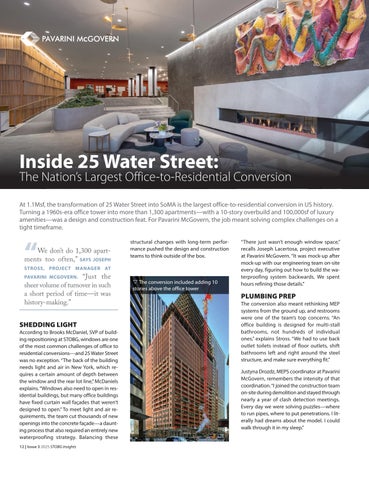
The Nation’s Largest Office-to-Residential Conversion At 1.1Msf, the transformation of 25 Water Street into SoMA is the largest office-to-residential conversion in US history. Turning a 1960s-era office tower into more than 1,300 apartments—with a 10-story overbuild and 100,000sf of luxury amenities—was a design and construction feat. For Pavarini McGovern, the job meant solving complex challenges on a tight timeframe.
“
We don’t do 1,300 apartments too often,” SAYS JOSEPH
structural changes with long-term performance pushed the design and construction teams to think outside of the box.
STROSS, PROJECT MANAGER AT
“Just the sheer volume of turnover in such a short period of time—it was history-making.” PAVARINI MCGOVERN.
SHEDDING LIGHT According to Brooks McDaniel, SVP of building repositioning at STOBG, windows are one of the most common challenges of office to residential conversions—and 25 Water Street was no exception. “The back of the building needs light and air in New York, which requires a certain amount of depth between the window and the rear lot line,” McDaniels explains. “Windows also need to open in residential buildings, but many office buildings have fixed curtain wall façades that weren’t designed to open.” To meet light and air requirements, the team cut thousands of new openings into the concrete façade—a daunting process that also required an entirely new waterproofing strategy. Balancing these 12 | Issue 3 2025 STOBG Insights
The conversion included adding 10 stories above the office tower
“There just wasn’t enough window space,” recalls Joseph Lacertosa, project executive at Pavarini McGovern. “It was mock-up after mock-up with our engineering team on-site every day, figuring out how to build the waterproofing system backwards. We spent hours refining those details.”
PLUMBING PREP The conversion also meant rethinking MEP systems from the ground up, and restrooms were one of the team’s top concerns. “An office building is designed for multi-stall bathrooms, not hundreds of individual ones,” explains Stross. “We had to use back outlet toilets instead of floor outlets, shift bathrooms left and right around the steel structure, and make sure everything fit.” Justyna Drozdz, MEPS coordinator at Pavarini McGovern, remembers the intensity of that coordination. “I joined the construction team on-site during demolition and stayed through nearly a year of clash detection meetings. Every day we were solving puzzles—where to run pipes, where to put penetrations. I literally had dreams about the model. I could walk through it in my sleep.”
PROJECT DETAILS Location: New York, NY
Certification: Targeting LEED Silver
Size: 1.1Msf
Sector: Building Repositioning
Client: GFP Real Estate
Completion: 2025
Architect: CetraRuddy “GFP Real Estate was a very hands-on client,” says Lacertosa. “They had a team on-site every day. Weekly design meetings sometimes became daily calls. Having that level of collaboration made it possible to keep pace.”
THE BIG PICTURE PARALLEL PROGRESS The job was further complicated by the fact that three massive efforts ran simultaneously: demolition, the full building fit-out, and the 10-story overbuild. “It was managed as one complete project, but those streams were happening all at once,” says Lacertosa. “It took an incredibly experienced field staff to keep new build structure, infill structure, and ongoing fit-out aligned.”
Looking back, the team agrees the hardest part was scale and speed. “Managing that volume of work, money, and stakeholders on schedule—that’s what I’m most proud of,” says Stross. For Drozdz, joining Pavarini McGovern through such a high-profile project was a one-of-a-kind experience. “This was my first office to residential conversion, and the biggest one in the country. It was tough, but incredibly exciting. You don’t often get to say you worked on a project that redefined an entire building type.” The first 25 Water Street residents have officially moved in, proving that even the most stubborn office towers can find new life.
That focus also extended to vertical transportation. Six new elevator shafts were installed while others were capped, extended, or repurposed—an enormous logistical and sequencing challenge.
LOADING LOGISTICS With just two hoists for material movement, sequencing became a project in itself. “It was like time and space Tetris,” says Lacertosa. “Apartments ranged from 600sf to 1,000sf, and you’re staging for hundreds of units while losing hoist runs. Every shipment had to be timed down to the week—anything arriving too early or too late caused problems.”
READ MORE In the NY Times
“Where do you put 1,300 vanities, kitchens, and tiles? On a normal job, you might have 200 units. Here, it was constant coordination,” says Stross.
RESIDENT AMENITIES
©
2025 KAREN FUCHS
Beyond the apartments, the building boasts impressive amenities like bowling alleys, pickleball courts, pools, and more—all of which had to be delivered in the first turnover phase. “That was a major challenge,” says Lacertosa. “We had a dedicated team just for amenities. It wasn’t how we would normally phase work, but it was a huge sales driver.”
BUILDING TOGETHER The project involved 87 different subcontracts across trades. That required daily coordination, both in the field and with the owner’s team. Issue 3 2025 STOBG Insights | 13
IN EVERY ISSUE
SAFETY COLUMN
NO TRACE Preventing the spread of mud and other waste on truck tires is a key part of environmental compliance. STO Building Group is expanding the use of trackout mats as a solution. When construction waste is tracked off of construction sites, it can spread on public roads and release sediment into water systems. Cleaning truck wheels to prevent the spread of debris, mud, and other construction waste is a core part of compliance and a key to protecting local environments. Traditionally, the construction industry has relied on pads of gravel spread over a filter cloth to remove debris and mud from vehicle tires. Gravel systems require an involved process for installation and removal, and they require regular maintenance and stone replacement when gravel is tracked off the site. Manufactured trackout mats have presented themselves as an alternative to traditional stone pads. These lightweight plastic mats are engineered to deform tires and remove lingering materials. Modern trackout mats facilitate faster installation and removal than gravel counterparts, and they require minimal maintenance during use. They also eliminate the problem of tracking stone onto roadways.
14 | Issue 3 2025 STOBG Insights
Some members of the STO Building Group family have begun piloting trackout mats on jobsites. These mats have the potential to simplify compliance and ensure local environments are protected.
“
We are incorporating trackout mats more and more on our project sites,” SAYS KEITH HASELMAN, SENIOR VICE PRESIDENT OF SAFETY FOR STO BUILDING GROUP. “Their ease of installation and removal, combined with their reliability, make trackout mats a valuable tool for complying with regulations and looking out for environments where we build.” Trackout mats are a simple innovation that can have a big impact—on compliance, project teams, and our local communities.
Pavarini McGovern is an equal opportunity employer stobuildinggroup.com/pavarini-mcgovern
CLIENT FIRST INTEGRITY & TRANSPARENCY COLLABORATION INNOVATION EXCELLENCE CULTURE OF SAFETY
PARTNERING TO IMAGINE, EXECUTE AND REALIZE OUR CLIENTS’ VISION Issue 3 2025 STOBG Insights | 15
WHEN DISASTER STRIKES
Layton Delivers
“These weren’t typical projects. They were emergency missions. Our team members and partners showed up ready to serve and then delivered.”—Jim Parker
In late 2024, Hurricane Helene slammed into the southeastern US, unleashing record rainfall and winds across Georgia and the Carolinas. The storm flooded entire communities and knocked out infrastructure—posing a critical threat to the operations of 16 HCA hospitals in the region.
ANSWERING THE CALL Among the hardest hit was Mission Hospital in Asheville, North Carolina. “The French Broad River overflowed its banks and flooded the city’s primary water pump station. Suddenly, there was no potable water in Asheville,” says Layton construction manager Jim Parker. “The governor and state health department were preparing to shut the hospital down. That’s when we got the call.”
Logistics were complicated by road closures, downed cell towers, and widespread power outages. Layton’s team used Starlink internet, satellite phones, and hard-copy maps to navigate the region and coordinate deliveries. Meanwhile, more than 250 employees and trade partners cleared debris from roadways and hospital access points.
Layton’s Healthcare team didn’t hesitate. Within 48 hours, they had installed two 40,000-gallon water tanks, drilled two deep wells, and restored cooling system functionality. “We had suppliers delivering equipment overnight. One of the tanks was craned in just hours after the order was placed. There was no room for delay,” Parker explained. A stream of water trucks delivered the 150,000 gallons of clean water needed each day to keep the hospital running.
There were locations where tree falls were so dense, crews had to cut through quartermile stretches just to reach the buildings,” JIM PARKER SAYS. “We had boots on the ground before we even had a full scope of the problem.”
16 | Issue 3 2025 STOBG Insights
“
In Spruce Pines, North Carolina, similar emergency work was required. Layton installed a temporary sanitary sewer system for Blue Ridge Regional Hospital, deploying vacuum trucks to manage waste, which allowed the hospital to continue caring for patients during the crisis. The team successfully kept the 16 hospitals up and running until critical infrastructure could be restored. But they weren’t done.
HURRICANE MILTON: A HOSPITAL IN CRISIS Less than two weeks after Helene, Hurricane Milton brought 120+ mph winds and storm surges to the Florida Gulf Coast. Once again, Layton teams deployed to HCA hospitals in the path of the storm.
At Largo Hospital, a powerful storm surge flooded the entire sub-basement, including vital areas such as the kitchen, sterile processing, the morgue, and the hospital’s central energy plant. The flooding immediately triggered a total power loss. “The hospital went black. All utility feeds were gone. We had patients on ventilators running on temporary battery power,” Parker says. “It was all hands on deck—nurses, contractors, and staff evacuating patients by flashlight, floor by floor.” After the water receded and the insurance adjusters had assessed the damage, crews faced a toxic mess of food waste, biological contaminants, cadavers, and failed electrical systems. Layton mobilized immediately. Within 24 hours, the team installed temporary air-handling systems to control humidity and prevent mold growth. Crews
worked around the clock to gut and disinfect the entire sub-basement and mechanical systems, then launched a full rebuild—completing a year’s worth of work in just 45 days. “Some of the gear we replaced has lead times over a year. But thanks to our supplier relationships, we had new switchgear and mechanical systems on site within days,” says Parker. “It was a logistical miracle.”
MISSION FIRST. CONTRACTS LATER. Throughout both disasters, Parker says the team never wavered in their commitment to Layton’s values, their client, and the communities they serve. The takeaway, according to him, is simple: “HCA knows Layton will be there when needed. When disaster strikes, we don’t show up with red tape—we show up with solutions.”
Issue 3 2025 STOBG Insights | 17
© JOHN BAER, BUILDING IMAGES PHOTOGRAPHY
Shedding Light on a Hidden Problem: Why LED Lighting Falls Short in Elevator Spaces Across the country, our project teams have been encountering a recurring and frustrating issue: LED lighting. Despite its many benefits, LED lighting is routinely failing to meet the minimum code-mandated lighting levels in elevator machine rooms, pits, and lobby sills. What seemed like a simple upgrade to more energyefficient fixtures has turned into a costly challenge and potential safety issue.
by Michael Walsh
VP of Elevator Construction Consultants, STO Building Group
18 | Issue 3 2025 STOBG Insights
THE ILLUSION OF COMPLIANCE When you stand directly beneath a newly installed LED fixture, the light feels bright. The foot-candle (fc) meter might even read above code requirements. But step just a few feet away, and the numbers drop—fast. In space after space, we’re seeing readings well below the required: l
19 fc in elevator machine rooms (ASME A17.1 §2.7.9.1).
l
10 fc at the pit floor (ASME A17.1 §2.2.5.1).
l
10 fc at elevator lobby sills (ASME A17.1 §2.11.10.2).
To meet these requirements, we often find ourselves doubling the number of planned fixtures, erasing the cost and efficiency advantages that made LEDs attractive in the first place. So, what’s really going on?
Without realizing these differences upfront, teams often resort to simply adding more lights. However, this “solution” often increases installation costs, adds to energy use, crowds ceilings, reduces maintainability, and complicates coordination with other trades and systems.
A SMARTER DESIGN APPROACH: LIGHT FOR THE SPACE, NOT JUST THE SPECS To restore both code compliance and safety, we need to shift our mindset. More light isn’t always better—better light is better. Here are some practical design adjustments project teams can make to solve for the LED lighting issue.
THE PROBLEM: LED LIGHT DOESN’T BEHAVE LIKE ITS PREDECESSORS
l
l
LEDs are point sources, meaning each chip emits light in a tightly focused beam. This means LED bulbs create intense brightness directly underneath, rapid fall-off in adjacent areas, and very sharp shadows. Traditional bulbs scatter light. Incandescent and fluorescent sources glow from a broader surface and fill in shadows with soft, ambient spill, which ultimately improves visibility even in low-contrast areas.
l
Machine rooms and pits have dark, absorbent surfaces. These don’t reflect LED light well, deepening the shadows and further reducing uniformity.
l
Multiple shadows compound the problem. Arrays of small LED emitters create layered, confusing shadows that make visual work difficult and reduce perceived brightness.
2. Choose fixtures that prioritize beam spread. Use wider beam angles or diffused optics and consider indirect/direct fixtures that bounce light off ceilings. 3. Use larger, more diffuse luminous sources. Replace slim LED strips with broader panels or linear troffers to mimic the evenness of fluorescent systems. 4. Refine placement and layout. Space fixtures closer together to overlap beams and offset from equipment to reduce harsh shadows. 5. Add targeted task lighting. Mount local lights on machinery or door frames and use integrated sill lighting to directly meet code at the threshold.
The root of the issue lies in how LED light is distributed. Unlike incandescent or fluorescent fixtures, which emit diffuse, multidirectional light, LEDs are precise and focused. Most of the time, that quality would sound like a strength, but in tight, complex environments like elevator systems, it can easily become a liability. Here are some key factors to consider:
1. Specify for uniformity, not just output. Look at average-to-minimum ratios, not just peak fc readings. Require photometric analysis in all elevator-adjacent spaces.
6. Improve surface reflectance wherever possible. Light-colored, matte finishes on ceilings and walls can significantly boost perceived light and reduce contrast.
ABOUT MICHAEL WALSH Michael Walsh is Vice President of Elevator Construction Consultants and a recognized expert in vertical transportation with over 36 years of experience in the elevator and escalator fields. His career includes senior roles at LF Driscoll and Citywide Elevator Consultants, where he led complex modernization and construction projects nationwide. A certified elevator mechanic and National QEI Certified Elevator Inspector licensed in multiple states, Michael holds more than 20 certifications across various elevator systems. He also serves on four National ASME Code Committees, contributing directly to the development of industry safety and performance standards.
RAISING AWARENESS TO IMPROVE OUTCOMES This isn’t just a contractor issue. Contractors, architects, lighting designers, engineers, and owners should work together to understand the implications of LED light behavior—especially in safety-critical environments. The assumption that “more lumens = more light” oversimplifies a complex interaction between technology, code, and human vision. By aligning design intent with real-world lighting behavior, we can avoid costly rework and ensure compliance from the outset. LEDs can still deliver their promised benefits when applied with a true understanding of how they perform in confined, technical spaces.
SCAN TO LEARN MORE
about Elevator Construction Consultants
Issue 3 2025 STOBG Insights | 19
BOSTON
Building Inspiration:
The LEGO Group’s US Headquarters In summer 2025, the LEGO Group unveiled their US HQ, a new state-of-the-art workspace in Boston’s Back Bay neighborhood. Guided by the LEGO Group’s commitment to colleague well-being, sustainability, and collaboration, Structure Tone Boston’s team partnered with BDG Architecture + Design and Syska Hennessy Group to create this colorful, light-filled space spanning six stories within the newly opened Lyrik building at 1001 Boylston Street. Designed by BDG, the LEGO Group space is LEED Gold- and WELL Goldcertified and equipped with sky terraces, over 90 meeting spaces, over 660 workstations, a product showroom, a retail testing area, a LEGO Brick Design Workshop, complimentary gym access, parents’ rooms, and flexible wellness areas for employees to engage in meditation, prayer, or relaxation. Playful common spaces, like the sky terraces, support team connection and collaborative working, and provide a capacity for continued growth. Construction also included the installation of radial staircases, a reception area, pantries, a novelty showroom, retail testing room, and barista café.
BUILDING A BRAND With such a recognizable, creativity-driven brand, the pressure was on the team to get the details just right. With design inspiration drawn from the stud and tube design on a LEGO brick, each floor was themed a different color and much of the space was curved—from round pantries on every floor to 46 round conference rooms. These round rooms
required collective cross-coordination between many different trade jurisdictions. According to Structure Tone superintendent Sarah Wolfel, the team identified this need early on to stay ahead of customized and long-lead procurement items so they could maintain the overall construction schedule. “Building round rooms takes really precise measurements of curves and radiuses, and lots of checking and double-checking,” says Wolfel. “It took four layers of quarter-inch sheet rock and metal in every room to get those curves just right so we needed to be sure we built in enough time.” Of course, the LEGO Group headquarters wouldn’t be complete without LEGO® models. Installing the physical models—including one representing a double helix DNA that spins—required extensive coordination. For the murals in particular, the ceiling had to match up precisely to the models.
PROJECT DETAILS Location: Boston, MA
Architect: BDG Architecture + Design
Certification: LEED and WELL Gold
Client: The LEGO Group
Engineers: Syska Hennessy Group (MEP); McNamara Salvia (structural)
Sector: Commercial
Size: 157,000sf 20 | Issue 3 2025 STOBG Insights
Owner’s Rep: Redgate
Completion: May 2025
READ The LEGO Group’s press release for more
“I was lucky enough to go to the LEGO model shop and help build the seventh floor Boston LEGO mural,” says Wolfel. “By the end, I was pretty close with the team, making sure that they had everything they need and helping them get models into the building and installed.” At the same time, the Structure Tone team was keeping an eye on the progress of the four central staircases across five floors. The team built the project schedule around these feature stairs to plan around the safety implications of a large hole in the space, the usability of each floor while under construction, and the logistics of maneuvering the steel and other materials required. “Completing each staircase was a major milestone,” says Ryan Megenedy, Structure Tone senior account executive. “If a staircase schedule was off, the whole floor’s schedule would be off, so it was critical that we kept it on track.”
BUILDING A TEAM With so many complexities to consider, teamwork was the name of the game—down to specification documents.
©
BDG DESIGN
“Much of the LEGO Group’s facilities team are based in Europe so their building standards are based on European building codes and qualified guidelines,” says Scott Whear, Structure Tone assistant project manager. “We worked really closely with them and associated consultants to adjust the specifications
award—and the first to win who does not work for the LEGO Group.
BUILDING AN IMPACT
and assure the Americanized construction elements met the European standards. For IT components like wiring and MDF rooms, it was incredibly important.” The construction team was so effective in solving these challenges that the LEGO Group presented their top workplace construction project award to Wolfel, making her the fourth person to ever win the
Adding the LEGO Group to Boston’s roster of corporate headquarters was big news in the city, and the Structure Tone team could not have been more proud to celebrate with the client and the community. The May 15, 2025 ribbon-cutting drew high-profile Boston leaders, such as Massachusetts Governor Maura Healey and Boston Mayor Michelle Wu, plus global leaders of the LEGO Group, including its CEO, Niels B. Christiansen. As part of the office’s unveiling, the company announced a $5 million philanthropic commitment over two years to bring play to more local children.
“
This fantastic new LEGO workspace is an important part of our US investment strategy, becoming a talent magnet in this important market,” NIELS B. CHRISTIANSEN NOTED AT THE OPENING.
“The Boston Hub will open up new ways for LEGO colleagues to create, connect and grow as we continue our mission to inspire and develop the builders of tomorrow across the US.” Issue 3 2025 STOBG Insights | 21
The Science of Scent: Osmo AI
Building the workplace of the future means balancing high-performance infrastructure, flawless finishes, and unforgiving timelines. For Osmo, an AI fragrance pioneer, the stakes were even higher: a facility that doubled as both R&D hub and client-facing showpiece—a stage where science meets wonder. RC Andersen brought that vision to life, taking on the challenge and transforming a blank space into a world-class lab.
ALL EYES ON AI
STYLE MEETS SCIENCE
At the heart of the Osmo lab and manufacturing space is an autonomous 50-foot-long fragrance compounding system. The system mixes fragrance compounds inside a climate-controlled room with a glass viewing enclosure—a centerpiece meant to inspire visitors as much as it performs scientific work. Housing a unique piece of technology requires precision beyond typical manufacturing builds, such as a structural mezzanine and complicated mechanical systems within a climate-controlled room—all without compromising the aesthetic vision of the owner and design team, led by KSS Architects.
Osmo envisioned a collaborative workspace for employees and clients, that would feel premium for visiting investors, clients and employees alike. They wanted modern design, sleek lines, and the atmosphere of a high-tech company office—all in a functioning lab environment that would welcome collaboration amongst the staff.
“Everything needed to be executed efficiently—not just structurally, but visually,” Kas Khan, RC Andersen project manager, explains. The RC Andersen team worked closely with engineers, designers, and a robotics vendor to ensure the enclosure both functioned flawlessly and highlighted the robot as the star of the space. Even exposed structural and mechanical elements were installed to be aesthetically pleasing to view.
“This is not our typical industrial build,” Khan notes. “We had to find solutions that would integrate the industrial, life sciences, and interiors spaces.” RC Andersen collaborated with designers to source materials that could withstand the rigors of lab work while delivering a polished, high-design look. Custom lighting, finishes, and details give the lab a welcoming feel while still meeting strict performance requirements. The result is a rare hybrid: a laboratory that feels like a showroom.
INFRASTRUCTURE FROM SCRATCH The Osmo project didn’t come with an existing framework to build upon. Every aspect of the infrastructure—from utilities and ventilation to advanced data connectivity—had to be built from the ground up. And the timeline left little room for error.
PROJECT DETAILS Location: Elizabeth, NJ
Client: Osmo Labs, PBC
Size: 58,000sf
Architect: KSS Architects
22 | Issue 3 2025 STOBG Insights
Engineers: Rock Brook (MEP); Harrison-Hamnett (structural)
Low Voltage Design: Rock Brook Transaction/Broker & Project Management: Newmark Industrial Advisory Group
“It was a process that had a consistently moving target,” explains Kahn. “Every move had to be planned in advance, and everyone had to stay in step as we identified gaps, adapted the plan and recovered to meet critical milestones.”
uncompromising safety—can be turned into opportunities for creativity and precision.
RC Andersen leaned on phased scheduling, and constant trade coordination to keep work moving. By sequencing scopes strategically, the team allowed robotics infrastructure, high-end finishes, and critical mechanical systems to progress at the same time. Temporary staging and just-in-time deliveries minimized congestion, keeping the site both safe and efficient.
“This wasn’t about delivering our typical industrial build,” Khan explains. “It was about making the stakeholder’s vision come to reality, on time and on budget, given the complexity of the design and moving timeline.”
The payoff: an aggressive timeline met without compromising precision or quality.
REBOOTING WITH SAFETY FIRST With heavy robotics equipment, fragile glass enclosures, and multiple trades operating simultaneously, jobsite safety was non-negotiable.
“
The core principle of RC Andersen’s safety culture is that you cannot have a successful project without implementing a solid safety plan from preconstruction to completion,” KAS KHAN SAYS.
For RC Andersen, the project reflects the firm’s ability to adapt to the most unusual demands while maintaining a clear focus on quality.
RC Andersen enforced strict protocols, from daily oversight to mandatory protective gear, and held regular orientations to ensure every worker understood the risks and expectations.
By anticipating challenges, coordinating seamlessly, and never losing sight of the client’s vision, RC Andersen delivered more than a laboratory. They delivered a stage for the future of immersive technology.
PROGRESS ON DISPLAY A project this unique deserved more than the usual progress reports. RC Andersen set up time-lapse cameras and scheduled regular walkthrough photography, giving stakeholders the chance to monitor the build virtually and watch the lab come to life in real time. The imagery also serves another purpose: it captures the story of a facility designed to inspire, documenting how a blank space was transformed into an olfactory research facility.
MORE THAN A LAB The Osmo project demonstrates how construction challenges—integrating robotics, marrying science with spectacle, sequencing complex trades, and ensuring Issue 3 2025 STOBG Insights | 23
IN EVERY ISSUE
UNDER CONSTRUCTION The groundbreaking kicked off what will be the tallest building in Montana at 285ft tall
Under Construction:
ST. VINCENT REGIONAL HOSPITAL Layton is building a 14-story replacement hospital for Intermountain Health’s St. Vincent Regional Hospital
The hospital’s advanced design reflects a strong commitment to innovation and flexibility. All operating rooms will be able to accommodate the latest advancements in medical and robotic surgical technology, with futureproofing at the core of the planning process. Surgical zones will be fully integrated, combining pre-op, procedure, and recovery spaces to streamline patient care and improve clinical efficiency.
The 14-floor, 737,000sf replacement hospital will include 243 beds, all housed in universal rooms designed to seamlessly convert up to ICU-level care—meaning they can evolve as patient needs grow. Set to open in 2029, the new hospital represents a critical investment in modern, adaptive, and efficient healthcare. This facility is designed to address the current needs of patients in the region, while accommodating both long-term population growth and future healthcare needs of the community.
24 | Issue 3 2025 STOBG Insights
“
Practicing 21st-century medicine in 100-year-old buildings is extremely hard,” SAID LEE BOYLES, INTERMOUNTAIN HEALTH PRESIDENT FOR ST. VINCENT R EG IONAL
HOSPITAL
AND
THE
MONTANA-WYOMING MARKET. “And
so to have rooms that fit the times that fit the technology that’s available, it’s going to be incredible.”
PROJECT DETAILS Location: Billings, MT Size: 737,000sf
“
Client: Practicing 21stIntermountain Health century medicine in a 10-year-old building is Architect: HDR extremely hard,” SAID LEE BOYLES,
INTE R MOUNTAIN
Engineers: HEALTH PRESIDENT FOR ST. Cator Ruma (MEP); VINCENT REGIONAL HOSPITAL Martin/Martin (structural) AND THE MONTANA-WYOMING
Sector: “To have rooms MARKET.
Healthcare that fit the times and the technology Completion: available, it’s going 2029 to be incredible.”
“It’s special when a vision becomes reality for the community and caregivers in Billings, Montana,” said Randy Patterson, Layton executive vice president. “The successful collaboration this team has had through the design and preconstruction phases are a testament to our evolution as a leading healthcare builder and will only continue as we help to build the new era of healthcare for St. Vincent Regional Hospital.”
The St. Vincent Regional Hospital will also be a major driver of economic growth in the region. At the peak of construction, the site will employ 600-700 workers, with an estimated 1,200 total individuals contributing to the build over the course of the project.
insights Mailbox or Inbox?
INSIGHTS MAGAZINE IS AVAILABLE AS A PRINT OR DIGITAL SUBSCRIPTION! SCAN THE QR CODE TO CONTINUE RECEIVING A HARD COPY.
Issue 3 2025 STOBG Insights | 25
A New Home for Excellence:
UNF’s Osprey Ridge Honors Residence Hall Designed to accommodate more than 500 students, the University of North Florida’s Osprey Ridge Honors Residence Hall is a state-of-the-art, 165,000sf facility that aims to make a lasting, positive impact on campus life. With its completion, the university’s total on-campus bed count rises to approximately 4,300. 26 | Issue 3 2025 STOBG Insights
PROJECT DETAILS Location: Jacksonville, FL Size: 165,000sf Client: University of North Florida Architect: Harvard Jolly Architecture/PBK Engineers: TLC Engineering Solutions Sector: Education The hall offers a range of modern amenities, including designated study spaces, comfortable lounge areas for socializing, and a central kitchenette on each floor. Purpose-built to unite all the university’s honor students, who were previously dispersed across campus, this vibrant, collaborative living environment fosters connection, engagement, and academic excellence. Despite facing challenges along the way, the Ajax team stayed committed to delivering an exceptional project, completed on schedule and within budget.
TACKLING TILT-UP Construction of the building used a tilt-up approach, a technique Ajax is very comfortable with. However, in this case, the team did not have access to the full panel drawings before construction got started, so they had to get creative.
“
We needed to map out where there’s brick, where there’s patterns in the concrete itself, any openings for lights, all of those details,” SAYS HENRY SOCKBESON,
SENIOR
PR OJ E C T
“So we put together panel books. Each panel has about four pages devoted to those details, which we could then field verify with the design team.” MANAGER AT AJAX.
CAMPUS LIFE Scheduling was another obstacle, requiring work around the university’s calendar of tours and events while minimizing disruption to students. For starters, the site happened to be next to the campus utility building, which tied to power, water, and gas for the residence hall. To ensure that the building’s utilities along with the building’s residents were not disturbed, the Ajax project team would have to halt construction for unplanned amounts of time. In typical university fashion, the University of North Florida also hosts many group tours and other events on campus all throughout the year. In fact, the university even brought local high school STEM programs to visit the jobsite as the project was underway. With so much activity on campus, the team was constantly communicating with the university and coordinating daily activities accordingly. “We tried to limit utility tie-ins, road closures, and things like that to school breaks,” says Sockbeson. “Then it was crunch time in between campus events to get as much done as we could.”
Completion: August 2025 “The intention is to promote an environment where students have common interests to build a strong academic and social support system in a convenient location,” said Dr. Jeff Chamberlain, Dean of the Hicks Honors College, at the project’s ground-breaking. For Ajax, the project continues a long-term, trusting relationship between the project team and the university—and even some of its students. “My time at UNF gave me the skills and confidence I needed to start my career in construction,” says Sid Myakala, Ajax project engineer who received his master’s in construction management from UNF in 2024. “As a former student myself, it means a lot to be part of a project that will have a lasting impact on campus.”
LIVING AND LEARNING
©
MATTHEW GOOD
UNF’s new residence hall isn’t simply a dorm—it’s a “living-learning community” for the college’s honors program students, who were previously spread between different dorms. And with a vision of 25,000 enrollment within the next five years, the project adds much-needed housing options on the growing campus.
Issue 3 2025 STOBG Insights | 27
Breaking Barriers, Building Health: UNIVERSITY HEALTH WHEATLEY CENTER
Healthcare construction is complex by nature—marked by strict technical standards, tight schedules, and the demand for long-term adaptability. When Structure Tone Southwest set out to build a 15,200sf medical facility on a raw Greenfield site, the goal was bigger than bricks and mortar. The University Health Wheatley Center was envisioned as a lifeline, expanding healthcare access for historically underserved neighborhoods. Today, it is a vital community resource, achieved through problem-solving, collaboration, and resilience.
PROJECT DETAILS PRECISION PLANNING: THE MEDICAL EQUIPMENT INTEGRATION One of the most complex hurdles was accommodating the center’s advanced medical equipment. Unlike standard office or retail spaces, healthcare facilities demand that every piece of technology—X-rays, ultrasound units, lab analyzers—fits seamlessly into the building’s infrastructure. Even small misalignments can disrupt installation, compromise safety, or delay readiness for patient care.
“
Location: San Antonio, TX
SOUTHWEST PROJECT EXECUTIVE,
Client: University Health
Healthcare equipment doesn’t give you much margin for error,” SAYS STRUCTURE TONE
FABIAN LEAL. “If you’re off by a
few inches, it can throw the whole room off. We had to think three steps ahead for every space.” To meet this challenge, the team coordinated closely with vendors, providers, and end-users early in the design process. BIM modeling, 3D visualization, and clash detection tools ensured mechanical, electrical, and structural systems were precisely aligned. In certain
28 | Issue 3 2025 STOBG Insights
Size: 15,200sf
Architect: Alta Architects Engineer: Moose Engineers Sector: Healthcare Completion: September 2025
rooms, additional steel supports were installed to handle the heavy loads of radiology machines. This level of coordination eliminated costly rework and guaranteed the facility could support current and future technologies.
BUILDING FROM THE GROUND UP At the same time, the greenfield site itself introduced another layer of difficulty. With no existing infrastructure, every utility line and drainage channel had to be created from scratch. Excavation, grading, and utility installation had to align perfectly with vertical construction to keep the project on schedule. “It was a race against time,” says Leal. “We had to anticipate challenges before they slowed us down. Everything—from utilities to staging areas—had to be timed just right.” To stay ahead, Structure Tone Southwest sequenced sitework in parallel with building construction. To avoid congestion, the team coordinated closely with city officials to ensure utilities were ready when needed. This careful orchestration allowed construction to proceed without the cascading delays often accompanying infrastructure work.
SAFETY AS THE FOUNDATION With tilt-wall construction, steel roofing, advanced MEP systems, and medical equipment installation all happening simultaneously, safety was a non-negotiable priority. Protocols included 100% glove use, mandatory orientations for every worker, and consistent on-site supervision. These measures protected the workforce and ensured that complex installation work could move forward without interruption.
ORCHESTRATING TRADES: COMPLEXITY IN MOTION Perhaps the most significant achievement was the seamless coordination among trades. Tilt-wall
crews, roofers, electricians, and medical equipment installers often had overlapping scopes. The team relied on BIM clash detection, weekly coordination meetings, and digital project tracking to keep progress moving. “Every move had to be planned like a dance,” says Structure Tone Southwest senior project manager Hugo Alvarado. “If one group was out of rhythm, the whole project could stumble. Collaboration kept us moving in sync.” The team compressed schedules by enabling multiple trades to work in parallel rather than sequentially without sacrificing quality.
QUALITY THAT CREATES A LASTING IMPACT Beyond completing the building on time, the team focused on longevity. Mechanical and electrical systems were tested to support sensitive medical technologies without interruption. Durable, hygienic finishes were chosen to withstand high patient traffic. Flexible spaces were designed to adapt to evolving medical practices. “The goal wasn’t just to deliver a clinic—it was to deliver a resource that would serve the community for decades,” says Alvarado. Today, the Wheatley Center delivers advanced healthcare in a neighborhood that once lacked easy access to such services. Patients receive faster, more efficient care, providers work in safe and intuitive spaces, and the community benefits from investing in long-term resilience. For Structure Tone Southwest, the project was both a technical achievement and a community milestone. By transforming construction challenges into opportunities for innovation, the team delivered far more than a building—they delivered hope, resilience, and a model for how healthcare construction can serve both people and purpose. Issue 3 2025 STOBG Insights | 29
IN EVERY ISSUE
STOBG CARES
PHILADELPHIA
Honoring Service, Changing Lives:
Structure Tone Philadelphia’s Partnership With Team Foster At STO Building Group, veterans and their families hold a special place in our hearts. Which is why Structure Tone’s partnership with Team Foster isn’t just important—it’s personal. It’s a way for us to honor that service and give back in a meaningful way. They sacrificed for us, and now Team Foster advocates for them.
AN HONORABLE CAUSE Founded in honor of Captain Erick Foster after he was killed in action, Team Foster is a nonprofit organization dedicated to supporting injured and disabled veterans through the power of accredited, life-saving service dogs. Team Foster provides funding for the training and placement of these highly skilled dogs; in 2024, more than 125 veterans were partnered with service dogs and 1,000 more benefited from animal assisted therapy through Team Foster’s efforts. The organization also works to educate the public, raise awareness about the challenges many veterans face, and advocate for veterans and service dogs.
30 | Issue 3 2025 STOBG Insights
“
The need is significant. More than 20 veterans and service members lose the battle to suicide every day,” SAYS NICK LIERMANN, TEAM FOSTER’S FOUNDER AND EXECUTIVE
“Service dogs are a clinically proven solution to help range of challenges, including hearing assistance, seizure or panic attack detection, PTSD mitigation, and much more. But unfortunately, there are no federal programs or insurance coverage for service dogs.” DIRECTOR.
PEDALING WITH PURPOSE The nonprofit’s biggest event is their “Ruff Ride,” a 24-hour team spin relay, hosted in Philadelphia, PA that brings together a wide array of companies, service organizations, friends, and families. “We had an incredible turnout this year,” says Luke Thomas, vice president at Structure Tone Philadelphia, and participant in this year’s ride. “Our group was bigger than the population of our entire office.” With a team of more than 60 members riding in shifts from 15 minutes to a few hours, Structure Tone made a strong showing at the event, which raised nearly $250,000 for
Team Foster. The team is already looking ahead with excitement to the next Ruff Ride the Structure Tone team will be participating in, set to take place in New York City in March 2026. “Ruff Ride is not just a fundraiser. It’s an opportunity to connect our community through shared experience,” says Liermann. “We are so grateful to have Structure Tone as an integral part of our community and the amazing success of Ruff Ride Philadelphia.”
PARTNERING FOR LASTING IMPACT In addition to the Ruff Ride, Structure Tone Philadelphia collaborates with Team Foster throughout the year, from happy hour fundraisers to educational events. In fact, this summer, Team Foster’s founder and executive director, Nick Liermann, spoke at Structure Tone’s quarterly leadership meeting, sharing Team Foster’s mission, vision, and impact. The impact this organization has on these veterans is truly life changing. “The amount of training and accreditation required for these dogs is overwhelming. Team Foster takes that burden away and gives veterans a resource that changes their lives,” says Thomas. “Being on the Advisory Council, I get to see how much they really care and want to make a difference. It’s awesome.” Liermann agrees. “Saying ‘thank you for your service’ is polite, but it does not help the veterans who need it the most,” he says. “Structure Tone is leading the way by showing others how to #ShowUp4Vets. Together, we are literally saving veteran lives.”
THE RUFF RIDE IS HEADING TO NEW YORK CITY | March 28–29, 2026! Scan for more information on how to participate
Issue 3 2025 STOBG Insights | 31
Preserving the Past While Building the Future Historic Renovations in Dublin DUBLIN LONDON
Across Dublin, historic structures remain a defining part of the city’s character. From the Georgian terraces that line its streets to the industrial mills along the Grand Canal, the city’s architecture tells the story of political, social, and economic evolution. Today, as global tech giants continue to invest in Dublin, many of these historic structures are being carefully adapted into modern workplaces.
32 | Issue 3 2025 STOBG Insights
However, converting buildings that weren’t designed for 21st-century office life is no small feat. According to Structure Tone Dublin Project Director Des O’Toole, three challenges arise again and again: matching materials, overcoming logistical constraints, and securing and maintaining client buy-in. 1. Matching Materials. Every renovation begins with the building itself. Historic structures are often a patchwork of stone, brick, and timber added over decades, and any new work must blend seamlessly with the old. “You can’t just drill a cable through stone or replace a wall with modern blockwork,” says O’Toole. “You have to reuse original materials wherever possible or source salvaged stone and brick that matches the character of the building.” At Google’s Boland’s Mill, for example, reclaimed Scottish pine beams and salvaged timber floors were installed to echo the mill’s original structure. Even elements added during renovation—like the new timber floors—now fall under protected status. “Once they’re in, they become part of the building’s story,” O’Toole explains.
transformations often demand more time and budget than standard builds, and unforeseen conditions are inevitable.
“
You need a client who understands that preserving history comes with costs,” DES O’TOOLE SAYS. “Sometimes you’re reinforcing rather than replacing, or designing around quirks that can’t be engineered out. But that’s what makes these spaces special.” Companies like Google, Salesforce, and Fiserv have embraced that philosophy. Their historic offices symbolize the integration of Dublin’s past with its modern role as a hub for innovation.
At Salesforce’s Dublin headquarters, the team faced similar requirements when transforming the decaying London and Northwestern Hotel into event and lounge space. Once flashy and decorative, the building had fallen into disrepair. Salesforce chose to restore its ornamental detail rather than erase it, making sure the historic façade continues to play a role in Dublin’s cityscape. 2. Logistics. Working within historic shells often requires ingenuity. These buildings were typically built for storage or manufacturing, rather than open-plan offices, tech cabling, or modern amenities. At Boland’s Mill, installing a mezzanine floor meant feeding steel beams through small existing windows since enlarging them was prohibited. Similarly, when Fiserv moved into its new Irish headquarters on the quays, the building’s riverside location presented challenges with dampness and rubble-filled stone walls, complicating MEP service installations. ©
DONAL MURPHY PHOTOGRAPHY
“You never know exactly what you’ll uncover until you start,” says O’Toole. “That’s why contingency planning is absolutely essential. It could be unstable timber, hidden water damage, or walls that won’t take modern loads. Every project requires creative problem solving.” 3. Client Buy-In. Perhaps the greatest factor in success is the client’s perspective. Historic
WHY PRESERVATION MATTERS In the 1960s and ‘70s, when demolition was preferable to preservation, rows of Georgian houses and historic warehouses were replaced with concrete blocks. Today, there is a renewed commitment to maintaining the city’s architectural fabric. For O’Toole, that work is deeply rewarding. “I grew up driving past the Boland’s Mill complex, wondering what would become of it,” he reflects. “To play a part in bringing it back to life was incredibly satisfying. These projects are more difficult, but they’re worth it—for the city, for the culture, and for everyone who walks past and sees history standing strong.”
Issue 3 2025 STOBG Insights | 33
London’s Top Four Sustainability Stories in 2025
Sustainability continues to be a hot topic. So now that we’re near the end of the year, we asked our London Sustainability team to reflect on the most unique and exciting initiatives they have been working on to reduce our carbon footprint so far in 2025. Here are their top four.
by Nicola Forest Head of Sustainability, Structure Tone London
LONDON
SCAN HERE For more information on London’s sustainability strategy
01
REIMAGINE, REUSE, REPEAT: GIVING MATERIALS A SECOND LIFE
On one of our Kings Cross projects, we worked closely with our strip-out and logistics subcontractors, along with Material Index, to reclaim and rehome a wide range of inherited base build and CAT A materials. Together, we diverted a significant volume of usable resources from landfill, donating: 90 furniture items l 180 linear metres of steelwork
l l
50 lockers
l
400 linear metres of timber joists
l
270 linear metres of ductwork
l
70 luminaires
l
170 sqm of carpet tiles
These items found a second life with a variety of organisations, including Age UK, Maiden Lane Community Centre, Cleveland Steel, Community Sauna, Lumiere Community Cinema, and ReSpace. This effort not only prevented 50.51 tonnes of carbon emissions but also helped us unlock two additional BREEAM credits that weren’t originally targeted. One key takeaway? Reclaiming materials requires true collaboration, from careful disassembly to coordinated storage and distribution. But the impact is well worth it: a lower carbon footprint and stronger community ties. 34 | Issue 3 2025 STOBG Insights
02
INVISIBLE FOOTPRINTS: PIONEERING TM65 CARBON DATA AT 20 ROPEMAKER STREET
As part of the project’s commitment to embodied carbon reporting, our Structure Tone London team has helped develop over 139 new or improved TM65 assessments, enhancing the availability and quality of carbon data for MEP, IT, and AV systems. With the support of Phoenix ME, we directly engaged manufacturers, many of which were undertaking TM65 assessments for the first time, providing guidance on the methodology and facilitating the collection of product-level data. The results: 114 new TM65 calculations developed
l l
25 existing calculations improved from ‘basic’ level
This not only improved the accuracy of carbon reporting at 20 Ropemaker Street, but through our partnership with One Click LCA, all TM65 assessments have been bulk uploaded to support future projects across the industry. These efforts are helping to shape a more transparent, data-driven future for low-carbon construction…one TM65 at a time.
03
REFURBISHMENT OVER REBUILD: EMBODIED CARBON SAVINGS
By choosing to refurbish rather than rebuild, we, alongside the design team, saved approximately 9,754 tonnes of embodied carbon on two recent refurbishment projects.
01
But refurbishment isn’t just about sustainability—it’s about legacy. Reusing buildings gives them a second life, allowing them to remain part of London’s architectural heritage while meeting modern needs. These projects now stand as examples of how thoughtful redesign can reduce environmental impact and celebrate the city’s evolving history.
04
SUSTAINABLE CHOICES, RESPONSIBLE IMPACT: PRODUCT RESPONSIBILITY STATEMENTS
We’ve now collated 150 Product Responsibility Statements from our supply chain and manufacturers. Each one documents key sustainability criteria of the products we’re using. This includes: Material origin
l
l
Recycled content
l
Typical delivery and packaging methods
l
Recyclability and reuse potential
l
Product-specific certifications
l
Ease of disassembly or demounting
l
Carbon impact
l
Options for responsible disposal or repurposing at end of life, including whether the supplier offers take-back programmes
This growing database allows our teams to make more informed design decisions, from reducing single-use plastics to selecting materials that are recyclable, demountable, and manageable at the end of their lifespan. It also opens up opportunities to rethink specifications and explore lower-impact alternatives from the outset. And this transparency doesn’t stop with us. By handing over these profiles to our clients, we give them clear visibility and ownership of what has been installed to empower them to make responsible decisions when it comes to the maintenance and removal of materials. Issue 3 2025 STOBG Insights | 35
Quality Builds its Own Reputation We build the amazing places that define communities.
ajaxbuilding.com 36 | Issue 3 2025 STOBG Insights
Ajax Building Company, LLC is an equal opportunity employer.
FROM THE FIELD
IN EVERY ISSUE
On the Road
High demand is driving the growth of travelers who work on remote jobsites. We’re listening to our people talk about the opportunities and challenges that come with working on the road. “That eagerness and willingness to travel, it gives you opportunity, a chance to shine,” Hammer says. “I think with any company, if you put in effort and you’re willing to do what other people don’t want to do, they appreciate that and want you to grow.”
by Greg Dunkle
STOBG Chief Operating Officer When the public thinks of a construction worker, they likely picture someone who grabs their lunch pail each morning, heads downtown to the jobsite, and makes it home each night for a hot meal with the family. But the reality of construction is different, with many field people relocating or spending significant time traveling back-and-forth to remote jobsites. I myself spent the first 16 years of my career as a traveler, starting out as a project engineer and finishing as an operations manager, all because I was willing to go places that others wouldn’t. A 2024 Phronesis Partners study of “Road Warriors” in travel-heavy industries like construction found that demand was driving a surge in traveling. Over half of travelers spent three or more months on the road each year, and more than 90% said their travel was increasing. While these road warriors acknowledged the challenges of traveling, they also reported accelerated career growth, improved relationships with coworkers, and healthier lifestyles. At STOBG, we talk regularly with our travelers about what it’s like to work on the road. Sean Hammer, a senior PM with Layton Construction, wanted to travel and see the country, something that helped him advance his career.
Our field people also report a chance to grow their skillset in new markets. James Marini, operations manager at Ajax Building Company, spent the first decade of his career working close to home in Gainesville, Florida before being asked to work on a project outside of Key West. “I got a lot of respect and credit from coworkers for going down to an area that’s known to be difficult to work in,” James says. “You’re on an island. How do you get this in? How do you get labor? When you go to a new place, invariably, a lot of things are done differently. You’re going to have an opportunity learn things that a lot of other people don’t get to learn.” Additionally, our employees also say that they offset the difficulties of moving to a new place by being proactive. Chuck Lester, a senior PM with Ajax and 45-year industry veteran, has done five remote projects since joining the company. He speaks positively about building relationships with his project team while working in Melbourne, Florida. “I was happy getting to know those folks,” Chuck says. “We used to have get-togethers for dinner, play golf—it was all about staying engaged. I think the key is not letting yourself just sit alone in an apartment. Get out, do things, embrace it. Let it be an adventure. Experience a new place. But you have to push yourself to actually go do it.” Sean, James, and Chuck all mentioned how their companies take steps to ensure that travelers are supported. Our companies are willing to help you maintain your lifestyle,” Sean says. “Travel jobs help you keep an open mind and take the opportunity to learn and explore. Issue 3 2025 STOBG Insights | 37
Uncharted Territory:
IPD for Interior Renovations
The timeline was ambitious—but well-coordinated teamwork and carefully tailored strategy ultimately prevailed, allowing for the fast-tracked completion of Project Epimetheus for Penn Medicine in Philadelphia’s University City. This has already made an impact on cancer care for Penn, allowing one of the world leaders in oncology to continue to provide top level care for its patients. The new linear accelerator (linac) treatment room—built in just three and a half months—is part of the larger Project Atlas expansion, another large investment in the future of radiation oncology at Penn. Designed to ensure uninterrupted patient care during upgrades to an existing machine, the facility delivers a critical new treatment option while positioning Penn as a leader in advanced oncology technology. “They wanted this room up and running to see patients as soon as possible—that was the goal,” says Nick Bonacci, superintendent at LF Driscoll. “We were putting together a schedule without knowing the exact timeframes of certain elements. Everything had to fall in place, on our end, the owner’s end, and the vendor’s end.”
THE IPD WAY The story of Project Epimetheus began with Penn Medicine’s radiation oncology department. For years, its suite had included one active linac and an unfinished shell space reserved for future expansion. When
an equipment vendor approached the department with the opportunity to bring a next-generation treatment application to market, the hospital seized it—on one condition: the room had to be completed in record time. Executing the project under such constraints required a high-trust, collaborative approach. Fortunately, Project Epimetheus was part of Penn’s larger Project Atlas initiative, already structured as an integrated project delivery (IPD) job. “That’s what’s great about IPD,” says Bonacci. “You can offer up an idea that may change the plan, and no one takes it as a criticism. We’ve all agreed to listen to each other’s ideas for the good of the project, so it’s easier to get consensus on critical decisions.” Vincent Fitzgerald, LF Driscoll senior project manager, echoed these sentiments, noting that using IPD was crucial in meeting the project’s goals considering the remarkably tight timeframe.
PROJECT DETAILS Location: Philadelphia, PA Size: 1,200sf Client: Penn Medicine Architect: Stantec Engineer: BR+A Sector: Healthcare Completion: July 2025 r Underground conduit, waterproofing and rebar installed for linac pit 38 | Issue 3 2025 STOBG Insights
r Masonry installation progresses; shielded block wall in progress
r Underground conduit rough-in for linac
“
Using an IPD approach for renovations is somewhat unchartered territory,” VINCENT “ With a FITZGERALD SAYS. traditional delivery method, there’s no possible way that project could have been completed within that time constraint. IPD created a willingness to solve an issue by all means possible— whatever it took.”
r The final linac is rigged into place and commissioning of the equipment begins space for direct access into the building. At the same time, the team was looking at lead times of two to three months for finishes like flooring and millwork and leveraging BIM coordination and weekly walk-throughs with the vendor to get the work done in the short turnaround time. Shifting the delivery of the linac to the front of the schedule
“Everyone gave a little bit,” says Julia Macchione, project manager at LF Driscoll. “Many of our subs worked overtime and second shifts to meet the schedule. But everyone understood the stakes.”
WHATEVER IT TAKES Though Project Epimetheus is now complete, it is only one piece of the broader expansion. Adjacent to the linac suite, LF Driscoll and its partners are constructing one of the world’s most advanced proton therapy centers, slated to open in 2027. As the first institution to bring this type of new proton technology in a side-by-side configuration, the project Penn at the forefront of radiation oncology innovation.
ALL FOR ONE That culture of teamwork also made all the difference for site challenges like logistics and procurement. The project unfolded in the heart of Penn Presbyterian Medical Centers’ active hospital campus, where moving tons of shielding material through public spaces was impractical. With their sister LFD project team in the demolition phase of the future Roberts Proton Therapy Center right behind them, the team was able to use that
was critical, and the collaboration culture of IPD made it work.
ZERO PUNCHLIST LF Driscoll met the tight deadline without sacrificing safety or quality. The team completed the project with zero punchlist items!
“Project Epimetheus may be a small piece of a larger initiative, but its impact will be far-reaching,” says Bryan Heigh, senior project manager at Penn Medicine. “For us, the success of this project represents not only a construction achievement, but a reaffirmation of our mission to bring the most advanced care to patients without delay.” Issue 3 2025 STOBG Insights | 39
Structure Tone | Structure Tone Southwest | STO Mission Critical | Pavarini | Pavarini McGovern LF Driscoll | LF Driscoll Healthcare | Govan Brown | Ajax | BCCI | Layton | Abbott | RC Andersen
Follow us: