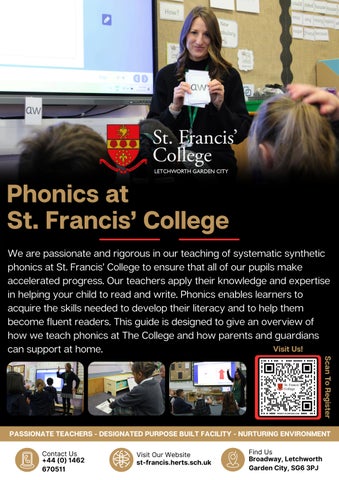
Phonics at St. Francis’ College We are passionate and rigorous in our teaching of systematic synthetic phonics at St. Francis’ College to ensure that all of our pupils make accelerated progress. Our teachers apply their knowledge and expertise in helping your child to read and write. Phonics enables learners to acquire the skills needed to develop their literacy and to help them become fluent readers. This guide is designed to give an overview of how we teach phonics at The College and how parents and guardians Visit Us! can support at home. Scan To Register PASSIONATE TEACHERS - DESIGNATED PURPOSE BUILT FACILITY - NURTURING ENVIRONMENT Contact Us +44 (0) 1462 670511
Visit Our Website st-francis.herts.sch.uk
Find Us Broadway, Letchworth Garden City, SG6 3PJ
What is Systematic Synthetic Phonics?
Systematic Synthetic Phonics (SSP) is a way of teaching children to read by introducing sounds in a certain order to build up children’s learning gradually. It teaches children how sounds are represented by written letters. Children are taught to read words by blending these sounds together to make words. For example, they will be taught that the letters ‘ma-t’ blend together to make ‘mat’.
How is phonics taught at St. Francis’ College? At St. Francis’ College, we deliver our daily phonics lessons using a DfE validated SSP scheme called Essential Letters and Sounds (ELS).
Pre-School In our Pre-School, phonics is taught using the ELS Foundation Stage which focuses on the seven key aspects of phase 1 phonics. It is designed to help children build their vocabulary, language and listening skills. It also encourages them to manipulate sounds before they learn to read and write.
The Prep School In Reception and Year 1, children participate in a whole class daily phonics lesson where the teacher teaches a new sound, or reviews previous sounds. This is shown to the class on the whiteboard and using flash cards in an engaging and interactive way. In reception, the children will learn the phase 2 and 3 sounds. In Year 1, the children will learn the phase 5 sounds. In Year 2, the phase 5 phonics sounds are recapped and consolidated and then the children move onto phase 6 which is taught through the ELS Essential Spelling scheme.
How can you support your child at home? Always make phonics fun and celebrate effort and not perfection.
Pre-School
Play rhyming games and sing nursery rhymes Go for listening walks and talk about what sounds you can hear. What is making those sounds? Explore voice sounds (can you make a long sound, loud sound, quiet sound?) Read picture books daily and talk about the story with your child Use robot talking to practise blending – “can you put on your coa-t?” “I can see a sh-ee-p!”
Reception
Learn how to say the pure sounds to ensure pronunciation is accurate Use robot talking to practise blending – “can you put on your coa-t?” “I can see a sh-ee-p!” Play listening games such as ‘I spy’ and ‘what’s that sound?’ Read picture books daily and talk about the story with your child. Support your child to read their school decodable book 4 times a week Practise the sound flashcards that are given out weekly Spot sounds everywhere!
KS1
Learn how to say the pure sounds to ensure pronunciation is accurate Foster a love for reading through exposing your child to range of fiction and non-fiction texts Read picture books daily and talk about the story with your child Support your child to read their decodable book 4 times a week Encourage your child to read and spell the HRS (harder to read and spell words) Use robot talking to practise blending – “fl-oa-t” and “bl-ue-b-ell”
Key terms and vocabulary These are the key terms your child will be exposed to from Reception onwards. Phoneme: A single sound in a word. For example, the word "jam" has three phonemes: /j/, /a/, /m/. Grapheme: A written representation of a phoneme. A grapheme can be a single letter (like 'm' in 'mat') or a group of letters (like 'oa' in 'boat'). Blending: The skill of merging individual sounds together to form a whole word. For example, blending the sounds /m/ /a/ /t/ to make the word "mat". Segmenting: The opposite of blending – The skill of breaking a word down into its individual sounds for spelling. For example, segmenting "dog" into /d/ /o/ /g/. Digraph: A single sound represented by two letters (e.g., 'oa' in 'boat'). Trigraph: A single sound represented by three letters (e.g., 'igh' in 'night'). Grapheme-phoneme correspondence: The relationship between a specific grapheme and the phoneme it represents.
ELS Pronunciation Videos It is important that as a Reception or Year 1 parent you are familiar with the pure sounds to ensure you can accurately support your child at home.
ELS Phase 2 sounds ELS Phase 3 sounds
Facebook St. Francis’ College
Instagram @stfrancisherts
ELS Phase 5 sounds
LinkedIn St. Francis’ College, Letchworth