LIVE IN THE WILDERNESS
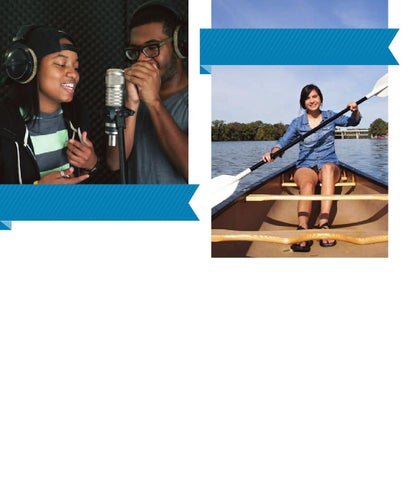
PRODUCE A HIP-HOP ALBUM The Shoe String Theory, the first album produced by hip-hop musician Megan Tillman ’14, came out in 2012. Download it for free at bitly.com/seu_music_download.
I like to write poetry, and when you put it with a beat, you get hiphop. For a long time, I was just getting free beats online to go with the words. But you can only go so far with that. My freshman year, I hooked up with Chris Beale ’12, who created beats for me. He puts sounds together — the kicks, high hats. It’s his own thing. When I started getting my own beats from Chris, I knew I could take my music wherever I wanted. The sky was the limit. I’d been performing live, but booking agents want to hear you before they book you. And I wanted to build a fan base. You can do mix tapes for free, but an album sounded so official. We spent months on the album. I was writing and writing; he was getting the beats together. And then we had three days to get down to my dad’s place in Houston, which has a studio, to pump everything out. Performing live compared to performing in a studio is like the difference between being in a play and being in a movie. Performing live, the pressure is on, but it’s natural, it’s raw, you can change things up. It’s flexible. But in the studio, you do take after take, trying to make everything perfect. The biggest challenge of putting out an album? Honestly, my dad. We’re both music heads, so we’re both trying to tell each other what we think. We bump heads. But he tries to help me in any way he can. Having an album out, a final product, is a great feeling. Saying you’re going to do something and actually doing it are two different things, and I take a lot of pride in seeing it completed now.
Kristina Schenck ’13, an Environmental Science and Policy major, spent the summer learning about natural resource management as a wilderness ranger in Minnesota’s Boundary Waters Canoe Area Wilderness as part of an internship program with the U.S. Forest Service.
The Boundary Waters are a different kind of wilderness than you typically see in the United States because there is so much water. There are gentle, rolling landscapes, beautiful pine and aspen trees, and lots and lots of green. But it’s literally not possible to explore the area without a kayak or canoe. You wouldn’t be able to get around. Canoeing is a beautiful way to travel. It’s a smooth ride, and while you may be focused on paddling, you can look around and see everything around you. The fish jump around you, bugs skim across the water and you can often see wildlife on the shoreline. It’s not like hiking, where you can’t see much except the trees around you. Not everything is that beautiful, though. I dug a lot of latrines — holes that were three or four feet deep, until we hit bedrock — with only a hand shovel. It can take four hours, and sometimes, while we were digging, we’d find a huge 70-pound boulder sticking out of the side of the hole. There’s a lot of strategizing when that happens. And, of course, you have to “naturalize” the old hole by filling it with dirt and maybe planting a tree on top. It’s gross, I guess. But you get desensitized to it. You just kind of hold your breath and tell yourself it’s just another day on the job. 13
81535 St Eds_REV_.indd 3
1/17/13 8:33 AM