WWW.STARTUPCPG.COM
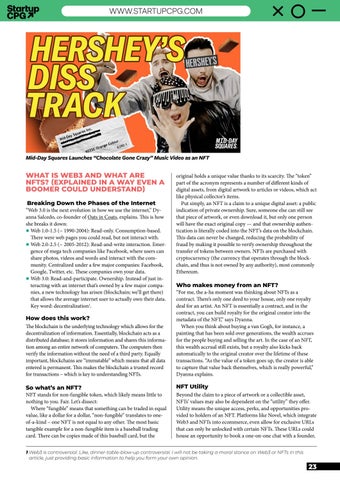
Mid-Day Squares Launches “Chocolate Gone Crazy” Music Video as an NFT
WHAT IS WEB3 AND WHAT ARE NFTS? (EXPLAINED IN A WAY EVEN A BOOMER COULD UNDERSTAND) Breaking Down the Phases of the Internet
“Web 3.0 is the next evolution in how we use the internet,” Dyanna Salcedo, co-founder of Oats in Coats, explains. This is how she breaks it down: lW eb 1.0-1.5 (~ 1990-2004): Read-only. Consumption-based. There were web pages you could read, but not interact with. lW eb 2.0-2.5 (~ 2005-2012): Read-and-write interaction. Emergence of mega tech companies like Facebook, where users can share photos, videos and words and interact with the community. Centralized under a few major companies: Facebook, Google, Twitter, etc. These companies own your data. lW eb 3.0: Read-and-participate. Ownership. Instead of just interacting with an internet that’s owned by a few major companies, a new technology has arisen (blockchain; we’ll get there) that allows the average internet user to actually own their data. Key word: decentralization1.
original holds a unique value thanks to its scarcity. The “token” part of the acronym represents a number of different kinds of digital assets, from digital artwork to articles or videos, which act like physical collector’s items. Put simply, an NFT is a claim to a unique digital asset: a public indication of private ownership. Sure, someone else can still see that piece of artwork, or even download it, but only one person will have the exact original copy — and that ownership authentication is literally coded into the NFT’s data on the blockchain. This data can never be changed, reducing the probability of fraud by making it possible to verify ownership throughout the transfer of tokens between owners. NFTs are purchased with cryptocurrency (the currency that operates through the blockchain, and thus is not owned by any authority), most commonly Ethereum.
Who makes money from an NFT?
The blockchain is the underlying technology which allows for the decentralization of information. Essentially, blockchain acts as a distributed database; it stores information and shares this information among an entire network of computers. The computers then verify the information without the need of a third party. Equally important, blockchains are “immutable” which means that all data entered is permanent. This makes the blockchain a trusted record for transactions – which is key to understanding NFTs.
“For me, the a-ha moment was thinking about NFTs as a contract. There’s only one deed to your house, only one royalty deal for an artist. An NFT is essentially a contract, and in the contract, you can build royalty for the original creator into the metadata of the NFT,” says Dyanna. When you think about buying a van Gogh, for instance, a painting that has been sold over generations, the wealth accrues for the people buying and selling the art. In the case of an NFT, this wealth accrual still exists, but a royalty also kicks back automatically to the original creator over the lifetime of these transactions. “As the value of a token goes up, the creator is able to capture that value back themselves, which is really powerful,” Dyanna explains.
So what’s an NFT?
NFT Utility
How does this work?
NFT stands for non-fungible token, which likely means little to nothing to you. Fair. Let’s dissect: Where “fungible” means that something can be traded in equal value, like a dollar for a dollar, “non-fungible” translates to oneof-a-kind – one NFT is not equal to any other. The most basic tangible example for a non-fungible item is a baseball trading card. There can be copies made of this baseball card, but the
Beyond the claim to a piece of artwork or a collectible asset, NFTs’ values may also be dependent on the “utility” they offer. Utility means the unique access, perks, and opportunities provided to holders of an NFT. Platforms like Novel, which integrate Web3 and NFTs into ecommerce, even allow for exclusive URLs that can only be unlocked with certain NFTs. These URLs could house an opportunity to book a one-on-one chat with a founder,
1 Web3 is controversial. Like, dinner-table-blow-up controversial. I will not be taking a moral stance on Web3 or NFTs in this article, just providing basic information to help you form your own opinion.
23