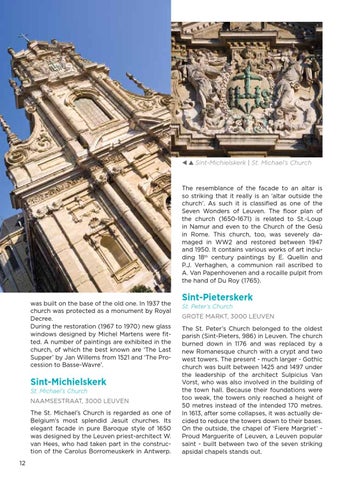
Sint-Michielskerk | St. Michael’s Church
The resemblance of the facade to an altar is so striking that it really is an ‘altar outside the church’. As such it is classified as one of the Seven Wonders of Leuven. The floor plan of the church (1650-1671) is related to St.-Loup in Namur and even to the Church of the Gesù in Rome. This church, too, was severely da maged in WW2 and restored between 1947 and 1950. It contains various works of art inclu ding 18th century paintings by E. Quellin and P.J. Verhaghen, a communion rail ascribed to A. Van Papenhovenen and a rocaille pulpit from the hand of Du Roy (1765). was built on the base of the old one. In 1937 the church was protected as a monument by Royal Decree. During the restoration (1967 to 1970) new glass windows designed by Michel Martens were fitted. A number of paintings are exhibited in the church, of which the best known are ‘The Last Supper’ by Jan Willems from 1521 and ‘The Procession to Basse-Wavre’.
Sint-Michielskerk St. Michael’s Church
Naamsestraat, 3000 Leuven The St. Michael’s Church is regarded as one of Belgium’s most splendid Jesuit churches. Its elegant facade in pure Baroque style of 1650 was designed by the Leuven priest-architect W. van Hees, who had taken part in the construc tion of the Carolus Borromeuskerk in Antwerp. 12
Sint-Pieterskerk St. Peter’s Church
Grote Markt, 3000 Leuven The St. Peter’s Church belonged to the oldest parish (Sint-Pieters, 986) in Leuven. The church burned down in 1176 and was replaced by a new Romanesque church with a crypt and two west towers. The present - much larger - Gothic church was built between 1425 and 1497 under the leadership of the architect Sulpicius Van Vorst, who was also involved in the building of the town hall. Because their foundations were too weak, the towers only reached a height of 50 metres instead of the intended 170 metres. In 1613, after some collapses, it was actually decided to reduce the towers down to their bases. On the outside, the chapel of ‘Fiere Margriet’ Proud Marguerite of Leuven, a Leuven popular saint - built between two of the seven striking apsidal chapels stands out.