50 Years of Woodworking at SSFS SSFS founder S. Brook Moore attributed the birth of Sandy Spring Friends School directly to the depth of his education at another Friends school, George School in Pennsylvania. Brook spoke of the experience of being exposed to the possibilities of the workings of the spirit through his teachers, especially his woodworking teacher, Robert Brown. In an article for the George School publication, the Georgian, Brook said of Brown that he “imparted to his students some of his own feeling and respect for the natural world, and his deep appreciation for excellence in all things, for quality of workmanship. An excellent craftsman himself, he inspired his students by example.” Brook continued, “I learned facts and certain skills, but more than that, I learned to recognize the power of the inward approach to life.” Brook learned cabinetry in high school, and it became his life's work. After working as an inspector in a wooden airplane factory during World War II, Brook returned to the homestead across the road from what would become the site of SSFS - the fifth generation of his family to live there - and began hand-crafting furniture, building a reputation for elegantly simple design and solid construction. He also built ultralight airplanes, and musical instruments were another fascination: in his later years, he made hammer and plucked dulcimers, harps, and viola de gambas. The sign on the road outside his house during that time read: "S.B. Moore, Instrument Maker."
6
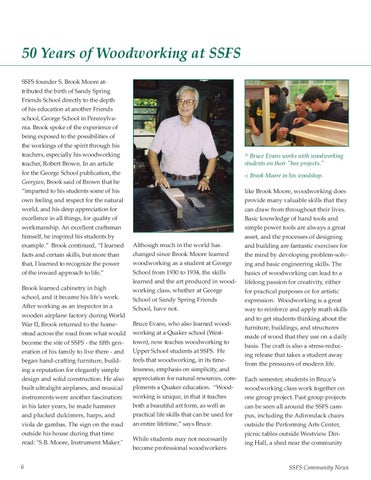
^ Bruce Evans works with woodworking students on their "box projects." < Brook Moore in his woodshop.
Although much in the world has changed since Brook Moore learned woodworking as a student at George School from 1930 to 1934, the skills learned and the art produced in woodworking class, whether at George School or Sandy Spring Friends School, have not. Bruce Evans, who also learned woodworking at a Quaker school (Westtown), now teaches woodworking to Upper School students at SSFS. He feels that woodworking, in its timelessness, emphasis on simplicity, and appreciation for natural resources, compliments a Quaker education. “Woodworking is unique, in that it teaches both a beautiful art form, as well as practical life skills that can be used for an entire lifetime,” says Bruce. While students may not necessarily become professional woodworkers
like Brook Moore, woodworking does provide many valuable skills that they can draw from throughout their lives. Basic knowledge of hand tools and simple power tools are always a great asset, and the processes of designing and building are fantastic exercises for the mind by developing problem-solving and basic engineering skills. The basics of woodworking can lead to a lifelong passion for creativity, either for practical purposes or for artistic expression. Woodworking is a great way to reinforce and apply math skills and to get students thinking about the furniture, buildings, and structures made of wood that they use on a daily basis. The craft is also a stress-reducing release that takes a student away from the pressures of modern life. Each semester, students in Bruce’s woodworking class work together on one group project. Past group projects can be seen all around the SSFS campus, including the Adirondack chairs outside the Performing Arts Center, picnic tables outside Westview Dining Hall, a shed near the community
SSFS Community News