Dismantling a dream: the uncertain future of an Indigenous learning initiative / p. 13 ‘Guys we really fucked up’: The Garter Press reveals it was all fake / p. 26
Lost in translation: one students account of work exploitation / p. 18
S2W12 / FIRST PUBLISHED 1929
Beyond Beatlemania: how technology has influenced modern fandoms / p. 10
HONI SOIT
Acknowledgement of Country We acknowledge the traditional custodians of this land, the Gadigal people of the Eora Nation. The University of Sydney – where we write, publish and distribute Honi Soit – is on the sovereign land of these people. As students and journalists, we recognise our complicity in the ongoing colonisation of Indigenous land. In recognition of our privilege, we vow to not only include, but to prioritise and centre the experiences of Indigenous people, and to be reflective when we fail to. We recognise our duty to be a counterpoint to the racism that plagues the mainstream media, and to adequately represent the perspectives of Indigenous students at our University. We also wholeheartedly thank our Indigenous reporters for the continuing contribution of their labour to our learning.
Editorial I came into this editorship with one — very specific — goal: to increase the number of non-Sydney private or selective school educated students reporting or creating for Honi Soit. Or, as the caption under my election head-shot put it, I was “WET for publishing stories that cater to students outside the Sydney private school bubble.” In 2016, days after finding out that we would edit the paper, I remember telling my room-mate, “if it gets to the end of the year and I have not done anything to further this cause, yell at me because I’ll deserve it.” So here I am admitting guilt: roast me, because in this goal I have failed. Honi has failed. There are no more low SES — or otherwise marginalised students — creating for this paper than previous years. The “Honi clique” remains as strong as ever. I don’t know how to fix this. In fact, I don’t think it’s something that editors, even with the best of intentions, can fix. Either way, here’s one last ditch effort to vidicate my conscience: To anyone reading this with something to say, but the belief that they don’t have anywhere to say it, I urge you, say it in Honi. I can only speak to this year’s editorial team, but I mean it when I say each week we were desperate for fresh content; for new voices. I predict next year’s team will face the same problem. To low-SES students, international students, students from regional backgrounds, first-in-family students, all other students struggling through each day: rich kids already have the world at their feet — don’t let them have student media too. MT
Contents
Letters / 3 News and Analysis / 4 Long Read / 7 Profile / 8 Culture / 9 Photo Essay / 12 Longer Read / 13 Opinion / 16 Creative / 17 Perspective / 18 Sport / 20 Regulars / 21 Puzzles / 22 SRC reports / 23 SUPRA / 24 Caseworkers / 25 The Garter Press / 26
Who made this edition happen? Editor-in-Chief: Maani Truu Editors Nick Bonyhady Natassia Chrysanthos Jayce Carrano Ann Ding Justine Landis-Hanley
Aidan Molins Kishor Napier-Raman Siobhan Ryan Michael Sun
Contributors Stephanie Barahona, Rhea Cai, Pola Cohen, Grace Franki, Eric Gonzales, Nick Harriott, Rose Hartley, Pranay Jha, Angelina Kosev, Lily Langman, Veronica Mao, Ana Subotic, Matt Sitas, Georgia Tan, Alan Zheng Artists Grace Franki, Maxim Adams, Robin Eames, Rebekah Mazzocato, Stephanie Barahona, Matthew Fisher, Tilini Rajapaksa, Jamie Weiss, Deepa Alam.
Front and back cover images by Aiden Magro. Honi Soit, Week 12, Semester 2, 2017.
Disclaimer: Honi Soit is published by the Students’ Representative Council, University of Sydney, Level 1 Wentworth Building, City Road, University of Sydney NSW 2006. The SRC’s operation costs, space and administrative support are financed by the University of Sydney. Honi Soit is printed under the auspices of the SRC’s directors of student publications: Nina Dillon-Britton, Pranay Jha, Isabella Pytka, William Ryan, Katie Thorburn, and Adam Ursino. All expressions are published on the basis that they are not to be regarded as the opinions of the SRC unless specifically stated. The Council accepts no responsibility for the accuracy of any of the opinions or information contained within this newspaper, nor does it endorse any of the advertisements and insertions. Please direct all advertising inquiries to publications.manager@src.usyd.edu.au.
What’s on this week According to that person in your class who relates everything to either anime or communism
2
SUHHAS - Rap Writing Circle
Fempower fundraising drinks
When: Thursday 26 October, 1pm Where: Gladys Marks Room, Manning Building Price: Free
When: Monday 30 October, 6pm – 10pm Where: Hermann’s Bar Price: $5-$10 donation suggested
We should go to this!!! These guys get together and write ‘raps’. UWU I love music, although I would love to go to a worker’s state like the Democratic People’s Republic of Korea where the glorious leader regulates a national musical genre that we can listen to. I would love for that genre to be something relatable like Final Fantasy soundtracks, but hip-hop would also be okay. As long as it’s stuff that triumphs workers’ values, like Hopsin-san, and that isn’t elitist liberal garbage like Kendrick Lamar.
Hey, this sounds interesting. It’s a fundraiser for fEMPOWER, which is an organisation which does workshops with young people to educate them about issues that affect women. Someone told me it was a really good program, and I’d probably agree with them if I didn’t think the only viable form of political action was picking up an AK47 and charging head on towards parliament house to start a communist insurrection. Plus, why praise these fake ‘feminists’ when the true feminist heroes of our culture, like Goku, Naruto, and Shinji Ikari are never given recognition for their revolutionary attitudes towards women’s liberation?
LETTERS
Fan mail Liberals are independent, I swear Dear Honi, Your last edition asked why someone without political convinctions would get involved in the partisan shitshow that is the SRC. While I know this is a hard concept for the left to understand but people do run as independents because they want to achieve something for students. Whether that’s student services or just making people aware the SRC exists. As much as the left wants to talk about how it’s an activist organisation, it’s only that way because the left have controlled it for so long that they’ve turned it into that ignoring that by advocating for their own little pet activist projects they may be isolating the vast majority of the student population. Running for SRC isn’t necessarily a partisan affair, and it shouldn’t be. It should be about achieving results for the students that are forced to pay for it. Sincerely, Kerrod Gream
Virginity in a sex positive world I have always been curious about sex. Throughout high school, I was the most sexually adventurous of my friends: I read all the magazine articles I could find, I scoured Tumblr and WatPad for the juiciest stories, and I was a huge Laci Green supporter. When I came to university I was even more excited by the prospect of entering the next stage of my sexual journey: penetrative sex. Only it never happened. ue to a combination of medication, medical conditions, and mystery, my only
sexual experiences were painful and ended premature of my goal. As time passed and I got older (I’m currently 23), another opportunity for sexual engagement with a partner hasn’t arrived. Pretty quickly I learnt to be ashamed of this fact about myself, to stop watching Sexplanations, to stop talking to my friends about sex, and to withdraw from the sex positive community for fear someone would realise my V-card disqualified me from joining, or even being interested in, the discourse. I commend Courtney Thompson for calling out a problem in the sex positive community that few seem to notice in Honi last week. In order to be considered sex positive, you have to have a lot of (often) great sex. Sexual empowerment is equated to sexual experience;heaven forbid you try to have one without the other! What Thompson doesn’t seem to realise, though, until the very last sentence of her article, is that speaking over virgins, asexuals, and celibates in order to share your overturned virgin status perpetuates the circle of shame and silence that you’re trying to stop. Thompson’s article falls into a rarely identified pattern of virgins-in-retrospect writing thinkpieces about what it used to feel like being a virgin and how those feelings look post-sex. In June this year, the sexuality podcast Why Oh Why, hosted by Andrea Silenzi, interviewed an anomaly: a 26-year-old virgin. Except she wasn’t. While she was 26 when she had sex for the first time, this occurred prior to her interview. It doesn’t just happen with sex. Laurie Penny, in an edited extract from her book Bitch Doctrine published by the Sydney Morning Herald in September, outlined the reasons why she believes women should remain single in their 20s. Of course, Penny is in a committed monogamous relationship. These articles are a call across the void from the people who have escaped the stigma and shaken off the shame and
embarrassment that you, the sorry sod reading, still shoulder. Let’s be clear: the intentions of these writers and speakers are good. They want to reassure people that if they can do it, you can do it, too. But in response to Thompson’s article, and the many like it, writing about virginity and not having sex from the perspective of someone who has had sex reinscribes the exclusivity of sex positive discourse where only the “sexually active” can participate, telling the readers that you cannot feel normal and okay about your sexuality and sexual history until you have had sex. Asking us to step into the conversation and share our experiences while simultaneously talking about how you used to feel ashamed and alone like us but now, after having sex, feel a lot better, isn’t inviting. And we’re all still trapped in the narrative of shame when you frame your history as an admission, a confession, a dark secret you’re now free from and thus able to discuss and discard. For anyone reading this who isn’t having sex, whether you want to or not, a reminder: you are already okay. You are already normal. You do not need to have sex to know that. Anonymous
Opening up STUCCO Dear Editor, SRC Legal Service as an independently incorporated charity provides free advice to about 500 students a year between 2 solicitors and a handful of law student volunteers (who we thank again for their contribution in 2017). We note a matter of general interest – Usyd have updated their Bullying / Harassment / Discrimination Prevention Policy to officially include (as of 22/9/17) all the well known residential colleges co-located at
Usyd. This follows the general trend in reform of student conduct policy over some years now. A notable absence is special hardship/discount STUCCO - an autonomously managed accommodation by/for 45 students - that we are told is 1/3 owned by Usyd / NSW Dept of Housing / NSW Dept of Education, and dedicated exclusively to Usyd students. The above Usyd BHDP Policy says it applies to “University related conduct” that “occurs on, or in connection with, University lands or other property owned by the University”: So stakeholders within and without STUCCO may well think the BHDP Policy should equally apply to STUCCO? We understand without being convinced that that the official Usyd/Student Affairs line to date is STUCCO is exempt. But should it be? On the BHDP metric the residential colleges now overtake STUCCO. Meanwhile STUCCO provides a rent discount equal to $7,800 a year compared to the open market (at $90 v $240 p/w). This fat financial subsidy may well be the difference between a university education or none. One might think 5 years is a reasonable time limit for individuals to gain this financial hand up. Or to put it another way, a new Stuccling cannot be nurtured in the shelter until a 5 year veteran Stuccling leaves the nest. There are reports of pressure within STUCCO - particularly in the lead up to summer ingress/egress - to bust the maximum 5 year limit via expert caucusing. This state of affairs may - by all accounts - be suitable fodder for a more vigorous BHDP Policy if Usyd ever did take on jurisdiction. Given the financial advantage to be gained by overstaying we wonder if another Usyd policy may also require updating: the Reporting Wrongdoing Policy. Regards, Thomas McLoughlin Solicitor Practitioner Director
Jetpack Presents: Ghosts of Glebe
VegeSoc end of semester dinner
Gaymers Undead Arcade!
When: 31 October – 11 November, 6.30pm Where: Glebe (secret location) Price: Concession $10 | General admission $20
When: Wednesday 25 October, 6pm Where: Lentil As Anything Price: $10 –15 donation suggested
When: Saturday 28 October, 5pm until late Where: The Hollywood Hotel, Surry Hills Price: Free
This Wednesday VegeSoc is putting on its end of semester dinner at Lentil As Anything in Newtown. It’s a very proletariat place; since it’s ‘pay by donation’, a lot of my friends on the left go and pay the appropriate amount for their class (which is $0). I’m gonna go to this but I don’t think I’ll eat there, I’ll go and eat some ~ramen~ in the city beforehand, because unlike vegetarian food it is truly anti-imperialist.
Finally, an event that celebrates the only other valid form of cultural expression: video games. It’s an all night party in Surry Hills for LGBT people with great games like Smash Bros, Left4Dead, and of course, Super Shrek Slam. There’s also drag shows, a costume contest, and karaoke. Last time I was at something like this, though, someone called me a ‘tankie’ (which is 100 per cent a slur) just because I said that “Stalin did nothing wrong” and that “if you don’t like Sword Art Online you should be put in a gulag”. Being called a tankie (even after I told this guy to self crit) is absolutely harassment so I’d prefer to stay out of toxic spaces like this.
Woah, cool! This is like, a *spooky* interactive theatre show where you explore the streets of Glebe through a blend of history and fiction. It’s being put on by the Jetpack Theatre Collective, who have spent the last few years running a series of highly successful shows exploring theatre in interactive and also traditional forms. It kinda reminds me of how anime blends traditional Japanese technique with western influence in its animation styles, or how my communism blends posts I read on Twitter with posts I read on Tumblr.
3
NEWSROOM
New Cellar Theatre set to open in January NICK BONYHADY
The Cellar shortly after its roof collapsed. Image: Margot Louisa
In early June this year, the roof of the Cellar Theatre collapsed due to heavy rainfall. The Cellar is underneath the Holme Building, and is the traditional home of the Sydney University Dramatic Society (SUDS). Though there were initial hopes that the Cellar would resume operating at the start of semester two, it is now scheduled to reopen in January. University of Sydney Union (USU) President Courtney Thompson told
Honi that “the Cellar is on track to be restored in time for the Summer Season.” No specific date has been set for the new theatre to open. The last major USU construction project — Hermann’s Bar — was delayed for several weeks before opening part-way through this semester. Keshini de Mel, SUDS President, said that the first show to be staged in the new Cellar has not yet been determined, but indicated that, on the
Notice of Council Meeting
89th Students’ Representative Council, University of Sydney DATE: 1st November TIME: 6–8pm LOCATION: Professorial Board Room (Quadrangle)
w: src.usyd.edu.au p: 02 9660 5222
4
current timeline, the last play to be staged in SUDS’ temporary home in the Holme Common Room will be The Dark Room. For SUDS, the relocation away from the Cellar has been challenging. “Repairs in the Cellar took longer than expected and we were never sure when they would be done”, de Mel said. “this meant that shows only ever got two to four weeks’ notice about whether to prepare a show for the Cellar or the Common Room.” “The C&S office has been very good in giving us stability in difficult circumstances”, de Mel added. “They deserve a medal.” Thompson similarly thanked SUDS as a whole, and specifically the production teams of plays that have been staged in the Common Room for their flexibility. For the last several years, the USU has been in a parlous financial state, making either bare profits or deficits. Fortunately, the cost of repairing the Cellar, which will include a new insulated ceiling to prevent noise leakage from the building above and a more versatile lighting rig, will be
borne by the University, according to Thompson. “It isn’t costing the USU anything as the University is contributing.” That contribution is likely sourced from the Student Services and Amenities Fee (SSAF) — the compulsory payment that all students make each semester. Most SSAF money goes directly to student organisations like the USU and the Students’ Representative Council, but 14 per cent is channeled into the University’s Capital Sinking Fund. This year, that amounted to a $2 million contribution. Past projects that have drawn on the Capital Sinking Fund include new stadiums used by Sydney University Sport and Fitness. If the refurbishment of the Cellar has been supported by the Fund, it would represent a rare instance in which the performing arts have benefitted from a pool of money that has often been reserved for athletes. Greg Robinson, the University’s director of campus infrastructure services, did not respond to Honi’s enquiries by print deadline.
What does it take to get expelled from university? MAANI TRUU Across years of campaigning against campus sexual assault, one call has often been repeated: that perpetrators of sexual assault or harassment should be expelled from campus. In the past, this hasn’t happened. We’ve even seen cases where victims have been expected to attend lessons alongside the perpetrator. If being accused of a crime against a fellow student isn’t enough to warrant an expulsion, or even suspension, from a course, what is? Data obtained under the Government Information (Public Access) Act shows that between 2015 and 2017, 118 University of Sydney students were suspended or expelled from their course. Of these, only 17 were “expelled” over the three years. According to the definition set out in the University of Sydney (Student Discipline) Rule 2016, these students faced “permanent expulsion from the University, an award course, or admission to or use of University lands”. The most common reason for expulsion was overwhelmingly “falsified certificates”, with ten students kicked off campus for “providing either forged or illegally purchased Professional Practice Certificates in support of a Special Consideration submission”. Of the remaining cases, three students were expelled due to “academic dishonesty”, one for “plagiarism”, and two for “fraud”. As defined in the now-repealed Chapter 8 of the University of Sydney By-Law (1999), students were also suspended “from admission to or from the use of
University grounds or any part of those grounds, either permanently or for a specified period” or suspended “from a University course either permanently or for a specified period”. Fraud of medical certificates was, once again, the most common cause of suspension, almost doubling the number of academic honesty offences, the next most common, at 65 cases. This was followed by a more specific “plagiarism” offence which totalled only six cases. Conversely, during this period, only one case of “sexual harassment” resulted in expulsion or suspension. The penalty for this incident in 2016 was a suspension for one year. More generally, three cases of “harassment” were penalised, which can refer to sexual harassment, unlawful harassment or bullying against staff or students. The disparity in numbers between fraud and academic honesty offences and harassment and bullying cases is likely due of the difficulty in proving the latter. The former is comparatively easy to prove due to the existence of a physical document. According to Vice Chancellor (Registrar) Tyrone Carlin, the new centralised special considerations system has increased the university’s ability to detect fraudulent certificates. But if you were worried about getting expelled, don’t worry too much; only 0.2 per cent of students found themselves in hot water, and almost all of these were temporary suspensions.
NEWSROOM
The SRC is larger than most think ANN DING In her presidential candidate interview with Honi earlier this year, when asked how she would address the SRC’s chronic inability to ensure sufficient attendance at meetings, Student Representatives’ Council (SRC) President-Elect Imogen Grant brought up the ex-officio members of council. Ex officio members are student representatives who, by virtue of their positions in other university organisations, also hold a position on the SRC. While ex-officio members don’t contribute to quorum (the threshold at which a meeting is deemed to have enough attendees), Grant saw the ex-officio members as an alternate pathway to consultation and collaboration. In Grant’s words, “if you have a president that actually reaches out to these people, forges relationships with them, you create a … democratic collaborative SRC”. There are 22 ex-officio members of council — the undergraduate fellow of Senate, the immediate past president of the SRC, the two undergraduate student members of the Academic Board as appointed by the SRC, the presidents of the students’ associations of Cumberland, the SCA and the Conservatorium of Music, and 15 faculty society presidents. Despite being in the regulations, the ex-officio members’ function is little different to any other undergraduate student on campus. Ex-officio members do not have a vote on council; voting is reserved for the 33 representatives elected at the SRC elections every September. Conversely, any student can attend SRC meetings as an observer and move or speak to motions. If the SRC were truly fulfilling its role as a representative body, one would hope that students are regularly being consulted with about their wants and needs. Ex-officio members could play a vital role in this pursuit, but little has been done to engage them. According to SRC President Isabella Brook, the members’ roles are
not clearly defined in the council’s regulations. However, she “view[s] these members as playing more of a consultative role within the council”. Brook states that in her term, she has “worked closely with the SRC's two undergraduate student members of the academic board as well as collaborating with the presidents of SCA, the Con and Cumbo on issues that impact their campuses”. In her interview, Grant says, “We have a whole heap of ex-officio members of council that probably don’t even know they’re members”. And she’s right. Of the ex-officio members who responded to Honi’s requests for comment, only Sydney Arts Students’ Society (SASS) president Jacob Masina and undergraduate member of Academic Board Ivana Radix knew of their roles as an ex-officio member. Masina is also a current Board director and benefits from the institutional knowledge of the moderate Liberal faction on campus, while Radix has been involved in the SRC for some time. Radix told Honi, “As an ex-officio member, it is my role to create dialogue between the Council and the Academic Board… that manifests through meeting regularly with the SRC President, as well as [talking to] caseworkers about the SRC's position on specific motions… [and] feeding this information back to the President to communicate to Council”. The other current ex-officio members who spoke to Honi all indicated that they had not been told they held membership of the SRC. When asked what his understanding of the ex-officio roles was, veteran hack and 2016 chair of the SRC Standing Legal Committee Cameron Caccamo said, “in the modern SRC, absolutely nothing”. Caccamo told Honi that in the past, ex-officio roles had been “a way of ensuring those with important representative positions outside the SRC are… involved”. In this respect, however, he believes they have been defunct roles
since at least 2012. SRC General Secretary Daniel Ergas says, as far as he can tell, “ex-officio members haven't been properly engaged in decades”. In 2015, as vice president, Ergas attempted to “re-establish the Faculty Societies Committee” (“part of the role of the [vice presidents], per the regs” he points out). His efforts, however, were in vain; only three or so faculty presidents showed up, while others did not respond to his messages. Since then, no other vice president has attempted to establish the committee. So, what if the SRC were actually to give ex-officio members a vote at council in order to encourage their engagement? After all, notwithstanding past instances of factions skewing society elections, faculty society presidents are usually elected by involved students from each separate faculty, meaning they are in many ways better positioned to consult and communicate with their peers. The majority of them have come into their position because they are passionate about their discipline and dedicated to the society, often having served on the executive in prior years. Satellite campus association presidents, too, help to sustain the student life of their campuses and advocate for their student bodies. And, while the position of undergraduate fellow of Senate has in recent years been undermined by undemocratic election practices including alleged coercion of voters and opaque or nonexistent policy platforms, the position is in principle an important one, lending students a voice in an often impenetrable and secretive Senate. It’s possible that giving ex-officio members a vote could lead to even more campus political factions fighting more intensely for faculty society presidencies and the like. But if we hope to create a more “democratic collaborative SRC” as Grant hopes, it might be worth considering giving its ex-officio members more power beyond a decorative title.
Uni looking to introduce universal late penalties SIOBHAN RYAN The University Executive’s Education Committee has endorsed a proposal to introduce University-wide late penalties of five per cent per calendar day for written assignments, with a mark of zero applied after 10 days. At a previous meeting, University faculties and schools voted seven-five for the common penalty to be five per cent per day rather than 10 per cent. This penalty would reduce the late penalties of some disciplines, such as law and engineering which are currently 10 per cent per day. A University spokesperson said implementing the change may require changes to Faculty Resolutions. However, they also said “some faculties and schools may adopt a local provision for pedagogical and accreditation reasons”. Given the close split between faculties and schools in favour of five per cent per day versus 10 per cent and the possibility of opting out, it is unclear how “University-wide” this change will be. Students’ Representative Council (SRC) President Isabella Brook told Honi she supports the change. “This is a step away from the harsh late penalties that exist in some faculties that unfairly target disadvantaged students. “A University-side policy sets a clear standard for students, especially those who are studying across multiple faculties.” The University is also looking into the possibility of a university-wide deadline of 11.59pm. The proposal needs to be approved by the Academic Board before it can be implemented. Assuming it is successfully passed, the committee proposed it would come into effect in semester one, 2019.
Students to be assessed on holistic qualities JAYCE CARRANO Undergraduate students will soon be assessed on their achievement of university-wide graduate qualities as part of the University’s 2016-2020 Strategic Plan. “The model involves embedding the graduate qualities in the undergraduate curriculum and assessing them on graduation,” said Associate Professor Peter McCallum, co-chair of the working group responsible for developing the assessment. The graduate qualities currently include “Depth of disciplinary expertise”, “Critical thinking and problem solving”, “Communication (oral and written)”, “Information/digital literacy”, “Inventiveness”, “Cultural competence”,
“Interdisciplinary effectiveness”, “An integrated professional, ethical and personal identity” and “Influence”. McCallum said these qualities reflect those needed for students to “make a valuable contribution to society and lead fulfilling lives”. Achievement of these outcomes will not appear on students’ transcripts, but in a narrative form on a supplementary document that students can choose to use. “Many scholarship applications or job applications, for example, ask for demonstrated communication skills and it may be of value to students to be able to present the supplement as evidence of this,” McCallum said.
The holistic and qualitative nature of the model is similar to rubrics such as VALUE adopted across many campuses in the United States. “It’s actually a very exciting project,” Deputy Vice-Chancellor (Education) Pip Pattison said. “If we can do it, we’ll be the first university to attempt something at this scale, but we think it will actually be very useful for students.” Nonetheless, Pattison admits “it’s still going to be very hard” to compare graduate qualities between disparate disciplines. It is also unclear how qualities like cultural competence will be demonstrated to a sufficient extent in subjects outside of the humanities, such as com-
puter science. Further, the new model may end up discouraging students from developing these qualities outside of university since the assessment will not take those activities into account. Nonetheless, consultation appears to have been lengthy, with faculty staff, student representatives, and employers providing feedback since 2015. Honi contacted spokespeople from the faculties of Business, Engineering, and Arts and Social Sciences who were all supportive of the proposal and satisfied with the level of consultation. Assessment of graduate qualities is scheduled to commence in 2020. A discussion paper about the model will be available at the end of October.
5
NEWSROOM
Higher education cuts in limbo NICK BONYHADY The federal Liberal government’s higher education legislation stalled in the Senate last week, after the Nick Xenophon Team (NXT) indicated that its senators would vote against several key provisions, including bringing the HECS repayment threshold down to $42,000 a year from $55,000. Rebekha Sharkie, NXT education spokesperson, said her party would only consider the reforms if they were recommended by a comprehensive review of higher education policy. Labor, the Greens and other members of the crossbench have also consistently opposed the legislation. In addition to the HECS changes, the government’s bill would have decreased the proportion of degrees that the government subsidises from 58 per cent to 54 per cent, cut universities’ primary federal funding source by 2.5 per cent, and made an additional 7.5 per cent conditional on performance. Universities Australia and the Group of Eight, the sector’s two lobbying organisations, opposed the policy. Vicki Thomson, Group of Eight chief executive, congratulated NXT on its decision. “Australia’s students and universities are not now subjected to punishing increases in student fees and loan repayment schedules, nor funding cuts to course and research delivery which would have seen students paying more for less.” Despite lacking sufficient votes to pass the Senate, the government’s bill remains on the slate of potential legislation to be considered. National Tertiary Education Union President Jean-
nie Rea said “It is critical that Senator Birmingham ends the uncertainty around higher education funding by acknowledging that he does not have support for his so-called reforms in the Senate.” Rea argues that unless the policy is formally withdrawn, students will face significant uncertainty about the cost of future studies while academics will remain insecure in their employment. “We cannot afford another protracted period where unlegislated policy measures remain on the Senate notice paper with no prospect of ever being passed.” Bruce Chapman, an ANU professor who is widely regarded as the driving force behind the HECS system, characterised the now-stalled changes as a “pussy cat” in comparison to the “man-eating crocodile” of the Abbott government’s 2014 reform package. He wrote: “Most affected will be current part-time workers, and the increased obligation essentially means a faster rate of repayment, and not a major impost.” Of the 183,000 people whom the Australian Tax Office estimated would have been affected by the lower HECS repayment threshold, a repayment rate of 1 per cent would have left most paying about $8 a week. Gwilym Croucher of the University of Melbourne concluded that while past evidence suggests that modest increases to the cost of education have not deterred significant numbers of students from studying at University, “when combined with the lower HELP thresholds for repayment and higher repayment rates, the changes may make studying less attractive than in the past, and potentially prohibitive for some students.”
Faculties reluctant to share grade data JAYCE CARRANO The University prides itself on operating using “standards based assessment”. This is distinct from fitting grades to a chosen distribution, a system colloquially described as ‘scaling’. At USyd, there are no target failure rates or score distributions; in theory, everyone can fail or ace any unit of study depending on their achievement of prescribed unit outcomes. Beyond this non-prescriptive approach to assessment, there is little unification across the university in how grades should be distributed or how data is handled. Aggregate grade data for each unit of study is held by individual faculties and never passes through the University’s central system, according to Ainslie Bulmer, Executive Director in the Office of Deputy Vice-Chancellor (Education). “It’s not data that I would be able to pick out of any kind of central university system.” It is also, as Honi discovered, data that some faculties are stubbornly unwilling to relinquish. The faculties of Business, Engineering, Health Sciences (FHS), and Medicine were happy to produce data regarding failure rates and average marks when contacted by Honi (see table). The Faculty of Dentistry initially said they were “not at liberty to provide data on failure rates or median marks for 2016”, but did so following further prompting. But many other faculties simply refused to produce any data, citing a variety of reasons. The Architecture faculty claimed unit of study data was “ sensitive and proprietary information”; the Science faculty took 11 days to determine that they couldn’t produce the data in time for publication; and the faculty of Arts and Social Sciences said the data could not be produced from their results processing system. The Nursing and Pharmacy faculties simply didn’t respond. Meanwhile, the Law School claimed it did not even calculate the failure rates for individual units of study. This is despite Deputy Vice-Chancellor (Education) Pip Pattison saying, “Individual unit of
6
study coordinators would need to be aware of failure rates and try to understand the reasons for it. It’s an important piece of feedback on the design of the unit.” Only FHS provided data for individual units. This is unsurprising, given that there are obvious misconceptions that can result from sharing the average scores and failure rates for every individual unit of study. “As a simple example, I can readily conceive of two units that are taught equally well having quite different grade outcomes due to a range of different factors (prior preparation, the extent to which the unit aligns with students’ interests etc,),” said David Lowe, Engineering & IT Associate Dean (Education). “And yet a superficial consideration may unfairly put the grade variation down to teaching quality.” This may justify refusing to share individual unit of study data, but whole-faculty averages do not come with the same risks. Yet more than half of the faculties contacted either didn’t respond or refused to supply this data as well. Instead they cited roadblocks that other faculties had already surmounted. Given that, their excuses ring somewhat hollow. Fear of reputational damage — from, for example, surprisingly generous average scores — is one competing explanation. But refusing to supply any data at all comes with its own dangers. The most obvious is that new students are left without an indication of what comprises a ‘normal’ score for their course. Given that the people most likely to share marks are the high achievers, this lack of data only exacerbates stress and feelings of inadequacy. In both the Law School and Business Faculty, rumours circulate of failure rates in excess of 30 per cent. The data provided by the Business school goes a long way to extinguishing that fear while the Law school’s opacity only leaves its students in limbo. Allowing the chance of failure to be exaggerated is a rather grotesque way of motivating students. This secrecy is not only a problem at USyd. Other
Group of Eight (Go8) universities similarly do not publish average marks and failure rates for each faculty. However, the Go8 do participate in what Pattison called a “multi-verification system”. “Each year a number of disciplines participate in this process and a couple of third year senior units from the discipline are selected,” Pattison said. “The unit outline, the learning objectives, the assessment tasks, and a sample of student work are sent off to a Go8 reviewer who is randomly selected from another Go8 university … the University of Sydney grades are pretty strongly endorsed by reviewers from outside.” The University’s administration provides no guarantee that a distinction in one faculty is equivalent to a distinction in another, and the reality is that implementing such a guarantee would likely prove impossible because there are too many factors at play. As Pattison says, “you are, on one level, comparing apples and oranges, and that’s tricky.” Supplying aggregate grade data at faculty level, however, allows for students to compare themselves with others studying approximately the same courses. This is critical if students are to make decisions about their studies and careers that are realistic and well-informed. Faculty/School Business Dentistry Engineering & IT Medicine Health Science
Average Score 64.72 Not provided 66.12 72.67 73.14*
Failure rate 7.8% 1.42% Not provided 3%** 1.77%
*This is the median score while other faculties provided mean scores. Unless there were extreme variations in grade distribution, this data is still broadly comparable. **This was calculated from a “passing rate” and may include students who withdrew, inflating this number. Units known to have less than 10 students were excluded due to the possibility of outliers significantly influencing results. It should be acknowledged that both high WAM requirements and pass boundaries around 60 per cent inflate the average score in Medicine; further, large faculties like Business will inevitably struggle to engage every lagging student leading to higher failure rates.
LONG READ
How much data is a rat’s life worth? SIOBHAN RYAN / The rules and regulations of using live animals in university education Last year, I took an optional psychology course involving a behavioural experiment on rats. Having sat through a year of lectures in which many of the foundational principles of behavioural psychology were explained to us with reference to the animal-based experiments which informed them, I was excited — this felt like ‘real’ science. Our tutorial material covered how to treat the rats properly — gently, in low light and with little noise — but unfortunately it’s difficult to control the noise level of a room full of students. The effects of loud noises were obvious, with our rat freezing in its tracks and losing concentration when people nearby laughed or spoke above a low hum. Still, I started to like our little rat, who we named Delilah, and became invested in her progress towards pressing a lever. While talking to someone about the course, they told me not to get attached to the rats because they would be killed at the end of the experiment. I later learned this was probably incorrect, but was horrified by the idea that the animals lived just to facilitate our learning, particularly for a major I later dropped. A student I did the course with had a similar experience when their rat seemed distressed. They said that while they found it useful to see and influence conditioning first-hand, they believe, “it wasn’t entirely necessary in order to learn the concept ... [and] I don’t think the benefits of the class were significant enough to justify the harm we appeared to do to the rats.” The experience made me wonder how the University regulates the use of animals in teaching, given that teaching lacks the more obvious benefits of animal research (scientific and medical advancement) and places animals in the (supervised) hands of relatively inexperienced students. Animal research is generally a very divisive issue. The University of Sydney conducts research and teaching activities involving a whole range of animals, from laboratory and domestic mammals to non-human primates (marmosets). It has come under fire particularly for that last category. In January 2016, a Fairfax Media investigation by Natalie O’Brien revealed experiments at USyd involving marmosets being used “to take electrophysiological readings from their brains before they were killed with an overdose and then had their eyes removed so their retinas could be dissected”. However, the research on marmosets represents a very small proportion of the research conducted at USyd. According to information released by USyd under the Government Information (Public Access) Act, 16 marmosets have been used in research at the University since 2012 — eight in 2012, six in 2015 and two in 2016. All of these experiments involved the marmosets being anaesthetised, experimented on, and then killed without regaining consciousness. In 2016, 44.95 per cent of research was conducted on laboratory mammals, 21.92 per cent on domestic mammals, 19.31 per cent on birds and 13.82 per cent on other animals. Duncan Ivison, USyd’s Deputy Vice Chancellor (Research), tells me, “We don’t have the capacity on campus to do significant non-human primate research … you need very specialised and appropriate facilities and it’s just not something we’re capable of doing.” So, what of research more generally? All institutions undertaking animal research are required, under the the NSW Animal Research Act and the Australian Code for the care and use of animals for scientific purposes, to establish Animal Ethics Committees (AECs) to oversee animal research. All AECs must include at least
one vet, one animal researcher, one independent person with a “demonstrated commitment to animal welfare” and one independent lay person. Dr Peter Knight, the Head of the Discipline of Biomedical Science and Deputy Chair of one of the University’s two AECs, believes this composition and the requirement of unanimity for research to go ahead ensures AECs reflect society’s views. As these views change, he believes, “it’s inevitable that it would become more difficult to get protocols approved in the future.” The AECs are responsible for ensuring all approved protocols address the ‘three Rs’ — replacement (getting rid of animals in the research entirely), reduction, and refinement (decreasing the impact of the research on the animals’ well-being) — as much as possible. Ivison tells me the University is very committed to these principles. “[We] award a prize every year to the researcher who’s done the most to exemplify the three Rs.” The AECs may send applications back to researchers to take consider these principles more deeply, which Knight says happens to “much more than 50 per cent” of applications. Some never receive approval. Projects using animals in teaching are assessed broadly in the same way as research. As the AEC as-
There were 6498 instances of animal use for teaching across a range of disciplines in 2016 sesses applications by weighing up benefits and costs, there is generally a higher standard for proving the benefits of teaching compared to research. “If you were euthanising a large number of animals specifically for the purpose of teaching, I don’t think the Animal Ethics Committee would approve it,” Knight tells me. “There may be animals that are going to be euthanised because they’ve reached the end of an experiment ... but I would be extremely surprised if the Animal Ethics Committee said that you could euthanise a large number of animals purely for teaching purposes.” Similarly, Knight believes projects involving highly invasive procedures or requiring animals to be bred specifically for them would have to show significant benefits to be justifiable as they involve greater costs. While animal use in teaching represents a small proportion of projects involving animals at the University — currently only 6 per cent of active projects are for teaching purposes — there were still 6498 instances* of animal use for teaching across a range of disciplines in 2016. Many of these procedures appear to be non-invasive based on the statistics for NSW overall. In 2015–2016, 40,249 of the 48,064 total instances of animal use in education fell into the two categories “observation involving minor interference” (22,837) and minor procedures not involving anaesthesia or analgesia (17,412), which includes shearing, injections or blood sampling, and trapping and release. Classic examples include vet students practising ultrasounds and other techniques for use in their careers, according to the University of Sydney’s Animal Welfare Vet, Dr Shaun Miller. The AEC’s scrutiny of animal use for teaching has also lead to some applications being rejected. Knight explains that three applications from the Science Faculty were rejected recently because they involved euthanasia. The applications were for animal use in classes the faculty
has have run for a number of years but, Knight says, “the fact that they are considered basic experiments is not good enough grounds for the Animal Ethics Committee to approve the experiment. There has to be basically no alternative ... if there’s an opportunity to replace with something then the Animal Ethics Committee will expect that the animals will be replaced”. In teaching, technological advancements have made it possible to replace some animal use with alternatives. For vet students, models and prostheses such as the ‘Breed’n Betsy’ can be used to practise skills. The wonderfully named ‘Betsy’ allows students to practice artificial breeding, pregnancy diagnosis and embryo transfer. Though models may not completely remove the need for practise on real animals, “the idea is that students are then more proficient, they know what they’re doing, there’s less risk of stressing the [animal] unduly” later, Miller says. Other options for replacement include computer models, in vitro techniques and even techniques involving 3-D printing, Miller explains. “So as all these things improve, the research and teaching will have to keep up.” Again, Knight explains that the AEC weighs up the importance of actually practising the skills as opposed to seeing demonstrations and simulating them. Sometimes, the decision will be made in favour of the teaching, e.g. in veterinary science where knowing how to do a real suture has obvious importance for the safety of animals in the future. Other times, the AEC finds that the learning outcome is not worth the cost. However, AECs are not without their critics. Dr Denise Russell, an Honorary Research Fellow in the University of Wollongong’s Philosophy Program, argues that AECs fail to appropriately consider replacement in their deliberations on applications. In an article, she notes that research applicants generally come from disciplines “in which animal experimentation has been the norm,” and alternatives not explored as thoroughly. The applicants are required to present the alternatives themselves in their applications, which Russell says puts an “unrealistic expectation” on them to assess all alternatives. The composition of the members also, she argues, does not include people from disciplines most focused on alternatives, such as computer simulation. However, perhaps introducing these alternatives at the teaching stage could pave the way for more thoughtful consideration of alternatives in future research applications. And this is important, because animal research seems here to stay. There are, of course, critics to animal research — Russell cites research about animal testing and concludes, “The human benefits are shown to be quite meagre.” However, while Ivison acknowledges this debate, he is also resigned to the inevitability of animal research. “There’s a really legitimate debate about ... the extent to which we can replace some of those experiments with other means ... but replacing animals entirely, in many domains of medical research, is just not feasible in the current time. It might be at some future point, and I think there’s a lot of interesting work going on in that domain. But for a lot of really significant areas of medical research, in relation to really devastating human diseases and challenges, animals are still part of the research environment.” [1] An instance refers to how many times an animal was used, not the discrete number of animals used (e.g. if the same cow received an ultrasound from a vet students four times in one year, that would count as four instances).
Art: Maxim Adams and Justine Landis-Hanley
7
PROFILE
In conversation with an un-Australian lawyer PRANAY JHA / Sarah Dale, principal solicitor at Refugee Action and Casework Service, is fighting the good fight Sarah Dale is un-Australian. Or rather, that seems to be how Immigration Minister Peter Dutton would describe her. In August this year, Dutton claimed that lawyers assisting refugees were “playing games” and “taking Australians for a ride”. The Immigration Minister was frustrated by their work fighting legal battles against a government that was (and still is) seeking to dispel claims of asylum and leave refugees languishing indefinitely in offshore prison camps. Given the Immigration Minister’s nationalistic grief, I decided to investigate the source of his frustrations by having a conversation with the principal solicitor of the Refugee Advice and Casework Service (RACS), Sarah Dale. Dale has an impressive record of working with asylum seekers and refugees. She has developed an outreach legal service for unaccompanied minors and worked extensively with children who were detained on Christmas Island. Her passion for refugee rights resonates in her voice as she describes the overwhelming joy of one of her clients who graduated from high school this year. For Dale, working with the children who have gone through the process alone — by far the most vulnerable victims of Australia’s Kafkaesque refugee policies — has been a particular highlight of her work. Dale was never interested in the corporate career paths that entice so many law students after university. Although RACS currently employs almost 50 volunteers each week, Dale recalls the attitudes of law students during her university days, who considered working in social justice to be an almost second-rate ‘alternative’ career path. For her, placements in community legal centres proved “to be the most exciting”, with the work being “just as legal, if not more legal, than any other placements”. As Australia “hit a time in our political history where asylum seekers ... were treated so poorly”, she says there’s nowhere else she would rather be “than fighting for people seeking asylum”. Beyond the expected linguistic and cultural barriers of working with clients from diverse backgrounds, the biggest challenge faced by RACS is political, created by a climate where asylum seekers are constantly demonised by politicians and the media, and where the work of such organisations is denounced as ‘un-Australian’. The antipathy towards refugees’ defenders sparked significant funding cuts to RACS in 2014, which have put considerable strain on the organisa-
Art: Stephanie Barahona
8
tion. Before the cuts, “anyone who arrived in Australia was able to receive funded legal assistance under the IAAA (Immigration Advice and Application Assistance) scheme”, says Dale. But in 2014, the government decided to discontinue the funding, leaving 27,000 people stuck without funded legal assistance. Subsequently, RACS has had to change its approach to assisting clients. Determined not to turn people away, Dale describes the arduous process of “fundraising and applying for grants”, while also needing to prioritise “ who we were going to help and how we were going to do it”. Ultimately, despite these challenges, the clinic set up by RACS “ended up seeing nearly 4000 people and lodging 2000 applications”, from 2014 onwards . Yet despite bipartisan support for offshore processing, Dale believes that “The Australian community that I know and work with are incredibly welcoming and incredibly compassionate”. The sense of apathy amongst the “centre-left” about the fate of asylum seekers is largely driven by hackneyed lines of rhetoric by career politicians. As attitudes towards asylum seekers coalesce around binary political ideologies, Dale believes that those in the middle start to view the issue as yet another arbitrary political battleground that is not “significant enough to sway their vote”. When refugees are used as “political hand-ball”, Dale suggests the issue of asylum seekers becomes polarising with “people becoming more aggressively opposed to refugees or staunchly in support”. Yet Dale maintains that treating refugees with respect and fairness should not be a question of politics. “For us, it absolutely isn’t political ... we have people who are incredibly vulnerable who have come to our country and asked for our help, and they can do that under International law”. Optimistically perhaps, Dale believes that “if we took a poll of the country about whether we should be locking people in camps tantamount to torture, whether we should leave children in detention for an indefinite period ... the community would absolutely say no”. She believes that part of the problem is people “not receiving the full picture” on who asylum seekers truly are and constructing unrealistic or dehumanising images of refugees. Dale is adamant that a fully informed community simply could not accept the way our government currently treats people seeking asylum.
Image: Sarah Dale
In a context of a seemingly uninformed or willfully ignorant population, Dale believes that the most powerful asset activists have are the stories of refugees, which allow Australian citizens to “relate to people”. She gives the example of Syria, “a thriving place” stricken by crisis, where stories of “doctors, nurses and academics ... wonderful, capable human beings”, have the ability to challenge the hegemonic narrative surrounding asylum seekers. As people begin to understand that asylum seekers “are absolutely just us who were dealt horrible, horrible cards in life… I think we will get there”. To achieve this, RACS facilitates community engagement programs, hosting legal sessions and publishing fact-sheets to spread information. Although their role is primarily legal, Dale talks of numerous events, such as movie screenings, that disseminate the stories of people seeking asylum. However, she believes more can be done, particularly among younger generations. The first step is supporting community legal services by following them on social media and assisting in any way possible. “If our legal team could just entirely focus on providing services and not worry about fundraising, then we could be assisting more people.” Additionally, by keeping informed and engaging in community programs, organisations assisting refugees are empowered with the necessary social capital to make a change. Lobbying for refugee rights in the current Australian climate can seem futile. With members of government and large media organisations taking callous stances against people seeking asylum, it is easy to believe those engaging in refugee activism are fighting a losing battle. However, after hearing the inspirational determination of lawyers like Dale and organisations like RACS, in the face of significant socio-political adversity, change does seem possible. Hopefully one day, members of parliament consider offshore processing, rather than the lawyers fighting it, to be un-Australian.
STUDIO
Passing women the mic STEPHANIE BARAHONA / How All Girl Electronic is helping Western Sydney women break into the music industry Like many industries, the Australian music industry is one that presents the same immobilising and dauntingly frustrating narrative: it has a problem with gender inequality. It is an industry that seemingly continues to favour and support the success of men over women. And the facts don’t lie. According to Triple J’s Hack’s second ‘Girls To The Front’ investigation conducted in March of this year, the majority of Australia’s most well-represented and successful artists are men, “making up the overwhelming majority of paid music makers in Australia”. They are also “far more likely to be booked on a festival line-up or played on the radio” and “receive the majority of national music grants”, while “staff in the industry and on public boards tend to be male-dominated.” Furthermore, a recent report titled ‘Skipping a Beat’ conducted by the University of Sydney this July stated that women are “chronically disadvantaged” with regards to “who ‘makes it’ as a success and who ‘makes the decisions’ at the board level.” Headed by Associate Dean of Undergraduate Business Rae Cooper, the report found that female creative artists earned far less than men. “Of the 100 most played songs on commercial radio in 2016, only 31 were by a female artist or act with a female lead,” the report says. Disturbingly, the report also acknowledged that female creators and consumers of music experienced rampant levels of sexual assault and harassment in the music scene, where the “2016 and 2017 music festival seasons in Australia saw multiple reports of women being sexually assaulted” at various popular festivals. In spite of these grim statistics, community-based
initiatives are being run to challenge some of the biggest problems that young female artists might face in the industry. All Girl Electronic is one of them. Founded and produced by Julia Mendel, All Girl Electronic (AGE) is one of many creative programs that are currently being offered at the Information and Cultural Exchange (ICE) located in Parramatta, the heart of Sydney’s booming west. In partnership with MusicNSW, FBi Radio and the University of New England, the program aims to empower female-identifying youth from the ages of 15 to 25 who are from Western Sydney with an interest in pursuing a career in electronic music, offering them a unique look into music production and the industry itself. Using the digital audio workstation program Ableton, these young women are trained and mentored in music software, composition and arrangement, recording, production, and performance by a powerhouse of Sydney’s best up-and-coming female producers. Previous workshops have featured Sydney-based female musicians and DJs Annie Bass, Rainbow Chan, Hannah Lockwood, Del Lumanta, and Nicola Morton. As Mendel explains, “AGE is just one program that is trying to actively address an ongoing issue which is the underrepresentation of women in Australian music. There’s a bunch of other initiatives [such as Women in Electronic Music Initiative, Girls Rock! Pink Noise, and LISTEN] trying to tackle this issue in different ways which is fantastic because it is a persistent and pervasive problem.” However, Mendel highlights the program’s distinct emphasis on social inclusion in Sydney’s music scene.
“Making it gender specific, free, and based in Western Sydney was done with the intention of overcoming barriers to participate… We see it as something that seeds talent and is an alternative pathway to develop skills and connect with Sydney’s music community.” USyd students Sara Tamim and Prinita Thevarajah, two participants of the program, recognised AGE’s importance from the beginning. As Tamim explains, “I think it’s so important. Girls can feel so marginalised in electronic music as it’s such a male-dominated thing — it can be super intimidating, but when you’re learning around girls like we do at AGE I find it so much easier to ask questions and express myself.” Thevarajah states that she “wanted to meet likeminded creatives in my area. Western Sydney can often be quite isolating, sometimes it feels that the only way to truly hone your skills or make it as an artist is to leave the suburbs.” Although this year is about to draw a close, a number of AGE workshops are being lined up for the following year. As Mendel states, “We are continuing the program into 2018 so there are plenty more opportunities for people to get involved. We have some more workshops as well as a series of special events lined up for next year. Beyond that we would love to see the program continue as a resource for Sydney women, trans and non-binary people, using it as a supportive space to learn and share their music and connect to our expanding AGE network.” Watch this space.
When the apple falls right of the tree JAYCE CARRANO / Why some people abandon their family’s left-wing politics and move to the right Assessing political sentiments across entire generations is understandably difficult. Despite this, conventional wisdom says, on the whole, we end up further left than our parents. Yet there are some young people who buck the trend. I spoke to three conservatives with left-wing parents: a moderate Liberal, a Trump supporter, and a Burkean conservative. “I’m a mod-Lib, so centrist but economically more conservative, but in terms of social issues, I would say I’m relatively progressive,” says Jennifer*, a USyd student studying Commerce and Law. Jennifer’s parents were two of the 42,000 Chinese students granted permanent visas by Hawke’s Labor government following the Tiananmen Square Massacre in 1989. “China was a communist country — everyone had a similar amount of food to live with or had equal social welfare —so my parents are quite passionate about giving welfare to the disadvantaged.” Jennifer considers her own politics to be more forward-focused than those of her parents. “They were born when communism came in full force, and I [don’t] think people had large aspirations for the future,” she says. “It was more a ‘live today to tell the tale’ kind of mindset.” Jennifer’s difficulties with bureaucracy and “redtape” while organising events for Youth Council pushed Jennifer towards favouring smaller government — but not far enough for anarcho-communism — and arriving at university did little to change her mind. She was approached by both the Young Liberals and Young Labor, but says “institutional battles within the left” turned her towards the right —despite having met people in the Young Libs who knew little about politics and simply sought “networking benefits”. Edward*, a law and criminology student at ANU who contracts for the Immigration Department, similarly points to the left to explain his step to the right. “Prominent left-wing individuals that categorise a whole group in the right as alt-right white supremacists — that alienates a lot of people. It definitely alienated
me.” He quickly continues, “As for gay marriage and things like that, I’ve never had a problem with that.” Edward says he was significantly more left-wing in high school. “I was heavily pro-Obama. I still like the guy. If Trump didn’t happen, or the campaign wasn’t messy, I probably still would have been quite left-leaning because my parents were left-leaning and that was the way I always was.” Edward recalls coming across a camera crew filming a protest on his way to class. “The news crew asked me a question and a bunch of the Socialist Alternative slapped a newspaper in my face and said I wouldn’t know because I’m a ‘rich, white bloke’ . They didn’t even know a single thing about me.” Tom* is at USyd, also studying law. However, he differs from Jennifer and Edward in several respects. “No one likes a woe-is-me story, but I was a classic working class kid,” he says. “My parents were 21 when they had me, dad was a drug addict, single mum raised me. I would see my dad maybe once every couple of months, but I remember we bonded because my dad was so left-wing.” When Tom turned 13, his dad gave him a copy of Das Capital. “When you’re a kid, there’s no other perspective, I was in my bubble.” Meanwhile, Tom’s mum is a Labor Party faithful. “She’s always voted Labor, she’ll vote Labor til she dies, but she doesn’t believe Bill Shorten knows what it’s like to be poor.” In high school, Tom’s nickname was Trotsky because of his devotion to Marx and Russian history. “When you’re young it’s easier to hate than love.. Marx told me that I could fix it all by just hating the bourgeoisie.” When Tom arrived at St Paul’s College on a scholarship, his socialist beliefs resisted the sandstone assault until he began reading philosopher Edmund Burke, often called the father of conservatism. At the same time, he was disillusioned by what he saw as the dominant voice of the campus left; one that didn’t advocate for the working class. “Studying law was another big thing. My dad used
to say ‘you know why the law used to be in Latin? So our class could never understand it.” But amongst the law tomes, Tom says his perspective about the common law rapidly changed. “It looks at the values, traditions and practices of the ordinary person.” Tom’s family’s continued happiness — in spite of their poverty — precipitated his current political stance. “My step-father works in a concrete pit in the boiling sun six days a week. He never breathes a word of complaint. Yet I go to an air-conditioned office with these guys who are charging $800 an hour for their work and they just don’t shut up.” For Tom, Marxism alone could not explain his family’s content. “I think one reason is that they hold values important: family, love, affections, cultural institutions, tradition. What bonds tie us together? Conservatives want to protect those at all costs.” But Tom is sure to add that reform is still necessary, that market solutions can’t fix everything, and that neoliberalism “is a danArt:Matthew gerous idea”. Indeed, Fisher each students’ embrace of right-wing ideas is punctuated by caveats and exceptions. This may be because they’ve spent considerable time developing a stance separate from their parents’. Alternatively, it may simply be that their positions are difficult to maintain. *NAMES HAVE BEEN CHANGED
9
STUDIO
Beyond Beatlemania MICHAEL SUN / A brief history of how technology has changed the way music fandoms operate When Apple released its first iPhone in Australia, it was met with much fanfare. The 3G bore the look (and name) of the future — it was sleek, and black, and ergonomic in all the right places; the wet dream of a technological early adopter who had already been lusting after the phone for a year, ever since the release of a previous model to our American cousins. It promised to change the mobile experience of a user like 16-year-old Aimee, for whom the prospect of a touch screen was enough reason to endure a night in the cold, spent queuing outside the glass façade of an Apple retail store in anticipation of a new device. Sadly, Aimee’s experience was not to last. Her iPhone broke little more than a week later when it slipped out of her hand in a flash of carelessness, and as she examined the unsalvageable cracks that now splintered across its screen, she wasn’t sure which was worse:
Aimee’s broken iPhone
having to live in a world without Apple products (at least until she’d saved enough from odd jobs to afford another one), or begging her brother to lend her an iPod Classic to tide her over. “I ended up choosing the latter,” she remembers, “and the rest is history.” As it turned out, he was reluctant to hand over his treasured Classic — after all, he’d just downloaded a smorgasbord of tracks onto it, amongst them the self-titled debut from preppy rockers Vampire Weekend — but did so anyway out of brotherly guilt, or maybe some celestial coincidence that destined Aimee to an adolescence of fandom. Like her beloved iPhone, Vampire Weekend were rule-breaking. They were the new kids on the block (without any similarity to the cheesy ‘90s boyband of the same name), having just unveiled their first full-length offering to an 8.8 rating from Pitchfork and similarly positive responses from an assortment of critics. They were in vogue, and they knew it. So it was that Aimee’s devotion, to these four men clad in Oxford shirts who waxed lyrical about the United Colours of Benetton and, in the same breath, the act of rushing across a college campus, blossomed. She found herself entranced all the way from the three punctuating notes that opened ‘Mansard Roof’ to the melancholy strings that faded out to salute the end of ‘The Kids Don’t Stand a Chance’, and before long she had tiptoed into Tumblr in an attempt to find like-minded enthusiasts. And find them she did: “I went from casually listening to their music to spending hours a week, a day, making GIFs and image edits dedicated to them,” she says about the Vampire Weekend ‘fandom’. “It’s not how I spend my time anymore, but it still
10
played a huge part in who I was growing up.” xxx By all accounts, fandoms aren’t a novel phenomenon. Youtuber and self-professed ‘fandom nerd’ Saberspark suggests that the very first modern iteration arose from Sherlock Holmes — “fans of the series held public demonstrations where they mourned the death of Holmes,” he says in an explanatory video from 2015. This concept of crazed obsession over certain cultural icons soon found its way into music, and the musical landscape of the second half of the 20th century quickly became defined by frenzied followers of bands from The Beatles (‘Beatlemaniacs’) to The Grateful Dead (‘Deadheads’). Puns aside, fandoms like these were incredibly influential in determining the success of an artist and more than anything, they were dedicated. They screamed and cried about their chosen musicians with reckless abandon and followed band members around countries in the hopes of catching even a glimpse of their favourite. They were labelled as groupies, and wholeheartedly reclaimed the term. Decades later, the advent of social media would usher these groupies into a digital frontier, replete with billions of users readily able to disseminate their passion. No longer was participation in a fandom predicated on physically attending every single band appearance to the point of exhaustion. Now, one could simply sign up to Tumblr or Twitter and engage in online expressions of support for their preferred artists. I first discovered Aimee’s account online sometime around 2013. I was 16 (the same age as when she had first chanced upon Vampire Weekend) and possessed a particularly embarrassing crush on frontman Ezra Koenig; the sort of crush that would leave me googly-eyed after too many hours spent watching his interviews, reading his past literature, and analysing his dog-print chino shorts. Modern Vampires of the City had just been released, and the fandom was busy debating whether the band was better suited to the sombre, cerebral ‘Step’, or the witty and beat-driven ‘Diane Young’. Aimee and I agree that, for the most part, the Vampire Weekend community was a positive space where we could trade rapid-fire banter with other enthusiasts, and where we often went to fill the gaps in our knowledge of the band, thus deepening our appreciation for their music. It wasn’t until the end of 2014, when we had both exited the fandom (Aimee, with grace; me, with a slow disappearance into the void) that cracks began to show. A 30-year-old Ezra Koenig had long been rumoured to be dating the 18-year-old Tavi Gevinson; a success story in her own right who founded Rookie Magazine at the tender age of 15. Fans had become factional, arguing over the appropriateness of Koenig’s choice to pursue a woman so much younger, more ‘innocent’. In the aftermath of their relationship, Gevinson penned a piece titled ‘The Infinity Diaries’, where she declined to refer explicitly to her ex-partner. But hardcore
Ezra Koenig
fans were able to interpret her inferences, as she described her manipulation at the hands of an older man who was a “sex addict”. That was the final nail in the coffin for a community whose death knell had rung months ago, and had been troubled by in-fighting ever since. The fate of the Vampire Weekend fandom was sealed. xxx “The Holy Roman Empire waits for you,” Koenig sings on ‘Walcott’, a track from their debut that still serves as a closer in their live gigs. Perhaps it was a self-fulfilling prophecy when just like their Roman counterparts, Vampire Weekend’s support base crumbled in such spectacular fashion. But such a demise isn’t necessarily common across the board. Most fandoms simply reach an age where tracking the every move of a musician transforms from being “acceptable” to “creepy”, or peter out after a disbanding. Then there are others who manage to sustain themselves even after a band’s separation. The legacy of one internet generation is passed on to the next via a virtual reserve of images, memes, inside jokes, and fanfiction. Luke — whose Tumblr blog vas-happenin-down-under was followed by 50,000 other users in the prime of the One Direction boyband fanbase — knows this all too well.
STUDIO deftly able to insert themselves into narratives, and create a listening experience that is infinitely more intimate. But it’s also the same token by which fandoms are so often criticised; this sort of self-insertion, of prying beyond the public personas of musicians and into their private spheres is often labelled as gratuitous and invasive. To this, Luke is defiant. “I never dwelled on the idea of privacy,” he proudly proclaims. “If waiting for hours outside the hotel they were staying at in Sydney makes me radical, then yes, I’m radical.” xxx
Zayn Malik
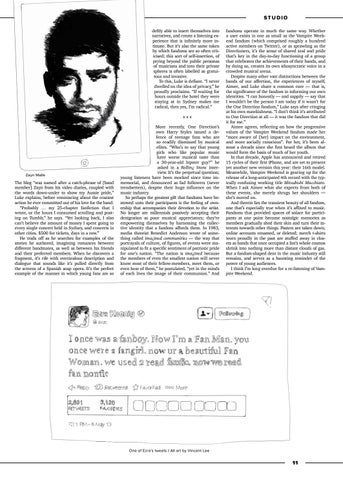
The blog “was named after a catch-phrase of [band member] Zayn from his video diaries, coupled with the words down-under to show my Aussie pride,” Luke explains, before reminiscing about the craziest action he ever committed out of his love for the band. “Probably … my 25-chapter fanfiction that I wrote, or the hours I consumed scrolling and posting on Tumblr,” he says. “Yet looking back, I also can’t believe the amount of money I spent going to every single concert held in Sydney, and concerts in other cities. $500 for tickets, days in a row.” He trails off as he searches for examples of the stories he authored, imagining romances between different bandmates, as well as between his friends and their preferred members. When he discovers a fragment, it’s rife with overzealous description and dialogue that sounds like it’s pulled directly from the screens of a Spanish soap opera. It’s the perfect example of the manner in which young fans are so
More recently, One Direction’s own Harry Styles issued a defence of teenage fans who are so readily dismissed by musical elites. “Who’s to say that young girls who like popular music have worse musical taste than a 30-year-old hipster guy?” he asked in a Rolling Stone interview. It’s the perpetual question; young listeners have been mocked since time immemorial, and denounced as fad followers (never trendsetters), despite their huge influence on the music industry. So perhaps the greatest gift that fandoms have bestowed unto their participants is the feeling of ownership that accompanies their devotion to the artist. No longer are millennials passively accepting their denigration as poor musical appreciators; they’re empowering themselves by harnessing the collective identity that a fandom affords them. In 1983, media theorist Benedict Anderson wrote of something called imagined communities — the way that portrayals of culture, of figures, of events were manipulated to fit a specific sentiment of patriotic pride for one’s nation. “The nation is imagined because the members of even the smallest nation will never know most of their fellow-members, meet them, or even hear of them,” he postulated, “yet in the minds of each lives the image of their communion.” And
fandoms operate in much the same way. Whether a user exists in one as small as the Vampire Weekend fandom (which comprised roughly a hundred active members on Twitter), or as sprawling as the Directioners, it’s the sense of shared zeal and pride that’s key in the day-to-day functioning of a group that celebrates the achievements of their bands, and by doing so, creates its own idiosyncratic voice in a crowded musical arena. Despite many other vast distinctions between the bands of our affection, the experiences of myself, Aimee, and Luke share a common core — that is, the significance of the fandom in informing our own identities. “I can honestly — and sappily — say that I wouldn’t be the person I am today if it wasn’t for the One Direction fandom,” Luke says after cringing at his own mawkishness. “I don’t think it’s attributed to One Direction at all — it was the fandom that did it for me.” Aimee agrees, reflecting on how the progressive values of the Vampire Weekend fandom made her “more aware of [her] impact on the environment, and more socially conscious”. For her, it’s been almost a decade since she first heard the album that would form the basis of much of her youth. In that decade, Apple has announced and retired 15 cycles of their first iPhone, and are set to present yet another new version this year: their 16th model. Meanwhile, Vampire Weekend is gearing up for the release of a long-anticipated 4th record with the typically confusing working title Mitsubishi Macchiato. When I ask Aimee what she expects from both of these events, she merely shrugs her shoulders — she’s moved on. And therein lies the transient beauty of all fandom, one that’s especially true when it’s affixed to music. Fandoms that provided spaces of solace for participants at one point become nostalgic memories as members gradually shed their skin and turn their interests towards other things. Posters are taken down; online accounts renamed, or deleted; merch t-shirts worn proudly in the past are stuffed away in closets as bands that once occupied a fan’s whole cosmos shrink into nothing more than distant clouds of gas. But a fandom-shaped dent in the music industry still remains, and serves as a haunting reminder of the power of young audiences. I think I’m long overdue for a re-listening of Vampire Weekend.
One of Ezra’s tweets / All art by Vincent Lee
11
GALLERY
Driving Jimmy Barnes MATT SITAS / These are photos that I took while working as a driver for Jimmy Barnes’ Red Hot Summer Tour. My job was to drive his van full of equipment around the state of Victoria for a week and drop it off in Tasmania after getting the ferry across.
On January 26th
12
Barnesie’s van
A crowd at Mornington
Another view of Mornington
From the van, in Melbourne
On the Spirit of Tasmania
LONGER READ
PROGRESS ON
We acknowledge and pay respect to the Gadigal of the Eora Nation upon whose lands the University of Sydney is built. We also acknowledge the Traditional Owners of the lands and waters of the Tiwi Islands, the Ngemba people of Brewarrina, the Ngaanyatjarra people of the Ngaanyatjarra lands in Warburton, the Mirarr people of Kakadu National Park, and the Murrawarri people from Weilmoringle. As we share our own knowledge and learning practices within this University may we also pay respect to the knowledge embedded forever within the Aboriginal Custodianship of Country. Aboriginal and Torres Strait Islander sovereignty has never been ceded to a foreign government and the fight for self-determination is ongoing.
PAUSE
NATASSIA CHRYSANTHOS and ROSE HARTLEY / Words POLA COHEN / Testimony ROSE HARTLEY / Photos
The uncertain future of the University’s Service Learning in Indigenous Communities initiative
Participating in SLIC is the most useful and important thing I’ve done in my life. I know that sounds dramatic, but it’s been a recurring thought since I set foot on Country.
The University’s Service Learning in Indigenous Communities (SLIC) program is pitched as being unlike any other unit of study on offer. Before going on Country, students are told to prepare for an experience that will transform hearts and minds; that they will meet people who will challenge their worldview, test their understanding of culture and confront their perception of history. Dozens of students have journeyed to remote Aboriginal communities over the past year — whether by three-day drive over arid red earth or by boat to the tropics that span Australia’s top end — and found this to be true. But since students arrived on Country at the beginning of this semester, the two Indigenous staff members who created the program have been dismissed from their roles by the University. The Service
Learning in Indigenous Communities program is now steered by a non-Indigenous member of staff, and essential elements have been recently dismantled without consulting students or communities.
The thing that makes this program so special is that it works for and with Aboriginal communities.
SLIC stands out against a historical background of paternalistic and unethical intrusions by academia into the life and culture of Aboriginal and Torres Strait Islander communities. Aboriginal and Torres Strait Islander Australians were locked out of tertiary education until just a few decades ago — Charles Perkins was the University of Sydney’s first Aboriginal graduate in 1966 — but they had long been the research subjects of so-called ‘parachute academics’; always data points in articles of academic journals, but never in control of how they were represented. Invasive methodologies and culturally incompetent processes were custom, as were racial biases that pathologised communities.
In 1983, an article by Aboriginal academic Rosalind Langford, titled ‘Our heritage — your playground’, took aim at this practice. “We are angry,” Langford wrote. “The Issue is control. You seek to say that as scientists you have a right to obtain and study information of our culture ... From our point of view we say you have come as invaders, you have tried to destroy our culture, you have built your fortunes upon the lands and bodies of our people and now, having said sorry, want a share in picking out the bones of what you regard as a dead past. “We say that it is our past, our culture and heritage, and forms part of our present life. As such it is ours to control and it is ours to share on our terms.” This experience has been consistent for Indigenous people worldwide. Linda Tuhiwai Smith, a Māori academic, writes: “The term ‘research’ is inextricably linked to European imperialism and colonialism. The word itself, ‘research’, is probably one of the dirtiest words in the indigenous world’s vocabulary. When mentioned in many indigenous contexts, it stirs up silence, it conjures up bad memories, it raises a smile that is knowing and distrustful.” Australia’s first conference to establish guidelines for ethical research in Aboriginal and Torres Strait Islander communities wasn’t held until 1986.
13
LONGER READ In Alice Springs, a group of leaders and researchers from the health sector gathered to advocate for community control and involvement in research and its findings, culturally appropriate methods, and practical benefits for communities. Shane Houston, a Gangulu man from Central Queensland, was present in that meeting. In 1987, Houston wrote a set of ethical guidelines for health research in remote communities. Just under thirty years later, he was appointed by a panel of 18 Aboriginal and Torres Strait Islander staff members and 15 senior academics to be Australia’s first Deputy Vice Chancellor for Indigenous Strategy and Services at the University of Sydney. The creation of the role was driven by a 2009 review that recommended the University do more to embed Aboriginal and Torres Strait Islander issues in its educational practice. It came off the back of decades of distrust and disillusionment.
People in Aboriginal communities know what they need. They just need people to listen to them, and to act based on what the communities say.
The SLIC program was created to forge new relationships between a tertiary institution and Aboriginal communities in Australia. An innovation of Houston and Shane Perdue, a Native American man from the Cherokee people, the SLIC program was built by entering into equal partnerships with remote communities around Australia. “Partnerships have always been the thing that have driven success,” Houston has said in the University’s own promotional material. “Discipline-based efforts have always been able to marry the goals of higher education and the desire of Aboriginal and Torres Strait Islander communities, to change the circumstances of our peoples.” The program established learning hubs in Aboriginal communities around Australia. Groups of students drawn from a range of faculties visit each semester, and under the guidance of an Aboriginal partner organisation, work on a cumulative longterm project in exchange for university credit before passing the project onto the next group to continue. Crucially, the program takes research out of the equation entirely. Communities have signed five year memorandums of understanding with the University on their own terms, dictating their priorities, the ethical considerations and values they wanted participants to adhere to, and setting parameters for projects. The range of projects established is broad, but each is tailored to meet the specific needs communities have identified. In one community, a group of students is working with the council to creatively devise ways of incorporating culture into structures of local governance. In another, they are designing an extension of an art gallery. In the Northern Territory, students are working with local organisations on projects dedicated to environmental sustainability. The program’s philosophy is forward-thinking,
14
seeking to instil its graduates with cultural competence and an acute awareness of issues facing Aboriginal communities in Australia. “We know that if we expose university students to a culturally diverse experience while they’re here, they actually take that lesson with them into their efforts to improve our society after,” Houston has said. “That’s the thing that drives us. We’re equipping leaders for the future that will produce a society that is better than the one we’ve had.” But equally as important as the educational capacity of the program is its emphasis on the needs of community. The projects are deliberately small in scale — remote communities have been sceptical of the ability of external efforts to generate real outcomes, and their small populations mean they could easily be overwhelmed by too many students. This is an opportunity for academia to serve Aboriginal communities, rather than the other way around; a historical change in dynamic. Other universities have seen this as a reformative approach to Indigenous affairs — Harvard and Toronto, for example, have reportedly been looking into building analogous programs. “Sometimes you pause, and think there’s [so] few of us here working on these big issues,” Justin O’Brien, chief executive of the Gundjeihmi Aboriginal Corporation, told ABC Radio. “We’ve got 6070,000 students sitting at the University of Sydney — many bright young minds that could be brought to bear on these challenges. We’re beginning a great journey, hopefully.”
On our third day, two Elders took us out bush with their granddaughters. The kids taught us to hunt for mangrove worms and long bums (a kind of shellfish), clambering over mangrove roots with ease and confidence. Later, back on the beach, the women painted our faces and sang for the kids while they showed us their dances. Another family who were camping nearby came over to join us. Even their baby sister, who can’t have been more than two, already knew her dance. Culture is so important.
Students’ immersion in community while on Country — visiting cultural sites, learning the importance of language, sharing stories, engaging with the operation of cultural authority — is instrumental in cultivating intercultural understanding. Building empathy with communities, and sharing the frustration felt when progress is stifled, provides students with a rare opportunity to gauge a mere glimpse of the marginalisation experienced by Aboriginal communities in Australia. Understanding culture is essential to the success of the projects, too. Any initiative seeking to have longevity and utility in Aboriginal communities requires an embedded awareness of a community’s cultural values and traditions, and spending time on Country allows students to grasp what this means. Considering the program’s historical dimension, the invitation to visit Country in the first place is a humbling experience.
“[SLIC] deepened my understanding of culture as a concept,” says Lilli, who worked on a project earlier this year. “It is so much more than the food you eat, clothes you wear, music you listen to, or even the language you speak. It is the lens through which you view the world. Speaking to Elders allowed me to see how many of the things that I take for granted as universal truths are in fact cultural constructions. “I think understanding culture in this way has value, firstly, because it increases your capacity to relate to all of our fellow humans,” she says, “but also because it teaches you to turn your own assumptions on their head and imagine alternative worlds that are kinder and fairer than this one.” “It’s everything university education should be,” says Erin, a current SLIC participant. “You’re working within communities, getting out of the classroom and talking to people, and coming up with real-world solutions that will make a difference. “During the time my group spent on Country, we saw how important it was to build relationships based on trust, respect and continuity.” A key element enshrined in the program that builds this trust and continuity is students’ return to Country at the end of semester. The SLIC model recommended that students visit communities twice: the first trip at the beginning of semester is a consultative one, introducing students to the project they’ll work on during semester in Sydney, while the second visit at the end of coursework sees them present their reports to the community. Recent changes to the program, made without explanation, include cancelling most groups’ return trips. “The return trip was hugely important in ensuring that the work we had done during semester was in line with what the community wanted,” says Naomi, who worked on a project in semester one. “The feedback we received allowed us to refine and focus our work. This meant that we could provide a detailed document to the next group of students that outlined the next steps as prioritised by the community, allowing a hand-over that was as smooth as possible for the next group of students to hit the ground running. This is vital for the sustainability of these projects.” For other groups, such as those implementing technological solutions, there are logistical imperatives in returning to Country. The visits allow groups to receive feedback on proposed models, enabling them to make changes in light of subsequent developments and deliver an optimal solution. But for all, the return visit is a critical element that cements the reciprocal nature of relationships based on trust and continuity, and honours the University’s commitment to genuinely engage with communities and their needs. “On a human-to-human level, it felt like coming home for Christmas,” says Lilli. “There was a whole group of people who were happy to see you welcoming you back. “For the community it is even more important. There are far too many programs which go out to communities, make wild promises, and disappear never to be seen again. There are far too many white-dominated institutions for whom these communities are simply a photo opportunity. Coming back shows the communities that SLIC is different.
LONGER READ “Many that we spoke to in the community felt that this was the first time that they had been listened to, and respected enough to decide for themselves what their communities need.” As a point of contrast to the top-down approach that often characterises federal and state-level decision-making, SLIC is geared towards a grassroots approach. While it embeds symbolic change in its philosophy, its practices consist of extensive consultations with local stakeholders and conversations with the community. As it evolves, the program’s capacity to communicate progress with policy-makers provides a potential avenue to translate local aspirations to a macro level and redress historical wrongs. “A large part of [our] project has been dealing with the consequences of the government building a uranium mine on land without [the community’s] consent,” says Hugo, who is in this semester’s SLIC cohort. “These are all long term projects, established on the community’s terms, and designed to be genuinely collaborative spaces of shared learning. They are working to consciously overturn the history of exploitation and unequal exchange that exists between universities, other institutions, and Aboriginal communities.” Naomi agrees. “If done in the right way, SLIC has huge potential for achieving its aim of ‘mutual benefit’ for communities and students,” she says. “Because the projects are designed by the communities, the work that students do directly addresses issues that are important to the communities. “Students learn to think in new ways as well as respect and seriously engage with the worldview of others. This is the sort of learning that is truly valuable and I will take it with me for the rest of my life.”
These communities have experienced over a century of colonisation, had children stolen from them, their traditional practices disrespected, and lived under the Northern Territory Intervention. Yet, despite all this, everyone we met was willing to engage with us and share their culture and their stories with us. They put their trust in SLIC and in the University.
In August this year, Shane Perdue was replaced as Director of Strategic Management (Indigenous Strategy and Services) by a selection panel that did not include anyone from the Indigenous portfolio. His replacement, Kylie Gwynne, is not Indigenous. Shortly after, on August 24, Shane Houston was dismissed from his role as Deputy Vice Chancellor for Indigenous Strategy and Services. Aside from an email sent to staff on a Thursday afternoon highlighting his achievements, no explanations were given as to why Houston was asked to leave the University so abruptly. Staff and students were shocked by his sudden departure, but the University offered them no explanation. The Aboriginal communities that Houston and Perdue had spent years building partnerships with were similarly not informed. On September 14, a page advertising the SLIC program was taken down from the University’s web-
site, before there had been any communication to students that the program had changed leadership. On October 6, students received an email from Gwynne saying groups would not be returning to Country to present their projects. The email said the department was working collaboratively with stakeholders that included “staff associated with student placements and students, as well as the Aboriginal communities involved, to review and enhance the SLIC Program”, and that, as a result, “the return visit to the community […] will no longer be possible.” But if staff, student or community feedback was sought in the decision-making process, there is no trace of it. Students are unaware of the reasons for disrupting the program mid-semester, some staff members associated with the program have taken leave while others are no longer able to speak to students, and it is unclear if communities have been informed of the extent of the changes. The most information students have received to date comes from a statement that appeared in a Sydney Morning Herald article three days later, on October 9, saying that the University had “recently become aware of issues with the Service Learning in Indigenous Communities program, including safety and compliance concerns, which has resulted in some aspects of the program being put on hold while they are resolved”. When asked what those safety and compliance concerns were, the University declined to comment, and students are still none the wiser.
People are trusting the University to work for the community. If those relationships are broken, USyd will become yet another institution which has passed through without making a positive difference.
Marion Scrymgour, CEO of the Tiwi Islands Regional Council and the highest-ranked Aboriginal woman to have served in government in Australia’s history, has told Fairfax Media she is concerned the SLIC program is being “watered down”. As Alexandra, an exchange student from Dublin, remembers, “returning to Country was half the point of our project. Without a return visit to gain feedback on this model and change it in light of subsequent developments, the project is completely undermined and becomes increasingly irrelevant in terms of its implementation.” Arguably more important is the trust that has been potentially compromised as a result of hasty and haphazard changes. The memorandum of understanding signed between the University and one of the communities recommends that the University: “Make commitments with utmost caution and utter certainty. Communities have bitter experience of expectations raised and then dashed as well-intentioned service providers have made promises then been unable to deliver. Few things are as corrosive to trust.” But the abrupt cancellation of return trips this semester seems to have neglected the fact that students left communities in August this year with
promises they’d be back again come November. Little heed has been paid to how the severance of such guarantees might affect communities already sceptical of engaging with tertiary institutions. The same memorandum recommends that: “Engagement processes should lead to the development of positive long-term relationships. Ensure as far as possible continuity of personnel and consistency of structures. This is essential to building trust within the relationship between University of Sydney staff and students and [...] communities. Where change in personnel is unavoidable, make careful provision for handover.” And yet continuity of both staff and structure has been disrupted in a single sweep. The university has failed to liaise with Aboriginal communities during this process. “We were concerned that Shane [Houston] was stood down with no discussion or communication,” Scrymgour told Fairfax. “I know it has caused a lot of concern. We’ve worked together quite extensively over many years.” Rather than reflecting the values the University has committed to on paper, recent weeks have been characterised by uncertainty and a lack of transparency. “I feel like these two things in particular are completely antithetical to the whole ethos of SLIC,” says Hugo. “The relationships that the University has formed with each of the communities have been founded on trust that has been built up over several years through the work of Shane Houston and others. “The way the University has behaved over this semester has completely undermined that trust. By sacking Shane out of the blue, the University has effectively severed that relationship that he has built up with the communities, and by continuing to keep communities and students uninformed they have worked to undermine this relationship further.” For many communities, changing the program without consultation is reminiscent of an all-too-familiar pattern of top-down decision-making and disrespect. “All the commitments the university gave as an exchange for us to open up our organisation is now turning into a one-way street,” Scrymgour said. “We are not happy.”
The University’s role has to be listening to these communities and ensuring that the wealth of knowledge which already exists there is communicated to the people with the ability to enact change. If my group can’t go back at the end of semester and discuss our report and recommendations, we aren’t fulfilling our role in the dialogue between the people and the council. If the staff members who have a connection to the community are removed, so is the trust which is integral to the program. And if our project is discontinued after this semester, we are yet another institution who has exploited Aboriginal communities for good publicity, and then abandoned them.
THE AUTHORS HAVE BEEN PARTICIPANTS IN SLIC. DUE TO CULTURAL CONSIDERATIONS, PROJECTS HAVE BEEN DE-IDENTIFIED FROM THEIR RESPECTIVE COMMUNITIES.
15
PODIUM
Face-off: Are degree-mandated internships ethical? GEORGIA TAN / For The debate surrounding unpaid internships used to begin with universities and employers questioning whether students should work for free. Now, students are often required to undertake an internship as part of their degree, earning academic credit for unpaid labour. The real issue is this: does the academic credit and the experience gained in these degree-mandated internships compensate students for their free work considering that they are, all the while, paying higher-education tuition fees? With 29.1 per cent of undergraduates failing to secure full time employment four months after completing their degree, perhaps degree-mandated internships could be the boost students need to land their desired graduate position. Degree-mandated internships provide students with guaranteed practical experience, which allows students to apply their academic knowledge to real world work. Why wait until graduation to learn vo-
cational skills and develop transferable soft skills needed in a students’ chosen career path when university can provide the space to do so? Practical experience often makes students more marketable to future employers. According to a report by the Department of Employment, 25 per cent of interns obtained paid work with their host organisation after their internship. Firms will benefit from the opportunity to train interns, assess their skills and work ethic, and source prospective talent. If degree-mandated internships can increase the employability of its graduates, universities will also gain from this endeavour.
Not only will such internships help students gain real world experience and potentially secure a graduate position, the networking opportunities and chance to discover whether their chosen career field is right can also be invaluable. These placements can help students better identify what particular areas within the profession they want to apply for jobs in, and potentially redefine choices for future career specialisation. Under the utilitarian principle, we should adopt the action that brings the most good. Degree-mandated internships, though unpaid, are a win-win situation. All parties — the interns, the host organisations, and the university — can benefit. If it can lead to students gaining industry experience and contacts, enhancing career opportunities, and potentially securing a future graduate position, then what reason is there to say that degree-mandated internships are unethical?
GRACE FRANKI / Against For many students entering into competitive fields like journalism and teaching, unpaid internships are an inevitability, with many students required to pay for mandatory placement unites as required by their degree. University students who have to balance work, life and study are placed in an incredibly difficult position; they are required to undertake significant amounts of unpaid work in order to graduate, but left unable to generate significant income to support themselves in the meantime. All the while, they compete for places against students with wealthier, well-connected relatives. An argument peddled by proponents of mandatory internships is that these placements increase the likelihood of securing a job after graduation. However, in submissions to the Productivity Commission Review of the Workplace Relations Framework by Interns Australia in 2015, four in five sur-
Art: Stephanie Barahona
vey respondents reported their unpaid internship did not lead to a paid position with that employer. Even beyond attempting to secure a job with the same employer, the requirement that all students complete an internship means this is something of a zero-sum game on a CV. Many of these students are undertaking internships towards the end of their degree, when their qualifications are roughly similar to that of a graduate. But the fact that employers have access to a continuous stream of interns means that they are more
likely to hire new unpaid students every semester rather than take on graduates as waged employees. Obviously internships do come with the opportunity to learn about an industry in a practical way. But this benefit isn’t unique to the current system. It would also be possible where internships were shorter and paid, or better yet, where degrees were restructured to focus on the vocational rather than theoretical aspects of an industry. When all students are required to undertake an internship, there is less of an expectation that coursework should be dedicated towards development practical skills. Remove the exploitative tradition of degree-mandated internships and perhaps there would be more pressure on lecturers and the university to keep course content relevant to a changing workforce.
On the benefits of ethnic ghettoes ALAN ZHENG / The migrant dream should not be the subject of shame In the mosaic of modern multicultural Australia, it is unsurprising that Pauline Hanson’s trademark postfact xenophobia and fearful cultural insensitivity towards migrant communities render her an outlier from politics and reality itself. In her oft-reproduced 1996 maiden Parliamentary speech, Hanson, describing the impending continental Asian invasion, remarked that migrant communities “form ghettoes”. A deeply contentious term, the ‘ethnic ghetto’ exists in the right wing imagination as a suburb or geographic area featuring a high-density population of minority ethnic or migrant diasporas. Accompanying this are connotations of danger rather than security, slumhood rather than suburbia, poverty rather than privilege. In 2016, Hanson declared the south-eastern Sydney suburb of Hurstville the textbook case. On the surface, Hurstville undoubtedly fits the bill — the 2011 census indicated that 26 per cent of its residents were born in Asia. Interestingly, the same census found that a total of 5.3 million overseas-born migrants lived in Australia, amounting to a comparable 26 per cent of the population. Ironically, if Hanson’s position that Hurstville is a ‘ghetto’ is accepted, by the same statistical proportionality, wider Australia must resemble one large ethnic ‘ghetto.’ It does, after all, have a higher proportion of overseas-born residents than the United States (14 per cent), Canada (22 per cent) and the United Kingdom (13 per cent). While it’s true that the top two countries of origin for immigrants are still New Zealand and the United Kingdom, at least by the numbers, Hurstville’s pro-
16
portion of overseas-born residents is unremarkable. This paradox indicates that the ‘ghetto’ is emblematic of White Australia’s moral panic rather than anything else. Yet aside from all the reactionary bluster, these ‘ghettoes’ provide a safe asylum for the people who live within them. Buried deep in the peripheries of the urban fringe and away from the CBD’s sprawling maze of plate-glass skyscrapers, multicultural spaces like Vietnamese Cabramatta and pan-Islamic Lakemba offer a more intimate and self-legitimising cultural space which purposefully functions separately from mainstream racial narratives, accelerating the accumulation of social and commercial capital, intergenerational friendship networks and professional contacts over a single lifetime. In these places, ethnic ghettoes provide economic networks to new migrant groups, whilst reducing the risk of rejection and discrimination. The local labour market produces an effective launching pad to higher earnings, ultimately enabling migrants to graduate from the ghetto’s informal sub-economy and into the fray of the wider domestic market, according to key findings by the Institute for the Study of Labor (IZA). It can be all too easy in a neoliberal society to myopically judge the economic productivity of places like Cabramatta against the CBD as the prevailing measure of success; this sort of hierarchisation inevitably occurs along racial divides and ignores the class and power differentials otherwise used to define and label ghettoes. These close-knit communities built around shared cultural affinity afford migrants the long-term in-
terpersonal stability necessary for entry-level small businesses to grow and build trust through the sacred handshake of a contract. This is particularly important when research by SBS showed that up to one third of small businesses in Australia are currently operated by entrepreneurial migrants. Speaking their mother tongues freely, migrants in ghettos are able to galvanise their self-sufficiency by trading ethnically unique products and services. The ghetto sub-economy is even further bolstered by informal credit unions like the hui in the historic New York Chinatown, multiplying circulation of money and consumption. But even this fundamentally neglects the ghetto’s cultural purpose. These communities must be judged on their own terms, beyond mere facilitation of an economic subsystem. Ghettoes are reaffirmations of the migrant identity, a low-cost acclimatisation to a new life, a first step towards autonomy and an antidote to the existential fear of the migrant parent that they have utterly abandoned their home, subjecting their children to a foreign world where they will gradually, inevitably lose sight of their history. The larger migrant narrative and the ghetto is not perfectly utopic; most times, it remains a messy site of conflict, pitting the powerful forces of the cultural past against the present and the vision for a multicultural future. But I remain optimistic that these ghettoes are never ghettoes to the people who reside in them. For us, these places are home.
GA A LL LL EE R RY Y G
Daemon ANGELINA KOSEV and ANA SUBOTIC / Fiction and art This is a true story. It happened to a friend of a friend of mine. Ana was not so happy when Ema got a boyfriend. Firstly, the whole thing seemed too touch and go for too long. He was here, he wasn’t. He was over for the night and then he would leave in the morning with no clear reason. Ana hardly ever saw him during daytime hours, which means Ema hardly saw him during daytime hours, which means something. Ana was mostly just not happy because the guy seemed like a genuine slimeball. Ana was not so happy when Ema got a boyfriend, but, if you’ve ever seen a movie like Steel Magnolias, then you’d already know that Ana and Ema could quietly acknowledge this and still keep up this functioning and respectful female friendship. The only time it ever got a little bitter was when Ana asked about the boyfriend. Ana had asked Ema what he does for money and Ema told her that he was a computer programmer and she was very curt about it. Ana asked Ema what his name was because they were in a confirmed relationship for a whole month now and Ana still didn’t know. Ema told her it didn’t concern her. After conversations like this they would sit in silence for a little while and eventually pretend it never happened. Ana did not mind so much because she was starting to see less and less of Ema’s boyfriend anyway. It seemed mostly Ema’s interaction with him was conducted over her phone. And if Ema was going to stay the night at his she would always tell Ana in advance. Always. Like I said, they maintained a functioning and respectful female friendship. After a short while, Ana never saw the boyfriend at all. Eventually, the only thing that bothered Ana was how little she ever saw of Ema as well. Ana had just started working as an architect and her working hours were bogus. Ema was still at uni most days and at her boyfriends’ house at night. Of course she would text Ana if she weren’t coming home but it would still sometimes sting. Once, when Ema was in the shower, Ana saw Ema’s phone light up with a message from ‘D’ that said: The Daemon is the
architect of the world. He is a good man to the right of the world. A good man. The only thing that really bothered Ana about this text was not that she was obviously being made fun of, but that she couldn’t deduce what the boyfriends’ name was from ‘D’ and she couldn’t understand why demon was spelt with an a. The only thing that really bothered Ana about this text was the letters. Eventually, the only thing that bothered Ana was how little she ever saw of Ema anymore and how, when she did, Ema was increasingly distant and erratic. She was always looking at her phone. Ana could see Ema’s eyes drift towards it when she was trying to talk to her. One time, Ema grabbed her phone and started laughing out loud like she hadn’t done in weeks. She turned the screen towards Ana to show her a text that wasn’t funny at all. It was from ‘D’ and it said: The Daemon knows that Ana and Ema are alone. The Daemon is the best family. Ana surmised from this that ‘D’ actually stood for ‘Daemon’, but what kind of name is that and what kind of loser constantly refers to himself in third person via text. Does he speak like this as well? Ana couldn’t say because she could not recall actually conversing with this loser. This computer programming, third person referencing loser. So she continued to see less and less of Ema. Ana was starting to feel like she lived alone and she was starting to enjoy it. But one night Ana came home later than usual expecting Ema to be there, and Ema was not. Ana called her name out and there was no reply, just silence from upstairs. Ana thought that maybe Ema was up in her
room with the Daemon, but he hadn’t been by in months. She decided it definitely wouldn’t be excessive to go upstairs and check Ema’s room. She just had to know. But upstairs she found nothing. All Ema’s clothes away. All her shoes where they belong. It’s the shoes that bothered Ana because there didn’t seem to be any missing. Maybe Ema had bought a new pair without showing her but it seemed too uncharacteristic. So Ana called Ema up to make sure she was okay, but of course the call rang out and hit the dead tone. Of course. She tried again and she heard the phone vibrating downstairs – it was still sitting there on the coffee table buzzing when Ana got to it. Ema had never left her phone behind before. Ana would attest that she had never looked through Ema’s phone before but there was that one time – that time that she had seen Daemon making fun of her work as an architect. Ana picked up the phone and looked through it for the second time. There were seventeen unread messages from Daemon, with the last one apparently being read at 6.66pm. I suppose that sounds ridiculous but I’m just telling you what I was told. There were also the two missed calls from Ana. She scrolled up to the messages and they said things like: The Daemon is the one who is in a relationship that has been the one for the most beautiful woman. and The Daemon comes up for the most beautiful woman when the Daemon is the one for her he comes and will take care of the world. The Daemon is the architect for the woman. and The Daemon knows when the right time is the right time is now he knows.
So Ana called the cops, of course, but she apparently could not file a missing persons report until Ema had been missing for over 24 hours. So she locked all the doors and went to her bedroom and locked that door, too. She googled only the name “Daemon” because she didn’t have a surname but nothing came up. She did not know what she was looking for but nothing came up. Just that Daemon is also the name of some computer operating system. All the Wikipedia page said was that it was some system “that runs as a background process, rather than being under the direct control of an interactive user”. Make of that what you will, but Ana made nothing of it. What she was looking for were the social medias of some guy who had girlfriends that mysteriously disappeared. The next day Ana pursued her idea to file a missing persons report but it looked like the parents of Ema’s boyfriend already had. Ema and Dimitri, right, these are the people who needed to be filed, a policewoman asked her. Ana was taken aback. Dimitri. ‘D’ was for Dimitri. So Ana stood there with her mouth slightly ajar for a minute before asking if maybe Ema’s boyfriend’s name was Daemon. The policewoman laughed in her face. It was absolutely not Daemon. And then Ana stood there for another whole minute and asked if she could be excused so that she could go back home and bring Ema’s phone in to the police office. The policewoman told Ana she did not care what Ana did. So Ana almost ran back home and picked up Ema’s phone off of the coffee table again. But all the messages from ‘D’ were gone. Everyone else’s messages were still there. Messages from Ana, there were even some messages from Dimitri (they were exceptionally boring), but none from ‘D’. They had all deleted themselves, I suppose. Make of that what you will. Three months after Ema and Dimitri went missing there was an alert on Ema’s bankcard being used in Nevada, America – which is a very long way away from Sydney, Australia, but the bank didn’t have an explanation for it. It’s just an automated alert, they said, but what’s weird is that the card had already been deactivated. Ema and Dimitri are still missing. So there you have it. It’s a true story; make of it what you will.
17
LOOKOUT
No pain, no gain ERIC GONZALES / Forcing gay men into narrow body ideals benefits no-one My gym indecisively straddles Newtown and Erskineville. Unsurprisingly, the people who congregate here every evening are mostly share-housing students and young professionals. Alone together, they pump iron to pulsating electronica, purifying their gluttonous transgressions or striving for athletic apotheosis. As the colossus besides me drops his barbell with a grunt, I realise the disingenuity of branding the gym-goers around me as ‘they’. I admit to myself that there is only ‘we’, before returning my gaze to the mirror to finish what I started. The surge of dopamine is an innocuous motive for rigorous exercise. In my case, it’s a half-truth. To feel fit isn’t enough. I need to look it, too. The ideal male physique is a portrait of neo-classical perfection: a tapering, towering torso with sumptuously rippled abdominals. Muscularity signifies masculine precepts of resilience, discipline, and control. The 1980s AIDS crisis demonstrates the social utility of this logic. Glowing tautness distanced gay men from the gaunt and pallid AIDS-afflicted body, extricating them from asso-
ciations of homosexuality with death and disease. Yet, eagerly co-opting musclebound machismo as the primary reference point of gay representation, particularly reinforced in 80s and 90s pornography — from homoerotic ‘beefcake’ magazines to COLT Studios’ hard-core films — merely substituted one narrow homosexual archetype for another. Though medicinal developments have significantly subdued the deadliness of AIDS, the Adonis complex lives on. It subtly survives in hawkish, scrutinising glances in gay clubs, and more explicitly in bodily classification: rugged ‘bears’ as distinct from slender ‘twinks’, with ‘otters’ somewhere in between. The muscular ideal is able-bodied. Arguably, he’s also moderately wealthy: the cost of a membership, gym gear, and supplements stack up, making gym-going a financially draining pastime for the most ambitious. Often, however, he’s Caucasian. My attempt to belong is inherently at odds with the emasculation of Asian men in the media who are portrayed as inferior and submissive, both in physique and personality (“Nice ass for an
Asian,” read anonymous messages on the virtual market-places of gay hook-up apps). Alternatively, we’re invisible altogether in mainstream Western pornography and, as a result, the sexual fantasies of other men. No matter how far I run or how much I lift, race can’t be burned off like fat. Ironically, reclaiming my individuality from racial stereotypes demands conformity, each rep sublimating me into another, more acceptable caricature of male queerness — except muscular Asian bodies will always occupy a liminal space in the gay nomenclature of ‘bears’, ‘twinks’ and ‘otters’, unwittingly resisting categorisation. Conformity seems valuable because it gives one the power to navigate incredibly hierarchical gay circles. And so, in a gym at dusk, you’ll find me slaving away in a suffocating room, asking forgiveness from my ‘community’ for my inadequacies. “No pain, no gain,” people say. But gay men have everything to lose from shallow, one-dimensional modes of self-representation: our money, our individuality, and most importantly, our happiness.
Late night talks and chalked sidewalks AIDEN MAGRO / Lessons learnt from doing activism with my mum After an organising meeting for an upcoming marriage equality rally, mum and I got in the car and fastened our seatbelts. I felt something was different. The same mum that had driven me to school was now driving me home after attending a political organising meeting. Back in high school, she had spent countless hours arguing with a less than supportive administration over my right to express myself. Now, she was just stepping outside school grounds and fighting for my rights, and the rights of other LGBTI+ kids, in Australia. My mum had long been my comrade; perhaps now she was for many others as well. Doing activism with your mum has its rewards and challenges. It’s great having someone as close as a parent supporting you in every politically endeavor. The relationship of mother and son is one that can often be dictated by a sort of natural hierarchy that demands respect, wherein there is a tendency to take everything our parent says as gospel. Something my mum has discovered from being involved in so many campaigns is the power of words and how we can use them to elicit change. To some degree, being an activist with my mum has reawakened me to their power as well. My mum discovered the act of chalking as a vehicle to have a very public say on certain issues when we chalked the Russian consulate with rainbow and messages of support to those who had been kidnaped in Chechnya due to their sexuality. The pavement outside our house is now always covered in chalk with messages such as “LGBTI Safe House” or “Equal Rights Now” - all my mum’s handwriting. One day, a young woman rung our doorbell; she looked sheepish. “It’s about your decorations and the pavement”. At first I thought she was going to complain about our disregard for free speech as many had done before, but the woman simply burst into tears and said “thank you”. I was taken aback as this young woman and my mother embraced. Mum’s words had not only made waves in our street but seemingly become a local phenomenon in Marrickville. My mum is indeed everyone’s comrade, however, there is an added benefit I share with her as her son. As we grow up, there is a tendency to take everything our parents say as gospel. But the political conversations between mum and I have created a space wherein all of our discussions are ones of mutual learning, where opinions are not right or
18
wrong but, rather, different; there is, now, a sense of level ground in our relationship as mother and son. I suppose in this instance, the challenges of a political relationship with my mum are indeed the rewards. Our bond has always been strong, but the disagreements we have had due to intergenerational misunderstandings have only reinforced these bonds rather than break them. Because we care about each other, we are more likely to work through political disagreements like we would an interpersonal dispute. What I was then left with, as we passed the couple pushing a pram down King Street, was the fact the political relationship my mum and I had formed was in no way similar to the relationships I had formed with people my age in student activism. While these relationships are still highly important to me, it is the personal nature of the relationship between my mum and I that has fostered a safe and respectful environment to share ideas and for that I could not be more grateful. Upon accessing the machinations of my political relationship with my mum, I was drawn to consider the political relationships I had made with people who were not my mum or were created before forming a sense of friendship. They lacked the ability to push through political disa-
greements. There is such a tendency in the left to completely abandon ship with on those people who hold a with a slightly different perspective, rather than work through these disagreements to reach a sense of unity and collectivity that is important for any movement. Is this perhaps because these relationships were founded purely on a political basis and lacked a sense of personal connection? Maybe. But while the relationship between my mum and I can’t be replicated in the relationships I have with others my age, there are things I can learn from the relationship between my mum and I that could be useful for these political relationships: a sense of empathy, and the idea of organising not for one own’s betterment but for the betterment of all. Art: Robin Eames
LOOKOUT
Lost in translation VERONICA MAO / A personal history of workplace exploitation as an international student It was a normal Saturday, and the cafe I was working in was buzzing as usual. As I piled up used plates, saucers, mugs and cutlery into one holdable stack, behind me, the shouts of my name penetrated the stirring air above the cafe like bullets. I scooted back to the woman I was serving, but instead of a quick “Thank you, darling”, she looked up at me and said, “This is too busy for you. Your boss should have hired like ten more people you know?” I had been caught off-guard, but managed to smile politely and whispered, “I know right? That’s called exploitation.” She gazed at me sympathetically. I quickly ended the conversation and went back to work. I didn’t want to admit that I was paid only $15 per hour for this strenuous job, because I could imagine this kind woman’s jaw dropping if she learned this, and the questions that would follow: Why are you still here then? Why don’t you report it? Yes, I well understood that I was exploited, but I kept working under these conditions — like most international students — because it’s virtually impossible for us to find a job that pays properly. Thinking of this makes me feel vulnerable. It also reminds me that I play a role by colluding with this corrupt system. I had never worked for money before I came to Australia. I started my first job as a waitress at a yum-cha restaurant in August 2016, one month after I arrived in Sydney. I wasn’t treated well by the boss, and learned quickly that it was an environment where I was seen not as a person but as a means to an end — and a cheap an insignificant one at that. I was paid $11 per hour, cash in hand and off the book, when the national minimum wage for an adult casual employee was $22.10 per hour. The boss of the restaurant was a harsh woman who was very proud of her business. She firmly believed that we were privileged to work in her restaurant for $11 to $14 per hour. She once said to the manager, “If they want to quit the job, let them. See if they could find another one that pays higher. I can easily find someone else to work anyway.” She was right. Over half a million international students are currently studying in Australia. With many of us looking for a part-time job to make ends meet or ease the burden on our parents, it’s a buyer’s market for employers when it comes to hiring. For most of us, the choice is between earning $10 per hour and nothing. Through the lens of capitalism, we are the ideal employees: young, energetic, uncertain about our rights,
and constantly feeling inferior due to language and cultural barriers. Because of these attributes, dodgy employers don’t worry about being reported, because they know that someone who is willing to take up an underpaid job doesn’t have better choices, and is unlikely to report them and risk losing their job. I stopped taking the job and myself too seriously. I started to consider the mistreatment and everything else I failed to understand as life lessons that I should embrace as part of my life overseas. Maybe this was what I needed, as someone who’d never set foot in the ‘real world’ before. Maybe there was nothing wrong with seeing myself as a means to an end — t was just a part-time job after all. I wouldn’t be waiting tables forever, so why not? These thoughts helped me rationalise the exploitation. I eventually quit the job after four months, not because I was underpaid, but because I was sick of my employer’s arrogance and disrespect. By then, I thought I already understood exploitation, but I didn’t know it could sometimes be cunningly disguised. In November 2016, I joined a communications agency as an intern. It was a small company run by two women, the owner and the manager, both friendly, intelligent and funny. The company targeted the Chinese consumer market while neither of them spoke Chinese. There were a few other interns there, all Chinese international students, and our job was to produce content for a Chinese social media platform. My supervisors were affable. They cared about my life, made me laugh, took me to lunch, and respected my opinions at work. I liked the job and my relationship with them, and the fact that I could get an internship and work in an office building in the city. It was a pleasant change for me to be treated well in a Sydney workplace, although it was an internship and I didn’t make a cent out of it. I spent a month in China for Spring Festival and was back at work in February 2017. My colleagues told me they had asked the boss to pay us when I was away. I learned that in Australia, unpaid internships are unlawful if the interns are doing “productive” work — i.e. assisting with the normal operation of the business. We should have been paid all along. My supervisors ignored the request and were particularly busy with business during those few days. I trusted my supervisors so much that I doubted my colleagues at first. But it didn’t take long for me to see the
Reading ruined me RHEA CAI / Bradbury, Barlow, and bad books Growing up, fiction was always seen as something second-rate, leisurely, indulgent. There was nothing qualitatively useful about a Choose Your Own Adventure addiction or an embarrassingly drawn-out crush on Gilbert Blythe, and my parents knew it. “Too many books,” my mother would lament, terrified that her only daughter would be perpetually inept at long division. “Maybe you would be better at maths if you stopped reading so much.” When she talked about books, however, an unspoken distinction persisted between books that were ‘bad’ and books that were ‘good’. ‘Good’ books were almost exclusively non-fiction: hefty encyclopaedias and nature glossaries thrust into my skinny arms for Christmas, a slim but unreadable volume on English grammar for my tenth birthday. It was the ‘bad’ books that kept me up until the early hours of the morning, using the dim light of my digital clock to illuminate each line. An unshakeable addiction to R. L. Stein, which gradually morphed into Stephen King and Ray Bradbury, caused my eyesight to plummet horrendously. My slim attention span in school became even
slimmer. I even began to convince my classmates that our pale-skinned, suspiciously coffee-dependent (what was really in that cup, hmmm?) science teacher was analogous to the likes of Kurt Barlow in Salem’s Lot. When big fat Bs and Cs started to float at the top of my primary school reports, my father put his foot down. “No more,” he vowed, and hid the books I had yet to read inside a cupboard underneath the fish tank. My family’s aversion to fiction is understandable. My grandmother was a biologist and my mother is a chemist. Both sides of my family have produced successful architects and engineers. Nobody dares to speak about my uncle, the failed artist, or my father, who gave up his studies in literature for pharmacy. In their eyes, the analysis of quantifiable, objective data could only heighten a kind of intelligence that applied to the ‘real world’, whilst a fixation on fantasy could not. Yet as I settled into the rat race of selective schooling, I could not shake the pressing urge to read and write outside the strictures of what I was being taught. When it was time to choose a degree, I kept up with theme of failing parental expectations and chose Arts.
fact that their kind gestures were simply an act. In April, they started to pay us. The wage was the precise minimum wage for a part time employee, although we were not told about our sick or annual leave entitlements. The boss would only pay us by sending invoices, with the condition that we all had our own Australian Business Numbers (ABNs), which are typically used by contractors but not ongoing employees. Paying employees as contractors can help employers avoid their tax, superannuation and insurance obligations. She called me after I resigned, asked me why I left, and why I would rather work for a cafe for $15 per hour than for her. She said she was heartbroken, and that it was compulsory to pay international students via ABN. She was so confident of my ignorance about Australian legislation that she lied to my face. They had been using us: using the enthusiasm of young workers yearning to enrich their resumes in Australia; using our lack of familiarity with Australian rules and laws; using the alienation and insecurity of international students who could be easily fooled by their caring faces; using the taboo of talking about money in Chinese culture to keep us as free labourers. They knew we couldn’t afford to sue them. I left, but some stayed, registered for an ABN, started ‘owning a business’ in Australia, and earning $17.70 per hour from it. More Chinese students would come and work as interns and become free labour sources for at least three months. They designed a flawless scheme targeted at us. I felt not only exploited, but betrayed. That’s why I left. I can still recall the last dinner I had with my employers before I resigned. The manager, who used to be an international student, talked about how she loved her uni life. “Even when I worked in a restaurant and earned very little money, I always knew that I wouldn’t be there for long. I have a future.” I looked at her attentively, and she looked so sincere and empathetic. I suddenly realised that she may have had the same kind of struggle as me before, but she had transformed into an advocate and beneficiary of the system that used to treat her unfairly. At the time, I failed to comprehend her words and their irony — they had been lost in translation.
Art: Tilini Rajapaksa
Reading may have ruined the life my parents envisioned for me, but it has forced me to confront the utility of ‘bad’ books. If reading horror novels in my prepubescent years predisposed me to unreasonable flights of fancy, reading the likes of Franz Kafka, David Foster Wallace and George Orwell demonstrated just how effortlessly literature becomes truth. When writers make sense of human experiences that are difficult to explain in other ways, they often engage with concealed or emerging social anxieties. Japanese sex robots? Philip K. Dick, 1968. Atomic bombs? H.G Wells, 1914. Really sensitive vampires? Stephenie Meyer, 2005. Sometimes, the very fiction of these texts seems to seep through and shape our reality. I’m now finishing up my second year of an English major, and uncovering the truth in literature is still an elusive and complex process. I still love ‘bad’ books more than ‘good’ books, but they are no longer so morally loaded. In fact, when I opened my mother’s Kindle last week to see what she was reading, the screen noted she had completed 53 per cent of Catching Fire. Sounds pretty ‘bad’ to me.
19
STADIUM
Comic by Deepa Alam and Jamie Weiss
Cheerleading: more than a Hollywood stereotype LILY LANGMAN / Is cheerleading the body-positive, team sport, we need? As American as a Mid-West mum armed with Costco coupons is ‘the cheerleader’, complete with blonde ponytail, pleated skirt, and perpetual enthusiasm. Forged in the cultural imagery of Kirsten Dunst’s cult performance in Bring It On and Lester Burnham’s wet dreams in American Beauty, the cheerleader is a cartwheeling contradiction: she is patriotically wholesome but vapid, virginal yet seductive. Competitive or ‘All Star’ cheerleading seeks to shatter this archetype, and with 55,000 competitors nationally, 15 per cent of which are male, it looks to be doing a pretty good job. On 14 October, 4,000 cheerleaders competed at Australia’s largest annual Nationals Scholastics competition for primary, high school, and university squads. According to Stephen James, Executive Director of the Australian All Star Cheerleading Federation (AASCF), modern cheerleading creates a welcoming space for young competitors: “girls like that feeling of belonging — of being part of something.” Competitive cheerleading has broken away from its American collegiate beginnings, with 96 per cent of competitors aged between 8 and 16-years-old, squads are no longer the sideline support for football games but an attraction in their own right. Complex choreography flips and stunting have replaced pompoms, and more and more teens are joining the ranks. James estimates a 40 per cent growth in enrolment this year. Basket Tosses (for which Australia holds the world record of 5.5 metres), Scorpions, and Bow and Arrows are just some of the intricate and physically grueling stunts. Bruised knees and torn ligaments are just as much the uniform of the cheerleader as the mini skirt.
20
Speaking above the throb of pop hits and cheers, James’ comments rang true at last week’s Scholastic Nationals. Unlike at dance eisteddfods, cheer squads applaud rivals and rush backstage to meet their favorite “cheerlebrities”. As for Hollywood-style squad romances? No luck. “Your team becomes your family,” Macquarie University Warrier cheerleader Ellie Orme tells me. Similarly, the bitchy in-fighting and peer pressure within teams to lose weight is nothing but an inaccurate cheerleader movie archetype. AASCF Judge and coach, Toni Altschwager affirmed the cheerleading industry’s body positive message: “Every body type is accepted, no one is excluded.” Despite receiving Olympic recognition in 2016, many still harbor ‘Dallas Cowboys’ stereotypes about cheer, which James refutes, saying , “they are not just there to shake their booty, they are athletes”. For most,the red lips, big bows and slightly-artificial-coconut scent of Le Tan is just another facet of cheer culture. But no extra marks are awarded for makeup, it is merely a “personal choice”, assures Altschwager. Strict uniform regulations also apply — “no midriffs for under 8’s” — and teams are penalised for inappropriate dance movements and song lyrics. “We do everything we can to protect the kids,” Altschwager said. As cheer moves away from over-sexualized convention it has also opened its doors to male competitors like USyd cheerleader, Oliver Kelly.“I like the fitness and the development of skills, there’s also a rush when you go on stage,” Kelly said. For Kelly, being a good cheerleader is more than just big smiles.
“Spirit is ... big, but just the willingness to put in the effort, learn the skills and have fun doing them. It’s not easy and it can get stressful.” While cheer injuries rank low when compared to other team sports like football, when they do occur they can be severe. A 2016 US study found that 65 per cent of all catastrophic sports injuries among highschool girls were from cheerleading. The most successful cheer squads put safety before attempting any as-seen-on-tv stunts. Kelly and his USyd ‘cheer-mates’ offer a utopian glimpse into the camaraderie of cheer athleticism without the egotistic trappings often associated with college sport. And when Art: your teammate is Rebekah five metres in the Mazzocato air above you need trust, not poms poms.
RUMPUS ROOM
The Camperdown Public Chatterbox CIVIL WAR LEADER AT USYD? Of the many colourful figures that have graced this campus in the recent past, Samir Geagea, a Lebanese militia leader turned politician, is perhaps one of the more interesting. Geagea, who lead the Lebanese Forces, a Christian militia turned political party during the country’s bloody civil war, was slated to speak at a public event held by the Australian Lebanese Foundation (ALF) at the University last Friday. Geagea’s speech was ultimately cancelled, although he did appear at an invitation-only dinner later that evening. In the initial event description, Geagea was compared with former South African president Nelson Mandela. After the war, Geagea was convicted of several high profile political assassinations, and spent eleven years in solitary confinement. Geagea’s trial and conviction drew condemnation from Amnesty International, who claimed that it was motivated by his refusal to accept continued Syrian military presence in Lebanon. Yet for many, Geagea is no hero. Lebanon’s Civil War was a long and brutal conflict, further complicated
by bitter sectarian divides. Geagea’s Lebanese Forces, like many of their rival factions, were implicated in numerous civilian killings and largescale human rights abuses. Whether this checkered history contributed to the ALF’s decision to cancel Geagea’s speech is unclear. GET READY FOR REPSELECT In the latest installment of RepsElect fuckery, it looks like an incoming SRC councilor who has never attended a Wom*n’s Collective meeting, and is not even a member of the WoCo Facebook group, might be taking over as Wom*n’s Officer for 2018. Honi understands the Vision/ Panda/Liberals unholy alliance have agreed to vote SASS first year officer and incoming Vision councilor Brooke Salzmann as Wom*n’s Officer, against the Collective’s wishes. In their response to Honi’s questions, they avoided confirming this, though several sources report Salzmann’s candidacy as fact. WoCo’s Officer pre-selection is set to take place this Thursday; long-time members Nina Dillon-Britton, Jess Syed, and Caitie McMenamin are rumoured to nominate. While there is no rule requiring
them to do so, most previous SRC councils have respected Wom*n’s Collective’s autonomy and voted in their pre-selected candidates. That process has been marred by controversy. Last year, the WoCo candidates, Imogen Grant and Katie Thorburn, won by only one vote over Unity and moderate Liberal-backed Andrea Zephyr. The deciding vote belonged to centre right Liberal Alex Fitton, himself no fan of reserving positions on the basis of gender identification. Fitton later declared that he identified as a non cis-male for the purposes of meeting affirmative action requirements. This year, however, it looks as if Wom*n’s Collective autonomy, along with that of other collectives such as Disability, Environmental, and Refugee, will be broken. But don’t go lunging for Salzmann’s jugular just yet; she, along with most of the Panda and Vision’s elected councilors, are first-time candidates with little previous stupol experience. A majority of the councilors ‘to blame’ don’t understand the history of AA and the unspoken rules of collective organising. If the left do not attain the numbers to enforce collective autonomy, expect a deeply unpleasant RepsElect (though you probably already were).
YOU CUT US OUT, WE’LL CUTTER YOU OUT While the Liberals have locked the left out of most SRC Collective positions for next year, collectives appear to be barricading themselves against the coalition’s pre-selected candidates. In a post in the Sydney University Education Action Group (EAG) organising page, current co-Education Officer and Socialist Alternative member April Holcombe revealed a screenshot showing Vision/Panda’s Education candidate, Sarah Cutter-Russell, asking to join the closed Facebook group. Holcombe captioned the pic, “First hey deal with the fucking Libs, now they want to join this group. Who even is this person? Besides not welcome.” Co-Education Officer Jenna Schroder echoed the sentiment in the comments section, quipping, “If she thinks she’ll be made an admin of this or the page ...” It appears Schroder is suffering from memory-loss; Schroder and her faction dealt with the Mod Libs so she could be elected as co-Education Officer with Ed McCann at RepsElect 1.0 in 2016. But you know what they say about pots and kettles.
21
RUMPUS ROOM
Jumbo Crossword Across 1. Speed-increaser lays crate out of order (9) 6. Interplanetary void-ship’s steering with alien headgear (5,6) 12. Naval youth rot at sea for discourteous promise? (9,4) 13. Overheard someone who interrogates an ape (7) 14. It might audibly bruise a neck (9) 15. Honi’s compilers’ work is WET in swimsuit top (11) 17. Strains beaten-up fists (5) 18. Sledge lead actor? (4-6) 20. Sick rat (4) 22. Poker ace is uncool: pokerface extremely and ultimately deceptive (4) 24. Who the French guardians clutch head of the dragon’s natural sustinances (10) 26. A quietly concealed bug (5) 28. Deafen Goofy often; wrote Goofy a spelling phrase (3,2,4,3,3,2,4) 30. Peephole for young dog I’ll have the tail cut off (5) 31. Sign-ups for unorthodox Lent sermon (10) 32. Cheesy strange lady? (4) 34. Note: urine produces devastation (4) 35. Frustrate Princess and encourage masquerade (10) 37. A racecourse for a Glaswegian (5) 40. High-flyer’s nuts clutched by your unloved, disheartened idoliser in… (4,7) 41. …rubbishy poem: perform tirade as it stops you stinking (9) 43. Meanwhile bury mime’s heart (7) 45. Flip the bird to wear down Dr Brad’s bits (5,3,5) 46. Upstaged operatic man is freer (11) 47. Fucked!? (9) Down 1. Acquiesced to Bad Seeds head member? (5) 2. Will cricket side read the riot act? (4,3) 3. Most altitudinous nerd games party, nor miscellaneous strike (8) 4. The night is young for redistributive knife? (5,2,3,7) 5. Starts raking hard your mother’s yard! (5) 6. Star Trek opening cryptic e-border (5,3,5,8) 7. Eat mish-mash for free-thinking (7) 8. Something to crack like a gangster? (3) 9. Opening for American post-grad exams in Spanish (6) 10. This crossword? (5-8) 11. Move beyond trend about wobbly cans (9) 16. Novelty bell, Troll doll, TV, shell, pen: us on Christmas going overboard (8,3,6) 17. Took to court over drug material (5) 19. Yarn-spinner on tonight (7) 21. Mostly an old codger’s mistake (5) 23. A loaned phrase! (7,6) 25. Spin the Goon’s happening (2,3,2) 27. No lines for veteran (2,3) 29. Georgia muted part of spectrum (5) 30. Orthodoxy for getting into a club
22
(5,4) 33. The whole taxi load? (8) 36. Gem according to one spot (7) 38. Put on tea — best Eastern (7) 39. Mushroom for Dalziel, a vampire slayer (6) 41. Frisbee round dance (5)
42. Nice, thanks, thanks, cheers (5) 44. English updo (3)
Puzzles by Sqrl and Skribblex
If you have been annoyed at Honi’s uneven dedication to puzzles this year, get involved in USyd’s own CrossSoc. It’s the place for you (also, we’re sorry).
Target
Target Rules: Minimum 4 letters per word. 11 tiny horse // 16 moderate size horse // 21 giant beautiful horse.
SRC REPORTS Note: This page is given over to the office bearers of the Students’ Representative Council. The reports below are not edited by the editors of Honi Soit.
President’s Report ISABELLA BROOK It’s weirdly emotional to be writing my last report as SRC President. Reflecting on the past year I can confidently say that it’s been the most challenging year of my life but also the most rewarding. It’s been an honour to serve as your president and spend every day representing students, working in your interests and fighting the good fight. I want to acknowledge the people who make the SRC the incredible organisation that it is. The Office Bearers who have worked their butt’s off this year organising rallies, events and collective meetings. The 89th Executive, including Dan and Bella who have been with me every step of the way and helped steer this organisation and showed so much dedication in doing so. And most importantly the SRC staff who spend tireless hours day in and out representing and advocating for students, the SRC would be nothing without its staff. Your SRC has one of the longest and proudest histories of student representation and activism, and I’d like to think that this year wasn’t any different. This year, amongst other things, your SRC defended 13 week semesters, fought for a fairer late
ALL BOOKS HALF PRICE
work policy, demanded and end to sexual assault on campus, advocated against the centralisation of student admin, all whilst standing in solidarity with our staff in their fight for fairer pay and working conditions. The student experience is not getting any easier. We have a government that does not care about students or young people, students are facing inordinate living costs and uncertain futures and the barriers that exist in higher education are not lessening. It’s so important, now more than ever, that we have a strong SRC that continues to advocate for students and a fairer society. Whilst I’m ready to move on, finish my degree and tackle the real world I’m proud to be leaving behind an SRC that I know will never stop fighting for students and fighting for what is right. I wish the best of luck to Imogen Grant and the 90th council. You have a big task ahead of you but I know you’re all extremely capable of leading this organisation and achieving amazing things for students. So thank you all once again for giving me this incredible opportunity to represent you. I hope I didn’t let you down.
OR LESS UNTIL THE END OF THE UNI YEAR
Level 4, Wentworth Building, University of Sydney (Next to the International Lounge) p: 02 9660 4756 | w: src.usyd.edu.au/src-books
SUPRA is responsible for the content of this page.
SUPRA
What does women driving in Saudi really mean?
JOCELYN DRACAKIS
ZUSHAN HASHMI | DIRECTOR OF STUDENT PUBLICATIONS AT SUPRA There is no doubt that allowing women to drive in Saudi Arabia is a cause for celebration for the women in the country and across the world. Also, there is no doubt that activists in the country and pressure from foreign voices have played a significant part in making sure that this happens. However, there are several more pressing issues that have resulted in making this dream into a reality. Late last year, Waleed Bin Talal became one of the first royals ever to state that women should be allowed to drive in Saudi Arabia. A few months later this was followed by then the Arabic hashtag "Prince Faisal women driving is coming" to become the trending topic on Twitter in Saudi,. Around the same time, Mohammad Bin Salman (or MBS as he is known), the heir-apparent to the Saudi throne, as appointed by his father, was for more conservative in his approach on the issue. However, he did state that this was a matter of discussion for the Saudi people, and on another note, stressed how important it was to empower women in Saudi Arabia, particularly to carve out a greater future for the nation. As made clear with King Salman’s royal decree though, his son is clearly on board now, and perhaps, is the decision maker in this instance. It is imperative to understand how this benefits him, the future of Saudi Arabia, and of course, the women of the country. Firstly, MBS is seen as a youthful, shrewd and controversial figure. For one, he is considered to be the mastermind behind the Saudi-led intervention in Yemen, which, of course, has received heavy criticism for its destruction of life, land and infrastructure, in a nation that was already stricken with poverty. However, at the same time, as previously mentioned he has pushed for significant social changes in the country, and new measures to open up the nation as a tourist destination with his Vision 2030 plan, albeit often being called reactionary measures. In turn, allowing women to drive significantly improves his image and perception overseas, as it seems to be the case that he will likely be ruling the country for a long time to come after his father passes away.
Image: Retlaw Snellac Photography
overseas across all degree levels. Therefore, women are employed across a range of different sectors, and are also active contributors to the Saudi economy. Therefore, through the ability to easily commute to work and back, they will be able further drive an economy that is, according to some analysts, ailing. Nonetheless, this is a step, a big step, that will not only empower women in the country and provide them with the freedom to travel, commute and access various facilities and products without depending on a driver or a male relative, but this will also support MBS’ ascension to the King of Saudi Arabia, and further legitimise his controversial rise in the kingdom.Either way, it is about time this happened.
Meet your Reps!
Yiasas! I’m Jocelyn, I’m lucky enough to be a councillor with SUPRA. I’m currently studying a Masters in International Public Health, and loving it. I’ve been involved in student advocacy for a few years now, but am particularly keen at USyd to fight for improved sexual assault and harassment policy and response mechanisms, and for better academic and welfare support for those of us battling with mental illness and disability. It’s been so wonderful to to see a dramatic lift in engagement of postgrads with SUPRA over recent months, from all diverse backgrounds, and I’m committed to working throughout my term to help expand the reach of SUPRA’s vital services to more postgrads who need them. Fun fact: I can play the bagpipes, and I love glitter, purple and rainbows.
GAYATRI KOTNALA
SAMAY SABHARWAL
The youngest defence minister in the world has also been championed for this fresh and innovative approach to the conservatism that has dominated policy in the country, and this new move only furthers the legitimacy of his future reign. Secondly, and far more importantly, Saudi Arabia is facing a significant economic crisis due the fall in oil prices. This, in turn, has resulted in a shift towards diversifying its economy and developing other avenues for income streams in the desert nation, such as the ARAMCO IPO and the development of a tourist hotspot. And the underlying basis for most of the abovementioned policy shifts and development is this very economic crisis, which also happens to be the fundamental reason for allowing women to drive in the country. After all, it is through enabling women to drive that the nation will be able to solve a major issue that has led to unemployment for women in the country – mobility and commuting. This of course, is not to say that women are not already working in the country, where over 30% of the private sector is represented by women, and their labour participation rates continue to significantly increase. Additionally, it is also a fact that women in Saudi Arabia are far more educated than men (over 50% of all graduates in the country are women). They also hold more PhDs than men, and it is not an uncommon sight to find Saudi women studying
24
Hi everyone! I am Samay Sabharwal and I’m studying a Master of Commerce in Business Information Systems at the Business School. I’m a die-hard Apple fan and I even have a Steve Jobs quote tattooed on my arm. I like reading about business, the military and I enjoy watching American Football (Tom Brady is G.O.A.T.). I also like graphs, presentations and group assignments (Not being sarcastic, I know it’s weird). I’m not much into partying or any party though; In fact, the only party I like is the Liberal Party! I am also the International Student Officer at SUPRA so feel free to email me at International@supra. usyd.edu.au, if you have any ideas or suggestion for International Students!
Hi! I’m Gayatri, the Co-VP of SUPRA, a part time master of management student, and a full time uni staff. I spend more time at uni than I do at home; I start mornings at the Arena Sports Centre, I’m at the Faculty of Pharmacy during the day, CBD Campus/ ABS in the evenings, the Flodge most Fridays, and the Quarter every weekend, when the panic starts to set in post-mid-sem break. Lifting heavy things and putting them back down at the gym helps me keep calm and focused. Currently I’m working on creating a more cohesive network of student representatives across the University, so that postgraduate and undergraduate students can achieve better outcomes together. I welcome your feedback and ideas: vicepresident@ supra.usyd.edu.au
The SRC is responsible for the content of this page.
CASEWORKERS
Coping With a Break Up Take a moment to look at your music collection and find an album that doesn’t have a song about breakups. You’ll probably be searching for a while. Obviously there’s a reason for this; at some point in our lives, most of us are going to find ourselves on either the giving or receiving end of a break-up. It’s never going to be easy, but let’s look at some ways that we can deal with relationship break-ups.
BREAK-UP DOS • Tell your partner sooner rather than later. • Be direct, honest and stick to the facts, but try to show empathy. • Try to avoid arguments about why you’re breaking up. • Give your partner some room to vent, but don’t escalate. • Talk to your family and friends about what you’re experiencing. • Stay physically active and socially engaged after the break-up. • Try to keep a balanced routine around sleep and diet. • Take your time before launching into a new relationship. It takes time to re-establish your ‘self’ after being part of a couple for a while.
BREAK-UP DON’TS • Don’t break up over social media, even if it does seem easier in the
short term. • Don’t use cliché break-up lines such as “it’s not you, it’s me”. • Don’t use an automated break-up call service. • Don’t try to get ‘payback’ or ‘revenge’. • Don’t contact your ex every time you think about them. • Don’t start contacting all your previous exes. They’re exes for a reason. • Don’t continually update Facebook with your emotional and angry updates against your ex. • Don’t binge drink or eat. Try and maintain a healthy, balanced diet. • Don’t behave spitefully toward your ex if they find a new partner.
COMMON EMOTIONS FOLLOWING A BREAK-UP OK, you now have a whole bunch of hints to help make life easier, but let’s look at the emotions you can realistically expect to go through after a break-up. Denial: Refusing to accept the relationship is over is common. Look out for thoughts like “they just need space for a few days”. Bargaining: Who doesn’t like a bargain? Look out for thoughts like: “I can change, I promise” and “It will never happen again.” Anger: Annoyed? Angry? Of course
you are! Look out for thoughts like: “after all I’ve done for you how dare you dump me!” or “How could I have been so stupid?” Guilt: You may feel guilty if you initiated the break-up or if your actions were the cause of the break-up. Sadness: It’s common to feel sad during a break-up and to feel a sense of despair. Common thoughts may include: “I will never meet anyone again”, “There’s something wrong with me” and “I will never get over this”. Give yourself some time to get through any of these reactions that might arise. There’s really no right or wrong emotional reaction. You just need to make sure you aren’t getting stuck as a result.
WHEN TO SEEK PROFESSIONAL HELP? If you feel you can’t move on and your mood is preventing you from doing many of your normal activities, you may benefit from talking to a professional. Contact the reception desk at CAPS to book an appointment with a psychologist or alternatively consult your GP. sydney.edu.au/students/counsellingand-mental-health-support.html
Reprinted from Capstivate Issue 1, March 2014
IN A PICKLE?
Ask Abe SRC caseworker HELP Q&A TIME ALLOWED ON CENTRELINK Dear Abe, I am in my third year of my health science course and I am on a Youth Allowance payment. Even though I didn’t receive anything previously, they say that the one-year I did at another Uni doing a similar course counts towards the amount of time I’m allowed to study and my payments will run out in the middle of the year. Is this true? And if so, what can I do? Struggling. Dear Struggling, Centrelink uses a set of rules for ‘satisfactory progress’ and allowable time. This means after a certain ‘time’ studying in a degree you cease to be payable – the payment runs out. This ‘allowable time’ is the minimum time it takes to complete your course, plus normally one semester. In some uncommon cases it can be a whole year more. They look at all your past study in the degree and add up that time. If you have been part – time ( under 3/4 load) then they count that ‘pro-rata’ i.e. as a fraction. If you fail units for reasons beyond your control they may not count those.Whether
you have been paid in the past doesn’t effect these rules. This can be a problem but doesn’t seem to be the issue they have raised with you. If you have studied in another course and you are on Youth Allowance (where you are under 22 when you apply) they should start the count fresh again from the start of your new degree. So your allowable time count doesn’t include the past degree, though sometimes you need to enter into an ‘agreement’ to complete on time. It appears what they have said is wrong as the count starts afresh, and so you should appeal the decision. Seek help from an SRC caseworker with that. If you had been on Austudy ( where you are over 22 when you apply for the the payment) its different. For Austudy people Centrelink will look at all (complete or incomplete) study in your current or past courses at the same level. For some of those student the payment does run out earlier. If this happens seek advice of an SRC caseworker to check the count and the rules. Some exceptions apply. Abe
Criminal Charges Motor Vehicle Accidents
Insurance Immigration
Fines Debts ...and more
If You Have a Legal Problem, We Can Help for FREE! 法律諮詢
Level 1, Wentworth Bldg, University of Sydney p: 02 9660 5222 | w: src.usyd.edu.au e: solicitor @ src.usyd.edu.au ACN 146 653 143 | MARN 1276171
法律アドバイス
Liability limited by a scheme approved under Professional Standards Legislation.
We have a solicitor who speaks Cantonese, Mandarin & Japanese This service is provided to you by the Students’ Representative Council, University of Sydney
25
Study finds your socks that you were looking for last week They were literally just under your bed, buried in a pile of clothes and stuff
Touch typers reveal their dirty secret You might think they rely on muscle memory, but they are actually sneakily looking at the keyboard the whole time
Generous Facebook user replies to each and every birthday wall post:
An editorial and apology from The Garter Press team
‘it’s what the people want’
The Garter Press Editorial Team
Stacy Smum Social Media Editor University of Sydney undergraduate student Katrina De Souza, age 19, has awoken from a long slumber after the tiring process of responding to all her birthday wall posts within two days of the occasion. “I put off responding to all the wall posts until the day after my birthday, because I didn’t want people to think I was hanging around my phone waiting for my people to post,” she told The Garter. “Even though that was actually the case.” When asked what the perfect amount of time to wait was between receiving the initial message and responding “Aw thanks hun! Catch up soon <3”, De Souza said, “I think you have to hit the sweet spot between 24 and 48 hours.” “48 hours makes it seem like you were trying too hard to seem aloof and uncaring,” she said. “But responding within 24 hours seems desperate. If you comment back in between those time periods though, it seems like you genuinely care about your friends
and the effort they’ve gone to, but that your day was still really fun and fulfilling, and that you weren’t constantly checking your phone to verify whether the posts were rolling in at a rate of 15 per hour.” She also highlighted the importance of adding variety to the responses. “They can’t all be identical, or it’ll be obvious that you’re just copying and pasting,” she said. “I tend to repeat replies every six responses. I vary between a love heart, smiley face, and angel face, and also between ‘hun’ and ‘babe.’ “If they’re someone I’m quite fond of, I’ll add an ‘xx’ for good measure.” De Souza’s response was different, however, when asked about private messages. “Oh yeah,” she said, when confronted with why her inbox was still full of unread ‘Happy Birthday!’ messages from miscellaneous acquaintances. “I don’t care too much about them, there’s less of a time imperative. I might get around to responding to them next week, if I manage — but that’s what they get for private messaging instead of signalling their love for me in a public space so that I can appear popular and well-liked.”
Guys, we really fucked up. We don’t want you to be alarmed, but we have some pretty shattering news to deliver to you — real, actual news this time. Unfortunately, it seems every single story The Garter Press has published this year has been fake. While we’re still not entirely sure how this happened, we suspect our intern, Gary, has been going in and changing each article after it has been formatted and laid up on the spread. The hard-hitting investigations, the trenchant analysis pieces, the piquant opinion articles, the analyses of social phenomena — all have been completely replaced and fabricated. Not a single one has been real. Not even that one about Fred Nile and Serena Williams. Consequently, our publication has read like one big joke. Indeed, some think it is satire. It’s the laughing stock of the media world. We don’t know why Gary felt the need to do this. Maybe it’s because we don’t pay him. It’s probably because we don’t pay him. The Garter unreservedly apologises to our readers for all the shit Gary did.
Interested in interning at The Garter Press? We’re looking for someone to replace Gary, because he’s a loose cannon. If you’re looking to get your foot in the door of the media industry, send us your CV and a 200-word statement on why you’re better than Gary. Honestly, though, anyone is better than Gary. We really need someone to replace him. Just apply, please? Pictured: De Souza in the 26th hour after her birthday, replying to the 39th wall post
New flying car harnesses hovering power of weird guy at party Nick Harriott Automotive Reporter At a press conference yesterday, world-renowned business magnate Elon Musk unveiled the next instalment in his pantheon of technological wonders: a flying car, powered by the raw, uncomfortable energy of someone hovering alongside your conversation at a party. The Tesla Sky has been in development for many years under the secret codename ‘Project Floater’, but many tech analysts assumed the project had been shelved after leaked memos revealed there was no commercially viable power source for a flying
car in today’s market. That was until Elon Musk stepped out on stage yesterday, revealing a new power source for a new age: the seemingly endless stream of nervous energy emanating from socially inept males. While Musk was understandably hesitant to reveal the inner workings of his new proprietary technology, he did explain the tech in broad strokes. “The science has always existed,” explained Musk. “For as long as there have been birthday parties and housewarmings, there have been awkward losers who can hover for infinite amounts of time, unobstructed, around conversations in which they are not welcome to participate. All
we’ve done is find a way to contain and manipulate that energy.” A panel of scientists who were invited to the conference said the breakthrough was “akin to Copernicus discovering the Earth revolved around the Sun, or Isaac Newton discovering the perfect ratio of bread to cream cheese in a cob loaf.” When asked how soon it would take for the first Tesla Sky to reach Australia’s shores, Musk was optimistic. “Let’s just say by next Christmas, this is the only thing you and your friends will be talking about… while a less good friend lingers awkwardly nearby.”
Mothers, lock up your daughter! She’s committed an act of cyberterrorism and is wanted in 23 countries
World News P9» In the world’s new energy economy, power sources like Terry Longfield (above) have become valuable strategic resources.
The real food fault lines When a lesser publication recently attempted to use fast food as a socio-geographic tool to explain class differences between Sydney regions, we decided to take this further and name three more Sydney fast food fault lines.
The Sydney water line In their original piece, the writers identified a socio-geographic phenomena called the ‘Red Rooster line’, which separates wealthy parts of Sydney from parts which had lower socioeconomic standing. When looking for other geographic arrangements that might separate parts of Sydney, we found when you search for all the major bodies of water in our city, they also seem to arrange themselves in one big formation or “line” across the city. Fascinating! Marrickville Pork Roll line Another strange Sydney food phenomena: When doing a search for “Marrickville Pork Roll” outlets, you seem to find a very peculiar pattern: they all seem to be contained within Marrickville. Why would it be that all the “Marrickville Pork Roll” vendors would be confined to such a small area? The jury is still out! McDonald’s Scatter We wondered if there might be any kind of pattern of where McDonalds outlets might be. Turns out: there isn’t! They’re just spread out around the city without any real pattern. Go figure.