SPECIAL FEATURE Systems IntegraƟon Asia August - September 2017
49
Projectors
VW Displays
LED Module
Brightness
3
1
2
Total Resolution
3
2
1
Electronic for VW
1
3
2
Installation/Calibration
3
2
1
Cost
1
2
3
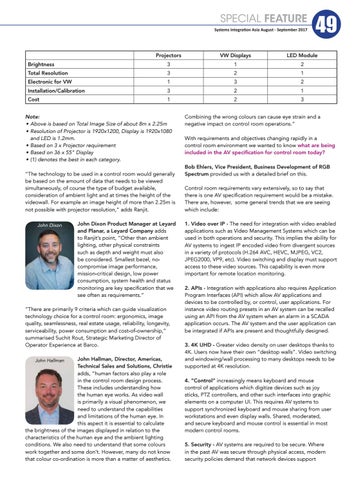
Note: • Above is based on Total Image Size of about 8m x 2.25m • Resolution of Projector is 1920x1200, Display is 1920x1080 and LED is 1.2mm. • Based on 3 x Projector requirement • Based on 36 x 55" Display • (1) denotes the best in each category. “The technology to be used in a control room would generally be based on the amount of data that needs to be viewed simultaneously, of course the type of budget available, consideration of ambient light and at times the height of the videowall. For example an image height of more than 2.25m is not possible with projector resolution,” adds Ranjit. John Dixon
John Dixon Product Manager at Leyard and Planar, a Leyard Company adds to Ranjit’s point, “Other than ambient lighting, other physical constraints such as depth and weight must also be considered. Smallest bezel, nocompromise image performance, mission-critical design, low power consumption, system health and status monitoring are key specification that we see often as requirements.”
“There are primarily 9 criteria which can guide visualization technology choice for a control room: ergonomics, image quality, seamlessness, real estate usage, reliability, longevity, serviceability, power consumption and cost-of-ownership,” summarised Suchit Rout, Strategic Marketing Director of Operator Experience at Barco. John Hallman, Director, Americas, Technical Sales and Solutions, Christie adds, “human factors also play a role in the control room design process. These includes understanding how the human eye works. As video wall is primarily a visual phenomenon, we need to understand the capabilities and limitations of the human eye. In this aspect it is essential to calculate the brightness of the images displayed in relation to the characteristics of the human eye and the ambient lighting conditions. We also need to understand that some colours work together and some don’t. However, many do not know that colour co-ordination is more than a matter of aesthetics. John Hallman
Combining the wrong colours can cause eye strain and a negative impact on control room operations.” With requirements and objectives changing rapidly in a control room environment we wanted to know what are being included in the AV specification for control room today? Bob Ehlers, Vice President, Business Development of RGB Spectrum provided us with a detailed brief on this. Control room requirements vary extensively, so to say that there is one AV specification requirement would be a mistake. There are, however, some general trends that we are seeing which include: 1. Video over IP - The need for integration with video enabled applications such as Video Management Systems which can be used in both operations and security. This implies the ability for AV systems to ingest IP encoded video from divergent sources in a variety of protocols (H.264 AVC, HEVC, MJPEG, VC2, JPEG2000, VP9, etc). Video switching and display must support access to these video sources. This capability is even more important for remote location monitoring. 2. APIs - Integration with applications also requires Application Program Interfaces (API) which allow AV applications and devices to be controlled by, or control, user applications. For instance video routing presets in an AV system can be recalled using an API from the AV system when an alarm in a SCADA application occurs. The AV system and the user application can be integrated if APIs are present and thoughtfully designed. 3. 4K UHD - Greater video density on user desktops thanks to 4K. Users now have their own “desktop walls”. Video switching and windowing/wall processing to many desktops needs to be supported at 4K resolution. 4. “Control” increasingly means keyboard and mouse control of applications which digitize devices such as joy sticks, PTZ controllers, and other such interfaces into graphic elements on a computer UI. This requires AV systems to support synchronized keyboard and mouse sharing from user workstations and even display walls. Shared, moderated, and secure keyboard and mouse control is essential in most modern control rooms. 5. Security - AV systems are required to be secure. Where in the past AV was secure through physical access, modern security policies demand that network devices support