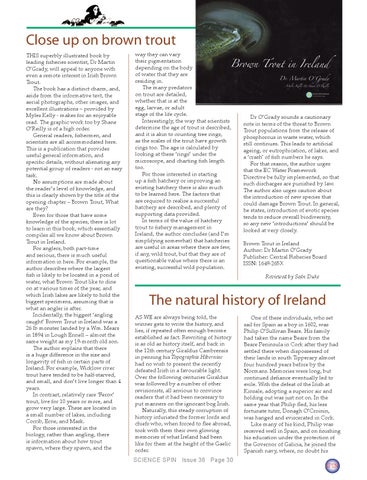
Close up on brown trout THIS superbly illustrated book by leading fisheries scientist, Dr Martin O’Grady, will appeal to anyone with even a remote interest in Irish Brown Trout. The book has a distinct charm, and, aside from the informative text, the aerial photographs, other images, and excellent illustrations – provided by Myles Kelly - makes for an enjoyable read. The graphic work too by Shane O’Reilly is of a high order. General readers, fishermen, and scientists are all accommodated here. This is a publication that provides useful general information, and specific details, without alienating any potential group of readers - not an easy task. No assumptions are made about the reader’s level of knowledge, and this is clearly shown by the title of the opening chapter – Brown Trout, What are they? Even for those that have some knowledge of the species, there is lot to learn in this book, which essentially compiles all we know about Brown Trout in Ireland. For anglers, both part-time and serious, there is much useful information in here. For example, the author describes where the largest fish is likely to be located in a pond of water, what Brown Trout like to dine on at various times of the year, and which Irish lakes are likely to hold the biggest specimens, assuming that is what an angler is after. Incidentally, the biggest ‘angling caught’ Brown Trout in Ireland was a 26 lb monster landed by a Wm. Mears in 1894 in Lough Ennell – almost the same weight as my 19-month old son. The author explains that there is a huge difference in the size and longevity of fish in certain parts of Ireland. For example, Wicklow river trout have tended to be half-starved, and small, and don’t live longer than 4 years. In contrast, relatively rare ‘Ferox’ trout, live for 10 years or more, and grow very large. These are located in a small number of lakes, including Corrib, Erne, and Mask. For those interested in the biology, rather than angling, there is information about how trout spawn, where they spawn, and the
way they can vary their pigmentation depending on the body of water that they are residing in. The many predators on trout are detailed, whether that is at the egg, larvae, or adult stage of the life cycle. Interestingly, the way that scientists determine the age of trout is described, and it is akin to counting tree rings, as the scales of the trout have growth rings too. The age is calculated by looking at these ‘rings’ under the microscope, and charting fish length too. For those interested in starting up a fish hatchery or improving an existing hatchery there is also much to be learned here. The factors that are required to realise a successful hatchery are described, and plenty of supporting data provided. In terms of the value of hatchery trout to fishery management in Ireland, the author concludes (and I’m simplifying somewhat) that hatcheries are useful in areas where there are few, if any, wild trout, but that they are of questionable value where there is an existing, successful wild population.
Dr O’Grady sounds a cautionary note in terms of the threat to Brown Trout populations from the release of phosphorous in waste water, which still continues. This leads to artificial ageing, or eutrophication, of lakes, and a ‘crash’ of fish numbers he says. For that reason, the author urges that the EC Water Framework Directive be fully implemented, so that such discharges are punished by law. The author also urges caution about the introduction of new species that could damage Brown Trout. In general, he states, introduction of exotic species tends to reduce overall biodiversity, so any new ‘introductions’ should be looked at very closely. Brown Trout in Ireland Author: Dr Martin O’Grady Publisher: Central Fisheries Board ISSN: 1649-265X Reviewed by Seán Duke
The natural history of Ireland AS WE are always being told, the winner gets to write the history, and lies, if repeated often enough become established as fact. Rewriting of history is as old as history itself, and back in the 12th century Giraldus Cambrensis in penning his Topographia Hiberniae had no wish to present the recently defeated Irish in a favourable light. Over the following centuries Giraldus was followed by a number of other revisionists, all anxious to convince readers that it had been necessary to put manners on the ignorant bog Irish. Naturally, this steady corruption of history infuriated the former lords and chiefs who, when forced to flee abroad, took with them their own glowing memories of what Ireland had been like for them at the height of the Gaelic order.
SCIENCE SPIN Issue 36 Page 30
One of these individuals, who set sail for Spain as a boy in 1602, was Philip O’Sullivan Beare. His family had taken the name Beare from the Beare Peninsula in Cork after they had settled there when dispossessed of their lands in south Tipperary almost four hundred years before by the Normans. Memories were long, but continued defiance eventually led to exile. With the defeat of the Irish at Kinsale, adopting a superior air and holding out was just not on. In the same year that Philip fled, his less fortunate tutor, Donagh O’Croinin, was hanged and eviscerated in Cork. Like many of his kind, Philip was received well in Spain, and on finishing his education under the protection of the Governor of Galicia, he joined the Spanish navy, where, no doubt his SPIN