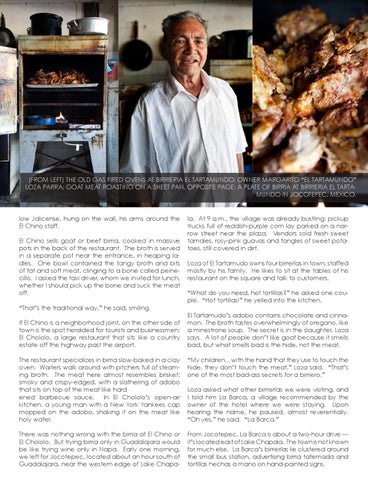
(FROM LEFT) THE OLD GAS FIRED OVENS AT BIRRIERIA EL TARTAMUNDO; OWNER MARGARITO “EL TARTAMUNDO” LOZA PARRA; GOAT MEAT ROASTING ON A SHEET PAN. OPPOSITE PAGE: A PLATE OF BIRRIA AT BIRRIERIA EL TARTAMUNDO IN JOCOTEPEC, MEXICO.
low Jalicense, hung on the wall, his arms around the El Chino staff. El Chino sells goat or beef birria, cooked in massive pots in the back of the restaurant. The broth is served in a separate pot near the entrance, in heaping ladles. One bowl contained the tangy broth and bits of fat and soft meat, clinging to a bone called peinecillo. I asked the taxi driver, whom we invited for lunch, whether I should pick up the bone and suck the meat off.
la. At 9 a.m., the village was already bustling: pickup trucks full of reddish-purple corn lay parked on a narrow street near the plaza. Vendors sold fresh sweet tamales, rosy-pink guavas and tangles of sweet potatoes, still covered in dirt. Loza of El Tartamudo owns four birrerías in town, staffed mostly by his family. He likes to sit at the tables of his restaurant on the square and talk to customers. “What do you need, hot tortillas?” he asked one couple. “Hot tortillas!” he yelled into the kitchen.
“That’s the traditional way,” he said, smiling. If El Chino is a neighborhood joint, on the other side of town is the spot heralded for tourists and businessmen: El Chololo, a large restaurant that sits like a country estate off the highway past the airport.
El Tartamudo’s adobo contains chocolate and cinnamon. The broth tastes overwhelmingly of oregano, like a minestrone soup. The secret is in the slaughter, Loza says. A lot of people don’t like goat because it smells bad, but what smells bad is the hide, not the meat.
The restaurant specializes in birria slow-baked in a clay oven. Waiters walk around with pitchers full of steaming broth. The meat here almost resembles brisket: smoky and crispy-edged, with a slathering of adobo that sits on top of the meat like hard ened barbecue sauce. In El Chololo’s open-air kitchen, a young man with a New York Yankees cap mopped on the adobo, shaking it on the meat like holy water.
“My children... with the hand that they use to touch the hide, they don’t touch the meat,” Loza said. “That’s one of the most bad-ass secrets for a birriero.”
There was nothing wrong with the birria at El Chino or El Chololo. But trying birria only in Guadalajara would be like trying wine only in Napa. Early one morning, we left for Jocotepec, located about an hour south of Guadalajara, near the western edge of Lake Chapa-
From Jocotepec, La Barca is about a two-hour drive — it’s located east of Lake Chapala. The town is not known for much else. La Barca’s birrierías lie clustered around the small bus station, advertising birria tatemada and tortillas hechas a mano on hand-painted signs.
Loza asked what other birrierías we were visiting, and I told him La Barca, a village recommended by the owner of the hotel where we were staying. Upon hearing the name, he paused, almost reverentially. “Oh yes,” he said. “La Barca.”