COMMUNITY
DEBATE
Overcoming Online Debating Challenges by Liana Schmitter-Emerson
T
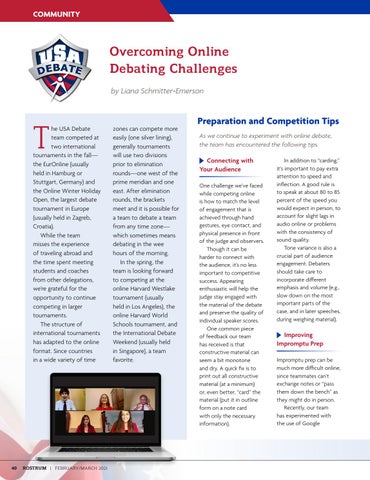
he USA Debate team competed at two international tournaments in the fall— the EurOnline (usually held in Hamburg or Stuttgart, Germany) and the Online Winter Holiday Open, the largest debate tournament in Europe (usually held in Zagreb, Croatia). While the team misses the experience of traveling abroad and the time spent meeting students and coaches from other delegations, we’re grateful for the opportunity to continue competing in larger tournaments. The structure of international tournaments has adapted to the online format. Since countries in a wide variety of time
40
ROSTRUM | FEBRUARY/MARCH 2021
zones can compete more easily (one silver lining), generally tournaments will use two divisions prior to elimination rounds—one west of the prime meridian and one east. After elimination rounds, the brackets meet and it is possible for a team to debate a team from any time zone— which sometimes means debating in the wee hours of the morning. In the spring, the team is looking forward to competing at the online Harvard Westlake tournament (usually held in Los Angeles), the online Harvard World Schools tournament, and the International Debate Weekend (usually held in Singapore), a team favorite.
Preparation and Competition Tips As we continue to experiment with online debate, the team has encountered the following tips.
Connecting with Your Audience One challenge we’ve faced while competing online is how to match the level of engagement that is achieved through hand gestures, eye contact, and physical presence in front of the judge and observers. Though it can be harder to connect with the audience, it’s no less important to competitive success. Appearing enthusiastic will help the judge stay engaged with the material of the debate and preserve the quality of individual speaker scores. One common piece of feedback our team has received is that constructive material can seem a bit monotone and dry. A quick fix is to print out all constructive material (at a minimum) or, even better, “card” the material (put it in outline form on a note card with only the necessary information).
In addition to “carding,” it’s important to pay extra attention to speed and inflection. A good rule is to speak at about 80 to 85 percent of the speed you would expect in person, to account for slight lags in audio online or problems with the consistency of sound quality. Tone variance is also a crucial part of audience engagement. Debaters should take care to incorporate different emphasis and volume (e.g., slow down on the most important parts of the case, and in later speeches, during weighing material).
Improving Impromptu Prep Impromptu prep can be much more difficult online, since teammates can’t exchange notes or “pass them down the bench” as they might do in person. Recently, our team has experimented with the use of Google