HOW DO WE DIAGNOSE A TRANSVERSE DEFICIENCY? Clinically, a narrow palate can
A maxilla can also be narrow in
present in different ways. The easiest
the absence of a crossbite. If the
maxillary transverse discrepancies
lower teeth appear to be excessively
to diagnose are when a crossbite
lingually inclined, one must imagine
is present. When we clinically see a
what the clinical presentation would
crossbite, it can appear unilaterally
be if these teeth were upright. If the
or bilaterally.
maxilla is narrow and we upright the lower teeth, this will lead to a
In unilateral crossbite cases, it is
crossbite — thus necessitating a
always a good idea to check for
maxillary expander.
a functional shift. Many times, these patients will present with a mandibular midline shift, but can be repositioned into centric occlusion and midlines will align once the maxillary expansion is completed. It can also appear as dental crowding. When we see dental crowding in the primary dentition, this is a red flag that there is inadequate bone. Crowding in the mixed dentition will
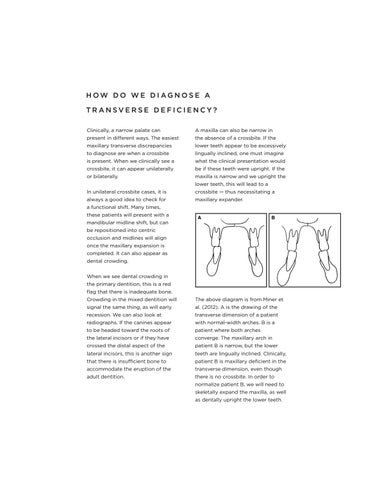
The above diagram is from Miner et
signal the same thing, as will early
al. (2012). A is the drawing of the
recession. We can also look at
transverse dimension of a patient
radiographs. If the canines appear
with normal-width arches. B is a
to be headed toward the roots of
patient where both arches
the lateral incisors or if they have
converge. The maxillary arch in
crossed the distal aspect of the
patient B is narrow, but the lower
lateral incisors, this is another sign
teeth are lingually inclined. Clinically,
that there is insufficient bone to
patient B is maxillary deficient in the
accommodate the eruption of the
transverse dimension, even though
adult dentition.
there is no crossbite. In order to normalize patient B, we will need to skeletally expand the maxilla, as well as dentally upright the lower teeth.