CONNIE ZHOU/Google
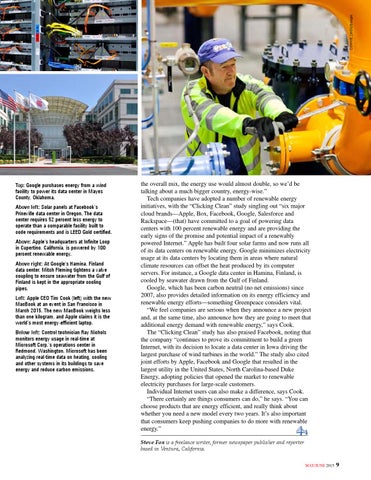
Top: Google purchases energy from a wind facility to power its data center in Mayes County, Oklahoma. Above left: Solar panels at Facebook’s Prineville data center in Oregon. The data center requires 52 percent less energy to operate than a comparable facility built to code requirements and is LEED Gold certified. Above: Apple’s headquarters at Infinite Loop in Cupertino, California, is powered by 100 percent renewable energy. Above right: At Google’s Hamina, Finland data center, Mitch Fleming tightens a valve coupling to ensure seawater from the Gulf of Finland is kept in the appropriate cooling pipes. Left: Apple CEO Tim Cook (left) with the new MacBook at an event in San Francisco in March 2015. The new MacBook weighs less than one kilogram, and Apple claims it is the world’s most energy-efficient laptop. Below left: Control technician Ray Nichols monitors energy usage in real-time at Microsoft Corp.’s operations center in Redmond, Washington. Microsoft has been analyzing real-time data on heating, cooling and other systems in its buildings to save energy and reduce carbon emissions.
the overall mix, the energy use would almost double, so we’d be talking about a much bigger country, energy-wise.” Tech companies have adopted a number of renewable energy initiatives, with the “Clicking Clean” study singling out “six major cloud brands—Apple, Box, Facebook, Google, Salesforce and Rackspace—(that) have committed to a goal of powering data centers with 100 percent renewable energy and are providing the early signs of the promise and potential impact of a renewably powered Internet.” Apple has built four solar farms and now runs all of its data centers on renewable energy. Google minimizes electricity usage at its data centers by locating them in areas where natural climate resources can offset the heat produced by its computer servers. For instance, a Google data center in Hamina, Finland, is cooled by seawater drawn from the Gulf of Finland. Google, which has been carbon neutral (no net emissions) since 2007, also provides detailed information on its energy efficiency and renewable energy efforts—something Greenpeace considers vital. “We feel companies are serious when they announce a new project and, at the same time, also announce how they are going to meet that additional energy demand with renewable energy,” says Cook. The “Clicking Clean” study has also praised Facebook, noting that the company “continues to prove its commitment to build a green Internet, with its decision to locate a data center in Iowa driving the largest purchase of wind turbines in the world.” The study also cited joint efforts by Apple, Facebook and Google that resulted in the largest utility in the United States, North Carolina-based Duke Energy, adopting policies that opened the market to renewable electricity purchases for large-scale customers. Individual Internet users can also make a difference, says Cook. “There certainly are things consumers can do,” he says. “You can choose products that are energy efficient, and really think about whether you need a new model every two years. It’s also important that consumers keep pushing companies to do more with renewable energy.” Steve Fox is a freelance writer, former newspaper publisher and reporter based in Ventura, California. MAY/JUNE 2015
9