Photographs courtesy Northeastern University
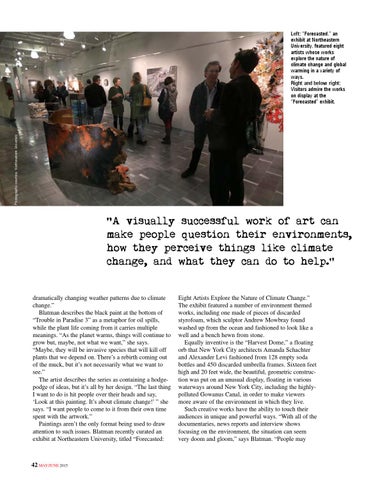
Left: “Forecasted,” an exhibit at Northeastern University, featured eight artists whose works explore the nature of climate change and global warming in a variety of ways. Right and below right: Visitors admire the works on display at the “Forecasted” exhibit.
“A visually successful work of art can make people question their environments, how they perceive things like climate change, and what they can do to help.”
dramatically changing weather patterns due to climate change.” Blatman describes the black paint at the bottom of “Trouble in Paradise 3” as a metaphor for oil spills, while the plant life coming from it carries multiple meanings. “As the planet warms, things will continue to grow but, maybe, not what we want,” she says. “Maybe, they will be invasive species that will kill off plants that we depend on. There’s a rebirth coming out of the muck, but it’s not necessarily what we want to see.” The artist describes the series as containing a hodgepodge of ideas, but it’s all by her design. “The last thing I want to do is hit people over their heads and say, ‘Look at this painting. It’s about climate change!’ ” she says. “I want people to come to it from their own time spent with the artwork.” Paintings aren’t the only format being used to draw attention to such issues. Blatman recently curated an exhibit at Northeastern University, titled “Forecasted:
42 MAY/JUNE 2015
Eight Artists Explore the Nature of Climate Change.” The exhibit featured a number of environment themed works, including one made of pieces of discarded styrofoam, which sculptor Andrew Mowbray found washed up from the ocean and fashioned to look like a well and a bench hewn from stone. Equally inventive is the “Harvest Dome,” a floating orb that New York City architects Amanda Schachter and Alexander Levi fashioned from 128 empty soda bottles and 450 discarded umbrella frames. Sixteen feet high and 20 feet wide, the beautiful, geometric construction was put on an unusual display, floating in various waterways around New York City, including the highlypolluted Gowanus Canal, in order to make viewers more aware of the environment in which they live. Such creative works have the ability to touch their audiences in unique and powerful ways. “With all of the documentaries, news reports and interview shows focusing on the environment, the situation can seem very doom and gloom,” says Blatman. “People may