Photographs courtesy Habitat for Humanity International
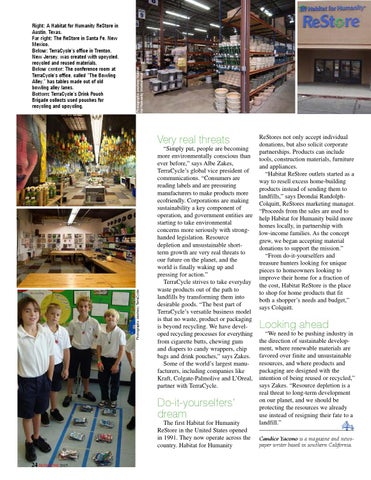
Right: A Habitat for Humanity ReStore in Austin, Texas. Far right: The ReStore in Santa Fe, New Mexico. Below: TerraCycle’s office in Trenton, New Jersey, was created with upcycled, recycled and reused materials. Below center: The conference room at TerraCycle’s office, called “The Bowling Alley,” has tables made out of old bowling alley lanes. Bottom: TerraCycle’s Drink Pouch Brigade collects used pouches for recycling and upcycling.
Photographs courtesy TerraCycle
Very real threats “Simply put, people are becoming more environmentally conscious than ever before,” says Albe Zakes, TerraCycle’s global vice president of communications. “Consumers are reading labels and are pressuring manufacturers to make products more ecofriendly. Corporations are making sustainability a key component of operation, and government entities are starting to take environmental concerns more seriously with stronghanded legislation. Resource depletion and unsustainable shortterm growth are very real threats to our future on the planet, and the world is finally waking up and pressing for action.” TerraCycle strives to take everyday waste products out of the path to landfills by transforming them into desirable goods. “The best part of TerraCycle’s versatile business model is that no waste, product or packaging is beyond recycling. We have developed recycling processes for everything from cigarette butts, chewing gum and diapers to candy wrappers, chip bags and drink pouches,” says Zakes. Some of the world’s largest manufacturers, including companies like Kraft, Colgate-Palmolive and L’Oreal, partner with TerraCycle.
Do-it-yourselfers’ dream The first Habitat for Humanity ReStore in the United States opened in 1991. They now operate across the country. Habitat for Humanity 24 MAY/JUNE 2015
ReStores not only accept individual donations, but also solicit corporate partnerships. Products can include tools, construction materials, furniture and appliances. “Habitat ReStore outlets started as a way to resell excess home-building products instead of sending them to landfills,” says Deondai RandolphColquitt, ReStores marketing manager. “Proceeds from the sales are used to help Habitat for Humanity build more homes locally, in partnership with low-income families. As the concept grew, we began accepting material donations to support the mission.” “From do-it-yourselfers and treasure hunters looking for unique pieces to homeowners looking to improve their home for a fraction of the cost, Habitat ReStore is the place to shop for home products that fit both a shopper’s needs and budget,” says Colquitt.
Looking ahead “We need to be pushing industry in the direction of sustainable development, where renewable materials are favored over finite and unsustainable resources, and where products and packaging are designed with the intention of being reused or recycled,” says Zakes. “Resource depletion is a real threat to long-term development on our planet, and we should be protecting the resources we already use instead of resigning their fate to a landfill.” Candice Yacono is a magazine and newspaper writer based in southern California.