Photographs courtesy Woodrow Wilson Center
Jennifer Turner
By STEVE FOX
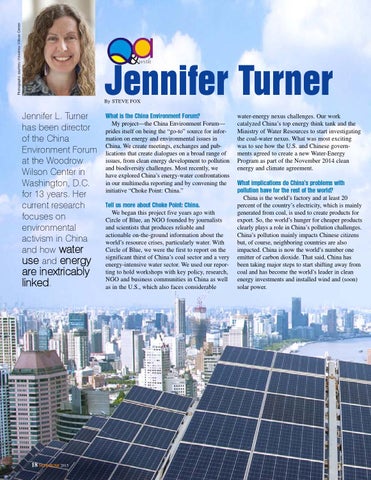
Jennifer L. Turner has been director of the China Environment Forum at the Woodrow Wilson Center in Washington, D.C. for 13 years. Her current research focuses on environmental activism in China and how water use and energy
are inextricably linked.
18 MAY/JUNE 2015
What is the China Environment Forum? My project—the China Environment Forum— prides itself on being the “go-to” source for information on energy and environmental issues in China. We create meetings, exchanges and publications that create dialogues on a broad range of issues, from clean energy development to pollution and biodiversity challenges. Most recently, we have explored China’s energy-water confrontations in our multimedia reporting and by convening the initiative “Choke Point: China.” Tell us more about Choke Point: China. We began this project five years ago with Circle of Blue, an NGO founded by journalists and scientists that produces reliable and actionable on-the-ground information about the world’s resource crises, particularly water. With Circle of Blue, we were the first to report on the significant thirst of China’s coal sector and a very energy-intensive water sector. We used our reporting to hold workshops with key policy, research, NGO and business communities in China as well as in the U.S., which also faces considerable
water-energy nexus challenges. Our work catalyzed China’s top energy think tank and the Ministry of Water Resources to start investigating the coal-water nexus. What was most exciting was to see how the U.S. and Chinese governments agreed to create a new Water-Energy Program as part of the November 2014 clean energy and climate agreement. What implications do China’s problems with pollution have for the rest of the world? China is the world’s factory and at least 20 percent of the country’s electricity, which is mainly generated from coal, is used to create products for export. So, the world’s hunger for cheaper products clearly plays a role in China’s pollution challenges. China’s pollution mainly impacts Chinese citizens but, of course, neighboring countries are also impacted. China is now the world’s number one emitter of carbon dioxide. That said, China has been taking major steps to start shifting away from coal and has become the world’s leader in clean energy investments and installed wind and (soon) solar power.