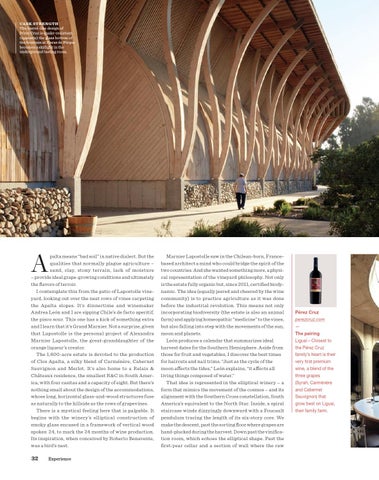
CASK STRENGTH The barrel-like design of Pérez Cruz is quake-resistant; (opposite) the glass bottom of the fountain at Haras de Pirque becomes a skylight in the underground tasting room.
A
palta means “bad soil” in native dialect. But the qualities that normally plague agriculture – sand, clay, stony terrain, lack of moisture – provide ideal grape-growing conditions and ultimately the flavors of terroir. I contemplate this from the patio of Lapostolle vineyard, looking out over the neat rows of vines carpeting the Apalta slopes. It’s dinnertime and winemaker Andrea León and I are sipping Chile’s de facto aperitif, the pisco sour. This one has a kick of something extra and I learn that it’s Grand Marnier. Not a surprise, given that Lapostolle is the personal project of Alexandra Marnier Lapostolle, the great-granddaughter of the orange liqueur’s creator. The 1,600-acre estate is devoted to the production of Clos Apalta, a silky blend of Carménère, Cabernet Sauvignon and Merlot. It’s also home to a Relais & Châteaux residence, the smallest R&C in South America, with four casitas and a capacity of eight. But there’s nothing small about the design of the accommodations, whose long, horizontal glass-and-wood structures fuse as naturally to the hillside as the rows of grapevines. There is a mystical feeling here that is palpable. It begins with the winery’s elliptical construction of smoky glass encased in a framework of vertical wood spokes: 24, to mark the 24 months of wine production. Its inspiration, when conceived by Roberto Benavente, was a bird’s nest.
32
Experience
Marnier Lapostolle saw in the Chilean-born, Francebased architect a mind who could bridge the spirit of the two countries. And she wanted something more, a physical representation of the vineyard philosophy. Not only is the estate fully organic but, since 2011, certified biodynamic. The idea (equally jeered and cheered by the wine community) is to practice agriculture as it was done before the industrial revolution. This means not only incorporating biodiversity (the estate is also an animal farm) and applying homeopathic “medicine” to the vines, but also falling into step with the movements of the sun, moon and planets. León produces a calendar that summarizes ideal harvest dates for the Southern Hemisphere. Aside from those for fruit and vegetables, I discover the best times for haircuts and nail trims. “Just as the cycle of the moon affects the tides,” León explains, “it affects all living things composed of water.” That idea is represented in the elliptical winery – a form that mimics the movement of the cosmos – and its alignment with the Southern Cross constellation, South America’s equivalent to the North Star. Inside, a spiral staircase winds dizzyingly downward with a Foucault pendulum tracing the length of its six-story core. We make the descent, past the sorting floor where grapes are hand-plucked during the harvest. Down past the vinification room, which echoes the elliptical shape. Past the first-year cellar and a section of wall where the raw
Pérez Cruz perezcruz.com — The pairing Liguai – Closest to the Pérez Cruz family’s heart is their very first premium wine, a blend of the three grapes (Syrah, Carménère and Cabernet Sauvignon) that grow best on Liguai, their family farm.