FEATURE
COLUMBUS HERITAGE
GEORGE W. WOODRUFF “As a financier he had insight, which amounted to genius. He had the money instinct; nay he made and saved money during all of his long life. At the time of his death his wealth ran into seven figures.” – Family Biographer BY ANDREA HAYES
Henry and George. Woodruff was now in the lumber business and a business partner of R. R. Goetchius. This move did not break the Woodruff’s ties to Columbus, though, instead it strengthened business relations to the growing city as the freshly sawn boards from the Juniper mill were sent to the Columbus mill run by Goetchius himself. After a relatively successful six year stay in Juniper, the Woodruff’s returned to Columbus in 1859. By this time, the family had expanded to include six children - Annie Bright Woodruff Hurt, Henry Lindsay Woodruff, Ernest Woodruff, George Sherwood Woodruff, Virginia Woodruff Howard and Francis Woodruff. In Columbus, George Waldo Woodruff quickly became involved with the local cotton gin company run by W. G. Clemons and Israel F. Brown.
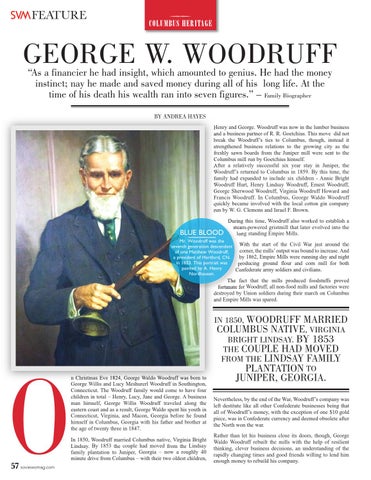
BLUE BLOOD
During this time, Woodruff also worked to establish a steam-powered gristmill that later evolved into the long standing Empire Mills.
Mr. Woodruff was the seventh generation descendant With the start of the Civil War just around the corner, the mills’ output was bound to increase. And of one Matthew Woodruff, by 1862, Empire Mills were running day and night a president of Hartford, CN. in 1653. This portrait was producing ground flour and corn mill for both painted by A. Henry Confederate army soldiers and civilians. Nordhausen.
The fact that the mills produced foodstuffs proved fortunate for Woodruff, all non-food mills and factories were destroyed by Union soldiers during their march on Columbus and Empire Mills was spared.
IN 1850, WOODRUFF
MARRIED COLUMBUS NATIVE, VIRGINIA
O 57 soviewsmag.com
n Christmas Eve 1824, George Waldo Woodruff was born to George Willis and Lucy Meshurerl Woodruff in Southington, Connecticut. The Woodruff family would come to have four children in total – Henry, Lucy, Jane and George. A business man himself, George Willis Woodruff traveled along the eastern coast and as a result, George Waldo spent his youth in Connecticut, Virginia, and Macon, Georgia before he found himself in Columbus, Georgia with his father and brother at the age of twenty three in 1847.
In 1850, Woodruff married Columbus native, Virginia Bright Lindsay. By 1853 the couple had moved from the Lindsay family plantation to Juniper, Georgia – now a roughly 40 minute drive from Columbus – with their two oldest children,
BRIGHT LINDSAY. BY 1853 THE COUPLE HAD MOVED FROM THE LINDSAY FAMILY PLANTATION TO
JUNIPER, GEORGIA. Nevertheless, by the end of the War, Woodruff’s company was left destitute like all other Confederate businesses being that all of Woodruff’s money, with the exception of one $10 gold piece, was in Confederate currency and deemed obsolete after the North won the war.
Rather than let his business close its doors, though, George Waldo Woodruff rebuilt the mills with the help of resilient thinking, clever business decisions, an understanding of the rapidly changing times and good friends willing to lend him enough money to rebuild his company.