Baseline » Issue 20
“Unlike other leak detection systems, which detect the sound of a leak (which means low differential pressure leaks can go unheard), Sentry can detect seeps or leaks quickly and points to where they are.”
13
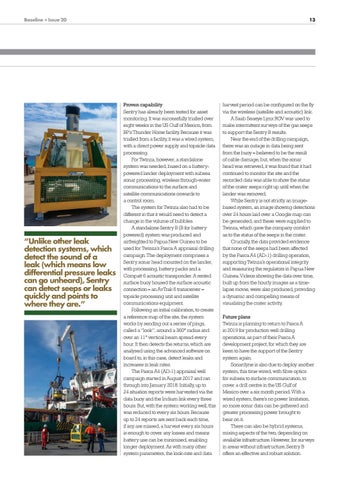
Proven capability Sentry has already been tested for asset monitoring. It was successfully trialled over eight weeks in the US Gulf of Mexico, from BP’s Thunder Horse facility. Because it was trialled from a facility, it was a wired system, with a direct power supply and topside data processing. For Twinza, however, a standalone system was needed, based on a batterypowered lander deployment with subsea sonar processing, wireless through-water communications to the surface and satellite communications onwards to a control room. The system for Twinza also had to be different in that it would need to detect a change in the volume of bubbles. A standalone Sentry B (B for battery powered) system was produced and airfreighted to Papua New Guinea to be used for Twinza’s Pasca A appraisal drilling campaign. The deployment comprises a Sentry sonar head mounted on the lander, with processing, battery packs and a Compatt 6 acoustic transponder. A rented surface buoy housed the surface acoustic connection – an AvTrak 6 transceiver – topside processing unit and satellite communications equipment. Following an initial calibration, to create a reference map of the site, the system works by sending out a series of pings, called a “look”, around a 360° radius and over an 11° vertical beam spread every hour. It then detects the returns, which are analysed using the advanced software on board to, in this case, detect leaks and increases in leak rates. The Pasca A4 (AD-1) appraisal well campaign started in August 2017 and ran through into January 2018. Initially, up to 24 situation reports were harvested via the data buoy and the Iridium link every three hours. But, with the system working well, this was reduced to every six hours. Because up to 24 reports are sent back each time, if any are missed, a harvest every six hours is enough to cover any losses and means battery use can be minimised, enabling longer deployment. As with many other system parameters, the look-rate and data
harvest period can be configured on the fly via the wireless (satellite and acoustic) link. A Saab Seaeye Lynx ROV was used to make intermittent surveys of the gas seeps to support the Sentry B results. Near the end of the drilling campaign, there was an outage in data being sent from the buoy – believed to be the result of cable damage, but, when the sonar head was retrieved, it was found that it had continued to monitor the site and the recorded data was able to show the status of the crater seeps right up until when the lander was removed. While Sentry is not strictly an imagebased system, an image showing detections over 24 hours laid over a Google map can be generated, and these were supplied to Twinza, which gave the company comfort as to the status of the seeps in the crater. Crucially, the data provided evidence that none of the seeps had been affected by the Pasca A4 (AD-1) drilling operation, supporting Twinza’s operational integrity and reassuring the regulators in Papua New Guinea. Videos showing the data over time, built up from the hourly images as a timelapse movie, were also produced, providing a dynamic and compelling means of visualising the crater activity. Future plans Twinza is planning to return to Pasca A in 2019 for production well drilling operations, as part of their Pasca A development project, for which they are keen to have the support of the Sentry system again. Sonardyne is also due to deploy another system, this time wired, with fibre optics for subsea to surface communication, to cover a drill centre in the US Gulf of Mexico over a six month period. With a wired system, there’s no power limitation, so more sonar data can be gathered and greater processing power brought to bear on it. There can also be hybrid systems, mixing aspects of the two, depending on available infrastructure. However, for surveys in areas without infrastructure, Sentry B offers an effective and robust solution.