06
Baseline » Issue 18
»KIT TRANSPONDERS
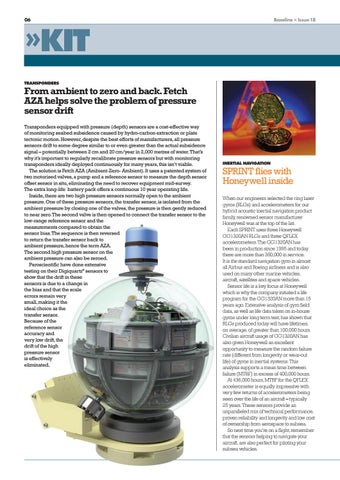
From ambient to zero and back. Fetch AZA helps solve the problem of pressure sensor drift Transponders equipped with pressure (depth) sensors are a cost-effective way of monitoring seabed subsidence caused by hydro-carbon extraction or plate tectonic motion. However, despite the best efforts of manufacturers, all pressure sensors drift to some degree similar to or even greater than the actual subsidence signal – potentially between 2 cm and 20 cm/year in 2,000 metres of water. That’s why it’s important to regularly recalibrate pressure sensors but with monitoring transponders ideally deployed continuously for many years, this isn’t viable. The solution is Fetch AZA (Ambient-Zero- Ambient). It uses a patented system of two motorised valves, a pump and a reference sensor to measure the depth sensor offset sensor in situ, eliminating the need to recover equipment mid-survey. The extra long-life battery pack offers a continuous 10 year operating life. Inside, there are two high pressure sensors normally open to the ambient pressure. One of these pressure sensors, the transfer sensor, is isolated from the ambient pressure by closing one of the valves, the pressure is then gently reduced to near zero. The second valve is then opened to connect the transfer sensor to the low-range reference sensor and the measurements compared to obtain the sensor bias. The sequence is then reversed to return the transfer sensor back to ambient pressure, hence the term AZA. The second high pressure sensor on the ambient pressure can also be zeroed. Paroscientific have done extensive testing on their Digiquartz® sensors to show that the drift in these sensors is due to a change in the bias and that the scale errors remain very small, making it the ideal choice as the transfer sensor. Because of the reference sensor accuracy and very low drift, the drift of the high pressure sensor is effectively eliminated.
INERTIAL NAVIGATION
SPRINT flies with Honeywell inside When our engineers selected the ring laser gyros (RLGs) and accelerometers for our hybrid acoustic inertial navigation product family, renowned sensor manufacturer Honeywell was at the top of the list. Each SPRINT uses three Honeywell GG1320AN RLGs and three QFLEX accelerometers. The GG1320AN has been in production since 1995 and today there are more than 350,000 in service. It is the standard navigation gyro in almost all Airbus and Boeing airliners and is also used on many other marine vehicles, aircraft, satellites and space vehicles. Sensor life is a key focus at Honeywell which is why the company initiated a life program for the GG1320AN more than 15 years ago. Extensive analysis of gyro field data, as well as life data taken on in-house gyros under long term test, has shown that RLGs produced today will have lifetimes, on average, of greater than 100,000 hours. Civilian aircraft usage of GG1320AN has also given Honeywell an excellent opportunity to measure the random failure rate (different from longevity or wear-out life) of gyros in inertial systems. This analysis supports a mean time between failure (MTBF) in excess of 400,000 hours. At 436,000 hours, MTBF for the QFLEX accelerometer is equally impressive with very few returns of accelerometers being seen over the life of an aircraft – typically 25 years. These sensors provide an unparalleled mix of technical performance, proven reliability and longevity and low cost of ownership from aerospace to subsea. So next time you’re on a flight, remember that the sensors helping to navigate your aircraft, are also perfect for piloting your subsea vehicles.