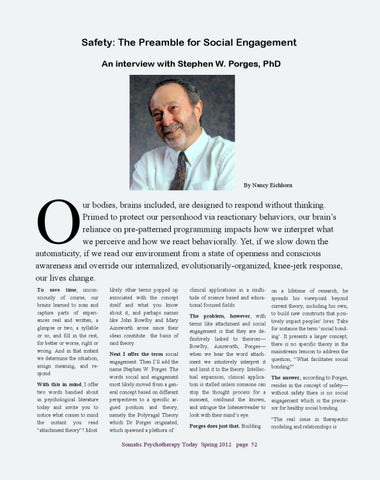
Safety: The Preamble for Social Engagement An interview with Stephen W. Porges, PhD
By Nancy Eichhorn
O
ur bodies, brains included, are designed to respond without thinking. Primed to protect our personhood via reactionary behaviors, our brain’s reliance on pre-patterned programming impacts how we interpret what we perceive and how we react behaviorally. Yet, if we slow down the automaticity, if we read our environment from a state of openness and conscious awareness and override our internalized, evolutionarily-organized, knee-jerk response, our lives change. To save time, unconsciously of course, our brains learned to scan and capture parts of experiences real and written, a glimpse or two, a syllable or so, and fill in the rest, for better or worse, right or wrong. And in that instant we determine the situation, assign meaning, and respond. With this in mind, I offer two words bandied about in psychological literature today and invite you to notice what comes to mind the instant you read “attachment theory”? Most
likely other terms popped up associated with the concept itself and what you know about it, and perhaps names like John Bowlby and Mary Ainsworth arose since their ideas constitute the basis of said theory. Next I offer the term social engagement. Then I’ll add the name Stephen W. Porges. The words social and engagement most likely moved from a general concept based on different perspectives to a specific argued position and theory, namely the Polyvagal Theory which Dr Porges originated, which spawned a plethora of
clinical applications in a multitude of science based and educational focused fields. The problem, however, with terms like attachment and social engagement is that they are definitively linked to theories— Bowlby, Ainsworth, Porges— when we hear the word attachment we intuitively interpret it and limit it to the theory. Intellectual expansion, clinical application is stalled unless someone can stop the thought process for a moment, confound the known, and intrigue the listener/reader to look with their mind’s eye. Porges does just that. Building
Somatic Psychotherapy Today Spring 2012 page 52
on a lifetime of research, he spreads his viewpoint beyond current theory, including his own, to build new constructs that positively impact peoples’ lives. Take for instance the term ‘social bonding’. It presents a larger concept; there is no specific theory in the mainstream lexicon to address the question, “What facilitates social bonding?” The answer, according to Porges, resides in the concept of safety— without safety there is no social engagement which is the precursor for healthy social bonding. “The real issue in therapeutic modeling and relationships is