1117EPSp06,08,12,14_Company Spotlight 11/17/17 12:19 PM Page 14
cover STORY
AFC Cable Continued from page 12
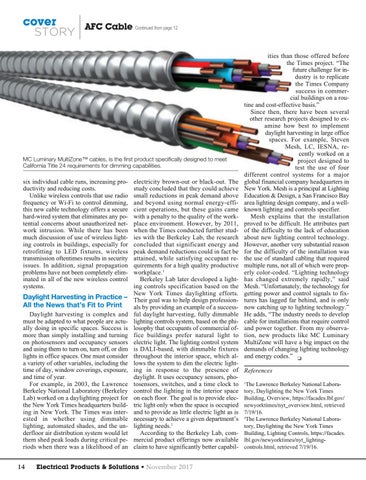
MC Luminary MultiZone™ cables, is the first product specifically designed to meet California Title 24 requirements for dimming capabilities.
six individual cable runs, increasing productivity and reducing costs. Unlike wireless controls that use radio frequency or Wi-Fi to control dimming, this new cable technology offers a secure hard-wired system that eliminates any potential concerns about unauthorized network intrusion. While there has been much discussion of use of wireless lighting controls in buildings, especially for retrofitting to LED fixtures, wireless transmission oftentimes results in security issues. In addition, signal propagation problems have not been completely eliminated in all of the new wireless control systems.
Daylight Harvesting in Practice – All the News that’s Fit to Print Daylight harvesting is complex and must be adapted to what people are actually doing in specific spaces. Success is more than simply installing and turning on photosensors and occupancy sensors and using them to turn on, turn off, or dim lights in office spaces. One must consider a variety of other variables, including the time of day, window coverings, exposure, and time of year. For example, in 2003, the Lawrence Berkeley National Laboratory (Berkeley Lab) worked on a daylighting project for the New York Times headquarters building in New York. The Times was interested in whether using dimmable lighting, automated shades, and the underfloor air distribution system would let them shed peak loads during critical periods when there was a likelihood of an 14
electricity brown-out or black-out. The study concluded that they could achieve small reductions in peak demand above and beyond using normal energy-efficient operations, but these gains came with a penalty to the quality of the workplace environment. However, by 2011, when the Times conducted further studies with the Berkeley Lab, the research concluded that significant energy and peak demand reductions could in fact be attained, while satisfying occupant requirements for a high quality productive workplace.1 Berkeley Lab later developed a lighting controls specification based on the New York Times daylighting efforts. Their goal was to help design professionals by providing an example of a successful daylight harvesting, fully dimmable lighting controls system, based on the philosophy that occupants of commercial office buildings prefer natural light to electric light. The lighting control system is DALI-based, with dimmable fixtures throughout the interior space, which allows the system to dim the electric lighting in response to the presence of daylight. It uses occupancy sensors, photosensors, switches, and a time clock to control the lighting in the interior space on each floor. The goal is to provide electric light only when the space is occupied and to provide as little electric light as is necessary to achieve a given department’s lighting needs.2 According to the Berkeley Lab, commercial product offerings now available claim to have significantly better capabil-
Electrical Products & Solutions • November 2017
ities than those offered before the Times project. “The future challenge for industry is to replicate the Times Company success in commercial buildings on a routine and cost-effective basis.” Since then, there have been several other research projects designed to examine how best to implement daylight harvesting in large office spaces. For example, Steven Mesh, LC, IESNA, recently worked on a project designed to test the use of four different control systems for a major global financial company headquarters in New York. Mesh is a principal at Lighting Education & Design, a San Francisco Bay area lighting design company, and a wellknown lighting and controls specifier. Mesh explains that the installation proved to be difficult. He attributes part of the difficulty to the lack of education about new lighting control technology. However, another very substantial reason for the difficulty of the installation was the use of standard cabling that required multiple runs, not all of which were properly color-coded. “Lighting technology has changed extremely rapidly,” said Mesh. “Unfortunately, the technology for getting power and control signals to fixtures has lagged far behind, and is only now catching up to lighting technology.” He adds, “The industry needs to develop cable for installations that require control and power together. From my observation, new products like MC Luminary MultiZone will have a big impact on the demands of changing lighting technology and energy codes.” ❏
References
1 The Lawrence Berkeley National Laboratory, Daylighting the New York Times Building, Overview, https://facades.lbl.gov/ newyorktimes/nyt_overview.html, retrieved 7/19/16. 2 The Lawrence Berkeley National Laboratory, Daylighting the New York Times Building, Lighting Controls, https://facades. lbl.gov/newyorktimes/nyt_lightingcontrols.html, retrieved 7/19/16.