7 minute read
Solidarity and strikes get results


By Amy Ferguson
Another pay increase
By Roise McCann
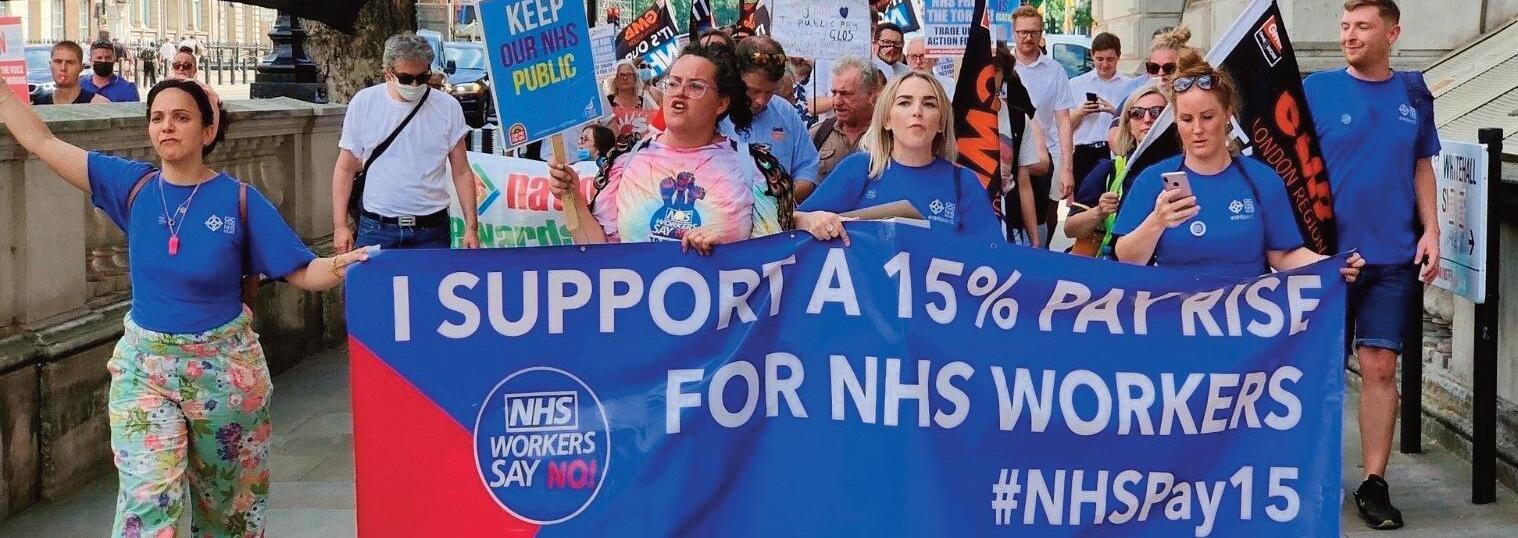
THE12 May is International Nurses Day. It is taking place in the same year that health workers across the UK were at the fore of a wave of industrial action taken to demand inflation-busting pay rises, safe staffing, and defence of the NHS from impending collapse fueled by Tory privatisation.
The disparity between the crucial role of health workers and the realities of their dissipating pay and working conditions have never been as stark. Health workers shouldered the enormous burden of keeping the deeply broken health system afloat during the Covid-19 pandemic through significant personal sacrifice and extra hours worked without pay on the good will of workers. The majority of health workers are women, who disproportionately bear the brunt of billions of pounds worth of society’s informal and unpaid care work making women nurses some of the groups most reliant on food banks as the cost of living crisis continues to spiral.
Luckily, we have Tory ministers to remind us repeatedly in the media that nursing is a “vocation”, that nurses should not complain about meagre wages or wards staffed by a couple of colleagues, and they certainly should not go on strike. Healthcare workers responded by coming out in their hundreds of thousands to fight for pay rises that would help restore safe staffing levels. Cuts to life saving services that have created longer waiting lists than ever for service users. Health workers have had enough; in taking industrial action many workers have connected the struggle for better pay and conditions to the fight for their patients and against the rampant privatisation of the system.
While pay offers on the table of 5% represent progress for many workers, it falls short of what is necessary to restore pay to 2008 levels. Junior doctors on strike in England have demonstrated the decimation of health professionals’ wages by demanding a 35% pay increase to restore wages to where they were in 2008.
Join us for a day of action on 12 May for International Nurses Day, to mobilise health workers, working people and young people looking to struggle for genuine change that offers dignity for health workers and service users alike.
FOLLOWING THREE days of strike action, Kingspan Water and Energy workers have won a one year pay deal of 10% across all grades, backdated to January, as well as a £1,000 one-off payment. This workforce, made up of multiple nationalities, and organised by Unite and Socialist Party member Neil Moore, fought an impressive battle against their bosses’ divide and rule tactics.
Not only did the company try to treat office staff and shop floor workers differently, but they also tried to fly in scab labour from Poland. Many of these workers would not have heard of the dispute. In response, the workers put out a message appealing to the Polish workers (in Polish) to not cross the picket line, to see that a victory in the dispute would be a victory for all workers. The point was made that their struggle for a fair livelihood in Poland was the same as that of the workers on strike: to fight against the greed of the capitalist class that is the cause of so much hardship among the working class, no matter where we live or are from.
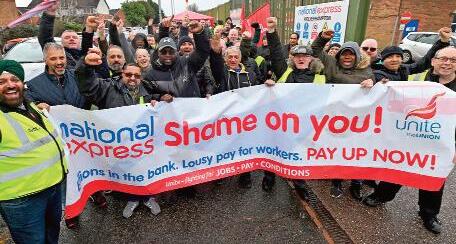
Similarly, National Express West Midlands bus strike came to an end with the acceptance of a one-year 16.2% pay increase and improvements to the drivers’ accident pay and Christmas pay rates, as well as a guarantee to implement terms and conditions that were agreed to last year. These workers also had to put up with bullying, intimidation, and divide and rule tactics by their employer, including dragging individuals into one-to-one meetings to try to break down their support for strike action, undermining democratic processes, and threatening strikers with no future overtime. The workers stood strong in their resolve and maintained unity by setting up a unionbusting hotline to assist all workers who were subjected to such tactics. As workers are getting organised and taking action, the capitalists are rattled. In the near future we will likely see more divide and conquer strategies being unleashed upon workforces. Such tactics can be overcome, and genuine pay rises won, with militant organising strategies, including those mentioned, as well as coordination between workforces and sectors.
AN EXPLOSIVE revolt in France began on 19 January 2023, MYRIAM POIZAT reports. The French government announced its proposal to raise the pension age from 62 to 64, and with that hundreds of thousands of working-class people took to the streets in an outpouring of furious opposition. In the context of a deepening cost of living crisis, this reform was but the tip of the iceberg. A bitter struggle against Emanuel Macon, the infamously titled ‘President of the rich’, was underway.
F OR MILLIONS facing worsening working conditions and living standards globally, lessons should be learnt from this movement, now entering its fourth month.
An injury to one is an injury to all
While only 10% of French workers are unionised, the anger and pressure from below forced conservative union leaderships into forming an inter-union structure to coordinate actions. This helped organise the significant strike of 3.5 million on 7 March – a number that officially qualified it as the second biggest strike since 1968.
Confidence among workers quickly grew as striking energy personnel took ‘Robin Hood’ actions which coordinated the distribution of free gas and electricity for schools, hospitals, social housing, public sports centres and public interest associations across the country. Supply was also restored to users disconnected due to unpaid bills, and the workers offered a reduced rate of up to 60% for small traders – help they would have never received from a government protecting the big companies’ rising prices and profits.
These workers’ actions gave a glimpse of the type of society that could be built through democratic workers’ control of resources. But they were also part of building real solidarity among all sections of the working class, as the responsibility for the current crises was shifted away from oppressed groups towards a regime and a system that serves only the interests of the ruling class; sexist, racist and transphobic attitudes have been challenged concretely.
International Women’s Day
This led to unions and feminist organisations joining forces on International Women’s Day to call a feminist strike. This significant action exposed the disproportionate impact of the pension reform on women – with gender roles often forcing them to work part time or interrupt their careers to care for children or elderly relatives, and the precarious and lower-paid jobs in female dominated sectors. As a woman on strike reported to the media: “I started working two years before my husband, but I will have to keep going after he’s retired.
That’s why I’m angry.”
But the 8 March strike went even further with demands against the rightwing backlash, the increase in gender-based violence and the attacks on abortion rights worldwide. The reason is simple: the struggle concretised the crucial need and real potential to challenge backward and misogynistic attitudes within society and within the movement to unite all working-class people in a common struggle against a common enemy and win change for all.
A weak Presidency
The Macron government’s weaknesses were quickly exposed. Its inability to rely on the support of traditional parties to back it up forced it to utilise, for the 11th time in less than a year, Article 49.3 of the French Constitution. This infamous article allows the government to pass legislation without taking a vote in the National Assembly.
Such an authoritarian move unsurprisingly added oil to the fire, inflaming the social movement, to which the French state responded with escalating police brutality. A protester from Sainte-Soline is currently clinging to his life in intensive care after cops savagely beat him and stopped paramedics from intervening. Many women have reported being verbally and physically assaulted, having their hair pulled during protests, and experiencing molestation during arrests.
In times of crises and instability, class struggles like the one taking place in France are a real threat to the system. In response, particularly in the French state, we often see increased state power being centralised around one leading political figure. This has led protesters to portray Macron as the wannabe King of France and reference Louis XIV’s notorious statement ‘l’Etat, c’est moi’ (I am the state).
Determination to win
Yet, determination in the struggle is not backing down. If anything, the increase in undemocratic measures and violence from the French state has reinforced the movement by bringing more young people out onto the streets. Students, who were at the forefront of explosions like #metoo and #blm, rejecting oppression and police brutality, have now begun organising in their schools and colleges in support for the workers’ struggle against the Macron regime.
This is a significant step forward. In the absence of clear strategy from the union leadership, a perspective for victory can be questioned. However, the growing presence of young people, the most radical section of society, can add confidence for workers to put pressure on their union leadership, move away from negotiation processes with the government and into further escalating actions in the workplace and the street.
For a workers’ government
Like the ones organised by energy workers and binmen recently, all other workers should coordinate renewable strike actions and build towards renewable general strikes. To do so, it is vital that they organise ‘anti-Macron’ strike committees in all schools, universities, communities and workplaces that can form local, regional and national assemblies to democratically discuss the demands and next steps of the struggle. Such committees could also lay the basis to scrap the undemocratic Fifth Republic of the rich and create a truly democratic revolutionary Constituent Assembly.
This is a necessary step towards a socialist government and socialist policies that seize the resources from the superrich and big business and bring them into democratic public ownership under workers’ control and management. A democratic, socialist France would be a beautiful beacon of hope for revolutionary change in a world of exploitation, climate catastrophe and oppression.n