3 minute read
New charter against sexual harassment in Hospitality


By Niall Dooris, NIPSA Member
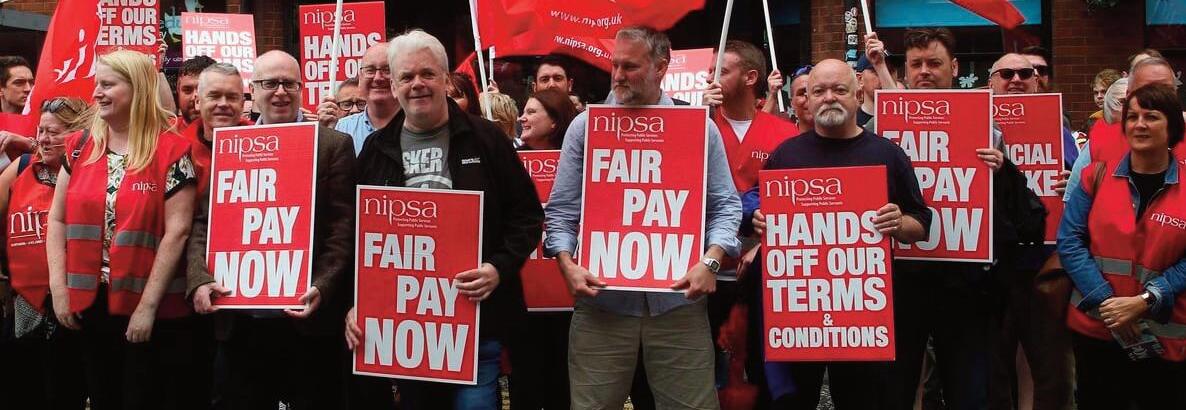
CIVIL SERVANTS in Northern Ireland are on strike on 26 April.
Workers in the Northern Ireland Civil Service will be joining their colleagues in the British Civil Service and teachers on strike, to put pressure on the government to offer a fair pay rise for public sector workers.
NIPSA (Northern Ireland Public Sector Alliance) completed a ballot of its members in the civil service in March that returned an 85% vote in favour of strike action and a 94% vote in favour of action short of strike action. This vote displays the willingness of workers in this sector to fight back against a real term pay cut.
The decision of the workers in the civil service to take strike action followed a measly pay offer in January by the government of £552 annually which amounts to less than a 2% increase on average for civil servants. The lowest paid civil servants will see their pay increase to £10.90 an hour, which will be just 48p above minimum wage! Inflation was at 10.1% in January, inflation for essential goods like food and fuel is even higher. Workers are rightfully angry at the pay offer because they it is in reality a pay cut.
Public sector workers are told the money is not there for a fair pay rise but this is a transparent lie. It is no coincidence that billionaire wealth has increased by £150 billion in the last two years, the logic of the system is that the working class must pay for every crisis while the rich continue to profit from this misery.
An ambitious strategy needed to win NIPSA has called for an inflationary pay offer (10-11%) plus 5% to account for the previous pay cuts. This is basically pay restoration to 2008 levels plus a small rise. It is possible for us to achieve this pay claim but a serious strategy of industrial action is required. Sporadic strike days are insufficient. We have to maximise the power of our strike action. This means coordinating with other unions but in particular other public sector workers. Important steps have been taken by taking strike action on the same day as the PCS and the teaching unions but this could be taken further and on a more consistent basis,
A key battle ground in our dispute is winning over agency staff. There must be a conscious approach to unionise and mobilise agency workers in the civil service who now make up a large section of the workforce. There are over 3,000 agency workers in the NICS alone. This means one in every ten workers in NICS is an agency worker.
The operational aspects of the service depend on agency workers . The pay offer directly affects them but these workers are on temporary precarious contracts for the specific purpose of undermining the service we provide and undercutting workers standing up for themselves. NIPSA should actively work to bring these workers into the union on this basis and take on the profiteering agencies to end casualisation.
We cannot accept the stonewalling of our pay claim. Despite claiming that no pay increase could be awarded in the absence of Stormont, housing executive workers won a pay increase. Clearly, money can be found and made available in the absence of an executive. The improved offer came after NIPSA members voted to strike, coordinating with Unite members already on strike for 7 months. This is a key lesson for our dispute. Pay rises can be won, regardless of Stormont, if we maximise our action.
By Saana Taussi, Hospitality worker
A RECENT survey by Unite showed that 90% of hospitality workers experience sexual harassment during work. To workers in hospitality, this hardly comes as a surprise, as the industry is notorious for poor working conditions.
The prevalence of zero hour contracts makes hospitality jobs extremely precarious and can make workers hesitant to report harassment. This especially applies to women workers who do the majority of temporary and part-time work. Low wages forces workers to put up with harassment from customers to avoid losing their tips. Those attending hospitality venues are not safe either - sexual harassment in nightclubs was at a 6 year high in 2022, and after the pandemic restrictions were eased, 1 in 9 women on a night out were spiked.
Unite Hospitality and Rosa have drawn together a charter against sex- ual harassment which puts demands on employers to ensure the safety of workers and customers. This includes having effective procedures for when harassment is reported and easy pathways for reporting, as well as better training for staff. Additionally, in order to tackle sexual harassment, workers need better working conditions that will not leave them vulnerable and powerless in the day-to-day. This means higher pay, stable employment contracts,fair rotas and trade union recognition.
The prevalence of sexual harassment and the general precarity of the hospitality industry are not isolated phenomena. Bosses are driven by the profit motive; not the welfare of employees, and therefore businesses suppress pay & cut hours in order to increase the bottom line.. Workers in the industry must get organised. Asking the bosses to play nice will never be enough; only collective action will win higher pay, secure contracts and safer workplaces.