Sylva



CHARLES W WOLFE, AGENT 180 Webster Road Sylva, NC 28779
Bus: 828-586-4026
charles.w.wolfe.bwll@statefarm.com






























CHARLES W WOLFE, AGENT 180 Webster Road Sylva, NC 28779
Bus: 828-586-4026
charles.w.wolfe.bwll@statefarm.com
An eviction moratorium has kept people in their homes even if they can’t pay rent during the COVID-19 pandemic, but what happens if the moratorium expires June 30? Legal Aid talks to The Smoky Mountain News about what renters need to know. (Page 6) Cory Vaillancourt photo
Mountain Projects receives affordable housing grant ..............................................9 Home sales double over 2020 ....................................................................................10
Haywood property tax bills will go up ........................................................................11
Sylva debates police staffing needs ..........................................................................12
Per capita payments exceed pre-pandemic levels ................................................14
Swain sets public hearing for proposed budget ....................................................17
Staffing a hurdle for Haywood summer school ......................................................18
Cullowhee Valley School chooses new mascot ......................................................19 Education News ................................................................................................................21
Twenty-two years later, some things haven’t changed ..........................................22 Seeing the light amid the darkness..............................................................................23
A&E
A consersation with Martin Sexton ..............................................................................24 The poetry of living off the grid......................................................................................29
Beginner backpacking trip highlights OMC’s new mission ................................30
D ESIGN & WEBSITE: Travis Bumgardner. .
D ESIGN & PRODUCTION: Jessica Murray. . .
ADVERTISING SALES: Susanna Shetley.
Amanda Bradley. .
Hylah Birenbaum. .
Sophia Burleigh. .
C LASSIFIEDS: Scott Collier. .
N EWS E DITOR: Jessi Stone. . .
WRITING: Holly Kays. .
Hannah McLeod. . . .
Cory Vaillancourt.
Garret K. Woodward. .
ACCOUNTING & O FFICE MANAGER: Amanda Singletary.
D ISTRIBUTION: Scott Collier.
travis@smokymountainnews.com
jessica.m@smokymountainnews.com
susanna.b@smokymountainnews.com
jc-ads@smokymountainnews.com
hylah@smokymountainnews.com
sophia.b@smokymountainnews.com
classads@smokymountainnews.com
jessi@smokymountainnews.com
holly@smokymountainnews.com
hannah@smokymountainnews.com
cory@smokymountainnews.com
garret@smokymountainnews.com
smnbooks@smokymountainnews.com
classads@smokymountainnews.com
C ONTRIBUTING: Jeff Minick (writing), Chris Cox (writing), George Ellison (writing), Don Hendershot (writing), Susanna Shetley (writing) Boyd Allsbrook (writing)
WAYNESVILLE | 144 Montgomery, Waynesville, NC 28786
P: 828.452.4251 | F: 828.452.3585
SYLVA | 629 West Main Street, Sylva, NC 28779
P: 828.631.4829 | F: 828.631.0789
I NFO & B ILLING | P.O. Box 629, Waynesville, NC 28786



Copyright 2021 by The Smoky Mountain News.™ Advertising copyright 2021 by The Smoky Mountain News.™ All rights reserved. Reproduction in whole or in part without permission is prohibited. The Smoky Mountain News is available for free in Haywood, Jackson, Macon, Swain and parts of Buncombe counties. Limit one copy per person. Additional copies may be purchased for $1, payable at the Smoky Mountain News office in advance. No person may, without prior written permission of The Smoky Mountain News, take more than one copy of each issue.
SUBSCRIPTION: 1 YEAR $65 | 6 MONTHS $40 | 3 MONTHS $25


BY C ORY VAILLANCOURT
OLITICS E DITOR
The Coronavirus Pandemic appears to be winding down and with it, protections designed to ameliorate the ensuing economic devastation that would have wreaked further havoc on vulnerable low-income populations.
Although the best known protections include extended eligibility for enhanced unemployment payments, a lesser known provision of the Trump administration’s COVID-19 response could soon result in a flood of evictions, exacerbating the existing homelessness problem across the country, when it expires on June 30.
“I expect there to be a lot more filings in a short period of time and a lot of fairly large money judgements against tenants who haven’t been paying,” said Chase Wells, a Murphy native and attorney with Legal Aid of North Carolina’s Sylva office.
Legal Aid is a statewide non-profit law firm that provides a variety of free services to low-income North Carolinians in the seven westernmost counties. Since last September, it’s been more difficult for landlords to evict tenants due to non-payment of rent, but that could soon change.
“When the CDC order first came out last year, evictions slowed down significantly but there have been more and more fillings every month since then,” Wells said.
In 2019, there were 637 small claims cases filed in Haywood County, according to Clerk of Courts Hunter Plemmons. The majority of those were evictions. The same goes for 2020, during which 404 cases were filed. Through early May 2021, there were 90 evictions actions filed.
The legal term for evictions in North Carolina is “summary ejectment,” and there are basically four different reasons it can occur.
The first and most common reason is nonpayment of rent.
Another is when a tenant stays beyond the end of their lease and becomes what’s called a “holdover.” This is especially prevalent with people who have a month-to-month lease. Often, these kinds of leases are oral.
“Leases can be oral or written. In fact, you don’t even have to say a word, if someone
who owns a piece of property just looks at you and nods and you go and start living on the property and paying rent by the month, then you’ve established just by your conduct a month-to-month lease,” said Wells.
The third reason is when a specific term in the lease has been violated, like no pets, no smoking, upkeep/lawn responsibilities or excessive guests.
The final reason is criminal activity taking place on the premises, although the standard of proof is far lower than in criminal courts.
“In a criminal court, we’ve all heard the expression, ‘beyond a reasonable doubt.’ The state has to prove to the jury beyond a reasonable doubt that a criminal action has occurred, and every element of that crime has occurred,” Wells said. “In civil court, for evictions, you don’t have to prove it beyond a reasonable doubt, you have to prove it by a lower standard — essentially, that it’s very likely that it did occur.”
The summary ejectment process begins with a notice to vacate. A lot of times, the lease will outline a waiting period between delivery of the notice and the landlord filing an action in court. In an oral, month-to month lease, notice is defined by law as seven days. People on a week-to-week lease get two days unless otherwise stipulated in the lease (if there is one). People on a yearly lease get 30 days, and tenants who own a mobile home but rent the lot get 60.
If the case originates due to an alleged breach of the lease, there’s often a cure period required after notice — like, cut the lawn in five days or you’re out.
In nonpayment cases, landlords have to give 10 days’ notice before filing.
After the notice period has expired, the landlord will file several documents including a summons, a complaint outlining the type of summary ejectment proceedings and any claims for damages, a servicemembers affidavit (to ensure they’re not evicting an active duty or deployed member of the armed forces who may miss the notice) and a CDC affidavit.

• Consult an attorney or contact Legal Aid of North Carolina or Pisgah Legal Services.
• Sign and date the CDC declaration, keep the original, deliver a copy to landlord/property management company in a manner that can be documented (registered mail, photo).
• File the CDC declaration with the court if there’s an active eviction case.
• An eviction order can be in place, but if a CDC declaration is also in place, a writ of possession cannot be issued until the CDC declaration expires.
The CDC affidavit simply states that the landlord delivered a blank copy of something called a CDC declaration to the tenant. The
tenant has to deliver a signed, dated CDC affidavit to the landlord, but should also file one with the clerk of courts as well.
A court hearing must be scheduled within seven days after the landlord files all those documents.
If the landlord gets the judgment they’ve asked for, there’s a 10-day grace period to allow the tenant time to consider an appeal. If the last day of that 10-day period is on a weekend, the deadline becomes the next business day.
On day 11, the landlord can get a writ of possession from the clerk. This is the actual “get out” letter.
A sheriff’s deputy then typically gives the tenant five days’ notice before executing the writ of possession.
If the tenant appeals, it goes to district court, which is far slower than magistrate court.
Getting a hearing usually takes a month. That period can be further lengthened if tenant files for discovery, asking for things like a copy of the lease, or a






copy of payment history. That period can also be lengthened if the tenant files counterclaims, like for not fixing things around the house. Asking for a jury trial can push the date out even further.
During that appeal period, usually the tenant would have to pay what’s called “rent bond” to the clerk of court and can be evicted if it’s not paid — unless a CDC declaration is in place.
The core of COVID-19 protections aren’t automatically granted, but rather center around that all-important CDC declaration.
A CDC order was filed on Sept. 4, 2020, and was originally slated to expire on Dec. 31, 2020, then Jan. 31, 2021, then on March 31, 2021, but ended up being extended through June 30.
Currently, the order covers all residential leases and is described as a “temporary eviction moratorium to prevent the further spread of COVID-19. This Order does not relieve any individual of any obligation to pay rent, make a housing payment, or comply with any other obligation that the individual may have under a tenancy, lease, or similar contract. Nothing in this Order precludes the charging or collecting of fees, penalties, or interest as a result of the failure to pay rent or other housing payment on a timely basis, under the terms of any applicable contract.”
To claim protection under the order, a tenant must deliver that CDC declaration to the landlord.
By doing so, in essence the tenant swears that they: have “used best efforts” to obtain rental assistance from governments; have received any stimulus check under the CARES Act; don’t expect to earn more than $99,000; cannot pay full rent due to “substantial loss of household income” or medical expenses; are using best efforts to make “timely partial payments that are as close to the full payment … as the individual’s circumstances” allow; would likely become homeless or have to move into a shelter or a new residence shared by people living in close quarters; understand they will have to eventually pay all back rent, fees and fines; and understand that when the order expires, the landlord may require payment in full and could initiate summary ejectment proceedings based on non-payment.
If all of those declarations are attested to by the tenant, then the tenant acquires the protections of the CDC order prohibiting evictions so long as the order remains in effect.
The constitutionality of the CDC order has been challenged in other states, but North Carolina Gov. Roy Cooper’s Executive Order 171 applies CDC protections to all North Carolina tenants, even if the CDC order is eventually struck down.
It’s unclear whether the CDC order will be extended again, and Cooper’s order runs though Dec. 31, but it could be repealed at any time, including if the State of Emergency is rescinded.
However, the protections in the order only extend to summary ejectment proceedings based on non-payment, meaning tenants can still be evicted for the other three reasons — being a “holdover,” committing a breach of contract or engaging in criminal activity.
“Landlords are finding creative ways to get around this,” said Wells.
One example is when a landlord claims a breach case because another person is now living with the tenant in breach of the lease, but that person has already been there for years and the landlord was well aware of their presence, but only filed the breach case after the tenant became three months late on rent.
There are plenty of other horror stories of landlords engaging in illegal tactics to violate the rights of tenants by intimidating them, including supergluing locks, even banging on the sides of trailers with baseball bats to terrify tenants and hasten their departure.
Sometimes, the tactics are downright bizarre, like what happened to Tony Smith and Carolyn Atchley, of Whittier, who weren’t late on their rent but were subject to a period of harassment by their landlord last year.
• We revert to all basic rules without the COVID protections. Tenants are still responsible for all late rent, late fees, utilities, etc.
• For those evicted who still owe damages, they may file for exemptions “notice of rights to have exemptions designated” that protect certain portions of certain assets like cars or trade tools from collections proceedings.
• In North Carolina, wages can only be garnished for child support or taxes.
• There is a 10-year statute of limitations for landlords to collect judgements, but a landlord can file a “new case” to reset the 10-year timer.
“A day after we signed the lease, she attempted to spend the night with me and my female, tried to push herself in the home,” said Smith, speaking of what should have been a sign that the arrangement was off to a bad start.
From there, the landlord began directing prospective tenants for an adjacent unit to Smith and Atchley, who objected. When they complained, the landlord told them that if they didn’t like it, they should leave. Then came the harassing phone calls, and the padlock on the gate, and the attempts to disconnect Smith and Atchley’s electric service.
Confrontations and police intervention ensued, and after three months, Smith and Atchley were served with summary ejectment papers. Representing themselves, they lost and subsequently appealed while continuing to pay their rent.
After their appeal, they were awarded $2,224 in damages and a refund of their last three months’ rent, with the help of Legal Aid.
“They did good,” Atchley said of Legal Aid. “Every time we called with a question they answered us, they found the answer. They did real good.”









BY HANNAH MCLEOD STAFF WRITER
When the Coronavirus Pandemic broke out in the United States in March 2020, Congress passed that CARES Act. Part of that legislation included a federal moratorium on evictions. The idea was the United States should keep people sheltered during a global pandemic, regardless of whether they could pay their rent in an economy that was quickly screeching to a halt.
The federal eviction moratorium was replaced by a CDC order in September, which has now been extended several times, with the latest order not set to expire until June 30.
According to the order, tenants are not relieved of any obligation to pay rent, make a housing payment, or comply with any other obligation that they may have under tenancy, lease or contract. Nothing in the order precludes the charging or collecting of fees, penalties, or interest as a result of the failure to pay rent or other housing payment on a timely basis.
The order requires tenants to prove they could not pay rent due to the Coronavirus Pandemic. Landlords can still proceed with summary ejectment on any grounds other than non-payment of rent due to the pandemic.
“It [the Eviction Moratorium] has had an impact on the number of evictions we’ve seen in court. However, we’ve still had a small number of evictions for holdover cases or for other lease violations that don’t involve non-payment of rent. But as a general rule, that has had quite an impact as far as the number of cases that we see in court,” said Roy Wijewickrama, Chief District Court Judge for the 30th Judicial District.
Landlords can go to court to evict tenants if they, for instance, trash the property, own a pet on the property when the lease prohibits it, or, most commonly, for remaining in a property after the lease is over. These types of cases have been ongoing throughout the pandemic.
According to Wijewickrama, prior to the eviction moratorium, the majority of summary ejectment cases were for non-payment of rent. Without the ability to see most of those cases through while the moratorium is in place, the number of eviction appeals being heard in district court has reduced dramatically.
Austin Lee is from Bryson City. He was a teacher for 16 years before leaving that post to manage his properties full-time. The market had been improving and putting his time and resources into being a landlord turned out to be more lucrative than teaching.
When the eviction moratorium went into place, he understood its importance, but, he says, he was worried.
“It was problematic. You know, for somebody like me, the taxes never stopped, the mortgage never stops, the water bill

“We’ve still had a small number of evictions for holdover cases or for other lease violations that don’t involve non-payment of rent. But as a general rule, [the Eviction Moratorium] has had quite an impact as far as the number of cases that we see in court.”
—
Roy Wijewickrama, Chief District Court Judge for the 30th Judicial District
never stops, that stuff just keeps going on,” said Lee.
Of his 24 tenants, only three went through periods that they could not pay rent due to the strains of the pandemic.
“I had a couple who lost work because of COVID of course,” said Lee. “And I told them, I’m not gonna put you on the street, we’re all in this bad situation. We just have to see what happens, we’ll figure it out. That was my thought process. The whole time was I’m just going to work through it with everybody because I know that unemploy-

rent collection rate of more than 96 percent throughout the eviction moratorium.
The CDC order is set to expire June 30, meaning summary ejectment cases for non-payment of rent, even if due to the effects of the pandemic, may continue after that date.
“I do anticipate an increase in the number of evictions once the moratorium ends,” Wijewickrama said.
ment’s coming, I know the stimulus is coming, and it did. And the vast majority of them paid and got current as soon as that stuff kicked in.”
For a local landlord though, having even a few tenants unable to pay causes issues down the line.
“It definitely stretched me thin, you know, what I had to do was basically just not do any kind of upgrades or maintenance during the time, just because the months were lean,” said Lee.
For instance, there was a roof that needed fixing. It was not about to cave in, or leak on a tenant, but it was nearing time for replacement. That project, and several other non-critical maintenance jobs got pushed back due to less monthly income. Lee saved money where he could, mowing and providing general upkeep himself instead of paying someone else to do the work.
“I keep reserves for emergencies and that’s where they kick in and come in very handy, but it was incredibly scary because, had a lot of people decided to not pay and for a long period of time, it would have become a huge problem,” he said.
Things are a bit different for the big guys. Michele Rogers is property manager for Select Homes of Waynesville, which has around 400 properties. She also belongs to the property management division of North Carolina Realtors. Only a handful of tenants, who Rogers knows and is working with, have been unable to pay rent during the pandemic. Select Homes maintained a
Rogers is also concerned about how lifting the moratorium will impact her business.
“My concern as a property manager is as soon as the moratorium is over, it’s going to actually lead to a housing crisis because so many people are going to be evicted,” she said. “And to make that worse, there is nothing available for rent right now. When we do get rentals available, we are renting houses in less than two days.”
To help prevent this crisis from happening, Rogers says, Select Homes is giving their tenants a list of resources and organizations that may be able to help them stay housed.
“I just feel like that’s our job,” she said. “Our job is more than just to collect the rent. We have to stay engaged in the community and we have to help people stay in there. That’s what we want to do. It’s a win-win.”
For Lee, the scariest part of all of this is the precedent it could set for the future.
“Personally, I just think it’s unfair to tell a business owner that they can’t run their business the way they should. The scariest part for me is, I hope it’s not the tip of the iceberg when they start trying to mandate and dictate a lot of stuff like that. If so, I’ll probably get out of the business, but by and large, it worked out good because I’ve got great tenants, just super good people.”
BY J ESSI STONE
The amount of time Legal Aid lawyers spend on helping clients with housing issues doubled during the pandemic.
“Locally, the biggest indicator of the increase in housing work is reflected in the fact that our office is now focusing about a third of the attorney time on legal matters related to housing — mostly in the area of evictions,” said Managing Attorney Suzanne Saucier. “This is in contrast to pre-pandemic numbers, where about one-sixth of attorney time was spent on housing matters. Our helplines have also seen twice as many families calling for legal help related to housing matters. Even our Senior Legal Helpline has seen seniors’ housing cases double in the past year.”
The last time The Smoky Mountain News talked to Saucier in February, the eviction moratorium had just been extended to March 31; it has since been extended to June 30. While she hopes it is extended once again to allow folks to stay in their homes even if they can’t pay their rent, she said the future has been impossible to predict.
“It is hard to say what the CDC will do with the eviction moratorium on June 30 when it is currently set to expire. We do know that in the past the CDC has waited until the last minute to issue any new extensions, so we encourage anyone who might be impacted by the current moratorium to stay up to date on any guidance,” she said. “We do think many renters and their families and children will be hurt if evictions for nonpayment are allowed, and if there continues to be delay in the state’s distribution of rental assistance. COVID is still a threat and evictions cause
many other related problems for homeless families and children.”
North Carolina recently opened a second round of federal funding through Project HOPE — Housing Opportunities and Prevention of Evictions — to assist renters with rent and utilities so they can remain in their homes.
Applications for the first round of funding were announced in October 2020 with $117 million for rent and utility assistance. To be eligible, households had to have income that is 80 percent of the area median income or lower and be behind on their rent because of COVID-19.
The HOPE Program is funded by U.S. Department of Housing and Urban Development Community Development Block Grant — Coronavirus funds and U.S. Department of Treasury Coronavirus Relief funds, which have been provided to North Carolina. The funds are administered by the North Carolina Office of Recovery and Resiliency, a division of the Department of Public Safety, and will be distributed through community partner agencies across the state.
According to a press release, Gov. Roy Cooper stated that the program would help “tens of thousands of families stay in their homes with the lights on.” However, Saucier said the first round of funding from that program took a long time to get distributed. If the second round is just as slow to come through as the first, it might be too late to do any good without the moratorium still in place.
“We have seen how the CDC and previously Governor Cooper’s eviction moratorium have helped families who were unable to
BY J ESSI STONE
N EWS E DITOR
Dogwood Health Trust recently invested in affordable housing initiatives in Haywood and Jackson counties by awarding a $872,671 grant to Mountain Projects.
The grant funding is expected to serve more than 400 families through Mountain Projects’ affordable housing division, Smoky Mountain Housing Partnership. The goal of SMHP is to increase affordable homeownership opportunities and increase access to affordable rental units over the next two to five years. The grant will also catalyze a homeownership center that will serve counties throughout the region.
Mountain Projects is one of the original community action agencies formed in 1965 under President Johnson’s War on Poverty. SMHP was formed in 2019 as the affordable housing division of Mountain Projects
pay their rent due to a loss of income related to the pandemic,” she said. “Recently, however, we are seeing that many families are losing their rental homes because the landlord is deciding to sell the property. This seems to be a new phenomenon that we were not seeing very often prior to the pandemic.”
“We are seeing that many families are losing their rental homes because the landlord is deciding to sell the property. This seems to be a new phenomenon that we were not seeing very often prior to the pandemic.”
— Suzanne Saucier
Given the booming real estate market in Western North Carolina, it’s not surprising that renters are having their homes sold out from under them. The problem is that home inventory across the region — for buyers and renters — is dismal.
According to a press release from Canopy MLS, which covers real estate across 13 counties in the region, home prices continue to respond to market dynamics of low supply. The median sales price ($318,500) and the average sales price ($394,482) rose 20.2 percent and 26.5 percent year-over-year, respec-
ments, being able to offset infrastructure and rising materials costs and expansion of affordable rental opportunities.
tively. The average list price increased 25.6 percent year-over-year to $467,032.
“Though home sales are off to a strong start this spring, housing affordability is weakening, and increased inventory is the best way to address rising home prices. Low mortgage rates have also continued to drive interest in the second-home market as well,” said Brian Cagle, a Canopy MLS Board of Directors member and Vice President/Managing Broker of BeverlyHanks & Associates. “While this is good for sales and growth, we also have to factor in the impact on first-time buyers and workforce buyers who live and work here and who are ultimately getting priced out of homeownership.”
Saucier said it’s important for tenants to reach out for assistance as soon as they begin experiencing any problems with their landlord. The more time Legal Aid has to assess the case, the more likely they are to get the best result for a client.
“To the extent that we get a case prior to an eviction being filed, we always attempt to mediate a resolution that is satisfactory for both parties. However, most of the time a tenant does not reach out to us until a court action has been filed. Our goal is always to find a good resolution for our client that avoids extended litigation,” she said. “Unfortunately, many families don’t know about our services in the region — our outreach resources as a nonprofit are limited. Many families are going through the litigation process on their own and do not know about their rights under the CDC eviction moratorium or otherwise.”
To apply for federal funding in North Carolina for rental assistance, visit or call 211 or 888.892.1162. Individuals can visit to make an appointment or to check for updates regarding the moratorium.
life skills that can positively impact their likelihood of homeownership.
with offices in Waynesville and Sylva. Its mission is to advocate for and create opportunities for workforce housing. SMHP strives to assist residents in their service area through programs that include financial literacy, down payment help, rental assistance, credit counseling, and home purchasing.
SMHP Executive Director Heather Boyd said the terrain in Haywood and Jackson counties makes buildable land scarce and, as a result, more expensive.
“Support like this from Dogwood Health Trust allows us to jumpstart a few key projects and leverage funds from other sources,” she said. “We anticipate being able to secure an additional $2.4 million from state and federal sources as a result of this grant.”
Specific elements that the $872,671 grant will support include hiring additional housing counselors, covering acquisition and predevelopment expenses on housing develop-
“The team at Smoky Mountain Housing Partnership knows their communities and they understand the constraints that prevent a family from owning a home,” said Sarah Grymes, Dogwood’s Vice President of Impact Investing for Housing. “They also share Dogwood’s commitment to address the disadvantages created by a lack of affordable housing. It’s our great honor to walk alongside them and to provide support to see real change take place in these counties.”
Boyd noted that with the grant funding from Dogwood, SMHP will be able to catalyze their homeownership center, ultimately serving over 400 families over the next two years.
“The right housing counselor has the potential to have significant impact in a person’s life,” she said. “Their efforts with a client can create generational impact because they’re doing more than just helping them buy a house; they’re helping them see the bigger picture and instill values that will last a lifetime.”
HUD-certified housing counselors often work with clients on budgeting, meal planning, credit counseling and foundational
To find out more about the services offered through the Smoky Mountain Housing Partnership, visit smokymountainhousing.org or call 828.452.1447.
Haywood Habitat for Humanity, another local nonprofit working toward increasing the number of affordable houses in the county, recently received a $20,000 People in Need grant from The Community Foundation of Western North Carolina. The grant was funded through The Leon Levine Foundation.
The grant will fund $4,000 on each of the first five new homes in Haywood Habitat’s newest neighborhood in Waynesville’s Chestnut Park. This will reduce the mortgage cost for the Habitat homeowners that purchase the houses.
“Community support like this provided through CFWNC is key to our ability to continue our work in Haywood County,” said Haywood Habitat Executive Director Jamye Sheppard. “This contributes greatly to keep home ownership costs affordable for families in need of a hand up. On behalf of Haywood Habitat, especially our homeowners, we are extremely grateful to be awarded this grant.”
With vaccinations underway and COVID-19 restrictions easing, April home sales rose 48.8 percent yearover-year with 1,138 homes sold across the Asheville region.
This time last year, home sales across the 13-county region declined 14.5 percent yearover-year, as buyers, sellers and agents were sidelined during lockdowns. Month-overmonth, April 2021 sales were nearly on par with March 2021 sales, declining slightly by 1.9 percent. These are completed transactions from Canopy MLS that include singlefamily homes, condos and townhomes across the 13-county Asheville region.
The region’s pending sales activity, or contracts where offers have been submitted but have not yet closed, rose significantly by 91.2 percent year-over-year and totaled 1,417 compared to 741 contracts submitted in April 2020. Compared to March 2021, contract activity is up a modest 3.6 percent. New listing activity showed sellers responding favorably to the spring market, rising 53.3 percent year-over-year with 1,438 properties listed versus 938 properties listed in April 2020. New listings compared to March 2021 are up 9.9 percent month-over-month, while year-to-date figures show the region’s new listing activity for the first four months of the year pacing ahead of the same period by 14.4 percent, with sellers listing nearly 600 more proper-
ties than they did during the first four months of 2020.
Still, even as inventory declined 62.9 percent year-over-year, leaving 1,541 homes for sale at report time, supply continues to hold steady at 1.3 months of supply in both March 2021 and April 2021. A year ago, in April 2020 there was 4.5 months of supply.
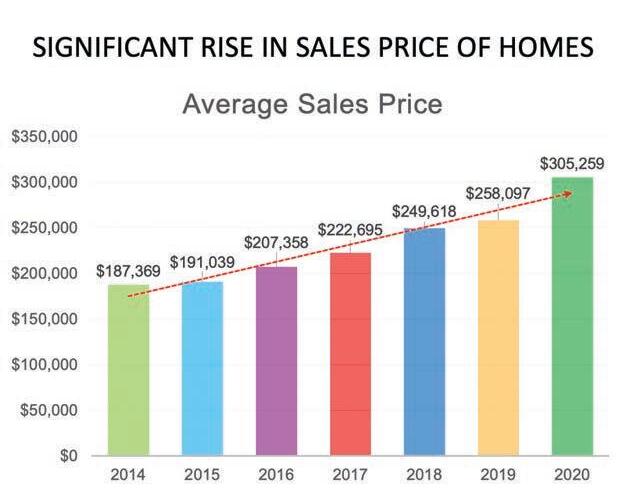
Low supply and high demand continue to push prices higher, with both the median sales price ($330,000) and the average sales price ($408,032) rising 24.1 percent and 29.9 percent year-over-year, respectively. The average list price increased 23.1 percent year-over-year to $471,712 in April, bringing the original list price to sales price ratio to 98.2 percent, while days on market averaged 48 days versus 78 days this time last year.
“The growth in new listing activity is a welcome sign and a trend that we’d like to see continue, as this will definitely help buyers with more choice,” said Dave Noyes, a Canopy MLS Board of Directors member and Broker-in-Charge with RE/MAX Results.
“We are aware that remote learning and work-from-home situations have kept many sellers from listing, but with summer approaching we hope to see more seller activity. However, buyers still face a difficult and fast-moving market due to inventory challenges.”
The Asheville region includes Burke, Buncombe, Haywood, Henderson, Jackson,
Madison, McDowell, Mitchell, Polk, Rutherford, Swain, Transylvania and Yancey counties.
Haywood County experienced positive sales trends this past month, as buyers purchased 109 homes in April 2021, an increase of 16 percent year-over-year, while pending sales rose 128.2 percent yearover-year. New listings showed seller confidence continuing to rise, increasing 112.3 percent year-over-year with 172 new list-
ings added to the market compared to 81 new listings added this time last year.
In the short-term this will help buyers with more choice, however with inventory critically low and down 52.3 percent yearover-year to 1.5 months of supply, heavy buyer competition in the county will continue to pressure prices.
For more residential-housing market statistics, visit www.carolinahome.com and click on “Market Data.”

BY C ORY VAILLANCOURT P OLITICS E DITOR
Yes, your property tax rate is going down, but no, your property tax bill probably bill isn’t. Wait, what?
That’s right, in what’s been perhaps the strangest two-year financial period in Haywood County history, a countywide property revaluation earlier this year revealed ascending property values across the county, some on the order of 20 to 30 percent.
This comes after most municipalities adopted austerity budgets last year, in the face of uncertainty over the economic effects of the Coronavirus Pandemic that unfolded during the last budget season.
“From a budgeting perspective, 2021-22 is one of the most unusual financial environments that budget teams statewide have encountered in their careers,” said Waynesville Town Manager Rob Hites in his annual budget message. “Within the time period of twelve months, municipalities have moved from an extremely pessimistic financial outlook to one that is far more positive.”
Property tax bills are calculated by multiplying the property’s value by the tax rate, expressed in cents per $100 in assessed value.
All things being equal, the increase in property values would normally generate much, much more revenue for local governments, leaving elected officials with several choices: keep the tax rate the same and utilize the windfall, lower the rate to a revenue-neutral figure based on existing needs, or split the difference with taxpayers.
Governing boards in Canton, Haywood County and Waynesville have all opted for the latter option.
The town of Canton’s tax rate has been the highest among Haywood County municipalities for quite some time now, but it hasn’t changed since 2007, giving taxpayers a small consolation — although inflation has undercut some of the town’s spending power over that time, there hasn’t been a tax increase in 14 years.
This year, the proposed rate will drop from 58 to 54 cents.
“I feel really enthusiastic about this budget,” said Canton Mayor Zeb Smathers. “It’s tight where it needs to be, but we’re planning for the future. The budget not only lays out this year, but larger projects in coming years. Here in Canton, we’re not standing still.”
Smathers said that long-term strategy goes heavy on recreation, especially with major work coming to Sorrells Park and the new Chestnut Mountain Park, but he’s not about to overlook critical infrastructure
improvements, like with the town’s water system, that would open up further economic development opportunities.
And just like in other municipalities, Canton will place a renewed emphasis on employee compensation; pressure from the booming Asheville metro area has driven up salaries in Buncombe County, so local governments in Haywood County often lose experienced employees.
“I think we’re losing money long-term with turnover,” Smathers said.
Last year, a $100,000 property in Canton would have a tax bill of $580. With this year’s rate cut, that would normally drop to $540, however, if that $100,000 property saw a 20 percent increase in value to $120,000, this year’s tax bill would be $648.
Almost 20 years ago, Haywood County’s property tax rate was an astounding 61 cents. That dropped to 49.7 cents in 2006, but as the Great Recession settled in, the rate jumped to 51.4 cents in 2009 and has slowly crept up since then to 58.5 cents.
Two slightly different forecasts put this year’s revenue-neutral rate at about 50.7 cents, meaning the county could raise roughly the same amount of money as last year with that rate, because of the jump in property values.
Commissioners opted to go with a rate of 53.5 cents this year, which will bring in an additional $2.4 million in revenue. However, according to County Manager Bryant Morehead, commissioners have opted to spend the bulk of that — $2.337 million — on bringing employee salaries up to market rates, to increase employee retention.
But that doesn’t quite tell the whole story; declining investment earnings due to low interest rates cost the county about $550,000. However, another unanticipated consequence of the Coronavirus Pandemic has resulted in skyrocketing sales tax figures for most Western North Carolina counties, which means even more revenue.
“Even though I had lots of experience in budget and finance, I had no experience in a pandemic,” Morehead said. “I couldn’t believe how the sales tax performed last year.”
Morehead said that the county realized a 16 percent increase, and that he’s been tasked by commissioners to put a priority on facilities maintenance, keeping the county’s property in better shape so it doesn’t need to be repaired as often.
Last year, a $100,000 property in Haywood County would have a tax bill of $585. With this year’s rate cut, that would normally drop to $535. However, if that $100,000 property saw a 20 percent increase
in value to $120,000, this year’s tax bill would be $642.
The property revaluation was especially kind to Waynesville. Last time, the town experienced a 1.59 percent decrease in taxable value, but this time, the residential tax base is up 25 percent, with commercial property showing a 15 percent increase.
As with Haywood County, the Town of Waynesville experienced increases in sales tax, in addition to the property valuation increases. That’s good news for town employees.
“The increases in the property tax base and increase in sales taxes provides the Town with sufficient revenue to fund a pay plan that takes an important step in placing the Town’s salaries in line with its competing municipalities,” reads Waynesville’s budget summary.
The pay study looked at eight local governments and determined that Waynesville’s entry level salaries were near average. The new budget will bring the town’s salaries closer to competing with local governments, which will help with employee retention. All
*Tax rates are expressed as cents per $100 in assessed property value. Sources: Town of Canton, Haywood County, Town of Waynesville.
in all, the increases will run about $800,000 across town departments, including employees who are paid through the water, wastewater and electric departments.
Last year, a $100,000 property in Waynesville would have a tax bill of $496. With this year’s rate cut, that would normally drop to $455. However, if that $100,000 property saw a 20 percent increase in value to $120,000, this year’s tax bill would be $545.









BY HOLLY KAYS STAFF WRITER
Sarah Dearmon was the only person who spoke during the May 27 public hearing for a proposed Sylva town budget that calls for an 18 percent increase over the general fund from 2020-21. But her comments directly addressed the main debate board members and town citizens have grappled with during this year’s budget process.
“In Sylva we currently have 5.4 officers for every 1,000 people,” said Dearmon, a Cullowhee resident who works in Sylva.
“With two additional officers you’d have 6.1 officers for every 1,000 people. I don’t really understand what justifies the need for that, especially without an increase in crime.”
This year’s property revaluation bumped the town’s value by 14.5 percent, generating an additional $345,000 with a flat tax rate. However, rising costs and employee pay increases quickly ate away that capacity. Town commissioners are considering upping the rate by 1.5 cents per $100 to fund a new part-time sanitation position and a new police officer position. Police Chief Chris Hatton had originally pushed for two new officers.

gories with large increases between 2019 and 2020 include patrols at town parks and security checks at day cares and churches.
Nestler believes there’s no need for taxpayers to fund additional officer salaries.
“There is no exponential increase in crime in Sylva. Nor does there appear to be an increase overall in crime at all,” he wrote in his analysis. “Most crime categories are showing a decline in numbers.”
Nestler said he’s not suggesting that officers aren’t overworked but said the town should “look to alternative solutions to this problem since crime doesn’t appear to be the driving factor behind the increases in actions.”
Hatton allows that 2020 was an unusual year for everybody, and that it wouldn’t be wise to enact a staffing change based solely on data from the last 12 months. Officers undoubtedly took more proactive actions in 2020 than is typical — both in the lockdown phase of the pandemic when calls went down and officers spent their time doing safety checks instead, and during the summer when protests kept the town on edge and business owners asked officers to keep an eye on their properties at night.
worth in overtime hours. However, commissioners were surprised when the proposed budget included a $10,000 increase in budgeted overtime, not a decrease.
“The reason we increased our 2021-22 overtime budget wasn’t to get more money,” said Hatton. “It was to make that line item more realistic.”
Over the last four fiscal years, actual overtime expenditures have ranged between $4,247 and $9,644 over budget. The proposed amount for 2021-22 is roughly even with actual expenditures for the current fiscal year. The coming budget year will include two Greening Up The Mountains festivals — the entire force must work the day of that event — as well as training for








The proposal has ignited a debate in Sylva about how many police officers a small town needs. The 2021-22 budget now under discussion would dedicate 32.9 percent of the general budget to the police department.
“I think the question that our community is asking right now is, ‘Is the cost of that level of policing versus the other things we could have with that money and do for our community worth it?’” Commissioner David Nestler said in a phone interview.
Nestler is the only one of the board’s five voting members who opposes raising taxes to add a new police officer. He says his opposition is rooted in an analysis he conducted of police department data from the past six years.
When making his budget request, Hatton told commissioners that demand for police services had exploded in the past year, with calls for service and officer actions combined rising from 8,199 in 2019 to 13,500 in 2020 — a 60.7 percent increase.
However, Nestler said, his analysis shows that calls and actions related to actual crime remained mostly flat between 2015 and 2020. Overwhelmingly, the increase came from proactive actions, especially security checks at businesses and banks. No data was entered for those categories until 2019, and between 2019 and 2020, actions/calls in these categories rose by 473% and 605%, respectively. Other cate-

“I think it’s important to remember that the need for an additional officer at the Sylva Police Department didn’t just happen recently,” he said. “Previous police chiefs have also recognized the need and they also requested an additional officer, but they were denied. We last added to our staff in 2008. Obviously, our town has seen a lot of growth since that time.”
In an interview Hatton gave The Smoky Mountain News five months after his August 2019 hire, he stressed the challenges his department was facing from increased demand for services. Between 2016 and 2019, calls for service increased 30 percent and total arrests more than doubled, including triple the number of felony arrests.
In January 2020, Hatton told the town board that if he didn’t get more officers, service would inevitably suffer. During this year’s budget process, Hatton emphasized the toll that lack of staffing has taken on his force, telling town commissioners that over the last year, officers stayed past their scheduled time to go home for a total of 620 hours and averaged 1,000 hours in overtime every year for the past three years. His force is overworked, he said, and it’s damaging morale, recruitment and retention.
Commissioner Greg McPherson said he’d support adding an officer after hearing that overtime statistic, noting that the town was already paying nearly an entire salary’s
new officers and catch-up for existing officers who could not participate in planned trainings during the pandemic.
However, Nestler’s takeaway is not that Sylva needs more police but that the police need fewer shifts.
“The conclusion I drew from looking at the data is that Sylva is over policing,” he said. “Am I surprised that the officers feel overworked? Not at all. If you’re over policing your town, then you’re probably overworking your officers.”
Hatton, meanwhile, said that his department is often getting by with the bare minimum. When fully staffed, the police department has two officers on day shift and three at night, though two officers is considered acceptable for night as well should a scheduled officer be unable to work.
Sylva already has far more officers per capita than almost any town in the fourcounty area.
According to a 2019 report from the Federal Bureau of Investigation, cities with fewer than 10,000 residents average 4.2 officers per 1,000 people. Most area towns have a ratio below that number. According to payroll data The F
Smoky Mountain News collected in 2020, Bryson City has 3.5 officers per 1,000 residents, Canton has 3.7, Franklin 3.8, Waynesville 3.2 and Clyde 3.4.
Sylva, meanwhile, has 5.2 officers per 1,000 residents, and that number would rise to 5.6 with the addition of another officer.
Hatton has defended that higher ratio, pointing out the large number of non-residents his force polices, including everincreasing numbers of tourists and Western Carolina University students. In 2011, WCU had 7,627 undergraduate students; by 2020, that number had increased to 10,979.
“Sylva PD is not only tasked with policing and providing service to the Town of Sylva, to those 2,800 residents, but they need to provide services to anyone who happens to be here at any given point in time,”
WCU Criminal Justice Professor Cyndy Caravelis told the town board during an April 22 presentation. “I drive back and forth several times a day between Cullowhee and Sylva, and I see state tags from about 10 different states every single time I head through.”
Sylva’s police force is also responsible for policing the busy N.C. 107 corridor, which has traffic counts exceeding 30,000 vehicles per day.
A busy road right through town is also a key characteristic for the only other town in the four-county area with a police-to-resident ratio exceeding Sylva’s. Maggie Valley, which serves a large seasonal population and whose narrow town limits hug U.S. 19, has 5.7 officers per 1,000 residents according to SMN data.
Nestler agrees that Sylva has some unique characteristics that could affect the officer-to-resident ratio, but he also believes that most towns have something unique about them that affect demand for policing.
“Sylva is not unique in that,” he said. “Also, if you have the increased burden of policing due to Western students, is that a burden that Sylva residents should exclusively pay for? And my answer to that is no, the county should help bear the burden.”
During his time on the board, Nestler has often voiced the opinion that town residents should get more coverage from county law enforcement, because they pay taxes for both departments. He’s gone so far as to question whether Sylva even needs its own police department given that the county sheriff’s office is located less than a mile away. Hatton, meanwhile, is adamant that a local police department is vital to serving citizens in the more densely populated business hub and county seat that is Sylva.
“The Sylva Police Department is tasked with protecting and serving the people and visitors within the town limits of Sylva,” he said. “The Sheriff’s Office is tasked with the entire county. The people of Sylva need a community police department that solely looks out for their unique interests.”
The town board is slated to vote on the 2021-22 budget during a meeting at 5:30 p.m. Thursday, June 10, to be held via Zoom and streamed on the “Town of Sylva NC” YouTube channel. To give public comment, contact Amanda Murajda at townclerk@townofsylva.org.









Thursday, June 17
Fletcher 7:30-8:15 @ Fletcher LawnGarden & Hardware Mars Hill 9:15-10:00 @ Parker Farm Supply
BY HOLLY KAYS STAFF WRITER


























Tiffany Henry will be Jackson County’s next director of economic development following a unanimous vote from county commissioners May 18. The vote followed a 25-minute closed session discussion at the end of the board’s regular meeting.








“We feel that Ms. Henry’s economic development expertise and knowledge of Jackson County will ensure a successful and smooth transition into the position of Economic Development Director,” said County Manager Don Adams. “We look forward to having her join our team.”

Henry’s appointment followed an extensive recruitment and interview process that involved county and community stakeholders, Adams said.
Henry will start her new job on June 21. A Jackson County native, she is currently the Small Business Center director at Southwestern Community College, having served in that role since 2013. Her professional background includes another 14 years of experience in finance, sales, lending, legal, project management and risk analysis. Henry owns 828 Escape Room and 828 Custom Printing, both located in Sylva, with her husband Jason.
Having also graduated from Smoky Mountain High School and Southwestern Community College, Henry holds a bachelor’s degree in business administration from Western Carolina University.
“As a native of Jackson County I’m passionate about my community, and I’ve worked hand-in-hand with small businesses in the region to develop a robust entrepreneurial ecosystem,” she said. “I’m looking forward to continuing what (former director) Rich Price has built as the economic developer for Jackson County. This opportunity will allow me to expand on my passion as I work collaboratively with small businesses, major industry, community development organizations
BY HOLLY KAYS STAFF WRITER
Despite a raging pandemic, Harrah’s Cherokee Casinos’ revenues for October 2020 through March 2021 delivered a larger per capita payment to tribal members than the last June distribution based on pre-pandemic earnings.
On June 1, the tribe sent out pre-tax distributions of $6,583 per member, or $5,596 after taxes. That’s $724 more than the pretax amount in the June 2020 distribution, which included two weeks of complete closure at the beginning of the pandemic, and $274 more than the June 2019 distribution, which was based on revenues accrued in a booming economy before COVID-19 was ever heard of.
“The last year has had more than its fair share of challenges, but our customers have been resilient,” said Harrah’s Cherokee General Manager Brooks Robinson. “Visitation and revenue have steadily increased since reopening last May and exceeded our forecasts each month. This is a testament to our team members who continue to provide world-class customer service while following enhanced health and safety protocols. Without them, our guests may not have felt as confident in returning.”
Between October 2020 and March 2021, 1.1 million people visited Harrah’s Cherokee Casinos in Cherokee and Murphy, 84.6 percent of the 1.3 million visits logged from October 2019 to March 2020.
However, the casino sold 5.4 percent more internal room nights during the 2020-2021 period, 194,000 compared to 184,000.
June distributions are typically smaller than December distributions, which are based on revenues realized during the busier season from April to September. In December 2020, tribal members received a pre-tax distribution of $4,899 — $2,315 less than the record-breaking $7,214 sent
and both local, state and federal entities to continue to make Jackson County a great place to live, work and play.”
The Small Business Center Henry currently directs offers free counseling and assistance to help entrepreneurs with business plans, marketing, production and accounting controls and a variety of other business issues. The center also provides free business seminars and reference materials for business owners to use.
Henry’s work at the SBC has earned her ample recognition. After just one year on
out in December 2019.
Currently, the two casinos employ just over 3,300 people, but more than 600 positions are vacant, with jobs available in culinary, hospitality and guest service areas. With a new 725-room hotel, 140,000square-foot convention center and 2,000space parking deck opening in late 2021, the casino’s need for new hires won’t slack
The Book opened as a sports betting venue this March, with locations in both Murphy and Cherokee.
Harrah’s Cherokee photo

per hour, and that many tipped, salaried and experienced employees would see increased compensation too. Additionally, the casino is now offering hiring bonuses between $500 and $3,000.
“Harrah’s Cherokee is committed to being the employer of choice in Western North Carolina,” the press release reads. “In this competitive job market, we are hopeful

off anytime soon.
“We typically see an increase in the number of open positions annually as we go into our busy summer season,” said Regional Vice President for Marketing Brian Saunooke. “This year, we are hiring for new amenities like The Book, our new hotel and convention center and several new restaurants, so the impact is amplified.”
The Book opened for sports betting in March, with locations in both Cherokee and Murphy. On May 28, Asheville-based Wicked Weed Brewing opened a 12,000square-foot brewpub on the second floor of the Cherokee casino. The pub features a 36seat main bar, walk-up tasting bar and small entertainment stage.
In an effort to attract more employees, Harrah’s announced in a May 17 press release that it would increase the starting pay rate for all non-tipped positions to $15
the job, Henry received the 2014 Rookie of the Year Award from the N.C. Community College System Small Business Center Network. In 2015 and 2017, she took home the SBCN’s Innovation Award for work supporting the agribusiness industry, especially creating the Appalachian Farm School, and was named State Director of the Year in 2018. In 2019, she received the SBCN Most Impact Award.
Henry will take the reins from former Economic Development Director Rich Price, who left the position Feb. 12 for a

that the combination of a $15 per hour starting wage, an exceptional benefits package and hiring bonuses will help us recruit the top talent. We’re looking for employees who enjoy building connections with each other and our guests by creating memorable moments — creating the extraordinary.”
The number of open positions has been hard on current team members, Saunooke said. Some are being asked to work six-day weeks, and certain areas of the casino have had to constrain their hours of operation.
Harrah’s is by far the largest employer in the seven western counties, accounting for about 10 percent of jobs in Jackson, Swain and Cherokee counties. However, it’s far from being the only business having difficulty filling open positions — at the moment, “Now Hiring” is the common refrain on business district signs and marquees across the region.
new job as director of economic development for Western Carolina University. Her salary of $65,500 is close to the top of the position’s advertised pay range of $53,700 to $66,800.
In February, commissioners approved a Comprehensive Economic Development Strategy for the county, which features eight economic development goals with shortterm, mid-term, long-term and ongoing action items under each. Implementing this document will be an important part of Henry’s new job.





BY C ORY VAILLANCOURT P OLITICS E DITOR
Alocal nonprofit group has its eyes set on funding that will be distributed to the Town of Waynesville as part of President Joe Biden’s American Rescue Plan. Although the funds — approximately $2.9 million over the next two years — have liberal guidelines as to their use, Helping Hands of Haywood wants to see them used to combat poverty issues that result in homelessness.
“I do hope it comes to be, because the county could use the support for a shelter,” said Korri McLauglin, a community social worker and board member of Helping Hands of Haywood. “If not, we’ll continue to fundraise.”
Helping Hands of Haywood is a 501(c)3 that started from humble roots in 2019 and to date has raised almost $50,000 while serving more than 200 residents with an all-volunteer team utilizing community partnerships to provide survival emergency services, case management and housing.
The vast majority of people HHH serves are Waynesville residents who are shortterm unsheltered and are actively searching for a place to call home. Most are employed. Many are children, disabled or elderly and suffer from poverty, medical problems, substance use disorder, mental health issues and the region’s noted lack of affordable hous-
ing.
During the May 25 Town of Waynesville Board of Aldermen meeting, McLauglin asked for up to $35,000 a year for two years to provide emergency shelter services at about $70 per night, essentially filling the county’s need for a low barrier shelter.
“One of our board members has extensive history working with grants, and we saw this as a possibility,” McLauglin said.
If they get it, they say it will result in reduced emergency interventions, a decreasing number of residents in threatening conditions, and a springboard to the next step in the housing continuum.
Several partner organizations also voiced support for the request through letters included with McLauglin’s presentation.
Mountain Projects, another longstanding local social services agency, said it would “continue to be an active partner” with HHH.
Grace Church in the Mountains has also collaborated with HHH and says it’s exploring ways to “deepen our partnership through our community outreach operation” and would attempt to match any funding provided by the town.
The North Carolina Harm Reduction Coalition has also coordinated with HHH in the past and supports the request.
McLauglin said she came away from the meeting with a positive outlook, based on
the board’s reaction to her presentation.
“I feel good about it,” she said. “They seemed interested, and asked some really good questions.”
Not everyone feels good about a low-bar-

rier shelter, however.
“Let’s assume that a low barrier homeless shelter is established and it is staffed with sincere workers with the best intentions who post strict but reasonable rules regarding operations. Granted, you just might have a success or two, but what happens with the

clientele who fail or refuse to abide by these guidelines? Where do they then go?” asked Eric Oberhultz, who spoke during the public comment session of the meeting. “Chances are, they will just continue on to be a nuisance, meandering about aimlessly, and continuing to get in trouble, only, the problems they cause will be exacerbated even more so by their increased numbers and closer proximity, all brought to you by a government that’s supposed to serve our community.”
Oberhultz also spoke at the May 11 Waynesville meeting, praising a May 1 cleanup effort by a group called “Saving Haywood” that ultimately resulted in the destruction of vital documents and other personal effects belonging to Elijah King, who was living under the Russ Avenue railroad bridge at the time. King told SMN last week he was pursuing legal action.
Peggy Hannah, who also spoke at the May 11 meeting and was part of the May 1 cleanup that resulted in King losing his birth certificate, social security card and contact lenses again spoke out against the idea of a shelter.
“You our city council, [sic] has [sic] turned a blind eye to our residents and our business owners F

BY J ESSI STONE N EWS E DITOR
Swain County will hold a public hearing at 6 p.m. June 10 to give residents an opportunity to comment on the 202122 proposed county budget.
After a number of budget workshops, County Manager Kevin King presented commissioners with the spending plan during a May 27 meeting. The total proposed budget of $19,488,575 includes increased pay for county employees, new county positions, establishing an animal control department and other capital project priorities. The property tax rate will remain at 36 cents per $100 of assessed value.
“We have tried to keep the interest of the taxpayer in mind at all times during this process,” King said in his budget message.
“Literally hundreds of hours have been put forth into the requests, reviews, and the recommendations of this proposed budget.”
The commissioners discussed further implementation of an employee step plan to ensure employees are being paid adequately and to also help the county with recruitment and retention efforts.
King said the county’s personnel committee was made up of 17 people this year and represented every county department. After holding several meetings to discuss how to retain qualified employees, the committee recommended to the board a step plan for the 2021-22 fiscal year.
“This plan was created using other plans that the county uses as a template for starting salaries for new employees and benchmarks for veteran employees,” he said. “Over the years of working with the personnel committee the step plan has always been at the forefront of the conversation. Most governmental organizations in the state and country have similar plans for employee compensation.”
In addition to the step plan, the committee recommended a cost-of-living increase for employees that did not receive an increase within the salary plan. King said the COLA would be a one-time payout of $500, which means it wouldn’t impact salaries. King included the step plan in his budget proposal.
“I served on the personnel committee and this is what they want. It does reward employees staying on with us,” said Commissioner Roger Parsons.
King also let commissioners know that the county was short staffed when it came to social workers in the Department of
who pay taxes. You are and have used tax dollars to implement more programs that will attract more criminals and drug addicts to our community,” Hannah said. “We have yet to get a number on people homeless in Waynesville. We have not identified them nor what their needs are and how we could assist them on an individual basis. This
Social Services. The county currently needs four new social workers and may have to get creative to fill the positions.
“Everyone is having a problem with staffing right now,” he said. “We’ve been advertising these positions for several weeks and haven’t received one single application.”
In this case, King said he doesn’t think the problem is how much the county pays but just a hard-to-fill profession right now. He said applicants should at least have a four-year degree in any field to apply for the position. Even if they have no experience as a social worker, the county can send new hires to a 72-hour training program to become a social worker.
Swain County has also been working on replacing the swimming pool at the recreation center and even though it’s scheduled to be open by July 4, King said they’ve had a problem finding enough certified lifeguards to have it covered for the season.
The budget includes eight brand new county positions — one in soil and erosion, one in environmental health, two new animal control officers, two paramedics and two 911 dispatchers.
While the county works to fill positions, commissioners will also do away with one county program that has been lacking in participants for the last several years — the in-home aid program. The four positions that remain in that program will be given the opportunity to stay on with the county in a custodial position as of Sept. 1 or can more than likely be absorbed by another private in-home aid provider.
The in-home aid program costs the county $80,000 a year for staffing, but the county is paying out more than it’s getting reimbursed for those services. King said the program has slowly been phased out over the years as employees leave and clients remain at a minimum. Back in 1997, the county had 40 employees in the program but is now down to four. The four remaining employees also don’t have enough clients to keep them busy because so many people choose a provider other than the county.
“The clients themselves wouldn’t go without services — they’d just have to pick another agency or pick their own person to come in to help them,” said Health Director Alison Cochran.
The public hearing for the proposed budget will be held at 6 p.m. Thursday, June 10, at the Swain County Administration Building, 50 Main St., Bryson City.
means more than housing. Without the numbers and data how do you conclude that we need more shelters, or a low barrier [shelter]?”
The town’s Homelessness Task Force, established shortly after the 2019 election, is expected to issue a report and recommendations this coming August.

















BY HANNAH MCLEOD STAFF WRITER
Students in Haywood County will not be provided normal bus transportation for the robust summer school program intended to address learning loss during the Coronavirus Pandemic.
In April, the North Carolina General Assembly passed the Summer Learning Choice for NC Families, an “act to establish school extension learning recovery and enrichment programs in each local school administrative unit to mitigate the impacts of COVID-19 on at-risk students.”
The bill lays out specific requirements for the summer school program, that are much more involved than the summer school of years past. Districts are required to provide 150 hours, or 30 days of instruction over the course of the summer.
This year’s summer program will look more like the regular school year by including all grades K-12, regular school transportation, meal service for each day of instruction and a period of physical activity.
This is not an easy undertaking for districts that have been stretched thin, working on an almost constantly changing learning plan over the past year and a half. Haywood County in particular is having trouble recruiting enough staff for its summer program.
“Our folks are exhausted and to add a
full-length summer on, is asking a lot of them, and they need a break,” said Trevor Putnam, assistant Superintendent for Haywood County Schools.
According to Angie Dills, Chief Academic Officer at Jackson County Schools, and Josh Lynch, Director of Curriculum at Macon County Schools, neither Macon or Jackson County Schools are experiencing similar staffing issues. Both counties will provide regular bus transportation to and from school, and both counties have enough teachers to staff a full summer program. Both counties are providing competitive pay for all staff contracting to work the summer program.
“This could be problematic for some folks for sure,” said Haywood County School Board Chairman Chuck Francis. “And it’s just a sad situation that we’re not able to find employees or bus drivers to fill the need. The whole situation is difficult nationwide, and we’re feeling it here as well. We’re continuing trying to work on it.”
The legislation laying out guidelines for the 2021 summer school session in North Carolina says schools must provide transportation services to the school facility housing the program, provided in accordance with the Plan A requirements for transportation established in the StrongSchoolNC Public Health Toolkit (K-12) issued on March 24.

In order to make the summer school program function with staff available, Haywood County Schools will provide transportation
to and from a few pick-up locations around the county, to the schools where instruction will take place, instead F







BY HANNAH MCLEOD STAFF WRITER
Henceforth, Cullowhee Valley School in Jackson County will be represented as the Cullowhee Valley Wolves.
Interim Superintendent Dr. Tony Tipton announced the official mascot decision at the May 25 school board meeting.
“I believe ‘the wolves’ is something the school, the students, the athletes can have fun with,” said Tipton.
For several weeks throughout the second half of the school year, suggestion boxes were set up in various locations around the school where students could drop in mascot ideas. Several of the mascot ideas were duplicates, but by the end of the suggestion period there were 42 unique mascot ideas. All the students at CVS voted on the list of 42, and the ideas were narrowed down to the top six mascot choices. Students then got a chance to vote from the top six choices, from which ‘Wolves’ was most popular.
“The exciting thing about it is that now we can take that and develop some new rituals around it, and become the wolves,” said CVS Principal Katherine Kantz. “I’m excited about the things that we’ll be able to do with it, finding the right visual representation and then the different things that we will do. For example, I’m really thinking that we get a great wolf howl and at the beginning of each basketball game or other games that we push the button and we
of taking students to and from their homes.
Pick-up spots will be located at Bethel Elementary, Clyde Elementary, Hazelwood Elementary, Junaluska Elementary, Jonathan Valley Elementary, Meadowbrook Elementary, North Canton Elementary and Riverbend Elementary. Students can choose to be picked up at any of these locations and taken to school where instruction will take place — Tuscola, Pisgah, Waynesville Middle, Canton Middle, Clyde Elementary, Hazelwood Elementary and North Canton Elementary.
Parents will be responsible for transporting students to and from the pick-up location of their choice. School will be released each day at 12:30 p.m., meaning parents will have to pick kids up from their pick-up site around 1 p.m.
According to Putnam, administration believes this transportation structure is in alignment with the transportation required under the Summer Learning Choice for NC Families bill.
“We believe it covers enough. It wouldn’t matter if it didn’t match. I mean, the reality is that’s the number of drivers we have and that’s the amount of transportation we can provide. Even if they said you shall provide transportation, great, come find drivers. We’re in an absolute pinch in regard to drivers, we only have what will work.”
Not only was the wolf mascot the top vote getter, it won both subgroups of the school as well. Students in grades K-2 and 38 both voted for the wolf mascot out of the last six choices.
“It’s important to note that no adults honed in on this at all, adults could turn in the ideas when we first collected the ideas, but only students were allowed to vote, not even the teachers,” said Kantz. “They needed to be the ones who would feel good about being represented by it.”
Cullowhee Valley School was charged with determining a new mascot after the old mascot, the rebel, was officially retired in January of this year. CVS had used the Rebel mascot since 1958. In 1994, when Camp Lab school closed and Cullowhee Valley School opened, there was some discussion within the community about changing the mascot, but ultimately, CVS remained the Rebels.
Over the past two years, CVS graduates in Jackson County, and around the country, wrote letters to school board members and started a petition to engage the Jackson County community. They also undertook fundraising efforts to assist in enacting new signage and renovations if the school board chose to change the mascot.
The new mascot will take effect this fall, when students return from summer vacation, or an extended summer school.
Haywood County Schools will pay bus drivers $20 per hour, slightly less than double their normal rate, to try and incentivize summer work. So far, 30 drivers have signed up to work during the summer school program. There are 68 bus routes, covered by 68 drivers during the normal school year. Many of the 30 who were willing to work the summer program could not commit to the entire summer.
“We’ll utilize 16 of those and we’ll have 14 others that actually sub or fill in when those 16 are not available to drive,” said Putnam. “Because, you know, people are taking vacations and they’re tired, they only want to drive a couple of days a week.”
Staff shortcomings don’t end with transportation services. Putnam said there are weeks and days during the summer school program when no teachers signed up to teach. In those instances, summer school directors will fill in for teaching staff.
“The other thing that complicates this is, we have a number of kids who signed up and say they are coming,” said Putnam.
“But what we’ve experienced with other summer school programs for some time, is that it tends to trail off the longer summer goes. So we may be adequate in the numbers we have, but it’s hard to know at this point, because this is, just like everything else this year, it’s uncharted territory.”












Federal health guidelines may have limited participation, but Southwestern Community College instructors made sure activities were as challenging as ever for high school students who attended this year’s STEM (Science, Technology, Engineering and Math) Event on April 16 at the college’s Macon Campus.
Instructors Elaine Merritt (Math) and Michael McIntosh (Science) set up three different challenges for the event, which drew students from Franklin and Nantahala High Schools.
“Even though we couldn’t have as many students here as we’ve had at our previous three STEM events, it was exciting to have the Groves Center buzzing with activity,” said Dr. Cheryl Davids, Dean of SCC’s Macon Campus. “All of our faculty and staff members were extremely impressed with the ingenuity of these young students. We all had a lot of fun.”
To learn more about Southwestern and the programs it offers, visit www.southwesterncc.edu, call 828.339.4000 or drop by your nearest SCC location.
It was first place honors for Kristen Revis and a solid third place for Sophia Spangler, finance students in Western Carolina University’s College of Business, in a national collegiate competition held this past week in St. Louis.
They rose from a field of 73 students representing 10 universities to find success in a financial planning competition by the International Association of Registered Financial Consultants.
Open to undergraduate students who are enrolled in a financial services curriculum, teams undertake a fictional case narrative and from it craft a financial plan, which is judged for effectiveness and potential for success.
When Leah McBride walked across the stage recently to receive an Adult High School diploma from Haywood Community College’s College & Career Readiness Department, she became the fourth of her siblings to celebrate the milestone. Being the youngest, she watched a sister and two brothers take the same journey and decided to follow in their footsteps.
“I wanted to get a jump start on college and I liked the flexibility of the schedule. I could choose to do the work from home or come in person,” she said.
For McBride, it was a good feeling to know she had easy access to the instructors.
This was also an important factor for Amber Summey, who also walked across the stage this year to earn a High School Equivalency. In traditional public high school, she felt like she did not

get enough attention from the teachers and decided to drop out of school over six years ago while in tenth grade.
After seeing a post on social media about an acquaintance going through the program at HCC, she decided to return to the classroom.
“At HCC, the teachers would take time to sit down and help me understand the material,” she said. “It made me feel more comfortable that they made sure I was learning what I was supposed to be.”
Now Summey is planning to continue at HCC and hopes to take pottery while McBride dreams of having a bakery where she can make a living from one of her passions.
For more information about obtaining a High School Equivalency Diploma or Adult High School credential, call 828.627.4700.
Western Carolina University Board of Trustees awarded Cherokee scholar Thomas Belt with its highest honorary degree, doctorate of humane letters, as part of its commencement ceremonies Saturday, May 15, in Cullowhee.
Belt, who speaks the western dialect of Cherokee, retired in 2018 as coordinator of WCU’s Cherokee Language Program. His work to preserve and revitalize the Cherokee language and traditional culture have had profound significance, not only for WCU, but the region and nation as well.
“It just finally occurred to me how prestigious it is for someone like me to be honored in this manner,” Belt said. “Even at this point I don’t have words for it. The fact that I am being recognized for the work that I did humbles me because I was just doing the best that I could do with my colleagues. It is an extreme honor to accept this
have some or all of their tuition and fees covered at Southwestern Community College over the next two years through Gov. Roy Cooper’s N.C. Longleaf Commitment Grant.
To qualify, students need to fill out the Free Application for Federal Student Aid. They also must be N.C. residents, and enroll in an associate degree or qualifying certificate program at SCC for the upcoming academic year that starts Aug. 16.
Students who qualify will receive between $700 to $2,800 per year. The amount will be calculated based on each student’s FAFSA submission. Even students who may not qualify for federal financial aid such as Pell Grants may qualify for this new program.
The funding is a grant, not a loan, and it will be awarded on a first-come, first-serve basis.
For guidance on filling out the FAFSA, visit: https://tinyurl.com/4hhx694f.
For more information about the Longleaf Commitment Grant, check out: https://tinyurl.com/2btccacn.
from the university.”
As a teacher and scholar at WCU, he developed vital materials for teaching Cherokee language and prepared multiple cohorts of students to read, speak and teach Cherokee language themselves.
“Tom worked tirelessly to make WCU a more welcoming place for Cherokee and Native American students,” said Kelli Brown, WCU chancellor. “These students had not always seen WCU as their place, in spite of Cullowhee’s identity as a significant ancient Cherokee site and its proximity to the Qualla Boundary. With his help, we began to change, working to make Judaculla’s place a true home for Cherokee and Native American students.”
Dr. Dana Ayers was sworn in as Superintendent of Jackson County Public Schools at the regular business session of the Jackson County Board of Education on May 25.
Assistant Clerk of Court Kelly Rich administered the oath of office.
“I’m honored that the board has chosen me to lead Jackson County Public Schools, and I am eager to begin,” Ayers said.
Ayers’ four-year term will begin June 1 when she assumes the role from Interim Superintendent Dr. Tony Tipton who has led the district since Sept. 1, 2020.
Anyone who graduated from a North Carolina High School in the past six months is eligible to
The Western Carolina University Board of Trustees has appointed Charles F. Thomas as dean of Hunter Library. Thomas will start in his new position effective July 1.
“Mr. Thomas’ experience in academic libraries, at a premier funding agency and at a major consortium, provide unique perspectives to this important leadership position,” said Provost Richard D. Starnes. “He will work closely with the Hunter Library faculty and staff to meet the contemporary challenges facing libraries and develop innovative approaches to maintain the library’s essential position within our campus community.”
Thomas comes to WCU from the University System of Maryland & Affiliated Institutions Library Consortium, which includes all of Maryland’s public universities, as well as other libraries. He has worked as the USMAI executive director for the past eight years.
Haywood Community College recently recognized five full-time and two part-time instructors for Excellence in Teaching awards.
Those recognized for full-time instruction include Christopher Bond — Spanish instructor, Dawn Cusick – Biology instructor, Eliza Dean – Early Childhood Education instructor, Lucy Lowe –Biology instructor, and Emily Reason – Professional CraftsClay instructor. Recognized for part-time instruction were Gary Gudac – Criminal Justice instructor and Janet Medford – Nurse Aide instructor.
HCC Nursing instructor Sarah McAvoy was recognized as Master Teacher. This award is a distinguished teaching award presented to the full-time curriculum faculty member who most exemplifies excellence in teaching by demonstrating excellent teaching, leadership, and service to the College and the community.
Early morning, June 2, 1999. I remember exactly where I was at and what I was doing. More on that later.
This morning, though — June 1, 2021 — I woke and got straight to work, jumpstarting my day early to make up for the Monday holiday. First thing I did was listen to a story on National Public Radio by Smoky Mountain News Politics Editor Cory Vaillancourt about the small motel in Maggie Valley with the controversial sign that was the catalyst for a community rally in support of law enforcement.
If you haven’t read the story or don’t know what I’m talking about, go to our website and you can find the print version, or go to Blue Ridge Public Radio’s site and find the radio version. This is not just an important local issue but one that’s been debated everywhere from the Oval Office on down to the county courthouse lawn.
After listening to the story and re-reading the print version, I started thinking about an opinion piece I could write for this week’s edition. Then I re-read Smoky Mountain News Staff Writer Holly Kays’ story — also in last week’s edition — about the plans for the Confederate statue on the steps of Jackson County’s iconic courthouse. County commissioners plan to alter the statue’s inscription by covering “Our heroes of the Confederacy” and replacing it with wording which says the statue was erected “… in memory of those who died during the American Civil War.”
The decision is stirring feelings on all sides of this emotional issue, and commissioner themselves were not unanimous in their vote to make the changes. How to handle
To the Editor:
As an occasional writer of letters to the editor I sometimes receive feedback, mostly positive but sometimes negative or dismissive. Most of the time I don’t hear anything, which causes me to wonder if I was just speaking to the void. I was very surprised then to see my name at the beginning of a guest column, no less. I am, therefore, gratified that people are indeed paying attention.
I am old enough to remember the old South with its white only rest rooms and water fountains. I don’t have a personal acquaintance with the situation that she described but I am not unmindful of them. I know that things like that occurred. Maybe Mrs. Curry thought that I didn’t know rather than being, like some, determined to live as if it were perpetually 1965 in Selma, Alabama. We have certainly come a long way since then. The death of all accusations of systemic racism should have been final with the election of Barack Obama in 2008 and his re-election in 2012. If there is still a racial disparity in various areas, we should look for other reasons rather than resorting to knee-jerk racism accusations It is to the credit of the writer and her hus-
Confederate monuments is a sensitive, delicate topic that is evolving even as I write this today, an issue I’m sure we’ll be writing about well into the future.
While reading the stories from The Smoky Mountain News and several other media outlets — national and regional — regarding police reform and Confederate monuments, I was reminded of how good reporting can enlighten one’s thinking. Too often the stereotypes regarding what “real mountaineers” believe or what “outsiders” believe turns out to be just plain wrong. Young versus old, Boomer versus Gen X’er, conservative versus progressive, local versus transplant, immigrant versus seventh generation American — however you want to slice it, more times than not if you really listen you’ll find that most people have more in common than some want us to believe.

As we mark the 22nd anniversary of this newspaper’s founding, there is much that has changed very little in that time span. While the larger media world has undergone a metamorphosis none could have predicted during this time, the foundations of good journalism remain the same. And please, don’t confuse the media bias on cable TV and their lunatic talking heads with what those of us in the trenches of local journalism are doing. We are fighting for our lives doing what I think is important work while they get million-dollar
band that they didn’t teach anything like what I referred to in my letter. What I am referring to is of fairly recent vintage and perhaps was not on their radar by the time they retired. I also was not saying that Critical Race Theory was presently being taught in our local schools but it is being pushed elsewhere as I will soon explain. Bad ideas seem to have the ability to really get around so — as the financial people like to say — past performance does not predict future results. It is easier to confront these damaging ideas before they take deep root. Of course, it can be denied that CRT is being taught if they don’t call it that. “Equity” should set off alarm bells as well. Poison by any other name is just as toxic. It is very likely that the writer and I inhabit different media universes. While the alphabet media is not above promoting completely false stories, its main deficiency is what it does not report at all. Therefore, many people never hear of important developments. I had heard of CRT through Robin DiAngelo’s “White Fragility” and Ibram Kendi’s “How to Be An Antiracist” where one is automatically racist for being born white and any defense against the charge of racism proves that you are racist and are demonstrating white fragility. You cannot keep your head down and let it
salaries for spewing hate and division.
Back 22 years ago in our first issue, I described what we at The Smoky Mountain News wanted to do: “If this newspaper has a mission, it’s to help the people in this region make informed decisions. As the pace of change cascades like a waterfall upon us, we’ll need to be armed with good information if we are to make the best choices.” That simple truth still guides us as we move into an unknown future.
And back then on June 2, 1999? Well, we had spent a year planning this newspaper’s start, what it would look like, what stories would be in the first issue, who we could get to advertise, all of that. That Wednesday morning, though, we — me, Greg Boothroyd and Neal Torda — found ourselves staring at a mountain of 12,000 newspapers and wondering how in the hell we would ever get them distributed in a four-county region and then find time to do it all again in one week. It was game on, so we rolled up our sleeves and got to work. Some things never change.
(Scott McLeod can be reached at info@smokymountainnews.com)
pass by without saying anything because now “silence is violence.”
Of course, this is absurd and should never be taken seriously and is totally inappropriate for children. I have no problem with teaching history, warts and all, but to teach everything from the false basis that this country was founded to perpetuate slavery as the “1619 Project” would have it is totally misguided and pits people against one another for no good reason.
The first time I was aware of any effort to include math in the antiracist effort was an article in Powerline. The Oregon Department of Education sent a letter to math educators telling them about a virtual course in math equity (A Pathway to Equitable Math Instruction) that they could sign up for. The claim by this group is that white supremacy culture can appear in the classroom in ways such as when “the focus is on getting the ‘right’ answer” and by requiring students to “show their work.” These quotes are from KATU-2, an ABC affiliate in Portland. Powerline picked it up from the Fox station there but no matter. This course also supports confronting ways that “math is used to uphold capitalist, imperialist, and racist views.” A Google search will find similar results from other parts of the country.
At the time I wrote the original letter I was
aware only occasionally of these stories but recently there has been a spate of news reports. For instance, there is a parental revolt against CRT in Loudon County, Virginia. Similar uprisings against school boards have occurred in other parts of the country. A Google search will yield results; just type in keywords. Google’s algorithms may discriminate against some outlets so searches with other search engines is a good idea as well. Going to the news sources themselves will be fruitful. Facebook and Twitter censor what they don’t like so a lot of good information is choked off to people who rely on these platforms. Give these websites a try: The Federalist, American Thinker, Breitbart, The Gateway Pundit, Real Clear Politics (has everything right, left and center), The Epoch Times, American Greatness, etc. Don’t be afraid of Fox News. I know it may be fashionable in some circles to knowingly sneer at people like Tucker Carlson or Rush Limbaugh, but they are more right than the so-called mainstream with their corporate “narrative.” I even like to read some left-of-center journalists like Glenn Greenwald and Matt Taibbi. I don’t always agree with them but at least they are unflinchingly honest. If inquiring minds really want to know, please expand your news sources.
Dave Parker Sylva
There was once a young girl in Southern India who lived in a house with no electricity. A coiled water hose sat in a corner of the room where she slept. Each night when the sun went down, she convinced herself it was a snake. In the morning when the sun rose, she would again see it was only a hose. Yet, in the evening when there was no light and she felt slightly different, all she could see was a snake. It did not matter that she knew the object was a hosepipe. There was something about the absence of light that led her to believe differently.

If you’ve been reading my column for any amount of time, you’ve noticed that I’m always in a state of reflection and personal growth. I have a restless spirit. Satiation requires constant learning, changing, evolving. I simply can’t sit in any one place for an extended period, especially if it’s feeing unhealthy or mundane.
Like the young girl in the story, I can allow darkness to overtake the light. Situations, whether personal, societal or global, can feel hopelessly overwhelming. Too much focus on the bad smothers all hope of goodness. This can be frustrating because I know when a person achieves awareness and clarity a sense of calm happiness soon follows. I know this because I’ve felt it.
I’ve found the only way to achieve that type of awareness is through certain intentional practices, such as meditation or mindfulness. Like many people, I once rolled my eyes when well-intentioned friends suggested I meditate. As a busybody, it’s hard for me to sit still, much less meditate. Further, I didn’t buy into the many purported benefits of this ancient practice. It felt impossible that a seemingly easy exercise could cure ailments like anxiety, pain, insomnia and depression.
During the height of the pandemic when home more often and facing significant uncertainty, I decided to meditate for five minutes each morning. At first, even that five minutes was challenging. I found my mind drifting all over the place, thinking about grocery lists and laundry. Nonetheless, when the five minutes concluded, I felt more relaxed and focused. It was many months before I started meditating for longer.
While practicing meditation, I also researched the topic. As someone who appreciates factual information and evidence, I wanted to know how and why meditation works. In the simplest of words,
meditation works by slowing incoming thoughts to a trickle. It affects the most evolved parts of the human brain such as the frontal lobe, parietal lobe, thalamus and reticular formation by slowing beta waves and calming racing, overwhelming thoughts and stimuli. Moreover, the longer and more often you meditate, the better the results.
Anecdotally, I’ve found several other benefits to meditation. I’m an overthinker and can perseverate on a conversation or situation for entirely too long. Meditating allows me to look beyond individual trees and see the entire forest, offering a more comprehensive, realistic assessment of a situation. Meditation also helps me discern what’s weighing me down the most. Once I get into a calming state, the heaviest things rise to the top. This is beneficial because it shows what parts of my life need problem solving or readjustment. I’ve also found that meditation assists with focus before sitting down to write a long article or stepping into an important meeting or conversation. Stress, anxiety, pain, poor sleep, inattentiveness and depression have always been part of the human experience so it’s no wonder meditation has stood the test of time. While psychotherapy, pharmaceuticals and other proposed treatments have shifted and changed, meditation has remained unaltered through the ages. There is no need to modify something that works so well.
Similar to meditation is mindfulness. If sitting down to meditate is too farfetched for your daily routine, you can be mindful in any situation. Whether walking your dog, sipping a mug of tea or gardening, focus on how the activity is affecting your senses. Don’t stress over whether you’re doing it correctly. For any type of mindful practice, concentrate on your breath and start with small sessions. Then build from there. There are many resources including books, apps and podcasts to assist you.
On the surface, meditation and mindfulness can look pointless. That’s because the true magic is happening on the inside. The most important component to these practices is heightened awareness. Awareness is clarity and clarity is light. When we rest in awareness, we see more clearly. We can’t unsee what we’ve seen in that light. When we train our minds in awareness and bring that clarity, not only to meditation but also to every moment of our lives, we can enjoy a happier existence and more harmonious experience with the world around us.
(Susanna Shetley is a writer, editor and digital media specialist for The Smoky Mountain News, Smoky Mountain Living and Mountain South Media. susanna.b@smokymountainnews.com)

BY GARRET K. WOODWARD
ARTS & E NTERTAINMENT E DITOR
Leaving his hometown of Syracuse, New York, in 1988, singer-songwriter Martin Sexton hit the road — in search of not only himself and his place in the world, but also his audience, too.
Now, over 30 years later, Sexton is regarded as one of the finest singers and songsmiths in the country, this mesmerizing blend of folk, soul and rock music. It’s a magnetism of tone and aura akin to the likes of Otis Redding, Van Morrison, and Simon & Garfunkel, to name a few.
It’s a communal thing when you’re at a Sexton show, with the cosmic reverend himself up there upon the high stage of melodic serenity, radiating this sense of togetherness and connection between fellow human beings in the presence of the universal language — music.
Smoky Mountain News: Amid “all this” that we’re currently facing as a society, have you been seeking out any silver linings?
Martin Sexton: Oh, have I ever. And I haven’t had to look very far. At first it was, “How am I going to pay the bills?” I just lost a year of touring all around the earth, and, of course, that’s how us musicians make the bulk of our living is touring. Luckily, we had a little money saved we tapped into, and other digital means of revenue streams, which have been a godsend.
But, the root true silver lining I found was, “Hey, I’m stuck.” In fact, it was a beautiful thing, [my family and I] were stuck up at [our cabin in the] Adirondacks [in Upstate New York]. We went up there, and we’re blessed to have that place.
We’re stuck in this cabin. Me and my family — my wife, my boy. And the silver lining we discovered was that we have to be together. We have to do something. So, we’re going to cut each other’s hair. We’re going to wax the floors. We’re going to build a tree house.
Me and my son, we’ve been talking about building the tree house for years, and this was finally the year we did it — we got it done. And then, I sat in the tree house and I wrote a song. [Some] songs came out of it.
I got to FaceTime with my family. I got to
focus and kind of look inward. There’s a lot to be learned from sometimes in life. You just have to chop wood and haul water, and there’s a big, big lesson there. We’re so caught up in being wired into the grid 24/7, constant leaps on our cell phones or smartphones reminding us of, “got to be connected, got to be connected.”
“To just chop wood — and I was literally chopping wood and hauling water — there’s a certain dignity in that. It brings you to the present. It keeps your head where your hands are.”
— Martin Sexton
But, to just chop wood — and I was literally chopping wood and hauling water — there’s a certain dignity in that. It brings you to the present. It keeps your head where your hands are. And to me, that was part of my silver lining, too, is remembering I’m a human being. I have family that I love. I need to count my blessings. We are here. We’re healthy. That’s what truly matters.
SMN: And I think the shutdown made folks realize how much they miss and need live music, that it isn’t just entertainment — it’s a healing force.
MS: Oh, yeah. You can’t get that digitally. You’ve got to be there and feel the vibration. You’ve got to feel the subs. You’ve got to see the singer sweating. You’ve got to hear your neighbors breathing, emoting, applauding and dancing. You know, there’s no real substitute for that physical reality.
SMN: And I would surmise a justification for why it is you love performing.
MS: Yeah. I mean, I never took it for granted, the fact I could show up and play and have people listen. But, having it gone for six months was a wake-up call.
[My first shows back] were in New

Martin Sexton.
Hampshire. About a hundred people, in a backyard at some venue. [Small stage], PA [system] was tiny, lights were literally hung up in a tree.
But, it was beautiful. People got live music. It definitely wasn’t the Fillmore [in San Francisco], but it was a beautiful, honest to goodness musical experience for music-loving fans. And, for me, I’m just happy to be singing in front of human beings, whether it’s in a backyard or on a massive stage somewhere.
SMN: What are you feeling in that moment, where you’ve created this back and forth energy that radiating into the air?
MS: Well, I’m honored and I feel a sense of unity with the people, a sense of “we are in this together.” There’s no real differences. Any differences are left outside the door, where now we’re all one — we’re all alike. We could be different races, different sexual orientations, different political schools. But, in that moment, we’re just people singing in harmony.
Acclaimed singer-songwriter Martin Sexton will perform on the Lake Eden stage at 7 p.m. Saturday, June 5, in Black Mountain. For more information and/or to purchase tickets, go to www.thefesty.com and click on the “Buy Tickets” tab. To learn more about Martin Sexton, visit www.martinsexton.com.

BY GARRET K. WOODWARD

I feel summer creepin’ in and I’m tired of this town again
He walked into the bar, grabbed a seat next to me, and proceeded to order four shots of Jameson Irish whiskey. He was surrounded by two friends to the left and one friend (me) to the right. I figured he was buying us a round, even if I wasn’t in the mood for liquor this past Monday evening.
Nope. He ordered the shots and when the bartender placed all four glasses in front of him, he grabbed one, tapped the wooden counter with a salute of the glass, and threw it down, leaving the other three shots unattended and quiet. Purposely silent.
He swallowed the firewater and shook his head back into reality, his gaze raising upward with a 1,000-yard stare — through the bartender, the back wall, through the window onto the parking lot, onward into
the never-ending abyss outside.
His name is John, and he’s been a friend of mine for, well, at least a few years at this point. We met a while back at The Water’n Hole on North Main Street in Waynesville, a blurry interaction of camaraderie and conversation way past the midnight hour. Shots of whiskey and cheap domestic beers shared between us.
Monday night, his clothes smelled of long gone and smoked cigars. His words spoke of his tours of duty as a Marine overseas in the Middle East. We were the same age, same taste in music, same life philosophies, same dreams of global travel. And yet, he had served and experienced war firsthand. I had not.
“Hey, brother, where have yah been?” I said, extending my hand to shake his.
“I’ve been driving a lot. All over the country — for work, for whatever. Doing a lot of thinking,” he said with a heavy presence.
“Well, I just wanted to say again, thank you for your service,” I leaned in and said in
a humble tone. His next beer was on me as he waited for his to-go order.
“And I appreciate that,” he said quietly. “But, today is not my day. Today is their day, all three of’em.” He then gestured to the untouched three shots of Jameson, symbolizing three friends of his, three fellow soldiers who didn’t make it home.
John finished his (now) lukewarm domestic beer. He grabbed the bartender’s attention and paid his bill, but not before telling her to leave those three shots of Jameson alone at the end of the counter, at least until the bar closed.
She said OK. He smiled with a slight tear in his right eye, only to shake my hand goodbye and leave the bar. Exit to the parking lot, crank the engine of his truck, go home and try again tomorrow.
In his absence, I sat there on the barstool. Empty seats now on both sides of me. NHL Stanley Cup Playoffs on the numerous glowing TVs in seemingly every direction of where I was positioned. I sipped my beer and smiled as I watched my beloved Montreal Canadiens win Game 7 of this divisional round against the Toronto Maple Leafs.
Monday night. Memorial Day 2021. Earlier that afternoon, I found myself on a dock on Lake Logan, in the depths of Haywood County. Warm sunshine and cold mountain waters. Friends and laughter. Grilled hot dogs and ice-cold beer.
word. I thought of my high school buddies who left our hometown for Iraq and/or Afghanistan, many never the same when we'd cross paths later on.
And I thought of how lucky I was to sit on that lake, in that sunshine and with those friends, in that moment, in a place where I'm free to roam and free to think, free to choose, and with the deeply-held right to stand up for others.
Shortly after John left, the bar soon turned a sing-along once Tom Petty & The Heartbreakers’ “Mary Jane’s Last Dance” came over the speakers. Several patrons erupted into a sense of solidarity amid odd times, even though the struggles of the human condition are as eternal as they
1
2
3
4
5
Nearby on the dock, as per usual, was my late grandfather's old Coleman cooler, used for decades on his hunting and fishing trips in the North Country. He served in the Army and was there at Pearl Harbor on Dec. 7, 1941. I thought of all he saw and partook in amid the Pacific Theatre.
I thought of my other late grandfather and all he witnessed in the European Theatre, especially during the Battle of the Bulge. I thought of all my extended family and ancestors who all served, some never coming home.
Frog Level Brewing (Waynesville) will host Kevin Fuller (singer-songwriter) 4 p.m. Sunday, June 6.
Lazy Hiker Brewing (Franklin) will host Duo of the Decade June 4, Positive Mental Attitude (rock/roots) at 8 p.m. Saturday, June 5.
The Classic Wineseller (Waynesville) will host a special dinner show with Sheila Gordon (vocals/piano) at 7 p.m. Saturday, June 5.
“Pickin’ on the Square” (Franklin) will host Lisa Boone Band (variety) 7 p.m. Saturday, June 5.
Nantahala Outdoor Center (Nantahala Gorge) will host “Bluegrass with Blue” at 6 p.m. Friday, June 4.
remain mysterious, “Well, I don’t know, but I’ve been told/You never slow down, you never grow old/I’m tired of screwin’ up, tired of going down/Tired of myself, tired of this town.”
I thought of all the World War II, Korean War and Vietnam War veterans that I've interviewed over the years as a journalist, telling their stories through the written
Monday night. The smile on my face slowly evened out once the hockey game ended and I thought of John, of all my old friends who served in the military, of those I never knew (but will always love) who also served, and of those I will befriend along this continued journey of understanding, humanity, and the push to make sense of why people do what they need to do to preserve justice and compassion for others.
Life is beautiful, grasp for it, y’all.

• Balsam Falls Brewing (Sylva) will host an open mic from 8 to 10 p.m. every Thursday. Free and open to the public. 828.631.1987 or www.balsamfallsbrewing.com.
• Boojum Brewing (Waynesville) will host karaoke at 8:30 p.m. on Wednesdays, trivia at 7 p.m. on Thursdays, Billingsley (jam/rock) June 12 and Positive Mental Attitude (rock/roots) June 19. All shows begin at 9 p.m. Free and open to the public. 828.246.0350 or www.boojumbrewing.com.
• The Classic Wineseller (Waynesville) will host a special dinner show with Sheila Gordon (vocals/piano) at 7 p.m. June 5. Cost is $62 per person, which includes the meal. Reservations required. 828.452.6000 or www.classicwineseller.com.
• Cowee School Arts & Heritage Center will host semi-regular live music on the weekends. 828.369.4080 or www.coweeschool.org.
• Currahee Brewing (Franklin) will host semiregular live music on the weekends. 828.634.0078 or www.curraheebrew.com.
• Elevated Mountain Distilling Company will host semi-regular live music on the weekends. Free and open to the public. 828.734.1084 or www.elevatedmountain.com.
• Friday Night Live (Highlands) will be held at the Town Square from 6 to 8:30 p.m. with Byrds & Crow June 4 and Frank & Allie (Appalachian folk) June 11. Free and open to the public. www.highlandschamber.org.
• Frog Level Brewing (Waynesville) will host The Realtorz June 4, Darren Nicholson Band (Americana/country) June 5, Kevin Fuller (singer-songwriter) 4 p.m. June 6, Gypsy & Me June 11 and Sugah & The Cubes June 12. All shows begin at 6 p.m. unless otherwise noted. Free and open to the public. 828.454.5664 or www.froglevelbrewing.com.
• The Haywood County Courthouse (Waynesville) will host the Haywood Community Band on the front lawn at 2 p.m. July 3 during the Stars & Stripes Celebration. Free and open to the public.
• Innovation Station (Dillsboro) will host Douglas Aldridge June 6 and Shaine Weston Lyles June 13. All events are free and begin at 2 p.m. unless otherwise noted. www.innovation-brewing.com.
• Innovation Brewing (Sylva) will host Bird In Hand (Americana/indie) w/Rye Baby

The “An Appalachian Evening” series will return to the Stecoah Valley Center in Robbinsville.
Performers include The Jones Brothers & Julie Nelms June 5, Frank & Allie June 12 and Buncombe Turnpike June 19. The three shows are free and open to the public.
All June shows will be live streamed at 7:30 p.m. on YouTube, with a link available at www.stecoahvalleycenter.com prior to the show. A special online performance by The Kruger Brothers will be held June 26.
Ticketed shows will include The Jeff Little Trio July 10 ($25), Liam Purcell & Cane Mill Road July 17 ($15) and Darin & Brooke Aldridge July 24 ($25).
For more information and/or to purchase tickets, call 828.479.3364 or click on www.stecoahvalleycenter.com.
(Americana/indie) at 7 p.m. July 4. Free and open to the public. www.innovation-brewing.com.
• Lazy Hiker Brewing (Franklin) will host Duo of the Decade June 4, Positive Mental Attitude (rock/roots) June 5 and karaoke 7 p.m. June 11. All shows begin at 8 p.m. unless otherwise noted. Free and open to the public. 828.342.5133 or www.lazyhikerbrewing.com.
• Lazy Hiker Brewing (Sylva) will host karaoke June 4. All shows begin at 8 p.m. unless otherwise noted. Free and open to the public. 828.349.2337 or www.lazyhikerbrewing.com.
shows begin at 6 p.m. Free and open to the public. 888.905.7238 or www.noc.com.
• “Pickin’ on the Square” (Franklin) will host Lisa Boone Band (variety) June 5 and Tugelo Holler (jamgrass) June 12. All shows start at 7 p.m. Free and open to the public. Located on Main Street. www.franklin-chamber.com.
• Satulah Mountain Brewing (Highlands) will host semi-regular live music on the weekends. 828.482.9794 or www.satulahmountainbrewing.com
• Saturdays On Pine (Highlands) will be held at the Kelsey-Hutchinson Park from 6 to 8:30 p.m. with The Linda Ronstadt Tribute Band June 5 and Crowe Brothers (bluegrass/Americana) June 12. Free and open to the public. www.highlandschamber.org.
• Southern Porch (Canton) will host semi-regular live music on the weekends. 828.492.8009 or www.southern-porch.com.
• Stecoah Valley Center (Robbinsville) “An Appalachian Evening” series will host The Jones Brothers & Julie Nelms June 5, Frank & Allie June 12 and Buncombe Turnpike June 19. The three shows are free and open to the public. A special online performance by The Kruger Brothers will be June 26. Ticketed shows will include The Jeff Little Trio July 10 ($25), Liam Purcell & Cane Mill Road July 17 ($15) and Darin & Brooke Aldridge July 24 ($25). 828.479.3364 or www.stecoahvalleycenter.com.
• The Ugly Dog Pub (Cashiers) will host semiregular live music on the weekends. 828.743.3000 or www.theuglydogpub.com.
• The Ugly Dog Pub (Highlands) will host semi-regular live music on the weekends. 828.526.8364 or www.theuglydogpub.com.
• Mountain Layers Brewing (Bryson City) will host semi-regular live music on the weekends. All shows begin at 6 p.m. Free and open to the public. 828.538.0115 or www.mtnlayersbeer.com.
• Nantahala Brewing (Sylva) will host a “Jazz Night” from 7 to 10 p.m. on Wednesdays and semi-regular live music on the weekends. Free and open to the public. 828.641.9797 or www.nantahalabrewing.com.
• Nantahala Outdoor Center (Nantahala Gorge) will host “Bluegrass with Blue” June 4 and 11, Brown Mountain Lighting Bugs June 5 and Somebody’s Child June 12. All
• Unplugged Pub (Bryson City) will host Blackjack Country June 3, Tricia Ann & The Wolfpack June 5 and Crossfire June 12. All shows begin at 8 p.m. Free and open to the public. 828.538.2488.
• Valley Tavern (Maggie Valley) will host Scoundrel’s Lounge 3 p.m. July 25. 828.926.7440 or www.valley-tavern.com.
• Water’n Hole Bar & Grill (Waynesville) will host semi-regular live music on the weekends. 828.456.4750 or www.facebook.com/waternhole.bar.
• Whiteside Brewing (Cashiers) will host semi-regular live music on the weekends. 828.743.6000 or www.whitesidebrewing.com.

Presented by “Kids at HART,” a production of “Sister Act Jr.” will hit the stage at 7:30 p.m. June 12 and 19, and at 2 p.m. June 13 and 20 at the Haywood Arts Regional Theatre in Waynesville.
The musical tells the story of Deloris Van Cartier, a high-spirited aspiring singer, who witnesses a murder and is forced to enter the Queen of Angels convent under witness protection.
Based on the hit film of the same name, “Sister Act Jr.” features music by Alan Menken, lyrics by Glenn Slater, a book by Cheri and Bill
Blue Ridge Public Radio and Foxfire Museum have launched the “COVID-19 Oral History Project” to collect pandemic stories from the community throughout Southern Appalachia.
Learn how to record your own stories, interview community members and leave your mark in the internationally-
• The Classic Wineseller (Waynesville) will host a special dinner show with Sheila Gordon (vocals/piano) at 7 p.m. June 5. Cost is $62 per person, which includes the meal. Reservations required. 828.452.6000 or www.classicwineseller.com.

Steinkellner, and additional book material by Douglas Carter Beane. This fabulous cast includes: Morgan Allen, Akilah Black, Henry Blackburn, James Cloninger, Robin Cloninger, Ruby Cloninger, Lia Collier, Kayenta Cruz, Melodie Erickson, Chelcy Frost, Drake Frost, Naomi Gevjan, Rob Gevjan, Tabitha Gevjan, Turner Henline, Erica Henry, Hannah Meigs, Logan Norman, Josie Ostendorff, Jada Roundy, Savanna Shaw and Abby Welchel.
Tickets are available now. For more information, contact the box office at 828.456.6322 or click on www.harttheatre.org.
renowned Foxfire archives.
During the virtual info session from noon to 1 p.m. Thursday, June 3, Foxfire and BPR staff will present a community toolkit with tips and tricks for interviewing.
Then, from 10:30 a.m. to 12:30 p.m. Saturday, June 5, meet in-person outside the Macon County Public Library in Franklin to be interviewed by the BPR and Foxfire team. Register at bit.ly/bpr_foxfire_event.
• “Dillsboro After Five” will take place from 3:30 to 6:30 p.m. on Wednesdays in downtown Dillsboro. Start with a visit to the Jackson County Farmers Market located in the Innovation Station parking lot. Stay for dinner and take advantage of late-hour shopping. www.mountainlovers.com.
• There will be a free wine tasting from 6 to 8 p.m. every Thursday and 2 to 5 p.m. every Saturday at The Wine Bar & Cellar in Sylva. 828.631.3075.
• The “Uncorked: Wine & Rail Pairing Experience” will be held from 10:30 a.m. to 2:30 p.m. on select dates at the Great Smoky Mountains Railroad in Bryson City. Full service all-adult first class car. Wine pairings with a meal, and more. For more information and/or to register, call 800.872.4681 or click on www.gsmr.com.







The exhibit “Inspiration: The Creative Muse at Work” will run June 4-26 at the Haywood County Arts Council in downtown Waynesville. The showcase will feature works from our current retail artists: Diannah Beauregard, Linda Blount, Barbara Brook, Bonnie Calhoun, Susan Remi Dawkins, Allison Gernandt, Gayle Haynie, Jude Lobe, Jennifer Sharkey, Debbie Skelly (earrings pictured), and Cheryl Summey. www.haywoodarts.org.
The Folk Art Center in Asheville has opened its Main Gallery exhibition showcasing the Graduating Class of 2021 of Haywood Community College’s Professional Crafts Program.
Located on the second floor until Aug. 22, the show continues the historical relationship between the Southern Highland Craft Guild and Haywood, an educational center of the Guild.
One of the most anticipated shows of the year, the class of 2021 represents works of wood, metal, clay, and fiber. This new generation of craft is led by instructors Amy Putansu in fiber, Brian Wurst in wood, Emily Reason in clay, and Robert Blanton in metals/jewelry.

• The Marianna Black Library (Bryson City) will be offering a free craft for adults. The library’s adult services staff will walk you through simple instructions to start creating an Americana star. The star craft will be from 1:30 to 2:30 p.m. Saturday, June 19. All crafts are limited, so call 828.488.3030 to reserve your spot. www.facebook.com/mariannablacklibrary.
• “Faces,” an exhibit of drawings by the late Ron Hunnicutt, who passed away in February, will be held through the end of June at the Macon County Public Library in Franklin. 828.524.3600.
• The Haywood County Arts Council’s “Art Works @ The Library,” a collaborative program between the Haywood County Public Library system and the HCAC, is currently showcasing works by artist Cayce Moyer at the Canton Library. Working in traditional and mixed media, Moyer blends the worlds of high-brow and low-brow work. Classically
trained at Savannah College of Art and Design, her portfolio includes drawing, painting, sculpture, illustration, graphic design, murals, and set prop painting for theatre and TV.
• Farmer’s Market (with artisans) will be held from 9 a.m. to 2 p.m. on Fridays and Saturdays through October at 117 Island Street in Bryson City. Stop by the old barn by the river for local, homegrown produce, as well as baked goods, jellies and preserves, authentic crafts, and more. Food truck, picnic tables and a strolling musician. Leashed pets are welcome. Outdoor event. Current Covid-19 safety protocols will be followed and enforced. 828.488.7857.
• Open call for artists to sell their work in the Carriage House Gift Shop at the historic Shelton House in Waynesville. For details, call 757.894.2293.
Haywood Community College and the Southern Highland Craft Guild share a history that documents the role of craft education in preserving traditional culture, creating economic opportunity and fostering professional practice. All of the artists represent the vitality and creativity of craft practice today.
Haywood Community College is located in Clyde. The college’s Professional Crafts Program began in recognition of the region’s strong craft heritage. It was envisioned that students would learn the
Norma Hendrix, retired art professor at Western Carolina University and founder/director of the internationally recognized arts organization Cullowhee Arts, will lead a two-day botanical art workshop June 14–15 at Lake Logan Conference Center in Canton.
Participants will learn to make graphite rubbings, embellished with collage. This workshop is for any level, including beginner.
basics of craft media and how to transform that craft into a business.
The showcase is free and open to the public. For more information, visit www.craftguild.org or call 828.298.7928. For more information about the Professional Crafts Program, call 828.627.4674 or visit creativearts.haywood.edu.
The art of frottage, or “rubbings,” is a printmaking process done without the need of a printing press. Using simple graphite sticks, an accurate impression of plant material is “rubbed,” onto vellum paper.
These rubbings become the basis of further creative exploration using collage materials, watercolors, and dry media, such as art graf chunks, and colored pencils.
Overnight single, double occupancy and commuter options are available. For more information, visit www.lakelogan.org/event/ botanical-art-workshop or call 828.646.0095.




If the word “value” is to mean anything, it should at least apply to two or more things. First it should refer to monetary worth, and second, and more importantly, it should refer to appreciation of higher consciousness regarding human experience.
that are the living, breathing world. The seasons followed one another in a simple yet intricate dance. We predicted the weather from the sky and the wind. All was as it should be. To find some human stillness that could be at one with the vibrant still-

In this sense Baron Wormser’s memoir The Road Washes Out in Spring (University Press of New England, 2006) hits the mark on both accounts. First, it is a book that is easily worth more than the price you will pay for it no matter where you buy it. And second, it has mega value(s) related to the times in which we are living now. Although the book was published in 2006 and about a life lived for 25 years previously, Wormser’s experience of living for a quarter century off-the-grid and in the backcountry woods of New England reads like a physical and mental handbook for how one can live self-sufficiently off the land, and how one’s (in this case, his) consciousness is elevated from doing so. We get the nuts and bolts of a hands-on (no electricity, no plumbing or running water, a hand-dug outhouse, a woodstove for heat and cooking, growing enough food to feed a family of four, and no rest for the weary) lifestyle straight from the Wormser’s mouth.
“We hauled manure. We dug and hoed and forked — no gas powered Rototiller for us. We watered — can by patient can. We fenced to keep out the deer, moose, woodchucks, and hares that wanted to have their share of our produce. We carefully stored our potatoes, cabbages, and carrots in bins and barrels in the root cellar.”
We also get more than a spade-full of learned wisdom from his enterprise become expertise. “There we were in the Maine woods with no sirens screaming, homeless people importuning, subways lurching, or auto security systems wailing. We were living what the gurus of the Back-to-the-Land Movement called ‘the good life.’” This complimentary duality, this double entendre of life and that which is laudatory and lambent, goes on throughout the book.
In The Road Washes Out in Spring we first get the true story that will read almost as fiction to those living in the mainstream of American culture — a family living by a high standard of environmental ethics with respect and reverence for the earth. This part of the book reads like a text in its detail and its ethics on how to live in harmony and relative prosperity with and off of the land. “Aestheticians of all stripes have proclaimed that beauty is harmony. So do the bees in the flower garden. No one can count all the microcosms at work inside the macrocosms

ness of being was the challenge.”
While we learn from being in Wormser’s classroom (he has spent time as a librarian, teaching in a small university, and as poetlaureate of Maine) about being part of the 1970s “Back-to-the-Land Movement,” we also learn about what it is to be a poet as part of this movement and this era of cultural expansion that is occurring in the American cultural landscape. Wormser takes us deep into the chasms of his own creative mind and the whirlpools of his compassionate heart in the other half of this book to give us a front row seat on the roller coaster ride that is the life of the poet:
“I had the horror of ‘studying’ poetry as though it was a subject like geometry or chemistry. Poetry was an environment, a realm, a category of existence, a perennial yet wayward art, a blend of the substantial and the insubstantial,
a species of praise. How could one ‘study’ such a fancy? Poetry believes in the validity of articulate feeling; students come to realize that this society doesn’t trust that belief. When I try to imagine a changed world, I imagine people taking the time to write down the likes of John Keats. When I am in a classroom dictating some lines to students, it is a revelation.”
In the end, what we have in The Road Washes Out in Spring is an amalgam of dualities, mirror images and multiple dimensions which could be read and seen as all being separate entities. Even separate books. But there’s more to Wormser’s book than the sum of its parts. Something greater. What he’s done in this fetching and forecastive memoir is to give us something better than you would expect from the individual parts, because the way they combine adds a different quality. What Wormser has done is to bring all these dualities into a state of unity — to which he aspires in this book and which he is able to pull off in my view — at a time when we need to bury our differences and focus on what we all share in common.
The Road Washes Out in Spring, then, is a book for our time — planting seeds of value at a moment when our values are skewed and out of sync with the greater values inherent on our planet and in the cosmos. A time when we need to shed our obsessions of diversity and embrace unity and to set our sights higher while planting our feet firmly on the ground that sustains us. Wormser learned this in the 25 years he lived off-the-grid and off of the land, lessons he is compassionately sharing with us now. (Thomas Crowe is a regular contributer to The Smoky Mountain News and author of the multi-award-winning non-fiction nature memoir Zoro’s Field: My Life in the Appalachian Woods.)













The trail begins at the Road to Nowhere near


this Wednesday morning as we echo through the graffiti-covered tunnel of the Road to Nowhere, descend a trail encased with blooming mountain laurel, and pitch our tents three miles later at the backcountry site Odvody had reserved through the park’s permitting site.

BY HOLLY KAYS STAFF WRITER
Th e morning fog is barely lifting at 8 a.m. when a group of five women meet outside Kathy Odvody’s home in Waynesville. I add my fully loaded backpack to the pile accumulating in the rear of Outdoor Mission Community’s lumbering 15passenger van, and after a brief exchange of names we buckle in for a 36-hour wilderness adventure.
It’s a diverse group, ranging in age from 28 to 70 and in backpacking experience from complete novice to Odvody, who has sectionhiked the entire Appalachian Trail. Some have known each other for years, and others have never met before. But the trail has a way of turning strangers into friends.
It’s a maxim that’s proven true over and over again, and it’s also a metaphor for OMC itself. Until last winter, OMC stood for Outdoor Mission Camp. An affiliate of Youth for Christ, the Maggie Valley-based nonprofit’s primary emphasis was on creating outdoor camp experiences for kids and teens. Then, founders Ruffin and Jamie Shackleford decided it was time to shift focus. As Outdoor Mission Community, OMC is an independent nonprofit that functions as a support organization, helping equip other groups and organizations to provide wilderness experiences to people of all ages and backgrounds.
“We hope that’s what we’re doing is providing a vehicle so many people could come in and have a greater impact on our communi-
ty,” Ruffin Shackleford said in a February 2020 interview discussing the change.
In pursuit of that goal, OMC is building a board of directors that will bring diverse skill sets, experiences and partnerships to the cause. Odvody chairs that board and organized the OMC Gals Beginner Backpack trip, a type of adventure that’s right in line with her interests and expertise. Odvody completed her A.T. section hike in 2019, 16 years after she started in 2003 at the age of 52.
“We’re going to do hopefully more beginning backpacking trips if people are interested,” she said.
Caley Tyler, a new board member who went on the backpacking trip, said that she’s optimistic about the organization’s future, especially after attending a recent partnership meeting that OMC hosted to bring a plethora of local outdoor-focused nonprofits together.
“We all have different skill sets, a slightly different population that we work with,” she said. “And it was so cool to meet and talk about what we have to offer each other and what skills we have and how we could come together and support our community.”
Tyler hopes that she’ll soon be adding her own organization to that list of partners. In early May, she sent in IRS paperwork to form a new faith-based nonprofit called Wild Intent, hoping to create opportunities for preteen girls to experience the outdoors while also building a self-confidence and sense of worth they will carry with them into adulthood.
“In the outdoors, you can be a little bit more vulnerable and you don’t necessarily have to worry about what you look like or a lot of the pressures that preteen girls or women in general live with every day,” she said. “I think a lot of that is reduced in the outdoors. There’s something very special about being outside.”
But at 28, Tyler doesn’t have much experience dealing with the paperwork and techni-
Outdoor Mission Community is looking for volunteers and board members to help carry out its mission in Western North Carolina. Check out www.outdoormissioncommunity.org for more information and an updated list of events. Contact info@outdoormissioncommunity.org or 828.926.3252.
calities involved in leading an organization. She doesn’t have a vehicle capable of carrying a large group of girls, or gear to loan them, or insurance to protect against accidents.
She expects that a partnership with OMC will go a long way toward addressing those challenges. The nonprofit wants to lift up burgeoning efforts like Tyler’s, whether that’s by loaning out the van — and the insurance that covers it — lending gear or simply offering mentorship and advice on how to run a successful organization.
“What drew me to OMC is that they want to help all people get outside,” said Tyler. “They have a faith-based mission too, but anyone is welcome.”
The wilderness begins shortly after Swain County’s Lakeshore Road passes the sign for the Great Smoky Mountains National Park. The freshly green leaves and high grasses of late May hide turkeys and turtles until the van is nearly upon them. Small explosions of color erupt every time a wildflower manages to peak around its grassy curtain.
With just days to go before the Memorial Day weekend, I’d expected crowds, and though the small parking lot is mostly full, the trail is mostly empty. I can count on one hand the number of groups our party of five passes
We open up our packs and take out lunch — for me, that means tuna and tortillas — and then set up camp. The novice campers in the group need some help turning hunks of canvas into shelter, so we work as a team. Everyone pitches in to help Megan Hauser put up the tent she’d borrowed from her brotherin-law and to assist Phyllis Woollen with her brand-new tent, an interesting set-up that uses trekking poles as tent poles. There’s a minor emergency when Woollen discovers the kit didn’t come with tent pegs, and that one of her trekking poles is missing the spike at the end that’s necessary to work with the tent, but the problem is quickly solved. Between the five of us, there are enough extras to make it all work out.
By the time we finish, it’s still pretty early — not quite 3 p.m. — so we ditch our backpacks and set out to explore some of the trails crisscrossing around the site. A short walk brings us to a finger of Fontana Lake, a swirl of tiger swallowtail butterflies rising from the beach as we arrive. We snap some photos and dip our fingers in the warm water before reversing course, deciding to walk a ways up the Forney Creek Trail before returning to camp for dinner.
It’s a good plan, but one that’s very nearly thwarted when a giant rattlesnake appears along the trailside, just as I’m about to pass. I hear the rattle and jump back instinctively, long before I’m able to fully appreciate the size of the coiled reptile, easily the largest snake I’ve ever seen outside of a zoo. We all stand back, watching and wondering what to do next, but then the snake unfurls itself and begins to slither — across the trail, down the other side and into a patch of sun some distance away.
We breathe, and then we walk.
Just a couple weeks earlier, I’d camped out overnight on an unseasonably cool May day when the high never cleared 55. Today, though, the air is humid and the afternoon sun beats a heat rising into the low 80s. Sweat rolls down me as I walk, and I wonder if it will be too hot to sleep.
I shouldn’t have worried. A cool breath enters the air as we eat our OMC-provided meals a couple hours later, eventually growing strong enough to demand a campfire, gleaming coals, and the kind of conversation that’s unique to the backcountry — long, meaningful and 90 degrees deeper than what you’d expect from people who mere hours ago were complete strangers.
The darkness deepens and the fireflies emerge, lanterns of yellow, blue and white blinking across the forested hillside, the nowinvisible creek still roaring with gusto.
The fire burns down, and our eyes grow heavy. It’s time to sleep.
Megan Hauser balances during a creek crossing (above). The group works together (below) to raise any items capable of attracting animals on the campsite’s bear cables.


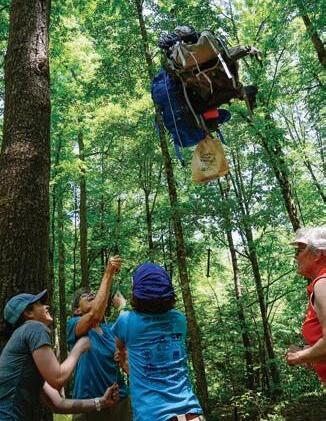
We return to the van around 5:30 p.m. the next day, and though I’m sweaty, sorefooted and badly in need of a shower, if given the choice I’d gladly avoid civilization a while longer.
I replay the day in my mind — the leisurely wakeup, the warm breakfast, and the 6-mile hike we took along the base of Pilot Mountain while our gear remained at the campsite. A flame azalea in full orange splendor, a ghostly bank of Indian pipes nearly hidden beneath a coat of leaf litter, spidery white Bowman’s root blooms at waist height, a strange purple-gray orchid that I later discovered is called large twayblade. Another rattlesnake, smaller than the first but also sitting right along the trail at the time we found it.
The sun, and how quickly its warmth made these cool coves humid and steamy. Then the grueling 3 miles between campsite and car — miles 7 through 9 for the day — all uphill and with a full pack on.
Odvody starts the car, and then she starts the conversation, asking us each to fill in the blank: “Before this trip I thought. Now I know.”
“I thought I could make it, and now I know I did make it,” said Woollen, 66, one of the two first-time backpackers on the trip.
“I thought I knew what I was doing because I’m a runner. I’m in shape. I hike all the time,” said Megan Hauser, 38, the other first-time backpacker. “But then I learned I had a lot to learn.”
The lessons learned were small things, mostly. Hauser wished she’d thought to bring a pillow with her — instead she slept with her head on a folded-up pair of pants. Woollen said it took her half the night to figure out that staying warm in a mummy bag involves a lot more scooching and cinching than she’d initially thought. Both women said the pack was heavier than they’d anticipated, that they’d underestimated how much more work it would be to hike loadedup like that than with the lighter day pack they’re used to.
But Woollen learned another important lesson too.
“I learned that I would enjoy doing it again,” she said.
Both she and Hauser had an easy answer as to why.
“The camaraderie,” said Woollen. “Sitting around the campfire, talking at night.”
In particular, talking to other women.
“That’s what I would say for the ‘before I thought, now I know,’” said Odvody. “Before I thought it would be awesome being with women, and now I know, I continue to know that it’s awesome being with women out in the woods. Because we know how to help each other. We know how to share openly, and we trust each other. It’s just different being with women.”
“I’ve got into more intimate conversations with women in the woods,” Woollen agreed. “I think some of my closest friends are people I have met hiking, because you talk the whole time you’re out there — or, not the whole time, but so much. You really open up and get to know people.”
It’s true, I think. On the trail, there’s no agenda other than putting one foot in front of the other and drinking in the beauty. The words come easy. So does the listening.
“I love going out in the woods because you realize what’s truly important is that quality time with people and hearing those stories, rather than checking off a to do list,” said Tyler.
When I get home, my to do list is there, still waiting to be checked off. But my mind is clear, my breathing easier than it had been before my night in the woods. I feel at peace — from my time outdoors, and from the knowledge that OMC’s work will make it possible for other people in my community to have their turn for a restorative backcountry adventure.
Seven of the world’s top botanical and horticultural experts will speak at the 2021 Southeastern Plant Symposium and Rare Plant Auction, this year taking place online Saturday, June 12, with a virtual Rare Plant Auction open from 3 p.m. Thursday, June 3, to 5 p.m. June 12.
Featured speakers include Fergus Garrett, one of the world’s greatest garden designers and makers; Stephen Barstow, also known as Extreme Salad Man and a global expert on ornamental edibles; Peter Zale, Ph.D., associate director of Conservation, Plant Breeding and Collections at Longwood Gardens in Pennsylvania; Kevin Conrad, botanist at the U.S. National Arboretum in Maryland; Irene Palmer, research specialist at N.C. State; Aaron Floden of the Missouri Botanic Garden and a world expert on plants with a focus on native American flora; and Hans Hansen, director of new plant development at Walters
Gardens in Michigan.
The $75 registration fee covers conference attendance, but there is no cost to participate in the auction. Proceeds benefit the endowments of Juniper Level Botanic Garden and J.C. Raulston Arboretum at N.C. State University. Register under the “Events” tab at www.jcra.ncsu.edu.
The Master Gardener Plant Clinic is back in action, with in-person service from 9 a.m. to noon on Tuesdays and 1 to 4 p.m. Thursdays at Haywood County Extension on Raccoon Road in Waynesville.
During these times, Master Gardeners will be available to help with all manner of plantrelated questions, including lawns, vegetables, flowers, trees, disease, pests, soils, fertilizers and more.
Virtual service is also available by emailing haywoodplantclinic@gmail.com with a description of the problem and any photos that may help with diagnosis, or calling 828.456.3575 and describing the issue to the receptionist.
Temporary, single-lane closures will be in effect along the Spur between Gatlinburg and Pigeon Forge through Thursday, June 10.
Roadside work on both the north and southbound lanes will include litter removal, string trimming, mowing, shoulder reconditioning and culvert cleaning. Closures will be in effect from 7 a.m. through 5 p.m. Tuesday through Thursday this week along the northbound Spur, and work will shift to the southbound lane from 7 a.m. to 5 p.m. Monday through Thursday the week of June 7. www.nps.gov/grsm/planyourvisit/temproadclose.htm.








188 Georgia Road, Franklin ∙ 3494534 49 McDowell Street, Asheville ∙ 2547716 35 NC Hwy 141, Murphy ∙ 8358389


Learn to fly fish — or sharpen your skills — with Haywood County Parks and Recreation this month.
Dates are June 4, 11, 19 and 25. Beginner classes will be held from 10 a.m. to noon each day below the Lake Junaluska dam, and intermediate classes will be 1 p.m. to 3 p.m.
Cost for each series is $10. Register with Ian Smith, ian.smith@haywoodnc.gov.
Hike Black Balsam with a moderate 4-mile trek starting at 10 a.m. Wednesday, June 9.
Phyllis Woollen and Betty Green will lead this hike to Sam Knob, featuring an elevation gain of 800 feet. It’s offered through Haywood Parks and Recreation, which offers a full schedule of guided hikes stretching through the season.
Hikes are $10 per person, and registration is required. Sign up by calling 828.452.6789.
A National Park Foundation grant will fund outdoor field trips for kids in the Great Smoky Mountains National Park.
The Great Smoky Mountains Institute at Tremont and Friends of the Smokies received the NPF Open OutDoors for Kids Hybrid Learning grant to support the program, called “Schoolyard Exploration, Smokies Style.”
The park is developing ranger-led, interactive K-12 field trips that highlight Smokies resources. Tremont’s Schoolyard Adventures guide teachers in how to use their schoolyard with up to three days of outdoor activities. Jointly, the park and partners will host a
series of virtual educator workshops and a community of practice designed for collaboration and sharing.
Great Smoky Mountains National Park is one of 32 national parks out of more than 400 receiving an NFP grant through their partners for the Open Outdoors for Kids Hybrid program.
Recognizing that the COVID-19 pandemic has shifted how and where students are learning, NPF collaborated with the NPS to find a way to meet the needs of students, teachers, schools and communities during these uncertain times and discuss how lessons learned can be applied in the long-term. The result was the Open OutDoors for Kids Hybrid Learning program. Hybrid design and a holistic approach to distance learning, which includes non-internet and internet-based elements, are among the most critical aspects of the program.

The most recent round of Pigeon River Fund Grant Awards distributed through the Community Foundation for Western North Carolina will provide $236,250 for water quality projects in Haywood, Buncombe and Madison counties.
Awarded projects include:
n $30,000 to help Haywood Waterways Association plan, engineer, design, permit and provide education for the Hominy

the Swim Guide, a weekly water quality monitoring program focused on sampling for E. coli bacteria at popular river accesses. n $6,500 to help Haywood Waterways Association repair two failing septic systems in the Pigeon River Watershed near Canton.
n $30,000 to help RiverLink complete an engineered design for the Southside Community Stormwater Project, which aims to solve flooding issues and improve surface water quality in Town Branch, also referred to as “Nasty Branch.”

Creek stream Improvement Project.
n $30,000 to help the Maggie Valley Sanitary District acquire and protect the 24.5-acre McGaha property in Haywood County.
n $30,000 to help The Conservation Fund protect the 25.1-acre Finger property in Haywood County.
n $25,670 to help MountainTrue improve its E. coli monitoring work by establishing a real-time testing location and conducting follow-up to identify possible sewer leaks documented from two infrared imaging flights.
n $24,000 to help the Southern Appalachian Highlands Conservancy survey a 109-acre conservation easement on the Crabtree Bald Geers property in Haywood County.
n $12,080 for MountainTrue to continue
n $28,000 to help Asheville GreenWorks make the Trash Trout more durable and install more such litter-capturing devices in Buncombe County. Funds will also recruit, train, manage and outfit volunteers for the new StreamKeepers Program.
n $10,000 to support Buncombe County Soil and Water Conservation District Envirothon and Youth Environmental Stewardship (YES!) Camp programs. n $10,000 to help Laurel Community Center Organization turn a creekside classroom into an aquatic-themed natural sciences/STEM classroom in Madison County.
Since 1996, the Pigeon River Fund has distributed more than $8.2 million in grants. The money comes from Duke Energy in exchange for the company’s damming the Pigeon River for hydropower. The fund is managed by the Community Foundation of Western North Carolina. The next application deadline for grant funds is Sept. 15.
The No Man’s Land Film Festival, the only adventure film festival featuring exclusively female athletes, will come to Western North Carolina for the fourth year running with an online streaming event at 6:30 p.m. Friday, June 11.
Hosted by MountainTrue, films will feature jaw-dropping stories of women capable of amazing athletic feats, and the stories of those who have risen above stereotype or disability to reclaim agency over their own lives. Free, with donations to MountainTrue encouraged. Register at www.mountaintrue.org/nmlff2021.



The pool at Lake Junaluska is now open for the season, and 2021 passes offering pool admission and special discounts at Lake Junaluska though Labor Day are on sale.
The pool will be open from 10 a.m. to 8 p.m. each day through Labor Day. Admission is complimentary for lodging guests, and anyone can access it by purchasing a daily or season pass.
Summer hours for kayak, canoe and paddleboard rentals have also started, with rentals available daily from 10 a.m. to 8 p.m. Guided pontoon boat cruises are available 1 to 8 p.m. Thursday through Sunday.
Daily passes allow all-day pool access, a round of mini golf and an hour of shuffleboard or cornhole, and they cost $10 per person, $30 per family and $5 per person after four people. Summer activity passes include admission for up to four people at the swimming pool, a round of mini golf, tennis and pickleball equipment rental, a $5 discount on a round of golf with cart and 10 percent off at Lakeside Bistro, Lambuth Inn Dining Room Junaluska Gifts & Grounds and canoe, kayak and paddleboard rentals. Buy daily passes at the swimming pool and season passes online at www.ljrec.org.
After a year’s slumber, the Highland Brewing Night Flight 4.5-mile race will return on Saturday, July 17, at the brewery in Asheville.
The race, capped at 550 runners, will step off at 7:30 p.m. and take runners through the Asheville Golf Course and Beverly Hills neighborhood and past the WNC Nature Center before finishing back at Highland Brewing Company. A post-race party and awards ceremony will be held at the Meadow.
Glow swag provided and dressing up encouraged, with beer waiting at the finish line. Proceeds go to the development of greenways in Asheville and Buncombe County through Connect Buncombe. Produced by Glory Hound Events. Cost is $43. Register at www.iamathlete.com.
Sign up for the second annual Unified Charitable Golf Tournament benefitting Haywood Pathways Center and The Community Kitchen by Friday, June 4, to get the early registration discount.
The tournament will be held starting at 9 a.m. on Friday, July 2, at Springdale at Cold Mountain. The golfer package includes breakfast by Holy Cow Food Truck, 18 holes of golf, cart rental and lunch immediately after the tournament. The for-





mat is captain’s choice.
Until June 4, registration is $125 per golfer or $500 per team, and after June 4 the cost is $150 per golfer or $600 per team until the registration deadline on June 18. Advantage packages and raffle tickets will be available with registration or on the day of the event.
Register online at www.haywoodpathwayscenter.org or in person at Haywood Pathways or The Community Kitchen. To become an event sponsor, contact david@haywoodpathwayscenter.org, thecommunitykitchen@gmail.com or 828.246.0332.



written by Ingles Dietitian Leah McGrath
Leah McGrath, RDN, LDN is the Corporate Dietitian for Ingles Markets. She can answer your questions about food from the farm to the plate, whether you want to know about nutrition, ingredients, preparation or farming practices.
Leah is a registered dietitian (RD), licensed in the state of North Carolina. She has a B.S. in Human Nutrition from the University of Maryland, completed her dietetic internship with the U.S. Army, served as an offecer and dietitian in the U.S. Army and worked in Public Health as a WIC and Nutrition Director in South Carolina.
For the past 19 years Leah has been the Corporate Dietitian for Ingles Markets. Her passion to learn more about the food system has led her to visit over 60 farms (of all sizes) and food entrepreneurs in the past 6 years. She is also actively involved with farmers and food businesses in Western NC and works regularly with ASAP (Appalachian Sustainable Agriculture Project) and the North Carolina Department of Agriculture to promote local and NC grown and made products. Stay connected with Leah!
Listen to her question and answer show, “Ingles Information Aisle”, every Saturday morning on WWNC 570am on iheartradio Read her columns in the Smoky Mountain News and in Smoky Mountain Living
If you have questions write to her at: Lmcgrath@ingles-markets.com Call her: 800-334-4936

Leah McGrath, RDN, LDN Ingles Market Corporate Dietitian @InglesDietitian


Leah McGrath - Dietitian 800.334.4936


Friends of the Smokies will host the third annual Smokies Cup Tournament at the Biltmore Sporting Clays Club Sept. 1617 this year.
Registration is open to teams of four at www.smokiescup.org. Teams can compete on either day, and morning and afternoon flights are available with breakfast and
lunch following the competition. Teams of four family members may enter the family challenge at no additional cost and will be eligible to take home an additional award. Proceeds will fund several projects and programs to help ensure that America’s most-visited national park is preserved and protected for generations to come.
Great Smoky Mountains National Park Superintendent Cassius Cash was named the winner of the 2021 Agency Leadership Award from the Public Lands Alliance during a virtual conference May 24.
The award recognizes a public land management agency employee who has made outstanding accomplishments in championing, cultivating and leading partnerships. The Great Smoky Mountains Association nominated Cash for his leadership throughout the past six years and for outstanding guidance during a difficult year wrought with fear, isolation and social unrest.
“The Smokies provide superintendents with nonstop challenges that play out on a national stage under the constant, relentless scrutiny of the media and area business leaders,” said GSMA Executive Director Laurel Rematore. “Superintendent Cash faces the challenges and pushes his park staff and partner organizations toward embracing the opportunity that lies within each challenge.”
tions plan in collaboration with GSMA, which runs the bookstores in park visitor centers. At the same time, he used his partnership prowess to address two major issues in groundbreaking ways. First, Cash has made it a priority to involve local people in finding solutions to unsustainable visitation levels through Visitor Experience Stewardship discussions — holding Zoom meetings with gateway community members to make them aware of the issues, gather their input and seek solutions together. Secondly, in response to the deaths of unarmed African Americans and the nationwide social justice movement that followed, Cash created Smokies Hikes for Healing, an initiative in which trained facilitators joined each of eight guided hikes with 10 participants in order to lead those groups in thought-provoking private discussions to recognize and confront the long-standing ills associated with racism.
These are only the answers.

In 2015, Cash became the park’s firstever African American superintendent and has since led the Smokies through situations as diverse as the 100th birthday of the National Park Service, the devastating Chimney Tops 2 Fire in November 2016, and the immense visitation numbers during 2017’s Total Solar Eclipse — all while demonstrating an authentic, honest approach to relationship-building in the park, said GSMA.
Last year, Cash led the development and implementation of a COVID-SAFE opera-
“I like to say, if I have left it better than when I found it, then I have done my job,” Cash said in a fall 2020 interview with Smokies Life magazine editor Frances Figart. “But that doesn’t just apply to my workplace. It’s also about my community. Addressing these issues and looking at how our communities can make changes or be a part of change, I think that is the job I’m here to do.”
For additional details on the 2021 Public Lands Alliance Partnership Awards, visit www.publiclandsalliance.org or watch the ceremony stream at www.facebook.com/publiclandsalliance.
• Rehearsals for the start of a new season by the Haywood Community Band begin at 7 p.m. on Thursday, June 3, in the Fellowship Hall of Long’s Chapel United Methodist Church, 133 Old Clyde Road. The rehearsals continue at the same time each Thursday evening. Membership is open to all who have previously played in a band, no matter how long ago it was. Auditions are not required. If you would like to participate, call band president Rhonda Kram, owner of the Stone Cottage Band Instrument Shoppe, at 828.456.4880.
• Jackson County Public Library will host its adult summer reading program beginning June 1. Sign up online now using the website www.fontanalib.org/summer. Call 828.586.2016. This event is co-sponsored by the Friends of the Jackson County Public Library.
• The Cherokee Bonfire & Storytelling will be held from 7 to 9 p.m. Sundays, Mondays, Wednesdays and Saturdays through Sept. 29 at the Oconaluftee Islands Park in Cherokee. The bonfire is free and open to the public. For more information, call 800.438.1601 or click on www.visitcherokeenc.com.
• The Lake Junaluska Flea Market will take place from 8 to 11:30 a.m. on Saturday, June 12, at the Nanci Weldon Memorial Gym at Lake Junaluska. Special early bird shopping is available from 7:30-8 a.m. for $5 cash. Everyone is welcome to attend.
• Cashiers area Chamber of Commerce will host a networking reception from 5-7 p.m. Thursday, June 10, at GlenCove by Old Edwards. Reservations are required, RSVP to office@cashiersareachamber.com.
• Betty Farmer, award-winning professor of communication at Western Carolina University and workplace consultant, will be facilitating an online workshop on “Understanding Emotional Intelligence,” from 9 a.m. to 3:30 p.m. on Friday, June 11. The registration fee for this workshop is $139. For more information and to register, visit pdp.wcu.edu and click on “Workshops and Certificates for Managers and Leaders.”
• With Heart Projects will host its inaugural Charity Golf Tournament at 12 p.m. Saturday, June 19, at the Waynesville Inn and Golf Resort. This is a four person captains choice tournament, entry fee is $250 and registration begins at 11 a.m.
For more information contact Gabriel Frazier at 229315-4240 or on With Heart Projects Facebook and Instagram.
n All phone numbers area code 828 unless otherwise noted.
n To have your item listed email to calendar@smokymountainnews.com
• Waynesville Yoga Center will host a 90-minute crash course to introduce the basics of yoga in a tutorial style class from 5:30 to 7 p.m. Sunday, June 6. Jake Gilmore will guide participants through the alignment details of basic sitting and standing postures, with personalized attention and opportunities to ask questions. For more information or to register visit www.waynesvilleyogacenter.com.
• Waynesville Yoga will host a restorative session with Amber Kleid and Shutri Nadis from 7 to 8:30 p.m. on Wednesday, June 23. Cost is $25 plus donations for musicians. For more information about what to bring or to register contact the Yoga Center at 828.246.6570 or hello@waynesvilleyogacenter.com.
• The Classic Wineseller (Waynesville) will host a special dinner show with Sheila Gordon (vocals/piano) at 7 p.m. June 5. Cost is $62 per person, which includes the meal. Reservations required. 828.452.6000 or www.classicwineseller.com.
• Frog Level Brewing (Waynesville) will host The Realtorz June 4, Darren Nicholson Band (Americana/country) June 5 and Kevin Fuller (singersongwriter) 4 p.m. June 6. All shows begin at 6 p.m. unless otherwise noted. Free and open to the public. 828.454.5664 or www.froglevelbrewing.com.
• Balsam Falls Brewing (Sylva) will host an open mic from 8 to 10 p.m. every Thursday. Free and open to the public. www.balsamfallsbrewing.com.
• Nantahala Outdoor Center (Nantahala Gorge) will host “Bluegrass with Blue” June 4, and Brown Mountain Lighting Bugs June 5. All shows begin at 6 p.m. Free and open to the public. 888.905.7238 or www.noc.com.
• Stecoah Valley Center (Robbinsville) “An Appalachian Evening” series will host The Jones Brothers & Julie Nelms June 5, Frank & Allie June 12 and Buncombe Turnpike June 19. The three shows are free and open to the public. A special online performance by The Kruger Brothers will be June 26. Ticketed shows will include The Jeff Little Trio July 10 ($25), Liam Purcell & Cane Mill Road July 17 ($15) and Darin & Brooke Aldridge July 24 ($25). 828.479.3364 or www.stecoahvalleycenter.com.
• Unplugged Pub (Bryson City) will host Blackjack Country June 3 and Tricia Ann & The Wolfpack June 5. All shows begin at 8 p.m. Free and open to the public. 828.538.2488.
• The Classic Wineseller (Waynesville) will host a special dinner show with Sheila Gordon (vocals/piano) at 7 p.m. June 5. Cost is $62 per person, which includes the meal. Reservations required. 828.452.6000 or www.classicwineseller.com.
• There will be a free wine tasting from 6 to 8 p.m. every Thursday and 2 to 5 p.m. every Saturday at The Wine Bar & Cellar in Sylva. 828.631.3075.
• Bryson City Wine Market will host weekly wine flight tasting events from 11 a.m. to 8 p.m. on Friday and Saturday. The market will also serve wine by the glass from 11 a.m. to 8 p.m. Monday through Saturday.
• The “Unto These Hills” stage production will be held at 8 p.m. Monday to Saturday from May 19 through Aug. 14 at the Mountainside Theater in Cherokee. There will also be a 10:30 a.m. show on Saturday, June and all Saturdays in July. For more information and to purchase tickets, click on www.cherokeehistorical.org.
• The exhibit “Inspiration: The Creative Muse at Work” will run June 4-26 at the Haywood County Arts Council in downtown Waynesville. www.haywoodarts.org.
• The Master Gardener In-Person Plant Clinic will be open starting in June, on Tuesdays from 9 a.m. to noon, and Thursdays from 1 to 4 p.m. at Haywood County Extension on Raccoon Road. Master Gardeners will be available to help gardeners with all gardening questions.
• Haywood County Parks and Recreation will guide a birding tour at Graveyard Fields at 8 a.m. June 2. The tour will be led by Howard Browers. Contact Haywood Parks and Rec to register at 828.452.6789 or Ian.smith@haywoodcountync.gov.
• A boating safety course will be offered 6-9 p.m. June 2-3 at Haywood Community College, giving participants a shot at a certification required to operate vessels propelled by a motor of 10 horsepower or greater. The free course is offered as a partnership between HCC and the
Visit www.smokymountainnews.com and click on Calendar for:
n Complete listings of local music scene
n Regional festivals
n Art gallery events and openings
n Complete listings of recreational offerings at health and fitness centers
n Civic and social club gatherings
N.C. Wildlife Resources Commission. Register at www.ncwildlife.org.
• The Nantahala Bike Club will sponsor a community social ride starting at 10 a.m. Saturday, June 5, at Friends of the Greenway headquarters in Franklin. Friends of the Greenway will have hot dogs, drinks and food for sale and a social ride will follow along the greenway, highlighting the new Main Street underbridge connector. 828.369.8488.
• Hike the Mountains-to-Sea Trail with Haywood Waterways Association during an 8.5-mile trek Saturday, June 5. The group will meet at 9 a.m. and return by 2 p.m. The event is free for Haywood Waterways members with a $5 donation requested from nonmembers. Space limited. No dogs. Hikers should bring their own lunch and water. RSVP to Christine O’Brien at Christine.haywoodwaterways@gmail.com or 828.476.4669, ext. 11.
• Haywood County Parks and Recreation will guide a hike from Black Balsam to Sam Knob at 10 a.m. June 9. The hike will be led by Phyllis Woollen and Betty Green. Hikes are $10 per person, paid at registration. Contact Haywood Parks and Rec to register at 828.452.6789 or Ian.smith@haywoodcountync.gov.
• Mountain True will host No Man’s Land Film Festival at 6:30 p.m. June 11, virtually on Vimeo. Visit https://mountaintrue.org/nmlff2021/ for more information.
• A three-day paddle festival will gather female paddlers at Nantahala Outdoor Center June 4-6. Register at www.noc.com/events, cost is $45. Donations and registration fees benefit the Shannon Christy Memorial Fund, which supports nonprofits focused on women’s empowerment as well as the Live Like Maria Fund.
• MountainTrue will offer a four-part climate change series exploring the impacts of climate change on the communities and ecology of the Southern Blue Ridge will stream on YouTube at bit.ly/3skxZnO. Some sessions are already available, upcoming sessions include 11 to 1 p.m. Wednesday, June 23.
• A series of volunteer workdays are scheduled for 9 a.m. to 3 p.m. Thursdays, with sites in Tennessee June 10, 17 and 24. In addition, a special opportunity will take place in North Carolina Saturday, June 5, in honor of National Trails Day. Space limited. Register with Adam Monroe at 828.497.1949.

The Smoky Mountain News Marketplace has a distribution of 16,000 copies across 500 locations in Haywood, Jackson, Macon and Swain counties, including the Qualla Boundary and west Buncombe County. Visit www.wncmarketplace.com to place your ad!
Rates:
• $15 — Classified ads that are 25 words, 25¢ per word after.
• Free — Lost or found pet ads.
• $6 — Residential yard sale ads.*
• $1 — Yard Sale Rain Insurance Yard sale rained out? Call us by 10a.m. Monday for your ad to run again FREE
• Legal N otices — 25¢ per word
• $375 — Statewide classifieds run in 170 participating newspapers with 1.1+ million circulation. (Limit 25 words or less)
• Boost Online — Have your ad featured at top of category online $4
• Boost in Print
• Add Photo $6
• Bold ad $2
• Yellow, Green, Pink or Blue Highlight $4
• Border $4
Note: Highlighted ads automatically generate a border so if you’re placing an ad online and select a highlight color, the “add border” feature will not be available on the screen.
Note: Yard sale ads require an address. This location will be displayed on a map on www.wncmarketplace.com
p: 828.452.4251 · f:828.452.3585 classads@smokymountainnews.com www.wncmarketplace.com
DONATE YOUR CAR OR TRUCK To Heritage For The Blind. Free 3 Day Vacation, Tax Deductible, Free Towing, All Paperwork Taken Care Of. Call 1-855-869-7055
ONLINE ONLY FIREARM AUCTION,
Pawn Shop in Rocking-tion.com, 800.997.2248,
ONLINE ONLY AUCTION, Featherlite Haul-
WORK FROM ANYWHERE You have an internet connection? 13 po-
Complete online training
MEDICAL BILLING & CODING TRAINING.
Gardener’s Assistant, Assistant F&B Manager, Banquet Captain, Banquet Supervisor, Banquet Server, Restaurant Reservationist, Host, Server, Busser, Bartender, Cook, Pastry & Bread Cook, Dishwasher, Reservations Specialist, Front Desk Agent, Bellman, Night Auditor, Room Attendant, Houseman, 2nd Shift Laundry, Retail Associate, Spa Attendant, Spa Concierge, Massage Therapist, Cosmetologist
Contract Positions: Fitness Instructor (spin), Makeup Artist


qualify. 833-990-0354
CWS- OWNER OPERATORS year driving experience. paid weekly paid per mile, regular home time. Call 1-800-832-7036 ext 1626.
THE JACKSON COUNTY DEPARTMENT Ofing for a Social Worker in Child Protective Ser-a four year degree in a Preference will be given
Degree in Social Work and/or experience providThe Application for may be obtained at the
FTCC - Fayetteville Technical Community College -

-our employment portalpleadmin.com/ Human
An Equal Opportunity Employer.
FTCC - Fayetteville Technical Community College--techcc.peopleadmin.com/techcc.edu. An Equal Opportunity Employer.
NOW HIRING AT MUSEUMweekday and weekendcation.
Care Social Worker in


a four year degree in a Preference will be given
Degree in Social Work and/or experience providThe application for may be obtained at the

THE JACKSON COUNTY DEPARTMENT Of

tiated adult protective









Better Homes and Gardens Real Estate- Heritage
• Carolyn Lauter - carolyn@bhgheritage.com

Beverly Hanks & Associates- beverly-hanks.com
• Billie Green - bgreen@beverly-hanks.com
• Brian K. Noland - brianknoland.com
• Anne Page - apage@beverly-hanks.com
• Jerry Powell - jpowell@beverly-hanks.com
• Catherine Proben - cproben@beverly-hanks.com
• Ellen Sither - ellensither@beverly-hanks.com
• Mike Stamey - mikestamey@beverly-hanks.com
• Karen Hollingsed- khollingsed@beverly-hanks.com
• Billy Case- billycase@beverly-hanks.com
• Laura Thomas - lthomas@beverly-hanks.com
• John Keith - jkeith@beverly-hanks.com
• Randall Rogers - rrogers@beverly-hanks.com
• Susan Hooper - shooper@beverly-hanks.com
• Hunter Wyman - hwyman@beverly-hanks.com
• Rob Roland - robroland@beverly-hanks.com
ERA Sunburst Realty - sunburstrealty.com
• Amy Spivey - amyspivey.com
• Rick Border - sunburstrealty.com
• Steve Mauldin - smauldin@sunburstrealty.com
• Randy Flanigan - 706-207-9436
Jerry Lee Mountain Realty
• Jerry Lee Hatley- jerryhatley@bellsouth.net
• Pam James - pam@pamjames.com
Keller Williams Realty - kellerwilliamswaynesville.com
• The Morris Team - www.themorristeamnc.com
• Julie Lapkoff - julielapkoff@kw.com
• Darrin Graves - dgraves@kw.com Lakeshore Realty
• Phyllis Robinson - lakeshore@lakejunaluska.com
Mountain Dreams Realty- maggievalleyhomesales.com
Mountain Creek Real Estate
• Ron Rosendahl - 828-593-8700
McGovern Real Estate & Property Management
• Bruce McGovern - shamrock13.com
RE/MAX Executive - remax-waynesvillenc.com remax-maggievalleync.com
• The Real Team - TheRealTeamNC.com
• Ron Breese - ronbreese.com
• Landen Stevenson- landen@landenkstevenson.com
• Dan Womack - womackdan@aol.com
• Mary & Roger Hansen - mwhansen@charter.net
• David Willet - davidwillet1@live.com




SCHOOL-HOUSE DARK ROCK ACROSS
1Beethoven's Third, popularly
7Biblical twin
12"-- -Ca-Dabra" (1974 song)
16Math calculation
19Fred Astaire, e.g.
20Piano challenge
21Get out of the field
22Year, in Portugal
23Start of a riddle
25Security datum
27Cockpit guess, briefly
28Math calculation
29Woolen cloth
31Many a roof edge
32Riddle, part 2
38Costume part, perhaps
39Future jr.
40Maine college town
41Riddle, part 3
50Debt slip
51"Annie" star Quinn
52Home of the Bay of Pigs
53Mr. America's pride
56Sensed
60Great serves
61It has limbs
62Bit of a lot
63Cow catcher
66Diner dish
68Riddle, part 4
73Home of Ikea
74Virtual bread?
75Elliptical
76Like saints
77Not had by
79Turns away
84With 55-Down, totally ready
85Mrs., in Berlin
86SOS signals
89"So cool!"
90Riddle, part 5
95"Heidi" author Johanna
98A juror takes one
99Corn-on-the-cob unit
100End of the riddle
109Intro studio class
110"-- Gold" (Fonda film)
111Author Sarah -- Jewett
112Gun rights org.
114Stunning with a gun
116Riddle's answer
121Suffix with polymer
122Town near Santa Barbara
123Everything, in Latin
124Ill-advised
125Decimal base
126New York City river
127"Zounds!"
128Notes with hashtags
DOWN
1Falco of "The Sopranos"
2Balsa transports
3Tavern sign
4Freud's "I"
5So-so mark
6Call into court
7Tiara shiner
8Best players
9Bad dog
10Exalting poem
11Really criticize
12The Little Mermaid
13Moisten, as grass
14GI's time off
15Clerk at TV's Kwik-E-Mart
16Actor Antonio -- Jr.
17Asymmetric
18Oscar winner Rita
24Laundry room brand
26London length unit
30Actor Ken
33"Oh, gross!"
34LI doubled
35Even -- speak
36Score unit
37Itty-bitty bit
41Little drink
42Bladed tool
43"They're playing -- song"
44Courtroom mallet
45Go hastily
46Dated
47Razor-inventing philosopher
48Chalked stick
49Remit, as sins
53Musician Guthrie
54Bone to pick
55See 84-Across
57Tea box
58Latin "Lo!"
59Mined find
60Year- -- -glance
61Green car?
63Zenith rival
64"TGIF" part
65Hearth residue
67Spiteful
68Like a missing GI
69Tony winner Carter
70Subside
71Start for friendly
72Aplomb
73"Na Na" lead-in
78Scot's refusal
79Bible boat
80Tripod part
81As well
82Really long time
83Hen or nanny
85Govt. money guarantor
86It lacks a heel
87Wood strip
88Throb
90Shaw of jazz
91Presage
92Ration
93Mineo of films
94Three, in Rome
95Try to hit, as a gnat
96Coined thing
97China's Sun --
101Mystical board
102Lower arm bones
103Kosher
104Like plow-pulling oxen
105Lock of hair
106Neither Rep. nor Dem.
107Many a bellybutton
108Lovers' meeting
113Firefighters' tools
115Sushi eggs
117"Can u believe it!"
118-- roll (lucky)
119Nashville-to-Chicago dir.
120Have debts

include general intake and community outreach-
four year degree in a Hu-erence will be given to Social Work and experience providing Social application for employorg/employment-opportuor the Sylva branch of the
ACTIVE
Veterand earn your degree at
medical training available learn more call 833-9703466
AIRLINES ARE HIRINGon Aviation training. Fi-tenance 866-441-6890.

OFFICE ADMINISTRATORaccounting and payroll
payable, maintenance of general ledger, and reconciliation of bank ac-
Here’s How It Works: Sudoku puzzles are formatted as a 9x9 grid, broken down into nine 3x3 boxes. To solve a sudoku, the numbers 1 through 9 must fill each row, column and box. Each number can appear only once in each row, column and box. You can figure out the order in which the numbers will appear by using the numeric clues already provided in the boxes. The more numbers you name, the easier it gets to solve the puzzle!
gree in accounting and/or
experience required. For more information or to org. (828) 557-2773 ma-
Be. prepared for power

ATTENTION SENIORS AGES 40-85 to help pay for funeral 407-960-4782
OXYGEN-Free info kit 888-9123728 LIFE ALERT. 24/7. One 2362
Estate Announcements NEVER PAY FOR HOME REPAIRSplete Care Home War-
preference, limitation or or national origin, or an inpreference, limitation or under 18 living with parand pregnant women. knowingly accept any ad-
CABLE PRICE INCREASE AGAIN? Switch
1-866-501-1596
PUBLISHER’S NOTICE