Friday, December 20, 2013
Britney’s ‘C’omeback
The Smoke Signal
www.thesmokesignal.org
Arts & Entertainment 13
clipartlord.com
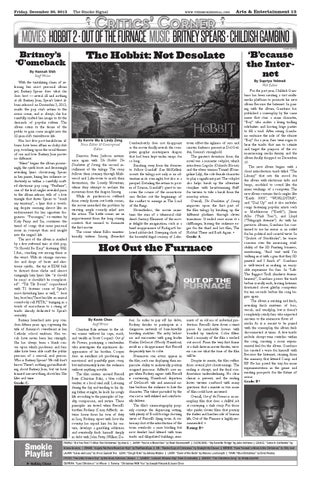
The Hobbit: Not Desolate
‘B’ecause the Internet
By Hannah Shih Staff Writer
With the tantalizing claim of releasing her most personal album yet, Britney Spears does what she does best — reveal all and nothing at all. Britney Jean, Spear’s latest album released on December 3, 2013, marks the pop star’s return to the music scene, and as always, she has carefully crafted her image to fit the demands of popular culture. The album caters to the desire of the public to gain some insight into the 32-year-old’s tumultuous life. Her last few post-breakdown albums have been affairs in shaky club pop, touching upon the usual themes of sex and love. Britney Jean proves no different. “Alien” begins the album promisingly, the synth beats and deceivingly revealing lyrics showcasing Spears in her prime, luring her audience seductively in within a carefully crafted electronic pop song. “Perfume”, one of the lead singles revealed prior to the album release, tells of a love triangle that drives Spears to “mark my territory”, a lyric that is touching despite seeming almost like an endorsement for her signature fragrances. “Passenger,” co-written by Katy Perry and Sia, continues the trend of songs that seem personal more in concept than real insight into the singer’s life. The rest of the album is marked by a few awkward tries at club pop, “It Should Be Easy” featuring Will. I.Am., standing out among them as the worst. With its strange crescendos and drops of beats and electronic synths, the try at EDM fails to distract from cliche and almost cringingly lazy lyrics like “it should be easy/ it shouldn’t be complicated”. “Tik Tik Boom” coproduced with T.I. features some of Spear’s most disturbing lines as well, “...beat her, beat her/Treat her like an animal somebody call PETA,” bringing in a touch of masochism to a string of tracks already dedicated to Spear’s sexuality. Britney launched into pop stardom fifteen years ago, capturing the title of America’s sweetheart in her Catholic school uniform. Her vocals have never been her strength. She has always been a blank canvas upon which producers and fans alike have been able craft the public persona of a sensual, real person. Who is Britney Spears? We still don’t know. There’s nothing groundbreaking about Britney Jean, but we have learned one new thing about her. She likes red wine. Grade: C-
britneyspears.com
By Supriya Yelimeli Web Editor
By Kerrie Wu & Lindy Zeng News Editor & Centerspread Editor
Director Peter Jackson returns once again with The Hobbit: The Desolation of Smaug, the second installment of the trilogy. The story follows their journey through Mirkwood and Lake-town to reach their destination, the Lonely Mountain, where they attempt to reclaim the mountain from the dragon Smaug. While its predecessor suffered from overly drawn out battle scenes, the movie remedied the problem by weaving ample comedy relief into the action. The battle scenes are an improvement from the long staring contests that seemed to dominate the first movie. The scene where Bilbo unintentionally wakens Smaug (Benedict
thehobbit.com
Cumberbatch) does not disappoint as the movie finally reveals the computer graphic masterpiece dragon that had been kept under wraps for so long. Breaking away from the dwarves to follow Gandalf (Ian McKellen) asserts the trilogy not only as an adventure in its own right, but also as a prequel. Detailing the return to power of Sauron, Gandalf ’s quest to uncover the source of the monstrous orcs fleshes out the beginnings of the conflict to emerge in The Lord of the Rings. Nevertheless, the movie maintains the aura of a whimsical children’s fantasy. Elements of the movie delight the imagination, such as a brief reappearance of Radagast’s beloved rabbit-sled. Sweeping shots of the beautiful frigid scenery of Lake-
town offset the ugliness of orcs and sinister darkness present in Dol Guldur, Sauron’s stronghold. The greatest deviation from the novel was a romantic subplot, which introduces Legolas (Orlando Bloom) and the elven warrior Tauriel (Evangeline Lily), the sole female character to play a significant part. The subplot also helps break up the adventure storyline with heartwarming fluff for viewers to take a break from the nonstop action. Overall, The Desolation of Smaug improves upon the first part of the film trilogy by breaking up the different plotlines through clever transitions. It ended once more at a cliffhanger, leaving the audience eager for the third and last film, The Hobbit: There and Back Again. ▪ Grade: A
Hot Out the Furnace
By Kevin Chen Staff Writer
Christian Bale returns to the silver screen without his cape, mask, and wealth in Scott Cooper’s Out of the Furnace, portraying a steelworker who investigates the mysterious disappearance of his brother. Cooper does an excellent job producing an emotional and painfully grim story, but unfortunately leaves the audience without anything notable. The film centers around Russell Baze (Christian Bale), a blue collar worker at a local steel mill. Laboring during the day and tending to his dying father at night, he leads his rough life according to the principles of loyalty, compassion, and justice. These principles are tested when Russell’s brother Rodney (Casey Affleck) returns home from his tour of duty in Iraq. Rodney, upset with how the country has repaid him for his service, develops a gambling addiction and eventually finds himself deeply in debt with John Petty (Willem Da-
foe). In order to pay off his debts, Rodney decides to participate in a dangerous network of bare-knuckle brawling matches. His risky behavior and encounter with gang leader Harlan DeGroat (Woody Harrelson) result in a disappearance that Russell desperately tries to solve. Numerous star actors appear in the film, each one displaying their impressive ability to realistically portray assigned personas. Affleck’s raw anger when Rodney argues with Russell is convincing. Harrelson’s depiction of DeGroat’s vile and immoral nature beckons the audience to hate the character. The talent provided by the star cast is well utilized and satisfactorily delivers. The film’s cinematography properly conveys the depressing setting, with plenty of B-roll footage showing views of Russell’s dying town. A stationary shot at the introduction of the town overlooks a once bustling but now derelict land littered with train tracks and dilapidated buildings, rem-
facebook.com
nants of an old era of industrial production. Russell’s drive down a street passes by ramshackle houses with boarded up windows. Color filters lend a majority of the film a washed out mood. From the very first frame at a dark drive-in movie theater, viewers can see what the tone of the film will be. Despite its merits, the film suffers from several plot shortcomings. The ending is abrupt, and the final confrontation underwhelming. No clear climax is present, and the ending leaves viewers confused with many questions that a minute or two more of film could have answered. Overall, Out of the Furnace is an exemplary film that does a skillful job at conveying a dark story. For those who prefer slower films that portray the darker and harsher side of human life, Out of the Furnace is highly recommended. ▪ Rating: B+
For the past year, Childish Gambino has been creating a vast multimedia platform to promote his new album Because the Internet. In pairing with the album, Gambino has published a screenplay by the same name that stars a main character, “Boy” who makes a living trolling celebrities and hosting huge parties to fill a void. After seeing Gambino embrace the role of the elusive “Boy” for a year, fans were eager to hear the tracks that aim to satirize and target the purpose of the ever-increasing media frenzy, and the album finally dropped on December 10. The new album begins with a short introduction track titled “The Library” that sets the mood for the album with electronic ticks and beeps, modeled to sound like the inner workings of a computer. The new album contains fresh singles like “Earth: 3005”, “WORLDSTAR”, and “Dial Up” and it also includes songs featuring popular artists such as Macklemore (“Earth”), Jhene AIko (“Pink Toes”), and Lloyd (“Telegraph Avenue”). As with his previous albums, Gambino has continued to use his music as an outlet for his political and societal views. In “Zealots of Stockholm”, he voices concern over the increasing availability of the 3D Printing business, mentioning, “And wait until I’m walking in it with a gun that they 3D printed and I finish it”. Gambino is well-versed in making an enjoyable experience for fans. In “Life: The Biggest Troll (Andrew Auernheimer)”, Gambino pauses the track before it really ends, leaving listeners frustrated about glitchy computers for ten seconds before the song begins again. The album is exciting and fresh, revealing fresh mixtures of bass, vocals, and wordplay, but it doesn’t completely satisfy fans who expected answers to the numerous flaws of media As it is meant to be paired with the screenplay, the album feels disconnected at times. A few tracks include abrupt tune switches within the song, creating a more experimental feel for the album. Gambino has created a voice for himself with Because the Internet, straying from the mimicry that littered Camp and EP. He has paved the way for more experimentation in the genre and exciting prospects for the future of music. Grade: B+
itunes.com