Santa Monica Daily Press
❑
Tuesday, November 12, 2002 ❑ Page 11
INTERNATIONAL
Bali bomb, Moscow stand-off renew interest in al-Qaida fight
In mourning
WASHINGTON — Using a bomb, a plan and a crowded nightclub in Bali, al-Qaida operatives gave Indonesia and Australia a rude awakening to terrorism. The lesson was much the same for Russia when Chechen separatists brought explosives into a Moscow theater and took the audience hostage. Yemen, chock-full of suspected al-Qaida and long uncomfortable with terrorism investigations, helped bring about a CIA missile strike that killed six militants, including a top al-Qaida organizer said to be planning new attacks on Western targets in Yemen. Many countries felt the sting when the Sept. 11, 2001 attacks claimed by al-Qaida killed thousands — including some of their citizens — in the United States. But it took the recent spate of smaller-scale, deadly attacks for them to see that Osama bin Laden’s network is truly a threat in their own back yards. “Whilst (terrorism) needs to be addressed at source in places such as Afghanistan, we nevertheless have to also attack it where it’s been realized,” Australian Defense Minister Robert Hill said after talks in Washington last week. “This is, you know, brought home to us in the most stark and terrible way.” Indonesia certainly saw the light. After nearly 200 people, about 90 of them Australians, died in the Bali nightclub, Indonesian officials stopped denying that a significant Islamic terrorist threat existed in their country, and President Megawati Sukarnoputri announced tighter anti-terror measures.
Bruce Hoffman, head of terrorist research at Rand Corp., a private research group, said countries now are more vigilant of tape-recorded threats from alQaida’s second in command, Ayman al-Zawahri. In the recording, al-Zawahri warned U.S. allies to get out of the Muslim world and referred specifically to Germany and France, making it clear to other countries that al-Qaida is “perfectly content to enmesh the citizens of other nations in their struggle,” Hoffman said. Germany, which rooted out al-Qaida clusters and, in a rare move, joined an international military campaign by sending soldiers to Afghanistan, stepped up its counter-terror activity after 11 Germans died in the bombing of a Tunisian synagogue last April by a group linked to al-Qaida. German Foreign Minister Joschka Fischer, in Washington recently to repair a rift over Iraq, discussed cooperation on terrorism as well with his U.S. counterpart, Colin Powell. “On our agenda, the war against terror is top priority number one,” Fischer said. “This is a new totalitarianism, and there is no possibility to negotiate with Osama bin Laden or similar guys.” France, too, has elevated its anti-terror profile after an alQaida-linked group blew up a bus in Pakistan in May, killing 11 French citizens, and when a French oil tanker was rammed near a port in Yemen by a boat packed with explosives — an attack similar to the USS Cole bombing pinned on al-Qaida that killed 17 American sailors. After Australia was hit hard by the carnage in Bali, authori-
ties immediately began a doorto-door hunt in Sydney for members of Jemaah Islamiyah, a group also believed to have ties to al-Qaida. The government declared Jemaah Islamiyah a terrorist organization, given its ambitions to create an Islamic superstate across Asia and northern Australia. “We’re learning more about the interrelationship between those networks ... and others out of the region, in particular from the Middle East,” Hill said. “And the more that we learn, the more we appreciate the extent of the challenge we face.” The message was driven home for Russia after Chechen rebels took an entire theater audience hostage in Moscow, a siege that ended when Russian forces pumped in knockout gas and seized the building. In the end, 128 hostages and about 41 captors died. Without offering evidence, the Russian Foreign Ministry said alQaida was involved in the theater plot. President Vladimir Putin promised to give the Russian military broad power to act “in all places where the terrorists, the organizers of these crimes or their ideological or financial sponsors are located.” U.S. officials view the new vigilance as a good thing, and hoped it would bode well for the overall fight against al-Qaida. “Too often in the past, with the fading memories of a terrible terrorist attack, the focus on permanent improvements in cooperation has faded,” Francis X. Taylor, counterterrorism coordinator at the State Department, said in a speech to the National Defense University on Oct. 23. “We cannot let that happen again.”
Jiang’s accomplishments — even to the point of doctoring quotes from Western journalists to make them sound rosier. The dozens of newspapers in the capital carry the same centrally generated stories, and often the same photos and front-page layouts. Press restrictions are nothing new during Communist Party congresses, held every five years. But the number of nonmainland journalists has grown as China’s economy has opened. There are 759 this year — some 100 more than 1997, according to organizers. Failure of foreign journalists to toe the government’s line has provoked some harsh responses. At least one photographer was detained and forced to delete digital-camera images after taking photos of police leading off a protester. The photographer was told his pictures were “unauthorized” and his press credentials applied only to official events. Several protesters, most act-
ing alone, have appeared outside the Great Hall of the People, the huge building facing Tiananmen Square where the congress is being held. They are quickly bundled away, and any pamphlets they try to hurl toward reporters or delegates are aggressively scooped up by police. News reports on the congress by Canadian, German, Finnish and Hong Kong television agencies, all intended for home audiences, were blocked as they were beamed out of China, reporters said. The footage showed antiChinese protests in Tibet, practitioners of the outlawed Falun Gong religious sect and other politically sensitive material. Foreign television agencies also said their requests for live shots outside the Great Hall had been rejected. Satellite broadcasts by CNN and the BBC visible at hotels and foreign compounds in Beijing have been repeatedly blacked out for brief intervals during reports on sensi-
tive political issues. The treatment contrasted with the friendly greeting given foreign reporters at the congress’ carpeted media center. Smiling attendants offered a coat check, Internet access and stacks of free reference books in several languages. “Warm welcome to all journalists both at home and abroad for covering the 16th National Congress of the Communist Party of China,” said a red banner on one wall. Forms were available to request interviews with party delegates, but requests for top and even midlevel delegates were rejected. The official Xinhua News Agency carried reports Monday about foreign press coverage of the congress. But they quoted only praise. Foreign reporters, Xinhua said, “see the 16th Communist Party congress as having significant meaning, and as advancing China on a continuing path toward development.”
BY SONYA ROSS Associated Press Writer
Brennan Linsley/Associated Press
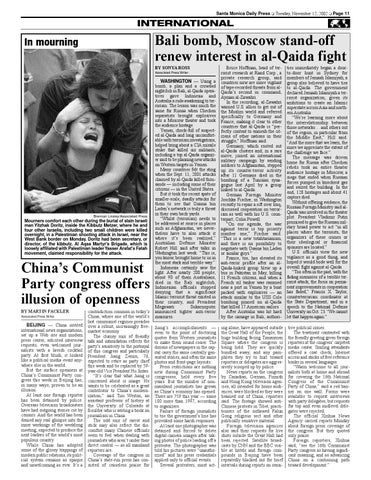
Mourners comfort each other during the burial of slain Israeli man Yitzhak Doritz, inside the Kibbutz Metzer, where he and four other Israelis, including two small children were killed overnight, in a Palestinian shooting attack in Israel, near the West Bank border on Monday. Doritz had been secretary, or director, of the kibbutz. Al Aqsa Martyr's Brigade, which is loosely affiliated with Palestinian leader Yasser Arafat's Fatah movement, claimed responsibility for the attack.
China’s Communist Party congress offers illusion of openness BY MARTIN FACKLER Associated Press Writer
BEIJING — China invited international news organizations, set up a Web site and modern press center, solicited interview requests, even welcomed journalists with a lavish cocktail party. At first blush, it looked like a political media event anywhere else in the world. But the surface openness at China’s Communist Party congress this week in Beijing has, in many ways, proven to be an illusion. At least one foreign reporter has been detained by police. Overseas television broadcasters have had outgoing stories cut by censors. And the world has been denied any real glimpse into the inner workings of the weeklong meeting, expected to produce the next leaders of the world’s most populous country. While China has adopted some of the glossy trappings of modern public relations, its political system remains as opaque and unwelcoming as ever. It’s a
contradiction common in today’s China, where one of the world’s last communist regimes presides over a robust, increasingly freemarket economy. The clumsy mix of friendly talk and intimidation reflects the party’s sensitivity to the portrayal of this congress and particularly President Jiang Zemin, 76, expected to retire as party chief this week and be replaced by 59year-old Vice President Hu Jintao. “It’s clear that what Jiang is concerned about is image. He wants to be celebrated as a great contributor to China’s modernization,” said Tim Weston, an assistant professor of history at the University of Colorado at Boulder who is writing a book on journalism in China. The odd mix of carrot and stick may also reflect the discomfort many Chinese officials seem to feel when dealing with journalists who aren’t under their direct control — as all mainland reporters are. Coverage of the congress in China’s state-run press has consisted of ceaseless praise for