Santa Monica Daily Press
❑
Thursday, November 7, 2002 ❑ Page 11
INTERNATIONAL
Security Council consultations begin on Iraq resolution BY EDITH M. LEDERER Associated Press Writer
UNITED NATIONS — The United States took a final revision of its Iraq resolution to the Security Council on Wednesday in hopes of winning approval after eight weeks of tumultuous negotiations with wary allies concerned it could trigger a new war against Iraqi leader Saddam Hussein. The draft has changed significantly since it was first introduced last month, but U.S. officials said the bottom line remains the same: tough new weapons inspections coupled with a threat of “serious consequences” if Iraq fails to comply. While the revised draft offers major concessions to critics, it still frees the Bush administration to take military action against Iraq without a second resolution. In an attempt to meet French and Russian concerns, the new U.S. draft gives Saddam “a final opportunity” to comply with U.N. inspectors, holds out the possibility of lifting sanctions against Iraq, and adds a reaffirmation of Iraq’s sovereignty. But it remains to be seen whether the latest draft, written with British support, will satisfy Russia, France and others. The council spent 90 minutes discussing the U.S. proposal behind closed doors and agreed to resume negotiations Thursday. French President Jacques Chirac spoke by phone with Russian President Vladimir Putin; both felt “many improvements to the text are already in place,” and the essential role of the Security Council is affirmed, the French leader’s spokeswoman said. However, the leaders agreed “it remains necessary to remove certain ambiguities” that could automatically trigger the use of force, said spokeswoman Catherine Colonna. Russia’s U.N. Ambassador Sergey Lavrov wouldn’t comment on the U.S. draft Wednesday, saying only, “we are not there, yet.” Diplomats said that inside the council, Lavrov cited several key provisions in the
U.S. draft that Moscow believes contained hidden triggers for the use of force. U.S. diplomats met Wednesday with the other four veto-wielding permanent council members — Russia, France, Britain and China — before sharing the new text with the other 10 elected members. U.S. Ambassador John Negroponte said he wanted a vote “by week’s end.” “We certainly believe that this is a resolution that deserves consensus support,” Negroponte said. U.N. Secretary-General Kofi Annan, who attended Wednesday’s council meeting, expressed hope that the council would speak “with one voice.” “I would prefer to see a unanimous decision, 15-0,” he said. “That is when we are really effective.” For a resolution to be approved by the 15member council, it needs at least nine “yes” votes and no veto by a permanent member. Syria, which opposes a new resolution, said it has “a lot of concerns.” Norway, Colombia and Bulgaria indicated they will support the resolution. Mexico and Singapore said they had sent the new text to their capitals to be studied. Wednesday’s consultations follow an extensive round of last-minute diplomacy. Secretary of State Colin Powell spoke Tuesday to his French, Russian, Mexican and British counterparts. A U.S. official, speaking on condition of anonymity, said Powell worked out some of the final points on key issues with French Foreign Minister Dominique de Villepin. Minutes after the resolution was officially introduced in the council Wednesday, Richard Grenell, Negroponte’s spokesman, said the new draft “calls for inspections anytime, any place, with no more exceptions.” The draft significantly waters down previous references to Iraq being in “material breach” of its obligations to disarm under U.N. resolutions — words Moscow and Paris argued could be used by Washington to trigger a war without Security Council authorization. The new draft adds a reaffirmation of
A brief truce
Nir Elias/Associated Press
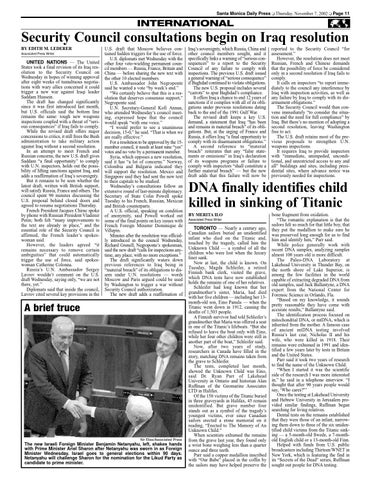
The new Israeli Foreign Minister Benjamin Netanyahu, left, shakes hands with Prime Minister Ariel Sharon after Netanyahu was sworn in as Foreign Minister Wednesday. Israel goes to general elections within 90 days. Netanyahu will challenge Sharon for the nomination for the Likud Party as candidate to prime minister.
Iraq’s sovereignty, which Russia, China and other council members sought, and it specifically links a warning of “serious consequences” to a report to the Security Council of any failure to comply with inspections. The previous U.S. draft issued a general warning of “serious consequence” if Baghdad continued to violate obligations. The new U.S. proposal includes several “carrots” to spur Baghdad’s compliance. It offers Iraq a chance to end 12 years of sanctions if it complies with all of its obligations under previous resolutions dating back to the end of the 1991 Gulf War. The revised draft keeps a key U.S. demand, a statement that Iraq “has been and remains in material breach” of its obligations. But, at the urging of France and Russia, it offers Iraq “a final opportunity to comply with its disarmament obligations.” A second reference to “material breach” reiterates that any “false statements or omissions” in Iraq’s declaration of its weapons programs or failure to comply with inspectors “shall constitute a further material breach” — but the new draft adds that this failure will now be
reported to the Security Council “for assessment.” However, the resolution does not meet Russian, French and Chinese demands that the possibility of force be considered only in a second resolution if Iraq fails to comply. It calls on inspectors “to report immediately to the council any interference by Iraq with inspection activities, as well as any failure by Iraq to comply with its disarmament obligations.” The Security Council would then convene immediately “to consider the situation and the need for full compliance” by Iraq. But there’s no mention of adopting a second resolution, leaving Washington free to act. The U.S. draft retains most of the previous proposals to strengthen U.N. weapons inspections. It requires Iraq to provide inspectors with “immediate, unimpeded, unconditional, and unrestricted access to any and all” buildings and sites, including presidential sites, where advance notice was previously needed for inspections.
DNA finally identifies child killed in sinking of Titanic BY MERITA ILO Associated Press Writer
TORONTO — Nearly a century ago, Canadian sailors buried an unidentified infant who died on the Titanic and, touched by the tragedy, called him the Unknown Child — a symbol of all the children who were lost when the luxury liner sank. Now at last, the child is known. On Tuesday, Magda Schleifer, a retired Finnish bank clerk, visited the grave, which DNA tests have now established holds the remains of one of her relatives. Schleifer had long known that her grandmother’s sister, Maria, had died with her five children — including her 13month-old son, Eino Panula — when the Titanic went down in 1912, causing the deaths of 1,503 people. A Finnish survivor had told Schleifer’s grandmother that Maria was offered a seat in one of the Titanic’s lifeboats. “But she refused to leave the boat only with Eino, while her four other children were still in another part of the boat,” Schleifer said. Now, after two years of study, researchers in Canada have filled in the story, matching DNA remains taken from the grave to Schleifer. The tests, completed last month, showed the Unknown Child was Eino, said Dr. Ryan Parr of Lakehead University in Ontario and historian Alan Ruffman of the Geomarine Associates LTD in Halifax. Of the 150 victims of the Titanic buried in three graveyards in Halifax, 45 remain unidentified. But grave number four stands out as a symbol of the tragedy’s youngest victims, ever since Canadian sailors erected a stone memorial on it reading, “Erected to The Memory of An Unknown Child.” When scientists exhumed the remains from the grave last year, they found only a wrist bone weighing less than a quarter ounce and three teeth. Parr said a copper medallion inscribed with “Our Babe” placed in the coffin by the sailors may have helped preserve the
bone fragment from oxidation. “The romantic explanation is that the sailors felt so much for that little boy, that they put the medallion to make sure he was preserved long enough for us to find him and identify him,” Parr said. While police generally work with recent DNA samples, analyzing samples almost 100 years old is more difficult. The Paleo-DNA Laboratory at Lakehead University in Thunder Bay, on the north shore of Lake Superior, is among the few facilities in the world capable of extracting degraded DNA from old samples, said Jack Ballantyne, a DNA expert from the National Center for Forensic Science in Orlando, Fla. “Based on my knowledge, it sounds pretty reasonable they have come with accurate results,” Ballantyne said. The identification process focused on mitochondrial DNA, or mtDNA, which is inherited from the mother. A famous case of ancient mtDNA testing involved Russia’s last czar, Nicholas II and his wife, who were killed in 1918. Their remains were exhumed in 1991 and identified a few years later by tests in Britain and the United States. Parr said it took two years of research to find the name of the Unknown Child. “When I started it was the scientific side of the research I was more interested in,” he said in a telephone interview. “I thought that after 90 years people would say, ‘Who cares?”’ Once the testing at Lakehead University and Hebrew University in Jerusalem provided similar findings, Ruffman began searching for living relatives. Dental tests on the remains established that they were those of an infant, narrowing them down to three of the six unidentified child victims from the Titanic sinking — a 5-month-old Swede, a 7-monthold English child or a 13-month-old Finn. Helped with funds from U.S. public broadcasters including Thirteen/WNET in New York, which is featuring the find in its “Secrets of the Dead” series, Ruffman sought out people for DNA testing.